The Coalition’s favoured energy technology is quite clearly nuclear – perhaps for no other reason than it is not wind or solar.
The Coalition no longer pretends that nuclear is the best option to address climate change, because they are tearing up their agreement on net zero, the softest of climate targets. That may be an admission that nuclear is very slow to build, particularly for a country that has never done so, and is still built on democratic principles.
Nor can they pretend that nuclear is the best technology on economics. Real world examples continue to defy the carefully constructed modelling commissioned by the Coalition.
In the UK, financing has finally been landed for the planned Sizewell C nuclear plant – and it turns out to be £38 billion, or around $A76 billion, for a 3.2 gigawatt facility. That translates to around $24 million a megawatt capacity cost, which is more than twice as much as the Coalition modelling would have you believe.
Sizewell C is expected to be a replica of Hinkley Point C, whose costs are now estimated at up to $A94 billion, and it seems that Sizewell kept its capital costs under control, because the UK government had to step in to take a 44 per cent stake. (The builder, the French government owned EDF, only wanted 12 per cent, because of the cost risks.)
It also changed the nature of the funding game – turning the new nuclear plant into a regulated asset (like Australia’s electricity networks), which will require consumers to start paying for the nuclear plant more than a decade before it is actually built.
Remember, this is the 5th or 6th plant to be built using the French EPR technology – and yet there is no sign of it getting any cheaper. And we haven’t see the inevitable delays and cost blowouts yet. Civil construction costs are blowing up projects all over the world, and nuclear is about as big as they come.
The UN starts another climate party
The Coalition’s anti-climate and no-to-net-zero stance comes as the UN climate conference is poised to start in Belem, Brazil, where UN secretary general Antonio Guterres has lamented “more failure” to do enough to keep the world on track to cap average global warming at 1.5°C.In remarks that might have been addressed specifically at the Coalition, but were directed at the world, Guterres said:
“Too many corporations are making record profits from climate devastation, with billions spent on lobbying, deceiving the public and obstructing progress,” Guterres said.
“Too many (political) leaders remain captive to these entrenched interests,” noting that countries are spending about ($A1.54 trillion) each year subsidising fossil fuels.
“We can choose to lead – or be led to ruin. Every fraction of a degree means more hunger, displacement and loss – especially for those least responsible. This is moral failure – and deadly negligence.”
What is the real target?
Those fractions of a degree are significant. The latest “emissions gap” report published by the UNEP says the world is headed for average of 2.9°C of warming based on current enacted policies, and 2.3°C and 2.5°C based on announced commitments.
What does a world of 3°C look like. Australia’s National Climate Risk report made it clear – catastrophic impacts, rising sea levels, collapsing ice sheets, the destruction of the Great Barrier Reef. Much of northern Australia would be uninhabitable.
Gina Rinehart, who appears to hold so much sway over the Nationals, wants to build a “defence dome” over northern Australia to protect its mineral riches. It might need a geodesic dome just to make it habitable.
What could possibly be done? As the UNEP notes: “The required low-carbon technologies to deliver big emission cuts are available. Wind and solar energy development is booming, lowering deployment costs. This means the international community can accelerate climate action, should they choose to do so.”
Astonishingly, the Coalition battle over net zero has been playing out in mainstream media as nothing more than political porn, focusing on personalities, egos and power. Climate science, and the renewable solutions, have barely been mentioned.
I’ve seen and heard maybe half a dozen interviews with Opposition energy and emissions reduction spokesman Dan Tehan and can’t remember him once being asked about climate science, or the economics and the engineering of the energy transition.
Does Australia really want to host COP31
Sometime in the next two weeks we will get an answer on whether Australia wants to host COP31, the next UN climate talks in 2026.
The plan is to do it in Adelaide, which would be a grand opportunity to show off the world’s most advanced renewable grid, with South Australia already at a world-leading share of 75 per cent wind and solar, and aiming for 100 per cent “net” renewables by 2027.
The state hosted the world’s first big battery and was the first to roll out “grid forming inverters,” which will help kill the need for fossil fuel generators and often has rooftop solar meeting the equivalent of all state demand. None of which was considered possible just a few years ago.
But if it is this hard to agree to a venue (Türkiye still has its hand up), does Australia want the hassle and embarrassment of presiding over a UN conference with no particular landmark goal, squabbling nations and the notable absence of the world’s biggest economy, the US?
Some in the ALP machine are thinking not. The delays and the massive oil and gas projects still being approved and rolled out, could make logistics tricky and the politics difficult. Which would be a shame: It is a rare opportunity for the Pacific Island nations to also have their say.
They have done so before when Fiji was the official host of COP23, but that was – for obvious reasons – held in Bonn, Germany. That might happen again, with Australia and Türkiye sharing “hosting” duties and various lead-up events, expos and talk-fests.
Duck! Free solar is coming your way
As the Coalition tries to tear itself apart over its position on climate and energy, federal energy minister Chris Bowen’s advocacy of “free solar” may turn out to be a political masterpiece – if only because it promises to change the conversation about the green energy transition.
Bowen wants to force energy retailers to offer at least three hours of “free electricity,” taking advantage of the abundance of rooftop and other solar in the middle of the day, and to make sure the benefits are shared with the 60 per cent of households that do not yet have, or can’t have, rooftop solar.
It’s sparked a predictable fury about heavy handed regulation: You can’t do that! And it’s true that some retailers already do offer such a tariff, although potential customers may want to assess the rates that are being charged in the evening peaks.
Morgan Stanley says the implications are significant enough – savings of up to $660 a year for non-solar households able to take up the offer (you need a smart meter and a big enough midday load so it can make sense), and estimates it might cost big retailers like AGL and Origin around $60 million each.
That suggests an uptake of less than 100,000 customers, which sounds about right. But it’s the messaging that counts – both to the long-forgotten consumer, and to the legacy retailers who are reminded they need to be on their toes to negotiate this energy transition.
Customers should no longer be the forgotten part of the energy transition. They now own rooftop PV, and are busy installing batteries and buying EVs. That will accelerate, but the benefits should not be theirs and theirs alone. Sadly, the legacy players sometimes need to be told to do the right thing.
Podcasts to listen to
This week on the Energy Insiders podcast, we talk to Vestas’ Jan Daniel Kaemmer about the prospects for wind industry in Australia, and of course the news of the week. See: Energy Insiders Podcast: The future of wind energy
The world of defence policy is truly on another planet. There, budgets are given to astronomical burgeoning and bizarre readings. Threats can be invented or exaggerated. Insecurity can be inflated. Decisions for the next project supposedly more lethal and more effective than ever can be made with cavalier disregard to realities. And the next cockeyed, buffoonish idea can be given a run for other people’s money. Those other people are, as always, the good tax paying citizenry of a country.
Australia has been doing superbly of late in this regard. It has given over territory and money to the United States, its appointed arch defender, so that the security of Washington’s imperium can be assured. It has done so in a manner suggesting advanced dementia, its politicians and strategists drivelling about the need to combat the barbarian yellow-red hordes to the north in a “changing security environment.”
First came the AUKUS trilateral security pact with the US and the United Kingdom, which enshrines the costly fantasy of nuclear-powered submarines Australia may never get and certainly does not need. Nor is there an obligation on the part of the US to part with any, a prospect ever more unlikely given the failure of its own submarine base to keep pace with annual production. Let’s not even start on the prospects of an AUKUS-designed submarine, which will be lucky to make it to the construction stage without sinking.
To itemise any number of foolish ventures and items being pursued by the Australian defence department would be injurious to one’s well being. This is largely because they keep comingin their risible daftness. Of late, the idea that Australia needs an anti-missile defence shield along the lines of Israel’s Iron Dome system is becoming more than a flirtation. And it’s being given a sense of frisson by Rafael Advanced Defense Systems, the Israeli company responsible for implementing and maintaining it.
The chance for Rafael to shine came at the Indo Pacific International Maritime Exposition, an event running from November 4 to 6. Its presence, along with the Australian subsidiary of Israel’s primary unmanned vehicle manufacturer Elbit Systems, had piqued activists from the Palestine Action Group (PAG), who gathered just before the opening of the exposition to protest that fact.
A predictably muscular reaction from the New South Wales police followed. According to PAG organiser Josh Lees, they “immediately attacked” the peaceful gathering with pepper spray and horses. The NSW Premier Chris Minns, for his part, was enthralled by the economic prospects of the gathering: defence exports were there to be grown, deals to be made. That these were with merchants of death was no big matter. “They’re not selling nuclear weapons … we want to see the industry grow.”
For its part, Rafael had pulled out the bells and whistles. The company, according to its display, offered “an integrated, combat-proven portfolio that delivers end-to-end protection and impactful projection for Australia’s naval forces, ensuring freedom of action in Australia’s northern approaches and across vital sea lines of communication.”
In an interview at the exposition, the company’s vice president of international business development, Gideon Weiss, hawked Iron Dome’s technology with salesmanship enthusiasm. “The perception that Australia is far and distant and isolated is completely untrue,” he remarked with stern certitude. “There’s absolutely no reason in the world why any Australian would think… that in a conflict, Australia would not be attacked.” The unasked question here is why Australia would make itself an appealing target to begin with. But Weiss did not break his stride: “Your enemies have a great arsenal of ballistic missiles, hypersonic ballistic missiles, cruise missiles, and long-range UAVs [unmanned aerial vehicles]. Why wouldn’t they use them against you if they wanted to?”
Asked whether the company’s message had bitten in Canberra, Weiss was assured. The “capability and the maturity of the technology” had been noted by Australia’s defence wonks and Rafael was always keen to focus on “sovereignty, about the Australian industrial context.” There was “infrastructure which to Australianise, if you will, these technologies.”
The company has shown ample familiarity with the soil they wish to till. The Australian Defence Strategic Review of 2023 declared the need to “deliver a layered integrated air and missile system (IAMD) operation capability urgently. This must comprise a suite of appropriate command and control systems, sensors, air defence aircraft and surface (land and maritime) based missile systems.” The current program to develop a “common IAMD capability” was “not structured to deliver a minimum viable capability in the shortest period of time but is pursuing a long-term near perfect solution at an unaffordable cost.”
Defence analysts called upon to comment on the matter are slavering. Jennifer Parker, a regular talking head on the subject, rues the fact that Australia can never, given its geographical size, be protected in its entirety. “Unlike Israel, where they can defend the entire country against missiles broadly… that’s not feasible for Australia because of our size.” Focus, she suggests, on the “critical infrastructure elements that we need to protect, like HMAS Stirling, Pine Gap and bases around Darwin, and design integrated air and missile defence around that concept.”
The United States Studies Centre, an Australian outpost soddenly friendly to the military-industrial complex and the needs of the imperium, is also unrelenting about the need for a more expansive missile defence system. Peter Dean, senior advisor on defence strategy, cites “the lack of effective ground-based air defence and an Integrated Air and Missile Defence system” as “the most critical gap in the achievement of Australia’s strategic goals.”
Another outfit most friendly to US interests, the Australian Strategic Policy Institute, is alsomuch in love with missile interception. “If we want to get serious about integrated missile defence,” ASPI senior analyst Malcolm Davis posits, “we need to have long-range, ground-based interceptor missiles that can handle threats like intermediate range ballistic missiles launched by China.”
The next wasteful program of military expenditure looms happily on the horizon, leaving the question of need unanswered. Weiss has good reasons to be optimistic that a train has been set in motion. “I wouldn’t want to name names,” he says with confidence, “but everyone knows us very well.”
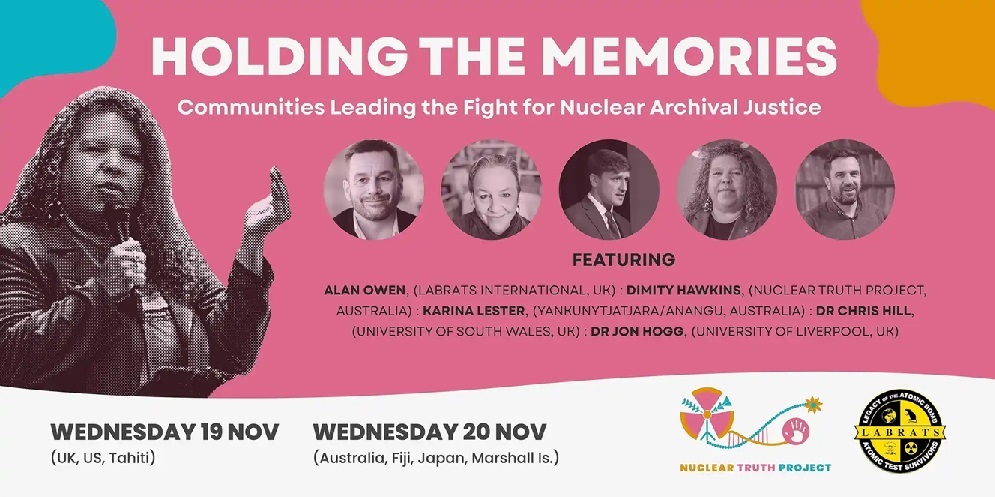
WHEN NEW YORK Wednesday November 19, 4pm, EST LONDON Wednesday November 19, 9pm, GMT MELBOURNE Thursday, November 20, 8am, AEST FIJI/MARSHALL ISLANDS Thursday 20 Nov – 9am FJT & MHT
Karina Lester (Yankunytjatjara-Anangu community leader, Australia)
Dr Chris Hill (University of South Wales, UK)
Dr Jon Hogg (University of Liverpool, UK)
Building on the Nuclear Truth Project’s Challenging Nuclear Secrecy report (2025), this international collaboration brings together affected community members, nuclear justice advocates and organisations from the UK and Australia.
The webinar will explore barriers to accessing nuclear archives and expose the power of community-held memory.
Focusing on British nuclear weapons testing in Australia and the Pacific (1952–1963), the discussion will focus on archival access as a core part of nuclear justice, victim assistance, and environmental restoration.
How do communities impacted by nuclear weapons testing overcome systemic barriers to accessing official records of harm to Peoples and Country?
Join us to learn how memory is held — and fought for — by those most affected.
Getting access to documents concerning a nuclear submarine base in NSW has become an FOI riddle wrapped in a submarine mystery inside a nuclear enigma. Rex Patrick reports.
You can’t have the documents. Hang on, maybe you can? Nope, they’re too sensitive. OK, they’re not sensitive, you can have them all. Except you can’t.
If you’re struggling to follow this, I’ll try to explain. But keep this in the back of your mind – all Australian taxpayers are paying for the Department of Defence’s part in this, and those NSW taxpayers also get to pay the NSW Crown Solicitor’s part.
It started with a single backflip. When I first asked the NSW Government for access to documents relating to the consideration of a nuclear submarine base in NSW, they said I couldn’t have the documents because they were Cabinet-in-Confidence.
When I took the case to the NSW Civil and Administrative Tribunal (NCAT), the NSW Government backflipped. They stated that their Cabinet exemption claim was wrong and asked NCAT if the Government could remake the decision.
Double backflip
The Tribunal said, “Yes, remake your decision”.
A month later, the NSW Government issued me a new decision. No! Again, “you can’t have them”! Across 12 pages of carefully worded legalese, they tried to explain why the public can’t see the documents.
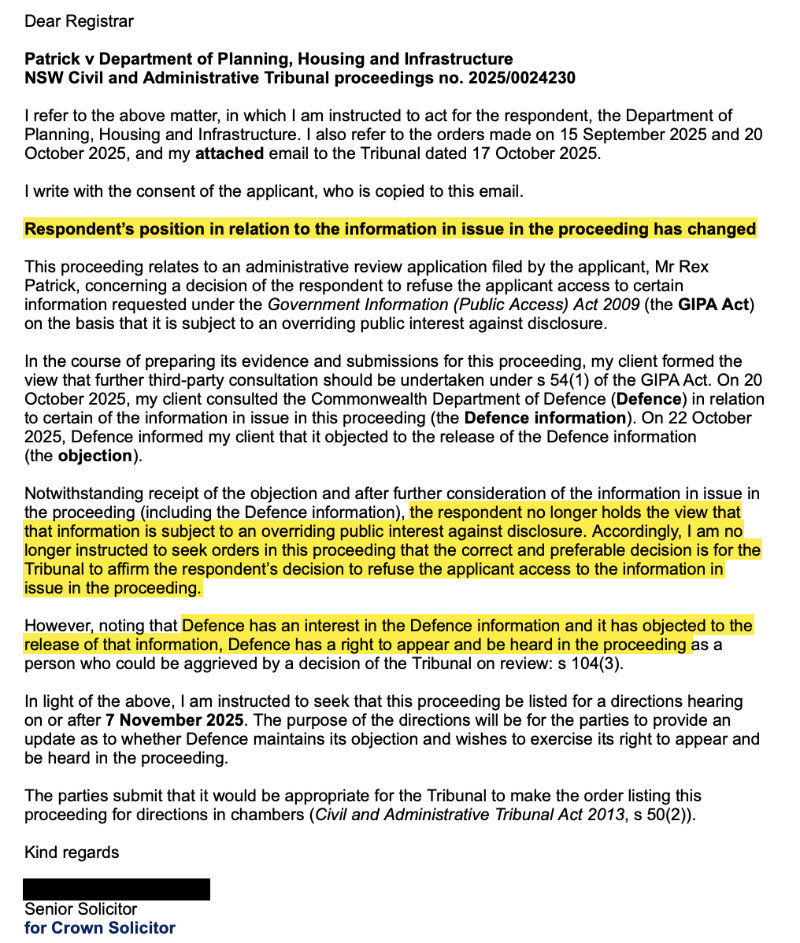
That was September. Fast forward to late October and, out of the blue, the NSW Crown solicitor wrote to me and advised, “the [NSW Government] position in relation to the information in issue in the proceedings has changed … The [NSW Government] no longer holds the view that information is subject to an overriding public interest against disclosure.”
Woo-hoo! Transparency at last. But wait…
Defence secrecy
The email went on to say, “… Defence has an interest in the Defence Information and it has objected to the release of that information. Defence has a right to appear and be heard in the proceedings …”
What secrets?
I am yet to find out the basis of Defence’s objection to releasing the material, but in a very closely related request for information, Defence objected to the release of information because those documents identified or described Defence infrastructure or capability (e.g. base locations, site suitability studies, strategic assessments).
But seriously, how sensitive can a base’s location be? How sensitive can buildings be? In five minutes, anyone with internet access can use Google Earth to avail themselves of the location and layout of HMAS Stirling in Western Australia, where US and UK nuclear submarines are currently visiting.
Moreover, the buildings that will support the permanent basing of submarines at HMAS Stirling can be seen by visiting the website of the Federal Parliament’s Public Works Committee.
Yellow peril
But what about the Chinese? Won’t they find out?
Defence may be worried that if the location is known, then the Chinese might buy land next door to the planned base. The problem is, the Chinese have already purchased land in the Port Kembla and Newcastle port precinct.
In fact, Newcastle Port is operated by a consortium with 50% Chinese ownership (98-year lease) through China Merchant Port Holdings;
“they probably already know more about Newcastle Port and its environs than Defence does.”
The Chinese purchases in both cities provide considerable ability for them to monitor and evaluate key infrastructure servicing and capacity developments; high voltage power supply arrangements, natural gas supply details, potable water arrangements, fire water supply details, rail and road access arrangements and area telecommunications.
And the Chinese won’t only have access to future strategic plans for the port areas; their purchases are significant enough that they could help shape those plans, having a seat at the table as interested constituents and ratepayers. We know Chinese officials have already used their property interest to have meetings with the Mayor of Newcastle.
And as for the details of what Australia will need to safely support a nuclear sub force,
“the Chinese already know that from their 50 years of operating nuclear attack subs.“
1×1515
0:05 / 5:59
1×1515
0:05 / 5:59
Getting access to documents concerning a nuclear submarine base in NSW has become an FOI riddle wrapped in a submarine mystery inside a nuclear enigma. Rex Patrick reports.
You can’t have the documents. Hang on, maybe you can? Nope, they’re too sensitive. OK, they’re not sensitive, you can have them all. Except you can’t.
If you’re struggling to follow this, I’ll try to explain. But keep this in the back of your mind – all Australian taxpayers are paying for the Department of Defence’s part in this, and those NSW taxpayers also get to pay the NSW Crown Solicitor’s part.
It started with a single backflip. When I first asked the NSW Government for access to documents relating to the consideration of a nuclear submarine base in NSW, they said I couldn’t have the documents because they were Cabinet-in-Confidence.
When I took the case to the NSW Civil and Administrative Tribunal (NCAT), the NSW Government backflipped. They stated that their Cabinet exemption claim was wrong and asked NCAT if the Government could remake the decision.
A month later, the NSW Government issued me a new decision. No! Again, “you can’t have them”! Across 12 pages of carefully worded legalese, they tried to explain why the public can’t see the documents.
That was September. Fast forward to late October and, out of the blue, the NSW Crown solicitor wrote to me and advised, “the [NSW Government] position in relation to the information in issue in the proceedings has changed … The [NSW Government] no longer holds the view that information is subject to an overriding public interest against disclosure.”
Woo-hoo! Transparency at last. But wait…
Defence secrecy
The email went on to say, “… Defence has an interest in the Defence Information and it has objected to the release of that information. Defence has a right to appear and be heard in the proceedings …”
Backflip, with Defence objection (Source: NSW Crown Solicitor)
What secrets?
I am yet to find out the basis of Defence’s objection to releasing the material, but in a very closely related request for information, Defence objected to the release of information because those documents identified or described Defence infrastructure or capability (e.g. base locations, site suitability studies, strategic assessments).
But seriously, how sensitive can a base’s location be? How sensitive can buildings be? In five minutes, anyone with internet access can use Google Earth to avail themselves of the location and layout of HMAS Stirling in Western Australia, where US and UK nuclear submarines are currently visiting.
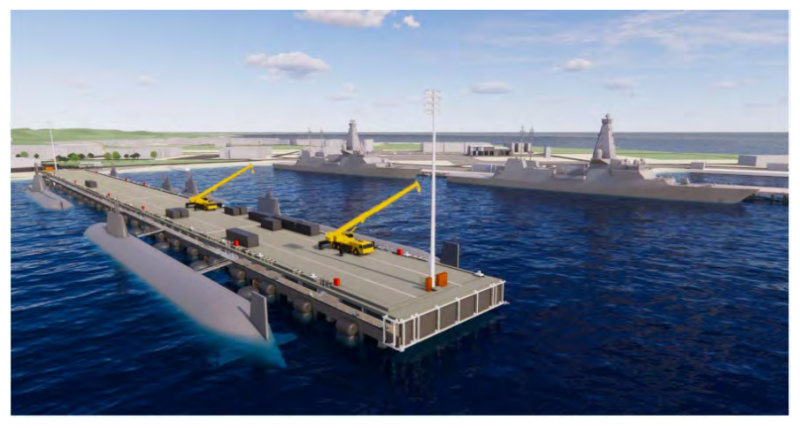
Moreover, the buildings that will support the permanent basing of submarines at HMAS Stirling can be seen by visiting the website of the Federal Parliament’s Public Works Committee.
Nuclear Submarine Piers (Source: Defence)
Yellow peril
But what about the Chinese? Won’t they find out?
Defence may be worried that if the location is known, then the Chinese might buy land next door to the planned base. The problem is, the Chinese have already purchased land in the Port Kembla and Newcastle port precinct.
In fact, Newcastle Port is operated by a consortium with 50% Chinese ownership (98-year lease) through China Merchant Port Holdings;
they probably already know more about Newcastle Port and its environs than Defence does.
The Chinese purchases in both cities provide considerable ability for them to monitor and evaluate key infrastructure servicing and capacity developments; high voltage power supply arrangements, natural gas supply details, potable water arrangements, fire water supply details, rail and road access arrangements and area telecommunications.
And the Chinese won’t only have access to future strategic plans for the port areas; their purchases are significant enough that they could help shape those plans, having a seat at the table as interested constituents and ratepayers. We know Chinese officials have already used their property interest to have meetings with the Mayor of Newcastle.
And as for the details of what Australia will need to safely support a nuclear sub force,
the Chinese already know that from their 50 years of operating nuclear attack subs.
But that won’t stop Defence objecting to the release of information that would otherwise be reasonable for the grant of social licence. It’s a department addicted to secrecy (how else are they going to keep their multi-billion dollar procurement blunders from public scrutiny).
A political ruse
Greens Senator David Shoebridge offered his perspective on the Federal Government’s secrecy:
“The Albanese government isn’t worried that China will find out where they want to put another US nuclear submarine base, they are worried the Australian public will. “The community of the Illawarra have already made it crystal clear that a nuclear submarine base has zero social licence to operate at Port Kembla. “The other potential target for Defence is Newcastle, and with a growing revulsion there with the use of the Williamtown F35 hub to arm Israel’s genocide in Gaza, Labor knows that option is also deeply unpopular. “Hiding these documents isn’t about preventing a foreign adversary from organising against Labor’s war plans, it’s about preventing the public opposing them.”
So, despite the NSW Government’s double backflip (which, despite them being cavalier in the first place, I do appreciate), it looks like I’ll have to keep fighting for transparency.
At least the backflips mean I’ll stand at the bar of NCAT with the NSW Government on my side of the argument. Meanwhile, we’ll all keep having to pay for both sets of lawyers, all necessary to keep politically sensitive topics from the public.
Apr 15, 2026 01:00 AM in Canberra, Melbourne, Sydney
Join the International Physicians for the Prevention of Nuclear War (IPPNW) on Tuesday, April 14th for a timely webinar exploring the risks associated with nuclear power and challenging the myth that it offers a simple, safe, carbon-free solution to the climate crisis



 Antinuclear