The non-corporate nuclear news this week

Some bits of good news – This City Turned Its Rooftops into a Climate Shield. Wales passed a ‘life-changing’ homelessness bill. a form of blindness.
TOP STORIES.
Trump Advisers Want Israel To ‘Attack Iran First’ For Better Optics: Politico.
National analysis of cancer mortality and proximity to nuclear power plants in the United States.
Year 4: The Timeline That Tells the Tale
“Selling a dream”: the French nuclear start-up that ran aground.
AUSTRALIA.
AUKUS & potential terrorism threats.
- Is Australia-US Alliance Hurting Australia?
- Jewish groups call on Tony Burke to cancel Israeli journalist visa.
- Good enough for Gina Rinehart should be good enough for Palantir.
- Australia invests $310m to fast-track parts for first AUKUS nuclear submarines.
NUCLEAR-RELATED ITEMS.
ATROCITIES. ‘Flagrant War Crime’: Investigation Recreates 2025 Israeli Massacre, Cover-Up of 15 Gaza Aid Workers. Israeli troops fired900+ rounds at Gaza medics – report
EVENTS
Webinar “Debunking Nuclear Hopium – Small Modular Nuclear Reactors, Advanced Nuclear Reactors, and Fusion” at https://www.grassrootsinfo.org/forums
| HEALTH. Middle-aged women ‘most at risk of cancer’ from nuclear power plants. |
| INDIGENOUS ISSUES. The hidden health crisis tied to America’s nuclear arsenal: How Native American families suffer the grisly side-effects from uranium mines. |
| LEGAL. Appeal court refuses TASC’s appeal against the High Court’s Sizewell C JR application decision. |
| MEDIA.New Book: The Dangers of Ionising Radiation Israel Responsible for Two-Thirds of Journalist Deaths in 2025: Press Freedom Group |
| OPPOSITION to NUCLEAR . No to uranium mining in Greenland. Britain must rethink its disastrous nuclear expansion – public protest can make it happen! |
| POLITICS Schumer, Jeffries blink…Senate, House to vote on War Powers Resolution next week to stop Trump’s criminal war on Iran . Democratic congressional leaders are working to stop War Powers Resolution opposing Trump’s criminal Iran war. |
| POLITICS INTERNATIONAL and DIPLOMACY. “The Surgery of the World”: Netanyahu Arrives in Washington to Deliver the Final Blow to Diplomacy and Ignite a Major War. DOOMSDAY: The Suicide Pact Nobody Voted For. US-UK tech talks restart with a focus on nuclear projects– ALSO AT https://nuclear-news.net/2026/02/28/3-b1-us-uk-tech-talks-restart-with-a-focus-on-nuclear-projects/ |
| SAFETY . ‘Making America Unsafe Again’: Alarm Over Environmental Review Exemption for Nuclear Reactors. UK regulators to begin formal assessment of TerraPower’s 345MWe sodium-cooled fast reactor. Nuclear power station workers ‘failed to ensure safety‘ after incident. Babcock CEO responds to Rosyth nuclear handling concerns. |
| SECRETS and LIES. National Endowment for Democracy leader cut off in Congress after boasting of ‘deploying’ 200 Starlinks to Iran amid violence. |
| SPACE. EXPLORATION, WEAPONS. SpaceX and Blue Origin abruptly shift priorities amid US Golden Dome push |
| SPINBUSTER. The Innate and Inseparable Ties Between Nuclear Weapons and Energy |
| WASTES. Decommissioning. The Nuclear Decommissioning Authority (NDA) group Strategy Effective from March 2026 |
| WAR and CONFLICT. Could Hungary’s fight over oil change course of Ukraine War? |
| WEAPONS and WEAPONS SALES. Hegseth Demands Anthropic Let Military Use AI However It Wants—Even for Autonomous Killer Drones and Spying On Americans– https://www.youtube.com/watch?v=0CFkZOmAUFE The Bombs Which Polish the Skulls of the Dead. Nuclear waste leaks show the need for focus on renewables. Zelenskyy says he’d accept nuclear weapons from UK, France ‘with pleasure’ |
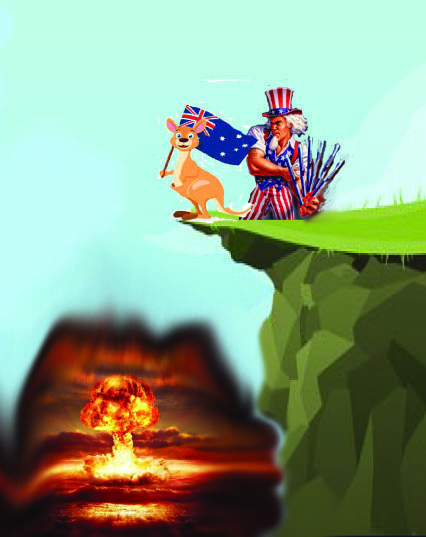
Is Australia-US Alliance Hurting Australia?
27 February 2026, By Denis Hay
Criticism of the Australia-US alliance examines whether unquestioning support for the US undermines peace, sovereignty, and regional stability.
Introduction – Asking the Question Australians Rarely Hear
For decades, Australia has treated close alignment with the United States as the unquestioned foundation of its foreign and defence policy. This article advances criticism of the Australia-US alliance in a calm, factual way, asking whether that loyalty still serves Australian interests or exposes the country to unnecessary risk. This is not an argument against the American people. It is an argument for honesty about power, history, and Australia’s place in the region.
The Problem – A History That Is Rarely Acknowledged
1. US power and coercion are not new
US pressure on other nations did not begin with Donald Trump. Across its history, the United States has used sanctions, economic coercion, regime change, and military force to advance strategic and corporate interests. Trump did not invent this behaviour; he removed the diplomatic language that once softened it. This matters because Australia often treats US actions as benign by default, even when they undermine international law or regional stability.
2. US military influence on Australia
The influence of the U.S. military-industrial system extends beyond policy advice to Australian territory itself. Through joint facilities, force posture agreements, and rotational deployments, US military assets run on Australian soil with limited transparency and little public scrutiny. Although described as cooperative, these arrangements often leave strategic control and escalation decisions primarily with Washington.
This creates a clear danger for Australia. In any conflict involving the United States, Australian bases may be considered legitimate targets, regardless of whether Australia has made an independent decision to participate. Hosting foreign forces therefore increases Australia’s exposure to war while reducing its ability to stand apart from US strategic choices.
The Impact – How Fear Shapes Policy and Public Debate
3. The China threat narrative in Australia
Public discussion of China in Australia is dominated by fear-based framing. China is routinely portrayed as an inevitable military adversary, despite being Australia’s largest trading partner and a country whose primary focus has been economic development and internal stability. This narrative leaves little room for diplomacy, cooperation, or recognition that China has not pursued global military dominance as the United States has.
4. Why politicians rarely challenge the US
Australian politicians across both major parties rarely question US behaviour because the costs of dissent are high. Defence integration, intelligence sharing, media pressure, and elite political incentives all discourage independence. Challenging the US risks being labelled reckless or weak on security, even when the concern is evidence-based and aligned with Australian interests.
The Alternative – A Clearer View of Australia’s Interests
5. Seeing China without fear or fantasy
Viewing China in a more positive and realistic light does not mean ignoring disagreements. It means recognising that China poses no credible invasion threat to Australia and that stability is better served through engagement than confrontation. A mature foreign policy distinguishes between legitimate concerns and manufactured fear.
6. An independent foreign policy grounded in peace
Australia keeps full sovereignty over its choices. Independence does not need abandoning alliances, but it does require the courage to say no when US actions increase the risk of war. Reducing automatic alignment would strengthen Australia’s credibility in the region and lower the chance of being drawn into conflicts that do not serve Australian citizens
Practical steps include:
• Prioritising diplomacy and regional institutions
• Limiting foreign military exposure on Australian soil
• Encouraging genuine parliamentary debate on alliance commitments
• Investing in peace building rather than perpetual deterrence……………….
Final Thoughts – Choosing Independence Over Reflex
Australia-US alliance criticism is not about turning away from allies. It is about recognising that blind loyalty carries real dangers. Australia is better served by calm engagement with its region, a realistic view of China, and a clear-eyed assessment of US behaviour. Peace, not fear, should guide Australian foreign policy https://theaimn.net/is-australia-us-alliance-hurting-australia/
No to uranium mining in Greenland
Since 2021, when the Inuit Ataqigiit party came into power, there has been a ban on uranium mining. Inuit Ataqatigiit is mainly an ecological party and I guess to some extent you could compare it to the German Greens, because it is also a mainstream party. Until 2013, the ban had existed for a quarter of a century, but it was lifted on the request of the Australian mining company, Energy Transition Minerals (ETM, formerly known as Greenland Minerals Ltd., GML), which threatened to abandon the big Kvanefjeld uranium and rare earths mining project, if ETM could not exploit the uranium deposit.
February 27, 2026, by IPPNW – International Physicians fot the Prevention of Nuclear War
[Ed. note: Niels Henrik Hooge works with NOAH, the Danish branch of Friends of the Earth. He is also closely associated with Greenland’s No to Uranium Association (URANI? NAAMIK) in Nuuk. Patrick Schukalla, IPPNW Germany’s policy advisor on energy and climate, spoke with Hooge in February about the role of Greenland’s uranium resources and other subsurface wealth, and the potential threats to the territory during this period of geopolitical tension.]
PS: Although Greenland is currently on everyone’s mind, little is being learned about the island itself, its people or the Arctic ecology. Instead, the focus is on the geopolitical desires of others, both imagined and real. You have been working against large-scale mining in Greenland for a long time and have achieved significant political successes in this area. Could you tell us about that?
.NHH:………………………………………………………………….. . Denmark, which for centuries was in full control of Greenland, has made no attempts to integrate Inuit culture into the rest of Kingdom. Another striking fact is that private ownership of land does not exist and land cannot be bought or sold. You can own buildings, but not the ground. The paradox here is that you now have some of the biggest and greediest industrialists in the world trying to control property that so far has been collectively owned. This is really a clash of opposite cultures.
PS: The last time we spoke was in 2021, ahead of the COP26 Climate Summit in Glasgow. We discussed uranium mining and the false claims made by the industry and some governments under the slogan ‘Nuclear for Climate’. IPPNW is PS: committed to a world without nuclear threats. This includes calling for an end to uranium mining. What role does uranium play in Greenland and in your campaigns today?
NHH: Since 2021, when the Inuit Ataqigiit party came into power, there has been a ban on uranium mining. Inuit Ataqatigiit is mainly an ecological party and I guess to some extent you could compare it to the German Greens, because it is also a mainstream party. Until 2013, the ban had existed for a quarter of a century, but it was lifted on the request of the Australian mining company, Energy Transition Minerals (ETM, formerly known as Greenland Minerals Ltd., GML), which threatened to abandon the big Kvanefjeld uranium and rare earths mining project, if ETM could not exploit the uranium deposit.
Under GML’s ownership, the controversial project has been at the forefront of the public eye for more than a decade, and the mining project and uranium mining in general have been a major factor in the formation of at least five government coalitions since 2013. When the uranium ban was lifted, Greenlandic and Danish NGOs, including NOAH, started to cooperate to have it reinstated. Particularly, I want to emphasize our collaboration with URANI? NAAMIK, Greenland’s anti-uranium network, which played a crucial role in mobilising the public against uranium mining. Although this type of mining now is banned, the anti-uranium campaign cannot stop completely. Mining companies are lobbying the Trump administration and its associates in the private sector to intervene and changes in Greenland’s political community could fundamentally affect the status of uranium mining.
…………………………………………………………………………………….. PS: If European governments are now trying to satisfy the US without Greenland being annexed, are you worried that regulations will be weakened and the protection of the Arctic environment will be compromised?
NHH: Yes, unfortunately this is a real risk and it could start a race to the bottom. On one hand, EU’s Arctic Environment and Sustainability Strategy implies that oil, coal and gas should no longer be extracted in Arctic areas. On the other hand, EU has adopted a policy under the European Critical Raw Materials Act of fast-tracking mining projects even if they do not have support from the local population and show signs of flawed permitting or inadequate environmental impact assessments………………………………………..
PS: What are your next steps, and what would you like your friends and partners in other European countries and beyond to do?
NHH: Currently, URANI? NAAMIK and NOAH are campaigning to have mining companies which have played a role in getting the Trump administration to try to annex Greenland screened and if necessary, banned for security reasons. Furthermore, there is now a majority in the Greenlandic population to rejoin the EU as a member state, and obviously it would make sense, if EU institutions and the European NGO community started to prepare for this eventuality. In NOAH’s opinion, it would imply a conception of a European Arctic policy that includes an offer to support the Greenlandic government in protecting and preserving Greenland’s natural resources.
This could become a lighthouse project for Greenland, the Danish Kingdom and the EU, putting environmental protection on the global agenda. If mineral extraction is completely or partially abolished, the Greenlanders should of course be compensated financially. The European Parliament has supported the idea of an Arctic nature protection area in the past, using the Antarctic Treaty as a model. The idea is backed by 141 environmental organizations, including some of the largest in Europe and the world. https://peaceandhealthblog.com/2026/02/27/no-to-uranium-mining-in-greenland/
1 This month
7 April – WEBINAR – Australia and the Doomsday Clock – Preventing nuclear war through NoFirstUse and other policies
Online | Tuesday April 7, 4:00-5:30pm, Australian Eastern Time / 8:00-9:30am Central Europe Time
– Access the registration link
15 April – Zoom –Nuclear Power is Not the Solution
Apr 15, 2026 01:00 AM in Canberra, Melbourne, Sydney

Join the International Physicians for the Prevention of Nuclear War (IPPNW) on Tuesday, April 14th for a timely webinar exploring the risks associated with nuclear power and challenging the myth that it offers a simple, safe, carbon-free solution to the climate crisis

21 April Webinar: No Nuclear Weapons in Australia
Start: 2026-04-21 18:00:00 UTC Canberra, Melbourne, Sydney (GMT+10:00)
End: 2026-04-21 19:30:00 UTC Canberra, Melbourne, Sydney (GMT+10:00)
Event Type: Virtual
A virtual link will be communicated before the event.
Host Contact Info: australia@icanw.org

of the week – Australians for War Powers Reform (AWPR)
To see nuclear-related stories in greater depth and intensity
 Antinuclear