The Mushroom Treatment: A Government That Treats You With Contempt Cannot Be Trusted

Greens Senator David Shoebridge nails it: “The Albanese Government needs to be clear about what support it is offering the US in its war on Iran. Labor’s claim that we are not offering support is plainly not true.”
COMMENT – Christina Macpherson – As a former Labor party member, I am totally disenchanted with the current Labor leadership. Anthony Albanese has faded away from a strong principled Labor leader to a pale grey accessory to the USA. And Penny Wong ! If she had any integrity she’s resign – it must be uncomfortable for her, forever sitting on the fence about everything
5 Mar 2026, https://urbanwronski.com/2026/03/05/8400/
The Albanese government gives us the mushroom treatment. Keeps us all in the dark and feeds us BS.
This week, our small target federal government gave a bravura homage to John Cage. While a US-Israeli war of no legality engulfs the Middle East, while Australia’s top-secret spy facility hums away in the desert night providing targeting data for strikes that have already killed hundreds of civilians, while US surveillance aircraft slip into RAAF Base Pearce from Diego Garcia without so much as a public flight plan, Anthony Albanese and Penny Wong polish their performance art, the blank face, the rehearsed non-answer, a version of Cage’s 4′ 33″ -and the inane repetition of lines that insult the intelligence of every Australian watching.
Asked about Pine Gap’s role? We got “we don’t comment on that facility.”
The litany of lies becomes a bad parody of accountability. Asked, “is the US-Israel attack on Iran legal under international law? We got: “that is a matter for Israel and the United States.” So the rules-based order they are in love with turns out to be Rafferty’s Rules, after all. And Wong is becoming a human bot before our eyes.
Asked whether we were briefed in advance. We got “this was a unilateral action by the United States.”
It is a performance not of statesmanship but of studied evasion. And it has been noticed. It’s top shelf-fobbing off. Wong and Albanese could fob-off and rebuff for Australia, when it becomes an Olympic event.
On international law being broken, the government’s hypocrisy is gob-smacking
Albanese and Wong have invoked “international law” and the “rules-based order” more than a hundred times since returning to government. They have called out Russia over Ukraine. They have criticised China. As recently as last year, Wong’s department was demanding China comply with international law, and the year before that, complaining that Chinese domestic legislation allowed Beijing to ignore it.
But when Canadian Prime Minister Mark Carney, a guest on Australian soil, stated plainly that the US-Israeli strikes on Iran appear “prima facie inconsistent with international law,” Wong’s response was to handball the question back to Washington and Tel Aviv.
“The legal basis of these strikes is ultimately a matter for the United States and Israel,” she repeated, for perhaps the twentieth time, to a press circus that grew visibly more frustrated with each non-answer.
This is not a position. It is a void in a vacuum in a vortex of entropy dressed up as a position.
The “rules-based order” mantra that Australia endlessly chants, a type of incantation to ward off witches, warlocks and bad faith actors, turns out to be a franchise. The rules apply to adversaries. Allies get a different menu. When Russia bombs civilian infrastructure it is an outrage; when the US does it, the legal basis is “a matter for those two countries.” When China ignores international law, Canberra clucks as volubly as any hen-house. When Israel and the Trump administration launch pre-emptive strikes without UN authorisation, without consulting allies, without even informing Albanese in advance, the government goes mute.
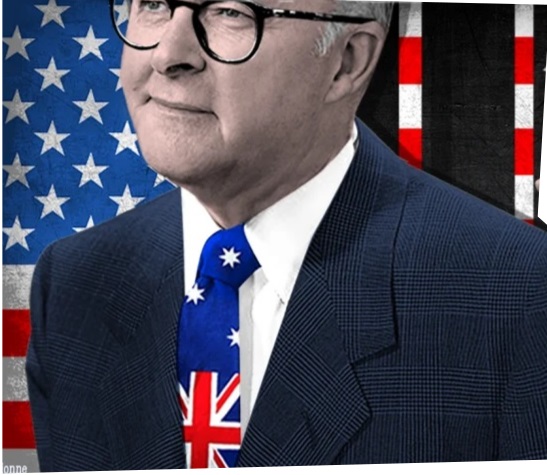
It’s not just hypocritical. It’s a double standard with added craven sycophancy, toadying and fawning over the US latest brain-fart that does lasting damage to Australia’s credibility as an honest broker in the region.
Surreal? Pine Gap, which is where the mushroom treatment gets especially dangerous.
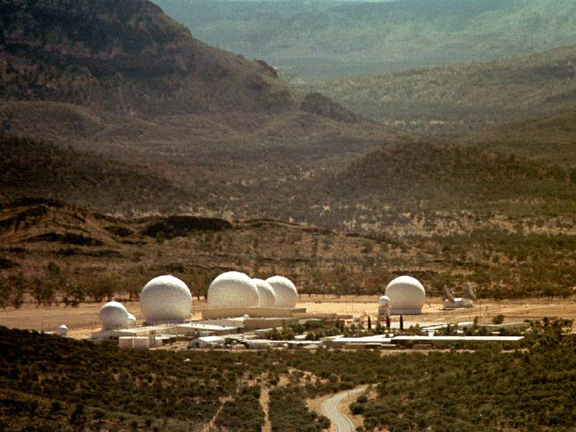
Pine Gap is not some quiet public library in the red centre. It is the eyes and ears of the American eagle. Or as Peter Cronau documents, the listening post for a swarm of US satellites that provide the intelligence feed for major US and Israeli military operations in the Middle East and now the Indian Ocean. It geolocates targets. It intercepts military communications. It detects missile launches and supports targeting. It cannot, as Cronau noted before the first strikes last year, not have been already involved.
When a US submarine sinks an Iranian ship in the Indian Ocean, an area directly within Pine Gap’s signals collection coverage, Australians have a right to know whether their facility, on their soil, provided the intelligence that killed those sailors. Wong’s answer: “We don’t comment on that facility.”
Wong assures us there is “a high degree of transparency in relation to the United States presence in Australia.”
You just can’t see it.
Or credit it. Or forgive her duplicity, The lie here is mind-boggling.
Yet now we learn that two US P-8A Poseidon maritime patrol and reconnaissance aircraft flew directly from Diego Garcia, the staging base for US operations across the Indian Ocean, to RAAF Base Pearce in Western Australia without prior public announcement, with flight plans lodged only once they were airborne. These are not joy rides. P-8A aircraft have been integral to Washington’s operations at the Strait of Hormuz. Their visit to Australian soil in the days following the bombing of Iran is not a coincidence. It is a data point.
Defence Minister Doughboy Richard Marles a US War Department dogsbody, doggedly declines to comment.
Greens Senator David Shoebridge nails it: “The Albanese Government needs to be clear about what support it is offering the US in its war on Iran. Labor’s claim that we are not offering support is plainly not true.”
The government does not want us to think about their epic credibility fail. That is the whole point.
The contempt is not limited to matters of war and peace. It runs through the entire fabric of how this government deals with Australians who have the temerity to ask questions. And to expect answers.
Albanese entered office in 2022 declaring that “the Australian people deserve accountability and transparency, not secrecy.” He criticised the Morrison government’s “cult of secrecy” and its “culture of cover-up.” Like a specialist performing a colonoscopy, he was going to shine a bright light into dark entrails. Instead he handed the patient a blindfold.
Not even under “Morrison Un-hosed” has freedom of information been so much of a running gag in a government which not only runs on the most expensive misinformation money can buy from its stable of top-end corporate consultancies but one which is very reluctant to share anything with anyone. Especially anything that might reveal its inner workings or help voters to hold it to account.
The Centre for Public Integrity finds that under Albanese, Freedom of Information requests granted in full have collapsed from 59 percent in 2011-12 to just 25 percent today. Outright refusals have nearly doubled to 23 percent. Almost half of initial decisions are found to be flawed on internal review. The Albanese government complies with Senate orders to produce documents only one-third of the time, a record worse than the Morrison government. The Centre’s Research Director, Catherine Williams, calls it a “deliberate effort to avoid scrutiny.” The government’s own record gives her no grounds to be contradicted.
This is not administrative slippage. This is policy.
What emerges from all of this is a government that has made a fundamental calculation: that Australian citizens do not need to know what is done in their name, with their money, on their soil, or at their risk.

They do not need to know whether their intelligence facilities are helping to kill sailors in the Indian Ocean.
They do not need to know whether US surveillance craft are operating out of Australian bases as part of a widening Middle Eastern war.
They do not need to know whether the strikes their government endorses are legal under the international law their government claims to champion.
They do not need to know what is in government documents that the Senate orders to be produced.
They do not need to ask. They just need to trust.
But trust, like international law, turns out to be something the Albanese government only demands of others.
There is a word for a government that maintains one set of rules for its allies and another for its adversaries, that invokes transparency as a slogan while systematically dismantling it in practice, that keeps citizens uninformed about activities on their own soil that may be drawing them into someone else’s war.
The word is untrustworthy.
Not dishonest in the flamboyant, self-destructive way of some politicians. This government is too careful for that. It is dishonest by omission, by evasion, by the rehearsed non-answer, by the careful deployment of “we don’t comment on that facility” as a substitute for democratic accountability.
Mark Carney, standing on Australian soil, said what Albanese and Wong won’t: the strikes appear inconsistent with international law, hegemons are acting without constraint, and the old world order is fraying. It took a visiting foreign leader to say plainly what our own government refuses to acknowledge.
That tells you something about how far we’ve travelled since Albanese promised us sunlight.
We got the mushrooms.
000000000
Too Quick to Support Force, Too Slow to Grow Peace

By Tara Gutman, ICAN Australia, Mar 03, 2026, https://icanaustralia.substack.com/p/too-quick-to-support-force-too-slow?utm_source=post-email-title&publication_id=6291617&post_id=189729809&utm_campaign=email-post-title&isFreemail=true&r=1ise1&triedRedirect=true&utm_medium=email
The US and Israeli strikes on Iran on the weekend present Australia with a difficult but necessary question: what does it mean to defend an “international rules-based order” if that defence is applied selectively?
Moments like this test whether our commitment to international law is principled or contingent.
Australia’s Foreign Minister moved swiftly to express support for the strikes. Yet their illegality was immediately apparent to leading legal experts worldwide, including clarion calls from Australia’s own Professor Ben Saul and Donald Rothwell. The unanimous verdict of the legal community is that the strikes were again, as was the case in June 2025, manifestly illegal under the UN Charter.
The prohibition on the use of force is a cornerstone of international law. Kick at it repeatedly, dislodge it enough, and the foundations begin to give way. Don’t for a moment let the flurry of legal opinions suggest that this is a rhetorical disagreement; it is a serious legal dispute about the limits of military power.
When powerful states stretch those limits, the consequences ripple outward. International law depends not only on formal enforcement, but on perception, consistency and restraint. If some states vest in themselves the authority to determine when force is justified, others will inevitably take note.
For a middle power like Australia, which relies on stable legal frameworks rather than strategic dominance, that erosion carries real cost. If Australia is serious about international law, it must apply the rules consistently to everyone, everywhere, at all times, including to its closest partners.
Then there is the deeper nuclear dimension.
Both the United States and Israel are nuclear-armed states. When nuclear-armed governments conduct strikes framed as counter-proliferation measures, it reinforces perceptions of hierarchy and hypocrisy in the global non-proliferation regime, centred on the Nuclear Non-Proliferation Treaty (NPT).
The NPT rests on a two-part bargain dating back to 1968: non-nuclear-weapon states agreed to forgo nuclear weapons while the five permanent members of the Security Council, who are nuclear-armed, promised that they would pursue disarmament “in good faith on effective measures relating to cessation of the nuclear arms race…and a treaty on general and complete disarmament“. Progress by the nuclear-armed states on that second pillar stalled, while reliance on nuclear deterrence has become more deeply embedded in strategic doctrine, and four additional states have developed their own nuclear weapons.
This credibility gap is precisely why the citizen-led coalition, International Campaign to Abolish Nuclear Weapons (ICAN), created in Melbourne in 2007, worked with humanitarians worldwide, in particular the Red Cross Red Crescent Movement, to develop a treaty that makes nuclear weapons illegal and sets the stage for their elimination.
This treaty-led approach to banning inhumane weapons has already been achieved for all other weapons of mass destruction. ICAN is now led from Geneva by former ALP Federal Member for Fremantle, Melissa Parke, and has over 700 partner organisations who continue to advocate for the Treaty on the Prohibition of Nuclear Weapons, the only legally binding global instrument that comprehensively prohibits nuclear weapons and establishes a pathway toward their elimination. Ninety-nine countries have joined this treaty.
Australia is not one of them.
Given our historical good standing on arms control, I’m often asked why this is, including by state and federal parliamentarians. The straight answer is that our government is fearful to confront our powerful ally, even on this topic on which the safety of life on earth rests, in fact, particularly on this topic.
Australia occupies an unusual position in the nuclear debate. We are not a nuclear-armed state. We do not host our own nuclear weapons. Yet we are deepening defence integration with nuclear-armed AUKUS allies, expanding force posture initiatives, hosting joint facilities, and embedding ourselves more tightly within extended deterrence arrangements. Alliance cooperation, we are told, brings clear benefits. It also brings exposure.
Retaliatory strikes on US facilities across the Gulf illustrate a basic reality: infrastructure associated with military operations become targets. As Australia expands access and interoperability, it is prudent, not disloyal, to assess how that affects our own vulnerability in a crisis. This is not an argument for abandoning alliances. It is an argument for clarity about trade-offs.
If Australia is prepared to criticise breaches of international law by adversaries, it must also be prepared to express principled concern when allies test those same rules. Selective application weakens the normative architecture we claim to uphold.
Military strikes can delay technical capabilities, but they don’t resolve the political drivers of proliferation. Durable non-proliferation outcomes have historically depended on negotiated constraints, verification and reciprocal commitments, not cycles of force and retaliation.
Security built on nuclear brinkmanship is brittle security.
The Australian government is not living up to the image of our nation as a principled, multilateral middle power that Prime Minister Albanese painted at the UN General Assembly last year when he said:
“If we give people reason to doubt the value of co-operation, then the risk of conflict becoming the default option grows. If we allow any nation to imagine itself outside the rules, or above them, then the sovereignty of every nation is eroded.”
Australia should walk the talk and swiftly reposition itself to buttress confidence in international law. The government should begin by publicly and repeatedly reaffirming that international law consistently, to allies and adversaries alike.
Next, it has a responsibility to clarify for itself and inform the public whether any joint facilities based in Australia played a role in supporting the strikes and take measures to ensure that Australian territory is not used to facilitate unlawful military action. Not to satisfy a journalist’s curiosity, but because it’s an obligation under international law.
Lastly, the government should demonstrate its commitment to diplomacy and, without further delay, join the Treaty on the Prohibition of Nuclear Weapons as part of a credible strategy to reduce nuclear risk. Numerous cities, councils and state and territory parliamentarians have signed a pledge in support of taking this action. So have a majority of federal Parliamentarians.
Australians want a world in which law constrains power. Our government must be prepared to defend that principle confidently and consistently, even and especially among allies.
At present, Australia risks being too quick to support force, and too slow to grow peace.
About the author
Tara Gutman is a lawyer and strategist specialised in international law at Lexbridge Lawyers. Tara is also Co-Chair of ICAN Australia.
Liberals’ hidden review regarding nuclear energy

Hidden review slams senior Liberals’ lack of reflection after devastating election loss, ABC 3 Mar 26
“…On nuclear energy, Mr Dutton said making the power plants government owned neutralised community concerns around safety, but provided Labor an attack line on cost.
“Labor didn’t lay a glove on the policy as such, but they were effective in their campaigning saying ‘he’s going to cut health, education and NDIS to pay for this’,” he said.
…The review deemed the almost six-month delay between the Coalition unveiling its plan to fund nuclear power stations and releasing the costings for it as “fatal”.
It was found that the gap allowed Labor to fill the vacuum with a “scare campaign”.
The federal secretariat had presented “considerable research” to Mr Dutton’s office outlining the significant effort required to win over voters sceptical of nuclear.
Research showed Mr Dutton’s “bold vision” was appreciated, but the nuclear policy was not sufficiently linked to the issue top of mind for voters — cost of living relief.”…………………………
https://www.abc.net.au/news/2026-03-03/inside-liberal-2025-election-review/106410316
1 This month

of the week – Australians for War Powers Reform (AWPR)
To see nuclear-related stories in greater depth and intensity
 Antinuclear