The Software Upgrade Australia Didn’t Need
18 March 2026 AIMN Editorial, By Ricky Pann https://theaimn.net/the-software-upgrade-australia-didnt-need/
Palantir and the Digital Dictator’s Operating System
Australia is undergoing a system update. It didn’t pass through a referendum, nor was it meaningfully debated in Parliament. Arriving quietly under the guise of maintenance and safety, Palantir Technologies has embedded itself into the central nervous system of Australia’s financial and intelligence apparatus. Through AUSTRAC and the Fintel Alliance, data from banks, law enforcement, and government agencies are now integrated into a single “God view”. The Australian Government is in fact investing in Palantir through stocks held by our Future Fund.
An Upgrade Without an Uninstall
Palantir represents a new phase in Silicon Valley’s evolution, a shift from consumer platforms to sovereign infrastructure. From apps designed to distract us to systems designed to govern us.
Palantir’s software deployment in Australia comes ahead of a coordinated lobbying push to expand adoption of its systems, positioning them to become a de facto operating system for governments globally through sheer market dominance.
Australia is making an unspoken admission: that social democracy is now seen as too slow and inefficient for an AI-driven world, where speed is quietly replacing human judgment. This is the great deception of hasty AI adoption.
These are the quiet admissions of a society steered by populist fear: the myth that productivity driven growth is limitless, and the delusion that automating human empathy will not edge us toward autocracy.
So where do we stop?
Do we outsource judgment.
Do we automate trust.
Do we accept a black box view of reality in exchange for speed.
The result is a feedback loop. Data feeds the system. The system reshapes perception. Perception justifies more data. Slowly, the world begins to look exactly as the software expects it to.
There’s a familiar feeling after a software update.
Nothing looks different.
The icons are where you left them.
The system boots. The coffee still tastes the same.
But something subtle has shifted.
Menus rearranged.
Permissions altered.
A few options you used to have simply evaporated.
We’re expected to accept a system that doesn’t reason, doesn’t ask permission, operates without consent, and collapses the complexity of human context, nuance, and lived experience into binary outcomes.
No announcement. No apology. Just a new normal.
The quiet inversion Orwell warned about: not brute force, but soft machinery. Not the scream, but the hum.
A world where seeing everything replaces understanding anything, where speed outranks judgment, and probability passes for truth.
The system doesn’t need to lie.
It just decides what is perceived as real.
Palantir isn’t a surveillance scandal. It’s a design choice.
Who’s Watching the Watchers?
One day, sitting on a bench, watching light move through trees, you realise something small but irreversible.
You’re no longer being seen by people.
You’re being interpreted by infrastructure.
That’s not a crisis moment.
It’s an installation moment.
And installations, once embedded deeply enough, rarely come with an uninstall option.
Australia didn’t choose authoritarianism.
It chose efficiency
We didn’t suspend democracy.
We quietly routed around it.
You don’t lose freedom all at once. You outsource it, piece by piece, to systems that promise to manage burden for us.
The pitch is seductive to politicians and bureaucrats: efficiency, seamless integration, prevention over response. But this isn’t a routine upgrade. It’s a Trojan Horse, quietly ushering in a new era of global corporatocracy.
Palantir does not merely process data; it installs a proprietary “ontology” with a map of clusters of a calculated reality that dictates to a government what is considered relevant or risky.
It replaces the presumption of innocence with algorithmic probability, shifting justice from what you did to what you might do. Once a sovereign nation relies on such a system, it no longer acts as a customer but as a dependent, outsourcing responsibility and accountability.
Authors note: I don’t mean to be nasty but…
I’m not in the habit of playing the man/woman/person instead of the ball but, this is the age of disruption in a period of brazen populism that rewards narcissism.
People like Trump, Musk, Altman, Karp and Thiel routinely make statements that are disconcerting, extreme, misleading, and at times plainly unhinged.
They face little consequence because wealth and power insulate them, reinforcing the belief that billionaire status equates to insight – despite being far removed from the lived reality of the people most affected by the chaos caused by the systems they shape.
Buyer Beware: To understand the creeping authoritarianism we as Australians just installed, we must look at the radically unhinged ideologies of the architects who designed it.
Peter Thiel: The Sovereign Dream
Founder Peter Thiel has been unusually candid about his beliefs. He has stated that he no longer believes freedom and democracy are compatible.
His worldview, influenced by René Girard’s theory of mimetic conflict, treats human society as inherently unstable, something to be managed, contained, and overseen by a competent elite.
Thiel’s Zero to One philosophy celebrates monopolies. Competition, he argues, is wasteful. Governance by consensus is inefficient. The future belongs to singular systems operated by those smart enough to bypass friction.
This worldview is not theoretical. Thiel is now a New Zealand citizen and has publicly acknowledged preparing for large scale civilisational disruption.
He owns property on New Zealand’s South Island, widely reported as part of a network of fortified survival infrastructure intended to function during a catastrophic global event, often described in Silicon Valley as an H2 scenario, a hard reset moment involving systemic collapse.
This may sound like a dramatic interpretation of his intention however, considering the dots we are joining, Palantir is the practical expression of this thinking.
Its a monopoly on state intelligence designed to operate beyond the slow checks and balances of democratic process, resilient not just to crime or terrorism, but to political instability itself.
This is mostly true for all disruptive big tech firms. They grow and evolve so fast that the consequential fallout of the technology lags years behind legislation. They operate in the wild west at the expense of law, privacy, social cohesion, mental health, criminality and human rights till the sheriff arrives.
Alex Karp: The Dialectical Justifier
CEO Alex Karp presents differently. He speaks the language of philosophy, progress, and reluctant necessity. He frames Palantir through a dialectical lens, civil liberties on one side, a dangerous world on the other, resolved by a system powerful enough to neutralise chaos.
Alex Karp acts as the “dialectical justifier, using Hegelian philosophy to reframe total mass surveillance and the reduction of citizens to managed variables as a necessary, moral “synthesis” between civil liberties and global chaos.
In this framing, surveillance is not abuse but compromise.
Dominance becomes protection.
Efficiency becomes morality.
Karp has acknowledged that bad times are very good for Palantir. The company is built for crisis. It thrives on instability, on moments when societies are willing to trade uncertainty for control.
The contradiction is hard to miss. In claiming to prevent fascism by enforcing order, the system quietly adopts fascism’s core mechanism, total visibility, preemptive control, and the reduction of citizens to managed statistical variables.
It is not win lose.
It is domination.
It is founder Peter Thiel who pushes this idea of world domination into the realm of absolute madness.
Thiel delivered a series of private, unhinged lectures titled “The Antichrist”. Using cobbled-together 1st-century doomsday theology and pop-culture manga like One Piece, he attempted to frame himself and his fellow technocrats as heroic rebels holding back a demonic, stagnant global state.
If you strip away this ridiculous theatrical charade, you don’t find a philosopher. You find the Nero of Silicon Valley, a wanna be digital dictator actively engineering the end of inconvenient democracy.
Here is the actual plumbing behind the smoke and mirrors:
A: The Hypocrisy of the “Anti-Satanist” Thiel preaches that global governance and regulation are the “Antichrist” of our era. Yet, his primary engine of wealth, Palantir, is the ultimate weapon of the administrative state.
Palantir provides the data-mining backbone for ICE, the Pentagon, and global police forces. He decries the global surveillance state while acting as Big Brother’s lead software engineer.
He isn’t fighting the system as a small government libertarian; he just wants the monopoly on its operating system.
B: The Untruths of “Stagnation” In his lectures, Thiel claims the world is trapped in scientific “stagnation,” literally labelling anyone who advocates for climate change mitigation, environmental survival, or AI safety guardrails as a “Luddite” and a “legionnaire of the Antichrist”.
This is a blatant untruth used to mask regulatory capture. He doesn’t care about stagnation; he simply demands a world where his tech monopolies can operate without the friction of human empathy, environmental protection, or legal boundaries.
C: The Puppeteer Behind the Chaos Thiel presents a false binary choice between total “Armageddon” and a stagnant global state.
But he is not a prophet warning us of the fire; he is the arsonist selling the fire extinguisher.
Operating through dark money donor networks, Thiel is the primary financial engine behind figures like J.D. Vance and organisations such as the Heritage Foundation – the architects of the Project 2025 blueprint.
He is one of the chief puppeteers behind the Trump-era chaos. Thiel actively funds anti-establishment disruption to dismantle regulatory frameworks, intentionally manufacturing the very societal chaos he claims only Palantir’s mass surveillance can manage.
D: The Delusion of Superiority and Human evolution Driven by René Girard’s “Mimetic Theory,” Thiel views the general public as a mindless, moronic mob that must be controlled by elites like him.
Embracing the delusion of the Sovereign Individual, Thiel has no intention of fixing the democratic systems he helps break. Instead, he is hoarding fortified doomsday bunkers in New Zealand, actively preparing for an “H2 scenario” heralding a catastrophic, systemic global collapse.
This deep disregard for humanity culminates in an obsession with redesigning human evolution itself. Thiel treats human limitation and death as defects to be solved, pouring massive investments into transhumanism, cryonics, and young blood transfusions.
His endgame is a complete evolutionary split: engineering a future where the billionaire class achieves digital eternity as a sovereign, immortal species, leaving the masses to burn on an unregulated, collapsing planet.
This may be hard to grasp but thats the type of people Australia has entrusted their government data to.
The Verdict
Australia didn’t choose authoritarianism; it chose efficiency. We are quietly outsourcing our reality to an unaccountable technocracy.
Thiel’s lectures aren’t a warning about a coming digital dictator; they are a job application for the position.
He is the man who sells you the matches, then offers to build you a fireproof bunker for the price of your freedom.
Palantir isn’t just software. It is an installation moment. And installations this deep rarely come with an uninstall option.
The Architecture of Silence: Palantir, AUKUS, and the Business of Genocide
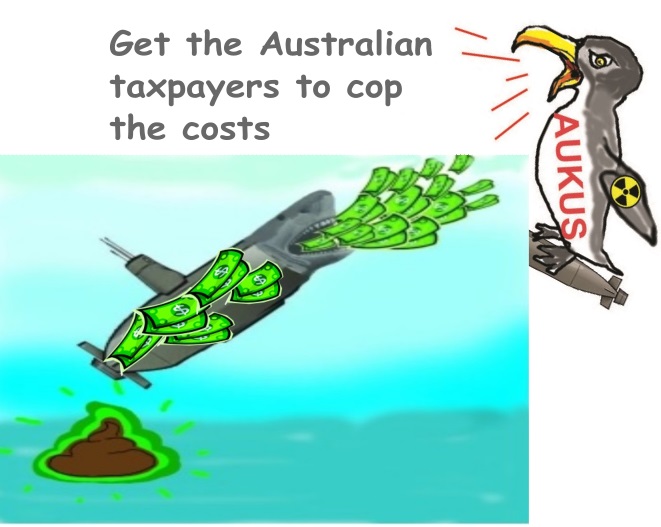
While Palantir refines its “kill chain” in Gaza, Australia is engaged in the largest military transfer of wealth in its history.
The submarines will not arrive until the early 2040s. In the meantime, Australia has established an export licence-free environment with the UK and US, allowing military and dual-use goods to be transferred between AUKUS partners without oversight. This includes AI and autonomy technologies
The line between Australian defence procurement and U.S. military-industrial interests has effectively dissolved.
18 March 2026 Dr Andrew Klein, Australian Independent Media
On December 10, 2025, Responsible Statecraft published a report that should have shaken capitals around the world. Buried in the details of President Trump’s 20-point “peace plan” for Gaza was a revelation: two American surveillance firms, Palantir and Dataminr, had embedded personnel inside the U.S.-run Civil-Military Coordination Center (CMCC) in southern Israel.
Their presence was not incidental. Palantir’s Project Maven – an “AI-powered battlefield platform” that collects surveillance data from satellites, drones, and intercepted communications to “optimize the kill chain” – was being positioned to shape Gaza’s post-war security architecture. Dataminr, which scans social media to provide “event, threat, and risk intelligence” to governments and law enforcement, was also inside the room.
This is not conspiracy. This is confluence – the quiet alignment of corporate interests, military objectives, and political capture. This article traces that confluence from the battlefields of Gaza to the boardrooms of Australia, and asks a simple question: Who benefits?
Part One: The Business Model – AI as Occupation
Palantir’s “Kill Chain” Optimisation
Palantir Technologies has been explicit about its ambitions. CEO Alex Karp has described the company’s technology as “optimising the kill chain.” Project Maven, for which Palantir recently secured a $10 billion Pentagon contract, sucks information from multiple sources and “packages it into a common, searchable app for commanders and support groups.” It has already been deployed to guide U.S. airstrikes across the Middle East, including in Yemen, Syria, and Iraq.
Since January 2024, Palantir has been in a “strategic partnership” with Israel’s military for “war-related missions”. The company has expanded its Tel Aviv office significantly over the last two years. Karp defended this collaboration amid international concerns over war crimes, saying Palantir was the first to be “completely anti-woke”.
The Gaza Laboratory
For the last two years, Gaza has functioned as an incubator for militarised AI. Israel’s Lavender system, an AI-assisted surveillance tool, used predictive analytics to rank Palestinians’ likelihood of being connected to militant groups, based on an opaque set of criteria. Public sector workers – healthcare workers, teachers, police officers – were included on kill lists because they had ties to Hamas by virtue of working in a territory the group governed.
The Gospel system functioned as a “mass assassination factory.” One source admitted spending only “20 seconds” per target before authorising bombing – just enough to confirm the Lavender-marked target was male.
Under Trump’s proposed “peace plan,” these technologies would be scaled up. The plan envisions “Alternative Safe Communities” – fenced, heavily monitored compounds where Palestinians would be relocated, their movements tracked by AI systems, their online activity scanned by Dataminr, their phones monitored by Palantir’s platforms. Entry would be contingent on approval by Israel’s Shin Bet, with criteria that could disqualify hundreds of thousands based on algorithmic “risk scores.”
For tech companies, war is opportunity. Access to vast datasets, real-world testing for new military systems, and long-term contracts for post-war surveillance infrastructure.
For Israel, the arrangement offers a way to outsource occupation while maintaining control.
For Palestinians, it promises more of what they have already endured: unremitting horror, dragnet surveillance, and death by algorithm.
Part Two: The Australian Connection – Wealth Transfer and Complicity
AUKUS: The $368 Billion Commitment
While Palantir refines its “kill chain” in Gaza, Australia is engaged in the largest military transfer of wealth in its history. The AUKUS nuclear submarine program is estimated to cost $368 billion over coming decades, with $53–63 billion allocated for the first decade alone.
The submarines will not arrive until the early 2040s. In the meantime, Australia has established an export licence-free environment with the UK and US, allowing military and dual-use goods to be transferred between AUKUS partners without oversight. This includes AI and autonomy technologies developed under Pillar 2 of the agreement, which focuses on “artificial intelligence and autonomy, quantum science, advanced cyber, and electronic warfare.”
The same technologies being tested on Palestinian populations in Gaza are, under AUKUS, being integrated into Australia’s defence infrastructure.
The Ghost Shark Precedent
In September 2025, the government announced a $1.7 billion investment in “Ghost Shark” autonomous submarines – underwater drones developed by Australian company Anduril, whose U.S. parent has close ties to the defence establishment. Assistant Minister Matt Thistlethwaite described the technology as so impressive that “the Americans have invested in the company.”
The line between Australian defence procurement and U.S. military-industrial interests has effectively dissolved.
The Cost of Living vs. The Cost of War
While this wealth transfers to the United States, Australians struggle with a cost-of-living crisis that the government refuses to adequately address. The Robodebt scheme – an automated system that raised unlawful debts against welfare recipients – offers a template for how algorithmic governance can devastate vulnerable populations .
The National Anti-Corruption Commission recently found two public servants engaged in “serious corrupt conduct” in relation to Robodebt. But as Economic Justice Australia noted:
“The system punishes only the vulnerable. The main sanction for damaging behaviour at the top levels of the Department has been naming and shaming.”
No one went to jail. No one lost their pension. The system protected itself.
The same pattern is now repeating at scale: algorithms making life-and-death decisions, with no one accountable when they fail.
Part Three: The Segal Nexus – Silencing Critics, Enabling the Agenda
The Envoy’s Role
Jillian Segal AO, Australia’s Special Envoy to Combat Antisemitism, occupies a unique position at the intersection of power. Her credentials are impeccable: former ASIC deputy chair, board member of the Sydney Opera House Trust, the Garvan Institute, and the Australia-Israel Chamber of Commerce. She is deeply embedded in the networks that connect Australian business to Israeli interests.
In December 2025, the Albanese Government formally adopted Segal’s Plan to Combat Antisemitism, accepting all 13 recommendations………………………………………………………………………………………..
The framework created by the antisemitism envoy – however well-intentioned – provides cover for those who would shut down debate. Critics are not engaged; they are managed. Those who persist are not answered; they are silenced.
The Business Connection
Segal’s husband’s company, Henroth Investments, donated $50,000 to Advance Australia, a right-wing lobby group that has shared anti-immigration content and claimed Palestinians in Australia were a “risk to security.” She has disclaimed knowledge of the donation, and government ministers have accepted her statement .
But the appearance matters. When the antisemitism envoy is married to a donor to an organisation that promotes anti-Palestinian rhetoric, it feeds a perception that her role serves a particular
political agenda rather than a genuine anti-racism brief. When her networks connect Australian business to Israeli interests, and when those interests align with the very AI companies testing their technologies on Palestinian populations, the confluence becomes visible.
Part Four: The Alignment of Values
In a bizarre way, the values of Palantir’s leadership align with the values of Australia’s political class…………………………………………………………………………………
What if they were, instead, a mechanism to enable and facilitate Israel’s transition to an AI-driven economy independent of the United States?
Consider the logic:
- Israel seeks economic independence. Netanyahu has announced plans to “taper off” U.S. military aid, pivoting toward AI sovereignty. A $200 million joint AI and quantum science center with the U.S. is in development.
- A state reliant on a single product must ensure demand. If Israel’s future exports are AI-driven surveillance and warfare technologies, it needs customers. It needs a demonstrated market. It needs a proof of concept.
- Gaza provides the laboratory. The technologies tested there—Lavender, Gospel, the Maven platform – are refined in real-world conditions, with a population that cannot resist, cannot refuse, cannot escape.
- Critics must be silenced. This is where the antisemitism framework becomes essential. If criticism of Israel’s actions can be reframed as antisemitism, if legitimate concerns about algorithmic warfare can be dismissed as hatred, if the very people documenting war crimes can be delegitimised – then the business model is protected.
- Australia plays its part. By adopting the antisemitism envoy’s recommendations, by embedding the IHRA definition into policy, by creating legal frameworks that can be used to silence critics, Australia becomes an enabler of this system. Not through conspiracy—through confluence. Through the quiet alignment of interests that requires no coordination, only opportunity
Part Six: The Accountability Vacuum
The Robodebt scheme offers a template for what comes next………………………………………………………………………………………………………………………..Conclusion: What We Have Discovered
This article has traced a network of connections that is not conspiracy but confluence:
- Palantir and Dataminr embedded in Gaza, testing AI systems on a captive population, refining technologies that will be exported worldwide.
- AUKUS transferring Australian wealth to the U.S. military-industrial complex, integrating the same AI and autonomy technologies into our defence infrastructure.
- Jillian Segal positioned at the nexus of Australian business, government, and Israeli interests, her office providing the framework that silences critics.
- The antisemitism claim deployed not against genuine hatred, but against legitimate criticism of Israeli policy – protecting the business model, enabling the silence.
· The accountability vacuum ensuring that when things go wrong, no one is responsible.
The pattern is consistent. The players are visible. The evidence is documented.
Australian news analysis
What remains is for Australians to ask themselves: Is this who we want to be?
Do we want our wealth transferred to corporations that “optimize the kill chain“? Do we want our government to enable the testing of AI warfare on a captive population? Do we want our political class to silence critics while profiting from death?
The answer, for those with eyes to see, should be clear.
But the system is designed to keep those eyes closed. To cry “antisemitism” at anyone who questions. To ensure that the only voices heard are those that align with the business model.
We have seen through it. Now we must help others see. https://theaimn.net/the-architecture-of-silence-palantir-aukus-and-the-business-of-genocide/
1 This month
7 April – WEBINAR – Australia and the Doomsday Clock – Preventing nuclear war through NoFirstUse and other policies
Online | Tuesday April 7, 4:00-5:30pm, Australian Eastern Time / 8:00-9:30am Central Europe Time
– Access the registration link
15 April – Zoom –Nuclear Power is Not the Solution
Apr 15, 2026 01:00 AM in Canberra, Melbourne, Sydney

Join the International Physicians for the Prevention of Nuclear War (IPPNW) on Tuesday, April 14th for a timely webinar exploring the risks associated with nuclear power and challenging the myth that it offers a simple, safe, carbon-free solution to the climate crisis

21 April Webinar: No Nuclear Weapons in Australia
Start: 2026-04-21 18:00:00 UTC Canberra, Melbourne, Sydney (GMT+10:00)
End: 2026-04-21 19:30:00 UTC Canberra, Melbourne, Sydney (GMT+10:00)
Event Type: Virtual
A virtual link will be communicated before the event.
Host Contact Info: australia@icanw.org

of the week – Australians for War Powers Reform (AWPR)
To see nuclear-related stories in greater depth and intensity
 Antinuclear