The weakest link: Australia’s submarine hopes depend on the UK, but Britannia no longer rules the waves
Guardian, Ben Doherty, 21 Mar 26
If the US is unable to provide Virginia-class submarines and the UK’s timeline to build the Aukus class falters, Australia could be left with nothing

Ben DohertySat 21 Mar 2026 01.00 AEDTShare178
When HMS Anson – a British nuclear submarine – surfaced just off the coast of Perth last month, it was hailed as vindication of the Aukus triumvirate: “a historic new phase” in Australia’s path towards commanding its own nuclear submarines.
The submarine’s arrival, it was argued, was demonstration of the political will behind the ambitious Aukus deal: manifestation of Donald Trump’s exhortation the agreement was “full steam ahead”.
But the Anson’s arrival brought with it no small amount of consternation also.
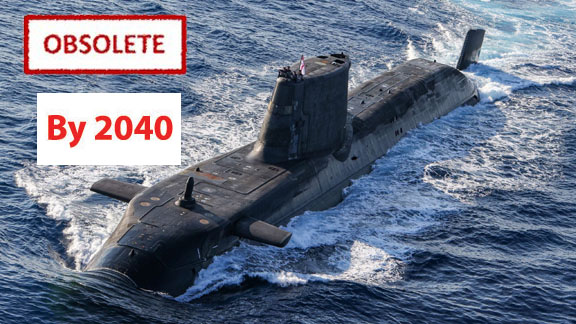
Anson is now the only attack submarine in the British fleet that can be put to sea, of a supposed complement of six. The others are all in maintenance, being refitted or have been stripped for parts to keep other subs afloat.
“Perhaps more local concerns should be the priority,” the news site Navy Lookout suggested, unconvinced by foreign adventurism.
And so it came to pass. When war suddenly broke out in the Middle East and the Anson abruptly ended its engagement in Australia early – called back to a potential deployment in the strait of Hormuz – there was no fanfare, none of the triumphalism.
t was, perhaps, a neat metaphor for the Aukus agreement itself: political intent aplenty, but capacity lacking.
The spirit is willing, but the flesh …
A ‘demanding’ timeline
In the gallons of newsprint spilled over the Aukus deal, forensic attention has been paid to the capacity of the US to spare three Virginia class submarines for Australia from the early 2030s.
Given sclerotic – and thus-far stubbornly unshiftable – rates of shipbuilding in the US despite billions in Australian taxpayers’ assistance, the Congressional Research Office has openly considered that instead of the US selling any Virginia-class submarines to Australia, it would instead rotate its own US-commanded vessels through Australian ports.
But Australia’s use of the American submarine is only ever intended as a transitory capability.
Far more than the US, Australia must depend on the UK.
For its own, sustained nuclear submarine capability, Australia will rely on Britain’s capacity to design and build the first of an entirely new class of nuclear submarine: the SSN Aukus.
Some have argued the UK’s nuclear submarine industry is beyond salvation.
“The UK is no longer capable of managing a nuclear submarine program,” rear admiral Philip Mathias, a former director of nuclear policy at the Ministry of Defence, said last year, blaming “gross mismanagement” and a “catastrophic failure of succession and leadership planning”.
Even the booster-ish House of Commons inquiry into Aukus heard it was “a source of national shame the way we’ve treated the nuclear submarine building enterprise in this country”.
Lord Case, formerly the head of Britain’s civil service, told the defence committee: “somehow, we became the world’s most embarrassed nuclear nation”.
The published “optimal pathway” forecasts the first Aukus class submarine being built by the UK for the Royal Navy in the “late 2030s”.
The design of that vessel will form the basis for Australia’s own Aukus submarines, to be built in Adelaide. Australia’s first Aukus submarine is due in the water in the “early 2040s”.
It is, by even the most optimistic accounts, a “demanding” timeline. And the UK has more pressing priorities.
It must first complete the seventh and final boat in the Astute class (Britain’s nuclear attack submarine, of which the Anson is the most recent into active service). But the UK also has, in construction, four Dreadnought class nuclear ballistic submarines, the basis of the UK’s nuclear deterrent.
All of these are being built by BAE Systems Submarines at Barrow-in-Furness, in Cumbria.
Put frankly, one senior UK defence source told the Guardian on condition of anonymity, while upholding Aukus is politically important to the UK, other boats must, and will, take precedence.
Back of the queue
That leaves Australia in an invidious position.
If the US is unable (by its own legislation) to provide Virginia-class submarines, and the UK’s timeline to build the Aukus class falters, those countries still have nuclear submarine fleets.
Australia will be left with nothing (its ageing diesel-electric Collins class submarines already having been extended far beyond their slated working life).
Australia has the most at stake in Aukus, but the least control over how it unfolds.
For while Australian tax dollars –A$1.6bn of a committed A$4.7bn to the US and A$452m of A$4.6bn to the UK – flood into foreign shipbuilding industries, Australia finds itself intractably at the back of the queue…………………………………………………………………………………………………………………………………………………………………………..
Questions to be asked
Marcus Hellyer, head of research at Strategic Analysis Australia, describes himself as “Aukus agnostic”.
“I don’t jump in and say ‘it’s all doomed’ or ‘it’s the greatest policy idea ever’, but there are certainly questions to be asked about the process that got us here, and how it is going.”
Hellyer says Aukus was announced to the Australian people without any public debate or a proper assessment of alternative defence strategies, such as hypersonic missiles.
And, he argues, while focus has been on the US capacity to deliver surplus Virginia-class submarines, Australia will ultimately have to rely far more heavily on a UK naval nuclear enterprise that has been “chronically underfunded”.
“Now the UK government would say ‘well, where we’re addressing that, we’re funding that’, but there is a massive backlog in both investment required and work to be done.”
Also, Hellyer says, it is hard to pin down exactly how far progressed the design for the new Aukus submarine is.
“It’s really hard to get any kind of reliable information out of any of the players about the maturity of the assets in this program. We keep being told by admirals that the Aukus design is ‘mature’. Well, define ‘mature’.”
“We’re not in the detailed design phase, so we’re still nowhere near starting construction … when are we actually going to start building this thing?”
There is, too, the adversary argument.
Since Aukus was announced in 2021, zero additional Aukus-nation submarines have been built beyond those already in the pipeline before the agreement was revealed. The US has built seven of its own nuclear submarines, the UK has launched one for its navy.
In that time, China, the superpower Aukus is designed to counter, has launched 10 nuclear submarines.
Historically, great naval powers have always had significant civilian industries upon which they can draw. China is now the world’s largest civilian ship builder. The US now accounts for just 0.1% of global shipbuilding.
“And their shipyards are successful not because they’ve got gazillions of lowly paid unskilled people banging away with hand tools,” Hellyer says, “they have significant technology and they are absolutely driven by efficiency, by delivering on time and on budget.
“That’s why the Chinese will continue to outcompete us in terms of building ships and increasingly submarines … and now they’ve made that policy switch: they’re now bringing that to their undersea domain.” https://www.theguardian.com/world/2026/mar/20/the-weakest-link-australias-submarine-hopes-depend-on-the-uk-but-britannia-no-longer-rules-the-waves
No comments yet.
1 This month

of the week – Australians for War Powers Reform (AWPR)
To see nuclear-related stories in greater depth and intensity
 Antinuclear
Leave a comment