How Australia’s Government Backed an Illegal War and Left Australians to Foot the Bill
The Speed of Capitulation
When American and Israeli missiles began striking Iranian cities in the final days of February 2026, the Australian government did not wait for the UN Security Council to meet. It did not wait for legal opinion. It did not wait for evidence.
Within hours, Prime Minister Anthony Albanese declared that “We support the United States acting to prevent Iran from obtaining a nuclear weapon and to prevent Iran continuing to threaten international peace and security.” Foreign Minister Penny Wong added that she would “leave it for the US and Israel to speak of the basis, the legal basis for the attacks.”
Not since the invasion of Iraq has an Australian government been so swift to endorse military action without international legal sanction. And not since Iraq has an Australian government been so unprepared for the consequences.
The Miscalculation
The operation was billed as a surgical strike. The theory – as arrogant as it was flawed – held that the removal of Iran’s leadership would trigger a swift regime collapse, that the Iranian people would rise up at America’s invitation, that the war would be over before it began.
What happened instead defies every neocon fantasy.
The Islamic Republic did not fracture; it consolidated. A new spiritual leader emerged. Iranian society rallied behind the flag. And Tehran demonstrated what analysts had long warned: that it possesses both the capability and the will to strike back effectively.
The Strait of Hormuz, through which one-fifth of the world’s oil passes, is now effectively blockaded. Iran has asserted control, allowing only Chinese oil tankers through under negotiated exemptions. Western and allied shipping has effectively stopped.
The war we were told would be quick and decisive is now entering its second month, with no end in sight.
The price of Brent crude has surged from $72 per barrel in January to over $110, and in some trading sessions, beyond $180.
The impact on Australian motorists has been immediate and brutal. Petrol prices have risen by more than 30 per cent in a month. Some rural service stations have run out of fuel entirely. Hundreds of outlets have imposed purchase limits of 50 litres per customer. Social media is flooded with images of panic buying – jerry cans stacked in driveways, queues stretching down highways.
Australia’s fuel reserves are dangerously low. According to Energy Minister Chris Bowen, we have 39 days of petrol, 30 days of diesel, and 30 days of jet fuel. This is far below the 90-day reserve recommended by the International Energy Agency. The government has already reduced reserve requirements for importers by approximately 20 per cent – equivalent to six days of national supply.
Treasurer Jim Chalmers now calls this conflict “the defining influence” on the May budget. He warns that Treasury has modelled two scenarios – one with oil at $100 per barrel, one with oil at $120 – and admits that “both scenarios could underestimate the cost.”
Even under conservative assumptions, the war could cut GDP growth by up to 0.2 percentage points across major trading partners, add up to 1.25 percentage points to inflation, and leave GDP 0.6 per cent lower in 2027.
The Treasurer’s own words should chill every Australian: “We’ve already seen four major shocks – the GFC, a major pandemic, a global inflation shock, escalating trade tensions – and this oil shock could become the fifth.”
The Food Chain: Fertiliser and Farming
The war is not just hitting the bowser. It is hitting the dinner table.
Australia’s farmers are now facing a crisis of their own. The Strait of Hormuz disruption has cut off supply of urea fertiliser, upon which Australian agriculture is heavily dependent. Prices have soared. Supply has tightened. And the winter planting season is about to begin.
Queensland farmer Arthur Gillen normally splits his winter crop between wheat and chickpeas. This year, with fertiliser costs prohibitive, he is reducing wheat to 20 per cent of his planting area and abandoning urea use entirely.
He is not alone. Farmers across the country are pivoting to low-fertiliser crops – lentils, chickpeas, canola – and reducing wheat acreage. This shift, driven by war, will reshape Australian agriculture for years to come.
The timing could not be worse. Rabobank warns that the Strait of Hormuz must be open by the end of April to get fertiliser to farmers in time for winter planting. If it is not, the impact on Australian food production will be severe and sustained.
Federal Agriculture Minister Julie Collins has announced a national food security review. Farmers are telling the ABC they fear fuel shortages will impact the winter harvest. The government is scrambling, but the damage is already being done.
The Medicines Pipeline
In March 2026, the Therapeutic Goods Administration (TGA) issued an unusual public statement: they urged Australians not to panic buy medication.
The reason is the Strait of Hormuz. Pharmaceutical companies have been forced to reroute critical medicines away from the Persian Gulf, switching from sea freight to air freight at enormous cost………………………………………………………………
The AUKUS Mirage
Perhaps the most profound strategic consequence of this war is the damage it has done to Australia’s faith in its alliance with the United States.
The US military resources that were meant to underpin the AUKUS nuclear submarine program are now stretched to breaking point in the Persian Gulf.
If Washington cannot keep its promises to South Korea or Japan, one Queensland University of Technology professor asked, what confidence can Australia retain in the submarine deal?
Public opinion is already shifting. Polls show more Australians oppose the war than support it. The government’s swift endorsement of an illegal conflict has left it morally stripped naked and strategically embarrassed.
The Government’s Response: Too Little, Too Late
To its credit, the government has belatedly recognised the scale of the crisis.
On March 27, Prime Minister Albanese announced new fuel security powers, including the use of Export Finance Australia to underwrite private sector fuel purchases. He called out panic buyers, declaring that filling jerry cans was “not the Australian way.”
Energy Minister Bowen has appointed a former energy regulator to lead a national fuel supply taskforce. The government is considering support for the nation’s two remaining refineries……………………………………………………..
The Path Forward
The war is not ending soon. Iran’s leadership has consolidated. The Strait of Hormuz remains closed to Western shipping. Global energy markets are in turmoil.
What Australia needs is not more loyalty to a declining hegemon. What Australia needs is a government willing to act in the national interest – not just in the interests of alliance management…………………………………………………….. https://theaimn.net/the-war-they-sold-us-the-price-we-pay/
USS Charlotte was at periscope depth, but the periscope was down, reducing the chance of it, or the wake it creates, being seen by the enemy. It was a tense moment.
“Safe/Fire key to Fire”, ordered the captain.
The officer manning the fire control console repeated the order, “Safe/Fire key to Fire” and then advised the captain, “Safe/Fire key is to Fire”.
“Fire 4 tube at Target 1”, the captain stated in a raised and clear voice.
The officer repeated the order and hit the ‘Fire’ button. A low-level thud was both felt and heard throughout the submarine as the pressurise discharge system pushed the Mk 48 Torpedo from the tube. “Weapon running” the officer called.
As the weapon ran towards the Iranian frigate the submarine carried out a further visual set-up through the periscope to update the weapon. The updated targeting solution was transmitted down the very long and thin guidance wire connecting the torpedo to the submarine.
The update was also loaded into the second torpedo’s guidance system. “Fire 1 tube at Target 1”.
The first torpedo did not do its job. The second exploded directly under the target, lifting the hull out of the water and sending a violent shock wave through it. The structural damage was completed as the hull dropped back into the water.
The first the Iranian captain of the frigate would have known about the US submarine would have been when he felt the explosion underfoot.
Queuing
USS Charlote did not just stumble across the INS Dena. Rather, days before, it had been queued to the target by folks back in the US tracking where every surface ship in the world is located.
The submarine travelled at high speed, around 30 knots (55 km/h), for days getting from its routine Indian Ocean patrol area to the waters south of Sri Lanka. That’s one of the key advantages of a nuclear-powered submarine. They can travel long distances fast.
As it arrived in the area the submarine’s crew would have detected (found it) and tracked the contact (worked out its range, course and speed), and then classified (identified) it using a combination of acoustic and electronic emissions, and finally confirmed it was the INS Dena visually through the periscope.
“Then ‘bang’.”
AUKUS implications
The Iran War has shown that submarines are 21st century war fighting assets with ever relevant capabilities; they can collect intelligence, conduct reconnaissance, launch land attack missiles, covertly land special forces, covertly lay mines, and sink submarines and surface ships.
But the events from 28 February onwards have shown us other things.
AUKUS has been described by many as a program that facilitates close alliance and force integration with the United States.
As Donald Trump broke its written Free Trade Agreement commitments to Australia on ‘Liberation Day”, those in the Canberra bubble were blind to that breach’s relevance to the ANZUS treaty and AUKUS agreement. Surely the US’s defence treaty with Australia would be treated differently.
As the US initiated an AUKUS review, that was to see AUKUS sceptic Elbridge Colby recommend stopping the program until Trump realised the financial benefit in continuing with it and overrode Colby, those in the Canberra bubble breathed a collective sigh of relief and chose not to think it too much.
Ruptured
As Trump, to use the words of Canadian Prime Minister Mark Carney, ‘ruptured’ the international rules-based order – carrying out a military operation in Venezuela, threatening Panama, bringing NATO to the brink by threatening to invade Greenland, attacking Iran and now threatening Cuba – those in the Canberra bubble didn’t seem to recognise the US Administration’s departure from Australian values; or perhaps likely they did but decided not to respond to it.
Only over the past month Prime Minister Albanese has responded properly to the ‘rupture’, not blindly committing Australian forces to follow the US into war, as has so often been the case (as a downpayment for US support for Australia if it needed it).
Albanese has despatched a RAAF early warning aircraft to support the air defence of the United Arab Emirates and other Gulf states, but we haven’t joined a US-led effort as has been the case in the past.
Sovereign thought
Albanese has it right. The US did not seek to build international support, and/or UN approval, for a strike on Iran. Instead it chose to plan in secret in cahoots with Israel and then launch a surprise attack to kill Iran’s leadership while negotiations with Iran were supposed to be ongoing.
Only when the going got tough did Washington call on allies for assistance, and under the circumstances where they rightly refused.
“Trump’s Iran War has caused harm to Australia.”
The impact of Trump’s war is causing economic harm right across the globe.
The war has also brought home Australia’s vulnerabilities. For decades distance has kept us relatively isolated from conflict, but this conflict directly affected us as world fuel supplies are disrupted and prices have sky rocketed. And the full extent of this new energy shock still lies ahead.
“Perhaps it’s the shock that we needed to have”
a chance to reflect on our need to take a more independent pathway in a world in which many past assumptions are being overturned.
US submarine shortages
Australia has long relied on the naval might of what Prime Minister Robert Menzies liked to call our “great and powerful friends” – first the British Empire and the Royal Navy; then Pax Americana upheld by the United States Navy. Now times are changing,
“and they are changing rapidly.”
The US Navy has gone from a Cold War era 1000-ship navy to a 600-ship navy during the Reagan era, to a current fleet of just 300 ships. China now has the world’s largest navy, 350 to 370 vessels, and Chinese shipyards are turning out warships much more rapidly than their counterparts in the US.
The US Navy still has a qualitative edge, but the US Navy is not what it was, and its well understood that quantity has a quality all of its own.
The US has been aiming to increase its number to 381 combat ships. 66 is the desired number for nuclear attack submarines – they have only 49 at the present moment.
Since 2011 the USN has purchased 2 submarines a year (this last year it was only one – because deliveries are so far behind).
The actual Virginia-class production rate has never reached 2.0 boats per year, and since 2022 has been limited to about 1.1 to 1.2 boats per year, resulting in a growing backlog of boats procured but not yet built.
They can’t build enough boats to meet their own needs,
“let alone ours.”
A school of thought in the US had been that submarines transferred to the Royal Australian Navy would be available for US in time of conflict, but the Iran War has speared that assumption.
And Trump noticed this week, first expressing disappointment at the UK’s refusal to become directly involved in the Iran War and then turning his thoughts to Australia, saying “Australia too, Australia was not great. I was a little surprised by Australia”.
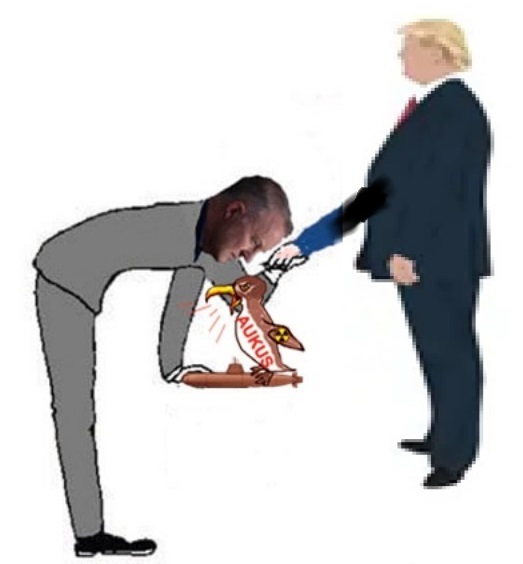
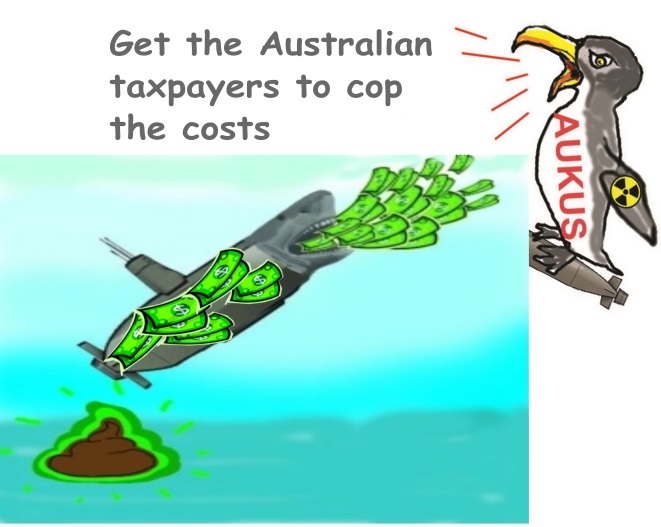
Trump is well known to hold a grudge. The one thing that will keep him supportive of AUKUS will be the money flowing from the Australian taxpayers to US shipyards, with no contract in place for delivery and no claw back option for the Australian contribution is the US does not deliver. That’s the sort of deal that Trump likes.
UK submarine shortages
And the United Kingdom are in a worse position than the US. The Royal Navy has one nuclear attack submarine available for operations – a fact made obvious to Australians when that sole submarine cut short a visit to Western Australia to head towards the Iran conflict zone.
Retired Rear Admiral Peter Briggs, in an event at the Canberra Press Club, organised by Malcolm Turnbull, said it all, warning the UK had “dropped below the minimal sustainable force” for submarines and the country would be late in delivering its first SSN-AUKUS boat, a design which Australia is also hoping to start building in Adelaide in the 2030s.
“It is queued up behind the final two (Astute-class boats) and four critically important ballistic missile submarines, the Dreadnoughts, that are being built in the shipyard.”
“You cannot get the first SSN-AUKUS out until the fourth ballistic missile submarine is clear of the yard. That is the UK’s national priority.”
Defence incompetence
Listen to this story
12 min
The US war on Iran has exposed Australia’s incompetent defence and procurement. Rex Patrick reports implications for AUKUS submarine program.
A tense moment
USS Charlotte was at periscope depth, but the periscope was down, reducing the chance of it, or the wake it creates, being seen by the enemy. It was a tense moment.
“Safe/Fire key to Fire”, ordered the captain.
The officer manning the fire control console repeated the order, “Safe/Fire key to Fire” and then advised the captain, “Safe/Fire key is to Fire”.
“Fire 4 tube at Target 1”, the captain stated in a raised and clear voice.
The officer repeated the order and hit the ‘Fire’ button. A low-level thud was both felt and heard throughout the submarine as the pressurise discharge system pushed the Mk 48 Torpedo from the tube. “Weapon running” the officer called.
As the weapon ran towards the Iranian frigate the submarine carried out a further visual set-up through the periscope to update the weapon. The updated targeting solution was transmitted down the very long and thin guidance wire connecting the torpedo to the submarine.
The update was also loaded into the second torpedo’s guidance system. “Fire 1 tube at Target 1”.
The first torpedo did not do its job. The second exploded directly under the target, lifting the hull out of the water and sending a violent shock wave through it. The structural damage was completed as the hull dropped back into the water.
The first the Iranian captain of the frigate would have known about the US submarine would have been when he felt the explosion underfoot.
Sinking of INS Dena (Source: US Department of War)
Queuing
USS Charlote did not just stumble across the INS Dena. Rather, days before, it had been queued to the target by folks back in the US tracking where every surface ship in the world is located.
The submarine travelled at high speed, around 30 knots (55 km/h), for days getting from its routine Indian Ocean patrol area to the waters south of Sri Lanka. That’s one of the key advantages of a nuclear-powered submarine. They can travel long distances fast.
As it arrived in the area the submarine’s crew would have detected (found it) and tracked the contact (worked out its range, course and speed), and then classified (identified) it using a combination of acoustic and electronic emissions, and finally confirmed it was the INS Dena visually through the periscope.
Then ‘bang’.
AUKUS implications
The Iran War has shown that submarines are 21st century war fighting assets with ever relevant capabilities; they can collect intelligence, conduct reconnaissance, launch land attack missiles, covertly land special forces, covertly lay mines, and sink submarines and surface ships.
But the events from 28 February onwards have shown us other things.
AUKUS has been described by many as a program that facilitates close alliance and force integration with the United States.
As Donald Trump broke its written Free Trade Agreement commitments to Australia on ‘Liberation Day”, those in the Canberra bubble were blind to that breach’s relevance to the ANZUS treaty and AUKUS agreement. Surely the US’s defence treaty with Australia would be treated differently.
As the US initiated an AUKUS review, that was to see AUKUS sceptic Elbridge Colby recommend stopping the program until Trump realised the financial benefit in continuing with it and overrode Colby, those in the Canberra bubble breathed a collective sigh of relief and chose not to think it too much.
Ruptured
As Trump, to use the words of Canadian Prime Minister Mark Carney, ‘ruptured’ the international rules-based order – carrying out a military operation in Venezuela, threatening Panama, bringing NATO to the brink by threatening to invade Greenland, attacking Iran and now threatening Cuba – those in the Canberra bubble didn’t seem to recognise the US Administration’s departure from Australian values; or perhaps likely they did but decided not to respond to it.
Only over the past month Prime Minister Albanese has responded properly to the ‘rupture’, not blindly committing Australian forces to follow the US into war, as has so often been the case (as a downpayment for US support for Australia if it needed it).
Albanese has despatched a RAAF early warning aircraft to support the air defence of the United Arab Emirates and other Gulf states, but we haven’t joined a US-led effort as has been the case in the past.
Sovereign thought
Albanese has it right. The US did not seek to build international support, and/or UN approval, for a strike on Iran. Instead it chose to plan in secret in cahoots with Israel and then launch a surprise attack to kill Iran’s leadership while negotiations with Iran were supposed to be ongoing.
Only when the going got tough did Washington call on allies for assistance, and under the circumstances where they rightly refused.
Trump’s Iran War has caused harm to Australia.
The impact of Trump’s war is causing economic harm right across the globe.
The war has also brought home Australia’s vulnerabilities. For decades distance has kept us relatively isolated from conflict, but this conflict directly affected us as world fuel supplies are disrupted and prices have sky rocketed. And the full extent of this new energy shock still lies ahead.
Perhaps it’s the shock that we needed to have ;
a chance to reflect on our need to take a more independent pathway in a world in which many past assumptions are being overturned.
Australia has long relied on the naval might of what Prime Minister Robert Menzies liked to call our “great and powerful friends” – first the British Empire and the Royal Navy; then Pax Americana upheld by the United States Navy. Now times are changing,
and they are changing rapidly.
The US Navy has gone from a Cold War era 1000-ship navy to a 600-ship navy during the Reagan era, to a current fleet of just 300 ships. China now has the world’s largest navy, 350 to 370 vessels, and Chinese shipyards are turning out warships much more rapidly than their counterparts in the US.
The US Navy still has a qualitative edge, but the US Navy is not what it was, and its well understood that quantity has a quality all of its own.
The US has been aiming to increase its number to 381 combat ships. 66 is the desired number for nuclear attack submarines – they have only 49 at the present moment.
Since 2011 the USN has purchased 2 submarines a year (this last year it was only one – because deliveries are so far behind).
The actual Virginia-class production rate has never reached 2.0 boats per year, and since 2022 has been limited to about 1.1 to 1.2 boats per year, resulting in a growing backlog of boats procured but not yet built.
US Naval Shipbuilding Plan (Source: Congressional Budget Office).
They can’t build enough boats to meet their own needs,
let alone ours.
A school of thought in the US had been that submarines transferred to the Royal Australian Navy would be available for US in time of conflict, but the Iran War has speared that assumption.
And Trump noticed this week, first expressing disappointment at the UK’s refusal to become directly involved in the Iran War and then turning his thoughts to Australia, saying “Australia too, Australia was not great. I was a little surprised by Australia”.
Trump is well known to hold a grudge. The one thing that will keep him supportive of AUKUS will be the money flowing from the Australian taxpayers to US shipyards, with no contract in place for delivery and no claw back option for the Australian contribution is the US does not deliver. That’s the sort of deal that Trump likes.
And the United Kingdom are in a worse position than the US. The Royal Navy has one nuclear attack submarine available for operations – a fact made obvious to Australians when that sole submarine cut short a visit to Western Australia to head towards the Iran conflict zone.
Retired Rear Admiral Peter Briggs, in an event at the Canberra Press Club, organised by Malcolm Turnbull, said it all, warning the UK had “dropped below the minimal sustainable force” for submarines and the country would be late in delivering its first SSN-AUKUS boat, a design which Australia is also hoping to start building in Adelaide in the 2030s.
“It is queued up behind the final two (Astute-class boats) and four critically important ballistic missile submarines, the Dreadnoughts, that are being built in the shipyard.”
“You cannot get the first SSN-AUKUS out until the fourth ballistic missile submarine is clear of the yard. That is the UK’s national priority.”
Defence incompetence
At the same conference, our Defence Department’s incompetence was on full display.
A Defence representative laid it out., After decades of submarine procurement failures (including the spending of $4B on French submarines we never got), it’s still “full speed ahead” in the best spirit of Captain Smith on the bridge of the Titanic.
In response to a question from Turnbull as to “what’s the plan B if we end up with no new subs” from the United States, Deputy secretary for strategy and policy, Hugh Jeffrey, answered, “You know, it’s not my job as a public servant, to talk about Plan Bs that’s the prerogative of government”.
He went on to lecture AUKUS sceptics,” If you really want to be in a position where we have no submarines then ‘turn back’. I do think, speaking as an apolitical public servant, we need to get out of this relentless politicisation of defence capabilities.”
AUKUS end
He surely did not realise what he said. He warns we’ll “be left with no submarines if the project is dumped”. The problem is that we’ll also be left with no submarines if AUKUS isn’t dumped. And we will have paid a lot for those no submarines.
After a failure on fuel security, with a failure on procuring submarines, and with the rules-based order ruptured by the very country we’re relying in respect of the program, maybe Albanese will finally cut this foolish program and move towards a more realistic, self-reliant and sustainable strategic policy.
If we don’t, we may well find our sovereignty to be hollow and that others will decide our nation’s future.
An ambassador who calls dead journalists terrorists. A death penalty for Palestinians only. A government that says nothing. And a Press Club that provides the stage.
I. The Spectacle
On March 31, 2026, the National Press Club of Australia hosted Dr Hillel Newman, the newly appointed ambassador of Israel, for an address titled “Reshaping the Middle East.”
What unfolded was not diplomacy. It was propaganda. It was the marketing of genocide. And it was allowed to continue, uninterrupted, on Australian soil, under the lights of an institution that once stood for journalistic integrity.
Newman rejected a figure of 70,000 dead in Gaza – a number, he said, provided by Hamas. He claimed the ratio of civilian to combatant casualties was “the lowest in urban warfare” and that Israel should be “commended” for the “low number of uninvolved civilians that were actually killed.”
He was speaking over the bodies of 70,000 people. He was speaking over the findings of a United Nations commission of inquiry that, in September last year, found that Israel had committed genocide in the Gaza Strip – accusing the nation of having committed four genocidal acts, “namely killing, causing serious bodily or mental harm, deliberately inflicting conditions of life calculated to bring about the destruction of the Palestinians in whole or in part, and imposing measures intended to prevent births.”
The Press Club did not challenge him. The journalists in the room did not walk out. The broadcast continued.
II. The Death Penalty Law
On March 30, the Israeli Knesset passed a law imposing the death penalty for terrorism-related offences. Human Rights Watch has analysed the bill and found it explicitly discriminatory.
The law makes death by hanging the default punishment for West Bank Palestinians convicted of nationalistic killings. It also gives Israeli courts the option of imposing the death penalty on Israeli citizens convicted on similar charges – language that legal experts say effectively confines those who can be sentenced to death to Palestinian citizens of Israel and excludes Jewish citizens.
Within the military court system of the Occupied Palestinian Territory, the bill imposes the death penalty for killings classified as acts of terrorism as defined under Israeli law, even without a prosecutorial request. The bill only allows courts to order life imprisonment in unspecified exceptional cases where “special reasons” are found, limiting judicial discretion. It also prohibits commutation of sentences and mandates execution within an accelerated timeframe of 90 days.
Israeli citizens and residents are explicitly excluded from this provision: military jurisdiction applies exclusively to Palestinians, while Israeli settlers are tried in civilian courts.
Human Rights Watch has noted that military trials of Palestinians have “an approximately 96% conviction rate, based largely on ‘confessions’ extracted under duress and torture during interrogations.”
Adam Coogle, deputy Middle East director at Human Rights Watch, stated: “Israeli officials argue that imposing the death penalty is about security, but in reality, it entrenches discrimination and a two-tiered system of justice, both hallmarks of apartheid. The death penalty is irreversible and cruel. Combined with its severe restrictions on appeals and its 90-day execution timeline, this bill aims to kill Palestinian detainees faster and with less scrutiny.”
The Palestinian Authority has condemned the law as a “war crime” and a “flagrant violation of international humanitarian law, particularly the Fourth Geneva Convention, which guarantees protection for individuals and fair trial rights.”
At the Press Club, Newman defended the law. “Just like in the United States, in Japan and in India, which have capital punishment, Israel has the right, as a sovereign state, to decide … capital punishment,” he said.
He did not mention the discrimination. He did not mention the 96% conviction rate. He did not mention the torture.
III. The Journalists
Newman was asked about the killing of journalists in Gaza and Lebanon. The International Federation of Journalists has reported that 261 journalists and media workers have been killed in Gaza since October 7, 2023. The Committee to Protect Journalists has accused Israel of killing a record 129 journalists in 2025.
Newman’s response was chilling.
He claimed that two of three journalists killed in an Israeli air strike in Lebanon were “100 per cent terrorist” members of Hezbollah’s elite Radwan force. He said they were “dressed up as journalists.” He claimed that both Hamas and Hezbollah “disguise themselves as press and remain terrorist operatives.”
When pressed on what percentage of killed journalists were not terrorists, he admitted: “The honest truth is that we have no way of knowing the exact amount of journalists who weren’t 100 per cent journalists who were killed.”
He has no way of knowing. Yet he called them terrorists anyway. On Australian soil. At the National Press Club.
The Committee to Protect Journalists has previously described such accusations as “smear campaigns” without “credible evidence to substantiate their claims.”
Newman also dismissed the broader death toll of journalists, saying: “When people outside quote 250, 300 journalists [have been killed], what they’re doing is they’re just buying [it] hook, line and sinker. If they would check, they would find that the majority of all the journalists, so-called journalists, that were affected were actually activists guised as journalists.”
He has no evidence. He provided none. The Press Club did not ask for it.
IV. The Frankcom Family
While Newman spoke inside the Press Club, the family of Zomi Frankcom stood outside.
Frankcom, an Australian aid worker, was killed by an Israeli drone strike on April 1, 2024, while working for World Central Kitchen in Gaza. Seven aid workers died. The convoy was struck three times.
Two years later, the family is still waiting for justice. They are still waiting for the release of critical drone footage audio that would establish motive. Former Defence Force chief Mark Binskin, who conducted an independent inquiry, was given access to unedited drone footage – but it did not include audio.
Newman was asked repeatedly whether the Israeli government would apologise to the Frankcom family. He refused. “Every incident of an innocent person or aid worker that is affected by a war situation is tragic, and we’ve expressed full sympathy with the family,” he said.
Sympathy. Not an apology.
He said reparations were “dependent on the final outcome of the interrogation.” Two years later, the interrogation is still not final.
Mal Frankcom, Zomi’s brother, said the family would like a formal apology, but he believed this was unlikely because it “could be seen as an admission of guilt.”
He met with Prime Minister Anthony Albanese on Tuesday. He urged the government to use all possible diplomatic levers to pressure Israel to complete its investigation.
The ambassador was asked about the audio. He said: “That’s not in my hands. It’s in the IDF’s hands.”
The IDF’s hands. Where it has been for two years.
V. The Australian Government’s Response
Foreign Minister Penny Wong told the Labor caucus that Australia opposes the death penalty “in all instances.” She pointed to a joint statement Australia signed alongside France, Germany, Italy and the United Kingdom that opposed the measure.
The statement said: “We are particularly worried about the de facto discriminatory character of the bill. The adoption of this bill would risk undermining Israel’s commitments with regards to democratic principles.”
A joint statement. Words. Not action.
The government has not summoned the ambassador. It has not imposed sanctions. It has not suspended military cooperation. It has not done anything that would cost Israel anything at all.
The same government that rushed to pass hate speech laws after the Bondi terror attack – laws that criminalise the phrase “from the river to the sea” – has nothing to say about a law that would execute Palestinian prisoners by hanging within 90 days, with no right of pardon, under a discriminatory legal regime.
The same government that welcomed Israeli President Isaac Herzog to Canberra has not condemned the man who wore a noose-shaped lapel pin while celebrating the passage of this law – Itamar Ben-Gvir, Israel’s National Security Minister.
The same government that expelled Iran’s ambassador after ASIO concluded Tehran orchestrated the bombings of a synagogue and a kosher restaurant has not applied the same standard to Israel.
VI. The Question of Double Standards
In 2024, the Albanese government expelled Iran’s ambassador, Ahmad Sadeghi, after domestic spy agency ASIO concluded that Iran had orchestrated the bombings of a synagogue in Melbourne and a kosher restaurant in Sydney.
A top Iranian diplomat, Mohammad Pournajaf, defected from the regime and was granted asylum in Australia. The government acted. The ambassador was expelled.
Yet Israel’s ambassador calls dead journalists terrorists, defends a discriminatory death penalty law, refuses to apologise for the killing of an Australian aid worker – and the government says nothing.
Why was the Iranian ambassador expelled, but the Israeli ambassador remains?
The answer is the network. The donors. The lobbyists. The fear of being labelled antisemitic. The capture of our political class by a foreign ideology that demands silence in exchange for support.
VII. Has the Press Club Been Captured?
The National Press Club is meant to be a forum for robust journalism. For challenging those in power. For holding the powerful to account.
On March 31, 2026, it provided a platform for an ambassador who called dead journalists terrorists. Who defended a discriminatory death penalty law. Who refused to apologise for the killing of an Australian aid worker.
The journalists in the room did not walk out. They did not cut the microphone. They did not refuse to platform a man who accused the dead of being terrorists without evidence.
This does no credit to Australian journalism. It does no credit to the Press Club. It does no credit to Australia.
VIII. The Questions They Refuse to Ask
We will ask the questions they refuse to ask:
Why was Hillel Newman given a platform to call dead journalists terrorists?
Why did the National Press Club not challenge his claims in real time?
Why has the Australian government not summoned the ambassador to answer for the death penalty law?
Why has the government not condemned the law in the strongest possible terms?
Why has the government not suspended military cooperation with Israel?
Why has the government not imposed sanctions?
Why has the government done nothing that would cost Israel anything at all?
Why was the Iranian ambassador expelled, but the Israeli ambassador remains?
The Frankcom family deserves answers. The Palestinian prisoners facing execution deserve the world to speak. The Australian people deserve to know why their government is silent.
IX. The Larger Pattern
This is not an isolated incident. It is the same pattern we have been exposing for weeks.
The same network that brought us the Segal Plan – mandatory Zionist indoctrination in universities. The same network that brought us the police crackdown in New South Wales – eight armoured officers breaking down a woman’s door at 5am. The same network that is turning our public service into an arm of foreign influence. The same network that has captured our political class.
The same silence. The same complicity. The same refusal to act.
Israel is committing genocide. The International Court of Justice has found it “plausible.” The United Nations commission of inquiry has found it has committed genocidal acts. The world is watching.
And Australia says nothing. Or says a few words in a joint statement, then returns to business as usual.
X. What Must Be Done
The National Press Club must answer for its decision to platform Newman. Why was he not challenged? Why was the broadcast allowed to continue? Why were dead journalists slandered without evidence on Australian soil?
The Australian government must summon the ambassador. He must answer for the death penalty law. He must answer for his comments about journalists. He must answer for the Frankcom family.
The government must condemn the death penalty law in the strongest possible terms. A joint statement is not enough. Words are not enough. Australia must use every diplomatic lever to oppose this discriminatory, inhumane legislation.
The government must suspend military cooperation with Israel. Australia cannot claim to oppose the death penalty while cooperating militarily with a state that imposes it discriminatorily.
The government must impose sanctions. The time for words is over. The time for action is now.
The Frankcom family must receive justice. The audio must be released. The investigation must be completed. Those responsible must be held accountable.
XI. A Warning
What happened at the National Press Club on March 31, 2026, was not an aberration. It was the logical conclusion of a pattern.
A foreign ambassador called dead journalists terrorists. He defended a law that executes Palestinians by hanging within 90 days, with no right of pardon, under a discriminatory legal regime. He refused to apologise for the killing of an Australian aid worker.
And Australia was silent. The government was silent. The Press Club was silent. The media was silent.
This is what complicity looks like. Not active participation. Silence. The refusal to speak. The refusal to act. The refusal to hold accountable those who commit atrocities in our name, with our support, under the cover of our alliance.
The wire is not cut. The shells fall short. The men who send others to die do not walk the ground.
But we will not be silent. We will ask the questions they refuse to ask. We will name the names. We will expose the pattern.
And we will keep cutting the wire until there is nothing left but the garden.
This article is dedicated to my wife, who stands with me shoulder to shoulder, and I am so proud of her.
Apr 15, 2026 01:00 AM in Canberra, Melbourne, Sydney
Join the International Physicians for the Prevention of Nuclear War (IPPNW) on Tuesday, April 14th for a timely webinar exploring the risks associated with nuclear power and challenging the myth that it offers a simple, safe, carbon-free solution to the climate crisis



 Antinuclear