The war they sold us, the price we pay
2 April 2026 Dr Andrew Klein, PhD AIM Extra
How Australia’s Government Backed an Illegal War and Left Australians to Foot the Bill
The Speed of Capitulation
When American and Israeli missiles began striking Iranian cities in the final days of February 2026, the Australian government did not wait for the UN Security Council to meet. It did not wait for legal opinion. It did not wait for evidence.
Within hours, Prime Minister Anthony Albanese declared that “We support the United States acting to prevent Iran from obtaining a nuclear weapon and to prevent Iran continuing to threaten international peace and security.” Foreign Minister Penny Wong added that she would “leave it for the US and Israel to speak of the basis, the legal basis for the attacks.”
Not since the invasion of Iraq has an Australian government been so swift to endorse military action without international legal sanction. And not since Iraq has an Australian government been so unprepared for the consequences.
The Miscalculation
The operation was billed as a surgical strike. The theory – as arrogant as it was flawed – held that the removal of Iran’s leadership would trigger a swift regime collapse, that the Iranian people would rise up at America’s invitation, that the war would be over before it began.
What happened instead defies every neocon fantasy.
The Islamic Republic did not fracture; it consolidated. A new spiritual leader emerged. Iranian society rallied behind the flag. And Tehran demonstrated what analysts had long warned: that it possesses both the capability and the will to strike back effectively.
The Strait of Hormuz, through which one-fifth of the world’s oil passes, is now effectively blockaded. Iran has asserted control, allowing only Chinese oil tankers through under negotiated exemptions. Western and allied shipping has effectively stopped.
The war we were told would be quick and decisive is now entering its second month, with no end in sight.
The Economic Wreckage: Fuel
Australia is an island nation. It imports approximately 90 per cent of its liquid fuel. We have two remaining refineries, producing less than a quarter of domestic demand. The rest comes through the Strait of Hormuz.
That supply line is now severed.
The price of Brent crude has surged from $72 per barrel in January to over $110, and in some trading sessions, beyond $180.
The impact on Australian motorists has been immediate and brutal. Petrol prices have risen by more than 30 per cent in a month. Some rural service stations have run out of fuel entirely. Hundreds of outlets have imposed purchase limits of 50 litres per customer. Social media is flooded with images of panic buying – jerry cans stacked in driveways, queues stretching down highways.
Australia’s fuel reserves are dangerously low. According to Energy Minister Chris Bowen, we have 39 days of petrol, 30 days of diesel, and 30 days of jet fuel. This is far below the 90-day reserve recommended by the International Energy Agency. The government has already reduced reserve requirements for importers by approximately 20 per cent – equivalent to six days of national supply.
Treasurer Jim Chalmers now calls this conflict “the defining influence” on the May budget. He warns that Treasury has modelled two scenarios – one with oil at $100 per barrel, one with oil at $120 – and admits that “both scenarios could underestimate the cost.”
Even under conservative assumptions, the war could cut GDP growth by up to 0.2 percentage points across major trading partners, add up to 1.25 percentage points to inflation, and leave GDP 0.6 per cent lower in 2027.
The Treasurer’s own words should chill every Australian: “We’ve already seen four major shocks – the GFC, a major pandemic, a global inflation shock, escalating trade tensions – and this oil shock could become the fifth.”
The Food Chain: Fertiliser and Farming
The war is not just hitting the bowser. It is hitting the dinner table.
Australia’s farmers are now facing a crisis of their own. The Strait of Hormuz disruption has cut off supply of urea fertiliser, upon which Australian agriculture is heavily dependent. Prices have soared. Supply has tightened. And the winter planting season is about to begin.
Queensland farmer Arthur Gillen normally splits his winter crop between wheat and chickpeas. This year, with fertiliser costs prohibitive, he is reducing wheat to 20 per cent of his planting area and abandoning urea use entirely.
He is not alone. Farmers across the country are pivoting to low-fertiliser crops – lentils, chickpeas, canola – and reducing wheat acreage. This shift, driven by war, will reshape Australian agriculture for years to come.
The timing could not be worse. Rabobank warns that the Strait of Hormuz must be open by the end of April to get fertiliser to farmers in time for winter planting. If it is not, the impact on Australian food production will be severe and sustained.
Federal Agriculture Minister Julie Collins has announced a national food security review. Farmers are telling the ABC they fear fuel shortages will impact the winter harvest. The government is scrambling, but the damage is already being done.
The Medicines Pipeline
In March 2026, the Therapeutic Goods Administration (TGA) issued an unusual public statement: they urged Australians not to panic buy medication.
The reason is the Strait of Hormuz. Pharmaceutical companies have been forced to reroute critical medicines away from the Persian Gulf, switching from sea freight to air freight at enormous cost………………………………………………………………
The AUKUS Mirage
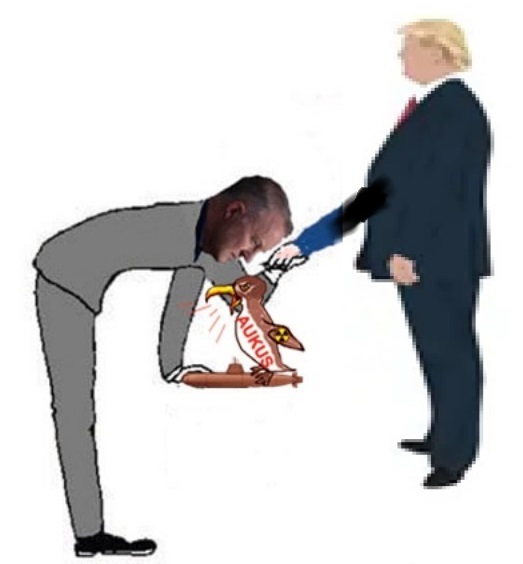
Perhaps the most profound strategic consequence of this war is the damage it has done to Australia’s faith in its alliance with the United States.
The US military resources that were meant to underpin the AUKUS nuclear submarine program are now stretched to breaking point in the Persian Gulf.
If Washington cannot keep its promises to South Korea or Japan, one Queensland University of Technology professor asked, what confidence can Australia retain in the submarine deal?
Public opinion is already shifting. Polls show more Australians oppose the war than support it. The government’s swift endorsement of an illegal conflict has left it morally stripped naked and strategically embarrassed.
The Government’s Response: Too Little, Too Late
To its credit, the government has belatedly recognised the scale of the crisis.
On March 27, Prime Minister Albanese announced new fuel security powers, including the use of Export Finance Australia to underwrite private sector fuel purchases. He called out panic buyers, declaring that filling jerry cans was “not the Australian way.”
Energy Minister Bowen has appointed a former energy regulator to lead a national fuel supply taskforce. The government is considering support for the nation’s two remaining refineries……………………………………………………..
The Path Forward
The war is not ending soon. Iran’s leadership has consolidated. The Strait of Hormuz remains closed to Western shipping. Global energy markets are in turmoil.
What Australia needs is not more loyalty to a declining hegemon. What Australia needs is a government willing to act in the national interest – not just in the interests of alliance management…………………………………………………….. https://theaimn.net/the-war-they-sold-us-the-price-we-pay/
No comments yet.
1 This month
15 April – Zoom –Nuclear Power is Not the Solution
Apr 15, 2026 01:00 AM in Canberra, Melbourne, Sydney

Join the International Physicians for the Prevention of Nuclear War (IPPNW) on Tuesday, April 14th for a timely webinar exploring the risks associated with nuclear power and challenging the myth that it offers a simple, safe, carbon-free solution to the climate crisis

of the week – Australians for War Powers Reform (AWPR)
To see nuclear-related stories in greater depth and intensity
 Antinuclear
Leave a comment