For Australia the Price is Always Right
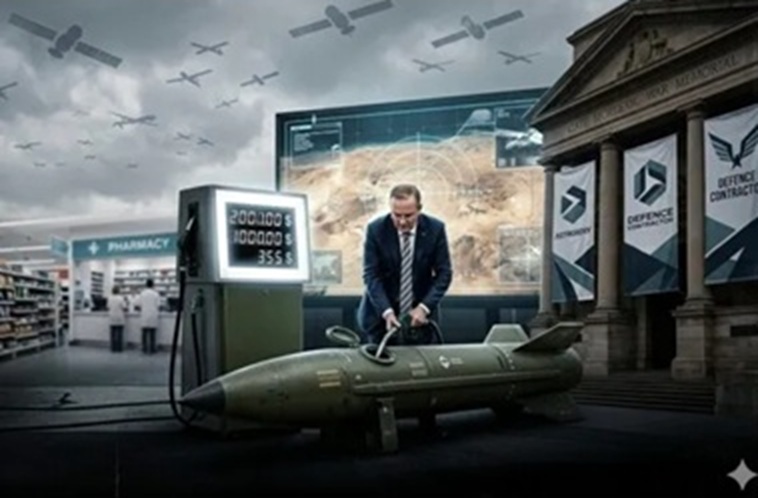
The War They Sold Us, The Bill We’re Paying
Dr Andrew Klein is right. The War They Sold Us, The Price We Pay, Australia has quietly signed up to another illegal war on Iran and, with customary discretion, sent the invoice straight to its own citizens. We are already paying. At the bowser. At the checkout. At the chemist. The meter is running long before the government has bothered to explain why it switched it on. Even if it could.
This is how modern war arrives. Not with declarations, not with debate, but with a price rise and a press conference. The explosions come later. The explanation, if it comes at all, arrives last and reads like a pamphlet for a product nobody ordered.
We also pay in subtler currency. In the steady domestication of war as background noise. In the way catastrophe is repackaged as content, mined for its dopamine yield, a bridge collapsing in slow motion, an oil rig burning through the night, a grainy clip of impact replayed until it acquires the sheen of inevitability. War as spectacle. War as story. War as something other people do, until it turns up in your petrol bill.
The Australian War Memorial, now politely underwritten by arms manufacturers, completes the lesson. BAE Systems, Lockheed Martin, Northrop Grumman, Thales. The merchants of death have not so much crashed the party as taken out a sponsorship package.
Remembrance, but make it corporate. Lest we forget, brought to you by the people who ensure there is always something to remember.
Meanwhile in Washington, Donald Trump and sneaky-Pete Hegseth compete to see who can sound most upbeat about lethality, like teenagers comparing horsepower. Bombing a country “into the Stone Ages” an unconscious but not entirely gratuitous reminder of the carpet-bombing of North VietNam is delivered as a punchline, a distraction from the latest domestic scandal, a line designed to travel. It is not strategy. It is not policy. It is performance. Yet Canberra treats it as if it were scripture.
We are told this is about deterrence. About stability. About preventing proliferation. We are always told this. Deterrence has become the diplomatic equivalent of “because I said so”. But deterrence without legal authority is simply pre-emptive war in a better suit. The United Nations Charter permits force in self-defence against an imminent threat, or with Security Council approval. Neither condition has been satisfied. To support such a war without asking that question is not prudence. It is obedience.
Yet our complicity did not begin with the first missile. It was preloaded. The decision was not just rushed; it was rehearsed, the latest turn in a relationship already militarised, already embedded, already incapable of saying no. An unlovely history hums beneath it. Our sycophancy is bipartisan. It has led us here before. It will lead us here again.
Australia’s “great and powerful friendship” now looks less like an alliance and more like a folie à deux, a shared delusion in which one partner sets the fires and the other holds the hose, congratulating itself on its sense of responsibility.
There was no pause for law. No insistence on evidence. Within hours of the first strikes, Prime Minister Albanese offered support. Foreign Minister Penny Wong declined even the courtesy of scrutiny, leaving it to the United States and Israel to explain the legal basis for their own actions. This is not diplomacy. It is ventriloquism with better tailoring.
The government that speaks endlessly of integrity treats the endorsement of war as if it were a diary entry. The legality is not tested. It is outsourced. The rules-based order is invoked like a hymn sung loudly enough to drown out the sound of the rules themselves being broken.
Complicity, But With Good Manners
If a war begins without clear legal authority and proceeds to strike civilian infrastructure, then support for that war is not neutral. It is participatory. International humanitarian law does not cease to exist because it is inconvenient to allies. Those who assist in serious violations may themselves bear responsibility. This is not radical. It is basic.
And assistance is precisely what is occurring. Intelligence sharing. Joint facilities. Interoperability so seamless it dissolves the distinction between ally and actor. When targeting data flows through shared systems, when surveillance feeds are integrated into operational decisions, Australia is not a bystander. It is part of the firing chain.
Pine Gap and the Useful Fiction of Distance
Pine Gap is often described as a listening post, which is a little like describing a power station as a light bulb. It is infrastructure. It is integration. It is the physical expression of a relationship in which distance is rhetorical and involvement is structural.
For decades, analysts from Dr Helen Caldicott to Des Ball and Richard Tanter have explained its role. Recent reporting has filled in the details. Satellite arrays. Signals intelligence. Real-time targeting capability. A system that does not observe war so much as enable it. We are helping Tomahawk missiles find their way into a children’s playground, a hospital or an ambulance depot.
Which makes Canberra’s occasional requests for “clarification” from Washington read like theatre reviews of a play in which it is already on stage. The explanation is not forthcoming because it is unnecessary. It is already baked into the system. Into the agreements. Into the quiet understanding that some questions are not asked because everyone knows the answer.
Australia keeps its eyes politely lowered, its bases open, its systems engaged, and calls this prudence. It is, in fact, participation with plausible deniability.
The Habit of Following
This is not new. It is ritual. VietNam, Iraq. Afghanistan. The same sequence, repeated with minor variations. Alignment first. Scrutiny later. Regret, if it arrives at all, delivered long after the damage is done and the architects have retired to write their memoirs.
We have perfected the art of joining wars we do not need to fight, for reasons that dissolve under inspection, in pursuit of credibility that never quite materialises. We call it loyalty. Others might call it habit.
We follow. We facilitate. We absorb the consequences. Then we explain, with great seriousness, that the decision was made elsewhere.
AUKUS and the Theology of Dependence
AUKUS is sold as strategy. It often reads as faith. A $368 billion act of belief in a future fleet of already obsolete submarines, we will struggle to crew, maintain or deploy, tied to a strategic doctrine we do not control, in conflicts we do not choose.
The Indo-Pacific framing flatters Australia with the illusion of centrality. In practice, it locks us into dependency. If the United States is stretched across multiple theatres, its commitments multiplying faster than its capacity, what exactly are we aligning ourselves with? Strength? Or strain?
A navy we cannot fully sustain, guarding sea lanes we cannot guarantee, in wars we do not declare. That is not sovereignty. It is folly, an epic and darkly comic absurdity that could be an epilogue to Waiting For Godot, 2.0.
The Bill Arrives Early
The economic consequences do not wait for the shooting to stop. Fuel reserves fall below recommended levels. Prices climb. Supply chains tighten. Farmers hesitate. Pharmacists ration. The abstractions of strategy resolve into the concrete arithmetic of shortage.
Thirty-nine days of petrol. Then what.
The government responds with monitoring, reviews, taskforces. The familiar liturgy of control. But the decisions that matter have already been taken elsewhere, in rooms to which Australia is invited only after the fact, if at all.
Meanwhile, the social cost accumulates. External conflict refracted through domestic politics. Suspicion, division, the quiet narrowing of who belongs. War does not stay offshore. It arrives in language, in policy, in the spaces where cohesion is invoked and quietly undermined.
The Question We Avoid
Was it worth it? The question is asked as if the answer might still be in doubt. The more difficult question is why it was done at all. Why a government would endorse a war without clear legal foundation, led by an administration defined by volatility, run by grifters and billionaire bros with consequences already measurable at home?
Why it was done without consent? Why the lessons of previous wars remain politely unlearned? Why the reflex to align survives every failure that should have extinguished it?
The “grifters and billionaire bros” are the Pozzos of the world – men who own the rope, drive the slave, and check their watch every five minutes to see if they are still important. They don’t do it for a “clear legal foundation”; they do it because the exercise of power is the only thing that convinces them they exist.
As Lucky might conclude, it was done for the sake of the “quaquaquaqua” – the noise we make to drown out the fact that the road is empty and Godot is never coming.
If those questions cannot be answered, then the answer is already in front of us. Alliance over autonomy. Secrecy over scrutiny. Habit over judgement. Inertia rules, OK?
We have chosen the alliance. We have accepted the war. We will inherit the consequences. The bill is already in the mail – our boots are well and truly on, and under, the ground.
Footnote: North Vietnam was subjected to some of the heaviest bombing in military history, with over 1 million tons of bombs and missiles dropped by the U.S. during campaigns like Operation Rolling Thunder. From 1965 to 1968, roughly 32 tons of bombs fell every hour, significantly exceeding the total ordnance used in the Pacific theatre of WWII
This article was originally published on URBAN WRONSKI WRITES
No comments yet.
1 This month
7 April – WEBINAR – Australia and the Doomsday Clock – Preventing nuclear war through NoFirstUse and other policies
Online | Tuesday April 7, 4:00-5:30pm, Australian Eastern Time / 8:00-9:30am Central Europe Time
– Access the registration link
15 April – Zoom –Nuclear Power is Not the Solution
Apr 15, 2026 01:00 AM in Canberra, Melbourne, Sydney

Join the International Physicians for the Prevention of Nuclear War (IPPNW) on Tuesday, April 14th for a timely webinar exploring the risks associated with nuclear power and challenging the myth that it offers a simple, safe, carbon-free solution to the climate crisis

21 April Webinar: No Nuclear Weapons in Australia
Start: 2026-04-21 18:00:00 UTC Canberra, Melbourne, Sydney (GMT+10:00)
End: 2026-04-21 19:30:00 UTC Canberra, Melbourne, Sydney (GMT+10:00)
Event Type: Virtual
A virtual link will be communicated before the event.
Host Contact Info: australia@icanw.org

of the week – Australians for War Powers Reform (AWPR)
To see nuclear-related stories in greater depth and intensity
 Antinuclear
Leave a comment