Nuclear culture wars – especially in Australia
Australia IS special – the only continent that is one single political state. Although Australia is really very multicultural, its government and business are determinedly white English-speaking.
But the white anglophones who identify with the USA, Britain, and Canada – live far away from those “kindred spirits”. Nearest neighbours are yellow and brown people, who don’t even speak English!
So – Australia has the “cultural cringe” – aw gee we’re not as good as those other anglophones. Only at sport -and even there, we’re losing touch. We MUST become as good as them – TECHNOLOGICALLY. Oh I know – we’d better get Nuclear Power, instead of that girly stuff – renewable energy.
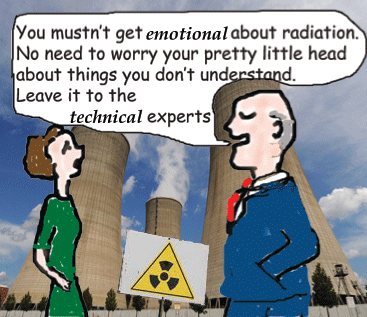
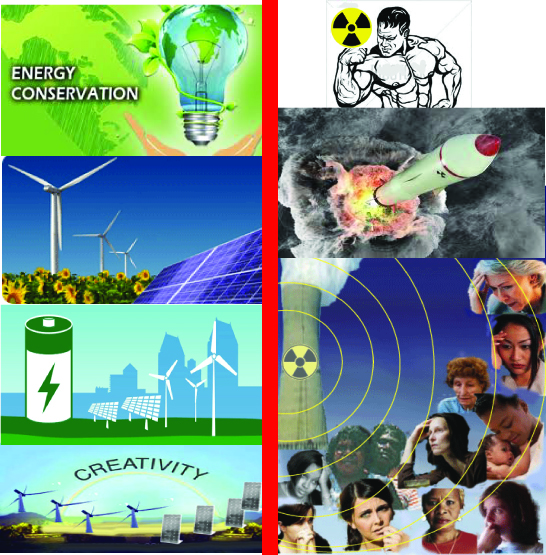
And I do mean “girly stuff”. Worldwide, it is a gender thing. Big strong men like nuclear power, weak uninformed women prefer energy conservation and renewable energy.
It really doesn’t matter which energy form is cheaper, more efficient, faster to implement, safer, cleaner …….. what is important is making Australia look important and technologically a leader, and also a strong opponent to China. We’re already a leader – in renewable energy – but that is sissy stuff, so it doesn’t count.
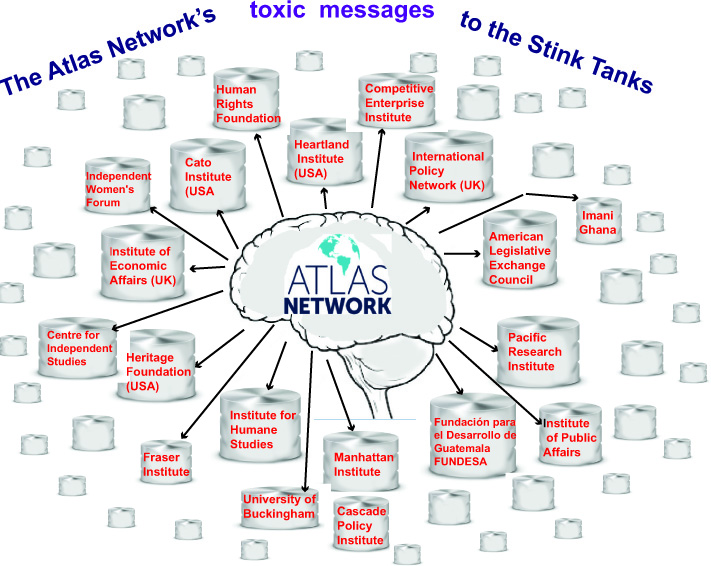
Now, there will need to be a grand propaganda campaign to get nuclear power into Australia. You see, we have compulsory voting here, which means that all those uniformed women will be voting. So it is going to be a big job to get nuclear into Australia. It will require all the skills of the Atlas Foundation, and its associated Think Tanks, to get the message across to the Australian public – including to wimpy-type men, as well as to women. But with the help of the Murdoch media, and social media – a good pro nuclear lobby should be up to it. Remember Australia’s referendum on an Aboriginal Voice to Parliament got defeated, with all that help last year.
Nuclear power exits Australia’s energy debate, enters culture wars
Jim Green, Jun 13, 2019, https://reneweconomy.com.au/nuclear-power-exits-australias-energy-debate-enters-culture-wars-47702/
What do these politicians and ex-politicians have in common: Clive Palmer, Tony Abbott, Cory Bernardi, Barnaby Joyce, Mark Latham, Jim Molan, Craig Kelly, Eric Abetz, and David Leyonhjelm?
Yes, they’re all men, and all so far to the right of the political spectrum that right-wing ideologues think they are right-wing ideologues.
And they all support nuclear power.
To the far-right, pro-nuclear luminaries listed above we could add the right-wing of the right-wing National Party (pretty much all of them), the Minerals Council of Australia (who lobby furiously for clean nuclear and clean coal), the Business Council of Australia ,media shock-jocks Alan Jones and Peta Credlin (and others), the Murdoch media (especially The Australian newspaper), the Citizens Electoral Council, and the Institute of Public Affairs and its front group the Australian Environment Foundation.
It’s no surprise that the far-right supports nuclear power (if only because the ‘green left’ opposes it).
But in Australia, support for nuclear power is increasingly marginalised to the far-right. Indeed support for nuclear power has become a sign of tribal loyalty: you support nuclear power (and coal) or you’re a cultural Marxist, and you oppose renewables and climate change action or you’re a cultural Marxist.
Support for nuclear power in Australia has ebbed in the aftermath of the Fukushima disaster, catastrophic costs overruns on reactor projects, and the falling costs of renewables.
Dr Ziggy Switkowski used to be nuclear power’s head cheerleader in Australia and he led the Howard government’s review of nuclear power in 2006. But he said last year that “the window for gigawatt-scale nuclear has closed” and that nuclear power is no longer cheaper than renewables with costs rapidly shifting in favour of renewables.
Peter Farley, a fellow of the Australian Institution of Engineers, wrote in RenewEconomy earlier this year:
“As for nuclear the 2,200 MW Plant Vogtle [in the US] is costing US$25 billion plus financing costs, insurance and long term waste storage. … For the full cost of US$30 billion, we could build 7,000 MW of wind, 7,000 MW of tracking solar, 10,000 MW of rooftop solar, 5,000MW of pumped hydro and 5,000 MW of batteries. … That is why nuclear is irrelevant in Australia. It has nothing to do with greenies, it’s just about cost and reliability.”
In January, the Climate Council ‒ comprising Australia’s leading climate scientists and other policy experts ‒ issued a policy statement concluding that nuclear power plants “are not appropriate for Australia – and probably never will be”.
The statement continued: “Nuclear power stations are highly controversial, can’t be built under existing law in any Australian state or territory, are a more expensive source of power than renewable energy, and present significant challenges in terms of the storage and transport of nuclear waste, and use of water”.
NUCLEAR COSTS INCREASE FOUR-FOLD, SEVEN-FOLD, TEN-FOLD
The 2006 Switkowski report estimated the cost of electricity from new reactors at A$40–65 per megawatt-hour (MWh). That’s roughly one-quarter of current estimates. Lazard’s November 2018 report on levelized costs of electricity gives these figures:
- New nuclear: A$161‒271 / MWh(US$112‒189)
- Wind: A$42‒80 / MWh(US$29‒56)
- Utility-scale solar: A$52‒66 / MWh(US$36‒46)
- Natural-gas combined-cycle: A$59‒106 / MWh(US$41‒74)
In 2009, Switkowski said that the construction cost of a 1,000 MW power reactor Australia would be A$4‒6 billion.
Again, that’s about one-quarter of all the real-world experience over the past decade in western Europe (and Scandinavia) and north America, with cost estimates of reactors under construction ranging from A$14‒24 billion.
The V.C. Summer project in South Carolina (two AP1000 reactors) was abandoned after expenditure of at least A$12.9 billion. The project was initially estimated to cost A$14.1 billion; when it was abandoned, the estimate was around A$36 billion. Largely as a result of the V.C.
Summer disaster, Westinghouse filed for bankruptcy and its parent company Toshiba almost went bankrupt as well.
The cost estimate for the Vogtle project in US state of Georgia (two AP1000 reactors) has doubled to A$38.8‒43.2+ billion and will increase further, and the project only survives because of multi-billion-dollar government bailouts.
In 2006, Westinghouse said it could build an AP1000 reactor for as little as A$2.0 billion ‒ that’s 10 times lower than the current estimate for Vogtle.
In the UK, three of six proposed reactor projects have been abandoned (Moorside, Wylfa, Oldbury), two remain in limbo (Sizewell and Bradwell) and Hinkley Point C is at the early stages of construction.
The estimated combined cost of the two EPR reactors at Hinkley Point, including finance costs, is A$48.7 billion (£26.7 billion ‒the EU’s 2014 estimate of £24.5 billion plus a £2.2 billion increase announced in July 2017).
A decade ago, the estimated construction cost for one EPR reactor in the UK was almost seven times lower at A$3.7 billion.
The UK National Audit Office estimates that taxpayer subsidies for Hinkley Point ‒ primarily in the form of a guaranteed payment of A$169 / MWh, indexed for inflation, for 35 years ‒ will amount to A$55 billion, while other credible estimates put the figure as high as A$91 billion.
Hitachi abandoned the Wylfa project in Wales after the estimated cost of the twin-reactor project had risen from A$26.4 billion to A$39.7 billion.
Hitachi abandoned the project despite offers from theUK government to take a one third equity stake in the project; to consider providing all of the required debt financing; and to consider providing a guarantee of a minimum payment per unit of electricity (expected to be about A$137 / MWh).
In France, one EPR reactor is under construction at Flamanville. It is seven years behind schedule (and counting) and the estimated cost of A$17.7 billion is more than three times the original estimate of A$5.4 billion.
In Finland, one EPR reactor is under construction. It is 10 years behind schedule (and counting) and the estimated cost of A$13.8 billion is nearly three times the original A$4.9 billion estimate.The A$13.8 billion figure was Areva’s estimate in 2012; true costs have likely increased
NUCLEAR EXITS AUSTRALIA’S ENERGY DEBATE, ENTERS CULTURE WARS
The far-right won’t let facts get in the way of their promotion of nuclear power. NSW Deputy Premier John Barilaro claims that nuclear power would probably be the cheapest power source for the average Australian household and is “guaranteed” to lower power bills.
The claim by the Institute of Public Affairs that 10 power reactors could be built for A$60 billion is out by A$100 billion or so. Jim Molan claims nuclear power is cheap and the cost is comparable to coal.
Clive Palmer claims that nuclear power is cheap and that the federal government should fund the construction of a nuclear power plant.
The far-right repeatedly claim that ‘small modular reactors’ (SMRs) will come to the nuclear industry’s rescue. But real-world experience with SMRs under construction suggests they will be hideously expensive.
According to a December 2018 report by the CSIRO and the Australian Energy Market Operator, the cost of power from SMRs would need to more than halve to be competitive with wind and solar PV even with some storage costs included (two hours of battery storage or six hours of pumped hydro storage).
Tony Abbott’s rationale for supporting nuclear power ‒ and repealing Howard-era legislation banning nuclear power plants ‒ is to “create a contest” with the unions, GetUp, the Greens and the Labor Party. Likewise, he said last year that promoting nuclear power “would generate another fight with Labor and the green left.”
Abbott ‒ and some others on the far-right ‒ would undoubtedly oppose nuclear power if Labor and the ‘green left’ supported it and they would be pointing to the A$14‒24 billion price-tags for new reactors in western Europe and north America.
Abbott seems to have forgotten the experience in John Howard’s last term as Prime Minister. Howard became a nuclear power enthusiast in 2005 and the issue was alive in the 2007 election contest.
Howard’s nuclear promotion did nothing to divide the Labor Party. On the contrary, it divided the Coalition, with at least 22 Coalition candidates publicly distancing themselves from the government’s policy during the election campaign.
The policy of promoting nuclear power was seen to be a liability and it was ditched immediately after the election.
LUNATICS IN CHARGE OF THE ASYLUM
Those of us opposed to nuclear power can take some comfort in its increasing marginalisation to the far-right. But there are far-right-wingers highly placed in the federal government and a number of state governments.
Right-wing National Party MPs are lobbying for a Senate inquiry and for a repeal of the legislation banning nuclear power. According to Greens Senator Sarah Hanson-Young:
“Talk of overturning the ban on nuclear power in Australia is crackpot stuff. Aside from being a dangerous technology, nuclear power is wildly expensive and would take a decade or more to build. It would be a funny joke if it wasn’t so embarrassing to have the Nationals, who are in government and who sit around the cabinet table, pushing for this. These people are meant to be in charge, and they’re running around like a bunch of lunatic cowboys.”
Senator James McGrath claims that many Nationals support nuclear power, hence the push for a Senate inquiry “to make informed decisions rather than allow the loons of Twitter to shout down this important discussion.”
On the subject of “loons”, as he describes them, McGrath’s pown erformance on ABC’s Q&A program in April was likened to a “one way trip to crazy town“.
It has the sense of a political set-piece: the far-right wins control of the numbers on a Senate inquiry and the government agrees with its pro-nuclear findings and repeals the legislation banning nuclear power.
But would Prime Minister Scott Morrison agree to repeal the ban given that there is no prospect of nuclear power being a viable option for Australia in the foreseeable future? Surely that would be an own goal, providing ammunition to political opponents and opening up divisions within the Coalition.
If Morrison agreed to repeal the ban ‒ and he says the government has no plans to do so ‒ it would presumably only be because he felt constrained to do so by far-right Coalition MPs and by non-government far-right Senators such as Pauline Hanson. (He is also dealing with the far-right push for government funding for a new coal-fired power plant.)
NSW Premier Gladys Berejiklian has the same calculation to make in response to the nuclear power push driven by right-wing Nationals (including Deputy Premier John Barilaro) and by One Nation’s Mark Latham (who introduced the Uranium Mining and Nuclear Facilities (Prohibitions) Repeal Bill 2019 to the NSW Parliament in May 2019).
ECOMODERNISTS
Of course, support for nuclear power in Australia isn’t exclusively limited to the far-right, although it is heading that way.
A tiny number of self-styled ‘pro-nuclear environmentalists’ or ‘ecomodernists’ continue to bang the drum. Ben Heard, for example, continues to voice his support for nuclear power ‒ his advocacy lubricated by donations and amplified by the right-wing media and by invitations to any number of nuclear-industry talk-fests.
Heard continues undeterred by the South Australian Nuclear Fuel Cycle Royal Commission’s clear acknowledgement that nuclear power is not economically viable in Australia or by its complete rejection of his ‘next generation’ nuclear fantasies.
But what impact could Heard’s nuclear advocacy possibly have in the current context, with fossil fuel interests fighting to protest their patch and to curb the growth of renewables, and with nuclear power being so exorbitantly expensive that isn’t part of any serious debate about Australia’s energy options?
Surely the only effect of nuclear advocacy in the current context is to muddy the debate about transitioning from fossil fuels to renewables and thus to shore up incumbent fossil fuel interests.
Australian economist John Quiggin discussed these issues last year:
“The problem is that nuclear fans like Ben Heard are, in effect, advocates for coal. Their line of argument runs as follows:
(1) A power source with the characteristics of coal-fired electricity (always on) is essential if we are to decarbonise the electricity supply
(2) Renewables can’t meet this need
(3) Nuclear power can
“Hence, we must find a way to support nuclear. The problem is that, on any realistic analysis, there’s no chance of getting a nuclear plant going in Australia before about 2040.
So, the nuclear fans end up supporting the Abbott crew saying that we will have to rely on coal until then. And to make this case, it is necessary to ignore or denounce the many options for an all-renewable electricity supply, including concentrated solar power, large-scale battery storage and vehicle-to-grid options.
As a result, would-be green advocates of nuclear power end up reinforcing the arguments of the coal lobby. … In practice, support for nuclear power in Australia is support for coal. Tony Abbott understands this. It’s a pity that Ben Heard and others don’t.”
Dr Jim Green is the editor of the Nuclear Monitor newsletter and national nuclear campaigner with Friends of the Earth Australia
Dutton’s plan to nuke Australia’s renewable energy transition explained in full
Giles Parkinson, Jun 21, 2024, https://reneweconomy.com.au/duttons-plan-to-nuke-australias-renewable-energy-transition-explained-in-full/
Opposition leader Peter Dutton has outlined his plan to bring the renewable energy transition in Australia to a halt, keep coal fired power stations open, build more gas and use taxpayer funds to build nuclear power plants in the 2030s and 2040s – if the Coalition wins the next election.
Here is an explanation of the plan as far as we know it.
What are the details?
There are not many, because the nuclear “policy” has been released in a one page press release. The Coalition says it wants to build seven nuclear power plants – all at the site of current or former coal fired power stations – in five states. It favours a mix of small modular reactors and large-scale nuclear. It wants the first reactor built by 2035.
Where exactly will they be built?
Two sites in NSW (Liddell in the Hunter and Mt Piper near Lithgow), two in Queensland (at the Tarong and Callide power plants), one in Victoria (Loy Yang in the Latrobe Valley), one in South Australia (Port Augusta), and one in Western Australia (Collie).
Are the site owners OK with that?
No, they say they haven’t been consulted and they say they have their own multi-billion dollar plans to build clean energy and industrial hubs. AGL CEO Damien Nicks says: “There is no viable schedule for the regulation or development of nuclear energy in Australia, and the cost, build time and public opinion are all prohibitive. ” However, the Coalition says if the site owners do not co-operate they will compulsory acquire the land needed.
Which technology will the Coalition use?
It’s not clear. Dutton wants to build small nuclear reactors at two sites, in South Australia and W.A. But SMRs do not exist yet, none have planning approval, and none even have licences to be built anywhere in the western world. Of the two large scale nuclear technologies cited, one (APR1400) has not been ordered anywhere in the world outside South Korea for 15 years. The other, the AP1000, sent its maker Westinghouse bankrupt in 2017 and was the technology used in the Vogtle reactor in the US whose massive delays and cost overruns might make it the last ever built in that country.
When is the timeline for the Coalition nuclear build?
The Coalition wants the first SMR up and running by 2035, and the first large-scale nuclear plant by 2037, with the rest in the 2040s.
Is that realistic?
No. SMRs – for all intents and purposes – haven’t been invented yet. There is no design in any western country that has even been licensed, let alone been given approvals or started construction. Globally, the industry is hopeful of getting the first up by the end of the decade. Even Canada, with a well established nuclear industry and an available site, says it is unlikely to have the second SMR up and running by 2035.
The timelines for large-scale nuclear are even longer. All four projects built or under construction in the last three decades in the US, France, Finland and the UK have suffered massive delays and cost over-runs. Australia has no regulatory platform, and no existing industry, apart from the small reactor at Lucas Heights in Sydney. Even pro-nuclear advocates like former chief scientist Alan Finkel say nuclear cannot realistically be delivered in Australia until the 2040s.
What are the costs?
The Coalition hasn’t said anything about costs, which is not surprising. SMRs have not been built and the only one that got close was cancelled by its would-be customers because it would have been hideously expensive. The Coalition’s timeline of 2035 means it wants to be an early adopter. The CSIRO puts the costs at more than $600/MWh, which might be palatable for a technology used only rarely for evening peaks, but such a price for “always on” power would be insane.
Would it lead to lower bills?
All Australian and international studies show that the Coalition’s choice of technologies – nuclear, gas and carbon capture – are by far the most expensive. See CSIRO, AEMO, Lazard, and BloombergNEF. Energy analysts say the growing reliance on gas power while renewables are stopped and coal kept on line would lead to soaring prices and an extra $1,000 on annual bills for the average household. The nuclear rollout will be entirely funded and subsidised by the taxpayer, which means that – as in France, Ontario and elsewhere – the costs of nuclear would be borne by the government and hidden from consumer bills.
What would happen to emissions?
Emissions will rise significantly if the Coalition puts its plan into action. One study suggests it would result in some 2.3 billion tonnes of additional carbon emissions over the Australian Energy Market Operator’s step change scenario.
What about Australia’s obligations to the Paris climate treaty?
The Coalition has made clear it will not seek to meet the current interim target of a 43 per cent cut in emissions. That means it is effectively ignoring the climate treaty, which requires no back-tracking on committed targets.
What about the net zero by 2050 target?
The Coalition says it still intends to meet that – but, by stopping wind and solar and building more gas, that target looks impossible under their plan.
The Coalition says the sites were chosen because they will not need new transmission. Is that true?
No. The site owners have their own plans. In Port Augusta, for instance, the grid capacity has already been mostly taken up by new wind, solar and batteries. “The myth that a nuclear reactor could just plug into the old Pt Augusta coal power station transmission lines is not true,” says South Australia energy minister Tom Koutsanstonis. “The transmission lines are already nearly full from new renewables. In truth, a nuclear reactor at Pt Augusta would need new transmission lines, the exact thing the LNP are complaining about.” And the large-scale nuclear reactors cited by Dutton will be twice the size of any existing unit in Australia, so it will need more grid infrastructure, and also more “back-up” in case those units fail.
The Coalition says the market operator has warned that the reliance on wind and solar will mean the lights will go out. Is that true?
No. The Australian Energy Market Operator says the biggest threat to energy reliability and security is the failure of ageing and increasingly unreliable coal fired generators.
The Coalition says wind and solar cannot power modern economies and businesses. Is that true?
No. The owners of Australia’s biggest smelters and refineries, including Rio Tinto and Ark Energy, are contracting multiple gigawatts of wind and solar to power their assets. South Australia says it has been flooded with inquiries from business with more than 2 GW of energy demand seeking to move to the state to access cheap wind and solar.
The Coalition says wind and solar cannot provide more than 10 per cent of the energy mix without causing problems. Is that true?
No. South Australia already enjoys a 75 per cent share of wind and solar, and the isolated W.A. grid has had 36 per cent wind and solar over the past year. The market operator says instantaneous levels of 100 per cent should be achieved in coming years.
The Coalition says the Labor government wants to build 28,000 km of new transmission lines by 2030. Is that true?
No. The market operator’s system plan envisages just over 5,000 km by 2030, one third of which have already been built, and some of the rest needed by growth in population and industry. The 28,000 km number comes from the “green export superpower” scenario and is for 2050. That assumes a switch from fossil fuel exports to green industries (steel, power, ammonia), and would likely be required whatever the technology.
Isn’t nuclear banned in Australia?
Yes, at federal and state levels. If the Coalition wants to repeal the laws it will need to get it through both houses of parliament, and who knows where the numbers will be after the next election, with the two-party preferred polls even stevens and any number of independents and minor parties also likely to emerge.
Do the states want nuclear?
No. The Labor governments in Queensland, NSW and Victoria have state laws against nuclear and intend to keep them. LNP Opposition leader David Crusafulli, favoured to take power in Queensland’s election in October, is also against nuclear. State governments in Western Australia, South Australia and even the Liberals in Tasmania are also opposed to nuclear, but legal experts say if the Commonwealth pulls rank, it is heading for the courts.
What if local communities object?
Nationals leader David Littleproud has spent the last few years defending the right of communities to oppose wind, solar, battery and transmission projects, and has demanded a pause and a “re-set.” But he says the Coalition will brook no opposition to its nuclear plans. If local communities don’t like it, tough luck. “We need strong leadership in this country, to have the courage of its convictions, to follow through and to make the tough calls in the national interest,” he told the ABC.
What will be the future of large-scale renewables under a Coalition government?
If the Coalition wins power, it won’t be good. Littleproud wants them stopped, and has vowed to rip up contracts written by the Commonwealth under the Capacity Investment Scheme, which could have 12 GW of capacity lined up over the next 12 months. States may plough on, but will face roadblocks and vetoes on projects. Investors say they need certainty.
So what is the real strategy here?
It’s pretty clear that the strategy is less about building nuclear and more about stopping renewables and protecting the fossil fuel industry, something that the Coalition has not been shy about for the last two decades. It will lead to higher costs, more emissions, squandered industry opportunities, and make the grid less reliable.
Will the strategy work?
Quite possibly. To people in the industry, pushing nuclear and walking away from Australia’s low cost wind and solar resources is nuts – from an engineering, economic and environmental point of view. But 95 per cent of people do not know, and are not interested in, the fine details of the complex energy system. They just want cheap power and the lights to stay on.
And to many of them the Coalition’s fear mongering may sound entirely plausible, particularly when the obvious misinformation is not contradicted by mainstream media – with a few notable exceptions such as The Guardian. See Trump, see Aboriginal voice referendum.
The fossil fuel industry is funding a massive campaign on social media to share simple and effective stories that make nuclear sound sensible and wind and solar as madness. They didn’t just think of this yesterday. If the renewable energy industry and Labor are not careful, they will lose this battle for hearts and minds.
Wow, that was exhausting. Do you need a lie down?
Yes.
Peter Dutton launches highly personal attack on Anthony Albanese, calling him ‘a child in a man’s body’ while spruiking his new nuclear direction

- Peter Dutton addressed party faithful in Sydney
- Painted PM Albanese as weak leader
By MICHAEL PICKERING FOR DAILY MAIL AUSTRALIA and WILLIAM TON and ANDREW BROWN FOR AUSTRALIAN ASSOCIATED PRESS, 22 June 2024
Opposition Leader Peter Dutton told Liberal Party faithful Prime Minister Anthony Albanese was ‘a child in a man’s body’ in a highly personal attack on Saturday.
Mr Dutton spoke to a federal council meeting of Liberal Party politicians, administrators and members in Sydney in which he painted Mr Albanese as ‘weak’ and a leader who told people ‘what they want to hear, not what needs to be said’.
‘He’s a man with a mind still captured in his university years; he’s a child in a man’s body,’ Mr Dutton said………. The opposition leader has cast the next federal election as defining Australia’s ‘future and fate’ with voters to decide the nation’s path forward on energy.
Australians will decide their energy future at the next election, says the opposition leader while slamming the government’s ‘reckless’ renewables policy and spruiking his nuclear pledge.
‘The next election will not only define the next political term, it will define the future and fate of this nation,’ he said.
Voters will have to choose the path they want to take including the nation’s energy future amid soaring power costs, Mr Dutton said.
‘A choice between Labor’s reckless renewables-only policy that will see the energy bills of Australians soar even more,’ he said.
‘Or the coalition’s plan for cheaper, cleaner and consistent energy, which includes our visionary plan to become a nuclear-powered nation and to do the right thing by the environment.’
It follows the coalition on Wednesday unveiling plans for seven nuclear reactors across five states on the sites of coal-fired power stations, should it win government.
The plan prompted safety concerns in regional areas where the reactors are due to be built, as well as criticism over the coalition not releasing any costings.
Prime Minister Anthony Albanese was panned for adhering to ‘unachievable’ renewable emissions targets, which the opposition said are blowing the budgets of Australians.
‘He’s more interested in appeasing the international climate lobby than sticking up for the interests of everyday Australians,’ Mr Dutton said.
‘I will be someone who doesn’t shirk the hard and necessary decisions which must be made in our national interest in these tough and precarious times.’
Opposition frontbencher Paul Fletcher dismissed fears the nuclear policy could make metropolitan electorates harder to win at the next election, saying it demonstrated the party’s commitment to achieving net zero by 2050.
The coalition faced significant challenges at the 2022 federal election in blue-ribbon, inner-city seats from teal independents, who pledged greater action on climate change.
While the reactors would be built in regional locations, Mr Fletcher said those in inner city areas would also embrace the idea of nuclear.
Under the plan, it would take until 2035 to 2037 at the earliest for the first facility to be built.
Assistant Climate Change and Energy Minister Jenny McAllister hit out at the nuclear policy which she said was expensive and risky.
‘Today Peter Dutton could’ve answered the many questions Australians have about his risky nuclear plan but all they got was more of the same nasty negativity and politics,’ she said.
‘Peter Dutton demands a mature debate but instead launches personal attacks. Peter Dutton demands lower power prices but opposes energy price relief and is unable or unwilling to say how much his nuclear plans will cost Australian taxpayers.
‘Australians deserve better.’
How a British nuclear testing program ‘forced poison’ onto Maralinga Traditional Owners
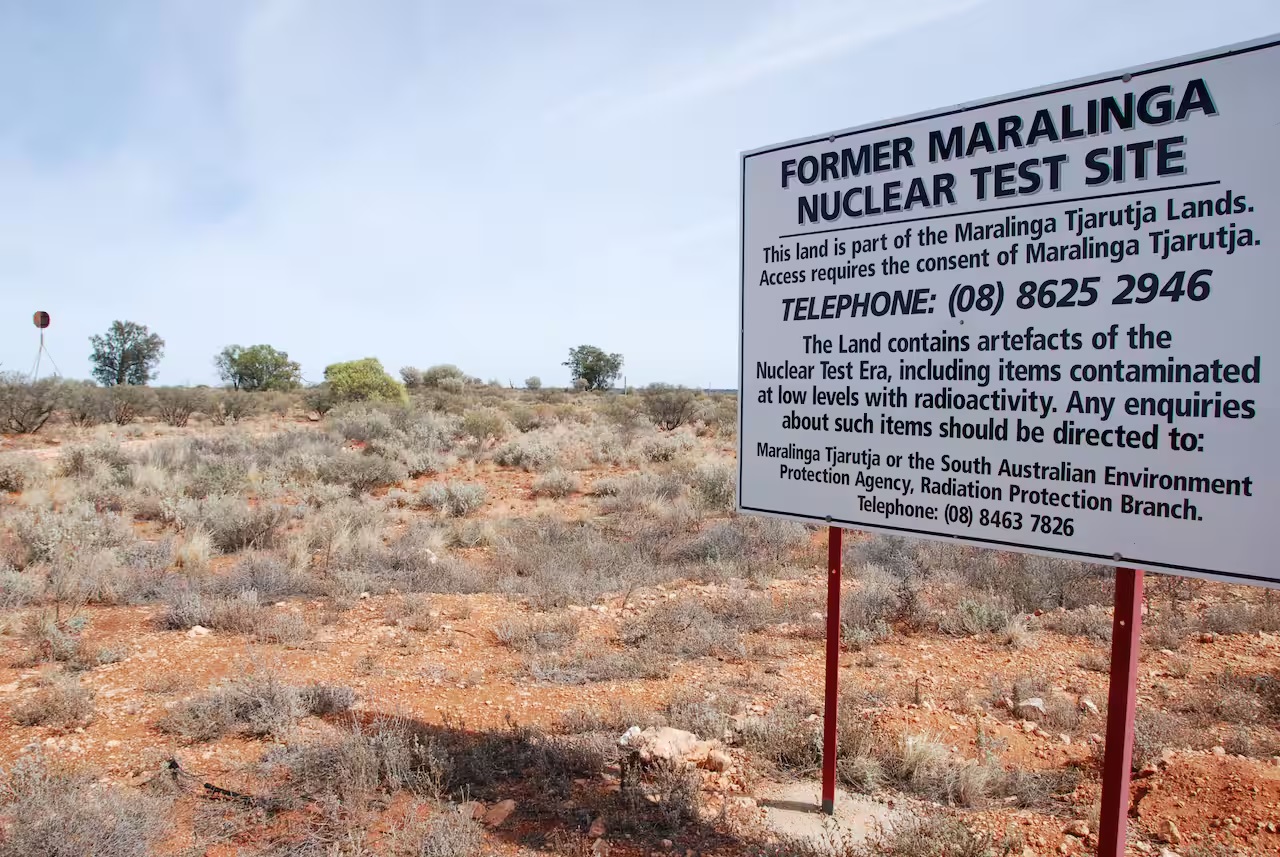
Indigenous Elders say they are once again being threatened by nuclear technology on their lands
SBS Sydney Lang, 20 June 24
Indigenous Elders are warning that their communities’ connections to sacred sites may be severed by nuclear power plants proposed by the Opposition.
Opposition leader Peter Dutton revealed earlier this week seven sites where the Coalition would seek to build nuclear power plants if elected.
One of the proposed sites is on Indigenous elder Aunty Janine Smith’s Country in Tarong, Queensland.
According to Smith, the proposal is a “death sentence to the land”.
Also responding to Dutton’s proposal, the Queensland Conservation Council’s Paul Spearim said: “White Australia has a shortsighted approach to Country”.
“You have forced poison onto the lands of Traditional Owners, and now Peter Dutton is proposing to create poisons that would last [hundreds of thousands] of years,” Spearim said.
First Nations and nuclear: A troubled history
Indigenous Australians’ fears about nuclear technology threatening their land and livelihoods are not occurring in a vacuum.
During the 1950s and 1960s,
the British government used the South Australian outback as a site for atomic bomb testing.
Keen to develop nuclear weapons of its own during the Cold War, the British government decided the remoteness of Maralinga and Emu Field made them ideal sites for nuclear weapon testing.
With agreement from the Australian government, the people living on Maralinga Tjarutja lands were relocated and told they could not return to their land. Many were rounded up and relocated to the Lutheran mission in Yalata, around 200km away.
The nuclear tests saw the wide-scale dispersion of radioactive material into the local environment.
Indigenous people living in and around the area, as well as British and Australian soldiers, were all exposed to radiation.
In the wake of the tests, there were many reports of cancer, blood diseases, eye problems, skin rashes, blindness, and vomiting — all of which are symptoms of radioactive poisoning.
It was not until 2009 that the land used for weapons testing was handed back to Traditional Owners…………………………………………………………………………………………………. more https://www.sbs.com.au/news/article/maralinga-how-australias-nuclear-testing-program-forced-poison-onto-the-lands-of-traditional-owners/zcuxce8o6
Israeli ‘extremist’ tells Australian audience Gaza should have been reduced to ashes
The Age, By Chip Le Grand, June 21, 2024
A former Israeli parliamentarian who once held a position in Benjamin Netanyahu’s government told an online gathering of Australian Jews this week that Israel should have abandoned adherence to international law and reduced Gaza to ashes.
In a series of incendiary claims, Moshe Feiglin, the leader of Israel’s far-right Zehut party, said there was no such thing as Palestinians, Palestinian statehood was the biggest lie of the 20th century and that Gaza should be resettled by Jewish Israelis and Arab families encouraged to leave.
“What Israel should have done to Gaza, on the 8th of October, was exactly what the British people did in Hamburg and Dresden, and exactly what the American people did in every Japanese city they could reach,” he told a Zoom meeting hosted by the Australian Jewish Association (AJA).
“They burnt them to ashes. No ridiculous humanitarian aid. They burnt those cities.
“If we had done that, we would have won the war in a few days and many of the hostages would be free today.”
The association’s invitation for Feiglin to speak, at a time when the war has bitterly divided Australian communities and unleashed antisemitic attacks on Jewish people, businesses and politicians, was condemned by Palestinian and Jewish community organisations……………………………………………………………………………………………………………………………..more https://www.theage.com.au/national/israeli-extremist-says-gaza-should-have-been-reduced-to-ashes-20240620-p5jnac.html
Over budget and plagued with delays: UK nuclear lessons for Australia
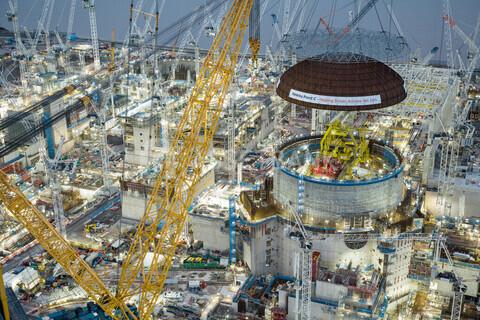
The big challenges facing nuclear power in Britain, both for large reactors and SMRs, are not technological or economic, but largely administrative and logistical.
AFR, Hans van Leeuwen, Europe correspondent, Jun 21, 2024 –
Behind the shore of England’s south-western county of Somerset lie the Quantock Hills – as perfect a landscape of lush rolling pasture and rugged heathland, laced with woodland groves and nestled hedgerows, as you could possibly imagine. It’s also home, incongruously, to a very, very large crane.
Big Carl, as it is known, is, in fact, the world’s largest. It is six kilometres long, 250 metres high and has 96 wheels. It has spent the past few years at Hinkley Point, on the Bristol Channel. Big Carl hit a mini-climax of hydraulic achievement just before Christmas last year, as it hauled a 14-metre tall, 245-tonne steel dome onto the top of a 44-metre nuclear reactor.
Progress at last. The reactor’s name is Hinkley Point C – which sadly doesn’t quite have the same folksy ring as “Big Carl”. Fifteen years have elapsed since French giant EDF and its Chinese partner began trying to build it, and rouse Britain from decades of nuclear slumber.
Lining up the regulators and the finance took seven years. Construction is in its seventh year, and might be only just past the halfway mark. There are 10,000 workers and 3500 British companies involved in pulling this off, at a cost that may end up topping £46 billion ($88 billion) – almost thrice the original estimate of £16 billion.
This is the kind of monumental scale of project that Opposition Leader Peter Dutton wants to bring to Australia. Alongside it, he also envisages small modular reactors (SMRs): more petite, but equally dully monikered, nukes that are thrown together in a factory and then operate from what is really little more than an industrial shed.
Britain wants to build those too, and is in the last throes of a competition to put taxpayer money behind at least one contender. But even the most advanced would-be manufacturer, Rolls-Royce, doesn’t appear to expect an SMR to actually be up and running until the start of the 2030s………………………………………………………………………………………………….
Why so long, and so costly?
Greatrex offers a warning to Australia: the big challenge facing nuclear power in Britain, both for large reactors and SMRs, but most clearly in evidence at Hinkley Point C, is not technological or economic, but largely administrative and logistical.
“Issues around bottlenecks in the planning system, the time it takes for permitting on various things, the issues around access to grid and grid connections, they’re all real factors,” he says.
“There are a whole number of issues around planning and permitting that seem to be taking more time to deal with than the actual construction period.”
This has left Greatrex and his organisation fighting a rearguard action against public and media perceptions that the industry is foundering – particularly as the flagship Hinkley Point C reactor project suffers repeated cost and deadline blowouts.
Although the government has this year doubled down on building large reactors to keep nuclear’s share of British electricity generation at about 25 per cent, the negative stories keep coming……………………………………………………………………………
For 35 years after the plant starts operating, taxpayers will fill any gap between that price and the going market rate, likely resulting in a subsidy far higher than that for offshore wind or solar. The government is also guaranteeing the debt funding of almost half the capital costs of building it.
The original estimated cost of Hinkley Point C was £16 billion, and the anticipated date to get it open and running was 2023. Now, it’s £35 billion in today’s prices, which could be £46 billion by the time the work is completed between 2029 and 2031.
EDF this year took a €12.9 billion ($20.8 billion) impairment charge on the project. The Chinese partner, having been frozen out of future nuclear projects in Britain for geopolitical reasons, has reportedly been withholding its own contributions this year.
The company has blamed the blowout on design changes enforced by the regulator, along with labour shortages and supply chain issues.
Going first to restart the nuclear construction industry in Britain after a 20-year pause has been hard,” Hinkley Point C boss Stuart Crooks said in a letter to staff earlier this year.
But the British government is still pushing on with a second reactor, the 3.2-gigawatt Sizewell C on the country’s east coast, which EDF will also build. This has taxpayer backing of £2.5 billion, and the government is on the hunt for £20 billion of private capital, supposedly by the end of the year………………………………………………………………………………
Rolls-Royce rollout starts at home
But even if the Coalition has to look elsewhere than Britain and Europe for its mega-reactors, energy spokesman Ted O’Brien has explicitly name-checked Rolls-Royce as a potential partner on SMRs………………………………………..
At any rate, Rolls-Royce has to crack its home market first. The government will next month decide which of six horses to back with taxpayer largesse. https://www.afr.com/companies/energy/over-budget-and-plagued-with-delays-uk-nuclear-lessons-for-australia-20240621-p5jnkq
Does the Coalition’s case for nuclear power stack up? We factcheck seven key claims

Will the Coalition’s plan be ‘cleaner’, as it claims?
No. Using more gas, less renewable energy and extending the life of coal-fired power plants will increase Australia’s greenhouse gas emissions.
The Coalition admits this. It wants to abandon the country’s 2030 emissions target and allow significantly more heat-trapping pollution while arguing it is still committed to net zero by 2050.
Will the Coalition’s plan be ‘cleaner’, as it claims?
Cheaper electricity, less emissions and ready by 2035 are some of the Coalition’s core promises on nuclear energy, but are they backed by evidence?
Adam Morton Climate and environment editorThu 20 Jun 2024, https://www.theguardian.com/australia-news/article/2024/jun/20/does-the-coalitions-case-for-nuclear-power-stack-up-we-factcheck-seven-key-claims
The Coalition has made a range of claims about what nuclear energy could do for Australia, and why it is better than building solar and wind.
What is the reality? We factcheck the key claims.
Would nuclear power provide cheaper electricity?
No evidence – such as economic modelling – has been produced to back up opposition leader Peter Dutton’s main argument about nuclear energy: that it would make Australians’ electricity bills cheaper than under a renewable energy-run grid and bring down other costs. As things stand, it is a baseless claim.
The CSIRO and the Australian Energy Market Operator (Aemo) have assessed the cost of different electricity sources and found that solar and wind backed by storage energy, new transmission lines and other “firming” – what the country is building now, in other words – were the cheapest option.
They found nuclear generation would be significantly more expensive – the most expensive technology available – for consumers. They suggested Australia’s first large-scale nuclear power plant (1GW capacity) could cost about $17bn, not counting finance costs. If a nuclear industry was established, that might eventually drop to $8.6bn.
Small modular nuclear reactors (SMRs), a developing technology that the Coalition has suggested could be used in South Australia and Western Australia, are likely to be far more expensive again. They do not exist anywhere on a commercial basis. The leading proposal for an SMR in the US was last year cancelled due to rising cost.
Confronted with this, the Coalition argues the nuclear experience in Ontario, Canada, demonstrates that nuclear energy is cheaper than Australian renewable energy.
This is not a relevant comparison. Like France, Ontario runs on nuclear plants built decades ago. Construction costs in the 1980s tell us nothing about the costs in the 2030s and 2040s.
Even then, the claim electricity is cheaper in Ontario is misleading. Wholesale electricity prices – the only part of the bill that is affected by the cost of generation – in Ontario are actually higher than the cost of new firmed renewable energy in Victoria and Queensland.
A more relevant comparison may be the ongoing construction of the large Hinkley C generator in the UK. It was initially expected to open in 2017 and cost about A$34bn. That has now been pushed out to 2031, and up to A$89bn.
Will using more gas until nuclear comes online cut costs?
There is no evidence it will.
Gas is the most expensive form of electricity generation currently used in the National Electricity Market, connecting the five eastern states and the ACT.
The price of gas is set on the international market – what fossil fuel companies can get by selling the gas in Asia. Nearly all Australian gas is exported. Opening a couple of new gas fields is not likely to materially change this.
Currently, gas is used in “peaking” plants that are turned on only when needed, at times of high demand. This is expected to continue for at least the next couple of decades. Gas-fired power provided less than 5% of total generation last year.
The Coalition has not explained how it would get more gas into the electricity grid. Would taxpayers pay to build several new gas power plants? It has also not explained how the resulting power could be as cheap as renewable energy.
Will the Coalition’s plan be ‘cleaner’, as it claims?
No. Using more gas, less renewable energy and extending the life of coal-fired power plants will increase Australia’s greenhouse gas emissions.
The Coalition admits this. It wants to abandon the country’s 2030 emissions target and allow significantly more heat-trapping pollution while arguing it is still committed to net zero by 2050.
Could Australia have nuclear energy by 2035?
Again, no evidence has been released to explain how this would be possible. The experience in developed democracies internationally is that it would take much longer.
The Coalition says if it decided to build SMRs there could be “two establishment projects” in place by 2035. If it opts for large-scale plants it says first power would be in 2037.
CSIRO found an initial nuclear power plant of any size would not be possible until after 2040. Other analysts, including the pro-nuclear Blueprint Institute, agree.
That’s just the technology challenge. The Coalition would also have to get legislation through both houses of federal parliament to overturn a nuclear energy ban. Labor and most of the crossbench oppose lifting the ban, and the Coalition is 20 seats short of a majority in the lower house and hasn’t had a majority in the Senate since 2007.
It would also need to persuade three states that ban nuclear energy – and remain strongly committed to their current position – to change their laws.
Have renewables caused a big increase in power bills?
No. It has a much smaller effect than factors related to fossil fuels.
Tony Wood, the energy and climate change program director for the Grattan Institute, says there was a 20% jump in wholesale electricity costs last year for four reasons: the war in Ukraine pushing up the price of gas; gas shortages; outages at ageing coal power plants reducing competition; and extreme weather causing flooding at coalmines. Prices have since started to come back down.
The renewable energy in the system has a smaller effect on price as the cost of incentive schemes is passed on, but it also helps reduce costs by increasing capacity and competition in the power grid
The coal-fired power plants in the grid are ageing, increasingly have units offline and need to be replaced. Evidence from government agencies and most independent experts is that renewable energy plus firming is the best path to an affordable, reliable, clean grid.
Is it true that “Labor can’t keep the lights on today”?
No. The lights are still on.
Coalition MPs making this claim were referring to the findings of Aemo’s “electricity statement of opportunities” report, which was portrayed as warning blackouts were imminent.
This misrepresents what the statement does. It is a message to the industry about how much more generation will be needed over time. This year’s statement found there could be reliability gaps in New South Wales, Queensland, South Australia and Victoria unless there was faster deployment of renewable energy and batteries.
This is consistent with other warnings that investment has slowed and needs to accelerate. But Aemo did not say blackouts were inevitable, or that renewable energy would cause them.
Is it true that you can’t run an industrial economy on renewables?
No – again, based on evidence from experts and industry.
The energy and economic transformation is challenging whatever technology is used. But the electrons are the same, regardless of the source.
Industry leaders have repeatedly welcomed renewable energy investment. Rio Tinto this year signed what it called Australia’s largest renewable energy power purchase agreement to run its operations in Gladstone.
BlueScope Steel applauded the creation of an offshore windfarm zone in the Illawarra, saying it had the “potential to supply significant quantities of renewable energy to help underpin BlueScope’s decarbonisation of iron and steelmaking in Australia”.
Aemo has repeatedly found an optimal future power grid, including one that would power new green industries, would run on more than 90% renewable energy.
Other countries, including those with some nuclear power, have similar goals. Both the US and Germany are targeting 80% renewable energy by 2030.
Nuclear engineer dismisses Peter Dutton’s claim that small modular reactors could be commercially viable soon

Hugh Durrant-Whyte says 2045 is a realistic timeframe, adding it was likely to be ‘more expensive than anything else you could possibly think of’
Peter Hannam, Fri 21 Jun 2024, https://www.theguardian.com/australia-news/article/2024/jun/21/peter-dutton-coalition-nuclear-policy-engineer-small-modular-reactors-no-commercially-viable
Australia would need “many decades” to develop the regulations and skills to operate a nuclear power plant, and the experience gained at the existing Lucas Heights facility won’t help much, according to New South Wales’ chief scientist and engineer.
Hugh Durrant-Whyte said he stood by comments made to a 2019 NSW upper house inquiry into uranium mining and nuclear facilities that running a plant and its fuel supply chain would require skills “built up over many decades”.
Stressing he spoke in the capacity of a trained nuclear engineer rather than as the state’s chief scientist, Durrant-Whyte said the industry demanded regulations and monitoring for all stages of fuel handling, power generation and waste management.
He told Guardian Australia that 2040 or even 2045 was the “realistic” timeframe.
“We would need people who were trained [on] how to measure radioactivity, how to measure containment vessel strengths, how to [manage] everything we do.”
The federal opposition on Wednesday revealed plans to build seven nuclear power stations in five states at existing coal plant sites, promising the first could be operating by the mid-2030s.
The government would own the plants and compulsorily acquire the sites if the owners – private companies as well as the Queensland and Western Australian governments – declined to sell them.
The shadow energy spokesperson, Ted O’Brien, has cited France and Canada as examples Australia could follow. He also offered the example of Lucas Heights, located in Sydney’s south, where a small reactor has been used for medical research for decades.
Durrant-Whyte said Canada’s nuclear industry employed about 30,000 people while France’s employed 125,000 – “not a trivial number of people”.
The UK, which operated nuclear plants for many years, has just one nuclear engineering program at an undergraduate level, limiting the supply of talent that could be imported from there.
He was also dismissive of the prospect that small modular reactors – which the opposition proposes to start its nuclear program with – were likely to be commercially viable soon.
“When I was [at Rolls-Royce] in 1979 my colleagues in the couple of desks next to me were designing SMRs,” he said. “It’s always the issue with anything big and complex. Whether it’s an aeroplane or a nuclear reactor, the first one is always the hardest.”
The capabilities learned at the Lucas Heights Ansto (Australian Nuclear Science and Technology Organisation) facility would make “little contribution” to supporting a nuclear power industry in the country, he wrote in his 2019 report.
“It must be recognised that this is a ‘zero-power’ pool reactor where the complexities of high pressure, high power, high radiation environments do not exist.”
Similarly, the capabilities needed to manage nuclear-powered submarines as part of the Aukus program also offered few transferrable skills. The pressurised water reactors on the submarines would be, in effect, SMRs of a 100-200 megawatt capacity size.
“My suspicion is we will buy the reactors in a piece of submarine and assemble that piece into submarines here,” Durrant-Whyte said. “But even then, let’s be clear, we’re not going to be doing that until the mid-2040s.”
As for safety, he said nuclear reactors were designed to be “very, very safe”. But there “have been a lot of accidents because of fuel handling and things like that” as a result of human error.
“It’s not like we haven’t had this [nuclear] conversation many times over the last 20 years in Australia,” Durrant-Whyte said. “It would be expensive, and likely more expensive than anything else you could possibly think of.”
Some of the Coalition’s proposed nuclear locations are near fault lines — is that a problem?
ABC, By political reporter Jake Evans, 20 June 24
The Coalition wants to build nuclear reactors at seven locations across the country, and several are on or near known fault lines.
But is that a problem?
There are plenty of countries with nuclear power that have more seismic activity than Australia, but that doesn’t rule it out as a potential complication for the Coalition’s nuclear aspirations.
Even where fractures in the ground (known as faults) have not been identified, earthquakes, landslides and groundwater issues can still be a risk.
Nationals leader David Littleproud said preliminary assessments at the proposed sites had been made and there would be further assessments made.
And he says where there are risks, they can be engineered around.
Nowhere is immune from earthquakes
Earthquakes above magnitude 5.0, like the deadly 1989 Newcastle earthquake, happen somewhere in Australia once every two years on average……………………………………………………………………… https://www.abc.net.au/news/2024-06-21/coalition-nuclear-locations-near-fault-lines-earthquake-hazard/104002464
Peter Dutton is seated aloft the nuclear tiger, hoping not to get eaten

The Conversation, Michelle Grattan, Professorial Fellow, University of Canberra, June 20, 2024
“…………………………………………… Peter Dutton and energy spokesman Ted O’Brien “are as well informed on things nuclear as any group I’ve talked to in the last 20 years in Australia,” Switkowski said, adding Dutton was “exactly right” is saying the nuclear generators should be government-owned
In the timing of his announcement, Dutton is putting his nuclear power policy through an early stress test……………
Parliament is about to start its final fortnight before a winter break, giving the government the chance for sustained king hits on the nuclear policy. If Labor can use the sitting to its advantage, and Dutton also takes a knock in the next polls, the “vibe” will change. The government could regain some momentum. It should be helped in this by the July 1 start of the tax cuts.
…………………Both sides claim to welcome the election being a referendum on energy. It’ll be about much more than that but energy – the government’s transition progress, the opposition’s response – will be a central battleground. With nuclear firmly out there, the weaponry is being marshalled.
By announcing the seven proposed sites for reactors, Dutton is attempting to reduce uncertainty, and counter the “would you want a reactor in your backyard?” scare.
Indeed the Coalition proposes to put the reactors – all on sites of former or current power stations – in its own backyards.
Of the seven seats involved, five are Coalition (three held by the Nationals, two Liberal). The affected part of the one Labor seat, Hunter, would transfer under the draft redistribution boundaries into the New England electorate of former Nationals leader Barnaby Joyce (a great fan of nuclear). The remaining seat, Calare, is held by independent Andrew Gee, formerly a National.
Of the seats, only one is on a margin of less than 5% (Flynn in Queensland).
Opposition sources say that in its polling, nuclear had more than 50% support in all these electorates. But the polling hasn’t been released.
Communities affected will be offered packages but there will still be local dissent over the plan. So local divisions will be running on two tracks in coming months – in the Dutton areas over the nuclear proposal, and in various other places over the rollout of transmission infrastructure and big renewable projects.
While naming the sites early is sensible, holding back the plan’s cost leaves the Coalition open to attack, especially given a major question over nuclear is that it’s so expensive.
There’s also the criticism the Coalition’s plan is pitched so far into the future it could create a big gap in the middle of Australia’s energy transition.
Dutton has abandoned Australia’s 2030 emissions reduction target; the renewed climate and energy wars are likely to hit investor confidence; and it’s not clear to what degree a Coalition government would slow the renewables rollout. All this could leave Australia in a limbo land in the late 2020s-early 2030s.
And history tells us it would be a miracle if the nuclear projects were on time or on budget (think Snowy Hydro 2).
The Coalition can thank Labor’s embrace of AUKUS for undercutting the safety argument. The planned nuclear-powered submarines with their attendant needs, facilities and waste have bipartisan support.
Nevertheless safety will be an issue for some people. In vox pops this week, there were mentions of Chernobyl and Fukushima…………………………
Regardless of polling, given the danger of big-target election pitches, Dutton’s nuclear radicalism is remarkable, albeit that it’s partly driven by a risk-averse desire to keep some climate doubting Nationals in the tent.
One mark of this radicalism is the pledge the generators would be government-owned. It’s a reminder the Coalition easily shrugs off its “small government” cloak, just like it did with all that spending during the pandemic…………………………..
It’s too early to predict how voters will judge the energy face-off. Nationals MP Darren Chester, who holds the Victorian seat of Gippsland, which would host a nuclear plant where the Loy Yang coal-fired power plant is located, puts it this way: “We’ve run out onto the field, maybe tossed the coin, but we haven’t even played the first quarter yet”. https://theconversation.com/grattan-on-friday-peter-dutton-is-seated-aloft-the-nuclear-tiger-hoping-not-to-get-eaten-232910
Dutton’s plan to build nuclear plants on former coal sites not as easy as it seems
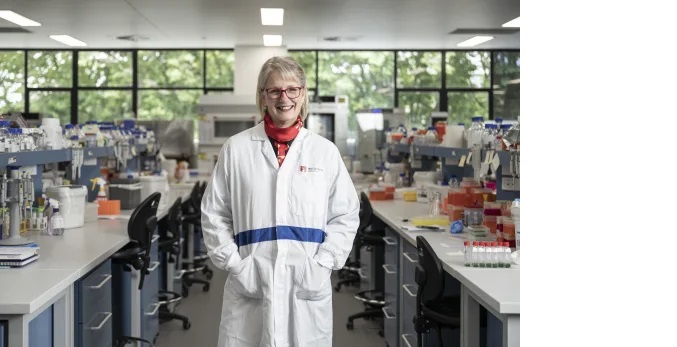
Dr Katherine Woodthorpe said it would be impractical for nuclear facilities to use existing poles and wires. CREDIT:LOUIE DOUVIS
By Bianca Hall, June 21, 2024, https://www.theage.com.au/environment/climate-change/dutton-s-plan-to-build-nuclear-plants-on-former-coal-sites-not-as-easy-as-it-seems-20240620-p5jnbo.html
Experts have cast doubt on the central pillar of Peter Dutton’s nuclear pitch to voters, saying it would take decades to fill in coal mine voids and make contaminated power station sites safe, during which time fragile and valuable transmission lines would be left to deteriorate.
Operators at several of the seven sites identified by the Coalition for nuclear plants already have well-advanced plans to transform their sites into renewable energy hubs with grid-scale batteries, hydrogen and solar once the coal runs out.
Announcing a future Coalition government would build seven nuclear power stations on the sites of existing coal-fired power stations, Dutton said nuclear facilities could be built on the sites of retired coal power plants using existing transmission poles and wires.
“Each of these locations offer important technical attributes needed for a zero-emissions nuclear plant, including cooling water capacity and transmission infrastructure,” he said.
“That is, we can use the existing poles and wires.”
Dr Katherine Woodthorpe, president of the Australian Academy of Technological Sciences and Engineering, said overseas examples like the United Kingdom’s Hinkley Point C showed it could take decades to approve and build new nuclear facilities – leaving aside the time needed to remediate dirty and geologically unstable former mine sites.
Woodthorpe said even if it only took 25 years to get a new nuclear facility up and running, that meant the existing transmission potential could lie dormant for 25 years after a coal plant closed.
“In theory it could be done, but when you look at the actual practicality of doing it they’d pretty well have to replace it all,” she said.
University of Sydney professor Glenn Platt, who specialises in energy policy, markets and grids, said there was already high demand for dormant transmission networks among renewables operators.
“The unknown bit [about the Coalition policy] is what happens to those poles and wires between now and when somebody wants to build the nuclear plant, because everybody else is trying to use those poles and wires today for wind and solar and battery projects,” he said.
“The landowners many of these sites are already deploying wind and solar or batteries on those sites. They would use up the available poles and wire infrastructure.”
AGL, which owns the Liddell Power Plant in the Hunter Valley, and Loy Yang A in the Latrobe Valley, said it was well-advanced in plans to transform the sites into industrial energy hubs with renewables, batteries and associated industries.
A spokesman referred this masthead to a statement made by chief executive Damien Nicks in March.
“AGL is already developing our coal and gas power station sites into low-emissions industrial energy hubs,” he said.
“As the owner of these sites, nuclear energy is not a part of these plans. There is no viable schedule for the regulation or development of nuclear energy in Australia, and the cost, build time and public opinion are all prohibitive.”
Many observers are looking to now-closed mine sites for clues about how Dutton’s policy could work on a practical level.
French energy giant Engie, which is rehabilitating Victoria’s closed coal mine Hazelwood, has estimated it could take up to 35 years under a worst-case scenario to finish filling the enormous mine void to a maximum depth of 116m and surface area of 1145 hectares.
Engie Australia and New Zealand manager of environment and planning Adam Moran, who has led the rehabilitation, said a nuclear facility could in theory be put on the site of a former coal power station.
“Could it be done? Yes, but if you had to choose a location, would you choose next to a mine void that’s been rehabilitated and full of water, or would you put it some distance further away?” he said.
“You would probably err on the side of caution, and move it well outside of the geological buffer zone that would exist around a rehabilitated coal mine.”
At Hazelwood, which had a 1600-megawatt transmission capacity when the coal mine operated, operators have installed a 150-megawatt-hour battery, which is now plugged into the mine’s existing transmission network.
In November, Yancoal announced plans to transform the coal mine at Stratford in the Hunter Valley, slated for closure this year, into a major 330-megawatt solar farm and pumped hydro facility capable of producing 300 megawatts in a 12-hour period.
A spokesman for EnergyAustralia, which operates the Mt Piper mine in Lithgow, said the company spoke regularly with governments and regulators.
“To date, we have not discussed the use of any EnergyAustralia sites in the context of nuclear,” he said
With its Mt Piper plant due to close in 2040, and Yallourn this decade, EnergyAustralia is increasingly looking to diversify, he said.
“We are focused on continuing to roll out existing, readily available technologies,” he said, which included gas and batteries.
“We are developing more batteries in multiple states, pumped hydro at Lake Lyell in Lithgow and working with partners to underpin further renewable energy.”
The Australian Manufacturing Workers’ Union and Climate Action Network Australia commissioned a report identifying industry and workforce opportunities presented by the renewable energy shift.
National secretary Steve Murphy said with government backing, coal workers could retrain and reap the benefits of renewable technologies.
“This is coming, so let’s get involved and get the best results for our members,” he said.
“We’re in a global race for the jobs of the future, and we spent 10 years standing still, [but] we can catch up very quickly with the natural advantages that we’ve got, provided that there is government support.”
Peter Dutton vows to override state nuclear bans as he steps up attack on PM
Opposition leader tells Liberal party officials that state premiers ‘won’t stop us’ and labels Anthony Albanese a ‘child in a man’s body’
Guardian, Jordyn Beazley, Sat 22 Jun 2024
Peter Dutton has vowed a Coalition government would override the states’ legislated ban on nuclear power, telling party officials on Saturday that state premiers “won’t stop us”.
The opposition leader made the comments in an address to the federal Liberal party council in Sydney, where he escalated his attacks on Anthony Albanese. He called the prime minister a “fraud” and a “child in a man’s body” that is “still captured in his university years”.
On Wednesday, the Coalition unveiled its controversial nuclear energy plan in the event it wins government, including seven proposed sites for nuclear reactors across five states. The nuclear pledge drew unanimous blowback from state premiers.
In question time this week, the New South Wales premier, Chris Minns, said he wanted to “make it clear” that his government would not be repealing the ban on nuclear energy in the state. The premiers of Victoria and Queensland said the same.
In responding to the criticism, Dutton said he would work “respectfully and collaboratively” with state premiers, “but I don’t answer to them”.
“The decisions I make will be in our national interest to the benefit of the Australian people,” he said on Saturday.
“Commonwealth laws override state laws even to the level of the inconsistency. So support or opposition at a state level won’t stop us rolling out our new energy system,” he said to a round of applause erupting from the room.
Some state opposition leaders have also opposed the Coalition’s nuclear pledge, with Victoria’s opposition leader, John Pesutto, saying his party had “no plans for nuclear” and Queensland’s opposition leader, David Crisafulli, also saying it was not part of the party’s plan and would remain that way.
In his address, Dutton said Crisafulli had taken “a perfectly understandable position on nuclear power” and was “getting a hard time from the worst premier in Australia, Steven Miles”.
Dutton said Australians would decide their energy future, saying the “the next election will not only define the next political term, it will define the future and fate of this nation”.
During his speech, Dutton slammed Albanese as being out of “his depth”, later adding “visionary Labor leaders – like the late, great Bob Hawke – knew that zero emissions nuclear energy was a good thing”.
“But Labor’s current crop of leaders have been reduced to posting juvenile social media memes of three-eyed fish and koalas.
“Frankly, their behaviour is an affront to the intelligence of the voters whom they seek to represent,” he said.
He then diverged from his scripted remarks to say “our prime minister is a man with his mind still captured in his university years, he’s as a child in a man’s body.
“[Albanese’s] more interested in appeasing the international climate lobby than sticking up for the interests of everyday Australians,” he said………………………………….
Prof Anne Twomey, a constitutional law expert at the University of Sydney, said the commonwealth can override state laws, but there were a number of hurdles the government would face.
The first would be enacting legislation that overrides any inconsistent state laws and passing that through the Senate, while ensuring government decision-making processes around the laws were done fairly.
“If you get through both of those, then … so long as the commonwealth enacts laws that are valid, that are supported by the Constitution, then those laws will override state laws that are inconsistent.”
Victoria’s premier, Jacinta Allan, said in a statement after Dutton’s remarks: “There is no plan that sits behind Peter Dutton and his Liberal National colleagues’ announcement to bring a nuclear power plant to Victoria – and no detail about how much it would cost, how long it would take, where the waste would go, the impact on water supply and the water security for the Gippsland community.
“When you look at all that uncertainty, it makes no sense when you have an alternative. We’ll continue to stand with the Gippsland community and stand against this toxic, risky, uncertain pathway that Peter Dutton wants to go down. https://www.theguardian.com/australia-news/article/2024/jun/22/peter-dutton-nuclear-power-energy-state-bans-attacks-pm
No costing, no clear timelines, no easy legal path: deep scepticism over Dutton’s nuclear plan is warranted
Ian Lowe, Emeritus Professor, School of Environment and Science, Griffith University June 20, 2024 https://theconversation.com/no-costing-no-clear-timelines-no-easy-legal-path-deep-scepticism-over-duttons-nuclear-plan-is-warranted-232822
It is very difficult to take Opposition Leader Peter Dutton’s nuclear announcement seriously. His proposal for seven nuclear power stations is, at present, legally impossible, technically improbable, economically irrational and environmentally irresponsible.
Given the repeated community objections to much more modest nuclear proposals, such as storage of low-level radioactive waste, there is almost certainly no social licence for nuclear power stations.
Dutton promises that, if elected, he would make nuclear power a reality within a little over ten years. Given the enormous obstacles even to turn the first sod, this seems like a pipe dream.
Here’s why.
Legal status: seemingly impossible
Some 25 years ago, the Howard Coalition government legislated a ban on nuclear energy in its environment laws. Coalition governments have been in power federally for most of the time since, but have made no attempt to repeal the ban.
Even a sweeping victory in the forthcoming federal election would not give the Coalition the Senate majority necessary to change the ban in the next term of parliament. As is usually the case, only half the Senate will be elected, so simple arithmetic shows no prospect of a Coalition majority. The only possibility would be negotiating with the crossbench.
Of the seven nuclear power stations Dutton is proposing to build on the site of old coal stations, five would be in the eastern states: two in Queensland at Tarong and Callide, two in New South Wales at Mount Piper and Liddell, and one in Victoria at Loy Yang.
Each of these states have their own laws banning nuclear power. The eastern premiers have made clear they will not change their laws. Even Dutton’s Queensland Liberal National Party colleagues, who face a state election in October, do not support the plan.
So the proposal does not satisfy current laws and there is no realistic possibility of these changing in the timeframe Dutton would need to get the first reactors built (he says the first would be operating by the mid-2030s).
Dutton could try to bypass the states by building on Commonwealth land. But this would mean missing the supposed benefit of locating reactors next to existing transmission lines at old coal plant sites.
Cost: astronomical
Cost is a huge problem. Dutton has promised nuclear will deliver cheap power. But CSIRO’s latest GenCost study on the cost of different power generation technologies shows there is no economic case for nuclear power in Australia. Nuclear power would cost at least 50% more than power produced by renewables and firmed with storage.
This estimate is conservative – in reality nuclear would likely cost even more, as GenCost relies on the nuclear industry’s cost estimates. All recent projects have gone way over budget.
The three nuclear power stations being built in western Europe are all costing two to four times the original budget estimate.
It is true a renewables-dominated grid will require more storage, which means building more grid batteries and pumped hydro schemes. It is also true we’ll need to expand our existing 40,000 kilometres of transmission lines by 25% to get renewable electricity to consumers.
But even when we add these extra costs, and even when we accept industry figures, nuclear still cannot compete with solar farms or wind turbines. CSIRO costs nuclear at between A$8 and $17 billion for a large-scale reactor.
There are no private investors lining up to build nuclear. Overseas, nuclear has always been heavily bankrolled by the taxpayer. Dutton’s plan would either require a huge spend of public money or a major increase to power bills. In the United Kingdom, for example, the government has assured the developer of its Hinckley Point C reactor they will be able to recoup the cost by charging higher rates for the power.
While Dutton is promoting nuclear as a way to avoid building expensive and often unpopular new transmission lines, this is not true. Several proposed reactors would need their own lines built, as coal transmission capacity is rapidly being taken up by renewables, as South Australia’s energy minister Tom Koutsantonis has pointed out.
Time: we’re out of it
Building a nuclear reactor takes years or even decades. Dutton has promised Australia would have its first nuclear power station operational in a decade, assuming his party is elected and their scheme implemented without delay in 2025.
This claim is wholly without merit. In 2006, the Coalition government commissioned a study on whether nuclear power was viable in Australia, which found it would likely take 15 years to build a reactor here. The timeframe today would be similar, because we don’t have a workforce with experience of building large nuclear reactors. We also don’t have the regulatory framework needed to give the community confidence nuclear power stations could be built and operated safely.
Even in the United States, the UK and France – three countries with long experience with nuclear – no recent project has been completed within ten years.
It defies logic to suggest we could start with a blank sheet of paper and build complex systems faster than countries with long-established industries and regulatory regimes.
Nuclear backers often point to examples in China and the United Arab Emirates, which have both built reactors within about a decade. But these countries do not tolerate the community objections which would be inevitable. In Australia, consultation, legal challenges and protests often delay far less controversial projects.
Why does this matter? Dutton’s push for nuclear isn’t happening in a vacuum. This is the crucial decade for action on climate change. As Australian climate scientist Joëlle Gergis has written, we are now paying the cost of long inaction on climate change in damage from more severe bushfires, floods and drought.
Let’s say the Coalition is elected and sets about making this plan a reality. In practice, this would commit us to decades more of coal and gas, while we wait for nuclear to arrive. We would break our Paris Agreement undertaking to make deep cuts to emissions, and keep making climate change worse.
A Coalition pie-in-the-sky nuclear nightmare

(Cartoon by Mark David / @MDavidCartoons)
By Belinda Jones | 22 June 2024, Independent Australia
Having reignited the “climate wars” with pie-in-the-sky nuclear energy plans, if the plans fail, Dutton and Littleproud will face the wrath of a climate-war-weary Australian people at the ballot box, writes Belinda Jones.
AUSTRALIANS finally caught a glimpse of the Coalition’s nuclear energy plan this week. And, we mean “glimpse” — a one-page media release identifying seven proposed locations for nuclear power plants and not much more detail than that.
Nationals’ Leader David Littleproud called for Australia to have “a conversation about nuclear”, which culminated in this week’s long-awaited announcement from Littleproud and Opposition Leader Peter Dutton.
It has taken two years to create a one-page media release. By any standard, that is poor form.
As Betoota Advocate editor Clancy Overell so eloquently summed it up this week,
“Man who was paralysed with fear over lack of details about Indigenous Voice provides a one-page media release for his half a trillion dollar nuclear plan.”
In fact, the Coalition press conference on nuclear energy inspired far more questions than answers, despite Dutton claiming the Coalition has done “an enormous amount of work”.
Obviously, for Australians, the most pressing concerns for nuclear energy are cost and the time it’ll take to build seven nuclear reactors, as well as safety concerns.
As a policy, it’s not off to a good start. State premiers have rejected the idea and their support is crucial to the success of nuclear energy, due to the fact state legislation would have to be amended to allow any nuclear energy plan even to exist…………………………………………………………………..
However, the states’ consensus on nuclear energy may not be a major hurdle for the Coalition’s nuclear plans. Constitutional law expert, Professor Emerita Anne Twomey, suggested “state bans on nuclear could be overridden by a federal law, as outlined in section 109 of the Constitution”.
Section 109 of the Australian Constitution states:
‘When a law of a State is inconsistent with a law of the Commonwealth, the latter shall prevail, and the former shall, to the extent of the inconsistency, be invalid.’
Perhaps, similar to the Coalition’s plan to announce first where they plan to build nuclear reactors, then consult with the local communities affected after the fact, their plan is to bulldoze their way past state laws irrespective of the wishes of constituents, state governments or any other objectors to their nuclear plans — which is hardly a democratic process.
One supporter of the current Coalition’s nuclear energy policy is nuclear physicist Dr Ziggy Switkowski, the former Howard Government advisor on nuclear. This is despite Switkowski telling a Federal Parliamentary Inquiry in 2019 of the risk of “catastrophic failure” and that the “window for ‘large nuclear generation’ had closed for Australia”. At the time, Switkowski cited the “emerging technology of small nuclear reactors [as] the viable option on the table”.
That prediction has been proven to be premature with no small nuclear reactors at a viable or commercial stage in 2024. The USA’s first small modular reactor was cancelled by developer NuScale last year due to cost blowouts.
Switkowski also told the 2019 Inquiry:
“It was unlikely the industry could establish enough support to gain a social licence to operate.”
This week, Switkowski weighed in on the scepticism his work in previous years had helped to foment within Australia saying, “The strong positions some critics have taken in the last 24 hours are ridiculous”.
Australia’s wealthiest woman and enthusiastic Coalition supporter Gina Rinehart has long been demanding nuclear energy be part of Australia’s energy mix — a view that may emanate from her business interests around uranium exploration and mining.
Rinehart is no fan of renewables, claiming they’ll force food prices up and send farmers broke. This is despite the fact that they produce alternative sources of income for farmers and provide reliable energy solutions where “there’s no mains just to switch on” in isolated, rural communities.
The Coalition’s proposed seven nuclear reactors would not provide any benefit to those rural communities to which Rinehart refers that are not connected to mains power, whereas a combination of solar or wind and battery power would.
So, the electorally embattled Dutton and Littleproud face an uphill battle to get their nuclear policy off the ground in the face of overwhelming opposition to their plans. And though their scant plans offer nothing substantial on the issue of Coalition nuclear policy, they have managed to “reignite the climate wars”, which may in fact be the method in their madness.
Rather than bring the nation together, divide and conquer on any issue seems to be their modus operandi.
For a nation exhausted by over a decade of “climate wars” that it hoped were well and truly over, the Coalition has taken a huge risk to bring expensive, pie-in-the-sky nuclear to the table and reignite those wars. If it fails and it likely will, based purely on economics, then both Dutton and Littleproud will face the wrath of a climate-war-weary Australian people at the ballot box and, ultimately, their own political parties.
Dutton and Littleproud have both nailed their colours to the mast, demanding a conversation on nuclear energy with no intention of taking no for an answer. Like their failure to consult with communities before announcing their plans, they may have put the cart before the horse. Time will tell. https://independentaustralia.net/politics/politics-display/a-coalition-pie-in-the-sky-nuclearnightmare,18704
1 This month


Help Aunty Sue Protect Her Land and Sacred Sites From Destructive Rocket Testing.
.

Australians deserve the truth
about
AUKUS – https://aukuspublicinquiry.com/

PETITION – To: Prime Minister Anthony Albanese and the Australian Labor Government

of the week – Australians for War Powers Reform (AWPR)
To see nuclear-related stories in greater depth and intensity

