by Lieutenant Commander Jim Halsell, U.S. Navy*, Australian Naval Institute, 5 Oct 25
The United States will require more than its existing inventory of nuclear-powered submarines to ensure victory in a conflict with China. The Navy should augment its existing submarine force with a fleet of conventionally powered submarines capable of launching cruise missiles.
By producing smaller, more cost-efficient submarines with the help of allies, the U.S. submarine force could mitigate the relatively low number of nuclear-powered submarines available for a conflict. …………………………………………………………………………………………………………………………….
The problem with the makeup of today’s submarine force is that these deep-diving, fast-driving, nuclear-powered submarines are expensive. These ships are both too expensive to build in sufficient quantity to meet operational requirements and too costly, in terms of dollars and capabilities, to risk losing in combat.
The cost per hull of a new Virginia-class SSN was originally $2.8 billion, but following the incorporation of the Virginia Payload Module in the USS Arizona (SSN-803) and follow-on Block V boats, that cost now exceeds $4 billion.4 In comparison, Japan spent an estimated $536 million per hull for its Sōryū-class submarines, which feature air-independent propulsion (AIP), allowing them to operate for weeks without snorkeling.5 Japan’s newer Taigei-class submarines are being built at an even cheaper $473 million per hull.6
…………………………………………………………………………………………………………….Much of the disparity stems from the prohibitive cost of nuclear propulsion systems. Conventional submarines are cheaper not only to build, but also to maintain, benefiting from simpler refueling logistics and a dramatically lower cost threshold.
One of the most compelling opportunities presented by the development of a U.S. conventionally powered submarine would be the chance to design and build it in partnership with key Indo-Pacific allies. Japan, South Korea, and Australia have decades of experience operating and constructing nonnuclear-powered submarines, and they are getting better with each iteration. ……………………………………………………………. https://navalinstitute.com.au/the-case-for-some-non-nuclear-subs/
I was scheduled to give a talk at the National Press Club of Australia on October 20 called “The Betrayal of Palestinian Journalists.” It was to focus on the amplification of Israeli lies in the press, which most reporters know are lies, betraying Palestinian colleagues who are slandered, targeted and killed by Israel. But, perhaps inadvertently proving my point, the chief executive of the press club, Maurice Reilly, cancelled the event. The announcement of my talk disappeared from the web site. Reilly said “that in the interest of balancing out our program we will withdraw our offer.”
The Israeli Ambassador, retired Lt. Colonel Amir Maimon, who spent 14 years in the Israeli military, is reportedly being considered to speak.
It is true that I know only one side of the picture from the seven years I spent covering Gaza. I was on the receiving end of Israeli attacks, including being bombed by its air force and fired upon by its snipers, one of whom killed a young man a few feet away from me at the Netzarim Junction. We lifted him up, each person taking hold of an arm or a leg, and lumbered up the road as his body swayed like a heavy sack. I saw small boys baited and shot by Israeli soldiers in the Gaza refugee camp of Khan Younis. The soldiers swore at the boys in Arabic over the loudspeakers of their armored jeep. The boys, about 10 years old, then threw stones at an Israeli vehicle and the soldiers opened fire, killing some, wounding others.
I was present more than once as Israeli troops shot Palestinian children. Such incidents, in the Israeli lexicon, become children caught in crossfire. I was in Gaza when F-16 attack jets bombed overcrowded hovels in Gaza City. I saw the corpses of the victims, including children. This became a surgical strike on a bomb-making factory. I have watched Israel demolish homes and entire apartment blocks to create wide buffer zones between the Palestinians and the Israeli troops that ring Gaza. I have interviewed the destitute and homeless families, some camped out in crude shelters erected in the rubble. The destruction becomes the demolition of the homes of terrorists. I have stood in the gutted remains of schools as well as medical clinics and mosques and counted the bodies. I have heard Israel claim that errant rockets or mortar fire from the Palestinians caused these and other deaths, or that the buildings were being used as arms depots or launching sites.
I, along with every other reporter I know who has worked in Gaza, including the over 278 Palestinians journalists and media workers who have been killed by Israel since the start of the genocide, many in targeted assassinations, have reported a reality in Gaza that bears no resemblance to how it is portrayed by Israeli politicians, its military and many media outlets that serve as Israel’s echo chamber.
Lt. Colonel Maimon can obviously, if he chooses, enlighten us about the artificial intelligence-based program known as “Lavender” and how it selects people, along with their families, in Gaza for assassination.
He can explain how Israel determines the quotas of civilian dead, how soldiers are permitted to kill as many as 20 civilians in order to target a Palestinian fighter and hundreds for a Hamas commander. He can let us know why Israel continues the mass slaughter when an internal Israeli intelligence database indicates that at least 83 percent of Palestinians killed are civilians. He can tell us how Palestinian civilians are abducted, dressed in Israeli army uniforms, have their hands tied, and are then forced to walk as human shields in front of Israeli troops into buildings and underground tunnels that are potentially booby-trapped. He can explain how the special unit called the “Legitimization Cell” carries out propaganda campaigns to portray Palestinian journalists as Hamas operatives to justify their assassinations. He can detail the targeting, bombing and controlled demolitions that have damaged or destroyed 97 percent of Gaza’s educational system, including every university and nearly all its hospitals. He can explain how, after Israel blocked all humanitarian aid on March 2 to starve the Palestinians in Gaza, Israeli officials set up the so-called Gaza Humanitarian Foundation to lure emaciated and malnourished Palestinians to four aid hubs in the south — aid hubs with little food and which Human Rights Watch calls “death traps” and Doctors Without Borders calls “orchestrated killing.” These hubs, open only an hour, usually at 2:00 am, ensure a chaotic scramble for scraps of food. Israeli soldiers, along with U.S. mercenaries, who include members of the Infidels Motorcycle Club, a self-professed anti-“radical jihadist” biker group that counts members with Crusader tattoos among its ranks, fire live rounds into the crowds killing over 1,400 Palestinians and injuring thousands more in and around the hubs since May. He can lay out the plans for the concentration camps in southern Gaza and the efforts to ultimately expel the Palestinians from Gaza and repopulate it with Jewish colonists. He can explain why Israel abandoned its own hostages, why it fired on vehicles headed into the Gaza strip on October 7 carrying Israeli captives and why it used Hellfire missiles to obliterate the Erez Crossing installation when it was seized by Palestinian fighters knowing that dozens of Israeli soldiers were inside.
If Lt. Colonel Maimon spoke with this honesty and candor we could call this balance. It would fill in a side of the equation I glimpse from the outside. It would complete the circle. It would match truth with truth.
But Lt. Colonel Maimon, I see from his past statements, will spew out the mendacious narratives used by Israel to justify genocide — Hamas uses Palestinians as human shields, it operates command centers in hospitals, it sexually assaulted Israeli women on October 7 and beheaded babies. He will make the spurious claim that Israel “has the right to defend itself,” ignoring the fact that Hamas and other Palestinian resistance groups, which lack an air force, mechanized units, artillery, a navy, fleets of militarized drones and missiles, pose no existential threat to Israel. More important, he will not address Israel’s flagrant violation of international law by occupying and settling colonists on Palestinian land and carrying out a livestreamed genocide.
This is not balance, unless we accept a world where truth is balanced by lies. It is an abandonment of the fundamental mission of journalists — to hold power accountable. But most egregiously, it is a terrible betrayal of our colleagues in Gaza who have been killed for chronicling the daily savagery in Gaza, for doing their job.
No doubt, the corporate sponsors and wealthy donors of the press club are pleased. No doubt, the club is able to slither away from its journalistic integrity. No doubt, it is spared the attacks that would come from allowing me to speak.
But please, have the decency to remove the word press from your club.
The Vanguard class submarine was welcomed back to port with her hull covered in slime and barnacles.
The marine growth indicated how long the submarine – which carries the UK’s nuclear deterrent – had spent submerged.
Nuclear submarines remain undetected by spending the majority of their time on patrol at very slow speed. This is to minimise their noise signature.
Biofouling as it is also known, can also indicate a submarine has been operating in either shallower or warmer waters.
Nuclear submarine patrols are being extended as Navy chiefs await new vessels.
This submarine was understood to have spent 203 days at sea. Earlier this year another spent 204 days at sea.
While only last year another Vanguard-class submarine broke the 200 day barrier for the first time. At least ten patrols are understood to have exceeded five months.
The trend for extended patrols is dangerous according to Admiral Sir Tony Radakin, the recently retired former Chief of the Defence Staff (CDS).
In his final speech he decried the decrepit state of the Royal Navy’s subsurface fleet at a time when the world is getting more dangerous.
In September Admiral Sir Tony said: ‘Our armed forces are not as strong as we would wish. There is something wrong when governments profess the nuclear deterrent at sea is our highest priority but our sailors are having to put to sea for extraordinarily long patrols in some of the most complex machines on the planet that are beyond their original design life.’……………………….
The oldest of the Vanguard class submarines first put to sea 33 years ago. The vessels have a recommended service life of 25 years.
The physical strain on the Vanguard class submarines is mirrored by the psychological effects on their crews of spending six months and longer at sea.
Each submarine has a crew of around 130 sailors and officers
Experts have also warned of the growing risk of a catastrophic accident as parts are being cannabalised from other submarines which are more than 30 years old…………………………….
The shortage of submarines is also compounded by the length of time it takes to conduct repairs.
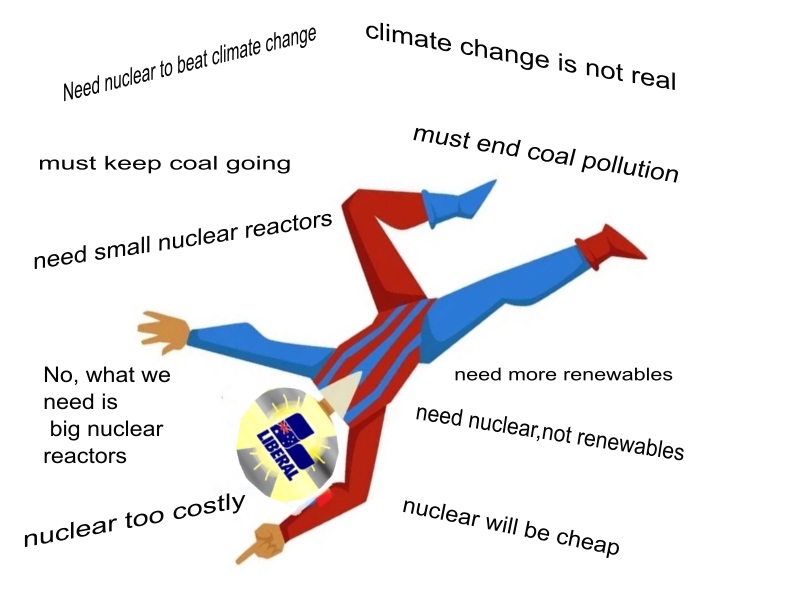
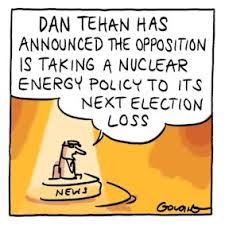
The coalition are revamping their proposal for nuclear energy, despite suffering an election loss with this policy. The details are yet to be confirmed, but the Opposition Energy Minister says they will adapt their plan to meet developments in the space.
The Coalition’s nuclear policy didn’t secure the party a win in the May federal election.
But that’s not stopping the Opposition Minister for Energy and Emissions Reduction:
“I have a very, very strong view that nuclear has to be part of our energy mix here in Australia, if we are going to be serious about reducing emissions.”
That was Dan Tehan speaking on ABC’s 730 program, following a trip to the United States which has inspired this latest revival of a Coalition nuclear energy policy.
Speaking on ABC Radio, Mr Tehan praised US advancements in the space.
“There’s basically a nuclear renaissance taking place in the US. There’s huge investment going into nuclear, there’s huge developments that are taking place. And everyone that I spoke to are incredibly confident given the use of AI, given the use of quantum, that they will continue to make rapid developments with nuclear technology.”
While avoiding detail, he did admit the policy would be adapted from their pre-election pitch to respond to rapid developments in the area.
But Mr Tehan is confident Australia should be influenced by the US model.
“The amount of investment, the amount of technological know-how going into nuclear, and the breakthroughs when it comes to small modular reactors, or micro-reactors, has to be seen to be believed. And the capital which is flowing into these developments, especially by the large tech companies in the US, is leading to developments which are occurring on a daily basis. And I have a very, very strong view that nuclear has to be part of our energy mix in Australia if we are to be serious about reducing emissions.”
While details of the policy remain unclear, the Opposition has already committed to some form of nuclear energy as part of a deal with the Nationals to prevent another coalition splinter.
Coalition frontbencher Bridget McKenzie insists the policy wouldn’t be in the top five reasons the coalition suffered a heavy loss in the May federal election.
She’s told Sky News the nuclear debate has to be viewed in the broader view of climate and energy policy.
She says the government is flagging poor policies to try and get Australia to emissions reduction targets, pointing to their efforts to encourage a switch to electric vehicles within a short time frame.
“Once again, we’re seeing the Labor Party pulling one lever for a policy solution, whilst making opposing decisions that aren’t good for the country. We know they aren’t going to meet their emissions reduction target, so they’ve doubled down on that and produced this transport sector plan for 2035 that’s going to see Australian motorists really do the heavy lifting and pay the costs of emissions reduction.”
Labor has long criticised the coalition’s nuclear energy plan – arguing the nation’s energy needs can be met with a mix of renewables and gas.
Addressing National Press Club following his election win, Prime Minister Anthony Albanese called the coalition’s nuclear policy a ‘last desperate attempt to delay action on climate change’.
He outlined his reasons for opposing the policy in a social media address in December last year.
“Here’s the lowdown on nuclear power – it will add $1200 to your power bills, it will take decades to build, it will block cheaper renewable energy. Energy experts at the CSIRO and the Australian Energy Market Operator have made that clear. Still, Peter Dutton is asking Australians to pay the price for his nuclear power scheme. Never before has so much taxpayer money delivered so little to so few Australians.”
The government is yet to respond to the coalition’s latest comments promoting nuclear energy and slamming Labor’s emissions reduction policy.
The Coalition has given its biggest clue yet on what its post-election policy will be.
Joseph Olbrycht-Palmer, 2 Oct 25. news.com.au
Opposition energy spokesman Dan Tehan has returned from a lengthy fact-finding mission to the US starry-eyed about a “nuclear renaissance taking place”.
Mr Tehan spent much of September touring facilities and meeting with nuclear heavyweights in the US.
His trip overlapped with the release of Australia’s first-ever climate risk assessment and Labor government’s 2035 emissions reduction targets.
His absence drew some criticism but, fronting media for the first time since landing back in the country, Mr Tehan said the knowledge he gained was worth it.
“What I learned was that there is basically a nuclear renaissance taking place in the US,” he told the ABC on Thursday.
There is huge investment going into nuclear.
“There are huge developments that are taking place.
“And everyone that I spoke to was incredibly confident, given the use of AI, given the use of quantum, that they will continue to make rapid developments with nuclear technology which will enable not only the US, but the globe, to provide abundant energy in a form which is emissions neutral.”
He was particularly struck by micro reactors, which are transportable nuclear power sources that typically generate between 1-20MW – or enough energy to power a small community, a military base or an industrial facility………………………………………………………
Mr Tehan’s comments are the strongest indication to date that the opposition may stick to its guns on nuclear despite its heavy defeat at the federal election in May.
The absence of an energy policy has sparked severe tensions within the Coalition and was key to the Nationals’ brief split from the Liberals.
Nuclear technology will be a key aspect of the Coalition’s energy policy heading into the next election, as opposition energy spokesman Dan Tehan argues it is essential to modernise the electricity grid.
Tehan told ABC radio on Thursday: “There is overwhelming agreement on the Coalition side that nuclear needs to be part of our energy mix” (SMH).
“I have no doubt that my colleagues, like I do, see very much a future for nuclear as part of our energy mix here in Australia,” he said.
Tehan has recentlyreturned from a study tour in the United States, where he reportedly toured facilities and spoke with nuclear experts about how the energy source could be used in Australia (Yahoo News).
Nuclear energy was a key proposal for former opposition leader Peter Dutton during his lost election campaign earlier this year, despite voter scepticism regarding its viability (The Saturday Paper).
The Australian Energy Market Operator, along with the owners of the country’s biggest fleets of coal generators have painted a pretty clear picture of the energy future: Forget baseload, it’s time has come and is going and almost gone – the future is about renewables and firming power.
It shouldn’t be too hard a concept to grasp. Low cost wind and solar will provide the bulk of the electricity supply, including and particularly from the rooftops of homes and businesses, and excess power will be stored in batteries at home and on the grid, and flexible “firming” assets will fill the gaps.
The focus on flexibility is the key. Firming assets might not be needed often, or even for long, but they will need to be switched on and off relatively quickly. Flexible demand side management will also play a key role, as will a focus on efficiency.
Australia’s operational paradigm is no longer ‘baseload-and-peaking’, but increasingly it’s a paradigm of ‘renewables-and-firming’,” AEMO boss Daniel Westerman said last year.
It’s a crucial point to understand. “Baseload” is not so much a technical virtue as a business model – the people who invest in coal generators, and nuclear in particular, count on those machines operating at or near full capacity most of the time.
Without it, they haven’t a hope of repaying the money that it took to build their facilities. They can flex a little, but the last thing they want or can do is dial down and up again on a daily or even hourly basis. Other machines are better equipped at doing that, and at much lower cost.
As the ANU’s Centre for Energy Systems wrote this year, the energy industry is aware that baseload is not just endangered, it is already functionally extinct. And they explain why in more detail.
Enter the Coalition’s new energy spokesman Dan Tehan, who quite clearly has not got the memo, and clearly hasn’t the foggiest idea what he is talking about.
Tehan has been on a “fact finding” tour of energy facilities in the US, which appears to have included no renewables, but a lot of nuclear, and – having briefed Coalition colleagues early in the week – he was keen to share his new-found knowledge with the ABC.
“Do you accept that expertise of the Australian energy market operator when it comes to base load power and the transition that’s underway?” Tehan was asked on the 7.30 Report.
“Well, your quote said it all there, Sarah,” Tehan replied. “Renewables and firming, and what nuclear can do is provide that firming over time, it can replace gas and coal, which are providing that firming at the moment.”
Clearly, he was already confused by the difference between baseload and firming. And then Tehan said this: “So my argument is as a replacement for diesel. When it comes to mine sites all that firming capacity over time, that’s exactly the role that nuclear can play.”
BHP is sourcing the bulk of its electricity needs for it massive Olympic Dam mine and refinery and nearby sites through two “renewable baseload” contracts with Neoen comprised only of wind and battery storage.
But Tehan was back at the ABC on Thursday morning, this time on Radio National, where he was extolling the virtues of “easily transportable” micro-reactors sized he said – and wait for it – between five and 10 gigawatts!
“And the particular thing that was really of note to me was how the research into micro reactors, so small, sort of five gigawatt, 10 gigawatt reactors, which are very transportable,” he said.
We suspect he meant megawatts, not gigawatts. (A gigawatt is 1,000 megawatts). And, we should point out, these micro reactors do not exist in any commercial form, and it’s doubtful too that they would be “very transportable”.
Tehan said he is convinced that in the US there is a “nuclear renaissance”, despite the recent World Nuclear Industry Status report pointing out there is no such thing. “The simple fact is … that there isn’t a single power reactor under construction in the 35 countries on the American continent,” ACF’s Jim Green writes.
Tehan insisted that 30 nations at COP29 had signed up to triple the amount of nuclear capacity. True, but they said they would do that over a 25 year timeframe, by 2050 – with the aim of lifting global capacity from around 350 GW to just over 1,000 GW.
In the meantime, a total of 120 countries have signed up to treble renewables – in just over five years – from 3,500 GW to 11,000 GW. That is 11 times more capacity than nuclear in one fifth of the time. It is pretty clear to everyone – except perhaps for Tehan and his friends – where the money is going.
And as AEMO’s Westerman told an energy summit hosted by The Australian last week, Australia is experiencing a “stunning democratisation” of energy generation, thanks to rooftop solar and consumer batteries.
Which means that they too will need the grid for “firming”, rather than baseload. Such a dramatic reshaping of the grid will leave no room for nuclear, or any other “baseload” power source. But Tehan and his mates seem intent to jam it into Australia’s energy debate, even if they can’t get it into the grid.
The federal shadow energy minister and shadow treasurer are adamant nuclear energy will form part of the Coalition’s future energy policy, though their leader has been less bullish.
Energy analyst Tony Wood says nuclear energy could work in Australia but the uncertainty caused by the lack of bipartisanship threatens to drive up power prices.
What’s next?
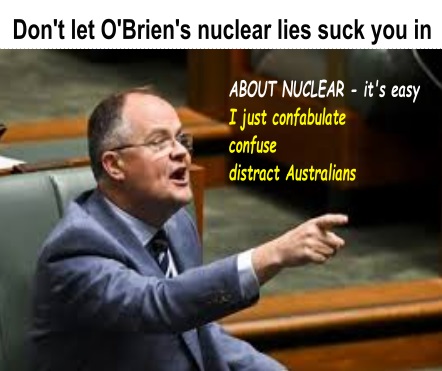
Deputy Opposition Leader Ted O’Brien says the Coalition’s energy policy is still in the works and more details will be shared once it is cemented.
Deputy Opposition Leader Ted O’Brien says he is “supremely confident” nuclear will be part of the Coalition’s future vision for Australia’s energy mix.
Shadow Energy Minister Dan Tehan made similar comments this week, signposting the resurrection of the Coalition’s nuclear policy after touring US nuclear facilities.
His predecessor, Mr O’Brien, was a key figure in the Coalition’s nuclear pitch at the last federal election — a policy some political pundits said contributed to their resounding loss.
Now Liberal deputy, Mr O’Brien said he was committed to giving it another go.
Mr O’Brien said the Coalition was yet to settle on the details of its new nuclear policy, including whether it would be government-funded or private sector-led.
Some commentators have speculated that the Coalition may look at narrowing its aspirations to focus on lifting the moratorium on nuclear energy, which has been in place since the late 1990s.
Mr O’Brien would not confirm whether the seven locations proposed to host nuclear reactors would still play a role.
But he maintains people in those regions, including Collie, 190 kilometres south of Perth, were “very open” to the idea.
On a two-party preferred basis, all four of Collie’s polling booths recorded a swing towards the Liberals, which Mr O’Brien said indicated local support for the Coalition’s energy policy.
However, he conceded that on a multi-party basis, there was a swing away from both major parties towards minor parties, such as One Nation and Legalise Cannabis.
Party leader less bullish
Opposition Leader Sussan Ley, also in WA at the moment, was less clear-cut on whether nuclear would play a role in the Coalition’s energy policy.
Asked about her colleagues’ comments at a press conference today, she said Mr Tehan would brief the party and policy teams next week on his US tour, where he had been specifically looking at developments in small modular reactors.
“We know that 19 out of 20 OECD countries … have either adopted or are in the process of adopting nuclear,” she said.
“It’s very important for the future, and we’ll continue to examine it closely.”
Federal Energy Minister Chris Bowen said the Opposition’s pro-nuclear stance was out of touch.
“Ted O’Brien masterminded the nuclear policy that was so comprehensively rejected by the Australian people just a few months ago,” he said.
“Now he says he is ‘supremely confident’ that his nuclear policy is right.
“It shows just how arrogant this LNP is — they just don’t get it.”
Analyst says energy indecision costs
Grattan Institute energy program director Tony Wood said nuclear energy warranted serious consideration.
However, he said a lack of bipartisanship around the future of energy could ultimately prove worse for electricity prices.
“When you’ve got different possible futures with different political parties, investors have to build more risk premiums into their decisions,” he said.
“That means the cost of everything goes up.”
Mr Wood said uncertainty could make the nation less attractive to the private energy sector.
“What [investors] want is clear and predictable policy,” he said.
The Electrical Trades Union (ETU) national secretary Michael Wright said workers in regional communities, such as the coal mining town of Collie, were also seeking clarity.
“When Peter Dutton was spruiking nuclear, we saw projects put on hold and jobs put on hold while developers waited to see which way the election went,” Mr Wright said.
“Now those jobs, for the most part, are back on. This sort of irresponsible attitude to the core business of powering our country costs jobs and jeopardises our grid. It’s just irresponsible and immature.”
Mr Wright said he was not ideologically opposed to nuclear but believed the infrastructure simply would not be ready in time to meet demand.
He said renewable projects had not been without their own challenges, with planning and regulatory approvals continuing to hold up work.
But he said it was time for Australia to pick an energy policy and stick to it.
The UK/Ireland Nuclear Free Local Authorities were proud to partner with Canadian and United States anti nuclear activists at a lively webinar, kindly hosted and organised by SOS: The San Onofre Syndrome, last Thursday (25 September).
Richard Outram, NFLA Secretary, was humbled to join an online panel of distinguished speakers who are working in opposition to new nuclear plants and nuclear waste dumps in both nations. There was an audience of around 50 activists joining us from across the globe, from Colwyn Bay to Hawaii, who had been invited to view the award-winning film ‘SOS – The San Onofre Syndrome: Nuclear Power’s Legacy’.
This time the focus was upon examining the situation in Canada.
Britain’s Nuclear Waste Services, being responsible for locating and building an undersea repository for our nation’s legacy and future high-level radioactive waste – the so called Geological Disposal Facility – has established strong ties with its Canadian counterparts, the Nuclear Waste Management Organisation which has determined to build a similar, though inland and underground, repository – called a Deep Geological Repository – at Ignace in Ontario.
Dr Gordon Edwards is a mathematician, physicist, nuclear consultant, and president of the Canadian Coalition for Nuclear Responsibility (https://www.ccnr.org). CCNR is a not-for-profit organization, federally incorporated in 1978, dedicated to education and research on all issues related to nuclear energy, whether civilian or military — including non-nuclear alternatives — especially those pertaining to Canada. He is based in Montreal.
Brennain Lloyd from We the Nuclear Free North (https://wethenuclearfreenorth.ca/) is a community organizer, public interest researcher and writer. For the last 30 plus years, Brennain has worked with environmental, peace and women’s organizations as a facilitator and adult educator supporting public participation in environmental and natural resource decision-making and various planning processes. She is based in northeastern Ontario.
The panel was also joined by Team SOS in the United States, namely Mary Beth Brangan and James Heddle, who are award-winning filmmakers of ‘SOS – The San Onofre Syndrome: Nuclear Power’s Legacy’ and co-directors of EON – the Ecological Options Network (https://www.eon3.org) and Morgan Peterson is an Oscar-nominated producer/director and director/editor of ‘SOS – The San Onofre Syndrome’. Mary Beth and James are based in Northern California, USA, whilst Morgan is based in Indiana, USA.
Richard is delighted that colleagues in the USA are looking to start work to build a network of nuclear free local authorities based on the model established from 1981 in the UK and Ireland.
It is almost 45 years since Manchester declared itself the world’s first nuclear free city and hosted the Secretariat of the Nuclear Free Local Authorities. Many cities across the globe followed Manchester’s lead in making similar declarations, many notably in the United States. It would be gratifying if these nuclear free cities could take the lead in establishing a new network across the Atlantic.
Richard said: “The purpose of establishing this Transatlantic Nuclear Free Alliance was to bring together anti-nuclear activists from both sides of the huge ocean which physically divides us in an online forum where we can share information on developments, support one another with campaigns, celebrate our successes, and share our common goals for a nuclear-free, peaceful and sustainable world.
“The UK / Ireland NFLAs would be delighted if from this meeting our colleagues in the United States could begin work to build their own network of nuclear free municipalities and we stand ready to lend support to such an initiative, where we can”.
Lisa Smithline from Moca Media TV, who ably performed the critical job of facilitating the event, summarised the event: “It was a deep and meaningful conversation. The feedback has been extremely positive, people are hungry for this information, the attendees didn’t want it to end!”
A future event will be held in around two months’ time – so do watch out for the invitation.
If you would like to attend and are not yet on the NFLA mailing list for news and future events, please email Richard Outram at richard.outram@manchester.gov.uk
In the meantime, the 25 September event can be viewed online at:
Stand in solidarity with Aunty Sue at the “No Consent for Missiles” rally, this Friday 10 October at 12 pm, beginning at the Australian Space Agency, Lot 14 (corner of North Terrace and Frome Road, Adelaide, Kaurna Land). The rally will then march to Parliament House.
STATEMENT OF NO CONSENT
Aunty Sue has addressed a Statement of No Consent to Southern Launch and every company that works with them—including the Australian Defence Force, Australian Space Agency, Thales, Varda, HyImpulse, Reaction Dynamics, German Aerospace Centre, AtSpace, and Perigee.
She has made it clear: there is NO CONSENT for the ongoing militarisation of Googatha Country.
In July, this statement was delivered in person to the head offices of these companies around the world.
Each company is now unambiguously aware: they are not welcome on the so-called “Koonibba Test Range.”
No more rockets.
No more missiles.
No more radioactive capsules.
This is sacred Googatha Country. It is not a military zone.
Please attend if you can—and share this message widely. In solidarity,
SYDNEY, AUSTRALIA – OCTOBER 11: Dr Jane Goodall poses for a photo at Taronga Zoo on October 11, 2008 in Sydney, Australia. Goodall, the world renowned primatologist, has acknowledged the breeding and work research carried out by the Chimpanzee Group at Taronga Zoo over recent years. (Photo by Robert Gray/Getty Images)
The Conversation, Mireya Mayor, Director of Exploration and Science Communication, Florida International University, October 2, 2025
Anyone proposing to offer a master class on changing the world for the better, without becoming negative, cynical, angry or narrow-minded in the process, could model their advice on the life and work of pioneering animal behavior scholar Jane Goodall.
Goodall’s life journey stretches from marveling at the somewhat unremarkable creatures – though she would never call them that – in her English backyard as a wide-eyed little girl in the 1930s to challenging the very definition of what it means to be human through her research on chimpanzees in Tanzania. From there, she went on to become a global icon and a United Nations Messenger of Peace.
Until her death on Oct. 1, 2025 at age 91, Goodall retained a charm, open-mindedness, optimism and wide-eyed wonder that are more typical of children. I know this because I have been fortunate to spend time with her and to share insights from my own scientific career. To the public, she was a world-renowned scientist and icon. To me, she was Jane – my inspiring mentor and friend.
Despite the massive changes Goodall wrought in the world of science, upending the study of animal behavior, she was always cheerful, encouraging and inspiring. I think of her as a gentle disrupter. One of her greatest gifts was her ability to make everyone, at any age, feel that they have the power to change the world.
Discovering tool use in animals
In her pioneering studies in the lush rainforest of Tanzania’s Gombe Stream Game Reserve, now a national park, Goodall noted that the most successful chimp leaders were gentle, caring and familial. Males that tried to rule by asserting their dominance through violence, tyranny and threat did not last.
While a treaty prohibits nuclear weapons stationed in Australia, the Government tries to circumvent it. Rex Patrick and Philip Dorling on Labor’s duplicitous nuclear word games.
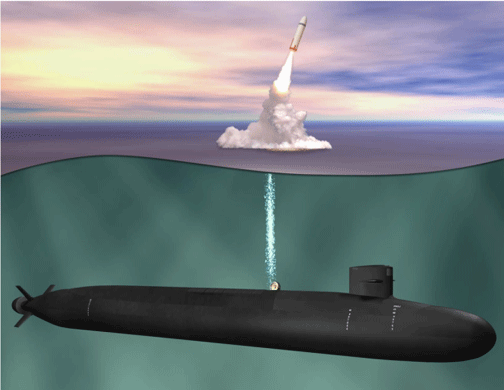
From 2032, nuclear-armed cruise missiles will be loaded into US Navy Virginia-class subs. The Treaty of Rarotonga prohibits nuclear weapons from being ‘stationed’ at HMAS Stirling, but maybe it’s OK for them to be ‘rotated’ through the base.
The South Pacific Nuclear Free Zone (SPNFZ) Treaty, first signed at Rarotonga in August 1985, was one of the successes of Australia’s activist nuclear disarmament and non-proliferation diplomacy of the Hawke and Keating Governments. Born out of South Pacific opposition to French nuclear testing and broader concerns about superpower competition in the Pacific, the Treaty entered into force on 11 December 1986. Amongst other things,
it prohibits the stationing of nuclear weapons within the South Pacific by member states. Australia is a member state.
Stationing is defined in the treaty as “emplantation, emplacement, transportation on land or inland waters, stockpiling, storage, installation and deployment.”
The treaty doesn’t prevent nuclear-armed ships from visiting a member state’s ports or transiting their waters. The Treaty was drafted to allow this, in part to accommodate Australia’s ANZUS defence relationship with the US. At the time US warships and submarines carried tactical nuclear weapons, but the US ‘neither confirmed or denied’ whether individual vessels were actually carrying them.
Additional protocols not ratified
At the urging of the Keating Government, in March 1996 President Bill Clinton’s Administration signed three Protocols to the Treaty of Rarotonga, giving an undertaking, amongst other things, not to station nuclear weapons on its territories within SPNFZ (American Samoa and Jarvis Island), and not to contribute to any act by a party to the Treaty that constitutes a violation of the Treaty.
After much delay, President Barack Obama’s Administration submitted the SPNFZ Protocols to the US Senate, but ratification has not occurred owing to Republican obstruction.
However, with USN submarines and surface vessels stripped of tactical nuclear weapons in 1991 (at the end of the Cold War), and US ballistic missile submarines not deployed from any South Pacific ports, the Protocols largely fell into contemporary irrelevance. However, with Donald Trump’s return to the White House, that’s all about to change.
Sea launched missiles
Sea launched missiles
In his first term, Trump ordered the US Navy to develop a new nuclear-armed, sea-launched cruise missile, SLCM-N, to provide the US subs and warships with flexible and low-yield nuclear strike options. In 2022, President Biden proposed cancelling the program, but Congress continued to fund it.
Now, with Trump back in the White House, the SLCM-N program is accelerating.
Trump’s ‘big beautiful Bill’ included US$2B for work on the missile and $US400m to accelerate work on its W80-4 warhead, likely to have a variable yield between 5 and 150 kilotons (the weapon that destroyed Hiroshima had a 15 kiloton yield).
Further funding is now proposed in the 2026 budget, with plans to move forward SLCM-N entry into service from 2034 to 2032.
Once the SLCM-N is deployed, the stationing of US attack subs in Australia could give rise to a breach of Australia’s obligations under the SPNFZ Treaty. The US could also be acting contrary to Protocol 2 to the Treaty, which it has signed, though not ratified.
A criminal offence
If US submarines ‘stationed’ in Australia are armed with SLCM-N missiles, Australian officials could be in some legal jeopardy.
The SPNRZ Treaty Act 1986 gives legal effect to Australia’s obligations under the SPNFZ Treaty.
Section 11 of the Act states, “A person who stations, or does any act or thing to facilitate the stationing of, a nuclear explosive device in Australia commits an offence against this section”. The penalty for doing so is imprisonment of up to 20 years, or a significant fine, or both.
So, MWM guesses it’s a really good thing that no US attack subs will be ‘stationed’ at HMAS Stirling, they’ll just be there as a “rotational force”. At least the Albanese Government wants everyone to think this is a big difference.
1×1515
4:46 / 8:46
Listen to this story
9 min
While a treaty prohibits nuclear weapons stationed in Australia, the Government tries to circumvent it. Rex Patrick and Philip Dorling on Labor’s duplicitous nuclear word games.
From 2032, nuclear-armed cruise missiles will be loaded into US Navy Virginia-class subs. The Treaty of Rarotonga prohibits nuclear weapons from being ‘stationed’ at HMAS Stirling, but maybe it’s OK for them to be ‘rotated’ through the base.
The South Pacific Nuclear Free Zone (SPNFZ) Treaty, first signed at Rarotonga in August 1985, was one of the successes of Australia’s activist nuclear disarmament and non-proliferation diplomacy of the Hawke and Keating Governments. Born out of South Pacific opposition to French nuclear testing and broader concerns about superpower competition in the Pacific, the Treaty entered into force on 11 December 1986. Amongst other things,
it prohibits the stationing of nuclear weapons within the South Pacific by member states. Australia is a member state.
Stationing is defined in the treaty as “emplantation, emplacement, transportation on land or inland waters, stockpiling, storage, installation and deployment.”
The treaty doesn’t prevent nuclear-armed ships from visiting a member state’s ports or transiting their waters. The Treaty was drafted to allow this, in part to accommodate Australia’s ANZUS defence relationship with the US. At the time US warships and submarines carried tactical nuclear weapons, but the US ‘neither confirmed or denied’ whether individual vessels were actually carrying them.
Additional protocols not ratified
At the urging of the Keating Government, in March 1996 President Bill Clinton’s Administration signed three Protocols to the Treaty of Rarotonga, giving an undertaking, amongst other things, not to station nuclear weapons on its territories within SPNFZ (American Samoa and Jarvis Island), and not to contribute to any act by a party to the Treaty that constitutes a violation of the Treaty.
After much delay, President Barack Obama’s Administration submitted the SPNFZ Protocols to the US Senate, but ratification has not occurred owing to Republican obstruction.
However, with USN submarines and surface vessels stripped of tactical nuclear weapons in 1991 (at the end of the Cold War), and US ballistic missile submarines not deployed from any South Pacific ports, the Protocols largely fell into contemporary irrelevance. However, with Donald Trump’s return to the White House, that’s all about to change.
Sea launched missiles
In his first term, Trump ordered the US Navy to develop a new nuclear-armed, sea-launched cruise missile, SLCM-N, to provide the US subs and warships with flexible and low-yield nuclear strike options. In 2022, President Biden proposed cancelling the program, but Congress continued to fund it.
Now, with Trump back in the White House, the SLCM-N program is accelerating.
Trump’s ‘big beautiful Bill’ included US$2B for work on the missile and $US400m to accelerate work on its W80-4 warhead, likely to have a variable yield between 5 and 150 kilotons (the weapon that destroyed Hiroshima had a 15 kiloton yield).
Further funding is now proposed in the 2026 budget, with plans to move forward SLCM-N entry into service from 2034 to 2032.
Once the SLCM-N is deployed, the stationing of US attack subs in Australia could give rise to a breach of Australia’s obligations under the SPNFZ Treaty. The US could also be acting contrary to Protocol 2 to the Treaty, which it has signed, though not ratified.
If US submarines ‘stationed’ in Australia are armed with SLCM-N missiles, Australian officials could be in some legal jeopardy.
The SPNRZ Treaty Act 1986 gives legal effect to Australia’s obligations under the SPNFZ Treaty.
Section 11 of the Act states, “A person who stations, or does any act or thing to facilitate the stationing of, a nuclear explosive device in Australia commits an offence against this section”. The penalty for doing so is imprisonment of up to 20 years, or a significant fine, or both.
So, MWM guesses it’s a really good thing that no US attack subs will be ‘stationed’ at HMAS Stirling, they’ll just be there as a “rotational force”. At least the Albanese Government wants everyone to think this is a big difference.
Nuclear re-armament
At the outset of the AUKUS agreement, the Australian Government would have been well aware of the first Trump Administration’s commitment to the SLCM-N program and its continuation under the Biden Administration.
Although this has received no public attention in Australia, the prospect that US Virginia-class subs will be nuclear armed is not a secret.
It’s in this context that the Australian Government have very deliberately used the words “Submarine Rotational Force-West (SRF-West)” to describe the presence of US submarines from 2027.
At a 14 March 2023 press conference, when a journalist asked the question,
“You made it very clear in the literature this morning that the stationed submarines in Western Australia will not constitute a US base. However, if there are up to four submarines out there, helping to train Australian sailors, they could be called on at any time to provide support in the Pacific or in Asia for the US. In what way is that not a base?”
Defence Minister Richard Marles responded with force:
Well, it’s a forward rotation. So, they’re not going to be based there.
When Defence Personnel Minister Matt Keogh introduced the Defence Housing Australia Amendment Bill 2025 in the Parliament in July this year, he explained the Bill was necessary, in part, to ensure housing for US personnel is available in close proximity to HMAS Stirling.
Defence is now committed to spending billions on upgrading and expanding facilities at HMAS Stirling to accommodate the continuous presence of USN attack subs, including housing for hundreds of American personnel and their families.
It’s really hard not to characterise what’s happening as ‘stationing’.
And eventually those stationed USN submarines are going to be nuclear-armed.
Situational double-speak
The stationing of nuclear weapons contrary to the SPNFZ Treaty is undoubtedly an issue the Government’s going to have to grapple with in relation to its leftie rank and file, but also diplomatically and legally.
There’s certainly potential for controversy and collateral damage to Australia’s relations in the South Pacific. Australia’s Pacific Islands partners are deeply attached to SPNFZ as the most significant legacy of the long campaign against nuclear testing in the Pacific and a declaration of the region’s desire for independence from the dictates of nuclear powers.
That was once part of Australia Labor’s political heritage, too, but that’s now being swept aside by AUKUS.
Foreign Minister Penny Wong has insisted that Australia is still committed to SPNFZ. In January 2023 she affirmed that, “… in partnership with the Pacific family, we remain steadfastly committed to the South Pacific Nuclear Free Zone Treaty.”
Three months later, she declared, “I want to make this crystal clear – we will ensure we comply with our obligations under the Treaty of Rarotonga.”
There’s no breach of treaty obligations yet, but Wong’s pledges will look pretty duplicitous when USN Virginia-class subs loaded with nuclear-armed cruise missiles are eventually based at HMAS Stirling.
Pacific Islands countries might wish to take the issue up through the Consultation Committee and complaints process established under Article 10 and Annexes 3 and 4 of the SPNFZ Treaty.
Moreover, while no one’s going to jail under Labor’s watch, the Government’s sophistry may also not stop an application for a permanent injunction being filed in the Federal Court, where the actual disposition of the US subs can be legally tested against the definition of the word ‘stationing’ in the Treaty.
In the meantime, MWM has fired off some new Freedom of Information requests (while we still can) to get to the bottom of it all. That includes one to the Australian Submarine Agency, which, according to a disclosure just made to the Senate, has recently opened a file on their system called “South Pacific Nuclear Free Zone Treaty Act 1986”.
Nuclear weapons could be fired by artificial intelligence, Australia’s Foreign Affairs Minister has warned the United Nations.
Speaking to the UN in New York on Thursday US time, Penny Wong issued a stark speech about technological advancements and armed conflict.
“AI’s potential use in nuclear weapons and unmanned systems challenges the future of humanity,” she said.
“Nuclear warfare has so far been constrained by human judgment, by leaders who bear responsibility and by human conscience. AI has no such concern, nor can it be held accountable.
“These weapons threaten to change war itself and they risk escalation without warning.”
Senator Wong has been with Prime Minister Anthony Albanese and Communications Minister Anika Wells at the UN this week, promoting Australia’s world-first under-16 social media ban.
Australia’s representatives have also been pushing to become one of 10 smaller nations to gain a 10-year non-permanent seat on the UN’s Security Council.
Senator Wong delivered the doomsday warning to the Security Council.
“Decisions of life and death must never be delegated to machines, and together we must set the rules and establish the norms,” she said.
“We must establish standards for the use of AI to demand it is safe, secure, responsible and ethical.
“To ensure AI transforms the tools of conflict and diplomacy for the better, the Security Council must lead by example – to strengthen international peace and security and ensure it is not undermined.”
Ukrainian President Volodymyr Zelenskyy delivered a similar warning to the UN’s General Assembly a day prior.
“It’s only a matter of time, not much, before drones are fighting drones, attacking critical infrastructure and targeting people all by themselves, fully autonomous and no human involved, except the few who control AI systems,” he said.
“We are now living through the most destructive arms race in human history because this time it includes artificial intelligence.”
President Trump has spoken at the United Nations, and now Prime Minister Anthony Albanese has too.
The contrast could not have been starker. Trump rambled like a man who’d just been handed the microphone at a small-town karaoke night – except the song was foreign policy and he didn’t know the words. He wandered through half-baked grievances, boasted about imaginary achievements, and at one point seemed to forget which country he was president of.
Albanese, meanwhile, spoke like an actual world leader – calm, confident, and passionate. He talked about climate action, regional security, and cooperation with the kind of clarity that makes you think, “Ah yes, this person knows what he’s talking about.”
And yet, if you relied on Australia’s right-wing media, you’d think you’d just watched two completely different events. To them, Trump was basically Moses parting the Red Sea with one hand while balancing the U.S. economy on the other. Albanese, apparently “reckless,” was a bumbling tourist who accidentally stumbled into the General Assembly and asked for directions to Times Square.
One commentator even claimed Trump was “extraordinary” – which is technically true if you count all the diplomats burying their heads in their hands. Meanwhile, Albanese’s calm and measured speech was branded “utterly humiliating” and dismissed as nothing but “symbolic gestures,” because apparently international diplomacy should be performed like a WWE entrance.
This is the theatre we live with now: policy and substance don’t make headlines, but a man ranting about wind turbines does. If Trump had started selling selfies from the UN podium, they’d have called it “bold economic diplomacy.”
The world saw two very different leaders this week – one looking like he could chair a serious discussion about global challenges, the other looking like he should be gently escorted back to his seat before he accidentally sanctioned Canada.










 Antinuclear