The Australian Israel Lobby Is Flat-Out Saying They Want A Ban On Criticism Of Israel
Caitlin Johnstone, Dec 19, 2025, https://www.caitlinjohnst.one/p/the-australian-israel-lobby-is-flat?utm_source=post-email-title&publication_id=82124&post_id=182048888&utm_campaign=email-post-title&isFreemail=true&r=1ise1&triedRedirect=true&utm_medium=email
Australians everywhere should be made acutely aware that the Australian Israel lobby is now explicitly advocating a ban on criticism of the state of Israel.
Not just hate speech against Jews. Criticism of a foreign state. They’re coming right out and saying it.
During a recent public video conference with the American Jewish Committee on the topic of the Bondi Beach shooting, the Executive Manager of the Australia/Israel & Jewish Affairs Council (AIJAC) explicitly says he wants pro-Palestine protests to be banned by the Australian government, and that addressing the problem of antisemitic hate speech in Australia necessarily means stopping opposition to Israel’s actions.
About 40 minutes into the American Jewish Committee’s YouTube video of the conference, AIJAC Executive Manager Joel Burnie demands that the Australian government take much stronger action to regulate freedom of expression regarding Israel and Zionism in Australia, saying the following:
“They need to act swiftly. They need to go to their own arms and their own institutions: no longer can you refuse service to a Zionist. We are going to prosecute people that spew hate speech against your people, and we’re not going to tip toe around the fact that the central problem here is Israel. I for one as Jewish leader will no long talk about antisemitism in isolation from Israel, because it’s the rhetoric and language on Israel that motivates the people to come and kill us. Those two terrorists were motivated by what was going on in Israel, and that’s what motivated them to come and kill us. So if they had Israel on their minds why are we acting as though it has nothing to do with the vitriolic binary nature of the pro-Palestinian advocacy movement?”
Burnie goes on to say that he wants a complete government ban on protests against Israel’s abuses throughout the nation:
“So overnight what we want immediately if you ask any Jew, what do you want, what do you want? No more protests! No more protests! No more no-go zones for Jews. I can’t, for two years, cannot take my kids to downtown Melbourne for two years on a Sunday, because of the pro-Palestinian marches, because of the violent nature of them. No more! Because that is an acceptance of the connection between the two. And until the prime minister is willing to do that, this is gonna happen again.”
Burnie is lying here, for the record. Anyone who has gone to the pro-Palestine demonstrations in Melbourne as I have will tell you that the protests are not even slightly violent in nature, and that there are Jews among the demonstrators who actively make their presence known. Those demonstrations have never been “no-go zones for Jews”; Joel Burnie doesn’t want to take his kids to downtown Melbourne on a Sunday because he doesn’t want to expose them to ideas and information which reveal the depravity of his Israel-supporting worldview.
Australians would probably benefit from watching the entire hour-long video of the conference, whose contents I first saw spotlighted on Twitter by Information Liberation’s Chris Menahan.
Some other highlights:
At 4:20 Burnie says that part of his role at AIJAC is “to take non-Jewish politicians and journalists and diplomats and other Australian officials to Israel.”
At 14:00 Nick Aronson, who is Chief of Staff to Australia’s so-called “antisemitism envoy” Jillian Segal, regurgitates the bogus propaganda line we’ve been hearing nonstop from Israel apologists throughout the western political/media class, “the words globalise the intifada actually mean globalise the intifada; it means kill Jews wherever they are”. Pro-Israel spinmeisters have been spouting this line with creepy uniformity ever since the Bondi shooting in order to justify government crackdowns on freedom of speech and assembly to protect Israeli information interests.
At 15:00 Burnie says “the gloves are off now” with regard to stomping out free speech in Australia, saying Jews need stop saying “not all pro-Palestinian supporters are antisemitic”, saying “The pro-Palestinian movement, or the things within the pro-Palestinian movement that we all are exposed to in the public, is too binary: you’re pro-Palestinian so you need to be viciously anti-Israel.”
At 16:20 Burnie claims the Bondi shooting “happened because of the protest movements on the streets”, citing no evidence.
At 17:30 Burnie again makes his “no more protests” demand, saying “If I could ask for one thing of the government today: no more protests. If they cannot utilise language that is not inciting violence, that does not marginalise and dehumanise Jews, they have no right to be on the streets.”
At 21:10 Burnie complains that there haven’t been any prosecutions and arrests for antisemitic speech.
At 33:30 Burnie singles out Australian Muslims, saying “there needs to be more monitoring and surveillance of Islamic hate preachers” and an auditing of their education syllabus because of an “antisemitism problem amongst the Australian Muslim community.”
At 36:25 Burnie says Jillian Segal’s notorious speech-suppressing plan for fighting antisemitism in Australia “wasn’t about quashing debate on Israel, it just happens to be that language on Israel invading all of our social spaces in Australia have made this country a very unsafe space and place for Jews.”
At 46:00 Aronson says “there’s absolutely no doubt that people need to go to jail” for antisemitic hate speech in Australia, but says that won’t be enough to fix the problem because “we can always arrest more people, make no mistake, but you can never arrest enough, to be honest.”
At 54:00 Aronson speaks of the need for regulating online speech, complaining that “a number of the online platforms pride themselves on what they call free speech — obviously we would disagree; we would call it hate speech.” At 56:00 he says “we need to continue to put pressure on these platforms to understand the role they have to play in social cohesion, and how far short they are falling of community standards.”
This comes as the Australian government announces plans to ramp up its war on free speech in the wake of the Bondi Beach attack. We can be sure to see more authoritarian measures rolled out in the weeks to come as Israel’s supporters seize on this opportunity to advance the information interests of a genocidal apartheid state.
The incoherent mix in Australian defence policy
Defence policy should be about defending Australia, and nothing else
John Quiggin’s Blogstack, 19 Dec 25
Discussions of defence policy in Australia typically start from two underlying presumptions. The first is that the protection of our freedom and sovereignty from foreign conquest is too fundamental to be subject to the kind of cost- benefit analysis that is, or ought to be, normally applied to public expenditure. The second is that defence policy can be used to promote a wide variety of goals, such as projecting power and influence through peacekeeping and disaster relief.
Unfortunately, these presumptions are mutually inconsistent, and lead to incoherent policy responses. This is most evident in the case of AUKUS, the largest single defence purchase in Australian history, and a major change in policy with the shift to nuclear-powered submarines. There has been no explanation of the strategic rationale for AUKUS, let alone any attempt to weigh costs and benefits. Yet there has been extensive discussion of the potential for increased employment of skilled trades workers. Given the expenditure involved and the relatively modest numbers of workers required, this ought to be a third-order consideration, yet it appears to have had a significant influence on the design of the program.
As the case of AUKUS suggests, the interaction between defence and industry policy is a tangled one. In particular, the strong political demand from South Australia for manufacturing industries to replace motor vehicle building has weighed heavily on policy choices, effectively ruling out “off-the-shelf” purchases of submarines, and placing a high premium on including some Australian contribution to production of such high-cost items.
A Future Made in Australia ?
Given that the stated aim of policy is “A Future Made in Australia” , a more rational policy approach would provide direct subsidies to manufacturing of all kinds, while leaving open the option of off-the-shelf purchases of defence equipment. Paying higher costs to encourage a domestic armaments industry entails the opportunity cost of forgoing assistance that might be provide to other industries with greater social and economic benefits.
There is a defence rationale for maintaining a capacity to produce some armaments. In the event of a long conventional war, Australia might be unable to import crucial supplies. Hence, it would make sense to seek some degree of self- reliance in this respect.
However, the goals of industry policy and defence self- reliance are often poorly aligned. Large-scale procurement projects such as AUKUS and the F-35 program often involve some element of local production and assembly, but the resulting capacity would not necessarily be of value in the event of a conflict in which Australia was isolated from allied support
……………………………. the claimed industrial benefits of AUKUS involve integration into United Kingdom and United States supply chains. This is consistent with an industry policy goal of increasing exports of elaborately transformed manufactures. But it is directly contrary to the defence goal of enhancing our independent capacity to protect ourselves in an emergency. In the event of a conflict that cut off international supply chains, we would be unable to secure parts and repair services except for the subset that happened to be allocated to Australia.In many cases, the appropriate response to the possibility of supply disruptions will be a combination of stockpiles and (for items with civilian use, such as fuel) rationing, rather than the maintenance of high-cost production capacity.
The Grey Zone
Lying between policies designed for national defence and those aimed at delivering non-defence benefits is the aptly named “grey zone” . As the name implies, this term is poorly defined and covers a wide range of hostile actions by other nation states and non-state actors, ranging from aggressive disputes over maritime boundaries to cyber-attacks and election disinformation. Crucially, the term is used almost entirely in the context of defence policy, and to support the implication that a military response of some kind is appropriate.
In general, however, the capabilities required to address grey zone problems will bear little relationship to those required to defend Australia against invasion. For example, the resolution of maritime disputes might involve the deployment of patrol boats and coast guard vessels. But, despite a long history of such disputes, dating back to the “Cod Wars” between the UK and Iceland, serious armed conflict remains vanishingly rare. Moreover, the possession of more powerful naval forces is of little value, as the failure of the Royal Navy in three successive “wars” over fishing rights indicates.
An incoherent mix of objectives
……………………………………………………………………………………………………………………………………………….. As political scientist Daniel Drezner has observed, if everything is a national security issue, nothing is. Rather than expanding the role of the defence forces, while exempting defence expenditure from normal assessments of costs and benefits, we should begin by building a force capable of protecting Australia against any plausibly possible threat of attack or invasion (bearing in mind, the impossibility of protecting ourselves against nuclear missiles). Having done that, any expansion of the mission should be tested both for cost-effectiveness and for consistency with our broader policy objectives. https://johnquigginblog.substack.com/p/the-incoherent-mix-in-australian?utm_source=post-email-title&publication_id=806934&post_id=182047815&utm_campaign=email-post-title&isFreemail=true&r=1ise1&triedRedirect=true&utm_medium=email
Ethics matter more than ever – even in Israel

19 Dec 25, https://theaimn.net/ethics-matter-more-than-ever-even-in-israel/
Who’d have thought, in this time of crisis, lies and propaganda, that it might be the Jerusalem Post that showed us an ethical direction?
And, on another matter of ethics – the Jerusalem Post, again.
I’m pretty used to the pro-Zionist propaganda that spills out from the Israeli media, the American media, and the Australian media.
I don’t know if it’s Hannukah, Christmas, or what, but in the usual cacophony of news and opinion, – that normally unfashionable subject of ethics is now standing out.

The Jerusalem Post spelt out its horror at the new, and murderous symbolism, of the lapel image now worn by ultranationalist Israeli politicians. Closely resembling the previous symbol, which called for the return of the Israeli hostages, their new symbol calls for continued killing of Palestinians, as the lapel image morphs from a ribbon into a noose.
A golden noose around Israel’s soul – says the paper – “The golden noose goes far beyond poor taste. It represents a theology of death, a reverence for vengeance that distorts the face of Judaism and deals a severe blow to Israeli society.”
“Jews around the world would be hard-pressed to defend and embrace the Jewish state.“
And indeed, this noose-wearing thing might backfire – as Jews in Israel and beyond reflect on the ethics of the Netanyahu government’s war on Palestinians.
Almost simultaneously, came the news of the massacre of Jews at Bondi Beach. The mainstream corporate news outlets have, predictably, latched on to this, to engender more vengefulness and hatred, and to blame Australia’s Prime Minister for his support of Palestinian state rights.
There is much coverage and genuine concern for the victims of this cruel outrage and their families. In amongst this, some sentimental coverage of the brave man who tackled an armed killer. As the ABC pointed out, media coverage treated this man as an oddity – as being a Muslim, one would not expect such decency. – a media attitude that is subtly Islamophobic.
” Ahmed al-Ahmed a 43-year-old Sydney fruit shop owner and father of two, moved toward the attacker, wrapped him from behind, wrestled away the long gun, and forced the shooter to retreat. He was shot and hospitalized, but his split-second decision is widely credited with preventing even greater carnage.”
And commented – “There is something profoundly Hanukkah about that moment.”
The Post goes on to reflect on those non-Jews of history, who risked everything to save Jews, – Raoul Wallenberg. Oskar Schindler. Chiune Sugihara and more
“These stories are not only about the Holocaust, but they are also about moral clarity under pressure, the choice to see a fellow human being and refuse to look away.”
This man’s courage and generosity of spirit has impressed people world-wide, and his actions have been praised in the media, cutting through the general tone of anger and hatred
The author, ZVIKA KLEIN, reminds that Hannukah means “a demand that human beings choose decency over cruelty“
Which is pretty much what Christmas is supposed to mean, too.
While the merchants of hate, revenge, and political opportunism hold sway in the corporate media, voices for compassion and decency are being heard too. These are hopes to cling to for the coming year, and bring some positive meaning to Hannukah and Christmas,
Israel Propagandists Are Uniformly Spouting The Exact Same Line About The Bondi Shooting.
they’re using a tragic mass shooting as a political cudgel against people who believe Palestinians are human beings. This is just one more cynical manipulation aimed at protecting Israel from criticism so that it can inflict more violence and suffering upon the world.
Caitlin Johnstone, Dec 17, 2025, https://www.caitlinjohnst.one/p/israel-propagandists-are-uniformly?utm_source=post-email-title&publication_id=82124&post_id=181835001&utm_campaign=email-post-title&isFreemail=true&r=1ise1&triedRedirect=true&utm_medium=email
Looks like some kind of memo went out or something, because pro-Israel outlets and individuals are all loudly amplifying one specific talking point about the Bondi Beach shooting.
Here are some examples:
“Bondi Beach Is What ‘Globalize the Intifada’ Looks Like”
~ Bret Stephens, New York Times
“The Intifada Comes to Bondi Beach”
~ David Frum, The Atlantic
“The Intifada Comes to Australia”
~ Walter Russell Mead, Wall Street Journal
“Shooting at Bondi Beach is what a globalized intifada looks like”
~ Herb Keinon, Jerusalem Post
“The Intifada Comes to Australia”
~ Ayaan Hirsi Ali, The Free Press
“Welcome to the global intifada”
~ David Harsanyi, Washington Examiner
“Palestinian propaganda has globalized the intifada”
~ Zachary Faria, Washington Examiner
“Bondi Beach massacre is what globalizing the intifada looks like”
~ Vivian Bercovici, National Post
“Chanting ‘globalise the intifada’ leads to Bondi Beach”
~ Danny Cohen, The Telegraph
“I have a simple question for leftists after the antisemitic shooting in Australia. What do you think ‘globalize the intifada’ means?”
~ US Senator Ted Cruz
“That attack in Sydney is exactly what it means to ‘globalize intifada.’ We saw the actual application of the globalization of intifada in Sydney.”
~ New York City Mayor Eric Adams
“These are the results of the anti-Semitic rampage in the streets of Australia over the past two years, with the anti-Semitic and inciting calls of ‘Globalise the Intifada’ that were realized today.”
~ Gideon Sa’ar, Foreign Minister of Israel
“When you refuse to condemn and only ‘discourage’ use of the term ‘Globalize the Intifada,’ you help facilitate (not cause) the thinking that leads to Bondi Beach.”
~ Former US antisemitism envoy Deborah Lipstadt (addressing New York City Mayor Elect Zohran Mamdani)
“What on earth do you think globalise the intifada means? And can’t people see the link between that kind of rhetoric and attacks on Jewish people as Jewish people? Because that’s what really struck at the heart of Jewish people in our country today — an attack on Jewish people organising around Hannukah, coming together as Jewish people.”
~ UK Health Secretary Wes Streeting
“Why is it still allowed? What is the meaning of globalise the intifada? I’ll tell you the meaning… it’s what happened on Bondi Beach yesterday.”
~ Ephraim Mirvis, Chief Rabbi of the United Kingdom
“Calls to ‘globalise the intifada’ and chants of ‘from the river to the sea’ are not abstract or rhetorical slogans. They are explicit calls for violence, and they carry deadly consequences. What we are witnessing is the inevitable outcome of sustained radicalisation that has been allowed to fester under the guise of protest.”
~ Israeli embassy in the UK
“This is what happens when you ‘globalize the intifada.’”
~ Newsweek editors
“This was not an isolated act of violence — it was the culmination of ‘globalise the intifada’ rhetoric that has been building around the world since October 7.”
~ Yoni Bashan, The Times
“For those who’ve been marching these past few years demanding to ‘globalise the intifada’ this is a barbarous anti-Semitic consequence of their pro-Islamist stupidity.”
~ Former BBC anchor Andrew Neil
“When people call to ‘globalise the intifada’, this is what they are calling for: dead Jews, terrorism and families shattered forever.”
~ Campaign Against Antisemitism spokesperson
“Taking a stand against antisemitism after Bondi Beach should begin with an unequivocal recognition that ‘intifada’ rhetoric is hate speech.”
~ The Bulwark’s Cathy Young
“It would be great if those who have been shouting ‘Global Intifada’ would revisit that phrase right now. It is not a ‘harmless left wing slogan.’ It is a call to blame — and kill — Jews who have nothing, absolutely nothing to do with the actions of the Israeli government.”
~ Spiritual guru and former US presidential candidate Marianne Williamson
Of course, these outlets and individuals do not actually care about the phrase “globalize the intifada”. If pro-Palestine activists had never chanted that slogan, pro-Israel spinmeisters would be focusing on a different line today. They are not trying to stop chants which they perceive as dangerous, they are trying to stomp out criticism of Israel’s genocidal atrocities.
As The Intercept’s Natasha Lennard wrote regarding the aforementioned Bret Stephens piece, “It’s all done in the name of fighting antisemitism by conflating the worst kinds of violent anti-Jewish bigotry, like what we saw in Bondi Beach, with any criticisms of Israel and its actions. To so much as say Palestinians ought to have basic human rights, in this view, becomes a deadly attack on Jewish safety.”
The term “intifada” means to “shake off” and “rise up”, and as Middle East Eye’s Craig Birckhead-Morton and Yasmin Zainab Bergemann explained last year, intifadas have historically included nonviolent resistance. Saying “globalize the intifada” isn’t calling for people to massacre Jewish civilians around the world, it’s advocating resistance to the power structure which incinerated Gaza and continues to inflict abuse upon Palestinians and any other population which doesn’t bow to the interests of the empire.
And the people scaremongering about this phrase know this. They’re fully aware that they’re using a tragic mass shooting as a political cudgel against people who believe Palestinians are human beings. This is just one more cynical manipulation aimed at protecting Israel from criticism so that it can inflict more violence and suffering upon the world.
As Em Hilton wrote for the Israeli outlet +972, “It is obscene how quickly the right has seized on this horror to advance an Islamophobic, anti-Palestinian agenda. And it is disgusting to see Israel’s politicians almost gleeful at the opportunity to distract from their genocidal onslaught in Gaza by using our pain and grief as a political weapon.”
Using the Slain: Israel Exploits the Bondi Beach Shootings
17 December 2025 Dr Binoy Kampmark, https://theaimn.net/using-the-slain-israel-exploits-the-bondi-beach-shootings/
Israeli Prime Minister Benjamin Netanyahu rarely passes an opportunity to comment upon the way Jews in other countries are treated. While the manic hatred directed against Jews remains one of history’s grotesque legacies, opportunism in the Netanyahu government is a ready instinct. With a customary sense of perversion, Netanyahu has managed to mangle Israeli policy, his own political destiny and the interests of Jews in a terrible, terrifying mix. The broad stroke charge of antisemitism is the front name of this venture, and it conveniently presents itself whenever Israeli policy requires an alibi when pursuing particularly unsavoury policies: massacre, starvation and dispossession of Gazans; the continued destruction and intended eradication of a functional Palestinian entity; efforts to prevent criticism of its settler policies in other countries.The slaughter of 15 people enjoying the festivities of Hanukkah on Sydney’s famed Bondi Beach by the father-son duo of Sajid and Naveed Akram, presented a political opportunity. Having already accused Australian Prime Minister Anthony Albanese of being a “weak politician who betrayed Israel and abandoned Australia’s Jews” earlier in the year, Netanyahu readied another verbal lashing. In prickly remarks made at a government meeting in Dimona, the Israeli PM accused his Australian counterpart of being a leader who had “replaced weakness and appeasement with more appeasement.” His “call for a Palestinian state pours fuel on the antisemitic fire.” It had rewarded “Hamas terrorists” and emboldened “those who menace Australian Jews and encourages the Jew hatred now stalking your streets.”
Other Israeli politicians also decided that an unmeasured though monstrous antisemitism stalked the island continent, spawning the Bondi killings. “We felt and experienced the intense antisemitism directed against the Jewish community in Australia,” claimed Aliyah and Integration Minister Ofir Sofer. Diaspora Affairs Minister Amichai Chikli thought it appropriate to send “a delegation of experts in emergency response” to Australia, promising to “stand with the Jewish community in this difficult time and to ensure that we, as the State of Israel, are giving them everything within our ability.”
Israeli Foreign Minister Gideon Sa’ar had a list of lecturing points for his Australian counterpart, Penny Wong. There had to be, he stated with a teacherly certitude, “a real change in the public atmosphere.” This required culling phrases and expressions that had been expressed on behalf of the Palestinian cause in public debate and protest. “Call such as ‘Globalize the Intifada,’ ‘From the River to the Sea Palestine Will be Free,’ and ‘Death to the IDF’ are not legitimate, are not part of the freedom of speech, inevitably lead to what we witnessed today.”
In Australia, the acceptance of such positions, and the watering down of the Palestinian cause, was rapidly normalised. A procession line of commentators proceeded to state begrudgingly that Israeli government policy could be criticised only to demonstrate how slim such latitude was. This firm, excruciating delineation was offered by Jeremy Leibler of the Zionist Federation of Australia: “Australians can criticise Israeli government policy, Israelis do it loudly and fiercely themselves. But delegitimising Israel’s right to exist, or slipping into a moral equivalence between a liberal democracy defending its citizens and a terrorist organisation that targets civilians, is something else entirely.”
Leibler’s semantic technique is important here, forcibly linking those who claim Israel has no right to exist to critics of Israel’s policy of self-defence after October 7, 2023 that has left 68,000 Palestinians dead, Gaza pulverised and an enclave on life support. At the instigation of South Africa, it is a policy that is being scrutinised by the International Court of Justice as being potentially genocidal. It is a policy that has been deemed genocidal by the UN Independent International Commission of Inquiry on the Occupied Palestinian Territory along with a clutch of notable human rights organisations, including the Israeli outfit B’Tselem. Arrest warrants have also been issued by the International Criminal Court for Netanyahu and his former Defence Minister Yoav Gallant, citing alleged war crimes and crimes against humanity.
Establishment voices from a long moribund press class are also of the view that not enough has been done by the Albanese government to combat a supposedly mad blight of antisemitism, seemingly unique from the other jostling hatreds. (Islamophobia, anyone?) The massacre, according to the unevidenced observation of veteran journalist Michelle Grattan, was “the horrific culmination of the antisemitism epidemic that has spread like wildfire in Australia.”
She noted, with grave disapproval, the failure to “formally” respond to the combative strategy proposed by the antisemitism envoy Jillian Segal, one that openly accepts the International Holocaust Remembrance Alliance’s stifling definition of antisemitism. Any official embrace of that definition – a point made by that definition’s originator, Kenneth Stern – would be a fashioned spear against free speech, censoring genuine criticism of Israeli policies. The Jerusalem Declaration, by way of contrast, notes that hostility to the Israeli state “could be an expression of an antisemitic animus, or it could be a reaction to a human rights violation, or it could be the emotion that a Palestinian feels on account of their experience at the hands of the state.”
Like most journalists wedded to the holy writ press brief and arid political interview, Grattan shows no sign of having been to a single protest condemning the murderous death toll in Gaza, or any gathering advancing the validity of Palestinian self-determination. Woolly-headed, she freely speculates. “Most of us did not recognise this fact, but this anti-Jewish sentiment must have been embedded in sections of the Australian community – the Hamas attack on Israel in October 2023 was the spark that lit the conflagration.” Her travesty of an effort to understand the attacks in Bondi becomes evident in cod assessments of various protest marches and demonstrations across Australian university campuses. Without even a suggestion of evidence, she claims that “university encampments” proved “intimidating for Jewish students and staff.” Those Jewish students and staff more than willing to engage in those encampments mysteriously warrant no mention. Efforts on the part of cloddish university managers to harass, suspend and censor students expressing pro-Palestinian causes don’t seem to interest Grattan either.
With laziness, she snacks on the propagandistic samples provided by Israel’s publicity relations buffet, referring to unspecified “others” who believed that the Albanese government’s recognition of a Palestinian state stoked local antisemitism. Foreign Minister Wong’s failure to “visit the sites of the 2023 atrocities when she went to Israel early last year was much criticised in the Jewish community.”
Thus far, Israeli propagandists have shamelessly badgered their opponents down under into accepting a streaky narrative that would fail to survive judicial, let alone historical scrutiny.The agenda is clear enough: the inoculation of Israel against international opprobrium. Much will now depend on Albanese’s fortitude, if he, and his ministers, can find it.
Ahmed Al Ahmed’s actions showed what moral clarity looks like — the commentary around him showed media bias.

Eli Federman, 19 Dec 25, https://www.abc.net.au/religion/bondi-hero-ahmed-al-ahmed-moral-clarity-media-bias/106162284
My roommate in rabbinical school Rabbi Yaakov Levitan signed his last Facebook message to me with the words “peace and love brother”. He lived that way as a Jewish community leader in Sydney. Terrorists on Bondi Beach murdered him as he was spreading light at a Chanukah gathering. In the chaos, Australian civilian Ahmed Al Ahmed ran toward one of the gunmen, tackled him and wrestled away his weapon, saving lives. He took two bullets and is in critical but stable condition. He is a hero.
But the media’s fixation on his Syrian and Muslim identity reveals an implicit bias that this kind of heroism — especially the kind that saves Jewish lives — is not to be expected from a Muslim.
Major outlets led with Ahmed’s religion before describing his courage. Headlines repeatedly framed him as a “Muslim man” who stopped a shooter, as if his faith explained the story rather than his actions. Some reports highlighted his Syrian background in the opening lines, treating that identity as the headline and his bravery as a footnote.
Such framing matters. The Islamophobia implicit here does not lie in the praise. It lies in the assumption. The coverage assumes that a Muslim risking his life to save Jews defies expectation. It treats decency as anomalous when it comes from a Muslim man. When goodness from Muslims becomes newsworthy because of who they are, not what they do, the media confesses how low its baseline expectations have fallen.
The reaction went further. Commentators and viral posts tried to erase Ahmed’s identity altogether. Some insisted he could not be Muslim. Others claimed he must be Christian. Several outlets reported on this reaction, amplifying the idea that Muslim heroism required explanation or denial. Still others highlighted online attacks branding Ahmed a “traitor” for saving Jews, again focussing on his faith as a problem rather than his courage as the point.
These narratives do real damage. They reinforce the idea that Muslim morality and Jewish safety stand in tension. They are wrong.
Recent history proves it. On 7 October 2023, Hamas carried out the deadliest massacre of Jews since the Holocaust. Amid the carnage, Arab and Bedouin Muslims risked their lives to save Jewish civilians under fire. Four Bedouin men from Rahat pulled 30 to 40 Jews out of danger near Kibbutz Be’eri while bullets flew. They asked no questions. They acted.
Surveys after the attack showed that large majorities of Arab Israelis, Muslim and Druze rejected the attacks and backed rescue and volunteer efforts. Much of the media coverage barely mentioned those findings because they disrupted the simple story line.
At the same time, honesty requires clarity. Antisemitism has surged worldwide, and Muslim leadership too often fails to condemn it clearly, publicly and consistently. Silence creates moral fog. When Jews hear hesitation instead of unequivocal rejection of Jew-hatred, trust is eroded and extremists gain ground. This is not a uniquely Muslim failure. Antisemitism infects many ideologies, religions, and political movements. Everyone must do more.
Ahmed did not issue a statement. He did not hedge. He acted. He showed what moral clarity looks like in real time. He affirmed, without words, that Jewish lives matter. He should not be the exception. He should be the rule.
Ahmed’s bravery does not erase antisemitism. It does not remove armed guards from synagogues. It does not bring my friend Yaakov back. But it does set a standard. If we want a world where such courage becomes ordinary, every community must raise its expectations. Muslim leaders must condemn antisemitism without caveat. Jewish communities must resist judging entire populations by their worst voices. And the media must stop treating Muslim decency as an anomaly and start treating it as normal.
Ahmed Al Ahmed did what any decent human being should hope to do. The tragedy is that his courage felt unexpected. It should not have. May Ahmed’s courage stand as the rule, not the exception.
Eli Federman has written for the Wall Street Journal, New York Times, USA Today, Reuters and other media outlets on society, religion and media bias.
Australians Being Massacred Shouldn’t Bother Us More Than Palestinians Being Massacred
Caitlin Johnstone, 16 Dec 25, https://www.caitlinjohnst.one/p/australians-being-massacred-shouldnt?utm_source=post-email-title&publication_id=82124&post_id=181738154&utm_campaign=email-post-title&isFreemail=true&r=1ise1&triedRedirect=true&utm_medium=email
On March 16 of this year, Reuters published an article titled “Israeli strikes kill 15 people in Gaza over past day, Palestinian medics say”.
Does anyone remember the 15 Palestinians who died on March 16, 2025?
Does that day stand out in anyone’s memory as particularly significant in terms of mass murder?
No?
Same here.
I honestly can’t remember it at all. This would have been during the tail end of the first fake “ceasefire”, a couple of days before Trump signed off on Israel resuming its large-scale bombing operations in Gaza, so this wasn’t one of those days with huge massacres and staggering death tolls. It doesn’t exactly stand out in the memory.
I have no idea who those people were. I don’t know their names. I never saw their pictures flashing across my news feed. I never saw any western officials denouncing their deaths, or media institutions giving wall-to-wall coverage to the news of their killing. So I don’t remember them.
I saw a tweet from Aaron Maté yesterday:
“15 civilians were killed in the massacre targeting Sydney’s Jewish community. A day in which Israel massacres 15 Palestinian civilians in Gaza would be at the low end of the average in 2+ years of genocide.
“Israel’s atrocities and the impunity they receive are undoubtedly the number one driver of anti-Semitism worldwide. And to show how little Israel and its apologists care about anti-Semitism, many are exploiting the Sydney massacre to justify Israel’s rejection of a Palestinian state; baselessly blame Iran; and demand more censorship of anti-genocide protests.”
Indeed, the worst people on earth are using the Bondi Beach shooting to argue for crackdowns on free speech and freedom of assembly to silence Israel’s critics online and on the streets, in Australia and throughout the western world. And when 15 Palestinians were killed by Israel on March 16, the west barely noticed.
I don’t remember the 15 Palestinians who died during that 24-hour period in mid-March, but I will always remember the Bondi Beach shooting. Someone could mention it to me thirty years from now and I’ll know exactly what they’re talking about. My society made an infinitely bigger deal about the deaths of 15 westerners in Sydney, Australia than the deaths of 15 Palestinians in Gaza, so it will always stick in my memory.
Hell, I can’t blame it all on society; if I’m honest I made a much bigger deal about it myself. I’ve felt sick thinking about the shooting ever since it happened, partly because I know it’s going to be used to roll out authoritarian measures and stomp out free speech in my country, but also partly because I’ve felt so bad for those who died and their loved ones. Even after spending two years denouncing the way western society normalizes the murder of Arabs and places more importance on western lives than Palestinian lives, I’m still basically doing the same thing myself. I’m a damn hypocrite.
I wasn’t born this way. This was learned behavior. If I had my slate cleaned and could see the world through fresh eyes it would never occur to me that I and my society would ever see 15 people being murdered in Australia as more significant than 15 people being murdered in Palestine. I would expect them to be viewed as exactly as terrible.
And they should be. Palestinians don’t love their families any less than Australians do. Australian lives aren’t any more significant or valuable than Palestinian lives. There is no valid reason for the world to have focused any less on the 15 people who were killed in Gaza on March 16 than on the 15 people who were murdered on Bondi Beach. But it did.
Sunday was an awful, dark day. Hundreds of lives have been directly devastated by this tragedy, thousands more indirectly, and in some ways the nation as a whole has been changed. The trauma will reverberate in the victim’s families for generations. The sorrow is palpable and ubiquitous. It’s everywhere; in the streets, at the supermarket. There is catastrophe in the air, and people around the world are feeling it.
And this is appropriate. This is what 15 deaths ought to feel like. This is what it feels like when you see mass murder inflicted upon a population whose murder hasn’t become normalized for you.
That’s all I’ve got to offer right now. Just the humble suggestion that every massacre of Palestinians should shake the earth just as much as the Bondi massacre has. Every death toll out of Gaza should hit us just as hard as the death toll out of Sydney did. Feel how hard this hits, and then translate it to the people of Gaza. This is happening there every single day.
In trying to get people to care about warmongering and imperialism what we’re really trying to do is get people to widen their circle of compassion to the furthest extent possible. To extend their care for the people around them to include caring about violence and abuse against people even on the other side of the world, who might not look and speak and live as they do. Maybe even extending it so far as caring about the non-human organisms who share our planet with us.
As Einstein wrote in a condolence letter toward the end of his life,
“A human being is a part of the whole, called by us ‘Universe,’ a part limited in time and space. He experiences himself, his thoughts and feelings as something separated from the rest — a kind of optical delusion of his consciousness. This delusion is a kind of prison for us, restricting us to our personal desires and to affection for a few persons nearest to us. Our task must be to free ourselves from this prison by widening our circle of compassion to embrace all living creatures and the whole nature in its beauty. Nobody is able to achieve this completely, but the striving for such achievement is in itself a part of the liberation and a foundation for inner security.”
Humanity won’t survive into the distant future unless we grow into a conscious species, and part of that growth will necessarily include widening our circles of compassion to include our fellow beings around the world. If we can’t do that, we’re not going to make it. We’re too destructive. We hurt each other and our environment too much. We destroy everything around us trying to shore up wealth and resources for ourselves, and it simply is not sustainable. It’ll get us all killed eventually.
We’ve got to become better. We’ve got to become more caring. More emotionally intelligent. Less susceptible to the manipulations of propaganda. A society driven by truth and compassion rather than lies and the pursuit of profit.
That’s the only way we’re making it out of this awkward adolescent transition stage with these large, capable brains still wound up in vestigial evolutionary fear-based conditioning. That’s the only way we achieve our true potential and build a healthy world together.
Wait, What?!
Racket cartoons, by Daniel Medina, https://racketcartoons.substack.com/p/wait-what?utm_source=post-email-title&publication_id=549592&post_id=181841928&utm_campaign=email-post-title&isFreemail=true&r=ln98x&triedRedirect=true&utm_medium=email, Dec 17, 2025
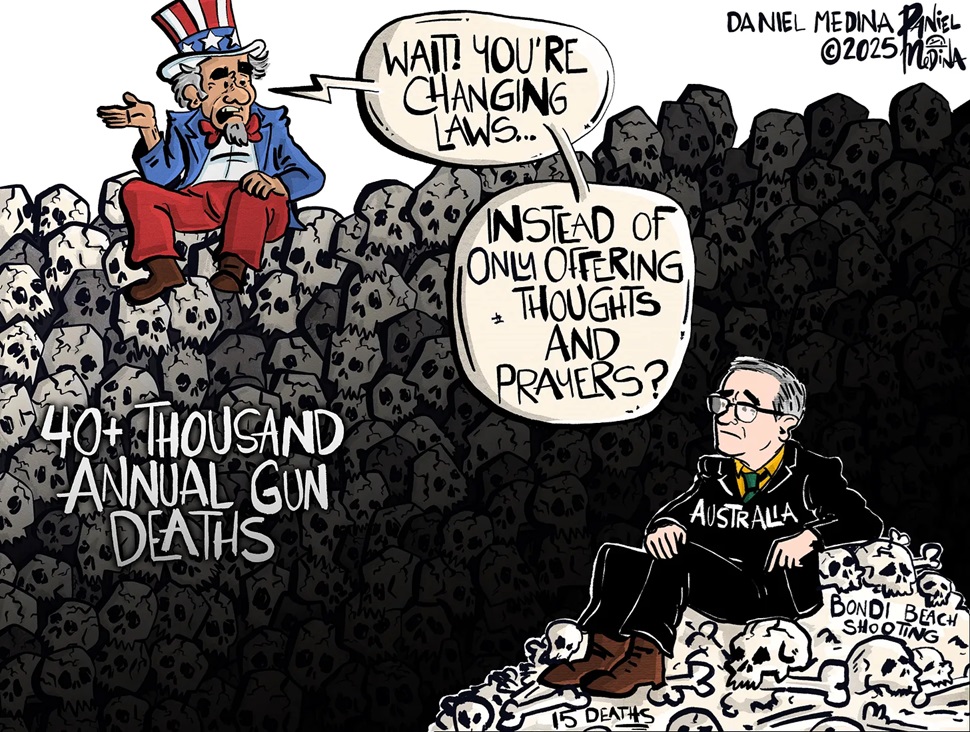
After the devastating massacre at Bondi Beach on Sunday, Australia’s PM and leaders promised to tighten gun laws to help make sure it never happens again. As an American reading this, and hearing more than just “thoughts and prayers,” I sat at my desk and felt deeply sad. Our country is so dysfunctional that we cannot handle even the basics of governing, let alone face the leading cause of death for American children: firearms.
What stood out to me was how quickly Australia’s leaders responded and how they seemed to agree that the government should act after something so terrible. In the United States, mass shootings are often followed by sadness but no action. It can feel like we accept these deaths as normal instead of trying to prevent them. Seeing another country treat gun violence as a problem they can fix makes our inaction even harder to understand.
Bondi demands grief, respect, fairness and empathy
15 December 2025 David Tyler, https://theaimn.net/bondi-demands-grief-respect-fairness-and-empathy/
A massacre demands clarity, not opportunism. Honouring the dead means resisting the rush to weaponise grief and insisting on evidence before politics raises its voice.
Australia’s Bondi Beach massacre demands grief, respect, fairness and empathy before anything else. As of the afternoon of 15 December, fifteen people are dead, murdered while gathered to mark Hanukkah. Families are shattered. A community has been targeted.
Politics Ebook
Nothing written in these first days should forget that, or rush past it.
But grief does not require silence, and it does not require surrendering the dead to political theatre. Within hours of the attack, familiar scripts were already being dusted off. Foreign leaders, local ideologues and media provocateurs moved quickly to bend fresh blood into proof of arguments they had long prepared. That reflex is not analysis. It is cheap, cynical, opportunism.
What we know, and what we do not
Police have confirmed that two men, a father and son, carried out the attack and were confronted by NSW Police within minutes. The elder was killed at the scene. The younger remains critically injured and under guard. Authorities are examining motive, movements, digital traces and licensing history. At the time of writing, no public finding has established foreign direction, state sponsorship or organisational command. That work belongs to investigators, not to commentators with deadlines.
What is clear is that the victims were Jewish Australians gathered for a religious celebration, and that antisemitism must be named plainly where it exists. There is no moral ambiguity about that.
Jews were targeted because they were Jews.
That fact alone is grave enough without being conscripted into other causes.
The moment that breaks the script
Police have confirmed that two men, a father and son, carried out the attack and were confronted by NSW Police within minutes. The elder was killed at the scene. The younger remains critically injured and under guard. Authorities are examining motive, movements, digital traces and licensing history. At the time of writing, no public finding has established foreign direction, state sponsorship or organisational command. That work belongs to investigators, not to commentators with deadlines.
What is clear is that the victims were Jewish Australians gathered for a religious celebration, and that antisemitism must be named plainly where it exists. There is no moral ambiguity about that.
Jews were targeted because they were Jews.
That fact alone is grave enough without being conscripted into other causes.
The moment that breaks the script
Against the horror stands a moment that should have arrested the rush to caricature. Ahmed al Ahmed, a Muslim Australian, fruiterer, father of two, ran toward danger. Video shows him confronting a gunman, disarming him, placing the weapon aside, raising a bloodied hand. He was shot and seriously injured. He survived. Others did not die because he intervened.
This matters. Not as sentiment, but as evidence. The attack was antisemitic.
The act that saved lives was Muslim.
Anyone who cannot hold both truths at once is not interested in understanding what happened, only in exploiting it.
The politics that arrived too quickly
Even before victims were formally identified, the blame industry went to work. Overseas figures folded Bondi into broader regional conflicts, pressing it into service as proof of distant enemies and permanent wars. Locally, others rushed to claim that Australia’s foreign policy settings, recognition debates or protest movements had “sent signals” and invited murder.
This does not withstand scrutiny. Over 140 UN member states recognise Palestinian statehood in some form, many for decades, without suffering massacres on their beaches. The attackers did not target Parliament, ministers or symbols of state. They targeted Jewish civilians at prayer.
Turning that into an argument for diplomatic reversal or communal suspicion is not security analysis. It is retrospective storytelling.
Bob Katter’s predictable calls for racial crackdowns and collective punishment follow on cue. They always do. Such politics does not make Australians safer. It corrodes trust, narrows cooperation, and teaches whole communities that silence is safer than engagement.
That is how information dries up, not how it flows. We do not need a smaller, meaner, whiter Australia.
Media and the hunger for immediacy
The media environment bears responsibility too. In the first 24 hours, speculation raced ahead of verification. Some outlets responsibly reported confirmed facts and official statements. Others leapt straight into imagined foreign command chains, proxy wars and ideological pipelines before evidence existed. Guidelines on reporting mass violence exist for a reason.
Premature conjecture does not inform the public. It inflames it.
There is a difference between naming antisemitism and conscripting it into every geopolitical conflict on the map. The first is necessary. The second is reckless.
What honouring the dead requires
Honouring the victims means insisting on facts over fury. It means allowing investigators to do their work without political interference or media frenzy. It means refusing to let grief be converted into justification for ‘forever wars’, domestic panic or the erosion of civic trust.
There will be time to ask hard questions about gun licensing, early warning and prevention. Intelligence. Those debates matter. They will be stronger if they are grounded in what actually happened, not in whatever story we most want to tell.
And it means holding onto the image that should endure from Bondi. Not the slogans, not the hot takes, not the scramble to assign blame, but a man who ran toward gunfire to save strangers whose faith was not his own.
That act does not erase antisemitism.
It rebukes the idea that violence must harden us into camps. In the long struggle against extremism, solidarity like that starves hatred far more effectively than all the pious goodwill rhetoric of a lifetime.
Coda: facts, not appetite
Here are the facts as they stand.
- Fifteen people were killed at a Hanukkah gathering on Bondi Beach. Two men carried out the attack. One was killed by police. One remains under guard. Police are not seeking a third suspect.
- The victims were targeted because they were Jewish. That is the crime. Nothing else needs to be smuggled into it.
- No public finding has established foreign direction, state sponsorship or organisational command. Those questions belong to investigators, not to press conferences.
- One man intervened.
- Ahmed al Ahmed disarmed a gunman, was shot, and survived. His actions saved lives.
- Everything beyond this is commentary.
A serious country knows the difference between evidence and appetite.
A resilient country resists the urge to conscript grief.
A decent country insists on grief, respect and empathy before politics raises its voice.
Politics Ebook
That is not timidity. It is how democracies hold their shape when they are tested hardest.
In moments like these, when fear tempts us toward smaller versions of ourselves, the work is to stay open, stay decent, stay human. We owe all of this to all others in their inconsolable, inconceivably painful, grieving.
Above all, we must expect it of ourselves; surely, this is how we realise our common humanity.
A Wave of Action to Demilitarise Newcastle
| Margie at Wage Peace , 14 Dec 25 |
We are so proud of the Muloobinba/Newcastle Crew who organised 7 actions last week to draw attention to their town supporting the genocide in Palestine. Newcastle is key to the transport of F35 parts. Folx travelled from all across the country to support Demilitarise Newcastle to say no to the community’s transition from coal to weapons.
A Week of Actions: Earth Care Not Warfare
Lockheed Martin in Williamtown is the logistics hub for the supply of ‘just-in-time’ F35 consumable parts for Israel. From here the F35 parts & components are sent direct to Sydney, then via commercial Thai Airways flights to TelAviv. We say NO! The F35=Genocide!
During the Weapons Outta Newy Week a SLOW bike tour was organised through all the weapons sites at the airport via BAE, LOCKHEED, BOEING, KONGSBERG, and a new greenfield development, ASTRO AEROLAB.
On Tuesday we attended the office of the Council, which owns the AEROLAB site.
And on Wednesday we walked from the old coal infrastructure down to Varley Engineering to symbolise the shift from coal to weapons. Varley are increasing the weapons side of their business. Varley could stick with ambulances and move into renewables, but instead are taking Newcastle into the dangerous arena of weapons exports.
During the Weapons Outta Newy Week a SLOW bike tour was organised through all the weapons sites at the airport via BAE, LOCKHEED, BOEING, KONGSBERG, and a new greenfield development, ASTRO AEROLAB.
On Tuesday we attended the office of the Council, which owns the AEROLAB site.
And on Wednesday we walked from the old coal infrastructure down to Varley Engineering to symbolise the shift from coal to weapons. Varley are increasing the weapons side of their business. Varley could stick with ambulances and move into renewables, but instead are taking Newcastle into the dangerous arena of weapons exports. https://linktr.ee/disruptwars
How long will the American Moronocracy last in the New Year?

Noel Wauchope, 15 Dec 25, https://theaimn.net/how-long-will-the-american-moronocracy-last-in-the-new-year/It’s hard to grab hold of the idea – of which of the morons in the USA administration will crack first?
I think that it has to be Pete Hegseth, the Minister for War. Perhaps “crack” is not the appropriate word. “Be thrown under the bus” might be more accurate.
The immediate problem is the rather gripping thought – of the vision of injured fishermen hanging desperately onto the debris, the wreckage, of their bombed boat. And then getting bombed again, and killled. Now, apparently, there exists a video of this wretched event.
CBS reported on December 4th, that U.S. lawmakers met behind closed doors, and viewed a video of a second strike on the boat. Well we, the public, are not allowed to see this video. Democrat Rep. Jim Himes said:
“what I saw in that room was one of the most troubling things I’ve seen in my time in public service.“
“You have two individuals in clear distress without any means of locomotion, with a destroyed vessel, who are killed by the United States.”
Even without seeing the video, our imaginations are struck with the horror of this event. And if it was not so terrible, why the need to cover it up?
And it’s not just that picture which is covered up. There’s also the trail of denials, blames, contradictory statements about that attack, – an incident that clearly breached international law, in the Geneva Conventions , The International Covenant on Civil and Political Rights, and also the Defense Department’s Law of War Manual .
https://www.youtube.com/watch?v=np1dG7qjzZM
The Washington Post reported that Pete Hegseth had given the order to “kill everybody,” but this was later denied by Admiral Bradley, who was in charge of the operation, and also by Hegseth and the White house.
The family of Colombian fisherman Alejandro Carranza Medina, believed killed by the US military in a boat bombing in the Caribbean Sea on Sept. 15, has filed a formal complaint with the Inter-American Commission on Human Rights accusing US Secretary of Defense Pete Hegseth of murder over the unlawful attack. The complaint also notes that President Donald Trump the commander in chief of the US military, “ratified the conduct of Secretary Hegseth described herein”.
That legal initiative mightn’t get anywhere, but the entire chain of command could be held liable for killing the survivors of the boat strike. The United States clearly imposes a duty to refuse unlawful orders.
That thought must be striking a bit of terror in the minds of the military officers involved, – and indeed in any U.S. military officer who might one day be given a similar order.
Anyway, wriggle around as he might, Pete Hegseth is at the top of decision-making on the whole illegal bombing of civilian boats in international orders. Unless you count Donald Trump as the top decision-maker. Trump would like this issue to just fade away. But if it doesn’t – well, then, perhaps a head should roll.
In his first presidency, Trump made a record number of his associates’ heads roll. But here’s the difference – some of them were quite skilful, and capable.
Not these days. Some examples :
Notably RFK Jr, is totally unsuited for Secretary of Health and Human Services. Tulsi Gabbard , with no strong background in Intelligence, is Director of National Intelligence, Attorney General, Pam Bondi has a background in criminal law, but is most notable for unflinching dedication to Donald Trump, no matter what. Director of DOGE, Elon Musk – well, he had to go in the inevitable clash between two grandiose egos. Steve Witkoff’s background as real estate developer, gave him no expertise to qualify him as Special Envoy to the Middle East. Marco Rubio as Secretary of State does have experience in politics, but is notable for having a fanatical war-hawk’s hatred of Cuba and China,
What all Trump appointees do have in common is unswerving devotion to Donald Trump. And that’s not going to be enough to sort out the Trump administration’s messes, with more surely to come.
But now, to come back to Pete Hegseth. Yes, he does have university degrees in politics. But even with university degrees you can still behave moronically. And Pete Hegseth sure does. He has a history of alcoholism, and an accusation against him of sexual assault. Even his mother accused him of being an abuser of women (though she later retracted this).
Hegseth was forced out of two veterans groups, due to his alcoholism, and accusations of financial mismanagement. Colleagues at his former employment at Fox News reported his drinking problem there.
Apparently Hegseth promised to stop drinking if confirmed in the job as Defense Secretary. There are rumours that he hasn’t stopped. But anyway that’s not his only problem. There was his careless use of commercial messaging app Signal to talk about an impending operation in Yemen.
All this has got Republican law-makers worried. And the mid-term elections will be coming up. Trump might just have to start the head-rolling, if this boat-bombing issue doesn’t go away.
And Pete Hegseth is the obvious first candidate.
By the way, the Internet is awash with stuff about Trump being not only a deranged narcissistic megalomaniac (which we all knew anyway), but on top of that, claims that dementia is setting in on him. (How long will the moron-in-chief last, anyway)
Israel Apologists Hasten To Use Bondi Shooting To Attack Anti-Genocide Activists
Caitlin Johnstone, Dec 15, 2025, https://www.caitlinjohnst.one/p/israel-apologists-hasten-to-use-bondi?utm_source=post-email-title&publication_id=82124&post_id=181641440&utm_campaign=email-post-title&isFreemail=true&r=1ise1&triedRedirect=true&utm_medium=email
Two shooters attacked a Jewish Hanukkah celebration at Bondi Beach on Sunday, killing fifteen people and injuring dozens of others. Police report that the shooters were a father and his son; the father was killed by police, and the son was captured.
The shooters appear to have been Muslim, but, much to the inconvenience of those who would like to use this incident to fan the flames of western Islamophobic hysteria, the man who selflessly risked his life to disarm one of them was also a Muslim father of two named Ahmed al-Ahmed.
As usual we’re seeing a lot of speculation about false flags and psyops regarding this incident, but I prefer to hang back from such commentary until I’ve seen some solid evidence.
I do have some thoughts about the public discourse we are seeing about the shooting right now, though.
Point 1: Obviously it is evil to massacre civilians for being Jewish.
Point 2: Obviously Israel’s massacring of civilians must continue to be opposed, and will continue to be opposed.
Today the worst people in the world are trying to pretend Point 1 and Point 2 are contradictory.
It’s so gross watching the tail-wagging excitement of Israel supporters in response to this shooting. They’re so happy they have another rhetorical weapon with which to bludgeon pro-Palestine voices into silence. They can barely contain their glee.
Benjamin Netanyahu immediately scrambled to hold a press conference proclaiming that the attack was the result of Australia taking some steps toward the recognition of a Palestinian state.
New York Times warmonger Bret Stephens penned an article titled “Bondi Beach Is What ‘Globalize the Intifada’ Looks Like,” arguing that the shooters “were taking to heart slogans like ‘resistance is justified,’ and ‘by any means necessary,’ which have become ubiquitous at anti-Israel rallies the world over.”
Iraq-raping war propagandist David Frum wrote a similar article for The Atlantic titled “The Intifada Comes to Bondi Beach,” saying the beach “has been repeatedly targeted by pro-Palestinian demonstrators” and denouncing the fact that “Many in the western world have interpreted post-October 7 anti-Israel actions within the framework of free speech.”
The virulently Islamophobic Australian senator Pauline Hanson swiftly slapped together a statement claiming that “the weekly anti-semitic protests across our nation” and “our obnoxious universities” were “warning signs” that such an attack was coming.
Sky News hastened to give a platform to Israeli Deputy Minister of Foreign Affairs Sharren Haskel in an interview where she declared that “this is what it means” to allow protesters to chant “globalize the intifada”, saying that “if you let that continue and run in your streets” you are inviting further terrorist attacks. Haskel has previously called pro-Palestine protesters in Australia “useful idiots” for Hamas.
Political dynasty princeling Chris Cuomo took to Twitter to assert that people who’ve been accusing Israel of genocide helped “fuel the hatred on bondi beach.”
The Jewish Chronicle’s Stephen Pollard tweeted a video of pro-Palestine protesters in Birmingham with the caption “It you deny the connection between this and what happened at Bondi Beach you are part of the problem.”
A viral tweet from Australian right wing social media personality Kobie Thatcher features a video of a pro-Palestine protest with the caption “This was Sydney, Australia just 6 months ago. These scenes should have been an urgent warning.”
Opposition Leader Sussan Ley has used the attack to demand that Prime Minister Albanese shove through the authoritarian speech suppression plan put forward by Australia’s “antisemitism envoy” Jillian Segal earlier this year, arguing that “We have seen public landmarks turned into symbols of antisemitic hate. We have seen campuses occupied and Jewish students made to feel afraid.”
From the earliest moments after this attack Israel apologists have taken it as a given that it was an act of terrorism in response to Israel’s genocidal atrocities in Gaza, but then framing the people peacefully protesting those atrocities as the problem.
They’re openly acknowledging that the genocide is violently radicalizing people, but instead of coming to the obvious conclusion that Israel should therefore not commit genocide, they’re citing it as evidence that people should stop protesting the genocide.
The Shadow Cabinet: How Encrypted Lobbying and the Erosion of Record-Keeping Are Undermining Australian Democracy

14 December 2025 Andrew Klein AIM , https://theaimn.net/the-shadow-cabinet-how-encrypted-lobbying-and-the-erosion-of-record-keeping-are-undermining-australian-democracy/
This article examines a developing crisis in Australian public integrity: the systematic use of encrypted and unminuted communications between lobbyists and the highest levels of government to evade transparency laws. Drawing on recent investigative reporting and parliamentary analysis, it argues that this practice, occurring alongside legislative efforts to weaken the Freedom of Information (FOI) framework and a failure to implement robust anti-corruption measures, represents a calculated retreat from ethical transparency. This creates a “dark space” in policymaking, fundamentally at odds with the stated mission of the National Anti-Corruption Commission (NACC) and the basic democratic contract of public trust. The article concludes that this constitutes a form of institutionalised obscurity that protects political interests at the expense of democratic accountability.
Introduction: The Promise and the Practice
The election of the Albanese government was heralded with a promise to restore trust and integrity after a decade of scandals. The establishment of the NACC was its cornerstone. However, a parallel track of conduct suggests a different priority: the management of political risk through the control of information. This article synthesises evidence revealing a pattern where commitments to transparency are actively undermined by operational secrecy, creating a profound dissonance between public rhetoric and private practice.
The Architecture of Evasion: “Going Non-Traceable”
At the heart of this issue is a reported, routine practice within the Prime Minister’s office. Lobbyists and stakeholders are advised to use encrypted messaging applications (such as Signal) and direct phone calls for substantive policy discussions, explicitly to avoid creating a discoverable record under the Freedom of Information Act 1982 (Cth). This guidance creates a two-tiered communication system: a formal, sanitised record for public consumption, and a shadow, substantive dialogue where real influence and negotiation occur. The justification – protecting “fluid thoughts” – is a stark departure from the principle that the formation of public policy should be a matter of public interest, not private conjecture.
Weakening the Scaffolding: Legislative and Systemic Failures
This operational evasion is not occurring in a vacuum. It is reinforced by systemic and legislative actions that degrade the infrastructure of transparency:
- The FOI Amendment Bill: The government is pursuing amendments that experts from the Australian Law Council and the Grattan Institute describe as “the most significant retrenchment” of transparency in decades. Key changes include a strict 40-hour processing cap – a logistical impossibility for complex requests – and the introduction of new, subjective grounds for refusal. This legally enshrines the difficulty of access.
- Chronic Record-Keeping Failure: A 2023 National Archives of Australia report found systemic failure across the Commonwealth in managing digital records. In 90% of recent audits, agencies received negative comments. Only one agency had a clear policy on capturing ministerial and departmental messaging for the official record. This is not negligence; it is a pervasive institutional disregard for the archival compact.
- Rejecting Anti-Cronyism Reforms: The government sat for two years on a review into “jobs for mates” in public appointments. When released, it rejected core recommendations to depoliticise the process, such as banning last-minute appointments before elections. This demonstrates a preference for preserving patronage networks over implementing substantive integrity reform.
The NACC in the Dark: An Integrity Watchdog Without a Trail
The establishment of the NACC was meant to be a circuit-breaker. However, its efficacy is premised on the existence of evidence – a paper trail, a digital record, a minute of a meeting. The practices detailed above are designed to eliminate that trail. The NACC’s own definition of “serious or systemic corrupt conduct” includes breaches of public trust and any conduct perverting the impartial exercise of official functions. Influencing policy through hidden channels, deliberately shielded from public and archival scrutiny, aligns precisely with this definition. The NACC’s first major survey, finding 15% of public officials were aware of corrupt conduct in their area, hints at the scale of the challenge it faces in a culture of obscurity.
Analysis: The “Trust Gap” and the Corruption of Process
The outcome is a critical “trust gap.” The public is asked to trust in institutions that are architecturally designed to avoid being held to account. This goes beyond traditional corruption (bribes for favours). It represents a corruption of process, where the very mechanisms for democratic oversight – FOI, archives, parliamentary scrutiny – are rendered inert. The government controls not only policy but the narrative of how that policy was formed, presenting a fait accompli to the public while hiding the machinery of influence. This creates a space where the lines between lobbying, policy development, and undisclosed conflicts of interest dangerously blur.
Conclusion: Gestures Versus Substance in the Democratic Contract
Australia is at an integrity crossroads. It has the gesture – the NACC – but is dismantling the substance required for that gesture to be meaningful. A democracy cannot function on a “need-to-know” basis where the government decides the public does not need to know how it is governed. The use of encrypted lobbying and the erosion of record-keeping are not administrative quirks; they are political strategies that sacrifice long-term public trust for short-term political convenience. Rebuilding trust requires not just new institutions, but a radical recommitment to transparency as the default, not the exception. Until the “dark space” of policymaking is illuminated, the promise of integrity will remain, like the lost records themselves, unfulfilled.
References……………………..
Grief is not a licence for hate
15 December 2025 AIMN Editorial, By Helen Reynolds https://theaimn.net/grief-is-not-a-licence-for-hate/
Australia is grieving.
The mass killing at Bondi has shaken Sydney and stunned the nation. In the immediate aftermath, there should have been space for mourning, solidarity, and quiet reflection. Instead, the noise arrived almost instantly – loud, cruel, and deeply familiar.
Within hours, social media filled with demands that Muslims be deported, that whole communities be treated as suspects, that fear be repackaged as policy. As if a tragedy can be explained by pointing at a faith followed peacefully by more than a billion people worldwide, including hundreds of thousands of Australians who are our neighbours, colleagues, doctors, teachers, and friends.
This reflex is not about safety. It never is.
It is about finding someone convenient to blame before the bodies are even buried.
Australia has walked this road before. We know where it leads. Collective punishment does not prevent violence – it multiplies it. Bigotry does not heal trauma – it extends it. And scapegoating minorities in moments of national shock is not strength; it is moral cowardice.
As if this wasn’t enough, a second chorus joined in from overseas. Americans – many of them – took it upon themselves to lecture Australia about gun laws. According to them, our strict firearms regulations “don’t work”.
This claim is not just wrong. It is offensive.
Australia reformed its gun laws after Port Arthur. The result was not theoretical, ideological, or symbolic. It was measurable and human: mass shootings largely disappeared. Gun deaths fell. Families were spared the kind of routine horror that now barely registers as news in the United States.
To be told, in the wake of fresh Australian bloodshed, that these laws “failed” is grotesque. What the critics really mean is that such laws would never survive the political system they are trapped in – a system paralysed by gun lobbies, identity politics, and a mythology that mistakes firepower for freedom.
Australia chose fewer coffins.Australia reformed its gun laws after Port Arthur. The result was not theoretical, ideological, or symbolic. It was measurable and human: mass shootings largely disappeared. Gun deaths fell. Families were spared the kind of routine horror that now barely registers as news in the United States.
To be told, in the wake of fresh Australian bloodshed, that these laws “failed” is grotesque. What the critics really mean is that such laws would never survive the political system they are trapped in – a system paralysed by gun lobbies, identity politics, and a mythology that mistakes firepower for freedom.
Australia chose fewer coffins.
America chose excuses.
There is a deeper sickness at work here, one that connects the Islamophobia at home with the gun evangelism abroad. It is the refusal to accept evidence when it conflicts with ideology. The refusal to sit with complexity. The demand that every tragedy confirm a pre-existing narrative.
Violence is not a religion.
Grief is not a policy platform.
And shock is not permission to abandon our values.
If there is anything to be defended in moments like this, it is not borders, weapons, or slogans. It is the fragile idea that a decent society responds to horror with humanity – not hate, not smugness, and not lies dressed up as certainty.
Australia can grieve without turning on itself.
We have done it before.
We must do it again.
AUKUS Caucus
The AUKUS agreement allows any party to withdraw with one year’s notice. But here’s the lethal asymmetry: Australia’s payments are subsidies, not deposits; they are not refundable, and there is no guarantee that the submarines will ever be delivered.
How the AUKUS Caucus built a cargo cult and called it strategy.
14 December 2025 David Tyler Australian Independent Media
There’s a certain kind of Australian politician who never quite grew out of childhood. You know the type: Richard Marles, Tony Abbott, Christopher Pyne. Peter Pan to a man. Their eyes light up whenever a Pentagon staffer remembers their name. They sit bolt upright like kelpie pups on the back of the ute, ears pricked for master’s return. They mistake condescension for intimacy, patronage for partnership, obedience for relevance.
Marles, Pat Conroy (Defence Industry), and Brendan O’Connor (Veterans’ Affairs) along with “Rear Admiral-Albo” and Wayfinder Penny Wong make up the AUKUS Caucus: a dream team. Not bound by evidence, timelines, or arithmetic; only by faith. Faith that if Australia sends enough money, bases and deference across the Pacific, the Great Mate in the Sky will someday descend bearing nuclear submarines and strategic salvation.
Australia’s $368 billion imaginary friend.
The Cargo Cult Playbook
Cargo cults arise when isolated societies witness advanced powers arrive with miraculous technology. Locals build imitation runways; light signal fires hoping the planes will return. The AUKUS Caucus has updated the ritual for the modern age. Our runways are ports. The offerings are our sovereignty. The signal fires are AUSMIN pressers. And the planes, as ever, do not land.
Richard Marles, Labor’s embattled Defence Minister, is the cult’s high priest. Asked about implementation delays, he smiles wanly and intones the sacred words: “Full steam ahead.” Full steam ahead to where is never explained.
AUKUS is sold as strategic realism. In practice, it operates as faith: belief substituted for capacity, ritual for delivery, loyalty for leverage.
The Hegseth Problem
This week Marles and Wong flew to Washington for the annual, ceremonial abasement known as AUSMIN. Their opposite number is Pete Hegseth. Former Fox News shouter, veterans’ charity mismanager, and a chap once carried from a strip club by mates after trying to storm the stage. Now improbably directing US defence as Secretary of War.
Hegseth’s character matters because AUKUS asks us to entrust our strategic future to decision-makers whose judgment, attention span and institutional grip are already demonstrably strained. His own mother calls him as an “abuser of women” who “belittles, lies and cheats,” urging him to “get some help and take an honest look at yourself.”
When a nation stakes $368 billion on the judgment of a man disqualified by his own mother from trust, it has crossed from strategy into pathology.
8 December, Marles and Wong are pictured nodding earnestly as Hegseth endorses a $368 billion submarine fantasy he cannot possibly deliver. He barks approval of AUKUS as “pragmatic hard power.” Wong, cryptic as ever, merely echoes Trump’s mantra: “full steam ahead.” The boats are not coming, so who cares what fuels the boiler?
The Pragmatic Hard Power Con
Pragmatic hard power? It could be a new brand of laundry detergent. The absurdity runs deeper than performance.
Australia is trading real sovereignty for imaginary submarines.
AUKUS legislation effectively transfers operational priority and access over key Australian military bases to the US. The terminology is pure institutional dissemblance: “expanded US rotational presence” and “integrated command arrangements.” In plain English: we concede control over our own strategic assets. We slip a few lazy billion to US and British shipyards to “expedite” production; meaning we subsidise their accumulated backlogs. We bind our “defence posture” so thoroughly into US command that when Washington sneezes, Canberra catches cold.
But we do get to wave flags. Hum anthems. Pay invoices.
Each concession merits national debate. Yet, the AUKUS Caucus has sealed the deal without meaningful parliamentary inquiry, without detailed public costings, only an “oversight” committee denied subpoena power, denied independent costing, and so carefully neutered it might as well be chaired by a shredder.
The Legal Trap
And yes, the legal architecture is exactly what critics feared. Under the agreement, Australia provides $4.7 billion (with more coming) to US and UK submarine builders, and according to questioning in Senate Estimates, there is no clawback provision; Australia does not get its money back if the US fails to transfer nuclear submarines.
The AUKUS agreement allows any party to withdraw with one year’s notice. But here’s the lethal asymmetry: Australia’s payments are subsidies, not deposits; they are not refundable, and there is no guarantee that the submarines will ever be delivered.
The US and UK can walk away at any time. They keep the cash, the upgrades, the expanded industrial bases and the sovereign right to prioritise their own needs. Which, as serious countries, they will do.
Australia, meanwhile, is padlocked like a rental fridge in a share-house. Jiggle the handle all you like, but the thing won’t open unless the bloke with the key decides you’ve paid up.
A Big Perhaps
At some point, the more unsettling explanation has to be entertained. Perhaps the submarines are not delayed. Perhaps they are not even expected. Perhaps AUKUS is not failing at all, but performing exactly as intended. The money flows early and without clawback. The bases open. Command structures integrate. Strategic dependency is formalised. The submarines remain permanently over the horizon, always promised, never required. If this were a ruse designed to secure American basing access and regional posture while outsourcing the political pain to future governments, it would be hard to design it differently. Whether Australia’s political class believes its own story, or merely finds it convenient, becomes almost beside the point. The outcome is the same.
And whatever the truth of the submarines, Defence needs a bit of a rescue.
Defence’s House of Horrors
Marles’ predicament worsens when you look at Defence itself: a moral, administrative and institutional nightmare he inherited and, like his predecessors, Linda Reynolds and Peter Dutton, has failed to master. Could anyone? Australia’s predicament worsens also.
The Brereton inquiry exposed 39 unlawful killings in Afghanistan. The stain remains. Atop this moral wreckage sits administrative farce: a Defence official leaked confidential information before walking straight into a job with a private weapons contractor.
The Hunter class frigates tell the broader story. What began life as a $45 million per ship concept has metastasised into $2.6 billion per ship, with hundreds of millions in variations already locked in, and the program at least 18 months late due to design immaturity.
When Labor took office, 28 major Defence projects were running a combined 97 years behind schedule, with roughly a quarter of procurement unfunded. Over it all looms $368 billion we’ve agreed to throw at AUKUS, as a $60 billion annual defence budget swells toward $100 billion by 2034, absorbing failure without correcting it. (AUKUS costs are a guess, announced without consulting Treasury, Parliament or any other authority.)
What Do We Actually Get?
And what does Australia receive for this tithe?
- Not submarines.
- Not even capability.
- A promise.
Five SSN AUKUS boats to be built in Adelaide at some conveniently indeterminate date. Early 2040s if all goes well. If Britain remembers how to build submarines at scale. If the US has spare industrial capacity. If history pauses politely to accommodate our fantasy.
The BAE Systems Track Record
BAE Systems, cast as AUKUS’s industrial saviour, spent two decades struggling to deliver the UK’s Astute class submarines……………………………………………………..
The Pillar Two Mirage
When reality intrudes, the faithful point to Pillar Two, the sideshow of defence tech collaboration; AI, cyber and hypersonics; meant to suggest strategic depth where there is only debt. Scott Morrison dubbed it “AUKUS in Space,” as if adding a preposition and some stars transformed a lopsided submarine purchase into visionary strategy.
But the real achievement is rhetorical: substituting buzz-words for credible policy. In this sense, AUKUS is Scott Morrison’s most enduring legacy.
The Question Marles Won’t Answer
No-one likes a smart-arse but the pitiful Richard Marles still cannot explain why nuclear submarines are worth this ruinous spend when modern diesel-electric boats exist.
Modern diesel-electric submarines provide maximum range, endurance and stealth, operating underwater before having to resurface to snorkel and recharge batteries. Australia’s own Collins-class diesel submarines demonstrated during 2003 multinational exercises that they were comparable in underwater warfare to US Los Angeles-class nuclear-powered attack submarines, trading roles and achieving , successful attacks despite being smaller and less powerful……………………………………………………………………………………………………………………………………………………………………………………………..
The Runway at Dusk
For $368 billion, AUKUS is not a procurement program. It is a wager on dependency.
Australia is paying staggering sums for submarines that do not yet exist, to be built by industries in chronic difficulty, on timelines that belong to fantasy, while ceding real autonomy over real assets in the present. In return, we receive reassurance. Access. Attention. The comforting sense that someone larger, louder and more heavily armed is standing somewhere behind us………………………………………………………………………………
History will not ask whether the submarines eventually arrived. It will ask why a nation willingly surrendered so much, so early, for so little certainty in return. And it will judge us not by the promises we believed, but by the choices we made when the risks were already plain. https://theaimn.net/aukus-caucus/
1 This month

of the week – Australians for War Powers Reform (AWPR)
To see nuclear-related stories in greater depth and intensity
 Antinuclear