Australian businesses are missing significant investment and innovation opportunities in Asia.
Education, business and professional exchange programs must be expanded.
Speaking from experience – CPA Australia has nearly 50,000 members in the region.
One of the world’s leading accounting bodies, CPA Australia, is urging the Federal government to take bold steps to strengthen Australia’s Asia capability, warning that Australian businesses are missing out on significant opportunities in the region.
Rebecca Keppel-Jones, Chief Member Operations Officer at CPA Australia, says many Australian businesses, particularly SMEs, remain domestically focused and are not capitalising on opportunities in Asia.
“Asia is central to Australia’s future prosperity. To remain competitive, we must build Asia capability from the classroom to the boardroom,” Ms Keppel Jones said.
“With Asia home to some of the world’s fastest-growing economies, Australia risks falling behind unless it invests in Asia capability now. We need more investment into existing programs, such as the New Colombo Plan, to improve Australians’ understanding of Asia.”
CPA Australia is proud to have maintained a strong presence in Asia for more than 70 years. It now represents nearly 50,000 members in mainland China, Hong Kong, Malaysia, Singapore, Indonesia, Vietnam and the UAE.
“Australia must better leverage its people-to-people connections and professional networks to unlock economic potential,” Ms Keppel-Jones said.
CPA Australia’s four key recommendations:
Expanding Asia-focused training for SMEs to improve business readiness and regional engagement.
Showcasing Australian success stories in Asia through a government-supported case study library to inspire and educate.
Increasing scholarships and professional placements for young Australians to study and work in Asia.
Revitalising Asian language and cultural education in schools and universities to reverse declining enrolments and build long-term regional literacy.
“As global dynamics shift, our ability to engage with Asia is more critical than ever. We need to ensure Australia’s workforce is globally competitive,” Ms Keppel-Jones said. “We are ready to work with government, educators and industry to turn these recommendations into action.”
The submission highlights CPA Australia’s active contributions to regional policy development, education and professional exchange, including a reciprocal work placement exchange program with Malaysia.
Eligible CPA Australia members can enjoy temporary work placements in Malaysia as part of a broader Young Professionals Exchange Program organised by the Department of Foreign Affairs and Trade. The exchange program is designed to enhance business engagement between Australia and its Southeast Asia partners and is available in Malaysia first, before being rolled out to other Southeast Asian markets.
What was once a theoretical discussion in U.S. military journals about blockading China’s oil supply is now steadily turning into a tangible, multi-layered strategy aimed at containing Beijing and preserving American global dominance.
In 2018, the US Naval War College Review published a paper titled, “A Maritime Oil Blockade Against China—Tactically Tempting But Strategically Flawed.” It was only one of many over the preceding years discussing the details of implementing a maritime blockade as part of a larger encirclement and containment strategy of China.
At first glance the paper looks like US policy thinking considered, then moved past the idea of blockading China. Instead, the paper merely listed a number of obstacles impeding such a strategy in 2018—obstacles that would need to be removed if such a strategy were to be viable in the near or intermediate future—and obstacles US policymakers have been removing ever since.
More contemporary papers published, including those among the pages of the US Naval Institute (here and here), have updated and refined not just an emerging strategy to theoretically confront and contain China, but a plan of action taking tangible shape.
Cold War Continuity of Agenda
Throughout the Cold War and ever since its conclusion, the US’ singular foreign policy objective has been to maintain American hegemony over the globe established at the end of the World Wars. A 1992 New York Times article titled “U.S. Strategy Plan Calls for Insuring no Rivals Develop” made it clear the US would actively prevent the emergence of any nation or groups of nations from contesting American primacy worldwide.
In recent years this has included preventing the reemergence of Russia as well as the rise of China. It also involves surrounding both nations with arcs of chaos and/or confrontation—either through the destruction of neighboring countries through political subversion, or the capture of these nations by the US and their transformation into battering rams to be used against both nations.
Ukraine is an extreme example of this policy in action. The US is also transforming both the Philippines and the Chinese island province of Taiwan into similar proxies vis-à-vis China.
Beyond this, the US seeks to prevent the majority of nations currently outside US dominion from joining with and contributing to the multipolar world order proposed by nations like Russia and China.
This strategy of coercion, destabilization, political capture, proxy war, and outright war has been used to target both Russia and China directly, their neighbors, and a growing list of nations far beyond their near abroad.
The US is demonstrating a clear, unwavering commitment to a multi-layered strategy of containment, coercion, and confrontation designed not just to prepare for conflict, but to make that conflict both inevitable and successful for the singular goal of maintaining global American hegemony
Strengths and Weaknesses of American Primacy
Enabling this strategy is America’s global-spanning military presence facilitated by its “alliance network.” This network of obedient client regimes both hosts US military forces and serves as an extension of US military, economic, and increasingly military-industrial power. US “allies” often pursue US geopolitical objectives at their own expense.
Again, an explicit example of this is Ukraine, which is locked in a proxy war with Russia, threatening its own self-preservation as a means of—as US policymakers described in a 2019 RAND Corporation paper—“extending Russia.”
While conflicts like that unfolding in Ukraine or the US-backed military build-up in the Philippines or on Taiwan has exposed a critical weakness of the United States—its lagging military industrial capacity vis-à-vis either Russia or China, let alone both nations—the US has demonstrated the ability to compensate through geopolitical agility the multipolar world is struggling to address.
This includes the ability of the US to mire a targeted nation in conflict in one location while moving resources across its global-spanning military-logistical networks toward pressure points in other locations, overextending the targeted nation and achieving success in at least one of the multiple pressure points targeted. The US successfully did this through its proxy war against Russia in Ukraine, which tied Russia up sufficiently for the US to finally succeed in the overthrow of the Syrian government, where Russian forces had previously thwarted US-sponsored proxy war and regime change.
It also includes the ability of the US to target partner or potential partner nations of Russia and China through economic, political, or even military means in ways Russia and China are unable to defend against—including through political subversion facilitated through America’s near monopoly over global information space.
These advantages the US still possesses also make potential maritime blockades very difficult for Russia and China to defend against.
Russian Energy Shipments as a Beta Test for Blockading China
France recently announced seizing a ship accused of being part of Russia’s “ghost” or “shadow” fleet—ships refusing to heed unilateral sanctions placed by the US and its client states on Russian energy shipments.
This was just one of several first steps toward what may materialize into a wider and more aggressive interdiction or blockade of Russian energy shipments. This may also be a beta test for implementing a long-desired maritime blockade on China…………………
Setting the Stage for a Blockade of China Has Already Begun
The 2018 US Naval War College Review paper lays out the realities of a potential blockade against China in 2018, noting the various opportunities and risks associated with such a strategy…………………………………………………………………………………………..
Since the paper was published, the US has pursued both continued preparations for a maritime blockade of China itself, as well as build up a number of regional proxies to wage war against China, as the US wages proxy war against Russia in Ukraine and, increasingly, through the rest of Europe……………………………………………………………………..
To understand Washington’s strategy toward China, one should not look to the political rhetoric of “retreat” or “homeland defense” in the Western Hemisphere, but rather to the tangible actions taking place across the Asia-Pacific and beyond—the meticulous encirclement of China’s periphery, the sustained attacks on its critical overland energy and trade links (BRI/CPEC), the calculated incapacitation of Russia as a potential energy supplier, and the establishment of local proxy forces (the Philippines, Japan, separatists on Taiwan) prepared to wage war.
Far from an abstract or “flawed” concept relegated to think-tank papers, the maritime oil blockade—or wider general blockade against China—is being incrementally prepared in real-time. By systematically removing the very obstacles noted in the 2018 Naval War College Review paper, the US is demonstrating a clear, unwavering commitment to a multi-layered strategy of containment, coercion, and confrontation designed not just to prepare for conflict, but to make that conflict both inevitable and successful for the singular goal of maintaining global American hegemony. https://sovereignista.com/2025/11/11/us-plans-for-china-blockade-continue-taking-shape/
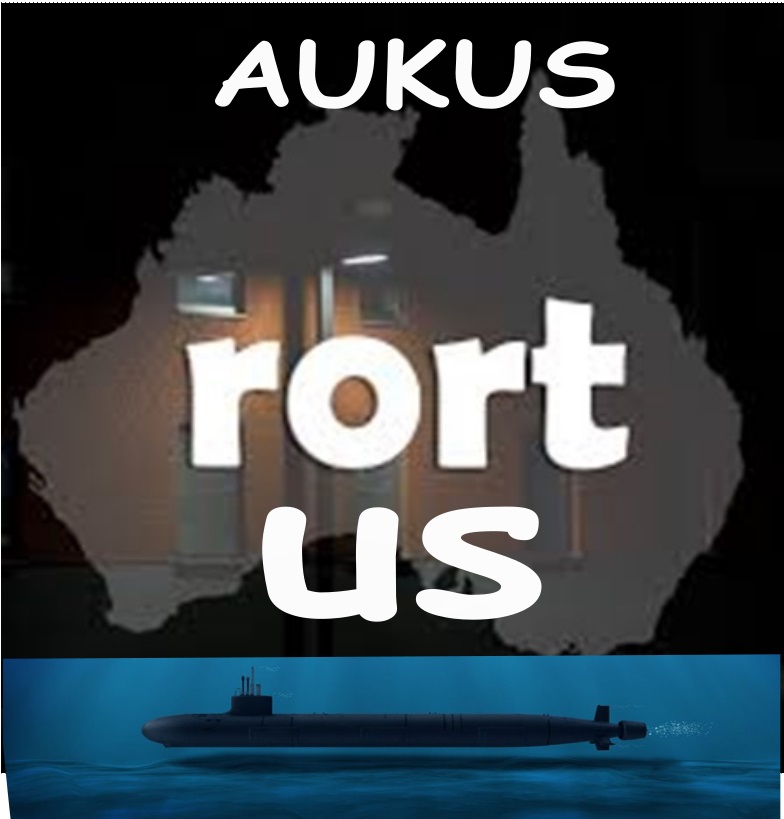
IN May’s Federal Election, Australians voted against dangerous nuclear reactors, so why is the Australian Government persisting with the AUKUS nuclear submarines deal?
More than 30,000 people have signed a petition calling for an independent parliamentary inquiry into the AUKUS pact.
Is it in our national security and best interests?
Now is the time for a parliamentary, given our UK and US partners are also reviewing AUKUS “anomalies”.
Why should Australia splurge $368 billion on submarines that might never be delivered?
Are they the most effective defence strategy or are there better, less expensive options? Submarine reactors use weapons-grade, highly enriched uranium (HEU), so what are the potential environmental and health impacts if they leak radioactive material?
his has been a recurring problem with nuclear reactors in UK submarines.
Submarine patrol routes, exercise and training areas are necessarily secretive, so what are the risks to civilian vessels navigating the same waters?
Between 1982 and 2015, UK civilian sources documented 170 “interactions” between civilian vessels and nuclear submarines including net “snaggings”, collisions, near misses and at least 30 suspicious unexplained sinkings in UK waters.
These incidents have led to loss of life, total loss of vessels and loss of fishing gear.
We need answers and I urge people to sign the AUKUS inquiry petition on the Australia Institute website.
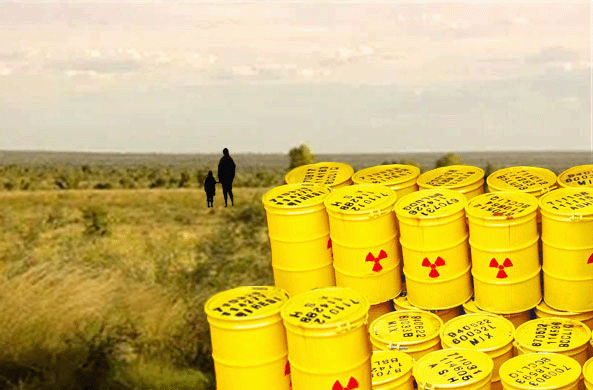
South Australians have a Right to Say No to undemocratic Federal imposed storage of AUKUS High Level nuclear waste in our State. All Federal MPs & Senators from SA, Members of the SA Parliament and candidates for the SA State Election on 21st March should declare their position:
Q: Will you accept or reject Federal imposed storage of AUKUS nuclear waste in SA? The Federal Government quietly took up new AUKUS Regulations (2 Oct) as powers to impose AUKUS wastes by override of State laws that prohibit nuclear waste storage in SA, NT and WA.
AUKUS Regulation 111 “State and Territory laws that do not apply in relation to a regulated activity” names and prescribes our SA Nuclear Waste Storage (Prohibition) Act 2000. The Objects of this key SA Law set out what is at stake: “To protect the health, safety and welfare of the people of SA, and the environment in which they live” from nuclear waste storage.
Federal Labor’s draconian powers to compromise public health, safety and welfare protections. n SA Law, lacks social licence, are an affront to civil society, and damages trust in governance. This is also a threat to Indigenous People with a cultural responsibility to protect their country.
Community expects our State Labor Government to give a clear State Election commitment to protect SA from the risks and impacts of untenable and illegal AUKUS High Level nuclear waste storage, see “The lethal legacy of Aukus nuclear submarines will remain for millennia – and there’s no plan to deal with it” (The Guardian, 10 August 2025, interview with Prof Ian Lowe).
Labor has a further key leadership test ahead of our Election: to commit to support Indigenous People’s human rights, set out in the United Nations Declaration on the Rights of Indigenous Peoples Article 29 (UNDRIP 2007), to “Free, Prior and Informed Consent” over storage of hazardous materials on their lands. AUKUS wastes absolutely are hazardous materials!
a Question for Premier Peter Malinauskas: Will you respect and support Indigenous Peoples Rights to Say No to Federal siting of AUKUS nuclear waste storage on their country in SA?
Call for full disclosure on a N-waste siting process after Labor breaks its commitment: The public has a Right to Know what regions are being targeted for storage of High-Level nuclear wastes. A secretive ongoing Defence review “to identify potential nuclear waste disposal sites” (ABC News March 2023) must be made public ahead of the SA State Election.
AUKUS Minister Marles has broken his commitment to announce a process by early 2024 to identify a site to dispose of AUKUS High-Level nuclear wastes. The failure by Defence to set out any process – other than to take up powers to impose nuclear wastes – is unacceptable.
REPORTER: Is a high-level nuclear waste dump the price that South Australia will have to pay for the jobs that go to the state? (Minister Marles Press Conference 14 March 2023)
MARLES: Well, as I indicated there will be a process that we will determine within the next 12 months for how the site will be identified. You’ve made a leap there, which we’re not going to make for some time. It will be a while before a site is ultimately identified. But we will within the next 12 months establish a process for how we walk down that path.
It is now over 4 years since Federal Labor agreed with Morrison’s AUKUS nuclear sub agenda.
SALabor to let ‘national security interests’ decide siting for AUKUS nuclear waste?
National press reported the Woomera Area to be a ‘favoured location’ for storage and disposal of nuclear sub wastes back in August 2023 (“Woomera looms as national nuclear waste dump site including for AUKUS submarine high-level waste afr.com). WA, Qld and Vic political leaders have rejected a High-Level nuclear waste disposal site in their States, with WA suggesting the Woomera Prohibited Area in SA: “would be one obvious location within the Defence estate, however, we will await the outcomes of the federal review” (SMH 15 March 2023).
Premier Malinauskas has so far only said AUKUS nuclear waste should go to a ‘remote’ location in the “national security interest” (see “Site for high-level nuclear waste dump under AUKUS deal must be in national interest, SA premier says” ABC News 15 March 2023).
The Premier’s “Office for AUKUS” (Letter, 7 Oct 2025) accepts “safe and secure disposal” of High-Level nuclear waste, including spent fuel, produced when subs are decommissioned. The Office says no decision has been made on a location but declines to reveal what is underway, expresses no concerns over unprecedented nuclear waste storage or‘social license’, and expects “community acceptance” (in SA?) for a nuclear ‘disposal solution’:
“I can confirm that no decision has been made on a location within Australia for the disposal of intermediate, or high-level radioactive waste from nuclear-powered submarines. Determining suitable locations and methods for safe and secure disposal will take time, but Australia will do so in a manner that sets the highest standards … and which builds community acceptance for a disposal solution.”
SA is left in the dark, without a say, as an ongoing target for an AUKUS nuclear waste dump.
AUKUS is to store US origin nuclear wastes from 2nd hand Virginia Class subs in Australia:
AUKUS aims Australia take on second-hand US Virginia Class nuclear powered subs in the early 2030’s loaded with up to a dozen years of US origin military High-Level nuclear waste and fissile Atomic-Bomb fuel accrued in operations of US Navy High Enriched Uranium nuclear reactors. Swapping an Australian flag onto this US military nuclear reactor waste places an untenable ‘for ever’ burden on all future generations to have to cope these US nuclear wastes.
Scenario: an AUKUS nuclear dump imposed on SA, High-Level military waste shipped into Whyalla Port to go north, nuclear subs to be ‘decommissioned’ at Osborne Port Adelaide.
Whyalla Port is back on a nuclear waste target range. How else could AUKUS nuclear waste get to a storage site in north SA? The Woomera Area is expected to be on a regional short list for an AUKUS dump, requiring nuclear waste transport routes across SA. Port Adelaide community has a Right to Say No to nuclear decommissioning plans for expanded Osborne submarine yards.
SA politicians must protect SA and rule out both an untenable AUKUS nuclear dump and decommissioning nuclear subs and nuclear reactors at Osborne or else-where in SA.
SA must respect Traditional Owners Human Rights to Say No to imposition of nuclear wastes.
The SA public have Rights to full disclosure and for politicians to have to declare their positions, We need an informed public debate ahead of our State Election. Silence by our political leaders, while a path is paved toward nuclear decisions, makes a nuclear waste dump future more likely.
Info: see Rex Patrick & “AUKUS waste in perpetuity”, and David Noonan in Pearls and Irritations.
Noel’s note for today – When will the public in each country wake up? Governments don’t care – they’re happy to waste taxpayers money on things nuclear, and especially weaponry.
AUSTRALIA.
Subs base enigma– NSW Government doesn’t know what to hide or why.
PLUTONIUM. Los Alamos National Laboratory Prioritizes Plutonium “Pit” Bomb Core Production Over Safety.Some 890 tons of Tepco nuclear fuel kept at Aomori reprocessing plant.
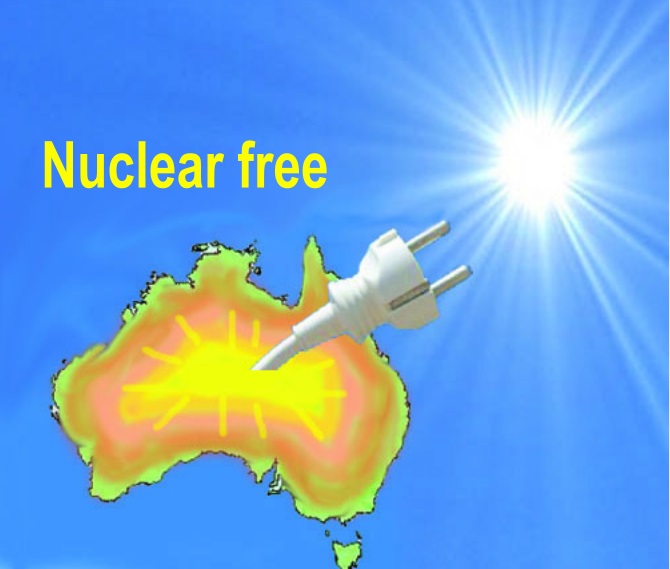
As one of the most advanced solar nations in the world, Australia is well placed to experiment with giving people free power – and if it succeeds, other countries may look to copy its approach
Australians received a welcome surprise this week with the news that every household will soon receive 3 hours of free electricity every day, as part of a world-first initiative to share the benefits of solar power. If successful, it could be a model for other to follow in a future that will increasingly be powered by sunshine.
The Australian electricity grid is zinging with excess capacity during the day thanks to solar power, but it is strained at night when people return from work and use most of their appliances. To address this, the Australian government says its “Solar Sharer” scheme will be rolled out from July 2026 in three states – New South Wales, South Australia and the south-east corner of Queensland – with the rest of the country joining in 2027…………………..(Subscribers only)..…………………. https://www.newscientist.com/article/2503532-australia-is-getting-free-electricity-will-other-countries-follow/
Liberals risk joining ‘baddies’ with fossil-fuel push
CanberraTimes, By Tess Ikonomou, November 9 2025
A senior Liberal has warned his party would push Australia towards joining “baddies” in rejecting international climate goals as it prepares to back fossil fuel-fired power.
Political infighting within the coalition has intensified over the Liberals’ commitment to a target of reaching net-zero emissions by 2050, a position the party is poised to follow junior partner the Nationals in dumping.
The Liberal Party’s formal position on the climate target will be decided following meetings in Canberra mid-week.
Liberal frontbencher and leading moderate Andrew Bragg on Sunday indicated he could quit shadow cabinet if his party decided it would pull out of the Paris Agreement and not maintain a clear goal for lowering emissions.
“If we left Paris, we’d be with Azerbaijan, Iran, Syria, you know, and a few other baddies,” he told ABC’s Insiders program.
“Australia has never been with those people before.
“Australia needs to be in Paris, in my opinion, and then we need to try to find a way to do net-zero better than Labor. That is better for jobs, better for industry, and better for decarbonisation.”
Senator Bragg added the Liberals were “not fringe dwellers” and most Australians want the nation to play a fair role in reducing emissions, an objective seen as key for the party to reverse its electoral decimation in urban seats.
Under the Paris Agreement, signed in 2015, members must increase their emissions targets every five years and cannot water down their goals……………………………………………………………………………………………………….
Opposition energy spokesman Dan Tehan has flagged subsidies could be offered to keep current coal-fired power plants operating for longer under the coalition’s long-awaited climate and energy plan………………………………………………………………………………………………
Mr Tehan also foreshadowed the Liberals would continue their pre-election policy of supporting the development of nuclear power plants.
The Coalition’s favoured energy technology is quite clearly nuclear – perhaps for no other reason than it is not wind or solar.
The Coalition no longer pretends that nuclear is the best option to address climate change, because they are tearing up their agreement on net zero, the softest of climate targets. That may be an admission that nuclear is very slow to build, particularly for a country that has never done so, and is still built on democratic principles.
Nor can they pretend that nuclear is the best technology on economics. Real world examples continue to defy the carefully constructed modelling commissioned by the Coalition.
In the UK, financing has finally been landed for the planned Sizewell C nuclear plant – and it turns out to be £38 billion, or around $A76 billion, for a 3.2 gigawatt facility. That translates to around $24 million a megawatt capacity cost, which is more than twice as much as the Coalition modelling would have you believe.
Sizewell C is expected to be a replica of Hinkley Point C, whose costs are now estimated at up to $A94 billion, and it seems that Sizewell kept its capital costs under control, because the UK government had to step in to take a 44 per cent stake. (The builder, the French government owned EDF, only wanted 12 per cent, because of the cost risks.)
It also changed the nature of the funding game – turning the new nuclear plant into a regulated asset (like Australia’s electricity networks), which will require consumers to start paying for the nuclear plant more than a decade before it is actually built.
Remember, this is the 5th or 6th plant to be built using the French EPR technology – and yet there is no sign of it getting any cheaper. And we haven’t see the inevitable delays and cost blowouts yet. Civil construction costs are blowing up projects all over the world, and nuclear is about as big as they come.
The UN starts another climate party
The Coalition’s anti-climate and no-to-net-zero stance comes as the UN climate conference is poised to start in Belem, Brazil, where UN secretary general Antonio Guterres has lamented “more failure” to do enough to keep the world on track to cap average global warming at 1.5°C.In remarks that might have been addressed specifically at the Coalition, but were directed at the world, Guterres said:
“Too many corporations are making record profits from climate devastation, with billions spent on lobbying, deceiving the public and obstructing progress,” Guterres said.
“Too many (political) leaders remain captive to these entrenched interests,” noting that countries are spending about ($A1.54 trillion) each year subsidising fossil fuels.
“We can choose to lead – or be led to ruin. Every fraction of a degree means more hunger, displacement and loss – especially for those least responsible. This is moral failure – and deadly negligence.”
What is the real target?
Those fractions of a degree are significant. The latest “emissions gap” report published by the UNEP says the world is headed for average of 2.9°C of warming based on current enacted policies, and 2.3°C and 2.5°C based on announced commitments.
What does a world of 3°C look like. Australia’s National Climate Risk report made it clear – catastrophic impacts, rising sea levels, collapsing ice sheets, the destruction of the Great Barrier Reef. Much of northern Australia would be uninhabitable.
Gina Rinehart, who appears to hold so much sway over the Nationals, wants to build a “defence dome” over northern Australia to protect its mineral riches. It might need a geodesic dome just to make it habitable.
What could possibly be done? As the UNEP notes: “The required low-carbon technologies to deliver big emission cuts are available. Wind and solar energy development is booming, lowering deployment costs. This means the international community can accelerate climate action, should they choose to do so.”
Astonishingly, the Coalition battle over net zero has been playing out in mainstream media as nothing more than political porn, focusing on personalities, egos and power. Climate science, and the renewable solutions, have barely been mentioned.
I’ve seen and heard maybe half a dozen interviews with Opposition energy and emissions reduction spokesman Dan Tehan and can’t remember him once being asked about climate science, or the economics and the engineering of the energy transition.
Does Australia really want to host COP31
Sometime in the next two weeks we will get an answer on whether Australia wants to host COP31, the next UN climate talks in 2026.
The plan is to do it in Adelaide, which would be a grand opportunity to show off the world’s most advanced renewable grid, with South Australia already at a world-leading share of 75 per cent wind and solar, and aiming for 100 per cent “net” renewables by 2027.
The state hosted the world’s first big battery and was the first to roll out “grid forming inverters,” which will help kill the need for fossil fuel generators and often has rooftop solar meeting the equivalent of all state demand. None of which was considered possible just a few years ago.
But if it is this hard to agree to a venue (Türkiye still has its hand up), does Australia want the hassle and embarrassment of presiding over a UN conference with no particular landmark goal, squabbling nations and the notable absence of the world’s biggest economy, the US?
Some in the ALP machine are thinking not. The delays and the massive oil and gas projects still being approved and rolled out, could make logistics tricky and the politics difficult. Which would be a shame: It is a rare opportunity for the Pacific Island nations to also have their say.
They have done so before when Fiji was the official host of COP23, but that was – for obvious reasons – held in Bonn, Germany. That might happen again, with Australia and Türkiye sharing “hosting” duties and various lead-up events, expos and talk-fests.
Duck! Free solar is coming your way
As the Coalition tries to tear itself apart over its position on climate and energy, federal energy minister Chris Bowen’s advocacy of “free solar” may turn out to be a political masterpiece – if only because it promises to change the conversation about the green energy transition.
Bowen wants to force energy retailers to offer at least three hours of “free electricity,” taking advantage of the abundance of rooftop and other solar in the middle of the day, and to make sure the benefits are shared with the 60 per cent of households that do not yet have, or can’t have, rooftop solar.
It’s sparked a predictable fury about heavy handed regulation: You can’t do that! And it’s true that some retailers already do offer such a tariff, although potential customers may want to assess the rates that are being charged in the evening peaks.
Morgan Stanley says the implications are significant enough – savings of up to $660 a year for non-solar households able to take up the offer (you need a smart meter and a big enough midday load so it can make sense), and estimates it might cost big retailers like AGL and Origin around $60 million each.
That suggests an uptake of less than 100,000 customers, which sounds about right. But it’s the messaging that counts – both to the long-forgotten consumer, and to the legacy retailers who are reminded they need to be on their toes to negotiate this energy transition.
Customers should no longer be the forgotten part of the energy transition. They now own rooftop PV, and are busy installing batteries and buying EVs. That will accelerate, but the benefits should not be theirs and theirs alone. Sadly, the legacy players sometimes need to be told to do the right thing.
Podcasts to listen to
This week on the Energy Insiders podcast, we talk to Vestas’ Jan Daniel Kaemmer about the prospects for wind industry in Australia, and of course the news of the week. See: Energy Insiders Podcast: The future of wind energy
The world of defence policy is truly on another planet. There, budgets are given to astronomical burgeoning and bizarre readings. Threats can be invented or exaggerated. Insecurity can be inflated. Decisions for the next project supposedly more lethal and more effective than ever can be made with cavalier disregard to realities. And the next cockeyed, buffoonish idea can be given a run for other people’s money. Those other people are, as always, the good tax paying citizenry of a country.
Australia has been doing superbly of late in this regard. It has given over territory and money to the United States, its appointed arch defender, so that the security of Washington’s imperium can be assured. It has done so in a manner suggesting advanced dementia, its politicians and strategists drivelling about the need to combat the barbarian yellow-red hordes to the north in a “changing security environment.”
First came the AUKUS trilateral security pact with the US and the United Kingdom, which enshrines the costly fantasy of nuclear-powered submarines Australia may never get and certainly does not need. Nor is there an obligation on the part of the US to part with any, a prospect ever more unlikely given the failure of its own submarine base to keep pace with annual production. Let’s not even start on the prospects of an AUKUS-designed submarine, which will be lucky to make it to the construction stage without sinking.
To itemise any number of foolish ventures and items being pursued by the Australian defence department would be injurious to one’s well being. This is largely because they keep comingin their risible daftness. Of late, the idea that Australia needs an anti-missile defence shield along the lines of Israel’s Iron Dome system is becoming more than a flirtation. And it’s being given a sense of frisson by Rafael Advanced Defense Systems, the Israeli company responsible for implementing and maintaining it.
The chance for Rafael to shine came at the Indo Pacific International Maritime Exposition, an event running from November 4 to 6. Its presence, along with the Australian subsidiary of Israel’s primary unmanned vehicle manufacturer Elbit Systems, had piqued activists from the Palestine Action Group (PAG), who gathered just before the opening of the exposition to protest that fact.
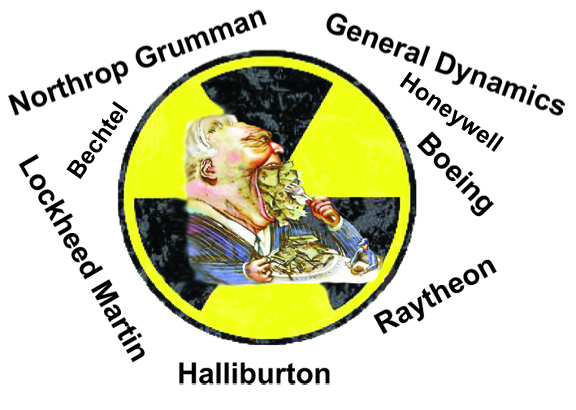
A predictably muscular reaction from the New South Wales police followed. According to PAG organiser Josh Lees, they “immediately attacked” the peaceful gathering with pepper spray and horses. The NSW Premier Chris Minns, for his part, was enthralled by the economic prospects of the gathering: defence exports were there to be grown, deals to be made. That these were with merchants of death was no big matter. “They’re not selling nuclear weapons … we want to see the industry grow.”
For its part, Rafael had pulled out the bells and whistles. The company, according to its display, offered “an integrated, combat-proven portfolio that delivers end-to-end protection and impactful projection for Australia’s naval forces, ensuring freedom of action in Australia’s northern approaches and across vital sea lines of communication.”
In an interview at the exposition, the company’s vice president of international business development, Gideon Weiss, hawked Iron Dome’s technology with salesmanship enthusiasm. “The perception that Australia is far and distant and isolated is completely untrue,” he remarked with stern certitude. “There’s absolutely no reason in the world why any Australian would think… that in a conflict, Australia would not be attacked.” The unasked question here is why Australia would make itself an appealing target to begin with. But Weiss did not break his stride: “Your enemies have a great arsenal of ballistic missiles, hypersonic ballistic missiles, cruise missiles, and long-range UAVs [unmanned aerial vehicles]. Why wouldn’t they use them against you if they wanted to?”
Asked whether the company’s message had bitten in Canberra, Weiss was assured. The “capability and the maturity of the technology” had been noted by Australia’s defence wonks and Rafael was always keen to focus on “sovereignty, about the Australian industrial context.” There was “infrastructure which to Australianise, if you will, these technologies.”
The company has shown ample familiarity with the soil they wish to till. The Australian Defence Strategic Review of 2023 declared the need to “deliver a layered integrated air and missile system (IAMD) operation capability urgently. This must comprise a suite of appropriate command and control systems, sensors, air defence aircraft and surface (land and maritime) based missile systems.” The current program to develop a “common IAMD capability” was “not structured to deliver a minimum viable capability in the shortest period of time but is pursuing a long-term near perfect solution at an unaffordable cost.”
Defence analysts called upon to comment on the matter are slavering. Jennifer Parker, a regular talking head on the subject, rues the fact that Australia can never, given its geographical size, be protected in its entirety. “Unlike Israel, where they can defend the entire country against missiles broadly… that’s not feasible for Australia because of our size.” Focus, she suggests, on the “critical infrastructure elements that we need to protect, like HMAS Stirling, Pine Gap and bases around Darwin, and design integrated air and missile defence around that concept.”
The United States Studies Centre, an Australian outpost soddenly friendly to the military-industrial complex and the needs of the imperium, is also unrelenting about the need for a more expansive missile defence system. Peter Dean, senior advisor on defence strategy, cites “the lack of effective ground-based air defence and an Integrated Air and Missile Defence system” as “the most critical gap in the achievement of Australia’s strategic goals.”
Another outfit most friendly to US interests, the Australian Strategic Policy Institute, is alsomuch in love with missile interception. “If we want to get serious about integrated missile defence,” ASPI senior analyst Malcolm Davis posits, “we need to have long-range, ground-based interceptor missiles that can handle threats like intermediate range ballistic missiles launched by China.”
The next wasteful program of military expenditure looms happily on the horizon, leaving the question of need unanswered. Weiss has good reasons to be optimistic that a train has been set in motion. “I wouldn’t want to name names,” he says with confidence, “but everyone knows us very well.”
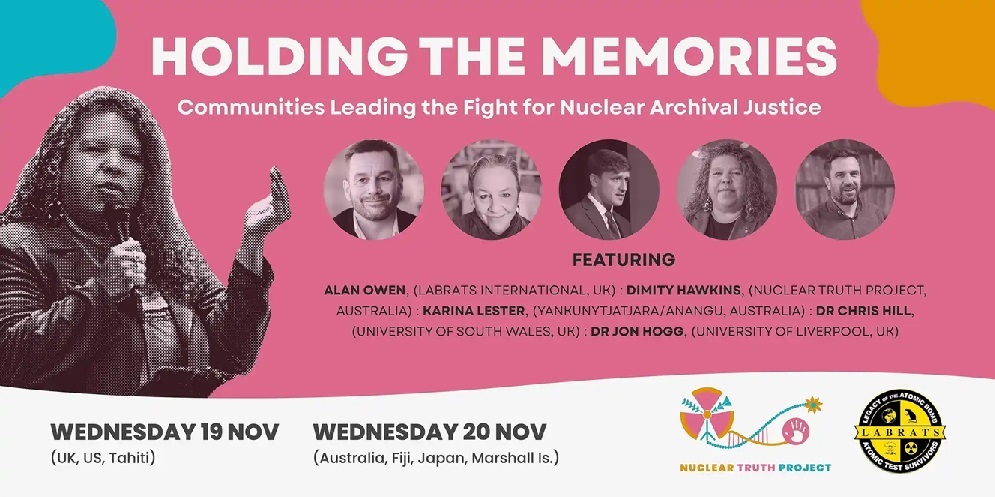
WHEN NEW YORK Wednesday November 19, 4pm, EST LONDON Wednesday November 19, 9pm, GMT MELBOURNE Thursday, November 20, 8am, AEST FIJI/MARSHALL ISLANDS Thursday 20 Nov – 9am FJT & MHT
Karina Lester (Yankunytjatjara-Anangu community leader, Australia)
Dr Chris Hill (University of South Wales, UK)
Dr Jon Hogg (University of Liverpool, UK)
Building on the Nuclear Truth Project’s Challenging Nuclear Secrecy report (2025), this international collaboration brings together affected community members, nuclear justice advocates and organisations from the UK and Australia.
The webinar will explore barriers to accessing nuclear archives and expose the power of community-held memory.
Focusing on British nuclear weapons testing in Australia and the Pacific (1952–1963), the discussion will focus on archival access as a core part of nuclear justice, victim assistance, and environmental restoration.
How do communities impacted by nuclear weapons testing overcome systemic barriers to accessing official records of harm to Peoples and Country?
Join us to learn how memory is held — and fought for — by those most affected.
Getting access to documents concerning a nuclear submarine base in NSW has become an FOI riddle wrapped in a submarine mystery inside a nuclear enigma. Rex Patrick reports.
You can’t have the documents. Hang on, maybe you can? Nope, they’re too sensitive. OK, they’re not sensitive, you can have them all. Except you can’t.
If you’re struggling to follow this, I’ll try to explain. But keep this in the back of your mind – all Australian taxpayers are paying for the Department of Defence’s part in this, and those NSW taxpayers also get to pay the NSW Crown Solicitor’s part.
It started with a single backflip. When I first asked the NSW Government for access to documents relating to the consideration of a nuclear submarine base in NSW, they said I couldn’t have the documents because they were Cabinet-in-Confidence.
When I took the case to the NSW Civil and Administrative Tribunal (NCAT), the NSW Government backflipped. They stated that their Cabinet exemption claim was wrong and asked NCAT if the Government could remake the decision.
Double backflip
The Tribunal said, “Yes, remake your decision”.
A month later, the NSW Government issued me a new decision. No! Again, “you can’t have them”! Across 12 pages of carefully worded legalese, they tried to explain why the public can’t see the documents.
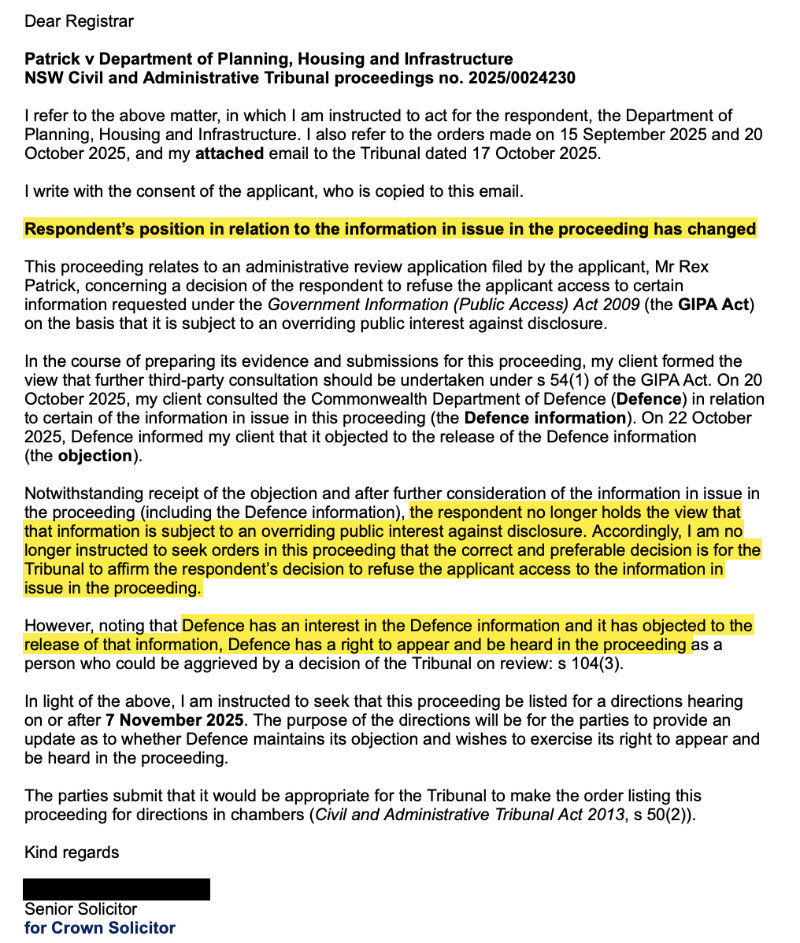
That was September. Fast forward to late October and, out of the blue, the NSW Crown solicitor wrote to me and advised, “the [NSW Government] position in relation to the information in issue in the proceedings has changed … The [NSW Government] no longer holds the view that information is subject to an overriding public interest against disclosure.”
Woo-hoo! Transparency at last. But wait…
Defence secrecy
The email went on to say, “… Defence has an interest in the Defence Information and it has objected to the release of that information. Defence has a right to appear and be heard in the proceedings …”
What secrets?
I am yet to find out the basis of Defence’s objection to releasing the material, but in a very closely related request for information, Defence objected to the release of information because those documents identified or described Defence infrastructure or capability (e.g. base locations, site suitability studies, strategic assessments).
But seriously, how sensitive can a base’s location be? How sensitive can buildings be? In five minutes, anyone with internet access can use Google Earth to avail themselves of the location and layout of HMAS Stirling in Western Australia, where US and UK nuclear submarines are currently visiting.
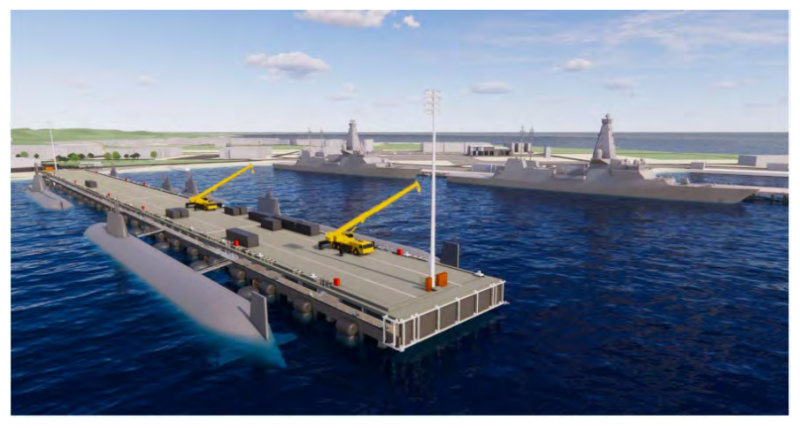
Moreover, the buildings that will support the permanent basing of submarines at HMAS Stirling can be seen by visiting the website of the Federal Parliament’s Public Works Committee.
Yellow peril
But what about the Chinese? Won’t they find out?
Defence may be worried that if the location is known, then the Chinese might buy land next door to the planned base. The problem is, the Chinese have already purchased land in the Port Kembla and Newcastle port precinct.
In fact, Newcastle Port is operated by a consortium with 50% Chinese ownership (98-year lease) through China Merchant Port Holdings;
“they probably already know more about Newcastle Port and its environs than Defence does.”
The Chinese purchases in both cities provide considerable ability for them to monitor and evaluate key infrastructure servicing and capacity developments; high voltage power supply arrangements, natural gas supply details, potable water arrangements, fire water supply details, rail and road access arrangements and area telecommunications.
And the Chinese won’t only have access to future strategic plans for the port areas; their purchases are significant enough that they could help shape those plans, having a seat at the table as interested constituents and ratepayers. We know Chinese officials have already used their property interest to have meetings with the Mayor of Newcastle.
And as for the details of what Australia will need to safely support a nuclear sub force,
“the Chinese already know that from their 50 years of operating nuclear attack subs.“
1×1515
0:05 / 5:59
1×1515
0:05 / 5:59
Getting access to documents concerning a nuclear submarine base in NSW has become an FOI riddle wrapped in a submarine mystery inside a nuclear enigma. Rex Patrick reports.
You can’t have the documents. Hang on, maybe you can? Nope, they’re too sensitive. OK, they’re not sensitive, you can have them all. Except you can’t.
If you’re struggling to follow this, I’ll try to explain. But keep this in the back of your mind – all Australian taxpayers are paying for the Department of Defence’s part in this, and those NSW taxpayers also get to pay the NSW Crown Solicitor’s part.
It started with a single backflip. When I first asked the NSW Government for access to documents relating to the consideration of a nuclear submarine base in NSW, they said I couldn’t have the documents because they were Cabinet-in-Confidence.
When I took the case to the NSW Civil and Administrative Tribunal (NCAT), the NSW Government backflipped. They stated that their Cabinet exemption claim was wrong and asked NCAT if the Government could remake the decision.
A month later, the NSW Government issued me a new decision. No! Again, “you can’t have them”! Across 12 pages of carefully worded legalese, they tried to explain why the public can’t see the documents.
That was September. Fast forward to late October and, out of the blue, the NSW Crown solicitor wrote to me and advised, “the [NSW Government] position in relation to the information in issue in the proceedings has changed … The [NSW Government] no longer holds the view that information is subject to an overriding public interest against disclosure.”
Woo-hoo! Transparency at last. But wait…
Defence secrecy
The email went on to say, “… Defence has an interest in the Defence Information and it has objected to the release of that information. Defence has a right to appear and be heard in the proceedings …”
Backflip, with Defence objection (Source: NSW Crown Solicitor)
What secrets?
I am yet to find out the basis of Defence’s objection to releasing the material, but in a very closely related request for information, Defence objected to the release of information because those documents identified or described Defence infrastructure or capability (e.g. base locations, site suitability studies, strategic assessments).
But seriously, how sensitive can a base’s location be? How sensitive can buildings be? In five minutes, anyone with internet access can use Google Earth to avail themselves of the location and layout of HMAS Stirling in Western Australia, where US and UK nuclear submarines are currently visiting.
Moreover, the buildings that will support the permanent basing of submarines at HMAS Stirling can be seen by visiting the website of the Federal Parliament’s Public Works Committee.
Nuclear Submarine Piers (Source: Defence)
Yellow peril
But what about the Chinese? Won’t they find out?
Defence may be worried that if the location is known, then the Chinese might buy land next door to the planned base. The problem is, the Chinese have already purchased land in the Port Kembla and Newcastle port precinct.
In fact, Newcastle Port is operated by a consortium with 50% Chinese ownership (98-year lease) through China Merchant Port Holdings;
they probably already know more about Newcastle Port and its environs than Defence does.
The Chinese purchases in both cities provide considerable ability for them to monitor and evaluate key infrastructure servicing and capacity developments; high voltage power supply arrangements, natural gas supply details, potable water arrangements, fire water supply details, rail and road access arrangements and area telecommunications.
And the Chinese won’t only have access to future strategic plans for the port areas; their purchases are significant enough that they could help shape those plans, having a seat at the table as interested constituents and ratepayers. We know Chinese officials have already used their property interest to have meetings with the Mayor of Newcastle.
And as for the details of what Australia will need to safely support a nuclear sub force,
the Chinese already know that from their 50 years of operating nuclear attack subs.
But that won’t stop Defence objecting to the release of information that would otherwise be reasonable for the grant of social licence. It’s a department addicted to secrecy (how else are they going to keep their multi-billion dollar procurement blunders from public scrutiny).
A political ruse
Greens Senator David Shoebridge offered his perspective on the Federal Government’s secrecy:
“The Albanese government isn’t worried that China will find out where they want to put another US nuclear submarine base, they are worried the Australian public will. “The community of the Illawarra have already made it crystal clear that a nuclear submarine base has zero social licence to operate at Port Kembla. “The other potential target for Defence is Newcastle, and with a growing revulsion there with the use of the Williamtown F35 hub to arm Israel’s genocide in Gaza, Labor knows that option is also deeply unpopular. “Hiding these documents isn’t about preventing a foreign adversary from organising against Labor’s war plans, it’s about preventing the public opposing them.”
So, despite the NSW Government’s double backflip (which, despite them being cavalier in the first place, I do appreciate), it looks like I’ll have to keep fighting for transparency.
At least the backflips mean I’ll stand at the bar of NCAT with the NSW Government on my side of the argument. Meanwhile, we’ll all keep having to pay for both sets of lawyers, all necessary to keep politically sensitive topics from the public.
Western Australia’s South West Interconnected System – the world’s biggest isolated grid – has reached a remarkable new record high of 89 per cent renewables, led by rooftop solar.
The new peak – 88.97 per cent to be precise – was reached at 11am on Monday, beating the previous record of 87.29 per cent set just a day earlier, and the previous peak of 85.36 per cent set on October 23. “Another milestone for WA’s clean energy future,” Sanderson wrote. “It’s another strong sign of the transformation underway in our energy system as we become a renewable energy powerhouse.”
The Australian Energy Market Operator says the record share was led by rooftop solar, which accounted for 64 per cent of generation at the time. Large scale wind accounted for just over 16 per cent, with the rest from large scale solar, solar battery hybrids, biomass and battery storage.
Former Chair of the UN Commission of Inquiry on the Occupied Palestinian Territory, Judge Navi Pillay has warned that Australia risks complicity in genocide if we fail to act on Israel’s assault on Gaza, Stephanie Tran reports.
Speaking at the National Press Club, the former UN High Commissioner for Human Rights reiterated calls for the Australian government to fulfil its obligations under international law in light of the findings of the UN Commission of Inquiry on the Occupied Palestinian Territory which concluded that Israel’s actions in Gaza meet the threshold for genocide under international law.
‘We are all witnesses to the carnage’
Pillay stressed that every government, including Australia’s, had witnessed the livestreamed atrocities in Gaza unfold in real time and could not claim they “didn’t know” what was happening.
“We are all witnesses to the carnage in real time on our TV screens…. 65,000 Palestinian civilians [have been] killed, including women and children and it was all shown live on our TV sets, so nobody can say we didn’t know what was happening. No Australian parliamentarian could say we didn’t know what was happening. That was the defence the Nazis put up. …That is what some South African whites said.”
The veteran jurist, who presided over the International Criminal Tribunal for Rwanda, said the Commission’s findings were based on verified evidence collected over the past two years. Pillay said that in determining whether Israel had genocidal intent, the panel implemented the legal test established by the International Court of Justice, that genocidal intent is the “only reasonable inference” from the facts.
“We followed UN rules, and we followed the test for genocidal intent. … It must be the only reasonable inference from the acts themselves.”
In September, the Commission concluded that genocidal intent was “the only reasonable inference” from Israel’s conduct, pointing to the military’s use of heavy munitions in densely populated areas, the systematic destruction of cultural and religious sites, and repeated defiance of International Court of Justice (ICJ) rulings ordering provisional measures.
The report also found that Israeli authorities committed four of the five genocidal acts defined by the Genocide Convention, namely killing, causing serious bodily or mental harm, deliberately inflicting conditions of life calculated to bring about the destruction of the Palestinians in whole or in part, and imposing measures intended to prevent births.
Australia’s obligations under the Geneva Convention
Pillay criticised Australia’s muted response to the Commission’s finding that Israel has committed genocide in Gaza.
“Under the Genocide Convention, every state… has the legal obligation to prevent the commission of genocide, to deal with the commission of genocide, and to protect against genocide.”
She called on the Australian government to define and publicise its policy on genocide prevention, warning that the government’s maintenance of ties to entities complicit in the genocide could leave it open to prosecution.
“Be careful what you’re doing,” Pillay said.
Listen to this story
4 min
Former Chair of the UN Commission of Inquiry on the Occupied Palestinian Territory, Judge Navi Pillay has warned that Australia risks complicity in genocide if we fail to act on Israel’s assault on Gaza, Stephanie Tran reports.
Speaking at the National Press Club, the former UN High Commissioner for Human Rights reiterated calls for the Australian government to fulfil its obligations under international law in light of the findings of the UN Commission of Inquiry on the Occupied Palestinian Territory which concluded that Israel’s actions in Gaza meet the threshold for genocide under international law.
‘We are all witnesses to the carnage’
Pillay stressed that every government, including Australia’s, had witnessed the livestreamed atrocities in Gaza unfold in real time and could not claim they “didn’t know” what was happening.
“We are all witnesses to the carnage in real time on our TV screens…. 65,000 Palestinian civilians [have been] killed, including women and children and it was all shown live on our TV sets, so nobody can say we didn’t know what was happening. No Australian parliamentarian could say we didn’t know what was happening. That was the defence the Nazis put up. …That is what some South African whites said.”
The veteran jurist, who presided over the International Criminal Tribunal for Rwanda, said the Commission’s findings were based on verified evidence collected over the past two years. Pillay said that in determining whether Israel had genocidal intent, the panel implemented the legal test established by the International Court of Justice, that genocidal intent is the “only reasonable inference” from the facts.
“We followed UN rules, and we followed the test for genocidal intent. … It must be the only reasonable inference from the acts themselves.”
In September, the Commission concluded that genocidal intent was “the only reasonable inference” from Israel’s conduct, pointing to the military’s use of heavy munitions in densely populated areas, the systematic destruction of cultural and religious sites, and repeated defiance of International Court of Justice (ICJ) rulings ordering provisional measures.
The report also found that Israeli authorities committed four of the five genocidal acts defined by the Genocide Convention, namely killing, causing serious bodily or mental harm, deliberately inflicting conditions of life calculated to bring about the destruction of the Palestinians in whole or in part, and imposing measures intended to prevent births.
Australia’s obligations under the Geneva Convention
Pillay criticised Australia’s muted response to the Commission’s finding that Israel has committed genocide in Gaza.
“Under the Genocide Convention, every state… has the legal obligation to prevent the commission of genocide, to deal with the commission of genocide, and to protect against genocide.”
She called on the Australian government to define and publicise its policy on genocide prevention, warning that the government’s maintenance of ties to entities complicit in the genocide could leave it open to prosecution.
“Be careful what you’re doing,” Pillay said.
“You may one day face charges of complicity in genocide.”
Her comments come amid growing pressure on the Albanese government over Australia’s defence ties with Israel, via the F-35 program and contracts with Israeli weapons manufacturers.
So, the Nationals have decided to stop pretending they care about climate change, and have thrown in their lot with the fossil fuel industries. It should come as no surprise – climate denial, coal and nuclear often go hand in hand.
It is the greed, stupidity and cowardice that stuns the most. This is a party that chooses not to support its regional constituency – those likely to suffer most from the impacts of climate change – but to side with billionaires determined not to let science and the fate of future generations get in the way of making money.
Climate science demands that strong action is needed as quickly as possible to avoid the worst impacts of climate change. This is true for Australia as it is for the rest of the world. Reaching net zero by 2050 is the very least that should be done – we should really be aiming for net zero in the mid 2030s or early 2040s.
The Nationals, though, having rejected near and medium term climate targets, can’t even be bothered kicking the can down the road, which is how many describe the task of net zero by 2050. And like most climate deniers, they voice support for the world’s most expensive, difficult and delayed technology – nuclear energy.
The most obvious technologies, and by far the best in the Australian context, are solar, wind, and battery storage. It is not all we need, but it is the lowest cost and the most readily deployable. The Nationals prefer to look the other way.
It looks, sounds and feels Trumpian. We’ve seen how idiots and ideologues have been promoted to the key roles in the new US administration, and the damage that has been done, the lives that have been lost and will be lost, and the attacks on science, the environment, and the foundations of western democracy.
But we really don’t have to look beyond our own shores to see how this plays out – new right wing governments in Queensland (LNP) and the Northern Territory (CLP) have ripped up renewables targets and ignored climate science to pursue what appears to be a single goal: To further enrich the fossil fuel interests that support them.
Tomago, not pronounced like tomato
This has consequences. The owners of the giant Tomago aluminium smelter last week flagged the possible closure in three years – not because of the transition to renewables, but largely because it has not come quickly enough in NSW.
There is deep irony in this. Rio Tinto believes it has secured the future of its Boyne Island smelter and associated refineries in Gladstone in Queensland by locking in a series of wind, solar and solar battery hybrid contracts – all the biggest of their type in Australia. And there are more to come, we understand.
This was the result of the state Labor government’s pro-active efforts and a common sense approach to the rollout of renewables and renewable zones in the country’s most coal dependent state, although the new LNP government has tried to bugger that up by “calling in” the wind project. It seems a phone call solved that issue.
NSW has arguably more ambitious transition plans – given the size of its grid – and a lot more urgency because of the age of its coal generators.
But behind the ostensibly bipartisan support have been acts of quiet and noisy sabotage – rabble rousing and planning delays – particularly from the Nationals that has made the rollout of wind and solar that much more difficult.
Of course, they are not the only ones to blame. The buyers’ strike by the big energy retailers, the failure of super to invest in their own country’s future, the pathetic coverage of mainstream media have all played their part………
Race to renewables
It is instructive to note the number of industries that are trying to transition to renewables as quickly as they can, to secure their future, like Boyne Island.
Fortescue is charging towards “real zero” – meaning burning no gas or diesel by 2030 to power and operate their iron more mines by 2030, which would be an extraordinary feat if they can pull that off in that time frame.
This is happening at the local level too – the federal battery rebate numbers are now at 108,000 (as of Saturday) and showing no signs of slowing down.
And there is renewed enthusiasm for vehicle-to-grid, essentially using the big batteries in EVs for the same purpose, to act as batteries on wheels. Amber’s Chris Thompson says consumer energy resources – such as batteries and EVs – is the next big wave.
“You really start to see the future forming here, where consumers are actually the backbone of the energy grid,” he says. “They are participating, they are accelerating this renewable transition, and we are desperately trying to work hard to make sure that we can help make it simple and easy for everyone to participate.”
And as ARENA’s Darren Miller noted: “We can expect the level of storage in these vehicles to exceed what we need in the grid by about three times. So all we need is a third of people plugging their cars in and having this technology to essentially provide all of the firming that we need for our grid for our home energy consumption.”
Carter had a simple message on what needs to be done.
“Stop fighting and get aligned for the common good. We need a global carbon platform and market. We can’t keep assuming that dumping manmade greenhouse gases is free or has no consequence,” he said.
Anthony Albanese said the stakes could not be higher.
Banning nuclear weapons, he told delegates at the 2018 ALP National Conference, was the “most important struggle for the human race”.
It was Albanese the activist, showing himself to be a politician of conviction, as he implored the Labor Party to pass a resolution in support of a treaty banning nuclear weapons.
“Labor in government will sign and ratify the UN Treaty on the Prohibition of Nuclear Weapons,” he told the party faithful
“This resolution is Labor at our best.”
The resolution was passed unanimously, but after almost four years in power Labor is yet to honour its promise of signing and ratifying the Treaty on the Prohibition of Nuclear Weapons.
At the National Conference that day in Adelaide, it was Richard Marles who seconded the resolution, albeit with far less passion, saying the treaty was “something we can all agree on”.
But in an interview with Four Corners, the now Deputy Prime Minister has stepped back from this commitment.
Asked why Labor had yet to sign the treaty, he said: “What’s really clear is that the [national] conference understands that this is a decision of government … a decision of Labor in government.”
“The decision that Labor has made in government has been to follow the non-proliferation treaty.”
While complementary to the nuclear weapons ban treaty, the NPT is something entirely different.
It was ratified by the Whitlam government in 1973 and seeks to limit the number of nuclear-armed states rather than put a prohibition on nuclear weapons.
When asked if Labor was still planning to sign the ban treaty, Marles reiterated that the Party “is pursuing the NPT”.
He denied it was a broken election promise, saying the words adopted by the National Conference meant the Labor government would make the final “decision” on signing the treaty.
That was not the impression Albanese gave the National Conference in 2018.
“Progress always requires leadership,” Albanese told the party faithful.
For an extra injection of political theatre that day, Albanese held up a Nobel Peace Prize medal, awarded in 2017 to Australian advocacy group ICAN for its work on the so-called ban treaty.
All this begs the question: why hasn’t the Albanese government signed the ban treaty?
Managing our alliances
The major stumbling block here is Australia’s alliance with the US.
Australia plays a small but crucial role in the US’s nuclear weapons program through defence facilities at Pine Gap and North West Cape, which provide early warning communications and targeting information.
Australia also seeks protection under America’s so-called “nuclear umbrella”, where the US agrees to protect some of its allies. This would be prohibited by the ban treaty.
Another obstacle is some of the language in the latest Defence Strategic Review, which says Australia’s best protection against the risk of nuclear escalation was the “United States’ extended nuclear deterrence”.
Albanese and Marles both clearly understood these issues back in 2018, when they were burnishing their anti-nuclear credentials with the left of the party.
Albanese even addressed such concerns in his speech.
“I am a very strong supporter of our alliance with the United States,” he told the conference.
“The fact is that we can disagree with our friends in the short term, while maintaining those relations.”
He cited the treaty to ban landmines, which Australia signed despite US opposition.
“The United States and many other countries that ended up supporting it today were hostile to the idea,” he said.
The new frontier
The problem for Albanese and Marles is that Australia is at a point in the geopolitical cycle where we are leaning into our alliance with the US, not pulling back.
Anxious that President Donald Trump will abandon the region, Australia is looking for ways to accommodate the US alliance.
That will see the US nuclear-capable B-52 bombers rotating through Tindal air base south of Darwin. In addition, US Virginia-class submarines docking at HMAS Stirling near Perth, could in the future be carrying nuclear weapons……………………….
, the nuclear arms control regime is breaking down.
The New Start treaty, a comprehensive arms control and transparency agreement limiting the US and Russia’s nuclear arsenals, expires in February and there is little prospect of it being renewed.
For Tilman Ruff, a founding member of ICAN whose Nobel Prize Albanese held at the 2018 conference, this only increases the need to sign the ban treaty.
“At a time of weakened international cooperation, it significantly increases the urgency of getting disarmament, preventing nuclear war,” he said.
“The treaty doesn’t prevent military collaboration with a nuclear-armed state. It only prevents collaboration on nuclear weapons.”








 Antinuclear