TODAY. The rise of the Übermensch – the tech gods

Douglas Rushkoff ,in his new book Survival of the Richest: Escape Fantasies of the Tech Billionaires, alerts us to this disturbing phenomenon of our decade – the influence of those super-wealthy individuals – Elon Musk, Bill Gates, Jeff Bezos, Mark Zuckerberg, Sam Altman, Peter Thiel.

Rushkoff explains the extraordinary breadth and power of these men. – “Musk not only owns X and Tesla but also SpaceX, StarLink, the Boring Company, Solar City, NeuraLink, xAI, and someday, he hopes, another finance company like PayPal” “Bezos doesn’t just control Amazon – but the Washington Post, IMDb, MGM, Twitch, Zoox, Kiva, Whole Foods, Ring, Ivona, One Medical, Blue Origin and, of course, Amazon Web Services” “Gates 20bn dollars’ worth of Microsoft stock and assets are Microsoft Azure (his 23% of the cloud), LinkedIn, Skype and GitHub.”
The really worrying thing is that these individuals think that they are experts on everything, and the world seems to be believing this.
Their individual expertise is in each case, in some form of advanced technology. Yet in fact, it is apparent that they are woefully ignorant of just about everything else that really matters. They have no interest in ecology – in the web of life that exists on this planet, and which is essential for human survival. Nor do they have any grasp of the significance of workplace conditions - consider the exploitation of Bezos’ Amazon workers. And they show no understanding of the environmental effects of the tech resource boom.
Yet their fantasies for the future seem to be accepted as realistic propositions: colonies on Mars and the moon, “doomsday” escape settlements, uploading a person’s consciousness to “the cloud”. So media coverage and tax-payers money go to approving and encouraging their schemes.
The part of all this that I find particularly sinister and dangerous is the complete downgrading of studies and expertise that are not highly technical. Studies in ecology, public health, sociology, history, culture and the arts.
We are marvelling at the “genius”, the “success” – of these lop-sided “experts” - all of whom seem to be significantly lacking in common sense. We follow them at our peril .

With the Persecution of Julian Assange Biden Is Overseeing the Silent Death of the First Amendment

By continuing the persecution of Julian Assange, the US government is signaling how little it cares about press freedom.
YANIS VAROUFAKIS, LINA ATTALAH, and JOHN KIRIAKOU, December 25, 2023/January 1, 2024, Issue, https://www.thenation.com/donate-display/?utm_medium=display&utm_source=Display&utm_campaign=2023-eoy&sourceid=1082390&ms=300-600&utm_content=300-600
In early 2024, a new, grim chapter may be written in the annals of journalistic history. Julian Assange, the publisher of Wikileaks, could board a plane for extradition to the United States, where he faces up to 175 years in prison on espionage charges for the crime of publishing newsworthy information
The persecution of Assange is clear evidence that the Biden administration is overseeing the silent death of the First Amendment—with global consequences.
Bob Woodward and Carl Bernstein’s exposé during the Watergate scandal is seen as a triumph of truth over power. Their investigative reporting led to the downfall of President Nixon, cementing their status as champions of press freedom. However, what if this tale had taken a dark turn, with the journalists prosecuted for espionage and silenced under the guise of national security? While this is mere fiction, Assange’s plight is all too real.
Assange, the standard-bearer of our era’s investigative journalism, awaits extradition in a British cell in Belmarsh Prison, a fate that could stifle the beacon of transparency he represents. At a time when the world grapples with the erosion of press freedom, with journalists imprisoned and killed, Assange’s case raises profound questions about the consequences of challenging power and unveiling uncomfortable realities.
The legacy of WikiLeaks goes beyond exposing government misconduct; it pierces the veil of secrecy shrouding global affairs. The release of Collateral Murder, the haunting camera footage from a 2007 Apache helicopter attack in Baghdad showing the murder of several civilians, including two Reuters journalists, shocked the world. As we’ve seen in the past two months, the killing of civilians and journalists in war continues. In the last two months, Israel’s bombardment of Gaza has killed dozens of journalists, according to the Committee to Protect Journalists. On Thursday, human rights groups determined that Israel had deliberately fired on a Reuters journalist in southern Lebanon—a blatant war crime.
The aim of targeting journalists is to keep information where governments want it—under lock and key. That is why Wikileaks is such a threat—because, since its founding, it has fearlessly worked to wrest that information out of the hands of the powerful and put it in the hands of the people.
Wikileaks exposed not only civilian casualties, torture, and other human rights abuses through projects such as the Iraq War Logs, but also published documents that offer invaluable insight into conflicts still raging today. For example, cables released by Wikileaks in the 2010 Cablegate leaks show Israel’s policy towards Gaza in the years following Hamas’s election victory in 2006 and the group’s 2007 takeover of the strip. According to the cable, Israel determined that Hamas’s rise in Gaza would benefit them as it would allow the Israeli military to “deal with Gaza as a hostile state” and so turned down a Palestinian Authority request for assistance in defeating Hamas. Israeli policy to blockaded Gaza was to “keep the Gazan economy functioning at the lowest possible level consistent with avoiding humanitarian crisis.”
This information is essential, and we need more of it. That’s why the three of us, as members of the Belmarsh Tribunal—a group of experts that gathers together at regular intervals to present evidence about Assange’s persecution—are raising our voices together to free the truth and free Assange.
The extradition case against Assange is now entering its final phase, with his final UK court hearing expected in early 2024. He could then be brought to the US to face charges under the Espionage Act. The potential ramifications for power-challenging, truth-seeking journalism cannot be overstated.
The application of the Espionage Act in the US sets a chilling precedent that reverberates far beyond Assange’s individual fate. The silencing of a truth-seeker sends a dangerous message, signaling a decline in the resilience of a free press against the forces of authoritarianism.
The latest meeting of the tribunal is taking place in Washington, D.C., on Saturday. (The Nation is a cosponsor of the event.) One of us, Lina Attalah, the chief editor of the Egyptian publication Mada Masr, is unable to attend in person. Her publication’s reporting of the ongoing assault on Gaza has raised the ire of the US-allied Egyptian state. If the US can imprison those who reveal torture and persecute journalists who reveal truths, what’s to stop the US government’s authoritarian allies?
In defending Assange, we defend the right to know, to question, and to challenge power. The echoes of history remind us that the struggle for press freedom is ongoing, and the fate of Julian Assange is a litmus test for the resilience of truth in the face of oppression. The world needs more journalism that fearlessly confronts power, not less.
The pressure is mounting on the Biden administration to free Julian Assange. It’s not only one man’s life that is at stake, but the First Amendment and freedom of the press itself. As long as the Espionage Act is deployed to imprison those who exposed war crimes, no publisher and no journalist will be safe.
Ralph Nader: ‘Nothing Will Stop Us’

There is only one institution that could stop Netanyahu’s mass military massacres of the Palestinian people. That is the U.S. Congress.
In 2015, over 400 Rabbis from Israel, the USA and Canada called on Prime Minister Netanyahu to stop the practice of demolishing hundreds of Palestinian homes as being contrary to international law and Jewish tradition. Their successors Rabbis for Human Rights are being ignored by the regime.
By Ralph Nader / Nader.org, https://scheerpost.com/2023/12/27/ralph-nader-nothing-will-stop-us/
The unstoppable Israeli U.S. armed military juggernaut continues its genocidal destruction of Gaza’s Palestinians. The onslaught includes blocking the provision of “food, water, medicine, electricity and fuel,” openly genocidal orders decreed by Netanyahu and his extreme, blood-thirsty ministers.
The stunning atrocities going on day after day is being recorded by U.S. drones over Gaza and by brave Palestinian journalists directly targeted by the Israeli army. Over 66 journalists and larger numbers of their families have been slain. Israel has excluded foreign and Israeli journalists for years from Gaza.
This no-holds-barred ferocity came out of the Israeli government’s slumber on October 7th which allowed a few thousand Hamas and other fighters to take their smuggled hand-held weapons and attack soldiers and civilians before being destroyed or driven back to Gaza.
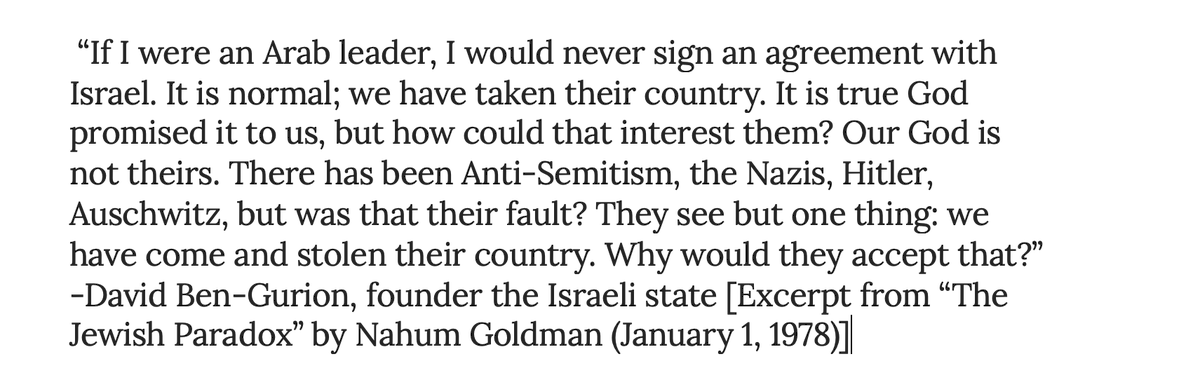
Seventy-five years of Israel military violence against defenseless Palestinians and fifty-six years of violently and illegally occupying their remaining slice of the original Palestine provides some background for Israel’s Founder, David Ben-Gurion’s candid statement: “We have taken their country.” (See, his full statement here).
The overwhelming military superiority of Israel – a nuclear armed nation – in the Middle East has produced a more aggressive Israeli government. Being more secure than ever before doesn’t seem to temper the expansionist missions of right-wing Israeli colonies in the West Bank.
Presently, the narrow Netanyahu majority in the Parliament believes that “nothing can stop us.” Presently, they are right.
Joe Biden and Congress are vigorously enabling the annihilations. The UN is frozen by the Joe Biden administration’s vetoes in the Security Council against ending the carnage in Gaza. The Arab nations either lay in ruins – Syria, Iraq – or are too weak to cause Israeli generals any worry. The rich Arab nations in the Gulf want to do business with prosperous Israel and, other than Qatar, care little about their Palestinian brethren.
The International Criminal Court (ICC) and the International Court of Justice (ICJ) are no obstacle. Israel, along with Russia and the U.S. do not belong to the International Criminal Court. The Palestinian Authority is a party, but the practical difficulties of investigating Israeli war crimes in Gaza and apprehending the accused are insurmountable. The ICJ’s jurisdiction requires a country to bring Israel before the Court for war crimes or genocide. In any event, the Court’s lead-footed procedures trespass on eternity. So much for international law and the Geneva Conventions. Netanyahu rejects the moral authority of seventeen Israeli human rights groups, including Rabbis and reservist soldiers. Their open letter to President Biden in the December 13, 2023 issue of the New York Times on “The Humanitarian Catastrophe in the Gaza Strip” was ignored by the media despite the truth and courage it embodied.
In the U.S., protests and demonstrations are everywhere. Many are organized by Jewish human rights groups such as Jewish Voice for Peace, If Not Now, Standing Together, Veterans for Peace and various student organizations. Everywhere Biden travels there are people from all backgrounds protesting.
A few days ago, the first protests by labor union members occurred in Oakland, California. Union activists could turn their attention to why, for years, union leaders put billions of dollars into riskier lower-interest Israeli bonds rather than U.S. Treasuries or bond funds investing in America. Like U.S. weapon deliveries, purchases of Israeli bonds by states, cities and unions have surged since October 7th.
Pope Francis, informed of the Israeli attack on the only Catholic Church and Convent in Gaza, which housed people with disabilities, killing and injuring Christians sheltering there, sorrowfully said: “Some would say, ‘It is war. It is terrorism.’ Yes, it is war. It is terrorism.”
In 2015, over 400 Rabbis from Israel, the USA and Canada called on Prime Minister Netanyahu to stop the practice of demolishing hundreds of Palestinian homes as being contrary to international law and Jewish tradition. Their successors Rabbis for Human Rights are being ignored by the regime.
The Head of the U.S. Bishops Conference and the National Council of Churches, representing millions of parishioners, condemned the bombings but received little coverage.
There is only one institution that could stop Netanyahu’s mass military massacres of the Palestinian people. That is the U.S. Congress. As long as over 90% of the politicians there automatically support AIPAC, the Israeli Government Can Do No Wrong Lobby, even a peace-loving Joe Biden cannot deter Netanyahu. Bibi (his nickname) could simply say to a hypothetically transformed Biden “Joe, take it up with OUR Congress.”
How has AIPAC achieved such domination on Capitol Hill? By years of relentless lobbying and the smear of “anti-semitism” to anyone defying them. AIPAC and its chapters don’t bother with marches or demonstrations. They personally focus on the legislator – one by one. Carrots or sticks. Praise, PAC money and junkets are the Carrots. The Sticks are smears and money for selected primary challengers in their Districts or States. Rep. Betty McCollum (D-MN) called AIPAC “a Hate Group.”
There are about 300,000 citizens spending significant time back in the states working Congress in AIPAC’s favor. They know the doctors, lawyers, accountants, clergy, local politicians, donors, golf champions and other friends of the Senators and Representatives, and forcefully promote Israeli expansionism backed to the hilt by the U.S. government.
AIPAC is proficient in part for lack of any organized opposition. It is also practicing state-of-the-art non-stop grassroots lobbying.
Congress is poised to send $14.3 billion to Israeli militarism – a “genocide tax” on U.S. taxpayers – without public hearings. While growing public opinion in the U.S. is against unconditional backing of the Israeli regime, it has not changed a single vote in Congress. Someday, more organized support for America’s national interest will.
(For calls to your legislators, the Congressional switchboard is 202-224-3121.)
‘We will coup whoever we want!’: the unbearable hubris of Musk and the billionaire tech bros

Unlike their forebears, contemporary billionaires do not hope to build the biggest house in town, but the biggest colony on the moon,
Today’s billionaire philanthropists, frequently espousing the philosophy of “effective altruism”, donate to their own organisations, often in the form of their own stock, and make their own decisions about how the money is spent because they are, after all, experts in everything.
Guardian, Douglas Rushkoff. 25 Dec 23,
Challenging each other to cage fights, building apocalypse bunkers – the behaviour of today’s mega-moguls is becoming increasingly outlandish and imperial.
ven their downfalls are spectacular. Like a latter-day Icarus flying too close to the sun, disgraced crypto-god Sam Bankman-Fried crashed and burned this month, recasting Michael Lewis’s exuberant biography of the convicted fraudster – Going Infinite – into the story of a supervillain. Even his potential sentence of up to 115 years in prison seems more suitable for a larger-than-life comic book character – the Joker being carted off to Arkham Asylum – than a nerdy, crooked currency trader.
But that’s the way this generation of tech billionaires rolls. The Elon Musk we meet in Walter Isaacson’s biography posts selfies of himself as Marvel comic character Doctor Strange – the “Sorcerer Supreme” who protects the Earth against magical threats. Musk is so fascinated with figures such as Iron Man that he gave a tour of the SpaceX factory to the actor who plays him, Robert Downey Jr, and the film’s director, Jon Favreau. As if believing he really has acquired these characters’ martial arts prowess, in June Musk challenged fellow übermensch Mark Zuckerberg to “a cage match” after Zuck launched an app to compete with the floundering Twitter. Musk and Zuck exchanged taunts in the style of superheroes or perhaps professional wrestlers. “I’m up for a cage match if he is,” tweeted Musk. “Send Me Location,” responded Zuck from Instagram’s Threads.
Billionaires, or their equivalents, have been around a long time, but there’s something different about today’s tech titans, as evidenced by a rash of recent books. Reading about their apocalypse bunkers, vampiric longevity strategies, outlandish social media pronouncements, private space programmes and virtual world-building ambitions, it’s hard to remember they’re not actors in a reality series or characters from a new Avengers movie.
Unlike their forebears, contemporary billionaires do not hope to build the biggest house in town, but the biggest colony on the moon, underground lair in New Zealand, or virtual reality server in the cloud. In contrast, however avaricious, the titans of past gilded eras still saw themselves as human members of civil society. Contemporary billionaires appear to understand civics and civilians as impediments to their progress, necessary victims of the externalities of their companies’ growth, sad artefacts of the civilisation they will leave behind in their inexorable colonisation of the next dimension.
While plans for Peter Thiel’s 193-hectare (477-acre) “doomsday” escape, complete with spa, theatre, meditation lounge and library, were ultimately rejected on environmental grounds, he still wants to build a startup community that floats on the ocean, where so-called seasteaders can live beyond government regulation as well as whatever disasters may befall us back on the continents.
To escape “near-term” problems such as poverty and pollution, Jeff Bezos imagines building millions of space colonies housing trillions of people on the moon, asteroids and in other parts of the solar system, where inhabitants will harvest the resources of space for themselves and those left back on Earth. Elon Musk is convinced he will build a city of a million people on Mars by 2050 at a cost of up to $10bn a person. The ChatGPT impresario Sam Altman, whose board of directors sacked him as CEO before he made a dramatic comeback this week, wants to upload his consciousness to the cloud (if the AIs he helped build and now fears will permit him).
…………………….. as chronicled by Peter Turchin in End Times, his book on elite excess and what it portends, today there are far more centimillionaires and billionaires than there were in the gilded age, and they have collectively accumulated a much larger proportion of the world’s wealth. ………………………………………..
What evidence we do see of their operations in the real world mostly take the form of externalised harm. Digital businesses depend on mineral slavery in Africa, dump toxic waste in China, facilitate the undermining of democracy across the globe and spread destabilising disinformation for profit – all from the sociopathic remove afforded by remote administration.
Indeed, there is an imperiousness to the way the new billionaire class disregard people and places for which it is hard to find historical precedent………………………………………………………………….
At least Zuckerberg’s anti-democratic measures are expressed as the decrees of a benevolent dictator. Musk exercises no such restraint. In response to the accusation that the US government organised a coup against Evo Morales in Bolivia in order for Tesla to secure lithium there, Musk tweeted: “We will coup whoever we want! Deal with it.”
Musk now has the ability to tweet this way as much as he likes: Twitter/X is his own platform. He bought it………………………………………………..
Musk not only owns X and Tesla but also SpaceX, StarLink, the Boring Company, Solar City, NeuraLink, xAI, and someday, he hopes, another finance company like PayPal (which he co-founded with Thiel but then sold to eBay). Similarly, Bezos doesn’t just control Amazon – the world’s biggest ever retailer, if that even does justice to the monolith – but the Washington Post, IMDb, MGM, Twitch, Zoox, Kiva, Whole Foods, Ring, Ivona, One Medical, Blue Origin and, of course, Amazon Web Services, which owns at least one-third of the cloud computing market. Included in Gates’s 20bn dollars’ worth of Microsoft stock and assets are Microsoft Azure (his 23% of the cloud), LinkedIn, Skype and GitHub. He also, incidentally, owns 109,000 hectares (270,000 acres) of US farmland.
This is unprecedentedly broad, or what could be called “horizontal” power. It is success across such a wide spectrum that has given today’s tech billionaires false confidence in the extent of their own expertise. Gates, who regularly dispensed advice on vaccines and public health in television interviews, eventually issued a report in which he graded each country’s pandemic response as if he were a school teacher who knew better than every nation’s department of health (no one got an A).
……………………. Today’s billionaire philanthropists, frequently espousing the philosophy of “effective altruism”, donate to their own organisations, often in the form of their own stock, and make their own decisions about how the money is spent because they are, after all, experts in everything.
Rather than donating to a university, Thiel’s Fellowship pays $100,000 “to young people who want to build new things instead of sitting in a classroom”. Meanwhile, contests such as Musk’s X Prize and Singularity University focus on “exponential technologies” that solve “global grand challenges”. Such moonshots reward the bold thinking that “aims to make something 10 times better”.
Their words and actions suggest an approach to life, technology and business that I have come to call “The Mindset” – a belief that with enough money, one can escape the harms created by earning money in that way. It’s a belief that with enough genius and technology, they can rise above the plane of mere mortals and exist on an entirely different level, or planet, altogether.
……………………………… This distorted image of the übermensch as a godlike creator, pushing confidently towards his clear vision of how things should be, persists as an essential component of The Mindset………………..
Any new business idea, Thiel says, should be an order of magnitude better than what’s already out there. Don’t compare yourself to everyone else; instead operate one level above the competing masses. For Thiel, this requires being what he calls a “definite optimist”. Most entrepreneurs are too process-oriented, making incremental decisions based on how the market responds. They should instead be like Steve Jobs or Elon Musk, pressing on with their singular vision no matter what. The definite optimist doesn’t take feedback into account, but ploughs forward with his new design for a better world. It happens ex nihilo – literally “from zero to one”. So like a supervillain constructing an all-seeing eye, Thiel builds a giant data analytics system, Palantir, through which he can observe and predict threats before they even manifest – all while preparing for Armageddon, just in case.
…………………………………………………… This is not capitalism, as Yanis Varoufakis explains in his new book Technofeudalism. Capitalists sought to extract value from workers by disconnecting them from the value they created, but they still made stuff. Feudalists seek an entirely passive income by “going meta” on business itself. They are rent-seekers, whose aim is to own the very platform on which other people do the work.
……………………………………………………………………. that’s what is really going on here. The antics of the tech feudalists make for better science fiction stories than they chart legitimate paths to sustainable futures. Musk and Zuckerberg challenge each other to duels as a way of advertising their platforms. Musk is less X’s CEO than its troll in chief. They are not gods; they are entertainers.
Instead of emulating them, we should first laugh at them, and then dismiss them. They’re like the contestants in an episode of Survivor, trying to be the last one on the island. It’s perversely amusing, and sometimes hard to look away. It’s the same impulse that leads many Americans to vote for Trump – less because they want him for president than because he will make for better television.
But it’s time to turn off this show, this car accident of a tech future, and get on with reclaiming the world from this new generation of robber barons rather than continuing to fund their fantasies. These are not the demigods we’re looking for.
Douglas Rushkoff is the author of Survival of the Richest: Escape Fantasies of the Tech Billionaires (Scribe). https://www.theguardian.com/books/2023/nov/25/we-will-coup-whoever-we-want-the-unbearable-hubris-of-musk-and-the-billionaire-tech-bros
COP28’s Unrealistic Tripling of Nuclear Power

according to the Bulletin of the Atomic Scientists, the declaration by 22 countries calling for a tripling of nuclear energy by 2050 is more fantasy than reality: “Even at best, a shift to invest more heavily in nuclear energy over the next two decades could actually worsen the climate crisis, as cheaper, quicker alternatives are ignored for more expensive, slow-to-deploy nuclear reactors.” (Bulletin of the Atomic Scientists, Dec. 13th, 2023)
BY ROBERT HUNZIKER, 22 Dec 23, https://www.counterpunch.org/2023/12/22/cop28s-unrealistic-tripling-of-nuclear-power/
UN climate conferences since 1992 have failed to follow thru with results, as CO2 emissions continue higher and higher with every passing year. In fact, post climate conference impact of adopted proposals has become something 0f an inside joke. The most recent conference, COP28, embraced nuclear power as a godsend challenging climate change.
“Triple Nuclear Power” still echoes throughout the halls of COP28. If one stands at the podium in the convention center now empty and listens intently, echoes reverberate “triple nuclear power” spewing out of red-faced maniacs from over 20 countries that committed to tripling nuclear power to bail our global asses out of a crazed climate system of epic proportions.
The US, UK, UAE, and others signed a declaration. Since they couldn’t budge oil and gas, it was decided to favor nuclear power as a surrogate for fixing the rip snorting global heating imbroglio found from pole to pole, from ocean to ocean. It’s real, it’s palpable; it’s now, much earlier than forecasts, as 1.5C prematurely comes to surface during irregular episodes.
Yet, according to the Bulletin of the Atomic Scientists, the declaration by 22 countries calling for a tripling of nuclear energy by 2050 is more fantasy than reality: “Even at best, a shift to invest more heavily in nuclear energy over the next two decades could actually worsen the climate crisis, as cheaper, quicker alternatives are ignored for more expensive, slow-to-deploy nuclear reactors.” (Bulletin of the Atomic Scientists, Dec. 13th, 2023)
Building nuclear power facilities has a long history that unfortunately casts a doubtful shadow over the idea of tripling by 2050. A now-famous plan by Princeton University in 2004 called for a “stabilization wedge” to avoid one billion tons of carbon emissions per year by 2055 by building 700 large nuclear reactors over 50 years.
In 2022, there were 416 operating reactors in the world. Starting in 2005 when the Princeton plan was announced, it would have meant building 14 reactors per year, assuming all existing reactors continued to function. However, over the 50-year cycle aging reactors and those going into retirement would ultimately require 40 new reactors per year. But throughout the entire history of nuclear power, on average 10 nuclear power plants connected to the electricity grid per year, and the number of new units was only 5 per year from 2011-2021.
Once again, like the sticky issue of direct carbon capture, achieving the scale of proposed solutions to climate change’s biggest weapon, or global warming, is beyond reality. Talk is cheap.
Meanwhile less expensive safer wind and solar easily trounce nuclear power’s newly installed output, by a country mile, to wit:
New nuclear energy capacity 2000-2020 42 GWe
New wind capacity from 2000-2020 605 GWe
New solar capacity from 2000-2020 578 GWe
Nuclear costs are prohibitively high: It’ll cost $15 trillion to triple nuclear capacity, assuming existing reactors continue to function, which will not be the case, raising this big bet well over $15T. Who’s putting up $15T?
And is there enough time to triple by 2050? From design to projected operation of the NuScale VOYGR plant takes 13 years. According to the International Energy Agency, the design and build phase for a country’s first nuclear reactor is 15 years. Several countries that signed on to the declaration to triple nuclear power are newbies.
According to a Foreign Policy article, Dec. 13th 2023 entitled: COP28’s Dramatic But Empty Nuclear Pledge: several reasons for skepticism about the nuclear energy triple buildout were enumerated, concluding: “The combination of macroeconomic pressures and regulatory restrictions means that neither pledges such as those made at COP28 nor memorandums of understanding with various industries, utilities, and governments should give anyone much confidence that a major expansion of nuclear energy is forthcoming.”
Nuclear expert Mycle Schneider, the lead author of the prestigious World Nuclear Industry Status Report (500 pgs.) now in in its 18th edition known for its fact-based approach on details of operation, construction, and decommissioning of the world’s reactors was recently interviewed by the Bulletin: Schneider’s publication is considered the landmark study of the industry.
Regarding NuScale, the US-based company that develops America’s flagship SMR (Small Nuclear Reactors), the company initially promised in 2008 to start generating power by 2015. As of 2023, they haven’t started construction of a single reactor. They do not have a certification license for the model they promoted for a Utah municipality. NuScale’s six module facility would cost $20,000 per kilowatt installed, twice as expensive as the most expensive large-scale reactors in Europe. And SMRs will generate disproportionate amounts of nuclear waste. No bargain here, assuming it even works efficiently enough, which is doubtful.
Schneider: “The entire logic that has been built up for small modular reactors is with the background of climate change emergency. That’s the big problem we have.” A sense of urgency cannot be met: “Considering the status of development, we’re not going to see any SMR generating power before the 2030s. It’s very clear: none. And if we are talking about SMRs picking up any kind of substantial amounts of generating capacity in the current market, if ever, we’re talking about the 2040s at the very earliest.”
Schneider on COP’s pledge to triple nuclear power: “From an industrial point of view, to put this pledge into reality. To me, this pledge is very close to absurd, compared to what the industry has shown.”
Looked at another way: “It took 70 years to bring global nuclear capacity to the current level of 370 gigawatts (GW), and the industry must now select technologies, raise finance and develop the rules to build another 740 GW in half that time… Why would anyone spend a single dollar on a technology that, if planned today, won’t even be available to help until 2035-2045?’ said Mark Jacobson, an energy specialist at Stanford University.” (Source: Nuclear Sector Must Overcome Decades of Stagnation to Meet COP28 Tripling, Reuters, Dec. 7, 2023) How about $15 trillion?
COP28 did not deliver on phase down of fossil fuels, and it’ll likely miss on tripling nuclear power. But once the results are finally known, it’s too late. The heat’s already on.
TODAY. Are we ignoring GAZA – the new Auschwitz, as the world ignored Nazi camps from 1933-39?

The “Western world” claimed it didn’t know what was happening in Germany, and beyond, as the Nazis established Dachau in 1933, and then thousands more concentration and forced labour camps, with a major goal being genocide of the Jews.
The weak excuse at the time was that England, USA and others “didn’t know what was happening”. Of course the news crept out – but it took an attack on USA’s Pearl Harbor 1n 1941, to get the Americans interested in stopping Germany .
History is repeating itself – but this time – THERE IS NO EXCUSE!. There is ample news coverage- reporting, photographs, videos, firsthand accounts – of the cruelty, slaughter, starvation, the unimaginable suffering – as the genocide of the Palestinians in Gaza progresses.
How can we possibly celebrate Christmas – “peace on Earth” “good will to all people” at this time?
And we must weep also, for the good Jews, who do not want this to be happening.
Judge Rules Assange Visitors May Sue CIA For Allegedly Violating Privacy

Kevin Gosztola, Dec 19, 2023, The Dissenter
A federal judge ruled that four American attorneys and journalists, who visited WikiLeaks founder Julian Assange while he was in the Ecuador embassy in London, may sue the Central Intelligence Agency (CIA) for their role in the alleged copying of the contents of their electronic devices.
The Americans sufficiently alleged that the CIA and CIA Director Mike Pompeo—through the Spanish security company UC Global and its director David Morales—“violated their reasonable expectation of privacy” under the Fourth Amendment of the United States Constitution.
Richard Roth, attorney for the four Americans, reacted, “We are thrilled that the court rejected the CIA’s efforts to silence the plaintiffs, who merely seek to expose the CIA’s attempt to carry out Pompeo’s vendetta against WikiLeaks.”………………………………………………………………………………………………………………………………………
The U.S. government on behalf of the CIA will likely appeal the decision. Nevertheless, it is a remarkable development because there is a distinct possibility that there may be a civil trial, where CIA spying on Americans is challenged. And all while the U.S. government pushes forward with the unprecedented act of putting a publisher on trial for engaging in journalism. https://thedissenter.org/judge-assange-visitors-may-sue-cia-for-spying/?ref=the-dissenter-newsletter&fbclid=IwAR1S-KR9qxfueGXiIYf0quxldvaXEus_rLZsBUQbwIbPaTmZ_VjSft9KBzI
Ted O’Brien’s fact-free nuclear cheerleading is cover for the same old climate vandalism
For O’Brien’s foray to be something other than time-wasting, oxygen-thieving nonsense, the shadow minister needs to be explicit about how much nuclear costs compared with other technologies.
For O’Brien’s foray to be something other than time-wasting, oxygen-thieving nonsense, the shadow minister needs to be explicit about how much nuclear costs compared with other technologies.
Katharine Murphy Guardian, 22 Dec 23
In huffing and puffing over renewables while denying the measurable costs of nuclear generation, the Coalition is digging in with the politics of relentless opportunism.
The great modernist poet TS Eliot once observed that humankind cannot bear very much reality. He might have been talking about Ted O’Brien, the shadow minister for climate and energy.
O’Brien is a fan of nuclear energy. That’s not a thought crime. I wouldn’t describe myself as a nuclear fan – but I know we might need every available technology, including nuclear, to reduce emissions in a manner consistent with the goal of limiting global heating to 1.5C. There are lots of things in life that we don’t love, but might need – nuclear energy is one of those things. I’m yet to be persuaded that Australia needs it given the other abundant resources we have, but I’m open…………………………………………………………………………………………
If I were the federal minister for climate change, I’d remove the legislative ban on nuclear energy and instead regulate the well-documented safety risks through other legislative means. Chris Bowen has a different view. Nuclear lacks a social licence in Australia. It is also prohibitively expensive. Given these two facts, why would you chew up valuable policy bandwidth (a finite commodity when you are trying to correct 10 years of obstruction and regression) looking at the nuclear ban, when you can accelerate actual, achievable risk mitigation right now? When it comes to the energy grid, Australia can execute the necessary transition much more rapidly using firmed renewables – a significantly cheaper technology that the community actually supports.
Bowen’s position is entirely logical.
………………………This week, a new analysis from the CSIRO, in collaboration with the organisation that runs the power grid, the Australian Energy Market Operator, found that electricity generated by solar and onshore wind is the cheapest in Australia. This remans the case even when you factor in the expenses associated with bolting renewables into the power grid. This same analysis found smaller nuclear reactors was the most expensive form of technology considered in the exercise.
O’Brien wasn’t happy. Big feelings ensured. Huffing and puffing. Renewables might be the cheapest form of energy for investors, “but not for consumers.” O’Brien felt the “big investors that come into Australia to make money from utility scale wind and solar projects can look after themselves, but it’s Australian households that I care about – even if Chris Bowen doesn’t.”
Dude. Come on. Can we be grownups?
Nuclear power is expensive. This is not a bolt from the blue, nor a conspiracy promulgated by the wild wokeists of the world. It’s a well-established fact. These things can be measured.
When John Howard asked businessman and nuclear physicist Ziggy Switkowski to scope out nuclear power in the mid-2000s, Switkowski concluded the government would need to legislate a carbon price to make the technology economical. Obviously energy verities have evolved over a couple of decades, but Switkowski maintained his point about the significant expense of conventional nuclear reactors in 2019, when he contributed a submission to a parliamentary committee chaired by (wait for it) O’Brien. Switkowski’s view in 2019 was that there might be commercial opportunity for small modular reactors in some parts of Australia, but “we won’t know until SMRs are deployed in quantity during the late 2020s.”
While we are on facts, here’s another one. The only company to have a small modular nuclear power plant approved in the United States has recently cancelled its first project due to rising costs.
Rounding out the picture, a centre-right thinktank recently acknowledged there was no prospect of nuclear energy playing a role in Australia before 2040. As my colleague Adam Morton has pointed out, Aemo says renewable energy could be providing 96% of Australia’s electricity by that time.
So, let’s inhabit reality. Please. It really doesn’t seem that much to ask.
Persisting with reality, if the Coalition wants to propose an Australian nuclear option seriously (as opposed to pretending to explore something while weaponising large scale renewable developments that can reduce emissions now) then lots of things need to happen.
For O’Brien’s foray to be something other than time-wasting, oxygen-thieving nonsense, the shadow minister needs to be explicit about how much nuclear costs compared with other technologies.
If he’s concerned about the high energy costs Australian households are facing, O’Brien needs a plan to pay for his preferred nuclear generation. If the government is paying, then consumers are actually paying through their taxes. Also: where do the reactors go? Where is waste stored? How is the industry regulated?
In the absence of substance and transparency, the Coalition is continuing to have a lend of the Australian people. You’d think a couple of decades having a lend of Australians on an existential issue would be enough, but apparently it isn’t.
In the Abbott era, things were simpler. It was acceptable to wonder out loud whether climate change was crap. Now, the Coalition has to say it supports net zero. It has to suggest nuclear could be the magic bullet to get us there. (Sort of) committing to nuclear, then, provides a measure of cover for the same old vandalism – thwarting the renewable technology the Coalition has spent two decades thwarting.
This isn’t a contention. Like the costs of nuclear, political behaviour can be measured. The Coalition is now leading the charge, with One Nation, against offshore wind developments in the Hunter Valley. …………………………………………………………………………………… https://www.theguardian.com/australia-news/2023/dec/23/ted-obrien-nuclear-cheerleading-renewables-climate-vandalism
Netanyahu’s Palestinian Genocide Is Also a Betrayal of the Jews
SCHEERPOST, December 21, 2023
Larry Gross offers his experience and thoughts on the growing calls of anti-Semitism against critique of Israel’s ongoing bombing of Gaza.
Apart from the death, destruction and suffering bestowed upon the Palestinian people in Gaza by the hands of the Israeli government, an ideological battle is taking place around the world, especially in the United States, where Jewish people face discrimination, prejudice and attacks on their identity by the hands of other Jews.
Former University of Pennsylvania—where former president Elizabeth Magill has just resigned because of this very issue—deputy dean Larry Gross and host Robert Scheer, “two old Jews,” as Scheer puts it, discuss the troubling, McCarthyite times that are transpiring now in the wake of the October 7th attacks and the subsequent daily bombardment of Gaza.
“It’s an attempt to silence opposition through a kind of rhetorical intimidation, and nobody should accept it. It is shameful and wrong and I would say it’s embarrassingly ignorant when the U.S. Congress votes for a resolution that defines criticism of Zionism as anti-Semitic,” Gross said.
The simple and objective realities that Jews like Gross and Scheer discuss could now be construed as anti-Semitic, despite them being Jewish. This “card,” Gross and Scheer argue, along with the “Holocaust card,” is illogical and stifles crucial dialogue.
Gross says “it is intellectually bankrupt, morally reprehensible and politically opportunistic,” while Scheer pleads “this idea that the U.S. Congress could tell even Jewish people that if you dare criticize this political movement of Zionism that you’re anti-Semitic, this is one of the greatest distortions of thought.”
“They pull out their victim card and accuse anybody who criticizes them of anti-Semitism. And as you know, if you’re Jewish, then you’re a, what do they call it, self-hating Jew? That’s the kind of trick psychoanalysts play, which is you can’t win no matter what you say,” Gross said.
Despite their vast experience with both Judaism as a religion and Israel as a state, with Gross spending eight years growing up in Israel and Scheer reporting on the Six-Day War when it happened, their contributions to the discussion of the war on Gaza can now be labeled and disregarded, thanks to the efforts of people like Elise Stefanik against university presidents in Congress and the rest of the establishment figures who uncritically take Israeli government officials’ words as fact.
Robert Scheer …………………………………………… If you are not Jewish, they’ll tell you you’re anti-Semitic. But even if you’re Jewish, they’ll tell you you are self-hating or anti-Semitic……………………………
Larry Gross ……………………………. (Jews are) famous for debate, dispute and argument. In fact, it’s sort of built into the centuries long tradition of Judaism………………………………… there is no uniform Jewish orthodoxy that everybody is expected to adhere to…………………………………….
…………………………….. there has been a consistent use of what might be called and has been called playing the Holocaust card that whenever the subject of Israel’s behavior externally or internally, particularly internally, comes up, the sort of importance of Israel: because Holocaust, because we need this because of the Holocaust, etc. is is played.
…………………………………And there are a number of problems with that. One of which is that at least half of the citizens of Israel come from communities and/or countries of origin that had nothing to do with the Holocaust, that were never in Europe, that were basically Middle Eastern Muslim countries…………………………………………………………………. . So Israel is not a collection of Holocaust survivors, as sometimes is implied.
……………………………..the key point today is that, to put it bluntly and crudely, the Holocaust card doesn’t work anymore, particularly for young people.
………………………………………….. So, I think the the Israeli effort to portray itself as needing to be militant and aggressive in the way that it has been, has run out of, you know, sort of moral authority and in fact, ceded the the role of victim, no longer held by the Jews, but held by the Palestinians whose lives they are constraining and controlling in ways that very much resemble the apartheid system in South Africa.
……………………………………… if you operate on a rhetoric of victimhood, the victims that we can see today are not Jews.
…………………………………….. But yes, so 1,200, let’s say Israelis were slaughtered in an obscene war crime by Hamas fighters on October 7th. But by now, the Israelis have killed, I don’t know, upward of 15, maybe by now, 20,000. ………………………………………………
Gross You know, using the kind of carpet bombing that just a year or so ago, we were decrying, condemning Russia for using in the Ukraine, except worse.
…………………………………………………………..just incidentally, one of the best examples, one of the biggest successes of the Israeli efforts to undermine political opposition through bogus claims of anti-Semitism is their collusion with politicians in Britain to get rid of Jeremy Corbyn. To undermine an actual leftist who was the head of the Labor Party and who was undermined by the centrist members of the Labor Party with the active support and participation and help of the Israelis in mounting bogus claims that Corbyn was anti-Semitic despite his entire record of support for causes.
………………………………………………. And incidentally, as long as we’re on the subject of, you know, sort of Israeli backstage political maneuvering, it is by now documented that Israel was supporting Hamas for years. Israel was allowing Qatar to funnel billions of dollars to Hamas. And Netanyahu is recorded on tape talking about how we support Hamas to to counter the Palestinian Authority……………………………………………………………………………
Scheer……………………………………………. the irony here, the deep irony is that we never really came to grips with the actual Holocaust, meaning the elimination, the death, the destruction of 6 million Jews. And that was at the hands of primarily a Christian Europe. As you point out, this was not a Muslim crime and it did not happen in the Mideast.
……………………………………………… But the terrible thing here is for those of us who come out of a secular or liberal or reformed Jewish tradition, this is a denial of the universalist human rights values. And that’s why young people are rebelling against this, because they accept that human rights are universal, whether it applies to Ukrainians or applies to anybody in the world,
Gross ………………………………. the religious parties have always succeeded in controlling important aspects of Israeli life, public and private, in terms dictated by religion, not by secular law.
……………………………………………….I mean, the extreme religious orthodoxies in Israel have become much more militant in a non-democratic fashion. And this is one of the reasons that the Israeli public has been protesting long before October 7th and since then but for more than a year or so since there have been demonstrations against this anti-democratic, religious parties.
……………………………………………………………. And what we suddenly had from ’67 on and with accelerating force was ultra orthodox Zionism, ethno-nationalist Orthodox Zionism. And they’re the ones who were pushing the eradication of the Palestinian communities on the West Bank. They care much more at the West Bank than they do about Gaza…………………… they’re engaged there in apartheid chopping up of the land and various forms of what I think could appropriately be called ethnic cleansing, trying to kick people out, to appropriate their land, to push them out on religious grounds. And incidentally, this is again, important because Israel and its allies in their P.R. are very dishonest about this…………………………………………………………………….
Scheer. ………………………………………………………….You get to blame the Palestinians. And I want to ask you, as a professor, as somebody who comes out of the university, you look at what’s going on now, people are afraid to speak up. That’s my experience……………………………………………………………………………………………………………………………………………………………………………………………………………….
Gross. ………………………………………………. the incredible failures of Netanyahu’s government has been this unleashed calamity in Gaza. They are making Gaza unlivable on purpose. In the delusion, illusory notion that somehow all of those Palestinians will leave and go somewhere else…………………………………….
Scheer. …………………………… I think that’s an important point on which to end and it goes back to the universalism of Jewish values of an oppressed people. The Palestinians are the Jews of the modern world, that probably can get you fired. ………………………………………………….. more https://scheerpost.com/2023/12/21/netanyahus-palestinian-genocide-is-also-a-betrayal-of-the-jews/
Ukraine losing 800 troops a day – ex-NATO officer

https://www.rt.com/news/589421-ukraine-losses-attrition-morale/ 22 Dec 23
Kiev’s manpower is “significantly worn out” as Russia’s “strategy of attrition” is taking effect, a former German Air Force Colonel has said.
Around 800 Ukrainian troops are being killed and wounded daily amid the conflict with Russia, retired German Air Force Colonel and prominent military analyst Ralph D. Thiele has claimed.
In an opinion piece for Focus magazine on Wednesday, Thiele, who used to serve in the personal staff of NATO Supreme Allied Commander Europe, claimed that Kiev needs to recruit more than 20,000 soldiers every month in order to replace its dead and injured. He did not reveal his sources or basis for his calculations, however.
Ukraine also requires additional personnel to be able to rotate its troops on the frontline, so that “exhausted soldiers” may recover and units may replenish their material supplies, he wrote.
According to Thiele, who now heads the Political-Military Society, EuroDefense (Germany) and StratByrd Consulting think tanks, “the highly motivated defense” and subsequent counteroffensive, which he described as “a thing of the past,” came at a “high price” for Ukraine.
Kiev’s manpower and hardware are “significantly worn out,” he said. “Western weapons systems are not miracle weapons and are wearing out,” the analyst added.
The worsening battlefield situation and decreasing Western support for Kiev are “eating away at the morale” of the Ukrainian troops, who “will have to save ammunition in a war of attrition and endure slaughter at the front without rest and without a greater sense of achievement,” Thiele stressed.
Russia has also lost “a large number of soldiers and huge amounts of material” during the conflict, but “it has much more of both than Ukraine,” he argued.
“Step by step, Russia’s superiority in the conflict with Ukraine is becoming more visible,” the analyst acknowledged. Moscow’s “strategy of attrition” is “taking effect” in terms of personnel, material, ammunition and morale, he said.
Thiele’s number of 800 Ukrainian soldiers being lost per day appears to be higher than the one announced by Russian Defense Minister Sergey Shoigu at the expanded meeting of the Defense Ministry’s Board on Tuesday. According to Shoigu, some 400,000 Ukrainian troops have been killed or wounded since the start of the fighting in late February 2022. This means that, according to Russian figures, Kiev’s daily losses stand at around 600 servicemen.
Russian President Vladimir Putin, who chaired the meeting, stressed that “we can say with confidence that our troops have the initiative” on the frontline with Ukraine. “In essence, we are doing what we consider necessary, what we want. Wherever… commanders decide active defense is best, it takes place. And where it is needed, we improve our positions,” Putin explained.
Day X Marks the Calendar: Julian Assange’s ‘Final’ Appeal

December 22, 2023, by: Dr Binoy Kampmark https://theaimn.com/day-x-marks-the-calendar-julian-assanges-final-appeal/—
Julian Assange’s wife, Stella, is rarely one to be cryptic. “Day X is here,” she posted on the platform formerly known as Twitter. For those who have followed her remarks, her speeches, and her activism, it was sharply clear what this meant. “It may be the final chance for the UK to stop Julian’s extradition. Gather outside the court at 8.30am on both days. It’s now or never.”
Between February 20 and 21 next year, the High Court will hear what WikiLeaks claims may be “the final chance for Julian Assange to prevent his extradition to the United States.” (This is qualified by the prospect of an appeal to the European Court of Human Rights.) Were that to take place, the organisation’s founder faces 18 charges, 17 of which are stealthily cobbled from the aged and oppressive US Espionage Act of 1917. Estimates of any subsequent sentence vary, the worst being 175 years
The WikiLeaks founder remains jailed at His Majesty’s pleasure at Belmarsh prison, only reserved for the most hardened of criminals. It’s a true statement of both British and US justice that Assange has yet to face trial, incarcerated, without bail, for four-and-a-half years. That trial, were it to ever be allowed to take place, would employ a scandalous legal theory that will spell doom to all those who dive and dabble in the world of publishing national security information.
Fundamentally, and irrefutably, the case against Assange remains political in its muscularity, with a gangster’s legality papered over it. As Stella herself makes clear, “With the myriad of evidence that has come to light since the original hearing in 2018, such as the violation of legal privilege and reports that senior US officials are involved in formulating assassination plots against my husband, there is no denying that a fair trial, let alone Julian’s safety on US soil, is an impossibility were he to be extradited.”
In mid-2022, Assange’s legal team attempted a two-pronged attempt to overturn the decision of Home Office Secretary Priti Patel to approve Assange’s extradition while also broadening the appeal against grounds made in the original January 4, 2021 reasons of District Judge Vanessa Baraitser.
The former, among other matters, took issue with the acceptance by the Home Office that the extradition was not for a political offence and therefore prohibited by Article 4 of the UK-US Extradition Treaty. The defence team stressed the importance of due process, enshrined in British law since the Magna Carta of 2015, and also took issue with Patel’s acceptance of “special arrangements” with the US government regarding the introduction of charges for the facts alleged which might carry the death penalty, criminal contempt proceedings, and such specialty arrangements that might protect Assange “against being dealt with for conduct outside the extradition request.” History shows that such “special arrangements” can be easily, and arbitrarily abrogated.
On June 30, 2022 came the appeal against Baraitser’s original reasons. While Baraitser blocked the extradition to the US, she only did so on grounds of oppression occasioned by mental health grounds and the risk posed to Assange were he to find himself in the US prison system. The US government got around this impediment by making breezy promises to the effect that Assange would not be subject to oppressive, suicide-inducing conditions, or face the death penalty. A feeble, meaningless undertaking was also made suggesting that he might serve the balance of his term in Australia – subject to approval, naturally.
What this left Assange’s legal team was a decision otherwise hostile to publishing, free speech and the activities that had been undertaken by WikiLeaks. The appeal accordingly sought to address this, claiming, among other things, that Baraitser had erred in assuming that the extradition was not “unjust and oppressive by reason of the lapse of time”; that it would not be in breach of Article 3 of the European Convention on Human Rights (inhuman and degrading treatment)”; that it did not breach Article 10 of ECHR, namely the right to freedom of expression; and that it did not breach Article 7 of the ECHR (novel and unforeseeable extension of the law).
-ADVERTISEMENT-
Other glaring defects in Baraitser’s judgment are also worth noting, namely her failure to acknowledge the misrepresentation of facts advanced by the US government and the “ulterior political motives” streaking the prosecution. The onerous and much thicker second superseding indictment was also thrown at Assange at short notice before the extradition hearing of September 2020, suggesting that those grounds be excised “for reasons of procedural fairness.”
An agonising wait of some twelve months followed, only to yield an outrageously brief decision on June 6 from High Court justice Jonathan Swift (satirists, reach for your pens and laptops). Swift, much favoured by the Defence and Home Secretaries when a practising barrister, told Counsel Magazine in a 2018 interview that his “favourite clients were the security and intelligence agencies.” Why? “They take preparation and evidence-gathering seriously: a real commitment to getting things right.” Good grief.
In such a cosmically unattached world, Swift only took three pages to reject the appeal’s arguments in a fit of premature adjudication. “An appeal under the Extradition Act 2003,” he wrote with icy finality, “is not an opportunity for general rehearsal of all matters canvassed at an extradition hearing.” The appeal’s length – some 100 pages – was “extraordinary” and came “to no more than an attempt to re-run the extensive arguments made and rejected by the District Judge.”
Thankfully, Swift’s finality proved stillborn. Some doubts existed whether the High Court appellate bench would even grant the hearing. They did, though requesting that Assange’s defence team trim the appeal to 20 pages.
How much of this is procedural theatre and circus judge antics remains to be seen. Anglo-American justice has done wonders in soiling itself in its treatment of Britain’s most notable political prisoner. Keeping Assange in the UK in hideous conditions of confinement without bail serves the goals of Washington, albeit vicariously. For Assange, time is the enemy, and each legal brief, appeal and hearing simply weighs the ledger further against his ailing existence.
Nuclear Power Fanatic Peter Dutton Shows Off His Nuclear-Powered Christmas Lights
Saying it was the most credible way to power a suburban Christmas light display, Peter Dutton has posted a picture of the Christmas lights at his Brisbane home, with a barely noticeable nuclear power plant in the background.
“I’m seeing a lot more of those ugly solar panels on roofs these days. So I wanted to show Australians what a nuclear-powered option looked like. You can hardly notice it at all,” Dutton said.
He said Australians were making a mistake in rushing towards renewable energy options, instead of the more practical option of nuclear. “People are are mucking around with sun and wind, when the more sensible solution of splitting an atom in a nuclear fission reactor in Australian suburbs is right there in front of us. Or behind me, in my case”.
More serious governance failures in Defence contracting
The pattern of poor governance by Defence has been further exposed following disturbing revelations in yet another contract.
MICHELLE FAHY, DEC 23, 2023 https://undueinfluence.substack.com/p/more-serious-governance-failures?utm_source=post-email-title&publication_id=297295&post_id=140001297&utm_campaign=email-post-title&isFreemail=true&r=1ise1&utm_medium=email
It was revealed this week that Defence Department officials congratulated themselves for not recording minutes of a critical meeting in which the work of consultants it had hired was being checked against the contract.
Incredibly, the failure to record minutes was noted as a positive in a post-implementation review of the project, with the only negative point listed being that the donuts arrived too early in the meeting.
This serious accountability failure is a breach of Defence’s contracting rules and the Commonwealth Procurement Rules, adherence to which is fundamental to good governance.
The failure to keep minutes of the key meeting means there’s no official record of who attended the meeting, in what capacity, and what contribution they made.
It was just one of a raft of irregularities found in a $100 million contract between the Defence Department and KPMG, which is part of the One Defence Data program, following a damning review by external consultants, Anchoram Consulting.
Some of the irregularities described in the review bear striking similarities to those found in Defence’s controversial Hunter Class frigate procurement from BAE Systems, Australia’s largest ever surface warship acquisition, which has been referred to the National Anti-Corruption Commission following a scathing report by the auditor general.
One of the grounds for the corruption referral was the absence of a number of important accountability documents, including minutes of key decision making meetings, related to the Hunter Class frigate procurement process. (Read full story on the $46 billion frigate procurement here and here.)
The Australian National Audit Office report on the frigates noted that the Defence Department was a serial offender when it came to deficient record-keeping. The auditors footnoted a comment from the Commissioner for Law Enforcement Integrity that a “lack of record keeping can create corruption vulnerabilities within an Agency”.
A lack of record keeping can create corruption vulnerabilities
Another revelation in the Anchoram review was that Defence had made “a six-figure payment” to KPMG “for work the government knew had not been delivered”.
Similarly, as the audit office revealed in May, during the frigate procurement process the Defence Department made milestone payments to BAE Systems even though BAE had missed the milestones.
Anchoram revealed that the KPMG project was plagued by a “lack of accountability” and “real and perceived conflicts of interest”. Core governance documents were not signed off and key requirements of KPMG’s contract were diluted from “mandatory” to “desirable”, sometimes in consultation with KPMG itself, despite Defence requirements stating explicitly that mandatory items cannot be changed.
Furthermore, Anchoram concluded that “the Commonwealth has a significant risk that it absolved [KPMG] from its commercial obligations and consequently transferred delivery risk from [KPMG] to the Commonwealth.”
The review said the Commonwealth’s ability to govern the One Defence Data program’s financials and ensure value for money had been “significantly compromised”.
Similarly, with the frigate procurement process, Defence sidelined the central procurement rule of achieving value for money. Numerous conflicts of interest and revolving door appointments, including the secretive involvement in the frigate tender evaluation process of people formerly employed by BAE Systems (as I reported exclusively in July) prefigure the serious governance issues exposed by Anchoram in Defence’s cosy arrangement with KPMG.
The Anchoram Consulting report, dated April 2022, has been released publicly this week following an order from independent senator David Pocock to the Defence Department.
Meanwhile, the Parliamentary Joint Committee of Public Accounts and Audit is conducting an inquiry into Defence’s frigate procurement process.
Labor MP Julian Hill, the chair of the committee, has stated: ‘It does feel like someone has back-engineered a decision and gone, “we want to go with BAE”…’.
The Anchoram Consulting report on the One Defence Data program can be downloaded here.
The ‘Greater Israel’ Scheme And Its Global Power Play: A Delusional Recipe For Armageddon

AuthorMatthew Ehret, The Last American Vagabond,
In 1996, a nest of American-born imperialists revolving around Paul Wolfowitz, Dick Cheney, Donald Rumsfeld, and Richard Perle created a new think tank called “The Project for a New American Century.”
While the principled aim of the think tank ultimately hinged on a new “Pearl Harbor moment” that would justify a new era of regime-change wars in the Middle East, a secondary but equally important part of the formula involved the dominance of “Greater Israel” Likud fanatics then taking power over the murdered body of Yitzhak Rabin.
It was toward the start of the new regime of Prime Minister Benjamin Netanyahu that Richard Perle wrote the report “Clean Break: A Strategy for Securing the Realm,” which outlined a series of goals that would govern the strategic vision of Washington and Tel Aviv for the next two decades. It called for:
Canceling the foundations for the Oslo Accords that threatened to bring about a climate of peace through economic cooperation in the Middle East under a two-state solution- Launching a new doctrine of “right of hot pursuit” justifying armed incursions into Palestinian territories
- Inducing the United States to overthrow Saddam Hussein’s regime in Iraq
- Armed incursions into Lebanon and possible strikes against Syria and Iran
In 2007, General Wesley Clark added even more detail to this neocon program when he revealed the content of a discussion he had with Wolfowitz and Rumsfeld 10 days after 9/11. General Clark stated that he was told of planned invasions of seven countries scheduled to take place within five years… namely: “Iraq, Syria, Lebanon, Libya, Somalia, Sudan, and Iran.”
This program was, in short, a recipe for establishing the long-awaited “Greater Israel” promoted by the likes of Theodor Herzl, Vladimir Jabotinsky, and Rabbi Abraham Isaac Kook over a century ago.
While the Anglo-Zionist timeline was disrupted over the ensuing years (sometimes involving brave intervention by individuals within America’s intelligence community), the intention embedded in “Clean Break” never disappeared.
With the coming breakdown of the over-inflated Western financial system on one side and the emergence of a viable new multipolar security and economic architecture on the other side, it appears the ghouls that orchestrated 9/11, assassinated Rabin (1995) and Arafat (2004), and revived the Crusades have decided to kick over the chess board.
Conducting a rational analysis of the motives for this type of dynamic poses a major difficulty for any geopolitical commentator used to thinking in academically acceptable terms, which presume that rational self-interest animates the players within a game. In this case, rational self-interest is infected by heavy doses of self-delusional Hegemonism, fanatical imperial zealotry, and end-times eschatology with a Messianic twist (taking both Christian and Jewish forms).
Sifting out Order from Chaos
Netanyahu and his neocon (see: uniparty) supporters in America and Britain appear to be supportive of Israel’s ambition to provoke a vast regional war on one hand, while also believing that perhaps they will be able to use Israel as a wedge to disrupt Russian and Chinese-led development corridors (BRI, short for Belt and Road Initiative, and International North-South Transport Corridor) on the other hand.………………………………………………………………………………………………………………………………………………………………………………………………………………………………………..
If Israel wishes to have full control over Gaza’s maritime oil/gas reserves, it can only achieve its goal if the legal owners and beneficiaries living in Gaza disappear.
On October 13, 2023, a policy paper authored by Israel’s Ministry of Intelligence was leaked. It recommended “the forcible and permanent transfer of the Gaza Strip’s 2.2 million Palestinian residents to Egypt’s Sinai Peninsula,” as +972 reported.
The paper laid out three possible scenarios for the people of Gaza. The first involves the replacement of Hamas with the Palestinian Authority in Gaza. The second involves the emergence of a new local Gaza authority (not Hamas or PA), and the third includes the expulsion of all civilians into Egypt. The report clearly identifies the third scenario as the most preferable option. The report’s authors write that this third option “will yield positive, long-term strategic outcomes for Israel, and is an executable option. It requires determination from the political echelon in the face of international pressure, with an emphasis on harnessing the support of the United States and additional pro-Israeli countries for the endeavor.”
Of course, US support for moving Gazans into the Sinai Peninsula began literally minutes after October 7. This would create a serious problem for future retaliation by extremely radicalized and traumatized people whose families have been killed by Israel’s crimes for decades. Hamas’ Qatar-based Muslim Brotherhood leadership of multi-billionaires would then easily be able to coordinate with Egypt’s Muslim Brotherhood to act as agent provocateurs attacking Israel.
The Muslim Brotherhood has served as a major organizing force led by Anglo-Zionist intelligence for decades, was instrumental in orchestrating the Arab Spring, and supported the overthrow of Bashar al-Assad.
Perhaps if this was still 1996, and no powerful coalition of Russia, China, and Iran existed to defend Egypt against the threatened Anglo-Zionist war, then perhaps the PNAC Clean Break Strategy for Securing the Realm might be possible. The decision to ignore reality by rehashing this obsolete program implies the height of incompetence, which threatens to grow far beyond a regional war and into a global thermonuclear conflagration more quickly than many imagine.
This foreshadowing of a prophetic global war to usher in the Messiah (as many Christian rapturists dream of), was outlined in depth by Greater Israel advocate and Jabotinsky collaborator Rabbi Abraham Isaac Kook 100 years ago.
Kook was Britain’s selection for the Chief Ashkenaz Rabbi for Jerusalem and Palestine from 1919 to 1935, and his influence in shaping several generations of radical Zionist zealots that took over control of much of Israel’s government after the inside job that was the Six Day War is immense. His prophetic remarks should not be easily dismissed. In his book Orot, Kook said:
“In wars, national characters crystalize. Israel, as the universal reflection of mankind, benefits thereby. The heels of Messiah follow upon World Conflagration… At the hour of the downfall of Western civilization, Israel is called upon to fulfill its divine mission by providing the spiritual basis for a New World Order.” [emphasis added]
The only hope to avoid this calamity and disrupt this flight toward an Armageddon scenario steered by End Times Messianic cultists is to force a ceasefire, as Russia, China, and the vast majority of world citizens (even Americans) demand.
Without this restoration of sanity, the world as a whole will be in for an experience that will make the 14th-century Dark Age appear to be an uncomfortable hiccup in world history. https://www.thelastamericanvagabond.com/greater-israel-power-armageddon/
What? Ukraine Is Not Winning the War? The Narrative Turns. Now What?

Patrick Lawrence ScheerPost, December 20, 2023.
“Putin’s Russia is closing in on a devastating victory. Europe’s foundations are trembling.”
This was the headline atop a Dec.9 commentary in The Telegraph, the farthest right of the major London dailies. The subhead elaborated the theme in yet graver terms: “Kyiv’s counteroffensive has ended in failure. This could be NATO’s Suez moment.” The piece that followed included all sorts of goodies in this line.
It is not official, not yet, that Ukraine’s grand counteroffensive, the great Russophobic hope of the Zelensky and Biden regimes earlier this year, has proven a bust and that defeat is in the offing. The closest we have to such an admission came from Volodymyr Zelensky earlier this month, when the Ukrainian president declared that the counteroffensive “did not achieve the desired results.” I loved that moment, to be honest. It reminded me of Emperor Hirohito’s famous declaration on August 15, 1945, when he announced the surrender on Japanese radio. “The war,” he told his desperate subjects, “has not necessarily progressed to our advantage.”
O.K., let’s leave Zelensky to Zelensky, Joe Biden to Joe Biden, and Antony Blinken to Antony Blinken. We can count news of failure unofficially official when mainstream media start dropping such news on their readers and viewers. The Telegraph, so far as I know, was the first big daily on either side of the Atlantic to make such blunt admissions. Others have already followed, if in gentler, more oblique language—in Zelensky-speak, this is to say.
A significant moment may be upon us. What will follow once it is acknowledged that the Nazi-infested crooks in Kyiv have failed? President Biden, as is his consistently unwise wont, radically overinvested in the proxy war he chose to start with the Russian Federation as soon as he took office three years ago next month. Having defined the Ukraine conflict as a war in the name of democracy and freedom —“values” rather than interests, this is to say—he has left the U.S. and its European clients no room for compromise and nearly none even for negotiation. What is the next move when defeat is too obvious any longer to deny?
If we are about to enter uncharted territory, will it prove dangerous ground? It may, but this is not yet clear. It will be uncertain and probably unstable: This we know. Of the many things I do not like about this circumstance, I will mention a few straightaway. Biden may be the stupidest president of the postwar era on the foreign policy side: He exhibits no capacity whatsoever for nimble or imaginative thought. He is a warmonger of long standing, an election year is upon us, and he is by now in obvious danger of being impeached. His mental incompetence, atop all this, is plain for all to see. ………………………………………………………………………………………………………
‘“People Snatchers:’ Ukraine’s Recruiters Use Harsh Tactics to Fill Ranks,” appeared Dec. 15. In it, Thomas Gibbons–Neff describes how plainclothes goons have taken to kidnapping draft-age Ukrainian men, some with mental or physical disabilities, and forcing them into the military induction process. This is sometimes done at gunpoint. People are taken off the streets, at factory gates, from inside shop:
Recruiters have confiscated passports, taken people from their jobs and, in at least one case, tried to send a mentally disabled person to military training, according to lawyers, activists and Ukrainian men who have been subject to coercive tactics. Videos of soldiers shoving people into cars and holding men against their will in recruiting centers are surfacing with increasing frequency on social media and in local news reports.
The harsh tactics are being aimed not just at draft dodgers but at men who would ordinarily be exempt from service — a sign of the steep challenges Ukraine’s military faces maintaining troop levels in a war with high casualties, and against a much larger enemy.
Lawyers and activists say the aggressive methods go well beyond the scope of recruiters’ authority and in some cases are illegal. They point out that recruiters, unlike law enforcement officers, are not empowered to detain civilians, let alone force them into conscription. Men who receive draft notices are supposed to report to recruitment offices.
We are reading here about a desperate regime that has sent too many of its able-bodied to their deaths and is now running out of bodies.
A day later, Carlotta Gall, with several colleagues sharing the byline, published “Ukrainian Marines on ‘Suicide Mission’ in Crossing Dnipro River.” Here we read about incensed grunts at the front condemning the Kyiv regime’s incessant propaganda as to the military’s progress against Russian forces. Again this is very effective reporting:
Soldiers and marines who have taken part in the river crossings described the offensive as brutalizing and futile, as waves of Ukrainian troops have been struck down on the river banks or in the water, even before they reach the other side …
In the case of the Dnipro, President Volodymyr Zelensky of Ukraine and other officials have suggested recently that the marines have gained a foothold on the eastern bank. The Ministry of Foreign Affairs posted a statement last month claiming they had established several strongholds.
But marines and soldiers who have been there say these accounts overstate the case.
“There are no positions. There is no such thing as an observation post or position,” said Oleksiy, who withheld his last name. “It is impossible to gain a foothold there. It’s impossible to move equipment there.”
“It’s not even a fight for survival,” he added. “It’s a suicide mission.”
…… The Times is not yet prepared to state plainly that Kyiv is not far from defeat. But, in that way, The Times thinks American readers must be gently prepared for bad news, as if we are a nation of kindergartners—well, let’s not “go there”—we are being so prepared.
…………………………………………………………..In plain English, the kind you and I speak: The Biden regime has no idea what to do in the face of failure, but, as failure cannot be admitted, it must be dressed up as a new strategy.
………………………………………………………………The significance of the moment is in large part in the collapse of the propaganda. ………………………………..more https://scheerpost.com/2023/12/20/patrick-lawrence-what-ukraine-is-not-winning-the-war/
1 This month
25 October – Film –Britain’s Nuclear Bomb Scandal: Our Story – part of the Adelaide Film Festival,
Screening and Conversation
A screening of Britain’s Nuclear Bomb Scandal: Our Story (2024) followed by a talk with 2026 Bettison and James Awardee and Tradtional Owner Karina Lester in conversation with Simone Tur.
When: Sun 25 Oct, 12:00pm-Screening, 1:15pm-Talk
Where: The Mercury
Free admission, register below by clicking on BUY TICKETS and select free event tickets, at end of web page:
https://www.adelaidefilmfestival.org/program/2026/britains-nuclear-bomb-scandal-our-story
.

Australians deserve the truth
about
AUKUS – https://aukuspublicinquiry.com/

PETITION – To: Prime Minister Anthony Albanese and the Australian Labor Government

of the week – Australians for War Powers Reform (AWPR)
To see nuclear-related stories in greater depth and intensity