NUCLEAR WASTE – PLANNING RESPONSIBLY FOR THE FUTURE
Dr. Margare Beavis . Medical Assiction for the Prevention of War, 2 Sept 23
MAPW welcomes the Federal Court decision in July to completely set aside approval of the proposed interim national radioactive waste facility at Kimba in South Australia.
We thank the Barngarla Traditional Owners who took this legal action. The Federal Court ruled that former Resources Minister Keith Pitt’s declaration of the Kimba site was affected by apprehended bias. We also acknowledge the work of the “No Radioactive Waste on Agricultural Land in Kimba or SA” group and so many others.
We welcome the decision by Resources Minster Madeleine King not to appeal the court ruling on the 10th of August.
In a shamefully delayed public reassurance, on the same day as the minister’s decision, ANSTO noted it will have sufficient storage capacity for their radioactive waste until a purpose-built facility is established, and that there is no threat to production and supply of nuclear medicines at the Lucas Heights reactor. Lucas Heights has the best facilities, experience and security to hold this waste until a permanent disposal facility is developed.
Now is the right time for a new more responsible approach
The Australian government should now embark on something we have never had: a rigorous, transparent, open to the public and experts, evidence-based, accountable process that comprehensively considers the production and management of radioactive waste in Australia now and in the future and establishes a comprehensive, long-term, best-practice national plan for radioactive waste management, including permanent disposal. Such a process will be required to gain community licence for a permanent national disposal site; considerable trust has to be rebuilt.
We must not repeat yet again the multiple failed attempts by federal ministers to impose a radioactive waste dump on a remote Aboriginal community. We should seek to minimise the future production of intermediate and high-level radioactive waste. We should avoid double-handling of waste, as was planned at Kimba. International experience shows that accidents and theft of radioactive materials occurs most often during transport. Intermediate Level Waste (ILW) and High Level Waste (HLW) present much greater challenges than low level waste (LLW). It is likely that disposal of ILW and any HLW will be most effectively, cost-effectively and securely managed in the same facility. Australia should not store or dispose of radioactive waste from other countries. ARPANSA is the body which should provide regulatory oversight for radioactive waste management in Australia.
We need to recognise the extremely long-term nature of highly toxic ILW. The vast majority of this waste is at Lucas Heights (3753 m3), with a very small volume in non-government sites (industry 3 m3, hospitals 1 m3 and none in research institutions). This waste has been safely stored for decades so there is time for responsible planning.
Future production of ILW at Lucas Heights
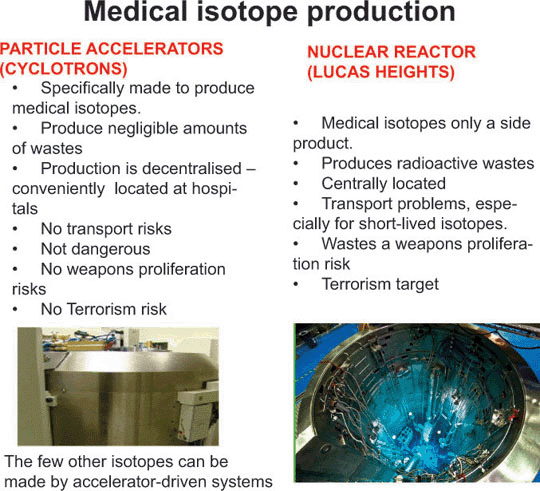
There are now much cleaner accelerator rather that nuclear reactor-based methods for producing nuclear isotopes that are medically and commercially approved internationally. These are the future of production of isotopes for medicine and science. Australia needs to adopt and deploy these methods. ANSTO’s current massive expansion to export reactor-produced nuclear isotopes is nowhere close to true cost recovery and will leave future generations with vastly more ILW than cleaner and cheaper accelerator-based production.
High level nuclear waste
Australia does not currently possess any HLW. However, Australia is to be burdened with a large amount of high level nuclear waste under the proposed acquisition of second-hand US nuclear-powered Virginia-class submarines and then submarines built under the AUKUS agreement. The proposed acquisition of nuclear-powered submarines is very high risk and problematic on many levels, but needs to be borne in mind in planning radioactive waste management.
Currently, all US and UK naval nuclear reactors utilise highly enriched uranium (HEU) fuel. It is therefore likely that proposed new SSN-AUKUS submarines will also be fuelled by HEU. This raises substantial proliferation concerns and risks and complicates implementation of nuclear safeguards. It also means that the naval reactor waste would still be HEU and still be weapons-usable. This adds not only a radiological dimension to the long-term danger of HLW but also a substantial security dimension, as this waste will need to be stored not only contained to minimise any risk to health and the environment over the geological timeframes of its toxicity, but will also need to be subject to military levels of security effectively indefinitely.
Fukushima Daiichi adds Insult to Injury for the Pacific’s Coral Reefs.
September 1, 2023 by Kevin Hester
As the El Niño builds to a terrifying crescendo, that won’t peak before April 2024, the Pacific’s Coral Reefs will become stressed, and a bleaching event will unfold as it did in the 2016 El Niño. What is our response? TEPCO and the Japanese government have decided to dump 1.3million tons of radioactive water into my beloved Pacific Ocean. After careful consideration the criminal cohort in Japan have decided to take the cheapest option and dump the radioactive sludge into the adjacent Pacific Ocean.
In the video above, I mentioned that Sea Surface Temperatures hit 38C off the coast of Florida. Here’s the evidence:
“Sea surface temperatures of more than 38C (100.4F) have been recorded off the coast of Florida – potentially setting a new world record.” Sea temperature off Florida reaches 38C- potentially a world record.
Almost every coral reef in the Northern Hemisphere is under stress.
Daily Global 5km Satellite Coral Bleaching Heat Stress Degree Heating Week
…………………………………………. We discussed the compounding consequences of the Pacific Ocean being irradiated thanks to TEPCO, the Japanese Government and Fukushima Daiichi. The very same people who triggered this disaster, by building a sea wall half the size their own analysis called for.
My Polynesian neighbours are furious. Niue and Tuvalu ‘concerned, dismayed, disappointed’ with Fukushima release
A bottomless pit of public money for the UK government’s nuclear vanity project
In response to Nuclear Minister, Andrew Bowie’s announcement of an
additional £341m government support for the Sizewell C project, TASC
deputy Chair, Pete Wilkinson, said “There seems to be a bottomless pit of
public money when it comes to funding Sizewell C, so besotted is the
government with this already redundant nuclear vanity project.
Not so for cash-strapped public sector workers though. The £341m recently announced,
taking taxpayer funding over an eye-watering £1.2bn, is apparently
designed to speed up preparations for construction of a plant which has yet
to receive dozens of licences and permits – not the least of which is the
Office for Nuclear Regulation’s permission to build on a site threatened by
climate change impacts – and is still subject to determination of an
outstanding legal challenge.
Put another way, it is public money to be
spent on the destruction of a coast which is designated as an area of
outstanding natural beauty for a project which may still not happen. It
also claims that it will ‘help to drive Putin further out of global
energy markets’, apparently missing the point that uranium supplies –
essential for the mythical nuclear renaissance and already at peak supply –
come largely from Russian-influenced countries, so out of the oil and gas
fire into the uranium frying pan.
As for the ‘rapid expansion of UK
nuclear energy’, the fantasy of 24GW from nuclear, should it ever be
attempted, will be cripplingly expensive and generate a mountain of waste
for which there is no universally acceptable disposal route, in short, a
recipe for future financial and environmental disaster rather than energy
security”
TASC 30th Aug 2023
The Fukushima Nuclear Disaster Still Casts a Shadow Over Japan


The “great powers” in the past had given island peoples repeated assurances that there would be no risk to health or environment from testing or dumping. Those peoples watch sadly now as Japan does likewise, engaging in intense propaganda efforts to line up regional states to endorse its wastewater dumping campaign.
The Jacobin, BYGAVAN MCCORMACK 2 Sept 23
Twelve years after the Fukushima disaster, Japanese authorities have started pumping wastewater from the plant into the ocean. They insist there’s no danger to public health, but Japan’s neighbors are up in arms about the controversial plan.
In 2011, Fukushima Daiichi Nuclear Power Plant, roughly 250 kilometers north of Tokyo, was hit by a magnitude 9.0 quake and tsunami. Three reactors stopped immediately, but the loss of electricity supply led over the following days and months to breakdown of the cooling system and to a series of hydrogen explosions and meltdowns of the cores of Reactors 1 to 3.
Prime Minster Kan Naoto feared for the worst. He faced the possible need to evacuate the whole Kanto region, including the Tokyo metropolitan area. Japan itself, its state and society, stood on the brink of catastrophe. That fate was only narrowly averted………………………
The Half-Life of Catastrophe
The flow of water to cool the debris polluted with various forms of radioactivity has had to be maintained to this day. Over the past twelve years, some 1.34 million tons of water have accumulated and is being held in a vast array of more than one thousand tanks along the coast of Fukushima prefecture.
Those tanks are now about 98 percent full, but the flow of contaminated water will have to be continued for at least the next three decades, or until such time as the site can be cleaned up. Nobody today can say with any confidence when that might be.
The polluted waters contain sixty-four radioactive elements, or radionuclides, the ones of greatest concern being carbon-14, iodine-131, caesium-137, strontium-90, cobalt-60, and hydrogen-3, also known as tritium. Some have a short life and might already have ended, but others take longer to decay, with a half-life of more than five thousand years in the case of carbon-14………………………………………………….
The Cheapest Option
In 2016, the Japanese government considered multiple methods of treating the water. Ruling out simple continuation of the status quo — more and more tanks along an already crowded seafront — there seemed to be three options: ocean discharge, atmospheric discharge, and underground burial. The estimated cost was 34.9 billion yen to release the problem materials as gas into the atmosphere, 24.3 billion to dig a deep hole and bury it, but just 3.4 billion to pour it out gradually into the sea…………………………………………………
Anxiety, alarm, and increasingly anger have been spreading, both within Japan itself (and especially in the Fukushima vicinity that bore the brunt of the initial 2011 disaster) and on the part of Japan’s Pacific neighbor states: China (including Hong Kong), Korea (both north and south), Russia, the Philippines, and the mini-states of the South Pacific, with eighteen countries and regions. In Japan, just 44 percent of people said they had “no worries” over the release, while about 75 percent said the government had not properly explained what it was doing.
The Japanese government had promised it would take no step without duly consulting all concerned parties. Yet it proceeded to ignore that principle both when it came to its own citizenry (especially those employed in its once-vibrant fishing industry) and in relation to its Pacific neighbors, whose shores are washed by the same Pacific waters.
Under Control”
True, the United Nations’ International Atomic Energy Agency (IAEA) has provided helpful cover for the Japanese government and the Tokyo Electric Power Company (TEPCO) by taking the view that the environmental impact of the discharge would be “negligible.” That judgment, however, is neither surprising nor decisive.
The IAEA, founded in 1957, is an organization devoted to the propagation of “safe” civil nuclear energy. Japan is its third-largest source of its funds, and the future of the global nuclear industry depends on there being seen to be a “final solution” to the problems posed by Fukushima………………
Though it has received little attention in media coverage of the problem, a small but significant body of scientific opinion has begun to express severe criticism of the IAEA for failing to apply its own fundamental principles. One paper accused the agency of being in some important respects “at least 10,000 times in error,” neglecting to give proper consideration to the nondumping solutions, and “grossly overstating well-known facts” in its “eagerness to assure the public that harm will be ‘negligible.’”
When Japan’s then prime minister Abe Shinzo told the world in September 2013 that Fukushima was ‘under control,’ he lied.
According to the paper’s author, Arjun Makhijani of the Institute for Energy and Environmental Research, a very different approach is required:
The IAEA should, starting with Japan, provide guidance to nuclear power-possessing countries to stop dumping so that the oceans that have been much abused in so many ways for so long can at least have a chance to begin recovering.
When Japan’s then prime minister Abe Shinzo told the world in September 2013 that Fukushima was “under control,” he lied. Until 2018, all attempts to locate the missing reactor cores, let alone to place them “under control,” had failed. Only in 2021 did it become possible at least to locate the debris in one reactor.
However, knowing the location is just the start. Now we know where it is, we are no closer to knowing how to deal with it. The recovery effort for two of the reactors will not commence until 2024.
If they succeed in locating the debris, estimated to be about 880 tons, it will then have to be extracted, gram by gram. Meanwhile, as of 2023, between four and five thousand workers are mobilized each day to perform various high-risk tasks in the disaster zone.
People of the Ocean
The “great powers” in the past had given island peoples repeated assurances that there would be no risk to health or environment from testing or dumping. Those peoples watch sadly now as Japan does likewise, engaging in intense propaganda efforts to line up regional states to endorse its wastewater dumping campaign.
Japan’s word today rings as hollow to Pacific Island peoples as that of the United States or France once did. Even the Japanese people themselves have “little trust in TEPCO or the Japanese Government” when it comes to Fukushima wastewater dumping, according to Suzuki Tatsujiro, former vice chairman of the Japan Atomic Energy Commission.
Japanese governments far into the future are to be bound now by the decisions taken by the current administration and by the process launched on August 24. The support given to Japan’s ocean dumping by prominent Western industrial countries strikes Pacific Islanders as hypocritical. Motarilavoa Hilda Lini is chief of the Turaga nation of Pentecost Island, Vanuatu, and an activist with the Nuclear Free and Independent Pacific (NFIP) movement. She put it this way:……………………………………………………………. more https://jacobin.com/2023/09/fukushima-nuclear-reactor-radioactive-waste-japan-ocean
Australian theatre company stages On the Beach, Nevil Shute’s nuclear-doomsday novel

WSWS Kaye Tucker, 1 Sept 23
On the Beach, Nevil Shute’s 1957 book, was recently staged by the Sydney Theatre Company (STC) in a two-act adaptation by playwright Tommy Murphy (Significant Others, Gwen in Purgatory, Holding the Man). The show was directed by Kip Williams, the STC’s artistic director.
Shute’s story is set in the Australian city of Melbourne in 1963—in other words, a few years into the future—following a devastating nuclear war in the northern hemisphere, and what are the final months of human civilisation. All human life has been wiped out in North America, Europe, China and the Soviet Union, and a deadly radiation cloud is moving southward towards Australia.
City residents, along with the captain and crew of the visiting American nuclear submarine USS Scorpion, are preparing for their inevitable deaths with only state-sanctioned suicide pills to ease their final days…………………………….
Shute’s novel was an immediate financial success in 1957, selling over a hundred thousand copies in the first weeks after its publication, and quickly becoming an international best seller. Twelve years after the US atomic bombing of Hiroshima and Nagasaki, millions of people around the world were deeply concerned about the possibility of nuclear war.
US director Stanley Kramer acquired the rights and the movie, shot in Melbourne and featuring some of Hollywood’s greats—Gregory Peck, Ava Gardner, Fred Astaire and Anthony Perkins—was released in 1959. “It was a fictional scenario,” Gardner said of the film, “but my God, everyone in the cast and crew knew it [nuclear war] could happen… I was proud of being part of this film.”
Other film and television productions have since been made. These include a made-for-television version in 2000 with Armand Assante, Rachel Ward, and Bryan Brown, followed by a full-cast audio dramatisation in 2008. In 2013, Lawrence Johnston directed Fallout, a documentary about the production of the Kramer’s film.
The STC’s staging of On the Beach—the first ever theatrical production—is timely and politically significant. Its four-week season at the 800-seat Roslyn Packer Theatre in central Sydney was well attended, indicating that Shute’s frightening story still resonates, not just with those who read it in the late 1950s, but for a new generation.
In fact, the ongoing and increasingly public speculation by government and military officials about the possible use of nuclear weapons in the US-led NATO war against Russia in the Ukraine, make Shute’s novel even more relevant than when it was released. Likewise, the Albanese government’s deepening involvement in US-led preparations for war against China, with multi-billion dollar purchases of nuclear submarines and other deadly weaponry, and the hosting of major military exercises in northern Australia, is encountering growing popular opposition.
Underpinning Shute’s book is his determination to raise awareness about the possibility and dangers of nuclear war. This is effectively presented in the opening pastiche of the STC production that gives a real sense of the impending danger that drives the author’s narrative………………………………………………………………………………………
On the flap of a 2010 edition of the novel, a Guardian reviewer rightly states, “On the Beach played an important role in raising awareness about the threat of nuclear war. We stared into the abyss and then stepped back from the brink.”
Rather than circumventing the crises “currently staring us in the face” or creating “a sense of hope,” as Williams suggests, Shute directly confronts his readers with the cataclysmic consequences of inaction……………………………………………………………………………………. https://www.wsws.org/en/articles/2023/08/31/nlzx-a31.html
—
Sen. Blumenthal: US Getting Its ‘Money’s Worth’ in Ukraine Because Americans Aren’t Dying.

“We’re losing no lives in Ukraine, and the Ukrainians are fighting heroically against Russia,” Romney said. “We’re diminishing and devastating the Russian military for a very small amount of money … a weakened Russia is a good thing.”
By Dave DeCamp / Antiwar.com https://scheerpost.com/2023/08/31/sen-blumenthal-us-getting-its-moneys-worth-in-ukraine-because-americans-arent-dying/
Sen. Romney recently called the proxy war the ‘the best national defense spending’ the US has ever done.
Fresh from a trip to Kyiv, Sen. Richard Blumenthal (D-CT) is arguing that the US is getting its “money’s worth” in Ukraine because Russia is taking losses and no Americans are dying, showing a lack of concern for Ukrainian lives.
“Even Americans who have no particular interest in freedom and independence in democracies worldwide, should be satisfied that we’re getting our money’s worth on our Ukraine investment,” Blumenthal wrote in the Connecticut Post.
“For less than 3 percent of our nation’s military budget, we’ve enabled Ukraine to degrade Russia’s military strength by half … All without a single American service woman or man injured or lost,” he added.
The argument has become a common talking point among hawks in Washington who want the US to keep fueling the proxy war against Russia. Sen. Mitt Romney (R-UT) recently called the conflict “the best national defense spending I think we’ve ever done.”
“We’re losing no lives in Ukraine, and the Ukrainians are fighting heroically against Russia,” Romney said. “We’re diminishing and devastating the Russian military for a very small amount of money … a weakened Russia is a good thing.”
The hawkish senators’ comments came amid Ukraine’s faltering counteroffensive. Despite the lack of success on the battlefield, the Biden administration and most members of Congress want to keep funding the war, which they acknowledge would not continue without US support.
“As Zelensky is frank and forthcoming to say, Ukraine could not have survived without America and our allies,” Blumenthal said. “But his counteroffensive is far from an assured success. In the end, the only way he loses is if America pulls the plug.”
The Washington Post recently reported that US intelligence has determined Ukraine’s counteroffensive will fail to meet its main objective of severing Russia’s land bridge to Crimea. Despite the conclusion, the US is pushing Ukrainian commanders to go harder on the battlefield and complaining that Ukraine has become too “casualty averse.”
Leading up to the counteroffensive, the Discord leaks and other media reports showed that the US did not believe Ukraine could regain significant territory. But the Biden administration still pushed for the assault and rejected the idea of a ceasefire.
Ukrainian drone attacks Russian town near major nuclear plant

- Summary
- Drone attacks nuclear town
- No damage to nuclear power station
- Kursk power station is one of biggest
- Ukrainian drone shot down near Moscow
MOSCOW, Sept 1 (Reuters) https://www.reuters.com/world/europe/ukrainian-drones-attack-russian-town-home-nuclear-plant-2023-09-01/–
A Ukrainian drone attacked a town in western Russia which is home to one of the country’s biggest nuclear power stations, though there was no damage reported to the plant, Russian officials said.
Governor Roman Starovoit said a Ukrainian drone had damaged the facade of a building in the town of Kurchatov, just a few kilometres from the Kursk nuclear power station, early on Friday. He had earlier said there were two drones but clarified his remarks.
“There are no casualties,” Starovoit said. Starovoit did not mention any potential damage to the Kursk nuclear power plant.
The Soviet-era Kursk nuclear power station has the same graphite-moderated reactors as the Chernobyl nuclear plant.
An explosion and fire at the Chernobyl plant in 1986, in then Soviet Ukraine, was the world’s worst nuclear accident, spreading radiation across Europe.
Currently three RBMK-1000 reactors in Kursk are operational with one shut down, according to Russia’s state nuclear corporation.
Russia and Ukraine have in the past accused each other of plotting to attack the Zaporizhzhia nuclear power station in Ukraine. Russian troops seized the station, Europe’s largest nuclear facility with six reactors, in the days after the Kremlin ordered the invasion of Ukraine in February 2022.
Another drone was shot down approaching Moscow on Friday morning, said Mayor Sergei Sobyanin. That briefly disrupted flights to Moscow’s Vnukovo airport.
In the western Russian region of Belgorod another drone was shot down, according to Governor Vyacheslav Gladkov.
Writing by Guy Faulconbridge; Editing by Clarence Fernandez and Michael Perry
Australian Financial Review gets it not quite right about why nuclear power is the wrong solution.

31 Aug 23
The Australian Financial Review says the question of why nuclear power isn’t the right solution for Australia deserves a serious answer.
Fair enough.
The Financial Review argues the rest of the world is moving to nuclear. An odd claim, when the world added 295GW of wind and solar last year but just 1.5GW of nuclear power. The International Energy Agency predicts that “only a small number of units are likely to start operating this decade”.
In fact, there are five serious answers to why nuclear is the wrong solution for Australia.
When thinking about the conundrum of how we manage this massive transformation to a lower-emissions energy grid, it is hard to think of a more ill-fitting solution for Australia than going down the nuclear road.
No.1 issue: cost. Proponents of nuclear energy simply dismiss the multitude of evidence that nuclear power is the most expensive form of energy available. Or, worse, seek to undermine the rigorous independent analysis that finds it so.
GenCost, independently prepared by the CSIRO and Australian Energy Market Operator, is one of many studies which find nuclear the most expensive form of energy. Despite the political attacks on AEMO and CSIRO in recent weeks, it is a robust report and their analysis stands up to scrutiny.
As AEMO has said: “Recent media commentary that AEMO’s Integrated System Plan (ISP) does not include transmission and storage, as well as generation costs associated with providing electricity to Australian customers, is wrong.” And the finding is clear: renewables (including the cost of transmission and storage) are cheaper than nuclear by several multiples.
If you don’t like the work of AEMO and CSIRO, sure, look around for an alternative report. Take a recent report by Lazard on the levelised cost of energy in the US. It found that between 2009 and 2021, utility-scale solar costs came down 90 per cent and wind 72 per cent, while new nuclear costs increased by 36 per cent.
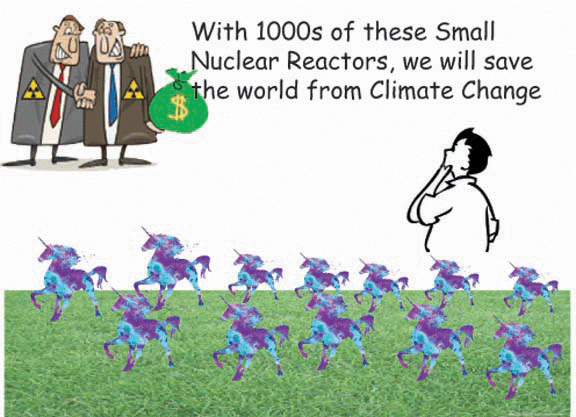
Small modular reactors (SMRs) can supply up to 300 megawatts per plant. They are conservatively costed at $5 billion each. You need quite a few 300MW SMRs to replace say a 2GW coal-fired power station like Eraring. That is an extremely expensive transaction. The leader of the Nationals has said nuclear power wouldn’t cost Australia “a cent”. How can an alternative government make such a ridiculous claim with a straight face?
2. Second, the much-vaunted small modular reactor technology is unproven. There is no commercial SMR operating anywhere in the world. There are two demonstration plants: one floating around on a barge in Russia and one in China.
Last week’s Financial Review editorial lauds Ontario’s plans. Really? Ontario Power Generation has not released any costings for its proposed SMRs and it is yet to receive (or even apply for) environmental approvals. Are we to hang our hat on this technology for our national energy plan?
3. Third, nuclear is notoriously slow to build. Can anyone credibly claim that Australia could have a nuclear plant operating by the early or even mid-2030s, when we need no-emissions technology to be supplying the vast bulk of our power? The answer to that question, reasonable observers would agree, is “no”.
4. inflexibility. The fourth serious answer to the Financial Review’s suggestion of a nuclear path is that it is not a flexible source of energy. As we move to more renewables, we need peaking and firming that can be tuned on and off at short notice to fill gaps in renewable supply. Coal-fired power stations can be turned down, but not off. Likewise, a nuclear power station cannot easily be turned off once it is running.
Nuclear power is largely useless as peaking and firming support for renewables. This is where gas-fired power stations are a useful back-up to renewables. The latest technology allows gas-fired power stations to be turned on with two minutes’ notice.

5. Finally, there’s the matter of nuclear waste. Small modular reactors would produce no small amount of waste. A Stanford University study finds that “… most small modular reactor designs will actually increase the volume of nuclear waste in need of management and disposal, by factors of 2 to 30 for the reactors …”
For 235 years, Australia has searched for comparative advantage. We have found one. It is renewable energy. Imagine having abundant resources of the cheapest form of energy available and choosing, as a matter of policy, to deploy a source of energy much more expensive and slower to build instead? That’s what advocates of nuclear power are arguing for.
After 10 years of denial and delay on climate action, I’m not interested in more years of distraction by a debate on an energy source which clearly doesn’t stack up for our country.
‘Ignorance, Incompetence and Cynicism’ -military and scientific authorities attitudes to Aboriginal rights and safety‘

29th August 2023
NFLA Policy Briefing 274: ‘Ignorance, Incompetence and Cynicism’: The attitudes the military and scientific authorities adopted to Aboriginal rights and safety during and after the testing of British atomic weapons in South Australia 29 Aug 23 https://www.nuclearpolicy.info/briefings/nfla-policy-briefing-274-ignorance-incompetence-and-cynicism-the-attitudes-the-military-and-scientific-authorities-adopted-to-aboriginal-rights-and-safety-during-and-after-the-tes/
Teachers in boycott of nuclear submarine project
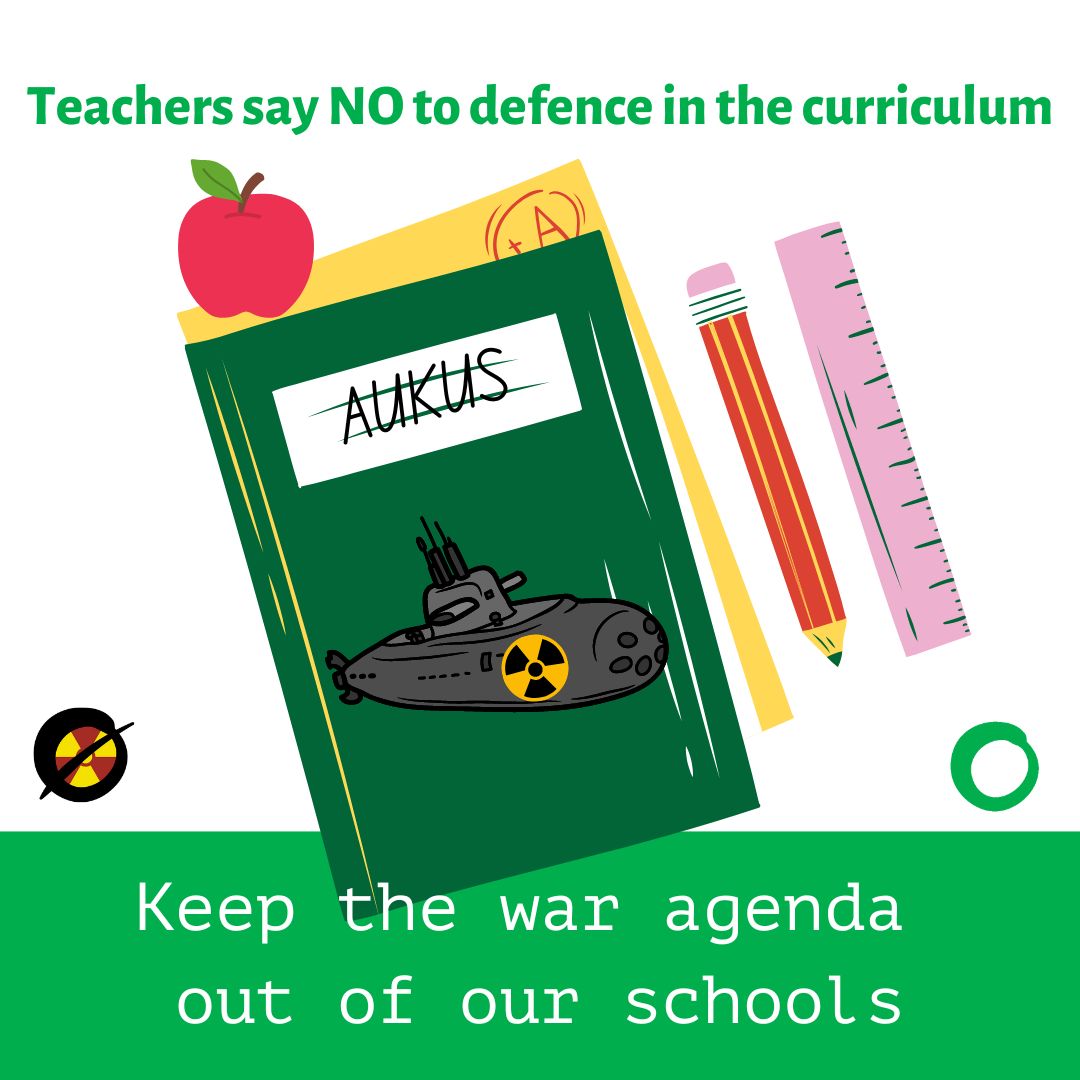
The Australian: https://www.theaustralian.com.au/nation/teachers-to-ban-indoctrination-on-nuclear-submarines/news-story/d7d7c434d3f4ec2982fb52063eecf1a3?amp
The Australian Education Union will meet to discuss boycotting a science experiment that would see students design nuclear-powered submarines.
By natasha bita. August 29, 2023 The Australian: https://www.theaustralian.com.au/nation/teachers-to-ban-indoctrination-on-nuclear-submarines/news-story/d7d7c434d3f4ec2982fb52063eecf1a3?amp
Pacifist teachers are boycotting a Defence Department “brainwashing’’ program that asks children to design nuclear-powered submarines.
The Australian Education Union federal executive will meet this week to consider a national boycott of the science project, which requires high school students to design a nuclear-powered propulsion system for a submarine.
The union is furious that the Albanese government is spending $368bn on AUKUS nuclear-powered submarines at a time when most public schools are receiving less money than they were supposed to under the Gonski needs-based funding deal.
At a grassroots level, some teachers are boycotting the Nuclear-Powered Propulsion Challenge, which was launched by Deputy Chief of Navy Rear Admiral Jonathon Earley in June as a science, technology, engineering and maths competition.
The controversial STEM challenge asks students to work in teams to submit engineering plans for submarine nuclear propulsion.
Defence devised the program “to inspire students to discover how nuclear propulsion works and how it makes submarines more capable’’.
Winning students from each state and territory will visit HMAS Stirling in Western Australia, tour a Collins-class submarine, dine with submariners and use a training simulator to “drive” a submarine through Sydney Harbour.
AEU branch meetings in Victoria have resolved to block the project in schools, and environmental group Friends of the Earth is now pushing for a national boycott.
Friends of the Earth nuclear-free co-ordinator Sanne de Swart said the Defence Department had made a “blatant attempt to normalise nuclear power and indoctrinate children into building instruments of death’’.
She said the STEM project was “indoctrinating” students and failed to address the health and environmental risks of nuclear power.
“It fails to acknowledge Australia’s significant and devastating history with nuclear, including the atomic bomb tests, uranium mining and the attempts to impose nuclear waste dumps,’’ she said.
Union members at Virtual School Victoria voted to condemn the program.
“We resolve to refuse to refer students to this program or others like it, and we will refuse to promote it within our schools,’’ the branch stated.
A union meeting of public school teachers in the regional Victorian town of Benalla also called on the state’s Education Department to “cease all involvement in this and similar programs’’.
“The government spending of $368bn on AUKUS nuclear submarines will require whole new industries in Australia, and beginning to draw our brightest teenage students into a war industry is outrageous,’’ their motion states. “A politicised pro-AUKUS curriculum has no place in our schools.’’
Melbourne primary school teacher Emma Kefford is planning to vote for a boycott at a meeting of the AUE’s inner-city branch on Thursday. She said she was “pretty disturbed’’ that the Defence Department was providing curriculum material to schools.
“I think it contradicts some of the other values in the Australian curriculum,’’ she said. “These inventions seem pretty exciting to young people, but they’re often removed from the realities of war and the horrors it entails.’’
The Victorian Education Department promotes the challenge on its website, saying: “We’re encouraging schools to register teams of 3 to 5 students to work together on the project.’’
The South Australian government also promotes the program on its website, as a way to “get young Australian minds thinking like engineers and scientists, by completing activities based on nuclear submarine engineering’’.
A spokesman for federal Education Minister Jason Clare said he did not share the concerns. The Defence Department was asked how many schools were participating but did not respond.
OPENING THE FLOOD GATES AT FUKUSHIMA
Discharging radioactive water from the damaged Fukushima Daiichi nuclear power plant is avoidable, risky and potentially illegal
By Sarah Hachman and Associate Professor Tilman Ruff AO, University of Melbourne, 29 Aug 23 https://pursuit.unimelb.edu.au/articles/opening-the-flood-gates-at-fukushima
The Japanese government intends to discharge all 1.34 million tonnes of wastewater from the Fukushima Daiichi Nuclear Power Station, an operation that began on 24 August 2023. Presumably, it also plans to discharge the wastewater that will continue to accumulate over the coming decades.
This decision is not only harmful to human and environmental health but is also in direct violation of international law.
The original announcement, made in 2021, came 10 years after a 9.0 earthquake and tsunami struck Japan’s east coast, damaging the cooling mechanisms at the Fukushima Daiichi Nuclear Power Station (FDNPS) and causing three nuclear reactors to meltdown.
The destruction of the FDNPS released an estimated 520 Peta Becquerels (520 x 10¹⁵ nuclear decays per second) of various radionuclides (radioactive elements) into the atmosphere, including cesium, carbon-14, iodine-129, and tritium. However, this figure excludes noble gases such as xenon-133, of which the Fukushima release was the largest since atmospheric nuclear bomb tests.
AN INCOMPLETE CLEAN-UP
Following the incident, the Japanese government worked with the UN’s International Atomic Energy Agency (IAEA) and the Tokyo Electric Power Company (TEPCO) on a plan to decommission the plant, efforts which continue to this day.
The first step of this process was to ensure the reactors remained stable. As such, ocean water was pumped into the reactors as a replacement for the now-defunct cooling mechanisms. Though necessary, this process, along with extensive groundwater leakage, has produced over one million tonnes of irradiated wastewater, which continues to accumulate daily.
This wastewater is being decontaminated using an Advanced Liquid Processing System (ALPS), a filtration process intended to remove 62 radionuclides from water using a series of chemical reactions. However, this system’s consistent effectiveness, even with repeated treatment, has not yet been demonstrated, and ALPS is incapable of eliminating tritium and carbon-14.
As of July 2023, the ALPS-treated wastewater was being stored on-site in 1,046 storage tanks that are nearing capacity, hence the claimed need for ocean discharge.
The Japanese government plans to incrementally discharge the treated wastewater into the Pacific Ocean over the next 30 to 40 years. Though presented with other disposal options, such as long-term storage in purpose-built, seismically-safe tanks and solidifying the water in a leakproof form such as mortar or concrete, the task force declined to explore these avenues due to complexity and cost.
Even after initial cleaning, 70 per cent of the stored wastewater contains levels of radionuclides above regulatory standards, in some cases up to 20,000 times higher. And it’s not just tritium (more on this substance below) in this water, there are other, more toxic, substances, such as cesium-137, strontium-90 and cobalt-60.
However, the IAEA found that Japan’s plans “are consistent with IAEA Safety Standards” and that the levels of tritium, carbon-14, and other potential radioactive contaminants will be within international standards when discharged, without TEPCO having demonstrated its water cleaning can consistently achieve this.
Dilution of the wastewater as planned to meet regulatory limits will not alter the total amount of materials released, which is the key factor.
TEPCO estimates the annual radiation dose to people from the discharged water would be lower than that of a dental x-ray or a round-trip flight from New York City to Tokyo.
However, TEPCO’s checkered history gives little grounds for confidence in its assurances.
NOT ENOUGH EVIDENCE OF SAFETY
Despite reassurance from the IAEA, the scientific community remains divided on the decision, citing growing evidence of how tritium may impact human and environmental health.
Moreover, environmental scientists have argued that the amount considered to be an environmentally safe level of radiation is more political than scientific. National standards invariably lag behind the science, and regulatory limits for tritium in water vary from as much as 7000 Bq/L (Becquerels per litre) in Canada to 15 Bq/L in California.
Tritium is a naturally occurring, radioactive form of hydrogen also produced by nuclear reactors and explosions. It is the largest radioactive byproduct of nuclear power plants. It reacts with oxygen to create tritiated water, which is why ALPS is unable to filter it. Tritium exposure has been largely considered to be harmless in low concentrations and, when ingested, tritiated water is processed in the body identically to water.
There is strong evidence, however, that tritium, particularly organically-bound forms, may have lasting health effects similar to other forms of radiation exposure, such as decreased lifespan, developmental delays and cognitive deficits, immunodeficiency, infertility and birth defects, and cancer and DNA mutations among humans, land animals and aquatic vertebrates and invertebrates who experienced high or prolonged exposure.
The International Commission on Radiological Protection considers tritium’s beta radiation overall to be twice as biologically damaging as X-rays, and organically-bound tritium three times as damaging as tritium incorporated into water.
Though the task force has committed to monitoring tritium exposure in aquatic animals, TEPCO noted that “fish tritium measurement is very difficult and there are only a few analysis agencies that are capable of performing this measurement,” and that reports from these agencies are often conflicting, making this an insufficient risk mitigation strategy.
ILLEGAL UNDER INTERNATIONAL LAW
Japan joined both the 1972 London Convention to prevent marine pollution by waste dumping, and also the 1996 Protocol which specifically prohibits the marine dumping of radioactive waste. In 1996, Japan ratified the United Nations Convention on the Law of the Sea (UNCLOS), an international agreement that established a framework for maritime activities.
By ratifying UNCLOS, Japan committed itself to “protect and preserve the marine environment” and abstain from polluting waterways from “land-based sources”.
Additionally, in 1992 Japan committed to the Rio Declaration, a collection of goals created by the UN targeting sustainable development and environmental protection that heavily emphasises the precautionary principle. Article 15 states: “where there are threats of serious or irreversible damage, lack of full scientific certainty shall not be used as a reason for postponing cost-effective measures to prevent environmental degradation.”
Though there is still debate within the scientific community surrounding the effects of tritium and what constitutes an acceptable level of radiation exposure, two truths remain. One, Japan has committed itself to environmental protection, and two, the contaminated wastewater is a land-based source of pollution.
Furthermore, the very existence of the debate on tritium’s safety and the knowledge that the discharged water will contain other, more harmful radioactive pollutants, requires Japan to employ the precautionary principle just as they agreed to in 1992.
The Japanese government moving forward with the discharge plan, disregarding its commitments to the global community and international efforts for environmental protection sets a precedent for how the global community responds to modern nuclear crises.
Approving this plan means approving a compromise on human and environmental health, inflicting a transboundary and transgenerational problem on peoples around the Pacific with no offsetting benefit or say in the decision, and a failure to engage state and non-state actors with stakes in the nuclear industry to question what’s acceptable.
As such, the Japanese government must follow through on its commitments to the international community and critically consider alternatives for wastewater disposal. The discharge is planned to go on for 30-40 years and radioactive wastewater will continue to accumulate.
Even though it has already started, it can still be stopped and a better alternative implemented.
Young Vietnamese Diplomat Envisions Nuclear-Free World

She is proud that Viet Nam has ratified the Treaty on the Prohibition of Nuclear Weapons and is currently at accession level with the NPT.
- Lê Nguyen An Khanh is a young diplomat with the Ministry of Foreign Affairs, Viet Nam. She is passionate about the non-proliferation of nuclear weapons and world peace.
- UNITAR Division for Prosperity trains government officials in Asia to learn about international nuclear disarmament processes and build their communication and negotiation skills.
28 August 2023, Hiroshima, Japan – Lê Nguyen An Khanh is a young official from Viet Nam, working at the Department of International Organisations at the Ministry of Foreign Affairs. She believes that diplomats like her have the responsibility to advocate for nuclear disarmament. But it’s not always easy to keep abreast of the intricacies of the field. “We are constantly having [to] research all the issues, of which nuclear disarmament and non-proliferation is a huge part”, she says………………………………………………………………………………….
Lê has had to learn how to take the uncertainties of global politics and turn them into something surmountable. She is proud that Viet Nam has ratified the Treaty on the Prohibition of Nuclear Weapons and is currently at accession level with the NPT. She wants to make sure her country’s voice is heard on the international stage, that it is seen as a world player. (Plus, she enjoys meeting, learning and working with like-minded people from different backgrounds and cultures.)
Being a young diplomat can come with its challenges: her views and opinions may not be granted the same weight as her older, perhaps more experienced, colleagues. But Lê challenges other young diplomats to be passionate and work hard.
“If you work hard enough, stick to your ideals and you are passionate about what you do and want to do in the future, people will recognize you – especially the seasoned diplomats who have already been there. You have to demonstrate that you are willing and have the capability to deliver. [If] you have a passion, you will be able to overcome challenges”. -Lê Nguyen An Khanh, Vietnamese diplomat and 2023 alumna, UNITAR Nuclear Disarmament and Non-Proliferation Training Programme
Looking to the Future
Lê will incorporate into her work all that she learned in the UNITAR training and expects to share her knowledge with colleagues in other departments and ministries as well. She applauds the UNITAR Hiroshima Office for putting together a well-organized and resourced training programme that she calls “an epitome of a good training programme”.
In the next 20 years, Lê says she wants to see more UNITAR offices around the world and for more people to learn about nuclear disarmament and non-proliferation. “I want to see UNITAR bring people from different regions with different cultures, race, genres to show the similar yet different experiences of their lives.”
Her personal goal is to make sure that she contributes to global peace.
Peace is a universal value. Everybody wants peace. I think peace is the motivation for every country to move towards development and stability. It is only when we have peace that we can move forward and make ourselves stronger.” -Lê Nguyen An Khanh, Vietnamese diplomat and 2023 alumna, UNITAR Nuclear Disarmament and Non-Proliferation Training Programme
About UNITAR
The United Nations Institute for Training and Research (UNITAR) is a dedicated training arm of the United Nations. In 2022, UNITAR trained 396,046 learners around the world to support their actions for a better future. In addition to our headquarters in Geneva, we have offices in Hiroshima, New York and Bonn and networks around the world.
The Division for Prosperity is based in the Hiroshima Office and Geneva. We seek to shape an inclusive, sustainable and prosperous world through world-class learning and knowledge-sharing services on entrepreneurship, leadership, finance and trade, digital technologies, and nuclear disarmament and non-proliferation. We empower individuals from least-developed countries, countries emerging from conflict, and small-island developing states – especially women and young people – to bring about positive change.
United Nations Volunteer Ruhiya Yousuf contributed to this article.
Only Idiots Believe The US Is Protecting Australia From China
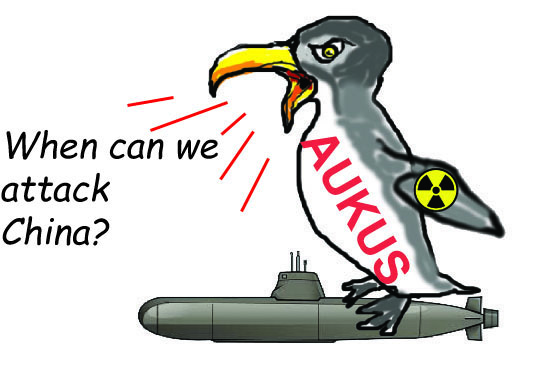
CAITLIN JOHNSTONE, AUG 29, 2023 https://www.caitlinjohnst.one/p/only-idiots-believe-the-us-is-protecting?utm_source=substack&utm_medium=email
The Economist has taken a keen interest in Australia lately, which if you know anything about The Economist is something you never want to see happen to your country. Two articles published in the last few days by the notorious propaganda outlet have celebrated the fact that Australia appears to be the most likely nation to follow the United States into a hot war with China as it enmeshes itself further and further with the US war machine.
In “How Joe Biden is transforming America’s Asian alliances,” The Economist writes the following:
Meanwhile, the ‘unbreakable’ defence relationship with Australia is deepening, following the AUKUS agreement struck in March, amid a flurry of equipment deals and military exercises. Should war break out with China, the Aussies seem the most willing to fight at America’s side. Australian land, sea and air bases are expanding to receive more American forces. Under the AUKUS deal, Australia is gaining its own long-range weapons, such as nuclear-powered (but not nuclear-armed) submarines to be developed jointly with America and Britain. The three partners want to work on other military technologies, from hypersonic missiles to underwater drones.
“Taken together the ‘latticework’ of security agreements, shows how America’s long-heralded pivot to Asia is accelerating.”
In “Australia is becoming America’s military launch-pad into Asia,” The Economist elaborates upon this war partnership with tumescent enthusiasm, calling it a “mateship” and likening it to a “marriage”, and calling for a rollback of US restrictions on sharing military technology with Australia.
“If America ever goes to war with China, American officials say the Aussies would be the likeliest allies to be fighting with them,” The Economist gushes, adding, “Australia’s geographical advantage is that it lies in what strategists call a Goldilocks zone: well-placed to help America to project power into Asia, but beyond the range of most of China’s weapons. It is also large, which helps America scatter its forces to avoid giving China easy targets.”
The Economist cites White House “Asia Tsar” Kurt Campbell reportedly saying of Australia, “We have them locked in now for the next 40 years.”
“Equally, though, Australia may have America locked in for the same duration,” The Economist hastens to add.
Well gosh, that’s a relief.
“How the world sees us,” tweeted former Australian foreign minister Bob Carr when sharing the Economist article.
“Historians will be absolutely baffled by what’s happening in Australia right now: normally countries never voluntarily relinquish their sovereignty and worsen their own security position out of their own accord. They normally have to lose a war and be forced to do so,” commentator Arnaud Bertrand added to Carr’s quip.
As much as it pains me to admit it, The Economist is absolutely correct. The Australian government has been showing every indication that it is fully willing to charge into a hot war with its top trading partner to please its masters in Washington, both before and after the US puppet regime in Canberra changed hands last year.
This sycophantic war-readiness was humorously mocked on Chinese state media back in 2021 by Impact Asia Capital co-founder Charles Liu, who said he didn’t think the US will actually fight a war with China over Taiwan, but the Australians might be stupid enough to fight it for them.
“US is not going to fight over Taiwan,” Liu said. “It’s not going to conduct a war over Taiwan. They may try to get Japanese to do it, but Japanese won’t be so stupid to do it. The only stupid ones who might get involved are the Australians, sorry.”
He had nothing to be sorry about; he was right. Australians are being very, very stupid, and not just our government. A recent Lowy Institute poll found that eight in ten Australians believe the nation’s alliance with the United States is important for Australia’s security, despite three-quarters also saying they believe the alliance makes Australia more likely to be drawn into a war in Asia.
That’s just plain stupid. A war with China is the absolute worst case security scenario for Australia; anything that makes war with China more likely is making us less secure. Making bad decisions which hurt your own interests is what stupid people do.
That’s not to say Australians are naturally dimwitted; we’re actually pretty clever as far as populations go. What’s making us stupid in this case is the fact that our nation has the most concentrated media ownership in the western world, a massive chunk of which is owned by longtime US empire asset Rupert Murdoch. This propaganda-conducive information environment has been distorting Australia’s understanding of the world so pervasively in recent years that on more than one occasion I’ve had total strangers start babbling at me about the dangers of China completely out of nowhere within minutes of striking up conversation with them.
This artificially manipulated information ecosystem has made Australians so pants-on-head idiotic that they think the US empire is filling their country up with war machinery because it loves them and wants to protect them from the Chinese. That’s as stupid as it gets.
The single biggest lie being circulated in Australia right now is that our government is militarising against China as a defensive measure. China has literally zero history of invading and occupying countries on the other side of the planet. You know who does have a very extensive history of doing that? The United States. The military superpower that Australia’s military is becoming increasingly intertwined with. The belief that we’re intertwining ourselves with the world’s most aggressive, destructive and war-horny military force as a defensive measure to protect ourselves against that military force’s top rival (who hasn’t dropped a bomb in decades) is transparently false, and only a complete idiot would believe it.
We’re not militarising to defend ourselves against a future attack by China, we’re militarising in preparation for a future US-led attack on the Chinese military. We’re militarising in preparation to involve ourselves in an unresolved civil war between Chinese people that has nothing to do with us. China has been sorting out its own affairs for millennia and has managed to do so just fine without the help of white people running in firing military explosives at them, and Taiwan is no exception.
The imperial media talk nonstop about how the People’s Republic of China is preparing to seize control of Taiwan using military force, without ever mentioning the fact that that’s exactly what the US empire is doing. The US empire is preparing to wrest Taiwan away from China to facilitate its long-term agenda to balkanize, weaken and subjugate its top rival.
Only a complete blithering imbecile would believe any part of this is being done defensively. It’s being done to secure unipolar planetary domination for the world’s most powerful and destructive government, and only an absolute moron would agree to risk their own country’s security and economic interests to help facilitate it.
TEACHERS ACT AGAINST SCHOOLS NUCLEAR SUBMARINES PROGRAM

the normalisation of militarisation and downplaying of nuclear risks in schools is a grave concern.
“Nuclear and military aspects in the curriculum fail to address health and environmental risks associated with both, as well as the drive to war,”
Education. 28 Aug 2023 https://www.nationaltribune.com.au/teachers-act-against-schools-nuclear-subs-program/
Children being taught to make weapons
Teachers are moving to boycott a new pro-nuclear-fuel brainwashing program being introduced into schools.
There’s growing momentum within unions to ban the Nuclear-powered Submarine Propulsion Challenge, which is a Defence Department initiative backed by the Federal and Victorian governments.
In a blatant attempt to normalise nuclear power and indoctrinate children into building instruments of death, the challenge asks students from years 7 to 12 to design a nuclear-powered propulsion system for a submarine.
Friends of the Earth (FoE) understands that motions calling for a boycott have already been passed in some chapters of the Australian Education Union.
One motion, passed at a recent branch meeting said: “We resolve to refuse to refer students to this program or others like it, and we will refuse to promote it within our schools. We call on the Department of Education to cease all involvement in this and similar programs.”
Another said: “We don’t intend to refer students to this program or others like it, or to promote it within our schools. We call on the Department of Education to cease all involvement in this and similar programs.”
Friends of the Earth is supporting the ban and has written to the Australian Education Union asking them to impose a nationwide boycott.
FoE Nuclear Free Coordinator Sanne De Swart said the normalisation of militarisation and downplaying of nuclear risks in schools is a grave concern.
“Nuclear and military aspects in the curriculum fail to address health and environmental risks associated with both, as well as the drive to war,” Sanne De Swart said.
“It fails to acknowledge Australia’s significant and devastating history with nuclear, including the atomic bomb tests, uranium mining and the attempts to impose nuclear waste dumps, all which have and continue to affect First Nations communities disproportionately .”
‘Peaceful Atom’ Sparks Fierce Debate In Kazakh Village Slated To Host Nuclear Power Plant
By Petr Trotsenko, August 28, 2023 Radio Free Europe
ULKEN, Kazakhstan — Plans are under way to build a nuclear power plant (NPP) scheduled to be online by 2035, to supply Kazakhstan’s soaring energy needs.
In Ulken, where the plant is likely to be built, opinions among the village’s 1,500 residents on what a nuclear future for their impoverished lakeside village would look like are split.
Ulken is located 330 kilometers northwest of Almaty on the shores of Lake Balkhash. The village was created in the 1980s to house workers for a planned hydroelectric power plant. That project was unfinished when the Soviet Union collapsed and high-rise apartments are the only completed constructions from the period.
Officially, Ulken is a village, but it feels like an urban settlement. There are no houses here, only apartments. There is no livestock, and no gardens grow in the rocky soil…………………………………………………………………………….
Khairulina wants to increase the population of Ulken, renovate the village, and give life to the abandoned apartments. For these reasons she supports the construction of an NPP. “If the project starts, civilization will come,” she said. The villager is concerned for the environment, but said, “We are not afraid of environmental problems, now everything is made with modern technology.”
Fishermen in Ulken are largely against the NPP project because they fear that Lake Balkhash will be affected and that fishing there could eventually be banned.
It’s not difficult to find fishermen. In front of one abandoned apartment, fish hang in the breeze.
The owner of the property is a young man named Rinat. The 34-year-old fisherman has devoted half of his life to the profession and works the lake every day. Rinat firmly opposes the construction of an NPP.
“The lake sustains us,” he said. “This year the water level in the Balkhash dropped severely, and the fish population decreased. If an NPP is built, there will be no water left in the lake,” Rinat claimed.
At the grocery store, I met another resident, Aleksei Losev. The 35-year-old moved to Ulken six years ago to live with his future wife. He’s not a fisherman, but does not expect anything good from the construction of the NPP.
“On one hand I support its construction, because new jobs will be created, people will come from abroad, and the village will develop. On the other hand, it’s about ecology,” he said, before referencing a troubled Soviet-era NPP in western Kazakhstan that is currently being decommissioned. “Three kilometers from Aqtau there is the Manghystau NPP. The environmental situation there is bad. Why? Wastewater! Both fish and seals are dying…. It will be the same here,” he said……………………………………………………………………………….
In the small assembly hall of the Ulken high school where the August 21 meeting to discuss the NPP took place, it was standing room only. Environmental activists who had travelled from Almaty for the meeting unfurled posters calling to put a stop to the project as residents chanted, “we support the peaceful atom!”
When the discussion on the planned NPP got under way it was clear that there would be little constructive conversation. The emotions of the crowd boiled over.
“We are against the nuclear power plant, it will destroy Balkhash Lake!” activists shouted.
“You’re not a nuclear specialist, how do you know it will be harmful? You don’t live in Ulken” responded some residents.
“It is not only an Ulken problem, this topic should be discussed by all of Kazakhstan!” the activists countered.
…………………………………………………………………… Another local man hoped to work in the future energy sector.
“We residents have been waiting for this construction for 40 years,” he said. “We started with the construction of the power station, we spent days without heat and electricity, we went through many different events together. Ulken needs this energy, this is the center of Kazakhstan. Our region is seismologically stable! There are 15 nuclear power plants in Japan, which has an earthquake every month. Energy is scarce and very expensive in our country. We all need electricity. We support the peaceful atom!” he said.
People in the hall clapped and someone asked, “What about solar energy?” nobody seemed to hear the question amid chants of “Peaceful atom! Peaceful atom!”
Then environmentalist Svetlana Mogilyuk spoke. Like many others, Svetlana came to Ulken to take part in the discussion.
“Dear residents, we have now listened very carefully to what was said,” Mogilyuk said. “No basic, truthful information was provided to you. In contrast to the claim that nuclear energy is not harmful to health, there are qualified studies showing that nuclear energy is still harmful! Numerous studies also confirm that children who live near nuclear power plants are more likely to develop leukemia, and deaths from cancer increase by 24 percent.”
As she made these claims, her microphone cut off. She continued without it.
“Nuclear power plants are harmful, they are accompanied by radioactive emissions. Citizens! You are now being told a lie! Hearings must be accompanied by basic information! You must understand that apart from the NPP, you have other opportunities, you have the opportunity to develop other types of electricity. They will be no less powerful, no less effective, but safer!”
……………………………………………………………………… many in Kazakhstan feel the construction of an NPP is a done deal for the government and that far more depends on its decision than the prospects for locals of a small village on the banks of the Balkhash. https://www.rferl.org/a/kazakhstan-nuclear-power-plant-debate-construction/32563042.html
1 This month


Help Aunty Sue Protect Her Land and Sacred Sites From Destructive Rocket Testing.
.

Australians deserve the truth
about
AUKUS – https://aukuspublicinquiry.com/

PETITION – To: Prime Minister Anthony Albanese and the Australian Labor Government

of the week – Australians for War Powers Reform (AWPR)
To see nuclear-related stories in greater depth and intensity

