All the way with Anthony A – Labor locks in AUKUS support despite union opposition
by Zacharias Szumer | Aug 19, 2023
The Labor Government’s continuation of the Morrison-era AUKUS agreement, and a $350 billion spend on nuclear-powered submarines, was expected to be the most contentious issue at the Labor conference this week. After a minor scuffle, the PM emerged victorious. Zacharias Szumer reports.
Going into the conference, the way AUKUS debates would proceed still seemed a partially open question. Most presumed backroom deals would minimise any open conflict, but there was still a few unknowns.
As it played out, delegates were only able to vote on whether those submarines should be nuclear, and after the Government’s side prevailed, another motion that proposed removing all references to AUKUS from the platform was shelved.
In the end, debate over AUKUS came down to two different amendments.
The first was a proposal for a 1,300-word pro-AUKUS “statement in detail” to be added to that party’s platform, which was brought by Defence Minister Richard Marles and Defence Industry Minister Pat Conroy.
The other – brought forward by Electrical Trades Union (ETU) national secretary Michael Wright and supported by Member for Fremantle Josh Wilson – was essentially that statement with all references to nuclear technology taken out.
One proposed amendment was:
“Making our contribution to the collective security of our region … is at the heart of Australia’s strategic intent behind acquiring a conventionally-armed, modern and fit for purpose nuclear-powered submarine capability.”
And another:
“Labor will ensure that the nuclear-powered submarine program will deliver secure, well-paid unionised jobs…”
There’s plenty more for those interested in plumbing the depths. They can read the entirety of the amendments here and here.
After a day and a half of largely frictionless procedure, the AUKUS debate saw not just the first moment of open conflict, but the first animated audience participation of conference proceedings.
Marles’ received a strong round of applause from delegates when moving to the lectern to make his opening statement, but was met with boos from some as soon as he mentioned the word “nuclear.”
The obligatory Curtin references
Marles said AUKUS followed in the footsteps of WWII Labor prime minister John Curtin, who “made the decisions which gave Australia its independence.”
“This isn’t giving us independence … It’s tying us to the US,” shouted a voice from the stands………………………………………..
Rank and file opposition to AUKUS
With that motion carried, it was declared that the conference wouldn’t hear a third amendment that would remove all reference to AUKUS from the party’s platform. That motion was brought by NSW Legislative Council member Anthony D’Adam, who told MWM that the outcome was “predictable” but still “disappointing.”
Nevertheless, he said forcing AUKUS onto the agenda “was a victory for the rank and file.”
Around 50 of Labor’s roughly 800 branches have passed broad anti-AUKUS motions, and two former federal senators, Doug Cameron and Margaret Reynolds, have signed on as the founding patrons of Labor Against War (LAW).
National convenor of LAW Marcus Strom told MWM that it was only a “partial victory” for his group because “what we’re having is a partial debate.”
In addition to not hearing the stridently anti-AUKUS motion, the party also reportedly knocked back an application from LAW to hold a stall and event at the conference fringe, which hosted a series of panel discussions on the sidelines of the main proceedings.
However, Strom said that the anti-nuclear proposal received support from “a broad coalition, and it’s something to build on.”
Around 50 of Labor’s roughly 800 branches have passed broad anti-AUKUS motions, and two former federal senators, Doug Cameron and Margaret Reynolds, have signed on as the founding patrons of Labor Against War (LAW).
National convenor of LAW Marcus Strom told MWM that it was only a “partial victory” for his group because “what we’re having is a partial debate.”
In addition to not hearing the stridently anti-AUKUS motion, the party also reportedly knocked back an application from LAW to hold a stall and event at the conference fringe, which hosted a series of panel discussions on the sidelines of the main proceedings.
However, Strom said that the anti-nuclear proposal received support from “a broad coalition, and it’s something to build on.”………………………………………………
MWM reached out to Marles’ office on Friday afternoon to discuss the merits of Marles’ approach but didn’t receive a reply.
Fukushima waste-water decision disregards scientific evidence, violates the human rights of Pacific region communities

Japan announces date for Fukushima radioactive water release
Greenpeace International, 22 August 2023 https://www.greenpeace.org/international/press-release/61364/japan-announces-date-for-fukushima-radioactive-water-release/
Tokyo – Greenpeace Japan criticises the Japanese government’s announcement of the start date for radioactive water discharges from the Fukushima Daiichi nuclear station into the Pacific Ocean.
The decision disregards scientific evidence, violates the human rights of communities in Japan and the Pacific region, and is non-compliant with international maritime law. More importantly it ignores its people’s concerns, including fishermen. The Japanese government and Tokyo Electric Power Company (TEPCO) – the nuclear power plants’ operators – falsely assert that there is no alternative to the decision to discharge and that it is necessary to move towards final decommissioning. This further highlights the failure of the decommissioning plan for the nuclear plants destroyed in the 2011 earthquake, stating that tens of thousands of tons of contaminated water will continue to increase with no effective solution.
“We are deeply disappointed and outraged by the Japanese Government’s announcement to release water containing radioactive substances into the ocean. Despite concerns raised by fishermen, citizens, Fukushima residents, and the international community, especially in the Pacific region and neighboring countries, this decision has been made,” said Hisayo Takada, Project Manager at Greenpeace Japan.
The increasing volumes of and the pending release of the radioactive water demonstrate the failure of the decommissioning plan for the Fukushima Daiichi. The contaminated water will continue to accumulate for many years without effective measures to stop it. The Japanese Government and TEPCO falsely claim that discharge is the only viable option necessary for eventual decommissioning. Nuclear power generation, which experiences shutdowns due to accidents and natural disasters, and perpetually requires thermal power as a backup, cannot serve as a solution to global warming.
“The deliberate pollution of the Pacific Ocean through these radioactive waste discharges is a consequence of the 2011 nuclear disaster and Japan’s decades long nuclear power program. Instead of acknowledging the flaws in the current decommissioning plan, the ongoing nuclear crisis, and the massive amount of public funds required, the Japanese government intends to restart more nuclear reactors despite evidence of major earthquakes and safety risks. The current government energy plan fails to deliver secure and sustainable renewables such as wind and solar energy that the climate emergency demands,” said Takada.
As of 8 June 2023, there were 1,335,381 cubic meters of radioactive wastewater stored in tanks[1], but due to the failure of the ALPS (Advanced Liquid Processing System) processing technology, approximately 70% of this water will have to be processed again. Scientists have warned that the radiological risks from the discharges have not been fully assessed, and the biological impacts of tritium, carbon-14, strontium-90 and iodine-129, which will be released in the discharges, have been ignored.[2]
The International Atomic Energy Agency (IAEA) endorsed Japan’s plans for discharge. However, the IAEA has failed to investigate the operation of the ALPS, has completely ignored the highly radioactive fuel debris that melted down which continues every day to contaminate ground water – nearly 1000 cubic meters every ten days. Furthermore, the discharge plan has failed to conduct a comprehensive Environmental Impact Assessment, as required by its international legal obligations, given that there is a risk of significant transboundary harm to neighboring countries. The IAEA is not tasked with protecting the global marine environment but it should not encourage a state to violate it.
“The myth is being perpetuated that discharges are necessary for decommissioning. But the Japanese government itself admits that there is sufficient water storage space in Fukushima Daiichi.[3] Long-term storage would expose the current government decommissioning roadmap as flawed, but that is exactly what needs to happen. The Fukushima Daiichi nuclear station is still in crisis, posing unique and severe hazards, and there is no credible plan for its decommissioning,” emphasized Shaun Burnie, Senior Nuclear Specialist at Greenpeace East Asia.
Member states at the United Nations Human Rights Council in Geneva, as well as UN Special Rapporteurs, have opposed and criticized Japan’s discharge plans.[4] Japan’s discharge plans also disregard the groundbreaking Human Rights Council resolution 48/13, which in 2021 determined that it is a human right to have a clean, healthy and sustainable environment.[5] Furthermore, Japan has failed to comply with its legal obligations under the United Nations Convention for the Law of the Sea (UNCLOS), to protect the marine environment including its legal requirement to conduct a comprehensive Environmental Impact Assessment into the discharges into the Pacific Ocean, given the risk of significant transboundary harm to neighboring countries.[6]
“Instead of engaging in an honest debate about this reality, the Japanese government has opted for a false solution – decades of deliberate radioactive pollution of the marine environment – during a time when the world’s oceans are already facing immense stress and pressures. This is an outrage that violates the human rights of the people and communities of Fukushima, and other neighboring prefectures and the wider Asia-Pacific region,” said Burnie.
Fukushima Daiichi Nuclear Power Station is still continuing to release radioactive materials

A new argument for considering the issue of contaminated ALPS water release .
This brief examines the amount of radioactive material that has been
leaking from the Fukushima Daiichi Nuclear Power Station ever since the
meltdowns occurred more than 12 years ago.
It is huge. Both TEPCO and the
government are undoubtedly aware of this reality. Despite this, they are
now attempting to release even the radioactive materials they have been
able to manage in tanks to the outside world. While attention focuses on
this release, this brief attempts to highlight the even larger problems of
Fukushima Daiichi and the irresponsible way the authorities are dealing
with them.
CNIC 23rd Aug 2023
The nuclear lobby is gearing up for a takeover of COP 28

The various nuclear front groups are organising to have a prominent role in promoting nuclear as the cure for global heating. What a lie! Surrounded by packs of lies – the most glaring being their pretense of being “not for profit” organisations.
By all possible means – academic lectures, art and culture, displays – whatever – they will be allout to control the propaganda emanating from the 2023 United Nations Climate Change Conference.
Of course, the nuclear industry might be expected to get strong competition from the oil industry, seeing that COP28 will be held in the United Arab Emirates, (Thu, 30 Nov 2023 – Tue, 12 Dec 2023)
Still, these two unrelenting propagandising, and polluting industries, will probably work together.
The one voice that’s sure to be excluded is the voice of degrowth, conserving energy, cutting down on consumerism.
Fukushima: What are the concerns over waste water release?

By Tessa Wong, Asia Digital Reporter, BBC News, 23 Aug 23,
Japan’s controversial plan to release treated waste water from the Fukushima nuclear plant into the Pacific Ocean has sparked anxiety and anger at home and abroad.
Since the 2011 tsunami which severely damaged the plant, more than a million tonnes of treated waste water has accumulated there. Japan has said it will start discharging it from 24 August.
Despite an endorsement from the UN nuclear watchdog, the International Atomic Energy Agency (IAEA), the plan has been deeply controversial in Japan with local communities expressing concerns about contamination.
Fishing industry groups in Japan and the wider region are also worried about their livelihoods, as they fear consumers will avoid buying seafood.
China has accused Japan of treating the ocean as its “private sewer”, and criticised the IAEA of being “one-sided”. While South Korea’s government has said it has no objections to the plan, many of its citizens are opposed to it.
So what is Japan’s plan and how exactly has it churned the waters?
What is Japan doing with the nuclear waste water?
Since the disaster, power plant company Tepco has been pumping in water to cool down the Fukushima nuclear reactors’ fuel rods. This means every day the plant produces contaminated water, which is stored in massive tanks.
More than 1,000 tanks have been filled, and Japan says that it needs the land occupied by the tanks to build new facilities to safely decommission the plant. It has also pointed out concerns that the tanks could collapse in a natural disaster.
Releasing treated waste water into the ocean is a routine practice for nuclear plants – though critics have pointed out that the amount from Fukushima is on an unprecedented, far vaster scale.
Tepco filters the Fukushima water through its Advanced Liquid Processing System (ALPS), which reduces most radioactive substances to acceptable safety standards, apart from tritium and carbon-14…………………………………………….
What do critics say?
Despite years of government assurances, the plan remains deeply controversial to the Japanese public. Only 53% said they support it, while 41% said they did not, in a survey conducted in August by the newspaper Asahi Shimbun.
UN-appointed human rights experts have opposed the plan, as have environmental activists. Greenpeace has released reports casting doubt on Tepco’s treatment process, alleging it does not go far enough in removing radioactive substances.
Critics say Japan should, for the time being, keep the treated water in the tanks. They argue this buys time to develop new processing technologies, and allow any remaining radioactivity to naturally reduce.
There are also some scientists who are uncomfortable with the plan. They say it requires more studies on how it would affect the ocean bed and marine life.
“We’ve seen an inadequate radiological, ecological impact assessment that makes us very concerned that Japan would not only be unable to detect what’s getting into the water, sediment and organisms, but if it does, there is no recourse to remove it… there’s no way to get the genie back in the bottle,” marine biologist Robert Richmond, a professor with the University of Hawaii, told the BBC’s Newsday programme.
Tatsujiro Suzuki, a nuclear engineering professor from Nagasaki University’s Research Center for Nuclear Weapons Abolition, told the BBC the plan would “not necessarily lead to serious pollution or readily harm the public – if everything goes well”.
But given that Tepco failed to prevent the 2011 disaster, he remains concerned about a potential accidental release of contaminated water, he said.
What have Japan’s neighbours said?
China has been the most vocal, accusing Japan of violating “international moral and legal obligations” and “putting its selfish interests above the long-term wellbeing of the entire humanity”.
It has also warned that Tokyo “must bear all consequences”, and has already banned seafood from Fukushima and surrounding prefectures…………….
n contrast to China, Seoul – which has been keen to build ties with Japan – has soft-pedalled its concerns. It says it “respects” the IAEA’s findings and has endorsed the plan.
But this approach has angered the South Korean public, 80% of whom are worried about the water release according to a recent poll.
“The government enforces a strong no-littering policy at sea… But now the government is not saying a word (to Japan) about the wastewater flowing into the ocean,” Park Hee-jun, a South Korean fisherman told BBC Korean………….
Thousands have attended protests in Seoul calling for government action, as some shoppers fearing food supply disruptions have stockpiled salt and other necessities.
In response, South Korea’s parliament passed a resolution in late June opposing the water release plan – though it is unclear what impact this would have on Japan’s decision. Officials are also launching “intense inspections” of seafood, and are sticking to an existing ban of Japanese seafood imports from regions around the Fukushima plant……………………………
the biggest vindication may lie with the IAEA report, released by the agency’s chief Rafael Grossi while visiting Japan in July.
The report, which came after a two year investigation, found that Tepco and Japanese authorities were meeting international safety standards on several aspects including facilities, inspections and enforcement, environmental monitoring, and radioactivity assessments.
Mr Grossi said the plan would have a “negligible radiological impact on people and the environment”.
Yet, Japan’s decision to start discharging the Fukushima water has set the stage for an intensified showdown with its critics.
Additional reporting by Yuna Ku and Chika Nakayama. https://www.bbc.com/news/world-asia-66106162
France heatwave curbs cooling water supply to St Alban nuclear plant
PARIS, Aug 23 (Reuters) – A heatwave curbing the availability of cooling water has prompted a production warning from operator EDF for the Saint Alban nuclear power plant on the Rhone river in eastern France for Aug. 26-27.
Similar warnings have been issued this summer at plants including those at Bugey and Tricastin, which are also on the Rhone……………………….more https://www.reuters.com/world/europe/france-heatwave-curbs-cooling-water-supply-st-alban-nuclear-plant-2023-08-23/
Rex Patrick demolishes Richard Marles’ slick lies about AUKUS and the nuclear submarines.

Michael West Media, by Rex Patrick | Aug 19, 2023 (the original shows Rex Patrick’s Freedom of Information request for documents on 6 aspects of the nuclear submarine arrangement, and the 6 responses from the Defence Deapatment – in each case “Deny Access”.)
At this week’s Labor Conference Defence Minister Richard Marles distributed a 32 paragraph statement for insertion into the ALP National Platform to explain the Albanese’s Government’s rationale for an incredible $368B of public expenditure on submarines. At $11.5B per paragraph, one can be left very disappointed in his words. Rex Patrick provides readers with a hard hitting paragraph-by-paragraph analysis that reveals a massive swindle.
A peaceful and secure region
- Labor believes that Australia’s interests lie in shaping a region that is peaceful, stable and prosperous. A predictable region, operating by agreed rules, standards and laws. Where no country dominates, and no country is dominated. A region where sovereignty is respected, and all countries benefit from a strategic equilibrium.
Labor is no stranger to hypocrisy when it comes to international affairs. To take but one example, West Papua is neither “peaceful, stable or prosperous”. Slow motion genocide is taking place there. Indonesia has engaged in shocking abuses of indigenous Papuans, including child killings, disappearances, torture and mass displacement of people. Hundreds of thousands of West Papuans have died in a struggle to be free of Indonesian rule.
Since becoming Defence Minister, Marles has sat down and met with his Indonesia counterpart, Prabowo Subianto on three occasions.
In the early 1990s, as the commander of Kopassus Group 3, Prabowo commanded Indonesian special forces and militias that were responsible for murder, torture and other human rights abuses in East Timor. In 1996 he led Indonesian forces in bloody reprisal actions against West Papua separatists.
In 1998 troops under Prabowo’s command kidnapped and tortured democracy activists and the General was implicated orchestrating mob violence in Jakarta against Indonesians of Chinese descent. He was banned from entry into the United States on account of his human rights abuses.
It appears some breaches of “agreed rules, standards and laws” that Marles talks about are subject to ‘looking the other way’, as is convenient.
Labor is using all elements of our national power to shape the world in our interests and to shape it for the better. We will always use diplomacy as our primary effort to reduce tensions and create conditions for peace. Labor will continue to build on our strong diplomatic efforts in our region and will rebuild Australia’s international development program.
The truth is that Australia’s international development program is a drop in the budget bucket when compared to the $368B being spent on AUKUS submarines, and which goes to UK and US defence contractors.
Labor is committed to maintaining peace, regional development, positive relationships and stability across our region. Labor is committed to a peaceful and nuclear weapons free Pacific.
In 1984 New Zealand’s Labour Prime Minister David Lange banned nuclear-powered and nuclear-armed ships from using New Zealand ports or entering New Zealand waters. Lange’s decision was widely seen as marking a milestone in New Zealand’s development as a nation and an important act of sovereignty and self-determination.
Australian Labor wasn’t quite so inclined. Labor Leader Bill Hayden’s declaration that nuclear-powered and nuclear armed ships would not be welcome in Australian ports never came to fruition. Instead, the Hawke Labor Government ensured that the South Pacific Nuclear Free Zone was watered down and that US nuclear-armed ships could continue to visit Australian ports. Labor’s leadership has now moved to ownership of nuclear-powered ships.
Securing Australia’s Sovereignty
- Labor’s defence policy is founded on the principles of Australian sovereignty and self-reliance.
All six Collins Class submarines were built in Australia. We own the intellectual property for the Collins submarines and we conduct 92% of the sustainment work here in Australia.
With AUKUS, we abandon that sovereign capability and self-reliance, buying out first three submarines from the US. We go from being builders and sustainers, to buyers and roadside assistance.
Building Australia’s military defence capability sits alongside our diplomatic efforts, as we play our part in collective deterrence of aggression. By having strong defence capabilities of our own, and by working with partners investing in their own capabilities, we change the calculus for any potential aggressor.
We are putting all of our Defence capability eggs in one basket, with a long term, bank breaking, monolithic program to get to the point where, at some stage in the late 2050’s, we’ll be able to keep just three submarines available for use at any time – in the context of China, Paul Keating describes this as “throwing toothpicks at the mountain”.
Defence cooperation partnerships, including with our ally the United States, are managed through robust policy frameworks and principles that maintain and protect our sovereignty. These frameworks govern the activities of foreign governments in, from or through Australia – and how we partner with other nations to acquire capabilities in line with our national interests. Australia’s Defence partnerships are anchored in Australian sovereignty.
We have gone from hosting the Pine Gap intelligence collecting facility near Alice Springs, the submarine communication station at North West Cape and participation in the Five Eye intelligence network to hosting US Marines and their helicopters in Darwin, B-52s from Katherine, US and UK submarines from Perth, U.S. Navy Maritime Patrol and Reconnaissance Aircraft from Australian air bases, pre-positioning of US Army stores and material in Victoria with a plan to establish a US Logistics Support Area in Queensland.
We’re seeing more US capability turning up on our shores. When the US engages in a conflict in the regions, we’ll have no choice but to be involved. Even if we were to refuse direct involvement, we’ll have capabilities and facilities here that will be involved in supporting US operations and they will be of (targeting) interest to the opposing side. The Joint Defence Facility Pine Gap will be intimately involved in providing intelligence to support US operations across the Pacific and Asia, including operations which will be staged from Australia.
But our forces will be directly involved, anyway. The integration and interchange marriage that’s being aggressively pursued will demand it.
Australia’s Defence partnerships isn’t anchored in Australian sovereignty, as Marles claims, it’s anchored to the US.
- Labor commits that our cooperation with these partners strengthens, rather than detracts from, our sovereignty by affording us access to capability, technology, and intelligence we could not acquire on our own and provides us with an opportunity to export our defence products.
Instead of focussing on ensuring Australia has the sovereign capabilities to defend ourselves and ensure we can make our own decisions about war and peace, our Government and the ADF leadership have chosen to go ‘all the way’ with the USA.
Instead of ensuring our equipment can communicate and work alongside the US’s and other’s equipment, we’ve embarked on a course of total integration into the US Armed Forces. We’ve surrendered interoperability choice to integration and interchangeability (identical equipment) in the context of US controlled operations.
Making our contribution to the collective security of our region and to the maintenance of the global rules-based order – so fundamental to Australia’s prosperity – is at the heart of Australia’s strategic intent behind acquiring a conventionally-armed, modern and fit for purpose nuclear-powered submarine capability.
The AUKUS submarine project is not about the long standing national security bedrock strategy of ‘Defence of Australia’. It’s about dovetailing the ADF into US strategy to fight a war against China in North Asia. It isn’t about defending Australian trade, it’s about acquiring the ability to strike at targets in the South China Sea, the East China Sea, the Yellow Sea and along China’s coast.
Labor will ensure that irrespective of whether our defence assets are developed indigenously, acquired from abroad, or developed in partnership – Australia will always make sovereign, independent decisions as to how they are employed.
Australia will make our sovereign decisions within an alliance framework in which we are the minor dependent partner. When it comes to decisions about war and peace in the Pacific, Washington will act according to its global interests and its increasingly erratic and confused domestic political situation. AUKUS has handcuffed Australia to US strategy at a time when the US is less reliable as a partner than it has been at any time over the past eight decades.
- Labor will ensure that all Australian warships, including submarines, are Australian sovereign assets, commanded by Australian officers and under the sovereign control of the Australian Government.
Each and every pawn on a chess board sits alone and acts singularly, but always under the direction of the chess player. Australia’s pawns will ultimately be directed by US decision-makers.
Labor believes that Australia’s acquisition of submarines does not involve any ante facto commitment to participate in, or be directed in accordance with, the military operations of any other country.
The idea that an Australian Government would be neutral in a conflict between the US and China over Taiwan won’t be given any serious consideration. Kim Beazley made that clear in confidential talks with the US years ago. In 2006 the then Labor leader privately told the US Embassy that “In the event of a war between the United States and China, Australia would have absolutely no alternative but to line up militarily beside the U.S. … Otherwise, the alliance would be effectively dead and buried, something Australia could never afford to see happen.”
The private thinking of Labor’s leadership is no different today, and through their embrace of AUKUS they have tightened the ties that bind immeasurably. If war comes, the only question will be how much of our still very small Defence Force will we directly commit to a high intensity conflict
“Opportunities for Australian workers“……………………….There’s been a big pitch on this to get Labor’s union base onside with AUKUS. However, while Marles talks big, the Government has given very few details. The Department of Defence is refusing to release its workplace study under FOI……….Past experience shows that Defence Department projections of Australian industry/jobs benefits are always over promised and under delivered. …. The US and the UK will be experiencing the benefits of Australian AUKUS funding well before any job creation at Osborne in South Australia. …………..
“Nuclear Safety and Stewardship”………………
Labor will redouble its efforts to strengthen the nuclear non-proliferation and disarmament regime, including the NPT. Labor will ensure Australian remains fully committed to the South Pacific Nuclear Free Zone Treaty, known as the Treaty of Rarotonga. Labor will uphold its proud history of championing practical disarmament efforts, its commitment to high non-proliferation standards and its enduring dedication to a world without nuclear weapons.
This is at best disingenuous. Labor has no forward disarmament or non-proliferation agenda. Labor’s national conference commitment to sign the Nuclear Weapons Prohibition Treaty was written with so many caveats as to always be a dead letter and it’s well and truly moribund now in the context of AUKUS. And there’s nothing else – there are no multilateral disarmament or non-proliferation negotiations underway, and Australia isn’t doing anything to advance the cause. ………………………………….
Labor will maintain the prohibition on the establishment of nuclear power plants. This prohibition does not apply to a naval nuclear propulsion plant related to use in a conventionally-armed, nuclear-powered submarine.
There is a bit of Animal Farm playing out here; nuclear plants on land – bad, nuclear plants on water – good.
- Labor will ensure Australia is a responsible nuclear steward and maintains the highest level of nuclear safety in respect of nuclear-powered submarines. This includes the establishment of an independent statutory regulator, the Australian Nuclear-Powered Submarine Safety Regulator, that will be responsible for providing independent oversight and regulation of the nuclear-powered submarine program. Labor will continue to support the important work of Australia’s Nuclear Science and Technology Organisation (ANSTO) in nuclear research and medicines as a priority.
The “independent” safety regulator sits within the Defence Department and will operate with a high degree of secrecy. It will never be truly independent. This was against the advice of Australian nuclear safety experts who emphasised the need for true independence and transparency, but it appears to be a compromise to accommodate US/UK security requirements.
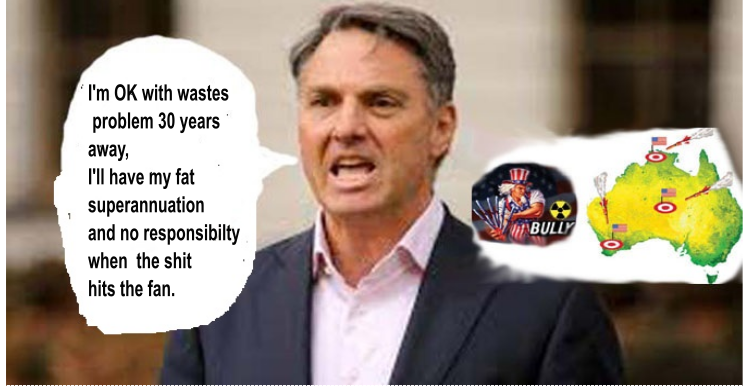
Labor is committed to ensuring the management of radioactive waste and spent nuclear fuel responsibly, including through an appropriately independent regulatory system. A rigorous process will determine the site of the nuclear waste facility, on the current or future Defence estate, with appropriate public consultation and agreement with First Nations communities to respect and protect cultural heritage. Australia will not be responsible for disposing spent nuclear fuel or accept other high-level radioactive waste from any other country.
Despite four decades of effort, Australia still hasn’t selected a site for a national low level radioactive waste repository. A high level waste repository is an even more difficult project – technically and politically. Albanese, Marles and other current decision makers will likely be long retired before this aspect of AUKUS is sorted out.
Even if the issue is solved, AUKUS radioactive legacy will linger for thousands of years.
Labor will ensure that regular updates are provided to Parliament, including relevant Parliamentary committees, and the relevant stakeholders, including defence industry, unions, and the ALP National Conference on the progress of Australia’s acquisition of conventionally-armed, nuclear-powered submarines.
The words in this paragraph are completely divorced from the reality of questions that have not been answered in the Senate and FOI’s which have been refused in full……………………………………………………more https://michaelwest.com.au/marles-mauled-rex-patrick-demolishes-defence-sophistry-on-aukus-submarines-nuclear/?utm_source=newsletter&utm_medium=email&utm_term=2023-08-24&utm_campaign=Michael+West+Media+Weekly+Update
French Winter Power Twice as Pricey as Germany’s on Nuclear Woes

By Todd Gillespie, April 19, 2023 https://www.bloomberg.com/news/articles/2023-04-19/french-winter-power-twice-as-pricey-as-germany-s-on-nuclear-woes?leadSource=uverify%20wall#xj4y7vzkg
France’s weakened nuclear power output means the cost of its electricity for next winter is more than twice as expensive as Germany’s, as concerns over the health of the country’s reactors persist.
The “massive” gap of nearly €250 ($273) per megawatt-hour between French and German prices is because traders are pricing in more risk as they await updates on Electricite de France SA’s struggles with its aging atomic fleet, according to analysts at Engie SA’s EnergyScan. “No participants want to risk being short next winter,” they wrote.
French power for the first quarter of 2024 is trading at €416 per megawatt-hour, more than double Germany’s rate of €169. Normally a power exporter, France’s atomic generation has been gradually returning to service but still remains below historical averages.
France, which relies on nuclear energy for most of its electricity, is expected to remain heavily dependent on power imports during the winter months to meet its demand. Meanwhile, Germany closed its last nuclear plants Saturday after years of political tension over phasing out the technology, but is still very reliant on polluting coal-fired power.
French nuclear availability was at 62% on Wednesday, according to data compiled by Bloomberg. Nuclear output on Wednesday was above its level for this time last year after weeks of historic lows.
— With assistance by Josefine Fokuhl and Francois De Beaupuy
The Fukushima nuclear plant will start releasing treated wastewater. Here’s what you need to know.

The Canadian Press, Mari Yamaguchi, The Associated Press 23 Aug 23,
TOKYO (AP) — Japanese officials plan to start discharging treated radioactive wastewater from the damaged Fukushima Daiichi nuclear power plant into the Pacific Ocean on Thursday, a contentious step more than 12 years after a massive earthquake and tsunami set off a battle against ever-increasing amounts of radioactive water at the plant.
The government and plant operator say the release is an unavoidable part of its decommissioning and will be safely carried out, but the plan faces opposition in and outside Japan. Here is a look at the controversy.
WHY IS THERE SO MUCH WASTEWATER?
The March 2011 earthquake and tsunami destroyed the plant’s cooling systems, causing three reactors to melt. Highly contaminated cooling water applied to the damaged reactors has leaked continuously to building basements and mixed with groundwater.
The plant operator, Tokyo Electric Power Company Holdings (TEPCO), has taken steps to limit the amount of groundwater and rainwater entering the reactor area, and has reduced the increase in contaminated water to about 100 tons a day, 1/5 of the initial amount. The water is collected and partly recycled as cooling water after treatment, with the rest stored in around 1,000 tanks, which are already filled to 98% of their 1.37 million-ton capacity.
WHY IS TEPCO RELEASING THE WATER NOW?
The government and TEPCO say they need to make room for the plant’s decommissioning and prevent accidental leaks from the tanks.
Japan has obtained support from the International Atomic Energy Agency to improve the transparency and credibility of the release and ensure it meets international safety standards. The government has also stepped up a campaign promoting the plan’s safety at home and through diplomatic channels.
WHAT’S IN THE TREATED WATER’?
The water is being treated by what’s called an Advanced Liquid Processing System, which can reduce the amounts of more than 60 selected radionuclides to government-set releasable levels, except for tritium, which officials say is safe for humans if consumed in small amounts.
About 70% of the water held in the tanks still contains cesium, strontium, carbon-14 and other radionuclides exceeding government-set levels. It will be retreated until the concentrations meet those limits, then diluted by more than 100 times its volume of seawater before it is released. That will bring it way below international safety limits, but its radioactivity won’t be zero.
HOW SAFE IS IT?
IAEA concluded in a report that the plan, if conducted as designed, will have negligible impact on the environment and human health. IAEA chief Rafael Grossi visited the plant and said he was satisfied with preparations.
Japan’s government says the release of tritium into the sea is a routine practice by nuclear plants around the world and that the amount will be several times lower than from plants in China and South Korea.
Scientists generally support the IAEA’s conclusion, while some call for more attention to dozens of low-dose radionuclides that remain in the water, saying data on their long-term effects on the environment and marine life are insufficient.
HOW WILL IT BE RELEASED?
TEPCO executive Junichi Matsumoto says the release will begin with the least radioactive water to ensure safety. After samples are analyzed in final testing, the water will be transported through a thin black pipe to a coastal area where it will be diluted with hundreds of times its volume of seawater.
The diluted water will enter an undersea tunnel and be released a few minutes later from a point 1 kilometer (0.6 mile) off the coast. The release will be gradual and will continue for decades until the decommissioning of the plant is finished, TEPCO officials say. Matsumoto said the slow release will further reduce the environmental impact.
Final preparation for the release began Tuesday when just 1 ton of water was sent for dilution with 1,200 tons of seawater, and the mixture was to be kept in the primary pool for two days for final sampling to ensure safety, Matsumoto said. A batch of 460 tons will be sent to the mixing pool Thursday for the actual discharge.
The company plans to release 31,200 tons of treated water by the end of March 2024, which would empty only 10 tanks because of the continued production of wastewater at the plant. The pace will later pick up.
WHY ARE PEOPLE WORRIED?
Fukushima’s badly hit fisheries, tourism and economy are still recovering from the disaster. Fisheries groups worry about a further damage to the reputation of their seafood. Fukushima’s current catch is only about one-fifth its pre-disaster level due to a decline in the fishing population and smaller catch sizes.
The head of the National Federation of Fisheries Cooperatives, Masanobu Sakamoto, said on Monday that “scientific safety and the sense of safety are different.”
Groups in South Korea and China have also raised concerns, turning the release into a political and diplomatic issue. China has stepped up radiation testing of fishery and agricultural products from Fukushima and nine other prefectures, halting exports at customs for weeks, Fisheries Agency officials say.
WHAT IF SOMETHING GOES WRONG?
The Japanese government says potential risks from the release of treated water are limited to reputational damage resulting from rumors, rather than scientific study. It has allocated 80 billion yen ($550 million) to support fisheries and seafood processing and combat potential reputation damage. TEPCO has also promised to deal with reputational damage claims.
The ageing nuclear reactors. How to keep them going for decades, (best to forget coming climate extremes)

plant-specific climate simulations do not exist for lower river levels, increased wildfires, or extreme weather events like tornadoes and heavy wind and rain.
Then there’s the issue of what to do with radioactive spent fuel.
Europe’s atomic reactors are getting old. Can they bridge the gap to an emissions-free future?
Reuters, By America Hernandez, Forrest Crellin, Prasanta Kumar Dutta, Anurag Rao and Aditi Bhandari, Aug. 22, 2023
Shaken by the loss of Russian natural gas since the invasion of Ukraine, European countries are questioning whether they can extend the lives of their ageing nuclear reactors to maintain the supply of affordable, carbon-free electricity — but national regulators, companies and governments disagree on how long the atomic plants can be safely kept running………………………………………………
Taken together, the UK and EU have 109 nuclear reactors running, most of which were built in the 1970s and 1980s and were commissioned to last about 30 years.
That means 95 of those reactors — nearly 90% of the fleet — have passed or are nearing the end of their original lifespan, igniting debates over how long they can safely continue to be granted operating extensions.
Extension talk: Bridging the gap or a new lease of life?
Regulations differ across borders, but life extension discussions are usually a once-a-decade affair involving physical inspections, cost/benefit estimates for replacing major worn-out parts, legislative amendments, and approval from the national nuclear safety authority.
In some countries — especially for those that planned to exit atomic power entirely after the 2011 Fukushima nuclear disaster in Japan — discussion is focused on the short term: eking out a few years to get through any shortages before new wind, solar and gas installations can be built to take over.
Anti-nuclear Germany had planned to switch off its last three plants by the end of 2022, only to grant the sites an emergency extension to April 2023 to make it through winter without Russian gas — which previously made up 40% of EU gas supply……………………………………….
So far, Finland, Sweden, Bulgaria, the Czech Republic, Slovenia, the Netherlands and Hungary have all taken steps to allow reactors to run for at least 60 years, subject to regular safety checks.
France, with the largest fleet, is carrying out a major 40-year inspection and refurbishment programme for its 32 oldest reactors.
ASN, the national safety authority, has said France’s pressurised water reactor (PWR) design in principle can be safely operated for 50 years — meaning the ageing plants can run through 2030 — but the regulator will not take a stance on extending to 60 years until the end of 2026……………………………………..
Some companies are pushing the limits further.
In February, Finland’s Fortum obtained permission to operate two reactors until 2050, when they will reach 70 years of age.
In Sweden, where licences are unlimited in time subject to regular safety checks, Vattenfall is considering 80 years of operation for its five reactors……………… More than scientific one-upmanship is at play.
…………………. The cost of pulling the plug
Politicians are also under pressure to keep energy prices low, especially as movements characterising climate action as costly and elitist gain ground.
That means ensuring steady, abundant supply — any swift, unexpected loss of a major source means market spikes and painful household bills.
Energy prices in Europe jumped exponentially in 2022 after many French reactors went offline. The impact was compounded by Russia’s invasion of Ukraine.
…………………………………..The biggest challenge is maintaining the reactor vessel, where uranium atoms are split to release neutrons inside the core. Those flying neutrons also hit the vessel’s steel walls, altering the lattice structure of the metal, making it hard and brittle.
Vattenfall and EDF try to slow down that embrittlement process by layering in special rods of hafnium metal or all……………………………….
Reactor vessels are generally seen as non-replaceable — though it has never been tried.
The same goes for the airtight containment building, which houses the reactor and all associated radiation-emitting parts, to keep it from being released into the atmosphere.
………………………… The French government, which this year nationalised EDF, has estimated it needs to hire and train at least 100,000 workers by 2033 if it hopes to run its fleet long term and build at least six new reactors.
That includes automation engineers, boilermakers, draughtsmen, electricians, maintenance technicians, blacksmiths, pipe fitters and welders.
Europe’s new pro-nuclear alliance would require some 450,000 skilled workers if it hopes to build an additional 50 GW of new nuclear by 2050, according to industry lobby Nucleareurope.
2050 and beyond: Hotter, drier, more radioactive trash
Industry cheerleaders point to Dubai’s new Barakah nuclear plant as proof reactors can be successfully designed to withstand desert heat and warmer water temperatures.
But few plants have room to be retrofitted with new safety systems, such as a dyke wall to protect against rising water levels, regulators warn.
“It’s a real headache to find [physical] space on a site that’s currently operating — we have reached certain limits in the feasible modifications of existing reactors,” said Karine Herviou, deputy director-general of France’s Institute for Radioprotection and Nuclear Safety, at the industry event on lifetime extensions.
The French fleet’s temperature margin to withstand heatwaves is constantly questioned, she added, while plant-specific climate simulations do not exist for lower river levels, increased wildfires, or extreme weather events like tornadoes and heavy wind and rain.
As a result, Herviou said in France: “There’s a general agreement that what we’ll do at the 50-year, 60-year mark will essentially be replacements for modernisation but very certainly not adding in any new safety systems … and checking for conformity and respect of already-applicable requirements, without further hiking the safety requirements.”
That rings alarm bells for third-party watchdogs like Mycle Schneider, who compiles the annual World Nuclear Industry Status Report and said ageing reactors need tighter scrutiny.
“You have a car, 30-to-40 years old, and your generator breaks down. You open the hood, the mechanic takes out the generator and then says, ‘Ooh, everything underneath is rotten’ — a 40-year-old nuclear plant is not all that different, you basically find on the go all kinds of things you didn’t expect to find,” Schneider said.
EDF wants the government to relax biodiversity rules which forbid plants from dumping used cooling water into nearby rivers on days they are deemed already too warm, limiting power production — which risks becoming more frequent.
Then there’s the issue of what to do with radioactive spent fuel.
Used uranium pellets, which are solid, are stored in special refrigerated swimming pools designed to cool the radioactive heat down for five-to-10 years. French company Orano then separates out the material into non-recyclable leftovers that are vitrified into glass (4% of the material), plutonium (1%) to create a new nuclear fuel called Mox, on which some 40% of France’s reactors can run; and reprocessed uranium (95%) which for now can only be re-enriched and “recycled” at one plant in Russia.
Non-recyclable waste can be safely stored in dry casks, but its ultimate destination is deep underground, where it will fully degrade over hundreds of thousands of years.
Sweden, Finland and France have plans to build such long-term underground sites……………………………………………………………………………… https://www.reuters.com/graphics/EUROPE-ENERGY/NUCLEARPOWER/gdvzwweqkpw/
Global Campaign Against Ocean Dumping of Nuclear Wastewater Worldwide Urgent Actions against Japan’s ocean dumping of nuclear wastewater on Aug 24th.
1. The USA
- Los Angeles, Aug 23rd, 12 – 1 PM @ Japanese Consulate
- New York, Aug 23rd, 12 – 1 PM @ Japanese Consulate (E 49th St & Park Ave.)
- Washington DC, Aug 25th, 11am @ Japanese Embassy
- Seattle, Washington, Aug 26th, 2pm @ Seattle Downtown ‘West Lake Park’
Organized by Global Candlelight Action
2. UK
- North Wales, Aug 25th, 5pm @ Bangor pier
Organized by PAWB ( People Against Wylfa B) and CADNO
3. Germany
- Berlin, Aug25th, 5 pm @ Brandenburg Gate
- Frankfurt, Aug 26th, 3 pm @ Rathenauplatz (Goetheplatz)
- Hamburk, September 9th
Organized by Global Candlelight Action
4. Fiji
- Suva, Aug 25th, 10am @ Japanese Embassy
Organized by PANG, Alliance for Future Generations, Pacific Conference of Churches; FWRM, DIVA for Equality and others joining the March including the largest Indigenous women’s network.
5. Japan
- Tokyo, Aug 22nd @ Japanese PM house
- Tokyo, Aug 23rd @ TEPCO
- Fukushima Iwaki, Aug 27th
Organized by Japanese CSOs alliances
6. Switzerland
- Zurich, September 16th
Organized by Global Candlelight Action
7. Canada
- Civil Zoom rally, on August 24, 5 pm
Organized by civil society in Canada
8. Australia
- Melbourne, Aug 26th (Sat), 5 pm @ Korea Society of Victoria
Organized by Global Candlelight Action
9. Korea
- Seoul, Aug 23rd, 7pm @ Japanese Embassy
- Seoul, Aug 24th, 7pm @ Japanese Embassy
- Seoul, Aug 26th, 6pm @ Korea Press Center
- 17 local cities nationwide in Korea hold a press conference and rallies from Aug 22nd~31st
Organized by Korean civil society alliances / Korean Peoples’ Action to Stop Dumping of Fukushima Daiichi Radioactive Water(KPA-SDFDRW)
So much Labor hope is riding on an empty vessel

Labor’s leaders have put staying in government first. But it’s a bit pointless when they cannot even persuade their own supporters why they are taking the positions they are.
AFR Laura Tingle, Columnist 18 Apr 23
On one side of the discussion there was a disparate collection of people expressing concerns about a profound policy shift which has a multitude of troubling – and unanswered – questions attached to it.
On the other, a cabinet full of ministers who before September 15, 2021, when it was announced by Scott Morrison, had never remotely considered that Australia buying nuclear-powered submarines from the Americans was obviously the strategic……………………………. (Subscribers only) https://www.afr.com/politics/federal/so-much-labor-hope-is-riding-on-an-empty-vessel-20230814-p5dw8a
Coalition’s campaign for nuclear energy implausible, experts say
SMH. By Mike Foley, August 21, 2023
Former chief scientist Alan Finkel says it would take decades to develop a local nuclear energy industry, as he and other experts reject the Coalition’s push to switch focus from renewables to nuclear energy as implausible since Australia needs urgent replacement for its ageing coal-fired power plants.
Opposition Leader Peter Dutton wants Australia to deploy emerging nuclear power technology, while Nationals leader David Littleproud has criticised what he calls the government’s “reckless race to renewables” and asked for the government’s clean energy target to be paused and reconsidered.
The Albanese government has pledged to more than double the amount of power the electricity grid sources from renewables to 82 per cent by 2030, to help achieve its target of cutting greenhouse gas emissions by 43 per cent by the same deadline.
Federal parliament banned nuclear power in 1998 and the moratorium has remained in place with bipartisan support, but Dutton is calling for the deployment of small modular reactors to reduce emissions from the electricity sector, instead of renewables that require a vast array of new power lines to link wind and solar farms to the cities.
Finkel said it was highly unlikely that Australia could open a nuclear power plant before the early 2040s, pointing out the autocratic United Arab Emirates took more than 15 years to complete its first nuclear plan using established technology………………………………………………..
Responding to assertions that small modular reactors, which are smaller than traditional nuclear plants, may be quicker and cheaper to build, Finkel said: “The reality is, it’s not being done in Europe and America.
“There’s no operating small modular reactor in Canada, America or the UK, or any country in Europe.”
Finkel noted that private company Nuscale is aiming to commission 12 small modular reactors starting from 2029, but he said it would probably take at least a decade to follow suit in Australia.
“I just can’t see anything less than 10 years from the time that the [Australian] government saw Nuscale start operating in America,” he said.
……………………………Energy analyst Dylan McConnell said deploying a small modular reactor at an old coal plant would not be the “plug-and-play” operation some optimists have suggested.
“You would have to decommission the existing coal plant and then build a new nuclear plant,” he said.
Alison Reeve, a climate and energy expert at the Grattan Institute, said investors could not start to investigate a nuclear project in Australia until the moratorium was lifted by federal parliament, and it would probably take years after that for states to pass their own laws and for a regulatory framework to be developed.
“This is not as simple as just removing the moratorium and then everything will be fine,” Reeve said. https://www.smh.com.au/politics/federal/coalition-s-campaign-for-nuclear-energy-implausible-experts-say-20230821-p5dy2a.html
Fukushima: wastewater from ruined nuclear plant to be released from Thursday, Japan says
Release plans approved by UN nuclear authority have caused outcry in China and concern for the reputation of Japan’s seafood
Guardian Justin McCurry in Tokyo 22 Aug 23
Japan is to begin releasing wastewater from the wrecked Fukushima Daiichi nuclear power plant from Thursday, in defiance of opposition from fishing communities, China and some scientists.
The prime minister, Fumio Kishida, has said that disposing of more than 1m tonnes of water being stored at the site is an essential part of the long and complex process to decommission the plant.
But the plan, announced by Kishida on Tuesday, has caused controversy because the water contains tritium, a radioactive substance that can’t be removed by the facility’s water filtration technology.
The decision comes weeks after the UN’s nuclear watchdog, the International Atomic Energy Agency (IAEA), approved the discharge, saying that the radiological impact on people and the environment would be “negligible”.
South Korea and China banned seafood imports from some areas of Japan after Fukushima Daiichi suffered a triple meltdown in the March 2011 triple disaster along the country’s north-east coast.
The South Korean government recently dropped its objections to the discharge, but opposition parties and many South Koreans are concerned about the impact the discharge will have on food safety. China remains strongly opposed, while Hong Kong, an important market for Japanese seafood exports, has also threatened restrictions.
Some experts point out that nuclear plants around the world use a similar process to dispose of wastewater containing low-level concentrations of tritium and other radionuclides.
“Tritium has been released [by nuclear power plants] for decades with no evidential detrimental environmental or health effects,” said Tony Hooker, a nuclear expert from the University of Adelaide.
Greenpeace, however, has described the filtration process as flawed, and warned that an “immense” quantity of radioactive material will be dispersed into the sea over the coming decades.
The government and the plant’s operator, Tokyo Electric Power (Tepco), also face opposition from local fishers, who say pumping water into the Pacific Ocean will destroy their industry.
In a meeting on Monday with Masanobu Sakamoto, the head of the National Federation of Fisheries Cooperative Associations, Kishida attempted to reassure fishing communities that the discharge was safe………………………………… https://www.theguardian.com/environment/2023/aug/22/fukushima-wastewater-from-ruined-nuclear-plant-to-be-released-from-thursday-japan-says
Much hype, enthusiasm, tax-payers’ largesse, for Britain’s “new nuclear”. (What could possibly go wrong?)

There would be up to £20 billion in subsidies, if needed, to get between five and eight SMRs up and running by early next decade, and about £160 million in grants to keep R&D ticking over into AMRs and nuclear fuels.
Britain fires starter’s gun on race to nuclear
In the second instalment of the Nuclear Option series, Prime Minister Rishi Sunak’s government is suddenly ready to shower billions of pounds on getting modular nuclear reactors up and running by the early 2030s.
Australian Financial Review Hans van Leeuwen, Europe correspondentAug 22, 2023 – London
The British government is ready to trowel more than £20 billion ($38 billion) of taxpayers’ money into turbocharging the country’s nuclear industry, as the daunting task of decarbonising the UK’s energy sector looms ever larger.
With offshore wind and solar unlikely to ensure Britain has uninterrupted baseload power, the official goal is to get 24 gigawatts of nuclear energy onstream by 2050 – up to a quarter of British power demand, up from 15 per cent now.
But hefty new gigawatt-scale nuclear power stations are struggling to get off the ground, so the government’s hopes are increasingly pinned on an early lift-off for small modular reactors (SMRs)
…………… …. Tom Greatrex, chief executive of Britain’s Nuclear Industry Association. says that although successive Downing Street administrations have all understood Britain’s flagging nuclear industry needs fresh legs, Prime Minister Rishi Sunak’s government is now gripped with urgency. And it has clocked the key catalysing role of taxpayers and public policy.
“The lesson from anywhere in the world where nuclear power has been deployed is that unless the state is actively involved in encouraging it to happen, it doesn’t happen,” Greatrex says.
“It is public policy that has driven it, basically because the infrastructure is so big and capital-intensive.”
The government recently unfurled a £170 million investment into hurrying up work on the embryonic but enormous Sizewell C, a 3.2-gigawatt nuclear reactor to be built by the mid-2030s. This came on top of £700 million in earlier subsidies.
But the real action must of necessity be elsewhere. Construction of the next big new nuclear reactor, the 3.2-gigawatt Hinkley Point C plant in Somerset, has been subject to seemingly endless delays and cost blowouts. And of the five creaky old mega-reactors now operating, all but one will be shut in the next five years.
So, the focus is squarely on SMRs, which in theory can be rolled out more cheaply and snappily; and also on advanced modular reactors (AMRs), which use exotic new tech or methods that are still either largely on the drawing board or even just a glint in some scientist’s eye.
A week before the Sizewell announcement, the government confirmed it would set up a new agency, revelling in the Tory-boilerplate name of Great British Nuclear, to gee up the industry.
There would be up to £20 billion in subsidies, if needed, to get between five and eight SMRs up and running by early next decade, and about £160 million in grants to keep R&D ticking over into AMRs and nuclear fuels.
“I look forward to seeing the world-class designs submitted from all around the world through the competitive selection process, as the UK takes its place front and centre in the global race to unleash a new generation of nuclear technology,” energy minister Andrew Bowie trumpeted.
Leaders of the pack

At the front of the SMR pack is Rolls-Royce, leading a consortium that has already received £210 million in government grants. It has beefed up its SMR workforce to about 600 people.
……………………………………………. GE Hitachi is Rolls-Royce’s main rival. Media reports say it already has a BWRX-300 under construction and regulatory review in Canada, a.nd its model is under consideration in the US. The company claims to be the only contender with a realistic shot of getting an SMR operational by 2030.
The two are very likely to feature on Great British Nuclear’s short-list, which will be compiled by the end of the year. Other contenders could include Nuscale and Westinghouse.

The lucky winners will get access to the government’s subsidy scheme, which could be worth £20 billion if that’s what it takes.
It’s unclear exactly what form this largesse will assume. It could use the “regulated asset base” model, where investors are given a guaranteed minimum return, funded by a levy on consumer energy bills.
Another model might involve “strike prices”: a guaranteed price per unit, to smooth out the risks and uncertainty involved in committing so much capital upfront.
Whatever the capital cost, it won’t be as much as required for a mega-reactor: perhaps £2 billion to get an SMR up and running, as opposed to the £20 billion-plus for Sizewell C, thanks to the SMR’s modular, factory-based construction method. The catch, of course, is that you get just 50 to 500 megawatts of energy, rather than 3.2 gigawatts.
“It’s the economics of volume versus the economics of scale,” Greatrex says.
The initial batch of SMRs will almost certainly be built on the site of decommissioned larger reactors: communities there are socialised to nuclear; there are good grid connections; and the geography favours PWRs. This could help overcome a raft of potential political, planning or permit obstacles.
Dark horses
While the SMRs bolt towards an early-2030s target, the government hopes to back other horses in slower time. The AMRs might use technologies that ultimately prove more efficient, such as MoltexFlex’s molten-salt reactor. Or they might have different applications, such as local start-up U-Battery………………………….

U-Battery ‘s key backer, Urenco, ultimately couldn’t pull in investors, and in March handed the intellectual property to the government-backed National Nuclear Laboratory.
Other AMRs have higher-profile investors: TerraPower has Bill Gates; NewCleo has Italy’s Agnelli family. Most are working across multiple markets. X-Energy, for example, is using US funding to build a pilot of its gas-cooled pebble-bed reactor in Texas, which it says would allow it to roll out quickly in Britain…………………
The government has fired the starter’s gun, and the race in Britain is on. There’s bipartisan political support and investor interest, so Greatrex’s only anxiety is that Westminster might become distracted.
“It’s about maintaining momentum and focus. When something is at the top of the agenda it gets that attention and focus,” he says. “But if that focus is lost, that drive and commitment is lost? Then things could go back to taking a very long time.” https://www.afr.com/companies/energy/britain-fires-starter-s-gun-on-race-to-nuclear-20230726-p5dr9r
1 This month


Help Aunty Sue Protect Her Land and Sacred Sites From Destructive Rocket Testing.
.

Australians deserve the truth
about
AUKUS – https://aukuspublicinquiry.com/

PETITION – To: Prime Minister Anthony Albanese and the Australian Labor Government

of the week – Australians for War Powers Reform (AWPR)
To see nuclear-related stories in greater depth and intensity

