American companies might make fuel for small nuclear reactors, except that there seems to be no market for them.

Russia’s Uranium Dominance Threatens America’s Next-Gen Nuclear Plans, By Tsvetana Paraskova – Oct 23, 2022, 10:00 AM CDT
- The United States has ambitious plans for its nuclear power industry.
- Russia’s stranglehold on the uranium market threatens to delay progress in nextgen nuclear power projects.
- U.S. companies are scrambling to develop the domestic uranium supply chain needed to fuel nuclear power ambitions.
……………………..
there is one major hurdle to the construction of most advanced reactors under development in the United States—the uranium type of fuel on which those reactors are designed to run is currently sold commercially by only one company in the world. And that company is a subsidiary of Russia’s ROSATOM, the Russian State Atomic Energy Corporation.
The federal government and U.S. companies developing advanced nuclear reactors—including Bill Gates’ TerraPower—recognize the urgent need to eliminate reliance on a Russian state corporation for nuclear fuel for America’s next-generation nuclear reactors.
The association Uranium Producers of America noted during a Senate committee hearing after the Russian invasion of Ukraine that “almost none of the fuel needed to power America’s nuclear fleet today comes from domestic producers, while U.S. nuclear utilities purchase nearly half of the of the uranium they consume from state-owned entities (SEO) in Russia, Kazakhstan, and Uzbekistan.”
“We estimate that there is more than $1 billion in annual U.S. dollar purchases of nuclear fuel flowing to ROSATOM,” said Scott Melbye, president of the association and Executive Vice President at Uranium Energy Corp.
ROSATOM is not under Western sanctions after the Russian invasion of Ukraine because of the Russian state firm’s importance in the supply chain of the global nuclear power industry. But the U.S. firms developing the next generation of more efficient, cheaper, and more environmentally friendly nuclear reactors don’t want to do business with Russia anymore.
Hence, the need for a commercially viable and stable domestic supply chain of the fuel for those advanced reactors—HALEU, or high assay low enriched uranium. ……………………………………….
the U.S. government faces the “chicken and egg” dilemma in HALEU supply, Matt Bowen, Research Scholar at the Center on Global Energy Policy at Columbia University SIPA, and Paul M. Dabbar, Distinguished Visiting Fellow at the same center, wrote in a paper in May this year/
“Existing enrichment companies, such as Urenco, Orano, GLE, and Centrus, could make HALEU, but these companies would likely be hesitant to invest too much in building HALEU infrastructure and completing NRC licensing without being confident there will in fact be a profitable market for the product,” they say.
Nuclear is on the front-line of climate change – and not in a good way.
Presentation at the SGR Responsible Science conference, 19.10.2022, by Dr.
Paul Dorfman (University of Sussex). Climate models have run hot. As
knowledge of enhanced climate sensitivity and polar ice melt-rate evolves,
it has become clear that sea-level rise is significantly faster than
previously thought, resulting in more frequent and destructive storms,
storm surge, severe precipitation, and flooding.
With rare extreme events
today becoming the norm in the future, existing risk mitigation measures
become increasingly obsolete. The corollary to this analysis is that
present and planned UK coastal nuclear installations will be at significant
risk. In other words, nuclear’s lower-carbon electricity USP sits in the
context of the much larger picture – that UK coastal nuclear will be one
of the first, and most significant, casualties to ramping climate impact.
Put simply, UK nuclear is quite literally on the front-line of climate
change – and not in a good way. UK civil nuclear infrastructure is
profoundly unprepared for climate impact and there is a very high
probability that reactors and their associated high-level spent fuel stores
will become unfit for purpose, and much sooner than expected.
Scientists for Global Responsibility 20th Oct 2022
Zelensky denies ordering attack on Crimean Bridge
https://www.rt.com/russia/565053-zelensky-crimea-bridge-attack/–-22 Oct 22
Officials in Kiev have taken credit for the blast, with the postal service even issuing a commemorative stamp
Ukrainian President Vladimir Zelensky has denied “ordering” the bombing of the Crimean Bridge, earlier this month. The president made the remarks during an interview with the Canadian broadcaster CTV, aired on Wednesday.
Asked to comment on the “spectacular attack” on the bridge, as the broadcaster put it, Zelensky said Kiev was not involved.
lensky said Kiev was not involved.
“We definitely did not order that, as far as I know,” he told the reporters.
The bridge was hit by a massive explosion on October 8, which severely damaged its road traffic section and killed three civilians, as well as setting a passing freight train on fire. Several top Ukrainian officials openly celebrated the attack, while the country’s postal service issued a stamp commemorating the blast, just hours after it happened.
Moscow has directly blamed Kiev for the incident, branding the explosion a “terrorist attack.” Russian law enforcement claims to have established how the bomb, which was disguised as construction materials, made it to the bridge from the Ukrainian port city of Odessa, via multiple transit countries.
Russian investigators believe the plot was hatched by Ukrainian military intelligence. Moscow has identified 12 individuals as suspected accomplices in the plot and has arrested eight of them, the FSB said.
The list of people in custody includes five Russians and three foreign nationals, who hold passports of Ukraine and Armenia. A spokesman for Ukrainian military intelligence told the media that the FSB was a “fake structure,” and that the report was unworthy of comment.
Days after the attack, Moscow ramped up its aerial bombing campaign against Ukraine, targeting its critical infrastructure with cruise missiles and suicide drones. Kiev reported on Tuesday that 23 people were killed and over 100 injured in the barrage.
Would the use of a tactical nuclear weapon in Ukraine lead to all-out nuclear war?

The idea of using a single tactical nuclear weapon is starting to be dangerously downplayed as maybe not all that bad, thus normalizing something that should instead be outlawed. Just hide in your basement for a few days while the radiation dissipates and it’ll be OK.
“tactical” is a term that covers a whole panoply of so-called “short range” weapons armed with a nuclear warhead. Such weapons can be launched from the ground, air, or sea, and even from a truck bed. A single weapon has a typical explosive yield of between 10 and 100 kilotons. The Hiroshima bomb was 15 kilotons. So that’s not exactly small.
Our fears would vanish if nuclear weapons did too
Edging toward Armageddon? — Beyond Nuclear International By Linda Pentz Gunter, 23 Oct 22, https://beyondnuclearinternational.org/2022/10/23/edging-toward-armageddon/
As we mark 60 years since the Cuban Missile Crisis, it’s truly horrifying to realize that our present times are considered to be the closest to nuclear war we have been since those 13 terrifying days in 1962.
What saved us then was cooler heads prevailing, as our stories last week described. But can we be assured that those with the power to press the proverbial button — whether at the pinnacle of leadership or lower down the chain of command — will act with similar sense and restraint?
With Kennedy and Khrushchev in command, there was a willingness on both sides to pull back from the brink, not only rhetorically, but through meaningful actions. Khrushchev removed his nuclear missiles from Cuba while the US publicly declared it would not invade the island. Privately, the US also agreed to dismantle its ballistic missiles stationed in Turkey.
And, as we have seen over the years — and in last week’s article by Angelo Baracca — sometimes it takes a person of more humble position to restore rationality and act with restraint. These near-misses ought to have put the halt on nuclear weapons development many decades ago
Instead, that most obvious of lessons was never learned: that nuclear weapons serve only one purpose; the mutual destruction of all of us. Instead, the nuclear arms race escalated to obscene heights and there are still at least 13,000 nuclear weapons in the world, leaving us perpetually on the edge of Armageddon.
And it was that word, “Armageddon,” that current US President Joe Biden used recently when he said at a Democratic gathering, “We have not faced the prospect of Armageddon since Kennedy and the Cuban Missile Crisis.”
Kennedy had met Khrushchev prior to the 1962 standoff and Biden described Russian president, Vladimir Putin, as “a guy I know fairly well”. But so far, that familiarity hasn’t relieved the current atomic tensions around Russia’s ongoing invasion of Ukraine. Instead, the news is full of alarm bells, warning that yes, Putin might just be mad enough to push the nuclear button and take us all down with him.
Pundits have cautioned that we are “not there yet,” which should not be taken as comfort. It should be taken as an opportunity to ensure that we never, ever get there. And it’s certainly not encouraging that Russia’s new top commander of the war in Ukraine. General Sergei Surovikin, is nicknamed “General Armageddon” for his command of Russia’s Syria bombardments. But, in the meantime, when we talk about Russia “using” nuclear weapons, what could happen?
Russia could use a single tactical nuclear weapon in Ukraine, although “tactical” is a term that covers a whole panoply of so-called “short range” weapons armed with a nuclear warhead. Such weapons can be launched from the ground, air, or sea, and even from a truck bed. A single weapon has a typical explosive yield of between 10 and 100 kilotons. The Hiroshima bomb was 15 kilotons. So that’s not exactly small.
The idea of using a single tactical nuclear weapon is starting to be dangerously downplayed as maybe not all that bad, thus normalizing something that should instead be outlawed. Just hide in your basement for a few days while the radiation dissipates and it’ll be OK.
But it’s that kind of thinking that prompted Biden to use the word “Armageddon” in the first place. “I don’t think there is any such thing as the ability to easily use a tactical nuclear weapon and not end up with Armageddon,” Biden said.
Because of course it wouldn’t be OK at all. Even after the radiation levels drop, the soil and water, and therefore food sources, would be contaminated. Essential infrastructure would be destroyed. There would be countless fatalities and many sick and dying. To use any nuclear weapon would be an abomination.
The White House has also said it would deliver what it described as a “decisive response”, should Russia use nuclear weapons. Again, it’s unclear what this means. Would the US reply with a nuclear attack of its own?
But what all of this does prove is that the possession of nuclear weapons isn’t deterring anything. What we are most frightened of right now is the possibility that Russia will use nuclear weapons and the US and/or NATO might retaliate.
Those fears would vanish if nuclear weapons did too.
That is why continuing to push for signatures and ratifications of the UN Treaty on the Prohibition of Nuclear Weapons is so important, because it’s the one treaty that spells out the immorality of nuclear weapons and the devastating humanitarian impacts that would result even from their so-called limited use.
Linda Pentz Gunter is the international specialist at Beyond Nuclear and writes for and curates Beyond Nuclear International.
Noisy support for an obvious failure

One impact of this continuing official nuclear support is that climate action is being diminished and slowed. As a paper in Nature Energy (which one of us co-authored) showed in 2020, in worldwide data over the past three decades, the scales of national nuclear programmes do not tend to correlate with generally lower carbon emissions. The building of renewables does.
worldwide substantive picture that shows nuclear power overwhelmingly to be slower, less effective and more expensive at tackling climate disruption than are renewable and storage alternatives.
As nuclear power sinks, its supporters crow louder. Why do media and governments insist on nuclear for climate?
Noisy support for an obvious failure — Beyond Nuclear International
By Andrew Stirling and Phil Johnstone, 23 Oct 22
At Edinburgh’s Haymarket station, on the route used by COP26 delegates hopping across to Glasgow last November, a large poster displayed a vista from the head of Loch Shiel. In the foreground, a monument to the Jacobite rebellion towers from the spot where Bonnie Prince Charlie raised his standard. From there, the water sweeps back to a rugged line of hills.
This is one of Scotland’s most iconic views, famous for both its history and its role in the Harry Potter films.
On the poster, written in the sky above the loch are the words: “Keep nature natural: more nuclear power means more wild spaces like these.” At the bottom is a hashtag – #NetZeroNeedsNuclear – with no further mention of who might be behind this advert.
But it’s not hard to find a website for this group, which claims to be run by “a team of young, international volunteers made up of engineers, scientists and communicators”, all with the engagingly smiley profile pictures to be expected from citizen activists.

Only when you scroll to the end do you see these activities are ‘sponsored’ by nuclear companies EDF and Urenco. At the bottom, it is explained that Nuclear Needs Net Zero is part of the Young Generation Network (YGN) – “young members of the Nuclear Institute (NI), which is the professional body and learned society for the UK nuclear sector”. The website asserts that the Nuclear4Climate campaign – described as “grassroots” both on the site and in a presentation to an International Atomic Agency conference in 2019 – is in fact “coordinated via regional and national nuclear associations and technical societies”……………………………………………
Of course, all this is par for the course in the creative world of PR. But there are more substantive grounds why nuclear advocates might wish to avoid too much public scrutiny at the moment. One reality, which can be agreed on from all sides, is that this is by far the worst period in the 70-year history of this ageing industry. So how come it is benefitting from growing and noisy support in mainstream and social media? Why are easily refuted arguments still being deployed to justify new nuclear power alongside renewables in the energy supply mix? And why has the media seized so enthusiastically on a few prominent converts to the nuclear cause?
Nuclear loses out to renewables
At current prices, atomic energy now costs around three times as much as wind or solar power. And that’s before you consider the full expense of waste management, elaborate security, anti-proliferation measures or periodic accidents. For more than a decade, nuclear has been plagued by escalating costs, expanding build times and crashing orders. Trends in recent years are all steeply in the wrong direction.
So the rising clamour of advocacy seems to be in inverse proportion to performance. Whatever view one takes, nuclear power is in a worse position than it’s ever been compared with low-carbon alternatives – and a position that is rapidly declining further.
In fact, despite misleading suggestions to the contrary by senior figures, background government data has for decades shown that the massive scale of viable UK renewable resources is clearly adequate for all foreseeable needs. Even with storage and flexibility costs included, renewables are available far more rapidly and cost-effectively than nuclear power.
So, for all the breakdancing, it really is a conundrum why persistently bullish government and industry claims on nuclear power remain so seriously under-challenged in the wider debate. It is becoming ever more clear that nuclear plans are diverting attention, money and resources that could be far more effective if used in other ways.
One impact of this continuing official nuclear support is that climate action is being diminished and slowed. As a paper in Nature Energy (which one of us co-authored) showed in 2020, in worldwide data over the past three decades, the scales of national nuclear programmes do not tend to correlate with generally lower carbon emissions. The building of renewables does.
In fact, this study found “a negative association between the scales of national nuclear and renewables attachments. This suggests nuclear and renewables… tend to crowd each other out.”
The issues are, of course, complex. But this finding supports what the dire performance picture also predicts: that nuclear power diverts resources and attention away from more effective strategies, increasing costs to consumers and taxpayers. So it is even odder that loud voices continue to make naïve calls to ‘do everything’ – that nuclear must on principle be considered ‘part of the mix’ – as if expense, development time, limited resources and diverse preferable alternatives are not all crucial issues.
Despite the urgency of the climate emergency, there is strangely little discussion about this evidence that nuclear power may be impeding progress with options that clearly work better.
The media loves nuclear power
In fact, the British media has developed a habit of doggedly repeating claims by the nuclear industry that are, at best, somewhat wishful thinking.
One would not guess from all the noise about ‘small modular reactors’ (SMR), for instance, that the record of new nuclear designs has consistently been one of delayed schedules and escalating prices. One might easily miss that efforts at nuclear cost reduction have always depended more on scaling up than scaling down. And new SMR programmes do not even claim to address pressing current carbon targets. With debate persistently dominated by naively optimistic projections, it is oddly neglected that these familiar claims and sources have all repeatedly been falsified in the past.
Likewise, UK media debate remains unquestioningly locked into sentimental attachments to old ideas of ‘base load’ nuclear power – a notion now recognised by the electricity industry to be outdated. Far from being an automatic advantage, the inflexibly steady ‘base load’ output of a typical nuclear power reactor can present growing difficulties in a modern dynamic electricity system. It often seems to be forgotten that frequent unplanned nuclear closures pose their own kinds of intermittency risks, made worse by the massive unit sizes of nuclear reactors……………………………………
It is against this substantive background that the persistent intensity of UK government support for nuclear power is so odd – and the rising clamour of UK pro-nuclear PR and media articles so striking. Nor is it just the media. Among campaigners, it is strange, given resolute government nuclear commitments, that even some of the previously most critical voices (like Friends of the Earth), seem to be growing strangely quieter…………………………………………………………………………………..
What remains more interesting is why parts of the press should so often and loudly repeat this ‘repentant critic’ trope in aid of such a struggling industry.
One more recent example is that of Zion Lights, whose billing in the Daily Mail as “the former XR [Extinction Rebellion] communications head” has been countered by that organisation. Lights’ shift of position – leaving the Extinction Rebellion to campaign in favour of nuclear power – was featured between June and September 2020 in City AM, the Daily Mail (twice) and the Daily Telegraph, as well as in an article on the BBC News website. Then, in a second round of attention in October, the story was again covered by the Mail, with Lights also featuring in The Sun, this time with a spin (since debunked) targeting wind power…………………..

What is even more notable about this specific instance of a general syndrome is that Lights – the individual at the heart of this story – has (to her credit) made no effort to conceal that she was employed for a period by a high-profile industry-supporting public relations outfit with a long track record of unashamed advocacy of nuclear power – the US Environmental Progress organisation……………
A lack of voices for renewables
The implications here go beyond any individual. What is strange is that media attention is so strong on these kinds of arguments, while counter-commentary is so relatively quiet. After all, whilst not infallible, environmental concerns about nuclear power have over the years generally been broadly vindicated……………………………….
Nor are these odd patterns restricted to traditional media. Social media also seems susceptible. At the same time as Lights’ oddly prominent personal journey was garnering so much unquestioning news attention, other striking developments were under way on Twitter. Here, the Friends of Nuclear Energy set up shop in December 2019, the UK Pro Nuclear Power group (UKPNPG) in April 2020, and Mums for Nuclear UK in July 2020.

In an especially intriguing example, Greens For Nuclear Energy has been active on Twitter since May 2019, spending considerable effort promoting nuclear power and attempting to change the position of the Green Party. Then Liberal Democrats for nuclear power (LDs4nuclear) set up on Twitter in October 2020. In taking up our invitation to respond to core questions raised in this article, GreensForNuclearEnergy pointed to its website, on which it emphatically urges “no compromise to combat climate change”.
This Green Party case is particularly noteworthy, since it is (strangely given underlying patterns of public concern on nuclear issues), the only organised political force in England collectively offering a consistently sceptical position about nuclear power in Parliament. With the longstanding Green grounding on this issue so strong over a half-century, it is especially strange that this development should come at a time when – at least for the Greens – the argument is more over than it has ever been.
What remains particularly striking about all the instances we cite is that none engage substantively with the real-world performance of nuclear power as it is. Despite vivid rhetorics around needs for ‘science-based’ policy – and occasionally colourful fear-mongering about intermittency ‘putting the lights out’ – none of these prolific voices address (let alone refute) the worldwide substantive picture that shows nuclear power overwhelmingly to be slower, less effective and more expensive at tackling climate disruption than are renewable and storage alternatives.
UK government policy
Despite the surface commitment, we see this trend in UK government energy policy too. Dig into more specialist civil service policy papers and you find spiralling prices and little in the way of an energy-related case for nuclear power. But – in a remarkable departure from the normally diligent attention to costs – the most recent energy white paper ignored all that boring economic detail. Official UK nuclear attachments are treated as an unquestionable given.
If a persuasive explanation is sought for this persistent intensity of UK government support for nuclear power, then the real picture seems clear behind the distractions. Official UK defence documentation, many unanswered national and international media reports, brief admissions to Parliament and explicit statements in other nuclear-armed countries all make it pretty clear that the reasons are actually more military than civilian.
So, it might be understood why deep-rooted nuclear interests are seeking to hide these inconvenient facts behind pretty pictures of the West Highlands. But why is the media so keen to help, squirrelling realities away from view behind tales of repentant environmentalists? Why is so much new noise building up behind nuclear power in formerly critical political parties, just when the case has grown weaker than ever?
Profound issues are raised here, not only concerning the cost and speed of climate action, but about the independence and professionalism of the UK media and the health of British democracy as a whole. Whichever opinion we each take on nuclear issues – and whatever the undoubted uncertainties and ambiguities – we should all care very deeply about this.
Andy Stirling is Professor of Science and Technology Policy at the Science Policy Research Unit at the University of Sussex. Dr. Phil Johnstone is Senior Research Fellow at the Science Policy Research Unit at the University of Sussex.
Methane pledge is not about “cow burps:” It means no new coal and gas projects — RenewEconomy

Greens say Australia won’t meet its commitment to Global Methane Pledge by reducing “cow burps,” but by halting new coal and gas development. The post Methane pledge is not about “cow burps:” It means no new coal and gas projects appeared first on RenewEconomy.
Methane pledge is not about “cow burps:” It means no new coal and gas projects — RenewEconomy
October 23 Energy News — geoharvey

Opinion: ¶ “Europe Should Sanction Russia’s Nuclear Industry – Now” • The Russian nuclear industry has once again managed to avoid inclusion in the latest round of EU sanctions. It is the eighth in a row that it skirted this vital issue in an apparent acknowledgment that Europe’s dependence on Russian nuclear fuel cannot easily […]
October 23 Energy News — geoharvey
Just like the Liberal Party, the Australian Labor Party appoints a pro-nuclear stooge (Madeleine King) as Resources Minister.
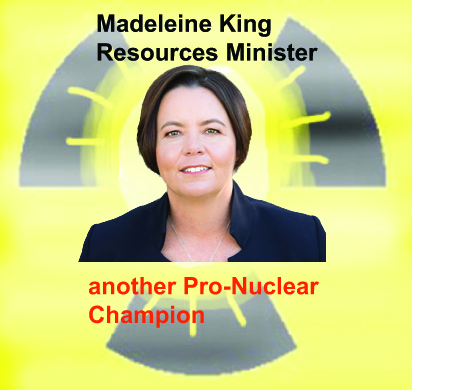
New Resources Minister backs Kimba nuke dump, https://vanguard-cpaml.blogspot.com/2022/06/new-resources-minister-backs-kimba-nuke.html?fbclid=IwAR0KRK5heMT8KlqDSY7WetXJhJrwMTqeMDwaLrzET6p-SQYA29j87DAp03Q by Nick G, June 6, 2022
The ALP’s new Resources Minister Madeline King has wasted no time in showing her support for the proposed nuclear waste dump at Napandee, near Kimba on Eyre Peninsula.
In response to an appeal to herself and PM Albanese from the disenfranchised and ignored Barngarla traditional owners, King has today stated that the nuclear waste dump was “a step forward” in the management of nuclear waste.
Background
Napandee was one of three sites proposed by the former Coalition government for the storage of intermediate and low-level nuclear waste. Two, including Napandee, were at Kimba, whilst a third was at Wallerberdina in the Flinders Ranges.
The operation of any of the three sites in SA was illegal under SA law.
Under state legislation introduced by the Olsen Liberals and strengthened by Rann Labor, it is illegal to operate a nuclear waste facility in SA or to import or transport nuclear waste in SA.
The legislation is quite clear and states:
8—Prohibition against construction or operation of nuclear waste storage facility. A person must not construct or operate a nuclear waste storage facility. Maximum penalty: In the case of a natural person—$500 000 or imprisonment for 10 years. In the case of a body corporate—$5 000 000.
9—Prohibition against importation or transportation of nuclear waste for delivery to nuclear waste storage facility. A person must not— (a) bring nuclear waste into the State; or (b) transport nuclear waste within the State, for delivery to a nuclear waste storage facility in the State. Maximum penalty: In the case of a natural person—$500 000 or imprisonment for 10 years. In the case of a body corporate—$5 000 000.
This legislation came about largely through the actions of the Kupa Piti Kungka Tjuta (the Anangu women of Coober Pedy) who led a campaign against a 1998 Howard Government proposal for a nuclear waste dump in SA.
In 2004, following Howard’s conceding defeat on the issue, three of those women, Eileen Kampakuta Brown, Ivy Makinti Stewart and Angelina Wonga issued a statement that began: “People said that you can’t win against the Government. Just a few women. We just kept talking and telling them to get their ears out of their pockets and listen. We never said we were going to give up. Government has big money to buy their way out but we never gave up…money doesn’t win.”
In 2016, SA Labor Premier Jay Weatherill set up a Royal Commission into SA’s nuclear energy future which included a proposal for a dump for high level overseas nuclear waste. Massive protests were held and a “citizen’s jury” effectively knocked all talk of nuclear waste dumps on the head.
The resurrected SA site proposals were met with further protests. The Adnyamathanha peoples led opposition to the Wallaberdina site and were successful in winning the vote in a community consultation of people in the Flinders Ranges.
The initial Kimba sites were rejected by former Minister Josh Frydenberg in 2016 due to a lack of broad community support; however in 2017 his replacement Matt Canavan revived the proposal and accepted Napandee as the site for the dump.
Barngarla Pushed Aside
Approval for the Kimba site required broad community support through a community consultation. In preparation for a local vote, millions of dollars of federal funds were poured into Kimba for “social and economic development” during the consultation process. Community facilities were upgraded, footpaths and gutters put in, and the town generally given a face lift.
No definition of “broad community support” exists in legislation, but Canavan mentioned a figure of “around 65%”. Kimba Council defined those eligible to vote as ratepayers living within a prescribed area and excluded the Barngarla native title holders on the grounds that they lived in other towns on Eyra Peninsula.
The Barngarla appealed to the Federal Court which upheld the Council’s decision on the grounds that the Barngarla would be “too difficult to identify”. A vote was held, resulting in a 61.5% vote for the dump with a majority of 70 in favour.
The Barngarla commissioned the Australian Election Company to poll people identified as Barngarla by the Barngarla Determination Aboriginal Corporation and identified 209 eligible voters. There were no votes for the dump, and 89 against it.
Had those 89 Barngarla votes been included in the Kimba Council “consultation”, the outcome would have been a “no” vote carried by a small majority.
Labor Opposition facilitates Napandee declaration
In Opposition, Labor had the opportunity to block the declaration of the Kimba site. However, Madeline King did a deal with the Coalition in June 2019 that allowed new Resource Minister Keith Pitt to declare Napandee as the site for the dump. Under the original federal legislation, an aggrieved party to the declaration had no right of judicial appeal. King negotiated to provide the appeal right and withdrew Labor opposition to the declaration despite saying that Labor would not pass the bill unless traditional owners were comfortable with it.
They clearly were not, and neither did they have the resources to properly fund a judicial appeal, although that process has now begun in the Federal Court.
Who is Madeline King?
Madeline King is a right-wing Labor politician with close ties to the mining industry and pro-US lobbyists.
She is a commercial lawyer who immediately prior to entering parliament was the chief operating officer of the Perth USAsia Centre, a think tank based at the University of Western Australia.
King was a ministerial adviser to federal Labor MP Gary Gray from 2011 to 2012. Gray had been National Secretary of the ALP from 1993 to 2000, but resigned to take up a position with fossil fuel giant Woodside Petroleum. As its Director of Corporate Affairs, he was an executive at the time when, in 2004, Foreign Affairs Minister Alexander Downer ordered the bugging of the East Timorese government during negotiations aimed at depriving the island nation of desperately needed revenue from underwater gas deposits. Gray was part of the Woodside negotiating team.
In 2007, Gray contested the WA seat of Brand and became part of Rudd’s Labor team. He retired in 2016 to take up a position with Mineral Resources, but was appointed Australian Ambassador to Ireland by Scott Morrison in 2020 in what some people have said was a move to prevent him having to testify in the case against Bernard Collaery and possibly incriminating Downer under cross-examination.
King’s employment as advisor to Gray has made her no stranger to the interplay between the corporate world and the benefits that accrue to Labor politicians who do their bidding.
No need for a Kimba dump
Opponents of the Kimba dump point out that much of the low-level waste (some of which needs to be stored for up to 300 years) is already safely stored at Woomera in SA. Some of it is stored at facilities at which it is produced. Medical nuclear waste accounts for only around 1% of the total and is short-lived and decays quite safely at the hospitals and treatment centres at which it is generated.
Intermediate level waste is generated at Lucas Heights in Sydney. Its decay time is far longer and needs to be kept from contact with humans for 10,000 years. A 2020 federal parliament inquiry confirmed that ANSTO, the operator of Lucas heights, has the ability to manage its waste onsite for “decades to come”. Ultimately, it will need to be stored in an underground repository. The government says this will take decades while the federal nuclear regulator says it could take a century to identify and construct.
If intermediate level waste is transported the 1700 kilometres from Lucas Heights to Kimba, it will be stored there as a temporary measure, in drums above the ground, pending its removal at some future stage to a permanent underground facility.
It therefore makes no sense to move these drums of intermediate level waste across the continent when there is storage capacity at Lucas Heights. Kimba is a temporary solution to a non-problem.
The issue of nuclear waste storage is one that must be referred to nation-wide community consultation. It is not a matter to be placed on the shoulders of this or that “remote” community to decided. We are all involved and we should all decide.
SA Unions made their position clear on March 15 when they unanimously supported a motion standing with the traditional owners. SA Unions Secretary Dale Beasley said “South Australian unions are completely united in their support of the Barngarla Traditional Owners and their opposition to the proposed nuclear waste site at Kimba”.
Let’s make this year’s Hiroshima Day (August 6) a day for concerted action against nuclear energy, nuclear waste dumps and nuclear-powered submarines.
Let’s keep alive the spirit of the Kupa Piti Kungka Tjuta.
NOWHERE TO HIDE -How a nuclear war would kill you — and almost everyone else.

Bulletin of the Atomic Scientists , 20 Oct 22, François Diaz-Maurin (@francoisdm) is the associate editor for nuclear affairs at the Bulletin of the Atomic Scientists.Thomas Gaulkin (@ThomasGaulkin) is multimedia editor of the Bulletin of the Atomic Scientists.
By François Diaz-Maurin, This summer, the New York City Emergency Management department released a new public service announcement on nuclear preparedness, instructing New Yorkers about what to do during a nuclear attack. The 90-second video starts with a woman nonchalantly announcing the catastrophic news: “So there’s been a nuclear attack. Don’t ask me how or why, just know that the big one has hit.” Then the PSA video advises New Yorkers on what to do in case of a nuclear attack: Get inside, stay inside, and stay tuned to media and governmental updates.
But nuclear preparedness works better if you are not in the blast radius of a nuclear attack. Otherwise, there’s no going into your house and closing your doors because the house will be gone. Now imagine there have been hundreds of those “big ones.” That’s what even a “small” nuclear war would include. If you are lucky not to be within the blast radius of one of those, it may not ruin your day, but soon enough, it will ruin your whole life.
Direct radiation is the most immediate effect of the detonation of a nuclear weapon. It is produced by the nuclear reactions inside the bomb and comes mainly in the form of gamma rays and neutrons. Direct radiation lasts less than a second, but its lethal level can extend over a mile in all directions from the detonation point of a modern-day nuclear weapon with an explosive yield equal to the effect of several hundred kilotons of TNT.
Microseconds into the explosion of a nuclear weapon, energy released in the form of X-rays heats the surrounding environment, forming a fireball of superheated air. Inside the fireball, the temperature and pressure are so extreme that all matter is rendered into a hot plasma of bare nuclei and subatomic particles, as is the case in the Sun’s multi-million-degree core.
The fireball following the airburst explosion of a 300-kiloton nuclear weapon—like the W87 thermonuclear warhead deployed on the Minuteman III missiles currently in service in the US nuclear arsenal—can grow to more than 600 meters (2,000 feet) in diameter and stays blindingly luminous for several seconds, before its surface cools.
The light radiated by the fireball’s heat—accounting for more than one-third of the thermonuclear weapon’s explosive energy—will be so intense that it ignites fires and causes severe burns at great distances. The thermal flash from a 300-kiloton nuclear weapon could cause first-degree burns as far as 13 kilometers (8 miles) from ground zero.
Then comes the blast wave.…………………………………….
Radioactive fallout…………………..
Immediate effects of nuclear war
In a nuclear war, hundreds or thousands of detonations would occur within minutes of each other.
Regional nuclear war between India and Pakistan that involved about 100 15-kiloton nuclear weapons launched at urban areas would result in 27 million direct deaths.
A global all-out nuclear war between the United States and Russia with over four thousand 100-kiloton nuclear warheads would lead, at minimum, to 360 million quick deaths.* That’s about 30 million people more than the entire US population…………………………..
As horrific as those statistics are, the tens to hundreds of millions of people dead and injured within the first few days of a nuclear conflict would only be the beginnings of a catastrophe that eventually will encompass the whole world.
Global climatic changes, widespread radioactive contamination, and societal collapse virtually everywhere could be the reality that survivors of a nuclear war would contend with for many decades.
The longer-term consequences of nuclear war
In recent years, in some US military and policy circles, there has been a growing perception that a limited nuclear war can be fought and won. Many experts believe, however, that a limited nuclear war is unlikely to remain limited. What starts with one tactical nuclear strike or a tit-for-tat nuclear exchange between two countries could escalate to an all-out nuclear war ending with the immediate and utter destruction of both countries.
But the catastrophe will not be limited to those two belligerents and their allies.
The long-term regional and global effects of nuclear explosions have been overshadowed in public discussions by the horrific, obvious, local consequences of nuclear explosions. Military planners have also focused on the short-term effects of nuclear explosions……………………..
widespread fires and other global climatic changes resulting from many nuclear explosions may not be accounted for in war plans and nuclear doctrines. These collateral effects are difficult to predict; assessing them requires scientific knowledge that most military planners don’t possess or take into account.
Global climatic changes……………………………………………..
Stratospheric soot injection………………………………
Changes in the atmosphere…………………………………
Changes on land…………………….
Changes in the ocean……………………….
Impacts on food production……………………………………….
Nowhere to hide
The impacts of nuclear war on agricultural food systems would have dire consequences for most humans who survive the war and its immediate effects.
The overall global consequences of nuclear war—including both short-term and long-term impacts—would be even more horrific causing hundreds of millions—even billions—of people to starve to death………………………………………………………
References & Acknowledgments…………………………
https://thebulletin.org/2022/10/nowhere-to-hide-how-a-nuclear-war-would-kill-you-and-almost-everyone-else/
SCOTT RITTER: Nuclear High Noon in Europe

Enter Volodymyr Zelensky, stage left. Speaking to the Lowy Institute, a nonpartisan international policy think tank in Australia, the Ukrainian president called for the international community to undertake “preventative strikes, preventive action” against Russia to deter the potential use of nuclear weapons by Russia against Ukraine
First and foremost, there has been zero talk about the employment of tactical nuclear weapons from the Kremlin.
The risk isn’t that Russia would start a pre-emptive nuclear war over Ukraine.
The risk is that America would.
https://consortiumnews.com/2022/10/19/scott-ritter-nuclear-high-noon-in-europe/ By Scott Ritter Consortium News 19 Oct 22, Now is the time for Biden to clarify U.S. nuclear doctrine. But he remains silent.
On Monday, Oct. 17, the North Atlantic Treaty Organization kicked off Operation STEADFAST NOON, its annual exercise of its ability to wage nuclear conflict. Given that NATO’s nuclear umbrella extends exclusively over Europe, the indisputable fact is that STEADFAST NOON is nothing more than NATO training to wage nuclear war against Russia.
Nuclear war against Russia.
Enter Joe Biden, center stage. Speaking at a fund raiser on Oct. 6, the president of the United States said that, “For the first time since the Cuban missile crisis, we have a direct threat of the use of a nuclear weapon if in fact things continue down the path they are going.”
Biden went on: “We’ve got a guy I know fairly well. He’s not joking when he talks about potential use of tactical nuclear weapons or biological or chemical weapons because his military is, you might say, significantly underperforming.”
Biden concluded: “I don’t think there’s any such thing as the ability to easily use a tactical nuclear weapon and not end up with Armageddon.”
The reader should let that sink in for a moment.
Don’t worry, NATO spokesperson Oana Lungscu reassured the rest of the world, the purpose of STEADFAST NOON is to ensure that NATO’s nuclear war-fighting capability “remains safe and effective.” It is a “routine” exercise, not linked to any current world events. Moreover, no “real” nuclear weapons will be used — just “fake” ones.
Nothing to worry about here.
Enter Jens Stoltenberg, NATO secretary general, stage right in the nuclear theater. In a statement to the press on Oct. 11, Stoltenberg declared that, “Russia’s victory in the war against Ukraine will be a defeat of NATO,” before ominously announcing, “This cannot be allowed.”
To that end, Stoltenberg stated, the STEADFAST NOON nuclear drills would continue as scheduled. These drills, Stoltenberg said, were an important deterrence mechanism in the face of Russian “veiled: nuclear threats.”
But they weren’t related to any current world events.
Enter Volodymyr Zelensky, stage left. Speaking to the Lowy Institute, a nonpartisan international policy think tank in Australia, the Ukrainian president called for the international community to undertake “preventative strikes, preventive action” against Russia to deter the potential use of nuclear weapons by Russia against Ukraine.
While many observers interpreted Zelensky’s words to imply a request for NATO to carry out a preemptive nuclear strike against Russia, Zelensky’s aides were quick to try and correct the record, saying he was simply asking for more sanctions.
Enter Joe Biden, center stage. Speaking at a fund raiser on Oct. 6, the president of the United States said that, “For the first time since the Cuban missile crisis, we have a direct threat of the use of a nuclear weapon if in fact things continue down the path they are going.”
Biden went on: “We’ve got a guy I know fairly well. He’s not joking when he talks about potential use of tactical nuclear weapons or biological or chemical weapons because his military is, you might say, significantly underperforming.”
Biden concluded: “I don’t think there’s any such thing as the ability to easily use a tactical nuclear weapon and not end up with Armageddon.”
While it has been made abundantly clear by the White House that Biden’s comments were his personal view, and not based on any new intelligence regarding Russian nuclear posture, the fact that a sitting U.S. president was speaking about the possibility of a nuclear “Armageddon” should send chills down the spine of every sane individual in the world.
No Kremlin Talk of Tactical Nuclear Weapons
First and foremost, there has been zero talk about the employment of tactical nuclear weapons from the Kremlin.
Zero.
Russian President Vladimir Putin has indicated that Russia would use “all the means at its disposal” to protect Russia. He said this most recently on Sept. 21, when in a televised address announcing partial mobilization, he accused the West of engaging in “nuclear blackmail,” citing “statements of some high-ranking representatives of the leading NATO states about the possibility of using nuclear weapons of mass destruction against Russia.”
Putin was alluding to a statement that Liz Truss made prior to her election as British prime minister, when, in response to a question on whether she was ready to undertake the responsibility of ordering the use of the U.K.’s nuclear arsenal, she replied, “I think it’s an important duty of the prime minister and I’m ready to do that.”
“I want to remind you,” Putin said,
“that our country also has various means of destruction and in some components more modern than those of the NATO countries. And if the territorial integrity of our country is threatened, we will certainly use all the means at our disposal to protect Russia and our people.”
Putin’s statements were consistent with that of Russian Defense Minister Sergei Shoigu, who in an address to the 10th Moscow Conference on International Security delivered on Aug. 16, asserted that Russia would not use nuclear weapons in Ukraine. According to Shoigu, Russian nuclear weapons are authorized for use under “exceptional circumstances” as described in published Russian doctrine, none of which apply to the Ukraine situation. Any talk of the use of nuclear weapons by Russia in Ukraine, Shoigu said, was “absurd.”
Apparently not to Biden, who despite his claim to know Putin “fairly well,” got it all wrong when talking about the potential for nuclear conflict.
The risk isn’t that Russia would start a pre-emptive nuclear war over Ukraine.
The risk is that America would.
Biden’s Pledge of ‘Sole Purpose Policy’
Biden came into office in February 2021 promising to enshrine in U.S. nuclear doctrine a “sole purpose policy,” under which “the sole purpose of our nuclear arsenal should be to deter — and, if necessary, retaliate against — a nuclear attack.”
It is now the middle of October 2022, and America finds itself in a situation where the president himself fears for a potential nuclear “Armageddon.”
If ever there was a time for Biden to make good on his pledge, now is it.
But he remains silent.
The danger inherent in Biden’s silence is that Putin and other Russian officials who are concerned about Russian national security must rely upon existing published U.S. nuclear doctrine, which continues to enshrine a policy of nuclear pre-emption promulgated during the administration of President George W. Bush. Under this doctrine, nuclear weapons are but another tool in the military’s toolbox, to be used as and when needed, including occasions where the destruction of battlefield targets for the simple purpose of gaining an operational advantage is the objective.
One can argue that this sort of non-nuclear preemption has its own inherent deterrence value, a sort of “madman” kind of vibe that makes an opponent question whether the president could act in such an irrational manner…………….
Former President Donald Trump breathed new life into Nixon’s “madman theory,” telling North Korea that if it continued to threaten the United States “[t]hey will be met with fire, fury and frankly power the likes of which this world has never seen before.” Trump went on to have three face-to-face meetings with North Korean leader Kim Jung-Un in a failed effort to bring about the denuclearization of the Korean peninsula.
It was under the Trump administration that the U.S. Navy deployed the W-76-2 low-yield nuclear warhead on its Trident submarine-launched ballistic missiles, giving the president a greater range of options when it came to the employment of nuclear weapons………………………………………………
As this article is being written, U.S. nuclear-capable B-52 bombers are flying to Europe from their U.S. bases, where they will practice delivering nuclear weapons against a Russian target. Dozens more aircraft, flying from Volkel Air Force Base in the Netherlands (home to an arsenal of U.S. B-61 nuclear bombs), will practice employing NATO nuclear weapons against…Russia.
Russia has responded to the NATO nuclear drill by going forward with its own annual nuclear exercise, “Grom” (Thunder). ………………….
Now is not the time for drama, or theatrically inflammatory rhetoric. Now is the time for maturity, sanity…restraint. A sage leader would have recognized the possibility of misperception on the part of Russia when NATO, a mere week after being encouraged by the Ukrainian president to initiate a preemptive nuclear strike on Russia, carries out a major exercise where NATO practices dropping nuclear bombs on Russia. A sober leader would have postponed these drills and encouraged similar action from Russia regarding its nuclear exercises.
Instead, America gets an unscripted, off-the-cuff reference to a nuclear Armageddon from a narcissistic egomaniac who uses the horror of nuclear annihilation as a fund-raising mantra.
It would take but one miscalculation, a single misunderstanding to turn STEADFAST NOON into “High Noon,” and “Grom” (Thunder) into “Molnya” (Lightening).
We’ve seen this scenario before. In November 1983 NATO carried out a command post exercise, codenamed ABLE ARCHER ’83, designed to test “nuclear weapons release procedures.” The Soviets were so alarmed by this exercise, which they believed could be used to mask a preemptive nuclear strike by NATO against the Soviet Union, that they loaded nuclear warheads onto bombers, bringing NATO and the Soviet Union to the brink of a nuclear war.
USA’s planned small nuclear reactors must have special uranium fuel – from Russia!
Putin holds the key to Biden’s nuclear dreams as Russian fuel needed for
new US plants. The West has been scrambling to wean itself off Russian
energy amid the war in Ukraine, but a Kremlin-controlled firm has a tight
grip on a crucial part of the nuclear industry.
The US is vying to roll out its new small nuclear power plants amid the global energy crisis as it weans
itself off fossil fuels, but Russia is the only country which has the fuel
needed to power the next-generation reactors. Now, the US is scrambling to
use some of its stockpile of weapons-grade uranium, (uranium is the fuel
widely used in nuclear plants) as an alternative as it hopes to kickstart
the nuclear revolution.
Express 20th Oct 2022
Renewable energy brings record savings to Europe

Renewable energies have allowed the European Union to avoid €99bn in
fossil gas imports since the beginning of the war in Ukraine, with an
increase of €11bn compared to last year thanks to record growth in wind
and solar capacity, according to a new report.
Edie 20th Oct 2022
European scramble for nuclear energy is hampered by risks of terrorist and cyber attacks, as well as the wastes problem.

Fabian Lüscher, who heads the nuclearenergy section at the Swiss Energy Foundation (SES), says that Europe’s ageing nuclear fleet is not adapted to deal with contemporary terrorist attacks and cyberattacks. “You even have to think of those very unlikely possibilities when planning risky infrastructure,” Mr Lüscher argues. And then, of course, there’s the problem of nuclear waste.
Decisions around the future of nuclear energy are urgently needed in
Europe. Russian supplies of natural gas have been disrupted amidst the war
in Ukraine, energy prices have soared to emergency levels. Meanwhile, some
countries are suffering a lingering hangover from the Covid-19 pandemic.
In France, half of the clearcountry’s nuclear power plants are currently not
operating. The main reasons are corrosion, planned maintenance, and delayed
maintenance due to pandemic-linked staffing issues, explains Phuc Vinh
Nguyen, who researches European energy policy at the Jacques Delors Energy
Center in France. Mr Nguyen warns that across the EU the energy price
crisis will probably last until at least 2024.
In this situation, some see the use of nuclear reactors as a way to decouple from Russian natural gas.
Russian influence also looms over many aspects of nuclear power generation:
Russia dominates the supply of nuclear fuel, the enrichment of uranium, and
the building of nuclear power plants in other countries. At Leibstadt,
Switzerland’s largest and youngest nuclear power plant, half of the uranium
supply currently comes from Russia. There, as elsewhere, there’s a scramble
to source more uranium from outside the Russian sphere of influence.
Fabian Lüscher, who heads the nuclear energy section at the Swiss Energy
Foundation (SES), says that Europe’s ageing nuclear fleet is not adapted to
deal with contemporary terrorist attacks and cyberattacks. “You even have
to think of those very unlikely possibilities when planning risky
infrastructure,” Mr Lüscher argues. And then, of course, there’s the
problem of nuclear waste.
BBC 21st Oct 2022
D’Ambrosio: We can’t sit around waiting for coal plants to close — RenewEconomy

Victoria says it couldn’t “sit around” waiting for coal plants to close, and insists state government ownership of energy will ensure profits kept in the state. The post D’Ambrosio: We can’t sit around waiting for coal plants to close appeared first on RenewEconomy.
D’Ambrosio: We can’t sit around waiting for coal plants to close — RenewEconomy
Victoria counts on $30 billion of offshore wind, not much solar, to replace coal — RenewEconomy

Victoria assumes more than half of the investment in its 95 per cent renewables target will be in offshore wind, with little in utility scale solar. The post Victoria counts on $30 billion of offshore wind, not much solar, to replace coal appeared first on RenewEconomy.
Victoria counts on $30 billion of offshore wind, not much solar, to replace coal — RenewEconomy
1 This month


Help Aunty Sue Protect Her Land and Sacred Sites From Destructive Rocket Testing.
.

Australians deserve the truth
about
AUKUS – https://aukuspublicinquiry.com/

PETITION – To: Prime Minister Anthony Albanese and the Australian Labor Government

of the week – Australians for War Powers Reform (AWPR)
To see nuclear-related stories in greater depth and intensity

