Nuclear power is shaping up as an election loser, and the Murdoch media is not happy

RenewEconomy, Jim Green, May 2, 2025
Whatever happens on election day, it’s certain that the Coalition’s promotion of nuclear power will cost it votes. It will probably cost the Coalition seats. It may cost the Coalition the election. And if the Coalition does unexpectedly well, it will be despite and not because of the nuclear policy.
The Murdoch press released polling results on April 19 showing that Labor’s campaign against the Coalition’s nuclear power policy is “driving a collapse in the Coalition’s primary vote in marginal seats across Australia.”
The RedBridge-Accent poll of 20 marginal seats found that Labor’s opposition to the Coalition’s nuclear plan is “a clear winner with a ‘net agree’ rating of 43.” Fifty-six per cent of poll respondents agreed with Labor’s claim that the Coalition’s plan will cost $600 billion and require spending cuts to pay for it, while only 13 per cent disagreed.
The Murdoch press reported on May 1 that 41 per cent of 1011 respondents to a Redbridge-Accent national poll ranked concerns that Peter Dutton’s nuclear plan will cost $600 billion and will require cuts to pay for it among their top five reasons for deciding to oppose a particular party.
Only one issue topped nuclear power as a vote-changing turn-off. The article was titled ‘Where the Libs went off track: Inside the Coalition’s disastrous campaign’ and it ran alongside another titled ‘Coalition nuked by nervous electors.’
In March 2024, James Campbell warned that the Coalition’s nuclear power policy is “stark raving mad.” In the same month, Tony Barry described the nuclear policy as “the longest suicide note in Australian political history.”
Meanwhile, the Coalition’s attempt to go quiet on its unpopular nuclear policy has only drawn further attention to it.
Costings
The Coalition’s decision not to release nuclear costings until December left a void which Labor filled with the $600 billion figure. Furious responses to the $600 billion figure have only served to focus attention on the expansive cost of Dutton’s taxpayer-funded nuclear frolic.
Just in the past couple of days, the Sky News Youtube channel has featured these videos:
‘Don’t listen to their lies’: Barnaby Joyce slams Labor’s nuclear costings
Labor’s $600 billion anti-nuclear lie given them lots of ‘traction’ in the election
‘Absolute balderdash’: Labor clings to ‘fictitious numbers’ of Coalition’s nuclear pricings
Labor’s anti-nuclear and power bill lies a ‘low point’ for Australia
A frustrated Barnaby Joyce told Andrew Bolt on Sky News:
“What they’ve done, ladies and gentlemen, is they’ve come up with this fantastic number. … The nuclear power stations are going to cost $600 billion. It’s like Dr Evil off one of those movies, you know coming out and saying ‘Oh you know 600 billion dollars’. BS. What they did, ladies and gentlemen, it’s like they got a turbo-charged Porsche and multiplied it by seven and said that is the price of every car in Australia.”
None of which comports with reality. Multiply the Coalition’s nuclear cost estimate by 2.5 and you’ll get the actual cost of recent reactor construction projects in the US, the UK and France. The Coalition assumes that reactors can be built in Australia for less than half the cost of recent projects in countries with vastly more experience and expertise. And much more quickly.
Liberals Against Nuclear
Polling commissioned by the Liberals Against Nuclear group provides further evidence of the political poison of the Coalition’s nuclear policy. The group said in an April 28 media release:
“A new uComms poll shows leading Liberal frontbencher Michael Sukkar could lose his seat at the coming election if the Party persists with its unpopular nuclear plan.
“The poll, commissioned by Liberals Against Nuclear, shows Labor and the Coalition tied at 50-50 in two-party preferred terms in Deakin. However, the same polling reveals that if the Liberals dumped their nuclear policy, they would surge to a commanding 53-47 lead.
“The polling follows a broader survey across 12 marginal seats that showed the Liberal Party would gain 2.8 percentage points in primary vote if it abandoned the nuclear energy policy.
“An earlier poll in the seat of Brisbane found the nuclear policy was a significant drag on Liberal candidate Trevor Evans’ support.
“The Deakin polling showed women voters are particularly opposed to the nuclear policy, with 53.2% of women saying it makes them less likely to vote Liberal compared to 41.3% of men. Overall, 47.5% of Deakin voters are less likely to support the Coalition because of the nuclear policy.
“The data also revealed that 56.1% of respondents don’t support nuclear power at all, with concerns about renewable energy investment reductions (19.0%), nuclear waste management (15.9%), and high build costs (13.0%) being the primary objections.
“In the crucial 35-50 age demographic that makes up many families in Deakin, 48.4% are less likely to vote Liberal due to the nuclear policy.”
Another UComms poll found that Dutton could be vulnerable in the seat of Dickson because of the nuclear policy. Forty-six per cent of those surveyed said they were less likely to vote for Dutton because of the policy.
National Climate Action Survey
The latest National Climate Action Survey of more than 4,000 respondents conducted by Griffith University’s Climate Action Beacon in partnership with the Monash Climate Change Communication Research Hub found that support for nuclear power has fallen since the Coalition announced some details of its policy in June 2024.
The survey found that:
* 59 percent of respondents wanted to keep a legal ban on nuclear power in 2024 (up from 51 percent in 2023), while the number opposing the ban fell from 34 percent in 2023 to 30 percent in 2024.
* Only 18 percent of women were in favour of lifting the ban compared to 36 per cent of men. Two-thirds (66 per cent) of women want the ban to stay, 51 per cent of men want it to stay.
* Those who said the benefits of nuclear power far outweighed the risks fell from 24.5 per cent support in 2023 to 22 per cent in 2024. Those who said the risks of nuclear power far outweighed the benefits rose from 21.9 per cent in 2023 to 26 per cent in 2024.
* 54.8 per cent of respondents would be very or extremely concerned if a nuclear power plant was built near them while only 11 percent would be comfortable.
Local opposition
The Coalition claims to have a social licence to build nuclear power reactors in the seven selected regions, and uses that as an excuse for the paucity of visits to those regions during the election campaign – by Peter Dutton in particular.
But polling in March 2025 by research firm 89 Degrees East for the Renew Australia for All campaign found just 27 per cent support for “developing large-scale nuclear energy infrastructure” in Gladstone, 24 per cent in the rest of Central Queensland, 24 per cent in Bunbury, 22 per cent in Central West NSW which includes Lithgow, 32 per cent in Hunter, and 31 per cent in Gippsland.
The poll also found that just 13 per cent of people polled thought nuclear reactors would bring down their bills the fastest compared to 72 per cent for renewables.
RE-Alliance National Director Andrew Bray said: …………………………………………………………………………………. https://reneweconomy.com.au/nuclear-power-is-shaping-up-as-an-election-loser-and-the-murdoch-media-is-not-happy/
As Dutton champions nuclear power, Indigenous artists recall the profound loss of land and life that came from it
Josephine Goldman, Sessional Academic, School of Languages and Cultures, Discipline of French and Francophone Studies, University of Sydney May 2, 2025 https://theconversation.com/as-dutton-champions-nuclear-power-indigenous-artists-recall-the-profound-loss-of-land-and-life-that-came-from-it-249371
Opposition Leader Peter Dutton’s promise to power Australia with nuclear energy has been described by experts as a costly “mirage” that risks postponing the clean energy transition.
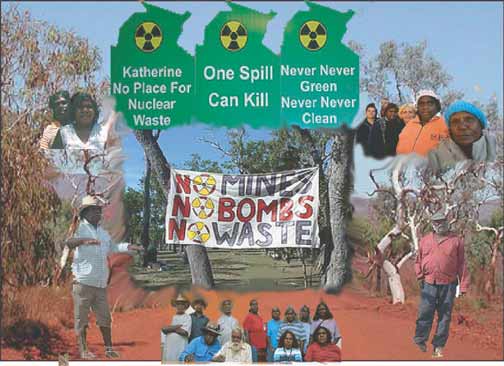
Beyond this, however, the Coalition’s nuclear policy has, for many First Nations peoples, raised the spectre of the last time the atomic industry came to Australia.
Indigenous peoples across Oceania share memories of violent histories of nuclear bomb testing, uranium mining and waste dumping – all of which disproportionately affected them and/or their ancestors.
Two sides of the same coin
While it may be tempting to separate them, the links between military and civilian nuclear industries – that is, between nuclear weapons and nuclear energy plants – are well established. According to a 2021 paper by energy economists Lars Sorge and Anne Neumann: “In part, the global civilian nuclear industry was established to legitimatise the development of nuclear weapons.”
The causative links between military and civilian uses of nuclear power flow in both directions.
As Sorge and Neumann write, many technologies and skills developed for use in nuclear bombs and submarines end up being used in nuclear power generation. Another expert analysis suggests countries that receive peaceful nuclear assistance, in the form of nuclear technology, materials or skills, are more likely to initiate nuclear weapons programs.
Since the first atomic bombing of Hiroshima in 1945, Indigenous peoples across the Pacific have been singing, writing and talking about nuclear colonialism. Some were told the sacrifice of their lands and lifeways was “for the good of mankind”.
Today, they continue to use their bodies and voices to push back against the promise of a benevolent nuclear future – a vision that has often been used justify their and their ancestors’ suffering and displacement.
Black mist and brittle landscapes
In 2023, Bangarra Dance Company produced Yuldea. This performance centres on the Yooldil Kapi, a permanent desert waterhole.
For millennia, this water source sustained the Aṉangu and Nunga peoples and a multitude of other plant and animal life across the Great Victorian Desert and far-west South Australia.
In 1933, Yuldea became the site of the Ooldea Mission. Then, in 1953, when the British began testing nuclear bombs at nearby Emu Field (1953) and Maralinga (1956–57), the local Aṉangu Pila Nguru were displaced from their land to the mission.
Directed by Wirangu and Mirning woman Frances Rings, Yuldea tells the story of this Country in four acts: act one, Supernova; act two, Kapi (Water); act three, Empire; and act four, Ooldea Spirit.
The impacts of nuclear testing are directly confronted in a section titled Black Mist (in act three, Empire). Dancers’ bodies twist and spasm as a black mist falls from the sky, representing the fog of radioactive particles that resulted from weapons testing. In reality, this fog could cause lifelong injuries when inhaled or ingested, including blindness.
But Yuldea is more than just a story of destruction. By exploring Aṉangu and Nunga relationships with Country before and after nuclear testing, it affirms their enduring presence in the region. This is captured in the opening prose:
We are memory.
Glimpsed through shimmering light on water.
A story place where black oaks stand watch.
Carved into trees and painted on rocks.
North – South – East – West.
A brittle landscape of life and loss.
To acknowledge is to remember
The podcast Nu/clear Stories (2023-), created by Mā’ohi (Tahitian) women Mililani Ganivet and Marie-Hélène Villierme, uses storytelling to grapple with the consequences of colonial nuclear testing.
Ganivet and Villierme address the memories of French nuclear testing on the islands of Moruroa and Fangataufa in Mā’ohi Nui (French Polynesia) from 1963 to 1996.
Rather than using a linear understanding of time, which keeps the past in the past and idealises a future of “progress”, Nu/clear Stories draws on Indigenous philosophies of cyclical or spiral time to insist that by turning to the past, we can understand how history shapes the present and future.
As Ganivet says when introducing the first episode, Silences and Questions:
We are part of a long genealogy of people who found the courage to speak before us. […] To acknowledge them here is to remember that without them we would not be able to speak today. And so today, we stand on their shoulders, with the face firmly turned towards the past, but with our eyes gazing deep into the future.
Stories in the Tomb
In her 2018 poem video Anointed, Part III of the series Dome, Marshall Islander woman Kathy Jetn̄il-Kijiner pays homage to Runit Island. This island in the Enewetak Atoll was transformed into a dumping site for waste from US nuclear bomb tests between 1946 and 1958.
A huge concrete dome was built on Runit Island in the 1970s to cover about 85,000 cubic metres of radioactive waste. The island became known as “the Tomb” to the Enewetak people – a tomb that still leaks nuclear radiation into the ocean today.
However, like the creators behind Yuldea and Nu/clear Stories, Jetn̄il-Kijiner refuses to remember Runit Island as only a nuclear graveyard. Instead, she approaches it like a long-lost family member or ancestor who she hopes will be full of stories.
Jetn̄il-Kijiner speaks to the island through her poem, drawing a devastating contrast between what it once was and what it is now:
You were a whole island, once. You were breadfruit trees heavy with green globes of fruit whispering promises of massive canoes. Crabs dusted with white sand scuttled through pandanus roots. Beneath looming coconut trees beds of ripe watermelon slept still, swollen with juice. And you were protected by powerful irooj, chiefs birthed from women who could swim pregnant for miles beneath a full moon.
Then you became testing ground. Nine nuclear weapons consumed you, one by one by one, engulfed in an inferno of blazing heat. You became crater, an empty belly. Plutonium ground into a concrete slurry filled your hollow cavern. You became tomb. You became concrete shell. You became solidified history, immoveable, unforgettable.
While Jetn̄il-Kijiner describes herself as “a crater empty of stories”, she continues to find stories in the Tomb: namely, the legend of Letao, the son of a turtle goddess who turned himself into fire and, in the hands of a small boy, nearly burned a village to the ground.
Juxtaposing this fire with the US’s nuclear bombs, she ends her poem with “questions, hard as concrete”:
Who gave them this power?
Who anointed them with the power to burn?The link between past and future
In their book Living in a nuclear world: From Fukushima to Hiroshima (2022), Bernadette Bensaude-Vincent and others explore how “nuclear actors” frame nuclear technology as “indispensable”, “mundane” and “safe” by neatly severing nuclear energy from nuclear history.
This framing helps nuclear actors avoid answering concrete questions. It also helps to hides the colonial history of nuclear technologies – histories which leak into the present. But not everyone accepts this framing.
Indigenous artists remind us the nuclear past must be front-of-mind as we look to shape the future.
Dutton’s ‘independent’ nuclear modelling was created by a pro-nuclear think tank
The Coalition has been plugging its nuclear modelling over the course of the election campaign — but was the advice actually as independent as it claims?
Crikey, Daanyal Saeed, May 2, 2025
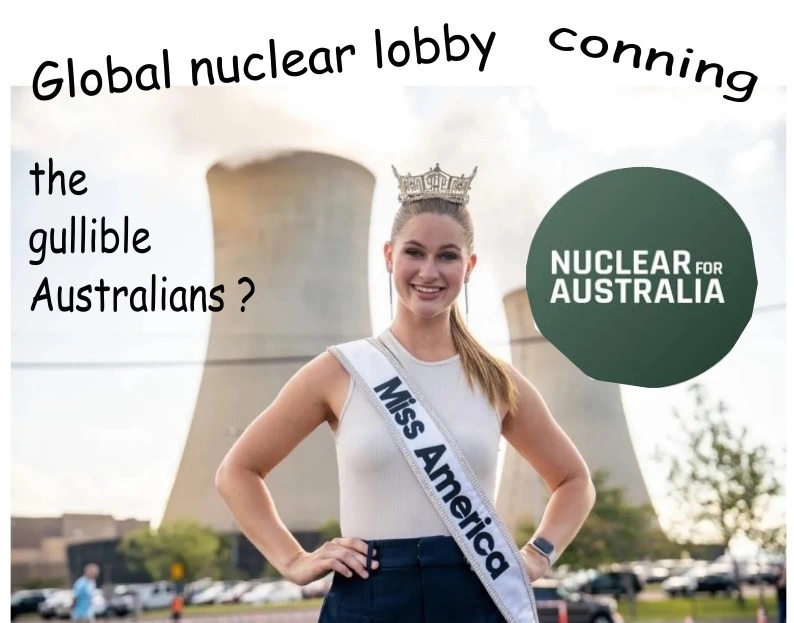
The Coalition’s much-vaunted nuclear modelling was — despite Opposition Leader Peter Dutton’s insistence it was “independent” analysis — created by a pro-nuclear think tank that has a cosy relationship with Nuclear for Australia, a lobby group with its own links to the Liberal Party.
Frontier Economics was the economic advisory firm responsible for the Coalition’s nuclear modelling and projected that the policy would cost an estimated $331 billion and involve the commissioning of seven nuclear reactors.
While Dutton said that Frontier “refused to take any money” when asked to model the plan by the Coalition, and Frontier in the report states that it was funded and directed solely by Frontier Economics, the issue of whether the work constitutes a “gift”, and the actual independence of the work, is still live.
In January this year, Frontier managing director Danny Price gave an extended interview to pro-nuclear lobby group Nuclear for Australia, where Frontier is described as a “non-partisan” and “pro-nuclear” organisation.
Nuclear for Australia has recently been reminded by the Australian Electoral Commission (AEC) of its legal obligations to authorise its electoral material after running thousands of dollars worth of online advertising in support of policies promoted by the Coalition. Teenage founder Will Shackel has previously denied that the Liberal Party is backing the group, despite a number of reported links to the organisation.
Crikey contacted the Coalition, Frontier Economics and the AEC about the status of the work as a gift and whether the work had been disclosed.
The AEC said it had nothing to add to the answers given in front of Senate estimates in late February, where Greens Senator for Queensland Larissa Waters raised the issue of whether the work constituted a donation to the Liberal Party’s campaign in the finance and public administration legislation committee.
“Disclosures for the 2024-25 financial year will be published in February,” a spokesperson for the commission said.
In estimates, Waters asked the acting electoral commissioner Jeff Pope whether the advice constituted an “in-kind” donation of the type normally required to be disclosed by political parties to the Electoral Commission.
Pope said that “subject to the circumstances, [the modelling] may well be a gift that needs to be disclosed at the appropriate time”, but stressed that it “really does depend on the circumstances, what the legal advice or advice is being procured for and who has obtained the advice”.
“A political party has to disclose all gifts,” he said.
Neither the Coalition nor Frontier Economics responded for comment.
The specifics of the modelling (in particular the assumptions it rests on) have been criticised since it was released in December 2024. However, the issue of the actual independence of the advice has not been raised, except by Senator Waters in front of Senate estimates.
Waters told Crikey she would be “very interested to know if the LNP has declared this modelling, from a firm with links to a pro-nuclear lobby, as an in-kind gift”.
“However, the lag in donation disclosure means we won’t know until next year.
“If this modelling is a Coalition policy costing, it should have been done by the independent Parliamentary Budget Office,” she said…………………. https://www.crikey.com.au/2025/05/02/peter-dutton-nuclear-power-modelling-election-2025-coalition/
Australians’ support for nuclear power ban rises despite Dutton’s best efforts to sell atomic future, survey finds

Only one in two Liberal party voters are in favour of lifting the national ban, according to the National Climate Action Survey.
Graham Readfearn Environment and climate correspondent. https://www.theguardian.com/australia-news/2025/may/01/australians-support-for-nuclear-power-ban-rises-despite-duttons-best-efforts-to-sell-atomic-future-survey-finds?fbclid=IwY2xjawKCE0ZleHRuA2FlbQIxMQBicmlkETFuSzNVZjdBUVlpaW9NUG41AR7HpN9FsEa4TXvZNvDnumjh3yUamClCltX2hRWi5NHKnYMed5Ju6qvo8drWaQ_aem_ewH1Tx1SHOHJtlwOSZIC2gThu 1 May 2025
Support for Australia’s ongoing ban on nuclear energy has risen sharply since Peter Dutton made the issue a central plank of Coalition energy policy, according to the country’s largest independent survey on climate change and energy.
The survey also found fewer people thought any benefits of nuclear power outweighed the risks compared with the previous year.
Even among people intending to vote Liberal, support for nuclear power was not overwhelming, with only 53% in favour of the party’s intention to lift the national ban if elected.
“These results clearly show that for any political party, proposing nuclear as a solution to Australia’s energy challenges is a very difficult task,” said Assoc Prof Kerrie Foxwell-Norton of Griffith University
Foxwell-Norton said the survey showed “the logic of investment and risk in nuclear power is not passing most Australians’ pub tests”.
The National Climate Action Survey, in its fourth year, is carried out by Griffith University and Monash University. The annual survey will be released in full in September and includes both new respondents and individuals whose views are tracked over time.
About new 2,500 respondents were surveyed in the last quarter of 2023 and again in 2024. The Guardian has previously reported other results from the survey, which showed Australians view solar and wind power more favourably than nuclear.
In 2023, the survey showed 51% of people supported Australia’s ban on nuclear energy. But in 2024 that rose to 59%.
That increase in support coincided with Dutton’s campaign to end the national ban on nuclear energy and build reactors at seven sites around the country.
More than a third of people intending to vote for the Liberal party had either an unfavourable view on nuclear electricity or no view at all, the survey found.
“That’s a lot of supporters who are not backing [the Liberal party’s] central energy policy,” said Foxwell-Norton.https://interactive.guim.co.uk/datawrapper/embed/Pxhwl/2/?dark=false
A majority of Nationals voters (54%) supported keeping the national nuclear energy ban. Only 18% of Labor voters opposed maintaining the ban.
When asked if they held any concerns about personally living within 50km of a proposed nuclear plant, 22% of Liberal voters said they were “extremely concerned” while 22% had no concerns at all.https://interactive.guim.co.uk/datawrapper/embed/pwiWR/1/?dark=false
Elsewhere in the survey, 81% of people supported assisting coal communities in the transition away from fossil fuels, and 84% would back financial incentives for rural landowners to host clean energy.
Foxwell-Norton said: “The oft cited divide between urban centre and regional and rural areas where these coalmines are located is politically expedient, wedge politics. It is politics that overlooks Australians and their relationship between places.
“Regional voters are more supportive of climate action because it is literally their everyday experience.”
This story was amended on 1 May 2025. An earlier version incorrectly said 28% of Liberal voters said they were “extremely concerned”, while 9% had no concerns at all, when asked if they held any concerns about personally living within 50km of a proposed nuclear plant. The correct numbers are 22% and 22% respectively.
Australia’s arms escalation is in the interest of no one but death
Independent Australia, By Bronwyn Kelly | 2 May 2025,
Instead of arguing about whether Australia needs more submarines, we would be better off working towards a world where no one needs them. Bronwyn Kelly reports.
THOSE WHO HAVE HAD the patience to listen to the full day of speeches and questions at the recent Sovereignty and Security forum held at the National Press Club have been given a unique insight.
The event, organised by former Prime Minister Malcolm Turnbull, shed light on what happens when members of an elite defence establishment attempt to set Australia’s strategic direction. They jockey for money for an industry of death.
Usually, they jockey quietly, but this particular forum allowed several to display how much of their thinking is motivated by money and is therefore fixated on militarism – as though peace and disarmament were not a prospect to be contemplated at all in Canberra.
Turnbull kicked off the day’s discussion by asserting that Trump’s America is now a country whose values are “aligned to a might is right world” and that, as such, it no longer shares Australia’s values. He made little, if any, reference to what Australia’s national values might be. Presumably, we were simply meant to infer that Australia should no longer aspire to emulate America, at least in its “might is right” approach to economic and military strategy.
As the day moved on, no one demurred from this description of America. They took it largely as a fact and mostly as one that would be long-lived rather than short-lived. There was general agreement that America has changed with the rise of Trump and that this has implications for our choices in defence, diplomacy, trade and international relations. Accordingly, they set about the laudable exercise of discussing how Australia should “recalibrate”.
But it was those with a vested and sometimes even nakedly pecuniary interest in defence industries that proved themselves to be among the most unwilling in the room to recalibrate. Instead they used the day wherever they could to argue for massive expansion of defence industries and weapons exports and also for increasing what they called a “deterrent” capability – shorthand for building a defence force and armaments at such a large scale that any adversary, no matter how much bigger their military capability might be than Australia’s, would calculate that an attack on Australia would not be worth the cost. At least that’s the theory.
Someone should tell them that deterrence doesn’t actually work when there is a large and insurmountable imbalance of power as there is in the case of Australia vis-a-vis China, Russia and the US. It’s a lot of money for nothing in our case, and our adoption of deterrence as an overriding posture in the most recent National Defence Strategy simply makes matters worse by forcing others to distrust us more and arm themselves. But that’s another article. Suffice to say here that those championing more investment in defence seemed unable to contemplate anything other than arms escalation.
Perhaps the most disheartening feature of the discussion, however, was that at no time did those advocating for arms escalation ask whether expansion of defence and defence industries was in Australia’s interest or show how it would be. They bypassed the questions of what is in our interest and what Australians might value and be prepared to defend militarily, and instead jumped straight to the issue of how much more funding they needed for the defence industry. The clamour for a greater share of GDP to be spent on defence activities swamped voices such as those of former foreign minister Gareth Evans and former chief of defence Chris Barrie — both of whom attempted to argue that the whole debate should be reframed so that we decide what is in our interest first, before we design a strategy to protect it in defence and foreign policy………………………………………………………………………….
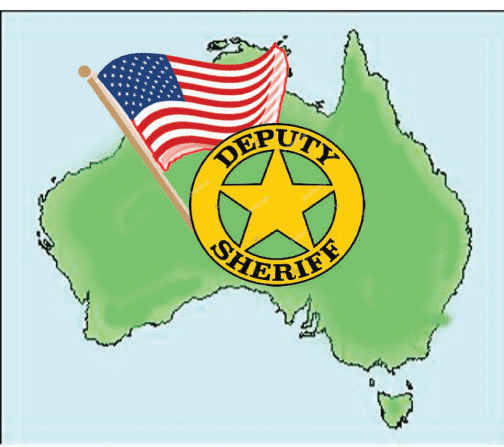
At the very least Australia’s alliance with the U.S., especially if it continues to take a military form, is very likely to defeat other attempts to engage more positively with the rest of the world and particularly with Asia. The need for greater engagement with Asia was something that most speakers agreed on at the forum – and yet the prevailing impression was that most could not bring themselves to think of abandoning the alliance, even as an option.
This reluctance begs the question of how far the prevailing regime in America diverges from our “values” before we say it’s behaving in a manner that is so contrary to our interests that we must detach ourselves from it? How many more regime changes, brutal incursions and even genocides fostered by the U.S. will it take? How much more destabilisation of other economies? How much lower should America sink into autocratic behaviours, threats to allies and obliteration of human rights within its own territory, before we detach ourselves? How much more ugly must America become?
…………………….Given that Australians don’t want their economy and well-being disrupted by war, they’d be far more likely to want to concentrate on strategies that reduce or prevent the need for military expenditures. This is not what those attached to defence industries want to hear, but if they are asking Australians to sacrifice all their well-being and place themselves unnecessarily at dire risk of attack, they should be prepared for justifiable pushback.
The next time Mr Turnbull hosts a forum for these elites, everyone will be better off if he frames the occasion so that they stop arguing about whether we need submarines and start working towards a world where no one needs them. Arms escalation is in the interest of no one but the merchants of death. So if elites are invited again to ponder a “recalibration”, a plan for eventual disarmament should be acknowledged as a necessary permanent feature of a viable defence strategy. Nothing else is in our interest.
Dr Bronwyn Kelly is the Founder of Australian Community Futures Planning (ACFP). She specialises in long-term integrated planning for Australia’s society, environment, economy and democracy, and in systems of governance for nation-states.
Aboriginal group from Port Augusta joins experts in explaining the impact of the nuclear industry

Philip White, 1 May 25
I’ve just returned from a powerful community meeting where a group of Aboriginal people came down from Port Augusta to tell people in the marginal SA electorate of Sturt about their opposition to the Coalition’s plans to build a nuclear reactor in their town.
Clinton (Stano) Dadleh, Aunty June Lennon, Aunty Vivienne McKenzie, Uncle Lindsay Thomas, Glen Wingfield (via Zoom) and Rhenee Lester gave moving accounts of their lived experience of Port Augusta and the impact of the nuclear industry on their families, while Dr Kate Wylie (Doctors for the Environment) and Dr Jim Green (Friends of the Earth) critiqued the Coalition’s nuclear plan in detail.
For those who couldn’t make it, the meeting was live streamed and can now be viewed on the following link:
The meeting begins at the 29 minute mark of the recording and the presentations begin at the 37 minute mark.
Why Military Neutrality is a Must for Australia
Embrace military neutrality. Australia faces a choice: join declining empires or lead in peace. Discover why neutrality is the way forward in a multipolar world.
April 30, 2025 , By Denis Hay, Australian Independent Media
Introduction: A Nation at the Crossroads
Picture this: It’s 2030. Australian submarines sail under U.S. command in the Taiwan Strait. Canberra receives intelligence briefings written in Washington. The media frames any dissent as disloyalty. Ordinary Australians ask: “How did we get dragged into another war we never voted for?”
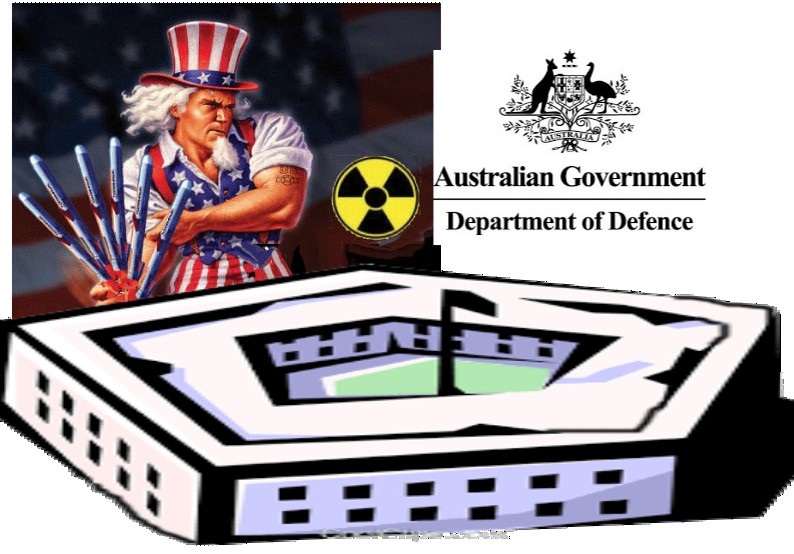
Rewind to 2025: our foreign policy is shaped not by peace or diplomacy, but by deals like AUKUS, designed to entrench Australia within the military-industrial interests of a declining superpower. Meanwhile, the world is shifting. BRICS is rising. The U.S. is losing credibility. And Australia must decide: Will we continue to act as a pawn, or will we embrace military neutrality and sovereignty through peace?
The Global Realignment: The World Beyond the U.S.
U.S. Decline and the Rise of Multipolarity
In 2015, analysts inside global financial circles began quietly withdrawing from the U.S. The reasons were clear:
• America’s fertility rate had fallen to 1.8 (below replacement).
• Civil unrest, mass shootings, and institutional collapse painted a picture of chaos.
• Trust in government and media plummeted (Edelman Trust Barometer, 2021).
Meanwhile, the BRICS+ bloc was expanding rapidly. By 2024, Saudi Arabia, UAE, and Iran had joined, and member nations began transacting in local currencies. The world was no longer unipolar—and Australia must adapt.
The BRICS+ Bloc and the Global South
The global South is now:
• Home to the largest youth populations (India, Nigeria, Indonesia)
• Receiving billions in tech investment (e.g., Microsoft’s $1B in African AI infrastructure)
• Transitioning to local currency trade
Australia can no longer afford to cling to outdated alliances that tie us to declining powers.
Why Australia Must Reassess Its Strategic Alliances
The Cost of U.S. Dependence
Our military is deeply entwined with U.S. command structures:
• AUKUS submarine deal: $368 billion to be tied into U.S. war planning
• Hosting U.S. troops, ships, and bombers in the Northern Territory
The Failure of U.S. Militarism
• Iraq and Afghanistan: trillions spent, no peace achieved
• Ukraine: Proxy war fuelled by NATO expansion and U.S. arms interests
Quote from the video: “America is being phased out… not because they hate it, but because it’s obsolete.”
What the OCGFC Knows – And Why We Should Listen
The Owners and Controllers of Global Financial Capital (OCGFC) have already moved on from America. They’re investing in the South. Australia should follow their strategy—but for peace, not profit.
The Case for Military Neutrality
What Is Military Neutrality?
Military neutrality means:
• No participation in military blocs
• No hosting of foreign military bases
• No involvement in foreign wars
Example of military neutrality: Switzerland has remained neutral for over 200 years. Reference: https://worldpopulationreview.com/country-rankings/neutral-countries
Benefits of Military Neutrality for Australia
• Enhanced sovereignty: Canberra decides, not Washington
• Improved regional trust
• Reduced risk of becoming a target in U.S.-China conflict
Strategic Independence……………………………………………………………………………….
Australia is now home to:
The Pine Gap spy base, integral to U.S. drone warfare and nuclear targeting
Rotational deployments of U.S. marines and bombers in the Northern Territory
Massive investment under AUKUS, where Australia receives nuclear-powered submarines it will not command independently
Growing integration into U.S. war planning around China and the South China Sea
The Quiet Absorption of Sovereignty
These developments raise serious questions:
If we cannot deny access to foreign troops on our soil, are we still sovereign?
If our military relies on foreign command systems, do we retain independent defence?
This is not a conspiracy theory. This is creeping dependency. Sovereignty is rarely lost overnight. It is eroded decision by decision, treaty by treaty, base by base—until there is nothing left to reclaim.
The Choice Before Us
We must confront an uncomfortable possibility: Australia is at risk of becoming a de facto 51st state – not through constitutional change, but through military submission.
The warning signs are clear. If we continue down this path unquestionably, we may find ourselves unable to make decisions without a nod from Washington.
Neutrality offers a way out. …………………………………………………………………………………………………… https://theaimn.net/why-military-neutrality-is-a-must-for-australia/
Traditional owner says “over my dead body” to the Coalition’s nuclear policy
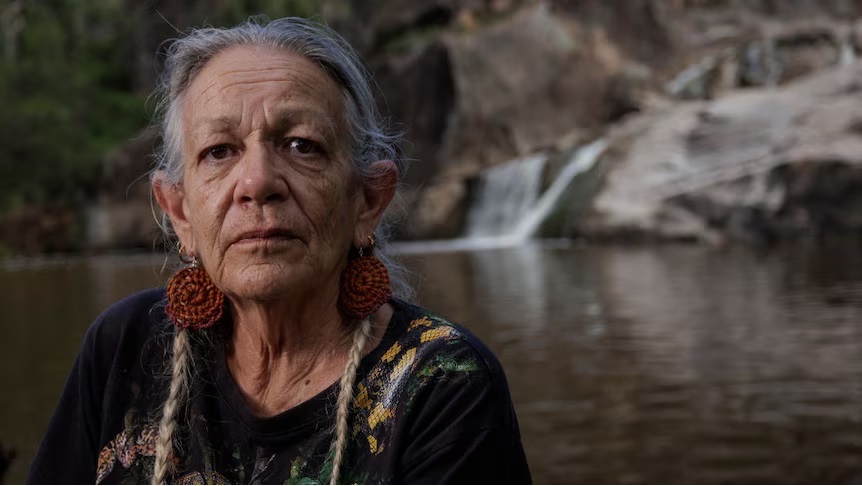
The scars of Australia’s nuclear past stain Coalition proposal for First Nations voters
The Age, By the Indigenous affairs team’s Kirstie Wellauer, Mon 28 Apr 25
In the 70s, Aunty Janine Smith protested against nuclear power on foreign shores.
“The contamination and the consequences of the bombings in Hiroshima, and then the Vietnam War and chemical warfare. There were always meltdowns somewhere,” she said.
“You know, it just reaffirmed my opinion of the safety of [nuclear] and the effectiveness of it.”
Today she is prepared to once again fight that battle, but now it’s at home on her own traditional lands — the site of one of the Coalition’s proposed nuclear power plants.
The Bujiebara traditional owner is worried the proposed plant at Tarong, north-west of Brisbane, could impact on culturally significant sites that lie only 4 kilometres away.
“Bujiebara were makers of stone axes and there is a large sandstone rock in the Tarong precinct that was used to grind the edge of these axes, that is our culturally significant site.”
She also holds concerns about the lack of water resources in the town given nuclear plants require more water than any other power source aside from hydropower.
“Because of the water limitations here, we just can’t. We haven’t got access to that kind of water,” she said.
“There is not enough water in the South Burnett to even supply all the towns with water.”
At the recent leaders’ debate hosted by the ABC, Peter Dutton insisted there was enough water for all seven of the proposed nuclear plants.
This claim was contradicted by one of his own senior frontbenchers, Nationals MP Darren Chester, who said the question of water requirements needed further scientific assessment that could take up to two and a half years.
Queensland Premier David Crisafulli is opposed to the Coalition’s nuclear policy. Mr Dutton will also need to overturn a federal parliament ban on nuclear power if he wins the election.
Aunty Janine Smith said she won’t ever give consent for nuclear power on her country.
“They want to try nuclear, then they’ll have to go over my dead body.”
The scars of Maralinga
For many First Nations people, anti-nuclear sentiment runs deep.
Passed down generation to generation, the enduring impacts of nuclear testing in the South Australian outback are front of mind for second-generation survivor Karina Lester this election.
Her late father, Yami Lester, was just 10 years old when he watched the British government drop an atomic bomb on his traditional country in 1953.
“Dad’s witness account [was] of the black mist rolling, and the ground shaking over his Walyatjatjara country,” said the Yankunytjatjara-Anangu woman.
“Four years after that test, my late father’s own world turned into complete darkness.”
Just a teenager, he went blind.
But loss of eyesight wasn’t the only impact worn by the Anangu people after the radioactive dust settled.
“Anangu died after those tests. Anangu still feel the effects of it through autoimmune diseases, through health issues, respiratory skin rashes, eye infections. The list goes on,” she said.
The Anangu people were not adequately warned about the test’s dangers.
It has taken decades and millions of dollars to clean up the radioactive fallout from the nuclear bombs, and tests show the contamination of the land remains highly active.
Ms Lester is now an ambassador for the International Campaign to Abolish Nuclear Weapons.
As the proposed rollout of nuclear power stations remains a cornerstone of the Coalition’s energy policy this election, she wants Australians to remember the lived experiences of her people when they head to the polls.
“We have the heavy burden of having to remind fellow Australians that this is not the way to go for nuclear power. We are standing up for our people and country.”
Proposed nuclear sites on Aboriginal land
The Coalition’s proposal has identified seven locations around the country for nuclear plants, all on the sites of current or former coal-fired power plants……………………………………………………………………………
Concerns for storage of nuclear waste
For both Karina Lester and Janine Smith, the issue of where the nuclear waste from these seven sites would be stored is also of major concern.
Under the Coalition’s plan, the radioactive waste generated by the power plants would be stored on site. At the end of each plant’s life the waste would be moved to a permanent home, yet to be established.
Over the decades, successive governments have attempted to establish a national nuclear waste repository — all have failed.
And part of that failing has been over a lack of consultation with relevant traditional owners.
Nuclear support falls since becoming Coalition policy

By Caitlin Fitzsimmons, https://www.smh.com.au/politics/federal/federal-election-2025-live-updates-dutton-pledges-40b-debt-cut-albanese-campaigns-in-perth-20250430-p5lvjh.html?post=p58kxt#p58kxtx
Public support for nuclear power has fallen since Dutton announced his nuclear policy in 2024.
That’s according to the latest National Climate Action Survey, an annual poll of 4000 people run by Monash and Griffith universities.
Key initial findings include:
The proportion of Australians who want to maintain the existing ban on nuclear power rose from 51 per cent in 2023 to 59 per cent in 2024. Those who wanted to ditch the ban fell from 34 to 30 per cent.
Two out of three women want to keep the ban on nuclear, compared with one in two men. Twice as many men as women want to lift the ban – 35.9 versus 18 per cent.
Those who said the risks of nuclear power far outweighed the benefits rose from 21.9 to 26 per cent, and those who said the benefits far outweighed the risks fell from 24.5 to 22 per cent.
Only 11 per cent of respondents would be comfortable with a nuclear power station nearby, and 54.8 per cent would be very or extremely concerned about it. Even fewer (10.8 per cent) said they would be happy to have a coal mine nearby. However, more than half had no concerns about nearby wind farms and almost two-thirds were fine with solar farms.
The survey asks a wide range of questions to gauge attitudes to climate change, extreme weather and different energy options. The full results for 2024 will be out in September.
The methodology is the same each year to ensure the results are comparable over time.
Nuclear power ‘not passing the pub test’, survey authors say
1 May 2025 , By Staff Reporter, https://www.aumanufacturing.com.au/nuclear-power-not-passing-the-pub-test-survey-authors-say
Support among Australians for nuclear power has fallen, according to a survey of more than 4,000 respondents conducted by Griffith University’s Climate Action Beacon in partnership with the Monash Climate Change Communication Research Hub.
The National Climate Action Survey was showing that “the logic of investment and risk” didn’t pass most Australians’ pub tests, according to Griffith University Associate Professor Kerrie Foxwell-Norton, a lead collaborator on the survey, which is now in its fourth year.
According to a statement from Monash University, among “key initial findings” were 59 per cent of respondents wanted to keep a ban on nuclear energy in 2024 (up from 51 per cent in 2023), 26 per cent said the risks far outweigh the benefits (up from 21.9 per cent) and over 54.8 per cent “would be very or extremely concerned” if a nuclear power plant was placed near them.
“The survey is a peerless, independent source of information about Australians’ climate actions, attitudes and beliefs as the nation – and the world – embarks upon societal transformations to a sustainable low carbon future,” according to Monash University Professor Libby Lester.”
The survey’s full findings will be released in September. Previous year’s results can be accessed here.
A major point of difference in the current election campaign, which will conclude this weekend, is in the opposition’s pledge to overturn a ban on developing any new nuclear power sites in Australia.
The Coalition plan involves two nuclear reactors beginning operation in the 2030s and, eventually, reactors in each mainland state at the site of retired or retiring coal plants.
Firefighters and nurses call on Coalition to drop nuclear energy plans

Region Canberra, 1 May 2025 | Chris Johnson
Firefighters and healthcare workers have written an open letter to Peter Dutton just a few days out from polling day, asking the Opposition Leader to drop his nuclear energy plan.
Organisations representing more than 350,000 emergency services workers this week called on Mr Dutton to dump the policy in the interests of good health.
The open letter was signed by the Australian Nursing and Midwifery Federation, Emergency Leaders for Climate Action, Climate Action Nurses, Climate and Health Alliance, Doctors for the Environment Australia, and the United Firefighters Union of Australia.
After stressing that doctors, paramedics, nurses, midwives and firefighters are among the hundreds of thousands of people the groups represent, the letter expresses “grave concerns” regarding the potential introduction of nuclear power into Australia.
“As the frontline responders to disasters and emergencies, we are uniquely positioned to assess the risks posed by nuclear energy infrastructure to public safety, worker health, and environmental security,” the letter states.
“Australia’s emergency services do not have the support or resources to respond to nuclear disasters.
“Unlike other nations with established nuclear industries, Australia lacks the necessary infrastructure, resources, and expertise to manage incidents involving nuclear reactors or radioactive waste transportation and storage.
“Furthermore, international examples have shown that populations residing in close proximity to nuclear reactors are at an increased risk of developing severe health complications.
“Existing emergency response and health frameworks would need extensive – and costly – overhauls to address these challenges effectively.
“Nuclear accidents expose emergency responders to ionizing radiation levels far exceeding safe occupational limits.
“International precedents such as Chernobyl and Fukushima demonstrate the devastating health impacts on first responders, including acute radiation sickness and long-term cancer risks.”
The letter then goes on to ask the Coalition to abandon plans for nuclear energy in Australia and prioritise safer energy solutions that “do not endanger” workers or communities, such as solar and wind backed up by storage………………………..
The backlash has been strong enough that Mr Dutton has barely mentioned nuclear energy during the election campaign.
If asked about it, however, he repeats his strong support for the energy plan.
Federal secretary of the Australian Nursing and Midwifery Federation, Annie Butler, said she was concerned about the impact that the proposed nuclear plants would have on the health of all people, but particularly nurses, midwives and carers.
“What we are still yet to see are detailed health risk assessments including how the health of nurses, midwives, carers and the community will be protected,” she said…………………..
Former NSW Fire and Rescue Commissioner Greg Mullins, who went on to found the group Emergency Leaders for Climate Action, said the Coalition’s nuclear scheme “gives rise to far more questions than answers” and in the “unlikely event it is ever actually delivered” it would result in massive amounts of dangerous, additional climate pollution.
“Firefighters and other first responders will be expected to deal with situations for which they have no training, equipment or experience, and like in Chernobyl, possibly lose their lives,” he said.
“Costs for protection from nuclear accidents were not factored into the Coalition’s vague modelling, and nobody should be fooled – this is nothing more than a ruse to continue generating profits for the fossil fuel industry who are funding the Coalition’s election campaign.”
Greg McConville, national secretary of the United Firefighters Union of Australia, said: “Much has been said about the cost of living in this election, but we should not forget the cost of lives………..
The open letter points out that current federal guidelines allow firefighters, emergency services, essential services and health workers to be exposed to radiation doses up to 500 times higher than civilian safety limits during catastrophic events.
“This is an unacceptable risk,” the letter states. https://region.com.au/firefighters-and-nurses-call-on-coalition-to-drop-nuclear-energy-plans/865191/
Dutton promises $40b debt cut as nuclear questions grow
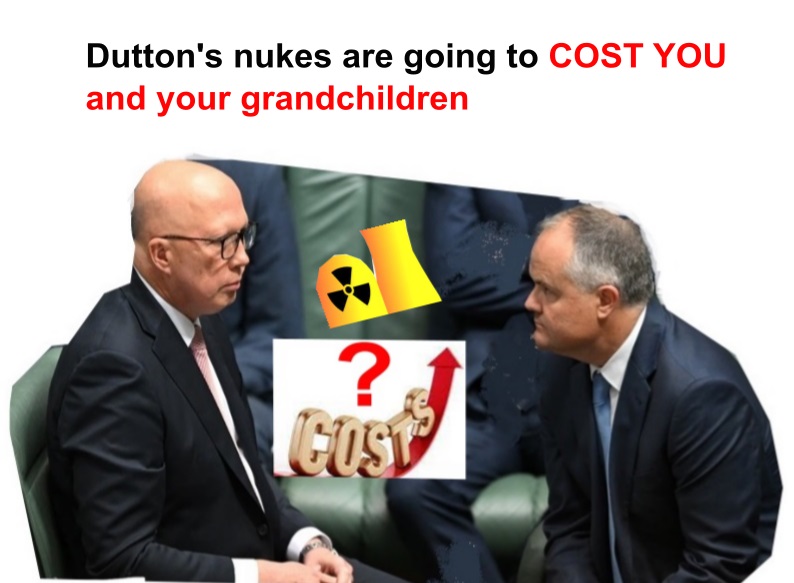
The Age, By Shane Wright and Mike Foley, April 30, 2025
The Coalition will pledge to slash at least $10 billion out of budget deficits over the next four years while bringing down government debt by $40 billion amid suggestions the cost of its signature nuclear power policy will be far more expensive than it has promised.
Shadow treasurer Angus Taylor and finance spokeswoman Jane Hume will on Thursday reveal the Coalition’s full costings, which will confirm cuts to several high-profile Labor programs, including its pledge to wipe $16 billion in student debts.
But even with its promises, both the Coalition and government will go to voters on Saturday with the budget facing deficits over the rest of the decade and gross debt soaring through the $1 trillion mark.
This week, ratings’ agency S&P Global warned Australia’s AAA credit rating could be put at risk if either of the major parties’ election promises resulted in larger structural deficits and more debt than expected.
On Monday, Treasurer Jim Chalmers and Finance Minister Katy Gallagher released the government’s own costings, which showed total budget deficits would be $1.1 billion lower than forecast in the March 25 budget.
Despite the modest improvement, the budget would show cumulative deficits of $150 billion over the next four years.
Taylor and Hume will outline cuts that will bring down the cumulative deficits by a double-digit level, with one of the biggest savings expected to come from axing up to 41,000 public servants based in Canberra. They will be reduced through natural attrition over the next five years.
It will scrap the government’s $14 billion Made in Australia production tax credits for the mining and green hydrogen sector.
The write-off of student debt, affecting both tertiary and vocational education students that the government estimates saves affected people about $5000, is due to start from June 1. But the Coalition would not go ahead with the proposal………………………………………….
Taylor and Hume will promise to bring gross debt down by $40 billion. That will be partly achieved by axing the government’s Rewiring the Nation Fund and stopping the $10 billion Housing Australia Future Fund.
The Coalition’s costings will have to include the impact of its 25¢-a-litre cut in fuel excise for the next 12 months, worth $6 billion, and its one-off $1200 tax offset to low- and middle-income earners that is estimated to cost $10 billion.
Chalmers accused the Coalition of being sneaky by holding back its costings, including key details about its nuclear policy, until the second-last day of the campaign. Chalmers did not release Labor’s 2022 election costings until the Thursday before polling day.
He said there were already black holes around the Coalition’s mortgage interest deductibility, petrol excise and small-business fringe benefits tax reduction policies while it would attempt to use heroic assumptions around productivity growth to make its numbers add up.
“They want to skate through all the way to the election, or as close as possible, without coming clean. I think that speaks volumes about the approach that they’re taking,” Chalmers said.
A key issue remains the Coalition’s nuclear policy. Peter Dutton has slammed as a lie the government’s claim that it will cost $600 billion, arguing CSIRO research shows it would cost $116 billion to deliver its planned five large-scale and two small modular reactors at seven sites across the country.
The $116 billion figure is based on construction costs for a specific type of reactor – Westinghouse’s AP1000, which is one of the most common and cheapest designs in use around the world.
Coalition energy spokesman Ted O’Brien and Nationals Leader David Littleproud have promised not to use the AP1000 if it would reduce irrigation water to local farmers.
The AP1000 requires significant amounts of water to cool its reactor.
Former Land and Water Australia chief executive Andrew Campbell found there is not enough water at least five of the seven sites nominated by the Coalition for nuclear reactors, in his recent report commissioned by the Liberals Against Nuclear lobby group.
Littleproud and O’Brien have separately raised the prospect of building what are known as dry cool reactors.
However, according to the World Nuclear Association, they cost up to four times more than a typical water-cooled reactor such as the AP1000.
Dry cooled reactors, which use air rather than water to dissipate heat from the plant’s core, are not in commercial use at large-scale nuclear plants.
Dutton confirmed on Wednesday that the Coalition had not finalised which reactors would be used.
“We will take advice from the experts on what is the best fit for those seven sites,” he said.
Littleproud told the National Press Club on April 24 that he had promised to farmers “there is nothing extra coming out of the consumptive pool” of water available to irrigators, and models would be selected based on their water consumption.
“There are other technologies in terms of dry cooling,” he said.
O’Brien in February said, “the nuclear technology for Australia is yet to be selected”………. https://www.theage.com.au/politics/federal/dutton-promises-40b-debt-cut-as-nuclear-questions-grow-20250430-p5lvei.html?ref=rss&utm_medium=rss&utm_source=rss_feed
Australian nuclear news items 28 April – 5 May
Headlines as they come in:
- Nuclear fallout: Coalition’s nuclear energy policy proved toxic to voters.
- Pie in the sky? After the Coalition’s stinging loss, nuclear should be dead. Here’s why it might live on.
- Nationals MPs ‘100 per cent’ back nuclear being kept as Coalition dissects loss
- A resounding win for the world’s nuclear-free clean energy movement.
- Coalition’s nuclear power policy must be nuked.
- Nuclear free voices have an important role to play in the days following the federal election.
- Coalition power plan ‘nuked’ at poll: climate groups.
- Coalition to put nuclear plan on the chopping block.
- Australia lays out red carpet for rapid green energy transition. Can Labor seize the moment?
- Australia Islamic Caliphate? Dark money and the 11th hour Election propaganda blitzkrieg.
- Nuclear power is shaping up as an election loser, and the Murdoch media is not happy.
- As Dutton champions nuclear power, Indigenous artists recall the profound loss of land and life that came from it.
- Australians once feared the health impacts of nuclear. Now nobody’s talking about it
- Dutton’s ‘independent’ nuclear modelling was created by a pro-nuclear think tank .
- Australians’ support for nuclear power ban rises despite Dutton’s best efforts to sell atomic future, survey finds.
- Australia’s arms escalation is in the interest of no one but death
- Malcolm Turnbull hasn’t drunk the Kool-Aid on AUKUS | ABC NEWS – https://www.youtube.com/watch?v=ccQCTLhF1Do
- Firefighters and nurses call on Coalition to drop nuclear energy plans.
- Nuclear power ‘not passing the pub test’, survey authors say
- Traditional owner says “over my dead body” to the Coalition’s nuclear policy.
- Dutton promises $40b debt cut as nuclear questions grow.
- Nuclear support falls since becoming Coalition policy
- What Australians really think of nuclear power
- Government ignores AUKUS ‘very high risk’ warning from the Admiral in charge.
- Aboriginal group from Port Augusta joins experts in explaining the impact of the nuclear industry.
- Why Military Neutrality is a Must for Australia. Renewables, coal or nuclear?
- This election, your generation’s energy preference may play a surprising role
- Coalition says its energy plan is climate approved. Here’s what the IPCC really says about nuclear.
1 This month
7 April – WEBINAR – Australia and the Doomsday Clock – Preventing nuclear war through NoFirstUse and other policies
Online | Tuesday April 7, 4:00-5:30pm, Australian Eastern Time / 8:00-9:30am Central Europe Time
– Access the registration link
15 April – Zoom –Nuclear Power is Not the Solution
Apr 15, 2026 01:00 AM in Canberra, Melbourne, Sydney

Join the International Physicians for the Prevention of Nuclear War (IPPNW) on Tuesday, April 14th for a timely webinar exploring the risks associated with nuclear power and challenging the myth that it offers a simple, safe, carbon-free solution to the climate crisis

21 April Webinar: No Nuclear Weapons in Australia
Start: 2026-04-21 18:00:00 UTC Canberra, Melbourne, Sydney (GMT+10:00)
End: 2026-04-21 19:30:00 UTC Canberra, Melbourne, Sydney (GMT+10:00)
Event Type: Virtual
A virtual link will be communicated before the event.
Host Contact Info: australia@icanw.org

of the week – Australians for War Powers Reform (AWPR)
To see nuclear-related stories in greater depth and intensity
 Antinuclear
