Small nuclear reactors are no fix for California’s energy needs

I know all too well that the hype is built on quicksand …….. many of those “building support for small modular reactors” are putting forward “rhetorical visions imbued with elements of fantasy.”
SMRs are just one of several wildly overhyped false promises on which the world is poised to spend hundreds of billions of dollars by 2040
Joseph Romm, April 18, 2025 , https://www.latimes.com/opinion/story/2025-04-18/small-modular-reactors-cost-california
It might seem like everyone from venture capitalists to the news media to the U.S. secretary of Energy has been hyping small modular reactors as the key to unlocking a nuclear renaissance and solving both climate change and modern data centers’ ravenous need for power.
On Monday, the Natural Resources Committee of the California Assembly will consider a bill to repeal a longstanding moratorium on nuclear plants in the state, which was meant to be in place until there is a sustainable plan for what to do with radioactive waste. Defeated multiple times in the past, this bill would carve out an exception for small modular reactors, or SMRs, the current pipe dream of nuclear advocates.
SMRs are typically under 300 megawatts, compared with the combined 2.2 gigawatts from Diablo Canyon’s two operating reactors near San Luis Obispo. These smaller nukes have received so much attention in recent years mainly because modern reactors are so costly that the U.S. and Europe have all but stopped building any.

The sad truth is that small reactors make even less sense than big ones. And Trump’s tariffs only make the math more discouraging.
I’ve been analyzing nuclear power since 1993, when I started a five-year stint at the Department of Energy as a special assistant to the deputy secretary. I helped him oversee both the nuclear energy program and the energy efficiency and renewable energy program, which I ran in 1997.
So I know all too well that the hype is built on quicksand — specifically, a seven-decade history of failure. As a 2015 analysis put it, “Economics killed small nuclear power plants in the past — and probably will keep doing so.” A 2014 journal article concluded many of those “building support for small modular reactors” are putting forward “rhetorical visions imbued with elements of fantasy.”
But isn’t there a nuclear renaissance going on? Nope. Georgia’s Vogtle plant is the only new nuclear plant the U.S. has successfully built and started in recent decades. The total cost was $35 billion, or about $16 million per megawatt of generating capacity — far more than methane (natural gas) or solar and wind with battery storage.
As such, Vogtle is “the most expensive power plant ever built on Earth,” with an “astoundingly high” estimated electricity cost, noted Power magazine. Georgia ratepayers each paid $1,000 to support this plant before they even got any power, and now their bills are rising more than $200 annually.
The high cost of construction and the resulting high energy bills explain why nuclear’s share of global power peaked at 17% in the mid-1990s but was down to 9.1% in 2024.
For decades, economies of scale drove reactors to grow beyond 1,000 megawatts. The idea that abandoning this logic would lead to a lower cost per megawatt is magical thinking, defying technical plausibility, historical reality and common sense.
Even a September report from the federal Department of Energy — which funds SMR development — modeled a cost per megawatt more than 50% higher than for large reactors. That’s why there are only three operating SMRs: one in China, with a 300% cost overrun, and two in Russia, with a 400% overrun. In March, a Financial Times analysis labeled such small reactors “the most expensive energy source.”

Indeed, the first SMR the U.S. tried to build — by NuScale — was canceled in 2023 after its cost soared past $20 million per megawatt, higher than Vogtle. In 2024, Bill Gates told CBS the full cost of his 375-megawatt Natrium reactor would be “close to $10 billion,” making its cost nearly $30 million per megawatt — almost twice Vogtle’s.
All of this has played out against a backdrop of historically cheap natural gas and a rapid expansion of renewable energy sources for electricity generation. All that competition against nuclear power matters: A 2023 Columbia University report concluded that “if the costs of new nuclear end up being much higher” than $6.2 million per megawatt, “new nuclear appears unlikely to play much of a role, if any, in the U.S. power sector.” R.I.P.
SMRs are just one of several wildly overhyped false promises on which the world is poised to spend hundreds of billions of dollars by 2040, including hydrogen energy and direct air carbon capture.
But nuclear power is the original overhyped energy technology. When he was chairman of the Atomic Energy Commission, Lewis Strauss — the Robert Downey Jr. character in “Oppenheimer” — predicted in 1954 that our children would enjoy nuclear power “too cheap to meter.”
Yet by the time I joined the Department of Energy in 1993, nuclear power costs had grown steadily for decades. Since then, prices for new reactors have kept rising, and they are now the most expensive power source. But solar, wind and battery prices have kept dropping, becoming the cheapest. Indeed, those three technologies constitute a remarkable 93% of planned U.S. utility-scale electric-generating capacity additions in 2025. The rest is natural gas.
China is the only country building many new nuclear plants over the next five years — about 35 gigawatts. Less than 1% of this projected capacity would be from small reactors — while more than 95% will be from reactors over 1,100 megawatts. Now compare all that to the 350 gigawatts of solar and wind China built — just in 2024.
For the U.S., President Trump’s erratic tariffs make small modular reactors an even riskier bet. If the U.S. economy shrinks, so does demand for new electric power plants. And the twin threats of inflation and higher interest rates increase the risk of even worse construction cost overruns.
Also, China, Canada and other trading partners provide critical supply chain elements needed to mass-produce SMRs — and mass production is key to the sales pitch claiming this technology could become affordable. That logic would apply only if virtually all of the current SMR ventures fail and only one or two end up pursuing mass production.
So, can we please stop talking about small modular reactors as a solution to our power needs and get back to building the real solutions — wind, solar and batteries? They’re cheaper and cleaner — and actually modular.
Joseph Romm is a former acting assistant secretary of Energy and the author of “The Hype About Hydrogen: False Promises and Real Solutions in the Race to Save the Climate.”
Peter Dutton insists there’s enough water for his seven nuclear plants, contradicting shadow frontbencher.
ABC News, By chief digital political correspondent Jacob Greber, 17 Apr 25
In short:
Voters are getting mixed messages about whether Peter Dutton’s nuclear power plan takes account of water needs.
The opposition insisted in Wednesday’s ABC Leaders Debate that allocations for all seven sites have been assessed.
What’s next?
But Nationals MP Darren Chester said water requirements would be based on experts’ “facts not opinions” and take up to 2 ½ years to determine.
The Coalition has sent voters contradictory messages about whether it has accounted for the vast water requirements of its seven proposed nuclear plants after Peter Dutton declared the issue all but resolved.
In Wednesday night’s ABC News Leaders Debate the opposition leader said he has already assessed water allocations for “each of the seven sites” where he plans to build nuclear power plants.
When challenged by ABC debate host David Speers whether “you need more” water for nuclear, Mr Dutton replied: “We’re comfortable with the analysis that we’ve done”…………………………………….
The Coalition’s mixed messaging on water comes amid signs the opposition is struggling to sell its vision of a nuclear powered future, including from groups that say they are close to the Liberal Party.
Part of the challenge is that nuclear power stations would require a large quantity of water in addition to what is already earmarked for agriculture, environmental flows and remediation of old coal sites, raising fears of major shortfalls during inevitable periods of drought.
A report this month by Australian National University visiting fellow Andrew Campbell, commissioned by Liberals Against Nuclear, found the Coalition’s plan would require 200 gigalitres of water a year.
Professor Campbell found that half of the proposed nuclear capacity would not secure enough water and that another 40 per cent of the proposed nuclear generation would be curtailed during dry seasons…………………………………….
Mr Dutton was also under pressure to explain whether he would use federal powers to override community and potential state opposition to nuclear power.
“If we can’t find consensus then we’ll do what’s in our country’s best interests,” he said…………………………………………………………………………. https://www.abc.net.au/news/2025-04-17/dutton-insists-theres-enough-water-nuclear-plants-election-2025/105189220?utm_campaign=abc_news_web&utm_content=facebook&utm_medium=content_shared&utm_source=abc_news_web&fbclid=IwY2xjawJxL1RleHRuA2FlbQIxMQABHmHPsgVOo6Uz9Yr3ZWf15QmjweMROqNxdmS8gyIkjOYfN9f5ywdwGVn-ibIM_aem_l8Clv5SwBwgY5pBtNlEZ5g
Lots of nuclear news this week – not industry handouts

Some bits of good news – The Eastern Tropical Pacific Marine Corridor is now bigger and better, thanks to international cooperation. Heartening’ reduction in Australian ocean plastic.
TOP STORIES.Murder in Broad Daylight :REPORTING FROM THE CLIMATE WAR ZONE.
The Conservative Argument Against Nuclear Power in Japan.
AI’s Energy Demands and Nuclear’s Uncertain Future.
How climate change could disrupt the construction and operations of US nuclear submarines -ALSO AT https://nuclear-news.net/2025/04/19/1-a-israel-still-eyeing-a-limited-attack-on-irans-nuclear-facilities/
Website of the week. Nuclearisation of the Irish Sea, N. subs and Civilian vessels
Climate. Eco anxiety – environment doom- ALSO AT https://nuclear-news.net/2025/04/16/2-b1-eco-anxiety-environment-doom/
The climate crisis has tripled the length of ocean heatwaves. Flood warnings as Europe named as the fastest-warming continent in the world.
Noel’s notes. Is Elon Musk a halfwit ? Donald Trump flounders about on the Ukraine situation.
AUSTRALIA.
- “The System” needs to change: War crimes whistleblower David McBride.
- Dotty and Cretinous: Reviewing AUKUS.
- Dutton’s nuclear revival smells rotten to Gens Y and Z. 10 reasons why nuclear energy is a bad idea for Australia.
- Tim Wilson, secretive money and “think” tanks. Australia’s democracy is at stake.
- Forget nuclear, Australia is on fast lane to 100pc renewables. The Coalition Nuclear Policy is a Fake. More Australian nuclear news at…….. https://antinuclear.net/2025/04/17/australian-nuclear-news-14-21st-april/
NUCLEAR ITEMS
| ART and CULTURE. Elon Musk and the dangerous myth of omnigenius. |
| ATROCITIES. ‘Only Hellfire’: Israel Says Lifesaving Aid, Troop Withdrawal Off the Table for Gaza. |
| CLIMATE. Nuclear Energy Means Climate Action Delay: O’Donnell and Winfield. |
ECONOMICS. UPENN REPORT: TARIFFS LIKELY NAIL IN COFFIN OF U.S. SMALL NUCLEAR REACTORS. – ALSO AT https://nuclear-news.net/2025/04/18/2-b1-upenn-report-tariffs-likely-nail-in-coffin-of-u-s-small-nuclear-reactors/
Chinese firm ‘will not bid’ to run Essex nuclear plant- ALSO AT https://nuclear-news.net/2025/04/17/1-b1-chinese-firm-will-not-bid-to-run-essex-nuclear-plant/
Third tender submitted in UK Small Nuclear Reactor selection process.
Framatome and Sizewell C sign contract for EPR reactor instrumentation.
CND Cymru has highlighted the continued lack of investment in communities and people, while billions are to be spent subsidising the nuclear industry.
‘Risk of insolvency’ at parent company of N.B. nuclear developer. A nuclear play in New Brunswick is facing a fragile outlook.
| EDUCATION. Westinghouse and McMaster University deepen eVinci microreactor collaboration. Ministry of Defence awards £2.6m contract for nuclear apprentice training. |
| EMPLOYMENT. Navy’s nuclear submarine hiring crisis as sailors forced to spend record 204 days underwater. |
| ENERGY. TIDES, NUKES AND BIRDS. |
ENVIRONMENT. Uranium Hot Particles Detected in Soil Samples from Site of Israel Bomb in Beirut– https://www.youtube.com/watch?v=Esd2e-UcFe4
Trump’s Latest Executive Order is Blatant Attack on States’ Rightful Action to Protect Communities and the Climate.
Sellafield Construction of new “Box Encapsulation Plant” Requires Dumping Nearly 1 Million Litres of Contaminated Water into the River Calder Every Day For An Unknown Length of Time.
| ETHICS and RELIGION. What Would Jesus Do?Saying It’s Antisemitic To Oppose Genocide Is Like Saying It’s Anti-Catholic To Oppose Pedophilia – https://www.youtube.com/watch?v=gWgBxGWxqLM |
| EVENTS. Campaign for Nuclear Disarmament (CND), to blockade RAF Lakenheath after US exemption to British nuclear safety rules revealed – 26 April. Second Annual WIPP Plutonium Trail Caravan on Saturday, April 26th. |
| HEALTH. Almost 7 months underwater pushes UK nuclear submariners to the limit – ALSO AT https://nuclear-news.net/2025/04/21/1-b1-almost-7-months-underwater-pushes-uk-nuclear-submariners-to-the-limit/No such thing as ‘clean’ nuclear energy.Uranium’s hazardous effects on humans and recent developments in treatment.Doncaster prisoners could sue government over exposure to radon gas. |
| LEGAL. GOP states sue NRC to deregulate SMR licensing. Lawsuit on Nuclear Regulation. |
| MEDIA. Documentary – “Atomic Secrets“. A picture paints a thousand words: Shocking aerial images of Sizewell C devastation. Why Is The BBC Middle East Desk Run By A Mossad Collaborator? |
| OPPOSITION to NUCLEAR . Germany’s New federal government wants nuclear fusion instead of nuclear power plants – no word on nuclear energy in the coalition agreement- ALSO AT https://nuclear-news.net/2025/04/16/2-b-1-germanys-new-federal-government-wants-nuclear-fusion-instead-of-nuclear-power-plants-no-word-on-nuclear-energy-in-the-coalition-agreement/ Protester for life. Peace camp protestors hand in letter to US airbase commanders at Lakenheath. CND Cymru condemns billions for nuclear industry. |
PERSONAL STORIES. “I Want A Death That The World Will Hear” — Journalist Assassinated By Israel For Telling The Truth
– https://www.youtube.com/watch?v=fNG5dyZXpZ8
| POLITICS. Ukrainian-born US lawmaker says Ukraine should cede land to Russia, demand Zelensky’s resignation. Ukraine’s Extension Of Martial Law Exposes Zelensky’s Fear Of Losing Re-Election. DOGE’s staff firing fiasco at the nuclear weapon agency means everything but efficiency. During Canada’s leaders’ debate, Carney praised a nuclear firm he bought while at Brookfield. Canada’s Liberal energy plan: more corporate, less climate? The removal of Trident must remain a core SNP policy. |
| POLITICS INTERNATIONAL and DIPLOMACY. Germany: One exit and back? The role of nuclear power in the Merz coalition. Trump playing Dr. Jekyll Mr. Hyde. Saudi Arabia, US on ‘pathway’ to civil nuclear agreement. Iranian minister says nuclear deal possible if US does not make ‘unrealistic demands’. US Energy Secretary says. Hopes for Iran nuclear talks tempered by threats and mixed messages. Trump envoy demands Iran eliminate nuclear programme in apparent U-turn. |
| SAFETY. Kyiv working to repair Chornobyl nuclear site damaged by drone attack |
| SECRETS and LIES. CIA: Undermining and Nazifying Ukraine Since 1953. |
| SPACE. EXPLORATION, WEAPONS. Gender Stunts in Space: Blue Origin’s Female Celebrity Envoys. |
| TECHNOLOGY. California Nuclear Plant Integrates AI for Efficiency.Bill Gates enters race to build mini-nuclear reactors in Britain.Aerial photos show state of Sizewell C preparatory works. |
| WASTES. DOE report: Cost to finish cleaning up Hanford site could exceed $589 billion.Robot starts 2nd mission to retrieve debris at Fukushima nuclear plant. |
| WAR and CONFLICT. Israel’s escalating West Bank assault is part of a larger plan to split the territory in two.UK deeply involved in Ukraine conflict – The Times. |
| WEAPONS and WEAPONS SALES.Unprecedented number of B-2 bombers amassed for Iran strike.Zelensky started the war then begged for missiles – Trump.U.S. advances microreactor program for military sites. https://dorseteye.com/why-is-the-bbc-middle-east-desk-run-by-a-mossad-collaborator/ |
WOMEN. I’ve got a rocket for these space cadets and their pantomime of feminism.
I’ve got a rocket for these space cadets and their pantomime of feminism

They do not operate the spaceship. They dress sexy for the spaceship flight.
pseudo-feminism.. which wrinkles its nose if you look grey, ugly or old
The Age, Jacqueline Maley, April 20, 2025
“……………………………………………………………….. We didn’t want to look but we found we couldn’t look away when, on Wednesday, Jeff Bezos’ Blue Origin – a space technology company – launched an all-female, B- and C-list celebrity crew of six into space, wearing skintight designer spacesuits and heavy make-up. It was the first fully-lady-mission since Russian astronaut Valentina Tereshkova’s solo space flight in 1963.
The team consisted of the billionaire Bezos’ fiancée, the television journalist and children’s book author Lauren Sanchez; pop star Katy Perry; television host and Oprah-bestie Gayle King; former NASA rocket scientist Aisha Bowe; activist, sexual assault survivor and scientist Amanda Nguyen; and film producer Kerianne Flynn.
“I was like, ‘What am I going to wear?’” Perry told Elle of her initial reaction to the invitation. “But seriously, I have wanted to go to space for almost 20 years.”
In terms of publicity for space tourism for the rich and (dubiously) famous, it was a bonanza. But the heavily girlified nature of the rhetoric around the mission (if we can call it that – the trip lasted for 11 minutes), and its explicit branding as an exercise in empowering girls to aspire to careers in space exploration, well, that made it a very dark day for feminism.
The whole exercise was emblazoned with such drippy femininity and lame girlboss-ery that all womankind was implicated. It was a test of the implicit feminist pact to Support Women. I suspect I failed it.
It’s not something that Virginia Woolf or Betty Friedan ever prepared us for – an all-woman space crew which served quotes like: “I think it’s so important for people to see … this dichotomy of engineer and scientist, and then beauty and fashion. We contain multitudes. Women are multitudes. I’m going to be wearing lipstick.”
Despite not having any direct link to the Trump administration, it all felt so very Trumpy – a symbol of the dark end-days of American democracy; the great American project of aspiration and exploration reduced to a commercialised stunt, obscenely wasteful and vulgar beyond words. …………..
… the moral emptiness of the mission was underscored by leaked documents showing the Trump administration plans to gut key science programs funded by the federal government.
Under the leaked plans, NASA’s science budget for the fiscal year 2026 would be nearly halved. As Nature reported: “At risk is research that would develop next-generation climate models, track the planet’s changing oceans and explore the Solar System.”
Separately, NASA’s Diversity, Equity and Inclusion chief Neela Rajendra was sacked, in compliance with Trump’s executive order to “terminate” all people employed under “DEI” programs.
Business Standard reported Rajendra “played a key role in national initiatives like the Space Workforce 2030 pledge, aimed at increasing representation of women and minorities in STEM fields”.
Sure, but did she put the glam into space? The girlstronauts represent a pantomime of feminism found everywhere across Trump-land.
It’s in the robotically doll-like women who sit behind the men of the administration, nodding and smiling as they announce powerful new assaults on the rule of law.
It’s in the milquetoast “Be Best” initiatives of first lady Melania Trump.
It’s in the administration’s persecution of trans people in the name of “women’s rights”, and in its rollback of abortion rights…………
But at least the women are on stage, right? Women can be treated as a special category as long as they uplift and adorn – that seems to be the message the girl crew have absorbed and then promoted. But there is little point in them being on view if they are not looking “glam”.
Such women equate a certain kind of physical presentation with self-respect, and they defend it as their “right”. They fail to realise, or are too rich to care, that the companies which sell them their version of beauty are exploiting them. They do not operate the spaceship. They dress sexy for the spaceship flight.
It is a nihilistic form of pseudo-feminism that insists on women’s right to “take up space” (as the astronaut women chanted when they reached the zero-gravity part of their adventure), but which wrinkles its nose if you look grey, ugly or old while doing so.
It is a way of reducing women to the status of a pretty distraction, while insisting, straight-faced, that at least that means we are being “seen”. https://www.theage.com.au/politics/federal/i-ve-got-a-rocket-for-these-space-cadets-and-their-pantomime-of-feminism-20250417-p5lslv.html
No walk in the park for nuclear reactors at life’s end
Canberra Times, By Poppy Johnston, April 20 2025
It may feel far, far away but the energy sources getting hooked up to the grid today will eventually need to be put out to pasture.
Decommissioning is a major undertaking for any industrial facility yet for nuclear power plants – on the table under the federal coalition’s alternative pathway to net zero – Australia’s lack of experience raises a host of unknowns.
Walking through the process of dismantling a nuclear power plant, Australian National University energy transition expert Ken Baldwin says the first step is removing the used radioactive fuel and coolant to be stored safely elsewhere.
Next is dismantling the rest of the plant, with some of the components surrounding the reactor made slightly radioactive during a lifetime of operation.
That radioactivity is “relatively short-lived” compared to the human lifespan-defying decay rates of more potent nuclear waste.
“Often what happens is the nuclear plant might be left in a safe state with the fuel and the coolant removed for a number of years to allow that radioactivity to decay,” Professor Baldwin tells AAP.
After that time has lapsed, work begins on removing what’s left.
Globally, the 2024 World Nuclear Industry Status Report has 213 closed power reactors on its count and 23 fully decommissioned.
Dismantling reactors takes 20 years, on average.
Retiring nuclear plants is a “horses for courses” proposition, Prof Baldwin says, with costs and timelines dependent on the type of facility, decommissioning plans and regulations.
A rule of thumb is 10-15 per cent of the total capital cost of the facility, equivalent to somewhere between $780 million and $3 billion for a standard 1 gigawatt nuclear plant, and adding roughly five per cent to electricity bills.
End-of-life costs are covered in a variety of ways, including putting aside funds before the plant is built………………….
For the United Kingdom’s 3260MW Hinkley Point C, developers were required to set aside 7.2 billion pounds, or almost 15 billion Australian dollars, for clean-up in 2016.
However the agency noted there was uncertainty about the actual bill and taxpayers could be on the hook if the cap was exceeded.
The threat of higher-than-expected decommissioning costs was raised by mining billionaire and green steel and renewables proponent Andrew Forrest at a business breakfast in Perth earlier in the month.
“You see France spending $60 billion to bring up two gigawatts but they’re not talking about the 14 nuclear power plants they’re having to completely take down and try and return to the environment,” he said.
“I go to the best engineers in the world and they’ve got no idea what that’s going to cost.”
Opposition leader Peter Dutton highlighted the costs of dismantling wind turbines when asked for clarity on his plan for decommissioning the seven nuclear power plants his party plans to build if it wins the federal election………………………………… https://www.canberratimes.com.au/story/8946374/no-walk-in-the-park-for-nuclear-reactors-at-lifes-end/
HALF-BAKED!

Tony Webb
New Community Journal, Vol 23 (1) Issue 89 p 37
The Coalition’s plan for our energy future including Nuclear power plants is based on:
Delivering half the electricity anticipated as needed to power homes and industry
and transition to zero carbon emissions.
Assuming cost of building nukes in Australia which has no experience of doing this
will be about half what the most nuke-favourable evidence world-wide from
countries that do have the experience suggests is needed.
Assuming these can be built in less than half the time evidence suggests they take to
build.
Ignoring the evidence that current official radiation-induced cancer-risk-estimates,
on which standards for worker OH&S are based, are less than half what the evidence
from nuclear power plant workers in Europe and North America suggests is the
inevitable and unavoidable reality. Also, ignoring that the cardio-vascular and heart
disease risk from such exposures is double that expected and the childhood
leukaemia risk in the community near these plants has been similarly under-
estimated.
Not to mention that the coalition’s costings ignore the long-term costs of
decommissioning these plants, the management, and (perhaps . . . . Dutton dream
on!) eventually finding a solution for long-term storage (never ‘disposal’) of the
highly radioactive wastes –
Nor to mention the fact that state and federal legislation currently prohibits such
nuclear power plants and is unlikely to be overturned any time in the near future.
And – despite this overwhelming evidence that the whole silly idea is half-baked – in
fact a smokescreen for continuing climate denial and extending use of polluting and
planet life-threatening fossil fuels, inface of this the Coalition doubles down on it
with backing from sections of the media and the fossil fuel lobby.
“The System” needs to change. War crimes whistleblower David McBride

by David McBride | Apr 20, 2025, https://michaelwest.com.au/the-system-needs-to-change-war-crimes-whistleblower-david-mcbride/
Afghan war crimes whistleblower David McBride languishes in prison while war crimes perpetrators roam free. David McBride writes for MWM on politics and whistleblowers.
As most of MW readers will know, I’m presently serving a five year sentence for the crime of being a whistle blower. From within my prison I watch the much vaunted National Anti-Corruption Commission (NACC) continue to do nothing, the Office of Special Investigator (OSI) continue its fumbling, and Ben Roberts-Smith travels the world.
While there is much more to government than simply law, justice and transparency, the fact that Labor promised so much in this space but delivered so little shows they can’t be trusted to deliver what they promise in any area. They certainly don’t deserve to be re-elected to office on the basis of their promises versus their actual treatment of whistleblowers.
Over the next three weeks Labor will promise the world, and announce a raft of ideas that will sound plausible, one of which is likely to be the Whistleblower Protection Authority. While this sounds good, as the idea of the NACC did before it, it is likely be just as much a disappointment. At least if historical performance is any guide.
As with the NACC and the OSI, the WPA will likely be staffed with specially appointed government-friendly staff who are well aware of their unwritten brief: act busy, do nothing.
It’s the system
Probably only one thing is guaranteed about this election: that in three years time Australia will be in worse shape that it is now. That is because our system promotes ‘window-dressing’: pretending to do good things with expensive PR and media campaigns, while actually doing the opposite. The party which tells the biggest boldest lies, and makes promises that it has no intention of keeping, will win. Australia will lose. A hung parliament is our only hope for progress.
If you want to understand the concept of window-dressing, all you have to do is consider how Labor came in on a promise of more transparent government, a better deal for women and climate action. Its hard not to smile in a black-humoured way when those three things are now considered in light of the last three years.
The Albanese Government is now in the process of offering a similar package of plausible and attractive policies to voters. Chances are they will be returned, just. But its a certainty that they won’t keep their promises this time any more than they did last time. A strong cross-bench however may compel them to keep their word.
We don’t need a new government in Australia, we need a new system of government. Nor is this an impossible dream. The only thing that makes this impossible right now is that the two major parties act in concert to stop it.
They are on a good thing, and they don’t want anything to change much to change. When Labor wanted the NACC to remain secret they went to Dutton, their supposed ‘sworn enemy’. They both love AUKUS in equal measure, claiming its a good deal for Australia, when it’s really just a good deal for the major parties.
Merry-go-round
MWM readers will know all this. The only way to get real change in this country is with a minority Labor government. Despite the fact that the media give them equal air time to the government, there is now little chance of Dutton forming a government. This time.
But 2028 will be a different prospect. We need to act now to keep ‘Morrison 2.0’ out in 2028, and putting Albanese back in charge, unfettered will make a Dutton victory inevitable. Albanese likes to style himself as the Joe Biden of Australian politics, and he is. But all know what happened after Joe Biden, and why.
I’m reluctant to tell anyone how to vote, its their choice, and the individual characteristics of each electorate are their own to decide. That said, I can’t be accused of not putting my money where my mouth is. I’m in jail because I stood up to Govt who has lost respect for truth and law, and the nation of Australia, and sacrifices our nation for their own selfish re-election campaigns.
So it is not hypocritical of me to ask MWM readers to vote strategically this election: for independents and minor parties. Nor do they have to be on ‘the left’. Don’t forget those conservatives who stood up for Julian Assange for example. But a vote for Labor is a vote for Liberal, next time, and it keeps our nation on this awful merry-go-round of sleaze, pretence and inaction that will surely destroy what we, and our parents worked so hard to create for our children. Australia can do better. But it starts with us.
Editor’s Note: David has appealed his conviction and sentencing and is awaiting a decision by the Bench of the ACT Supreme Court. In the event of a loss on either, he intends to appeal to the High Court. You can help to fund his legal defence here.
Dotty and Cretinous: Reviewing AUKUS

April 20, 2025 Dr Binoy Kampmark, https://theaimn.net/dotty-and-cretinous-reviewing-aukus/
It was a deal for the cretinous, hammered out by the less than bright for less than honourable goals. But AUKUS, the trilateral security alliance between Australia, the United Kingdom and the United States, is now finally receiving the broader opprobrium it should have had from the outset. Importantly, criticism is coming from those who have, at points, swooned at the prospect of acquiring a nuclear-powered submarine capability assuming, erroneously, that Australia somehow needs it.
A report by the Strategic Analysis Australia think tank has found that AUKUS, despite the increasingly vain promise of supplying the Royal Australian Navy with nuclear powered submarines in 2032, has already become its own, insatiable beast. As beast it is, with the cost over the next four years for the submarine program coming in at A$17.3 billion, exceeding by some margin the capital budget of the Royal Australian Airforce (RAAF) at A$12.7 billion. One of the authors of the report, Marcus Hellyer, notes that “in terms of acquisition spending, the SSN [nuclear-powered attack submarine] enterprise has already become the ADF’s [Australian Defence Force’s] ‘fourth service’.”
The report notes some remarkable figures. Expenditure on SSNs is estimated to be somewhere between A$53 billion and A$63 billion between 2024-2034, with the next five years of the decade costing approximately A$20 billion. The amount left over for the following years comes in at $33 to $44 billion, necessitating a target of $10 billion annually by the end of the financial decade in the early 2030s. What is astounding is the amount being swallowed up by the ADF’s investment program in maritime capabilities, which will, over the coming decade, come to 38% of the total investment.
The SSN program has made its fair share in distorting the budget. The decade to 2033-4 features a total budget of A$330 billion. But the SSN budget of $53-63 billion puts nuclear powered submarines at 16.1% to 19.1% more than either the domains of land and air relevant to Australia’s defence. “It’s hard to grasp how unusual this situation is,” the report notes with gravity. “Moreover, it’s one that will endure for decades, since the key elements of the maritime domain (SSNs and the two frigate programs) will still be in acquisition well into the 2040s. It’s quite possible that Defence itself doesn’t grasp the situation that it’s gotten into.”
To add to the more specialist literature calling large parts of AUKUS expenditure into question comes the emergence of disquiet in political ranks. Despite the craven and cowardly bipartisan approval of Australia’s dottiest military venture to date, former Labor senator Doug Cameron, who fronts the Labor Against War group, is a symptom of growing dissent. “There are other more realistic and cost-effective strategies to protect our territorial integrity without subjugating ourselves to a dangerous, unpredictable and unworthy Trump administration.”
On the other side of the political aisle, former Liberal Prime Minister Malcolm Turnbull is pessimistically inclined to the view that Australia will never get those much heralded submarines. “There will be Australian sailors serving on US submarines, and we’ll provide them with a base in Western Australia.” Furthermore, Australia would have “lost both sovereignty and security and a lot of money as well.”
The spineless disposition of Australia’s political cadres may prove irrelevant to the forced obsolescence of the agreement, given the scrutiny of AUKUS in both the United States and the United Kingdom. The pugilistic nature of the tariff system imposed by the Trump administration on all countries, friendly or adversarial, has brought particular focus on the demands on naval and submarine construction. Senior Democrat on the Senate Armed Services Subcommittee, Virginia Senator Tim Kaine, told an AUKUS dinner in Washington this month that “We are already having trouble getting these ships and subs on time [and] on budget. Increase those prices – it’s going to be a problem.”
Taine’s point is logical enough, given that steel and aluminium have been targeted by particularly hefty rates. Given the array of products requiring exchange in the AUKUS arrangement, tariffs would, the senator reasons, “slow us down and make things harder.”
Another blow also looms. On April 9, the White House ordered the Department of Government Efficiency (DOGE) to comb through the procurement of US Navy vessels in order “to improve the efficiency and effectiveness of these processes” and contribute to the Trump administration’s Maritime Action Plan. Consistent with Trump’s near obsession of reviving national industry, the order seeks “to revitalize and rebuild domestic maritime industries and workforce to promote national security and economic prosperity.”
Australian taxpayers have every reason to be further worried about this, given the order’s emphasis that US departments and agencies pursue “all available incentives to help shipbuilders domiciled in allied nations partner to undertake capital investment in the US to help strengthen the shipbuilding capacity of the US.” Given that that US submarine industrial base is already promised $US3 billion from Australia’s pockets, with $500 million already transferred in February, the delicious exploitation of Canberra’s stupidity continues apace.
In the UK, the House of Commons Defence Committee this month announced a parliamentary inquiry into the defence pact, which will evaluate the agreement in light of changes that have taken place since 2021. “AUKUS has been underway for three years now,” remarked Defence Committee chairman and Labour MP, Tan Dhesi. “The inquiry will examine the progress made against each of the two pillars, and ask how any challenges could be addressed.”
The first pillar, perennially spectral, stresses the submarine component, both in terms of transferring Virginia class SSNs to Australia and the construction of a bespoke nuclear-powered AUKUS submarine; the second focuses on the technological spread of artificial intelligence, quantum capabilities, hypersonic advances and cyber warfare. While Dhesi hopes that the inquiry may throw up the possibility of expanding the second pillar, beady eyes will be keen to see the near non-existent state regarding the first. But even the second pillar lacks definition, prompting Kaine to suggest the need for “some definition and some choices”. Nebulous, amorphous and foolish, this absurd pact continues to sunder.
The real cost of living fix is renewables, not nuclear.

Rebecca Huntley, 17 Apr 25, https://www.theage.com.au/national/the-real-cost-of-living-fix-is-renewables-not-nuclear-20250416-p5ls6g.html?fbclid=IwY2xjawJugrVleHRuA2FlbQIxMQABHtL82zfItVvTzl1Whe-Xljzky1fA18I2OzDTIwenfyKp9DOUjyNmJ66-LmtG_aem_hNiWeGlA3t9nFn0LY_ilkQ&utm_medium=Social&utm_source=Facebook
Right about now in the election cycle, you would be expecting the Coalition to double down on its energy policy. Labor made a whopping announcement to bring down the cost of batteries for all Australian households, but we have had radio silence from the Coalition on its much-touted nuclear policy.
Why? Because Australians know it won’t bring down bills. And this is a cost-of-living election. Despite what Peter Dutton and other pro-nuclear forces would have you believe, polling consistently shows strong public support for renewable energy. In some places, it’s even growing.
In my own polling from February this year, 70 per cent of Australians supported a shift to renewables such as solar, wind and hydro. But what’s even more interesting is that even amid the escalating attacks on renewables from fossil fuel interests, almost half of people we surveyed said they felt more supportive of renewables now than they did a year ago.
Australians see renewables delivering tangible benefits in their daily lives. They notice solar panels slashing bills on rooftops across their neighbourhoods. They hear about large-scale battery projects stabilising the grid during peak demand. They understand that wind and solar, paired with storage solutions, offer a clear path to lower power costs – one that’s clean and safe.
Voters want cost-of-living solutions that will really bring down energy prices today, not in 20 years. A striking 72 per cent of Australians believe that renewables such as solar, wind and battery storage are the fastest way to cut power bills. Sixty per cent say they’re more likely to vote for political candidates who can help them access energy upgrades like rooftop solar.
Contrast that with nuclear. Recently touted as the solution to our energy challenges by the Coalition, nuclear power is now conspicuously absent from the national conversation. The reason is simple: Australians don’t buy it. Only 15 per cent believe nuclear reactors would lower energy bills. It’s no surprise, then, that its political champions are quietly retreating from the spin.
Nearly 40 per cent of voters blame profit-seeking by energy companies for rising power prices – more than any other factor. And 60 per cent say the federal government has a responsibility to step in to bring bills down. The message is clear: voters want leadership that prioritises their needs over corporate interests.
This presents an undeniable opportunity for political leaders to connect with voters across demographics. But it also demands courage – a willingness to challenge the status quo dominated by fossil fuel companies and their record-breaking profits at the expense of struggling households.
This election will be even more of a power struggle than usual and if politicians want to come out on top they will need real policies that voters believe can deliver cheaper energy now.
Six months ago, I wrote in this paper that “if you give voters free solar and batteries, they might keep you in power, Mr Albanese.”
There’s a winning strategy staring our pollies in the face: embrace renewables as the foundation of Australia’s energy future and deliver solutions that cut bills now, and for decades to come.
Australians are already on board. Labor is catching up. And it’s clear. Australians don’t want nuclear. They simply want the solution that brings bills down now.
Dr Rebecca Huntley is one of Australia’s foremost researchers on social trends and a Fellow of the Research Society of Australia. She is Director of Research at 89 Degrees East.
Almost 7 months underwater pushes UK nuclear submariners to the limit.

Nuclear-armed HMS Vanguard spent 204 days underwater, finally docking last month — and such gruelling conditions are causing experienced personnel to quit
Charlie Parker, Friday April 18 2025, The Times
Guarding Britain’s most powerful weapons deep beneath the waves are sailors who have not seen sunlight, breathed fresh air or spoken to their families for months.
Operating in total isolation on increasingly long patrols, submarine crews are enduring “mind-boggling” marathons underwater to ensure nuclear missiles can be launched at any moment.
Now, after a Vanguard-class vessel returned from a record 204 days at sea, submariners tasked with maintaining the deterrent have revealed what life is like on board the boats.
The £6 billion “bomber” looked grey, barnacled and rusty as she docked at HM Naval Base Clyde, in Scotland, last month. Welcoming her home was Sir Keir Starmer, the only person capable of authorising a nuclear strike, who thanked the crew for completing the tour. https://www.thetimes.com/uk/defence/article/life-on-britains-nuclear-subs-as-record-patrols-push-sailors-to-limits-m5m7q58p8
Dutton’s nuclear revival smells rotten to Gens Y and Z
By Glenn Davies | 19 April 2025, https://independentaustralia.net/politics/politics-display/duttons-nuclear-revival-smells-rotten-to-gens-y-and-z,19640
Forty years on from the first Palm Sunday anti-nuclear marches, Peter Dutton’s attempt to revive nuclear power is thankfully still a hard sell, writes history editor Dr Glenn Davies.
THIS YEAR, Palm Sunday, the traditional day of protest for peace, will occur on 13 April.
Australia has a long history of resisting uranium mining and nuclear development. During the 1980s, Palm Sundays in Australia were occasions for enormous anti-nuclear rallies all across the country, reaching a peak in 1985.
On 19 June 2024, Peter Dutton announced:
“…nuclear energy for Australia is an idea whose time has come.”
At the same time, he released “the seven locations, located at a power station that has closed or is scheduled to close, where we propose to build zero-emissions nuclear power plants”.
Nothing announced by Peter Dutton today changes the fact that nuclear energy is, according to reams of expert analysis, economically unfeasible in Australia. This is as true today as it was in the 1970s and 1980s.
The Palm Sunday peace march is an annual ecumenical event that draws people from many faith backgrounds to march for nonviolent approaches to contentious public policies. The event is based on the account of Jesus’ procession into Jerusalem, which some see as an anti-imperial protest — a demonstration designed to mock the obscene pomp of the Roman Empire. Palm Sunday is now considered an opportunity to join together to demonstrate for peace and social justice.
A major focus of activism in Australia during the anti-nuclear movement in the 1980s was the campaign against uranium mining, as Australia holds the world’s largest reserves of this mineral.
The Australian anti-nuclear movement emerged in the late 1970s in opposition to uranium mining, nuclear proliferation, the presence of U.S. bases and French atomic testing in the Pacific.
During the 1980s, Palm Sundays in Australia saw enormous anti-nuclear rallies all across the country.
The annual Palm Sunday rallies were organised by the People for Nuclear Disarmament (PND), beginning in 1982 and reaching a peak in 1985.
On Palm Sunday in 1982, an estimated 100,000 Australians participated in anti-nuclear rallies in the nation’s biggest cities. In Melbourne, more than 40,000 people marched to call for nuclear disarmament and highlight the multiple dangers associated with uranium mining and nuclear power. They were joined by a similar sized rally in Sydney. During the same week 5000 marched in Brisbane while numerous other protests were held across Australia.
While 1984 was the year of George Orwell’s dystopian future, the 1980s were less about a surveillance society than nuclear fear. In 1984, Labor introduced the three-mine policy as a result of heavy pressure from anti-nuclear groups. This was also a time when many Australians were concerned that the secret defence bases at Pine Gap, North West Cape and Nurrungar, run jointly with the United States on Australian soil, were “high priority” nuclear targets.
An estimated 250,000 people took part in Palm Sunday peace marches in April and the Nuclear Disarmament Party gained seven per cent of the vote in the December 1984 Election and won a Senate seat. In addition, the election of the Lange Labor Party Government in New Zealand in July, resulted in New Zealand banning visits by ships that might be carrying nuclear weapons and were also considered targets in a nuclear war
The refusal of New Zealand to permit a visit by the USS Buchanan in February of that year threatened the future of the ANZUS alliance.
Australia did not follow the example of New Zealand.
In 1985, more than 350,000 people marched across Australia in Palm Sunday anti-nuclear rallies demanding an end to Australia’s uranium mining and exports, abolishing nuclear weapons and creating a nuclear-free zone across the Pacific region. The biggest rally was in Sydney, where 170,000 people brought the city to a standstill.
In 1985, I was a first-year James Cook University student living at University Hall. JCU students in Townsville supported the massive Palm Sunday rallies by our southern cousins in a public protest by tagging on the end of the May Day (Labour Day) march along The Strand.
As we marched behind the Townsville unionists with their hats and placards, remembering and publicly affirming the sacrifices their forebears had made – the mateship, the loyalty and the determination to build and protect the freedom and rights we now enjoy – we realised this march was about empowerment in a world where individuals still too often have little control over their own destiny when it comes to the workplace. And this was the lesson we young students learned on that day from our older working brothers, as we also were desperately looking for more say in the safety of our world.
May is a beautiful time of the year in Townsville, with breezy, high-skied blue days. Marching along The Strand, we were proclaiming our concerns for ensuring a better and safer world for all our futures.
It would be irresponsible for us not to chant:
Two, four, six, eight. We don’t want to radiate.
One, two, three, four. We don’t want no nuclear war.
By the late 1980s, the political, social and economic mood had swung firmly in favour of the anti-nuclear movement. Though it was clear that the three already functioning mines would not be shut down, the falling price of uranium, coupled with the 1986 Chernobyl disaster, ensured that there would not be a strong effort to broaden Australia’s nuclear program.
During the 1980s, there was a mushroom cloud shadow cast over Australia. The protests of the anti-nuclear movement were successful in linking the horror of nuclear war to the zeitgeist of the 1980s. The anti-nuclear movement served an important function in Australian politics, where it visibly prevented any further pro-nuclear policies from being enacted by the Australian Government.
Former Labor Environment Minister Peter Garrett is the lead singer of rock band Midnight Oil and a prominent nuclear disarmament activist since the 1980s.
He recently stated in a Sydney Morning Herald op-ed:
Younger voters understandably won’t know that a generation their age once packed the Sidney Myer Music Bowl with Midnight Oil, INXS and other friends to “Stop the Drop”.
They won’t remember our Nuclear Disarmament Party campaign, which won Senate seats in Western Australia and NSW in the ’80s.
They can’t know what it was like to grow up during the Cold War era or live through horrific meltdowns at the Three Mile Island, Chernobyl and Fukushima nuclear power plants, which were also “completely safe” until the day that they weren’t.
But generations Y and Z can still smell a rotten idea when they give it a good sniff.
The use of nuclear energy as a solution to Australia’s future energy needs is still a hard sell.
Times have obviously changed since the 1970s, but significant political and economic barriers remain — and the problem of cost is still unsolved. This is compounded by apocalyptic visions of global destruction as part of our contemporary zeitgeist. It’s just that in its modern incarnation, the apocalypse has become more varied.
Gone is the single event; now we have a multiple-choice-question-sheet worth of ways to end our time on Earth. In the 2020s, the apocalypse continues to figure heavily in social life with constant references to wild weather, global financial crises, lone wolf terrorism, environmental collapse and zombie plagues.
And perhaps the greatest fear of all is that in this fracturing of fear may come complacency.
Opposition Leader Peter Dutton will continue to struggle to get traction, not only during the current Federal Election campaign but as long as the spirit of the 1985 Palm Sunday protest march lives.
Nuclear Fantasies and Migrant Fearmongering: Dutton’s Debate Playbook Is a Fact-Free Zone
April 17, 2025 Lachlan McKenzie, Austrlian Independent Media
How Dutton Dodged, Distracted, and Drowned in His Own Déjà Vu
Snarky Essay Critique: Peter Dutton’s Greatest Hits (of Avoidance)
If leadership debates were Olympic sports, Peter Dutton would medal in mental gymnastics. The ABC Leaders’ Debate, moderated by David Speers – Australia’s answer to a human fact-checking algorithm – exposed Dutton’s campaign as a greatest-hits album of deflection, fearmongering, and policies reheated from the Tony Abbott Memorial Bin. Let’s dissect the carnage…………………………………………………………………………………………….
3. Nuclear Power: Dutton’s Radioactive Fairy Tale
When Speers asked if Dutton would cling to his nuclear pipedream, the Opposition Leader dodged like a TikTok influencer avoiding accountability. No costings. No timeline. Just vibes. Speers, ever the adult, reminded viewers nuclear plants take 15 years and $387B – funded by… checks notes … pixie dust?
Fact-check fail: Dutton’s energy chaos narrative collapsed when Albanese cited renewables’ grid share (40%) and falling bills in states with actual climate policies. Dutton’s reply? Crickets………………………………………………. https://theaimn.net/nuclear-fantasies-and-migrant-fearmongering-duttons-debate-playbook-is-a-fact-free-zone/
Is Elon Musk a halfwit ?

April 19, 2025, https://theaimn.net/is-elon-musk-a-halfwit/
A silly insult! I hear your cry. Yes, as the Oxford Dictionary defines a “halfwit” as a”foolish or stupid person” And I do agree, it is stupid to call Elon Musk “stupid”.
But that’s not what I mean. I guess that I have invented a new interpretation of “halfwit”.
According to my view , one can be brilliantly clever with one kind of thinking, yet lacking in understanding of other important ways of thinking, as though half of one’s brain is sort of not functioning. I was prompted to ponder on this by Gautam Mukunda‘s article in The Business Standard – “Musk and the dangerous myth of “omnigenius“. Mukanda deplores “the Halo Effect” – a cognitive bias in which we revere someone for remarkable success in just one area, and assume that they will be equally great in other areas.
Mukunda gave a chilling example. “Musk’s Department of Government Efficiency (DOGE )fired hundreds of employees at the National Nuclear Security Administration, the agency responsible for the production and security of nuclear weapons and management of nuclear waste sites” (These cuts were soon reversed under the advice of Arms Control Association Executive Director Daryl Kimball).
Mukunda is exploring the attitude of people in general, towards valuing a high achiever So he’s not actually discussing Musk himself and Musk’s way of thinking.
But it looks as if Elon Musk had no insight into the potential negative consequences of the firing of nuclear safety staff.
This touches on Musk’s apparent lack of interest in some areas of life – employment relationships, social studies – the non-technical areas. We all know that Elon Musk is a genius in science and technology. He’s got all that impressive knowledge. And let’s not forget – his early, and no doubt continuing motivation – to save and benefit humanity. Hence his desire, and technical know-how – aimed at creating a safer home for humanity -on another planet.
And what about Musk’s undoubted knowledge of science? Does it include those “soft” sciences – biology, ecology, cytology, genetics, psychology, neuroscience….
Neuroscience comes up with some clues to human ways of thinking. For one example, the development of the frontal lobe of the brain comes at different ages between males and females. Complex research has also shown for example, the role of testosterone in embryonic development in both sexes. It may account for males having, on the whole, better abilities in spatial understanding, and for female thinking on the whole encompassing more regions of the brain at the one time. Now this is a terrible digression from the immediate topic, but just my attempt to indicate that individual brain function differs between people.
Getting back to Elon Musk, it is just my guess that he, for one reason or another, is really good at STEM thinking (Science, Technology, Engineering and Maths). And unfortunately, even within that STEM, those so-called “soft” sciences don’t seem to count. It would seem that Musk is uninterested both in those other sciences, and of humanities studies.
So – that’s what I’m calling being “half-witted” – terrific at the concrete technical stuff, but sadly lacking in that other half – those other, less well-defined , areas of thinking.
So I think that Gautam Mukunda is onto something, when he warns us “why do we listen to these people? And why should they get positions of power in areas where they have little knowledge or experience?”
10 reasons why nuclear energy is a bad idea for Australia
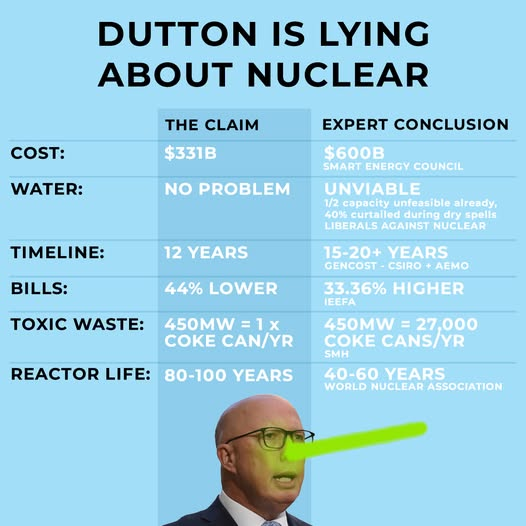
There’s a lot of information and disinformation out there on nuclear energy. These are my 10 reasons why nuclear energy would be a bad idea for Australia
By Arthur Wyns, University of Melbourne, https://pursuit.unimelb.edu.au/articles/10-reasons-why-nuclear-energy-is-a-bad-idea-for-australia 16 April 2025
As always seems to be the way, energy and climate policy is proving to be an area of contention between the major parties in Australia’s 2025 election.
One issue that’s provoked a lot of discussion and confusion is the Liberal-National Coalition’s proposal to build seven nuclear power plants across Australia.
It’s a controversial idea that’s opposed by Labor, the Greens, many independent MPs and some Liberal groups.
Both the Climate Change Authority and Australia’s Commonwealth Scientific and Industrial Research Organisation (CSIRO) concluded that the deployment of nuclear energy in Australia would significantly increase the country’s energy prices and cause us to miss our climate change targets.
1. Too expensive
It’s extremely expensive to build and operate nuclear power plants anywhere in the world. Independent analysis by the Institute for Energy Economics and Financial Analysis (IEEFA) found that building nuclear power in Australia could see average household electricity bills rise by $AUD665 a year.
Estimates by CSIRO and the Australian Energy Market Operator (AEMO) for the 2024-2025 GenCost Report also found renewables are the cheapest option for any new electricity generation.
2. Too slow
Even if we drop everything else and throw all our weight behind nuclear energy, it wouldn’t play a role in Australia’s energy grid for more than a decade.
It took an average of 11 years to build the nuclear reactors that came online around the world in 2023 – largely in countries with a well-established nuclear industry, like China.
In Australia, CSIRO estimates it would take at least 15 years before we’d reach the first nuclear generation.
3. Too risky
Nuclear accidents are rare but they have devastating consequences.
The Chernobyl disaster in 1986 and the Fukushima disaster in 2011 contaminated large areas and continue to impact the health of hundreds of thousands of people. Both disasters caused a rise in anti-nuclear sentiments in the Australian public.
They also led to the majority of German citizens supporting an end to nuclear power in the country, with the three last remaining nuclear power plants in Germany taken offline in 2023.
4. Hard to build
Nuclear power stations are huge and complicated infrastructure projects that almost never stay on schedule.
The UK’s Hinkley Point C nuclear plant construction is now running 14 years late and is costing three times more than it was estimated: a whopping $AUD90 billion.
Smaller nuclear power plants, known as Small Modular Reactors (SMRs), have been proposed as an alternative, but there are no known commercial SMRs operational anywhere in the world.
The only company to have a small modular nuclear power plant approved in the US has since cancelled its first project due to rising costs.
5. Produces nuclear waste
Once in operation, nuclear reactors continuously produce radioactive waste. Generally, this waste is buried underground, where it remains radioactive for thousands of years.
Australia already produces a relatively small amount of low-level radioactive waste for some medical and research activities.
However, Australia currently doesn’t have any waste storage facilities to process high-level radioactive waste that would be produced by nuclear reactors – and recent efforts to build the country’s first radioactive waste storage facility have failed.
6. Uses lots of water
Nuclear reactors need to be cooled constantly, which requires high volumes of water.
It might not make sense to switch to a water-intensive energy source in the driest inhabited continent in the world, which is already facing increasing droughts and extreme heat.
Even countries like France and Sweden – with dramatically cooler climates compared to Australia – are increasingly being forced to shut down their nuclear power plants during warm periods when their cooling water heats up.
This means they then have to import energy from neighbouring countries.
7. No energy security
Australia’s remaining coal-fired power stations are old and increasingly breaking down, with over 60 per cent of our coal-generating capacity now more than 40 years old.
Even in the most optimistic scenarios, nuclear power is unlikely to come online before 2040, by which time all of Australia’s coal plants will have retired, according to the National Electricity Market.
In other words, the timelines for a coal-to-nuclear transition don’t add up.
Extending the life of these ageing coal-power plants would mean spending billions to prop up coal rather than investing in updating the electricity grid and expanding more cost-effective and readily available forms of energy like renewables.
8. No expertise
While nuclear generation is well established in many countries, it has never been deployed in Australia.
We currently lack the trained workforce and technical capability required for building a large-scale nuclear reactor.
Any attempt to go nuclear would leave Australia reliant on foreign companies and expertise. This is something we’re seeing play out in building and maintaining the nuclear submarines Australia agreed to host as part of the AUKUS deal.
In comparison, the renewable energy industry already creates more than 25,000 local jobs in Australia and this is expected to grow.
9. We’ll miss our climate goals
While nuclear energy is a form of low-emissions energy in many countries with established pre-existing nuclear facilities, focusing on the development of new nuclear energy in Australia is a diversion from taking real climate action.
Australia’s Climate Change Authority (CCA) recently released a detailed analysis concluding that a nuclear pathway for Australia would result in an additional two billion tonnes of greenhouse gas emissions.
It would extend the use of some coal-fired generators, slow down the uptake of clean technologies, and obstruct existing national plans to deliver 82 per cent renewable electricity by 2030.
10. Illegal in Australia
In the late 1990s, the Australian Federal Government introduced several new laws banning nuclear energy, including the National Radiation and Nuclear Safety Act (1998).
This Act prohibited the development of any new nuclear power sites in Australia.
The Commonwealth Environment Protection and Biodiversity Conservation Act (1999) also introduced rules preventing the construction or operation of any facilities that generate nuclear power.
Building nuclear reactors is currently illegal in every Australian state and territory.
Ultimately, pursuing a lengthy, expensive and potentially harmful energy source is a misguided step for Australia, particularly when we have all the resources and potential to make us a renewable energy superpower.
Arthur Wyns is a research fellow at Melbourne Climate Futures, University of Melbourne. He has written widely on climate change and global health issues, and regularly advises national governments and UN agencies. In 2023-2024, Arthur was the senior health advisor to the government of the United Arab Emirates as the host of the COP28 UN climate conference. He was a climate change advisor to the World Health Organization during 2019-2023, where he represented WHO at the UN climate negotiations, authored several UN reports on climate change and health, and acted as WHO’s speechwriter on climate change. Arthur is an editor of the Journal of Climate and Health and sits on the editorial board of ClimaHealth, the knowledge platform of the WHO-WMO Joint Office for Climate and Health.
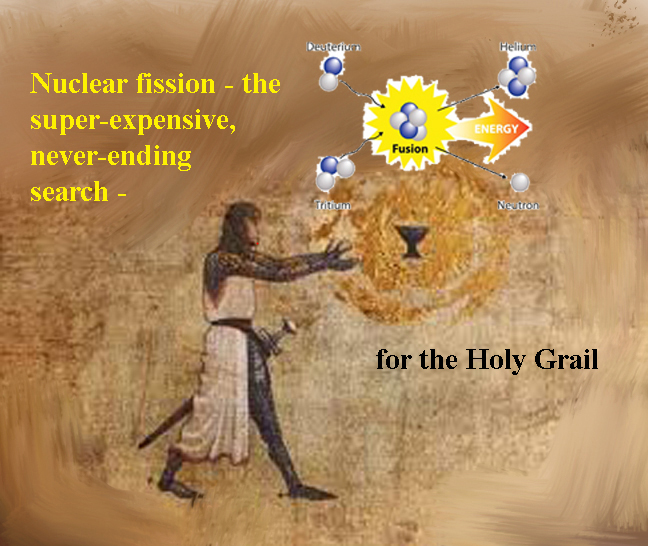
The Australian investors betting big on fusion – the “holy grail” of nuclear tech
ReNewEconomy, Rachel Williamson, Apr 17, 2025
One of Australia’s biggest super funds is backing nuclear tech – but not the kind being pitched by the federal Coalition.
Hostplus is investing in fusion energy.
CIO Sam Sicilia says a combination of tech advances in the last five years and a youthful member base means fusion is now a real option for big, patient investors…………………
Fusion power is the holy grail of energy technologies: it makes more energy than nuclear fission, produces less waste, doesn’t create anything that could be used in a weapon, and has zero risk of meltdown.
The truth is more complicated, not least because the longest ever sustained reaction was only achieved in January, when China’s “artificial sun” reactor in Heifei managed a whole 17 minutes. …………………..
And with almost half a billion dollars of funding sunk into the industry last year, the race is on for companies ranging from Commonwealth Fusion Systems – the MIT spinout that is leading so far and Hostplus’ investment pick – to Australian startup HB11………………………………………………………………………………
If this sounds ambitious for a technology that just five years ago was still wrestling with major functional problems, it isn’t to people in the industry – even in Australia.
Patrick Burr leads the student project to build a donut-shaped tokamak fusion reactor – just a little one – at University of New South Wales (UNSW). He also works with Australia’s only home-grown fusion company, HB11 Energy.
He says commercialisation of fusion energy is now an engineering problem that requires money and people…………………………………………………………………………..
Australia as a fusion power? Maybe
Matt Bungey is taking a bet that fusion energy will be ready for launch – in Australia – by the late 2030s.
Bungey is a partner at Western Australian venture fund Foxglove Capital and an investor in another fusion frontrunner, Type One, which recently set up an Australian subsidiary.
He believes fusion should be part of a diverse energy strategy even if by the late-2030s renewables and storage are the dominant generators.
But he does admit there is a deadline.
“There’s a timing element here, if you don’t get it right before the mid 2040s there’s a question of whether you really need it,” he says.
The other view is that Australia’s energy needs will scale in unimaginable ways as the demands of decarbonisation and AI require more electricity……………………………………………………………..
Today the global industry has attracted $US7 billion ($A11 billion) in funding, according to the FIA.
But even the $A130 billion Hostplus is merely dipping a toe in – its CFS investment is worth $US136 million.
Still, CFS CEO Bob Mumgaard says there is enough curiosity in the technology from within Australia to warrant a look here – even if nuclear power generally is still illegal. ……………………………………………………………………………………
Australia enters the chat, with HB11
Australia does have its own fusion startup in HB11. It is forging a technology path quite different to those pursued by CFS (a tokamak design) or Type One (a stellarator).
HB11 is using lasers and a proton-boron fuel, rather than the more common deuterium/tritium, deuterium/deuterium, or deuterium/helium3 combos.
“The key difference between what we’re doing and what most of the other private fusion companies are doing is we’re using [boron] which does not produce neutrons,” McKenzie says.
Boron is abundant and costs about a dollar a kilogram, and the method of firing a laser at small pellets to create an ongoing reaction doesn’t make the materials around them radioactive – more on this later.
McKenzie gently negs the tokamak and stellarator players, saying none have produced a net gain – more energy out than in – whereas laser fusion has, in December 2022 at the National Ignition Facility in California.
“The catch is it’s much harder to produce. Essentially we’ll need much bigger lasers [than we have now],” McKenzie says.
How big, you might ask?
Computer simulations suggest that, right now, they may need to be several football fields long and multiple storeys high. The National Ignition Factory’s laser is in a 10-story building about the size of three American football fields; China’s version in the southwest city Mianyang will be 50 per cent larger again, a size MxKenzie says “is about right”.
HB11 has a plan for its version of fusion to be widespread by the mid-2050s but it has a long way to go.
“When we achieve a neutronic hydrogen-boron fusion energy gain we’ll be on our way to Stockholm to pick up a Nobel prize,” McKenzie says.
Is it illegal or not?
Australia’s ban on nuclear fission technology for energy might apply to fusion – but also might not.
Experts spoken to by Renew Economy say there isn’t much interest within federal government to revisit nuclear rules and carve out a new area for fusion, somewhere between legal nuclear medicine and illegal fission.
But the UK and USare showing how fusion might be introduced, without dumping it in with fission.
Both countries say they won’t regulate fusion technology like fission, but instead treat the new reactors more like a particle accelerator.
That’s a framework that advocates like Bungey are pinning their hopes on, given almost every major hospital in Australia houses a particle accelerator to make nuclear medicines. These are controlled by the Australian Radiation Protection and Nuclear Safety Agency (ARPANSA) as well as a suite of other regulators.
McKenzie says the deuterium-tritium fuel might be difficult for nations to support, given both are fuels used in nuclear weapons, but generally fusion should not be affected by national bans on fission energy.
“My legal understanding is that it will not come under Australia’s nuclear ban. But yes … what the rest of the world is doing, fusion is a relatively new field with no regulations,” he says.
“The US and the UK very recently passed legislation where the nuclear fission and fusion regulators are different and they require different standards, so you’re starting to separate the two technologies and that makes a big difference.”
But it’s Italy that might be the most appropriate model for Australia because it’s coming from a total ban on nuclear energy as well, Mumgaard says.
But Italy is also un-banning fission technology after a 40-year hiatus, producing a draft law in March to set up both fission and fusion technologies.
Pros and cons
Fusion is now such a small sector in Australia that it’s hard to find one person who isn’t connected to one of the local or global companies competing to be first, cheapest, or most realistic.
UNSW’s Patrick Burr is involved with HB11 but happy to also cut through the marketing speak. Every technology, as Burr says, has its drawbacks.
The main problem today is talent. Burr says companies are already cannibalising each other’s staff, from fusion engineers, scientists, down to people in the supply chain, and educating new talent was one reason why UNSW launched the student-led tokamak project.
But there are some practical problems as well which are high on the ‘to solve’ list of the engineers.
One of the first dot points on any ‘why fusion is better’ powerpoint slide is the tiny amount of waste it produces from a reaction.
But this is misleading. The irradiated waste of a fusion plant is the whole internal structure, albeit with a hundreds of years half life instead of a thousands of years half life.
Dealing with concrete or equipment that is toxic for hundreds of years is manageable for a society, Burr says. The challenge will be figuring out how to handle the higher volumes of radioactive material.
Another drawback is the source of fuel.
The most common fuel pairing is deuterium and tritium – the former is abundant in nature, the latter is not and has a short half life. Other fuels have their own challenges, such as HB11’s boron-hydrogen method, which right now requires giant lasers to activate.
Taking a position on nuclear energy in a country like Australia, where it doesn’t exist outside the medical sector, is a bet on the distant future.
For Burr, it’s a question on whether Australia will have won the fight with hard-to-decarbonise sectors in 50 or 100 years’ time. And whether the country wants to make a bet today on a technology that may – or may not – be that solution. https://reneweconomy.com.au/the-australian-investors-betting-big-on-fusion-the-holy-grail-of-nuclear-tech/
1 This month
7 April – WEBINAR – Australia and the Doomsday Clock – Preventing nuclear war through NoFirstUse and other policies
Online | Tuesday April 7, 4:00-5:30pm, Australian Eastern Time / 8:00-9:30am Central Europe Time
– Access the registration link
15 April – Zoom –Nuclear Power is Not the Solution
Apr 15, 2026 01:00 AM in Canberra, Melbourne, Sydney

Join the International Physicians for the Prevention of Nuclear War (IPPNW) on Tuesday, April 14th for a timely webinar exploring the risks associated with nuclear power and challenging the myth that it offers a simple, safe, carbon-free solution to the climate crisis

21 April Webinar: No Nuclear Weapons in Australia
Start: 2026-04-21 18:00:00 UTC Canberra, Melbourne, Sydney (GMT+10:00)
End: 2026-04-21 19:30:00 UTC Canberra, Melbourne, Sydney (GMT+10:00)
Event Type: Virtual
A virtual link will be communicated before the event.
Host Contact Info: australia@icanw.org

of the week – Australians for War Powers Reform (AWPR)
To see nuclear-related stories in greater depth and intensity
 Antinuclear