Kevin Rudd on the ‘decisive decade’ between USA and China
Are we in the middle of Cold War 2.0? | The Bottom Line, 24 Feb 2022 Within years, China will overtake the United States as the world’s number one economy, and China’s influence is spreading worldwide – mostly at the expense of US global leadership. Former Australian Prime Minister Kevin Rudd tells host Steve Clemons that this is the “decisive decade” in relations between the two powers. Either they find a way to share wealth and power, or they head down a collision course.
But with today’s political climates in the West and East – where politicians are rewarded for nationalistic tough-talk and zero compromise – is there hope for better relations between Beijing and Washington?
Australia’s Defence Department silent about its slippery dealings using tax-payers’ money, involving Russian contractors

With very little disclosure, the contract was awarded to Vertical Australia, a company newly minted as the local agent for a Russian company, Air Company Vertical-T. The services would include the use of a Russian Mil Mi-26, the largest and most powerful helicopter ever produced.
And now the Australian partners, Michael West Media and CrikeyINQ have found a disturbing story about the Australian Defence Force and a web of intrigue involving contracts that include Russian contractors and what appears to be money laundering using Australian taxpayers money…………………
Operation Slippery: Russian aviation magnate diverts Australian Defence profits to tax havens, Michael West Media By Michael West|, December 4, 2019 Australia’s Department of Defence is keeping silent. Yet it has serious questions to answer over its dealings with an elusive Russian aviation tycoon, an American mercenary outfit and a money trail which winds from Canberra to the Seychelles via Cyprus. Thanks to the #29Leaks data leak unveiled today in a global collaboration of investigative journalists by the Organised Crime and Corruption Reporting Project, Michael West Media and Crikey INQ raise serious questions about how the Government is spending our taxes. Kim Prince, Suzanne Smith and Michael West report.
In late 2010, a Department of Defence tender was issued for cargo helicopters to support Australia’s war effort in Afghanistan. At the time, Operation Slipper was in full swing, an operation notable for the first deaths of Australian soldiers in battle since the Vietnam War: 41 soldiers died and 261 were wounded fighting jihadist groups during the operation which began in October 2001 and ended in 2014.
With very little disclosure, the contract was awarded to Vertical Australia, a company newly minted as the local agent for a Russian company, Air Company Vertical-T. The services would include the use of a Russian Mil Mi-26, the largest and most powerful helicopter ever produced.
The businessman behind Vertical Australia was a Russian aviation entrepreneur, Vladimir Skurikhin, who is connected to a slew of companies and partnerships around the world, from Cyprus to the Seychelles to the City of London. His deal with Australia’s Defence Department appears to involve leasing high-tech helicopters replete with pilots and crew.
On the face of it, the defence contract proceeded unremarkably; with the exception of a minor dispute that found its way to the NSW Supreme Court. The dispute was not between the Australian Defence Force (ADF) and its supplier Vertical Australia, but within the supplier’s own payment chain, which included a mysterious entity in Cyprus, a banking haven for Russian oligarchs.
Vladimir Skurikhin, the General Director of Vertical-T, would later attest that the complex chain was in place due to a mistaken belief that Australian companies were forbidden from making payments directly to Russia.
The upshot of the dispute was twofold. Firstly, Vertical Australia paid more than $2.3 million into the Supreme Court of NSW, leaving the court to decide to whom it should be remitted. Should it be paid directly to the Russian supplier Vertical-T, or to its erstwhile intermediary, Wellman Limited of Cyprus? On this score, the court would ultimately rule in favour of Vladimir Skurikhin’s military contracting company Vertical-T.
The second effect was that DynCorp Australia was appointed as Vertical-T’s new agent, and Vertical Australia folded. DynCorp, part of the controversial US defence contractor DynCorp International, had been trying to get a foothold in Australia for eight years. Its parent, DynCorp International, which is owned by a New York private equity firm Cerberus Capital, has been embroiled in a suite of scandals including corruption allegations over US military contracts in Iraq and sex-trafficking in Bosnia. It has been labelled a “mini-Blackwater”, a reference to its history of providing mercenary services.
All of this was water under the bridge until October this year, when Michael West Media and Crikey INQ were invited to participate in a cross-border investigation. The Sarajevo-based Organised Crime and Corruption Reporting Project (OCCRP) had received a massive leak of data from UK-based Formations House. It would require an international team of investigative journalists to extract maximum advantage from it.
Formations House
Formations House is a company formation agent, sometimes referred to as a shell company factory. They offer a range of services for creating and operating corporate entities in a number of countries including offshore secrecy jurisdictions, aka tax havens, such as the British Virgin Isles and the Seychelles.
Although legitimate companies use the services of Formations House too, many others enlist it to hide their murky deals, to avoid tax and inspection from financial regulators. Part of the lure for business people keen to hide things is the prestigious address, — number 29 Harley Street in London. Besides the offer of an upmarket address, Formations House provides a local phone number, a bank account, and preparation of annual accounts and company filings. For those seeking a business façade and a degree of anonymity, this is a one-stop-shop.
Although legitimate companies use the services of Formations House too, many others enlist it to hide their murky deals, to avoid tax and inspection from financial regulators. Part of the lure for business people keen to hide things is the prestigious address, — number 29 Harley Street in London. Besides the offer of an upmarket address, Formations House provides a local phone number, a bank account, and preparation of annual accounts and company filings. For those seeking a business façade and a degree of anonymity, this is a one-stop-shop……………..
And now the Australian partners, Michael West Media and CrikeyINQ have found a disturbing story about the Australian Defence Force and a web of intrigue involving contracts that include Russian contractors and what appears to be money laundering using Australian taxpayers money…………………
STS Corporation and the MH17 disaster
Deep in the Formations House leak is a UK-based company, STS Corporation. Its bank statements show tranches of cash arriving from various countries including Afghanistan, Russia and Australia. There are also frequent outbound transfers from STS to entities in tax havens where, in many cases, the real beneficiaries of the money are simply unknowable……………
Defence Department refuses to respond
Questions were put to the Department of Defence about its knowledge of the beneficiaries of the Vertical Australia contract payments and the money trail through tax havens. No answer has been forthcoming, including answers to questions about money-laundering and the flow of Australian taxpayer dollars to Russian interests in tax havens. …………………….
Contacted for this story, Centre Alliance senator Rex Patrick said the intrigue surrounding the Skurikhin transactions reflected the urgent need for greater transparency in Defence and in the way the Federal Government went about its procurement…………….
“I will be making further inquiries in the Parliament in relation to this procurement. Part of the solution to this is my ‘Tax Transparency in Procurement and Grants” bill which requires companies to disclose their structure, particularly in respect of related entities domiciled in tax havens, as they tender for work.”
The Seychelles Connection……………..
The rise of DynCorp
On the Australian front, the Formations House leak includes an agreement, signed by a former director of DynCorp Australia, in which STS is to act as agent for DynCorp Australia, representing the company in business dealings in Europe and the Middle East.
On its website, DynCorp says it “…sustains and improves the ADF’s operational capabilities through logistic support, facilities maintenance, and project management services”. So what products or services would this defence contractor, who is presumably entirely dependent on the public purse, have to export via its agent? We attempted to contact the Dyncorp director, and later put this question to an associate, but at the time of publication there had been no response. …………………….
Spectre of money-laundering through Australian courts
So, what are two companies controlled by a Russian tycoon doing soaking up the resources of Australia’s court system in a dispute and why would the payments be described as refunds on legal fees?
Around the time in question, sham litigation had become a popular tool for money launderers. ………………………https://www.michaelwest.com.au/operation-slippery-russian-aviation-magnate-diverts-australian-defence-profits-to-tax-havens/
Perth could be the first city in the world to be nuclear bombed, in the (unlikely)event of Putin deciding on a show of nuclear strebgth
 | |||

Frightening graphic reveals the horrific carnage a nuclear bomb would cause in Australia’s biggest cities – as Vladimir Putin’s nuclear sabre-rattling sparks global fears
- President Putin has put his military on ‘nuclear alert’ over war in Ukraine
- Such an attack would cause mass devastation and prove a point to the west
- However experts say it’s highly unlikely Putin will want to start a nuclear war
By KEVIN AIRS FOR DAILY MAIL AUSTRALIA, 3 Msr 22, A devastating Russian nuclear missile nicknamed ‘Satan’ could flatten every major Australian city if it’s unleashed in the very unlikely event of all-out nuclear war, experts have warned…………………………….
Curtin University nuclear expert Victor Abramowicz …..
‘Using battlefield nuclear weapons would be an unmitigated disaster for Ukraine, but you’d need multiple steps for that to lead to missiles flying at Washington and Moscow”. ‘
Bizarrely though, Perth in Western Australia could be the first place in the world to be targeted if Putin tries to prove a point and frighten the west into thinking a bigger city could be on the cards next.
NATO generals have war-gamed various situations to pinpoint where Russia may target if it was ever to lash out in a bid to get the West to buckle to its demands.
And bombing Perth – because of its remoteness from nearby civilisation – emerged as a terrifying possibility.
They feared Russia may nuke Perth as a show of power and determination while still avoiding engaging the US in mutually-assured nuclear Armageddon.
Despite potentially killing up to half a million in the nuclear bombing, future effects would be limited, with the radiation fallout confined to the vast desert outback. …………
If Perth was specifically targeted by one of the Satan missiles, the effects would be devastating
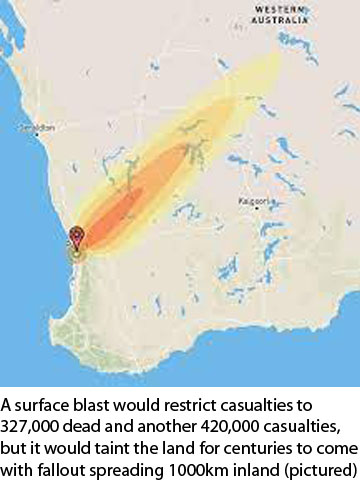
If the Satan warheads explode in a 10MT airburst over Perth, modelling by Nukemap predicts 505,000 fatalities instantly, with another 575,000 injured.
A surface blast would restrict casualties to 327,000 dead and another 420,000 casualties, but it would taint the land for centuries to come with fallout spreading 1000km inland…………….. https://www.dailymail.co.uk/news/article-10562917/Russia-Ukraine-war-happen-nuclear-bomb-dropped-Australia.html
A nuclear bomb on Sydney would mean umimaginable carnage
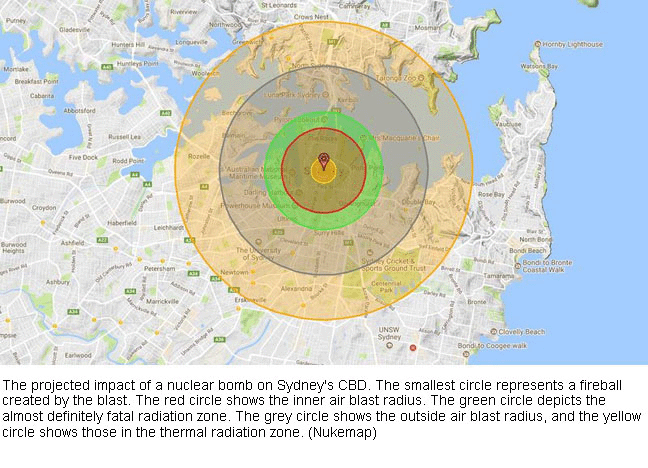
Frightening graphic reveals the horrific carnage a nuclear bomb would cause in Australia’s biggest cities – as Vladimir Putin’s nuclear sabre-rattling sparks global fears, By KEVIN AIRS FOR DAILY MAIL AUSTRALIA, 3 Mar 22, ”……………………But if the attack was to target Sydney or Melbourne, the carnage would be almost unimaginable.
Almost a million would die instantly in a 5km fireball which would engulf Sydney city centre, turning the inner-west, CBD and Eastern Suburbs to ash.
Buildings would be crushed to dust from Homebush to Collaroy to Cronulla.
If the airburst happened over Parramatta, the devastation would be even greater. The entire greater Sydney area from Penrith to Richmond to Palm Beach to Camden and the Royal National Park would be ablaze.
Anyone in the city left alive after the nuclear fireball and initial blast would be suffering third degree radiation burns all over their body, with many losing limbs.
The only saving grace might be that all their nerve-endings would probably be burnt away and they’d feel little to no pain.
Further out and windows in the Illawarra and Central Coast would be blown out by the blast, inflicting maiming injuries on locals, many of whom would be standing by a window to watch the distant explosion.
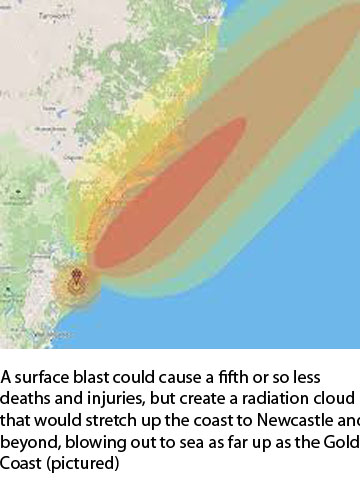
A surface blast could cause a fifth or so fewer deaths and injuries, but create a radiation cloud that would stretch up the coast to Newcastle and beyond, blowing out to sea as far up as the Gold Coast.
‘There’s no doubt that any large-scale nuclear weapons use would be quite catastrophic,’ Australian National University Professor Stephan Fruehling told the I’ve Got News For You podcast.
If you have a nuclear weapon that’s exploded on the ground, you’re looking at a very significant fallout plume and local contamination, which is essentially dangerous because of the radiotoxicity and contaminating water supplies and food chains.’

In Melbourne, a similar airburst explosion would instantly destroy everywhere around the CBD including Docklands, South and East Melbourne and Carlton in a deadly fireball.
More than 900,000 would die in a blink of an eye with another 1.3 million injured.
Everything from Sunshine West to Box Hill and north to Broadmeadows would be flattened in a 30km-wide blast range.
Everyone from Orangefields to Boronia to Whalan would be burnt to a crisp, with windows blown out and property damaged 85km from the epicentre, stretching from Frankston to Bacchus Marsh to Wallan.
A surface explosion would reduce the death total by a couple of hundred thousand, but the radiation cloud would stretch across Victoria, over Albany and Canberra and reach Sydney and Newcastle…………… https://www.dailymail.co.uk/news/article-10562917/Russia-Ukraine-war-happen-nuclear-bomb-dropped-Australia.html
While Scott Morrison froths against Putin, Australia rushes to become a top weapons seller to the world

Australian leaders would sound less hypocritical and less vulnerable to criticism if they displayed a consistent interest in in peace, in social justice, in principles of non-violence and were enthusiastic champions of universal human rights.
To challenge Putin avoid Australian aggression https://johnmenadue.com/to-challenge-putin-avoid-australian-aggression/ By Stuart Rees, Mar 2, 2022 Australia’s determination to become the 10th most successful (up from 20th) manufacturer and exporter of arms adds ammunition to the argument that we have no explicit policy for peace.
Scott Morrison frothing about Putin can be replaced by some acknowledgement of our part in a world order gone wrong.
In response to Russia’s invasion of Ukraine, the Australian Prime Minister fumes about aggression that will not be allowed and the raft of government sanctions that will be imposed. In defence of democracy, he says, Australia’s sanctions policy is in lock step with other peace living nations, but there’s something bogus with these claims.
If your country has been a consistent and enthusiastic champion of peace, of non violence and of principles of world order nurtured by respect for human rights, then it would be plausible to challenge chronic abusers of international law. But television images of Scott Morrison frothing about the new iron curtain encircling Ukraine, would look more convincing against a backdrop of radical changes in Australia’s domestic and foreign policies.
A start could easily be made by adopting the Uluru statement and giving Indigenous people due recognition in the constitution. A genuine effort to repudiate the past and build a new future.
That initiative needs to be followed immediately by ceasing our unfathomably evil conduct towards asylum seekers and the special sadism reserved to reject refugees’ appeals to be reunited with their families. The trifecta in these cruelty stakes concerns the political bullies’ brave determination to prevent the Sri Lankan family and their little girls from returning to Bilolea.
Continue readingResidents facing eighteenth once-in-a-hundred year event since last January
Residents facing eighteenth once-in-a-hundred year event since last January – satire
The Shovel
Politicians and media have labelled the devastating floods in Queensland and NSW a once-in-one-hundred year natural disaster, the eighteenth once-in-one-hundred year natural disaster in the past year.
“A misinformation ecosystem:” Scott Morrison’s climate ads given Public Disservice Award — RenewEconomy

The Morrison government’s ‘Making Positive Energy’ ad campaign labelled ‘disinformation’, after receiving ‘Public Disservice Award’. The post “A misinformation ecosystem:” Scott Morrison’s climate ads given Public Disservice Award appeared first on RenewEconomy.
“A misinformation ecosystem:” Scott Morrison’s climate ads given Public Disservice Award — RenewEconomy
Ukraine war – a great opportunity Each new NATO country was a new customer for the weapons industry
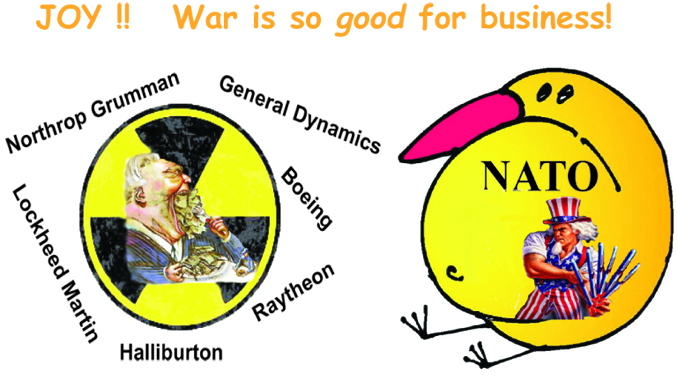
“Lockheed began looking at Poland right after the wall came down,” veteran salesman Dick Pawlowski recalled. “There were contractors flooding through all those countries.” Arms makers became the most aggressive lobbyists for NATO expansion. The security umbrella was not simply a formidable alliance but also a tantalizing market.
New alliance members meant new clients. And NATO would literally require them to buy Western military equipment.
Arms Industry Sees Ukraine Conflict as an Opportunity, Not a Crisis, Jonathan Ng, Truthout , 2 Mar 22,In February, a photograph of Russian President Vladimir Putin sitting hunched over a 13-foot table with French President Emmanuel Macron circulated the globe. News about their sprawling table and sumptuous seven-course dinner was reminiscent of a Lewis Carroll story. But their meeting was deadly serious. Macron arrived to discuss the escalating crisis in Ukraine and threat of war. Ultimately, their talk foundered over expansion of the North Atlantic Treaty Organization (NATO)
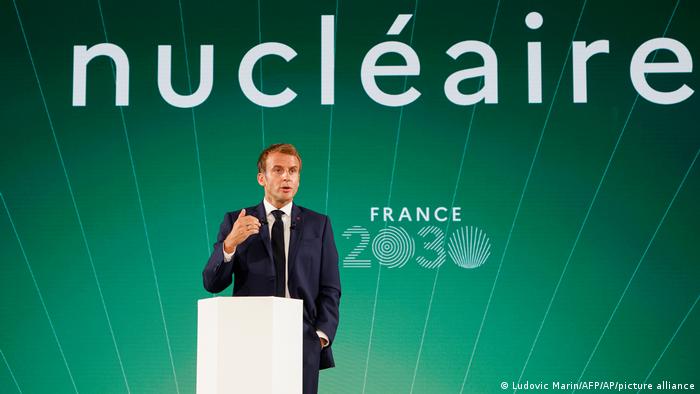
Yet the meeting was surreal for another reason. Over the past year, Macron, the leading European Union (EU) peace negotiator, has led an ambitious arms sales campaign, exploiting tensions to strengthen French commerce. The trade press even reported that he hoped to sell Rafale fighter jets to Ukraine, breaking into the “former bastion of Russian industry.”
Macron is not alone. NATO contractors openly embrace the crisis in Ukraine as sound business. In January, Raytheon CEO Greg Hayes cited “tensions in Europe” as an opportunity, saying, “I fully expect we’re going to see some benefit.” Likewise, CEO Jim Taiclet of Lockheed Martin highlighted the benefits of “great power competition” in Europe to shareholders.
On February 24, Russia invaded Ukraine, pounding cities with ordnance and dispatching troops across the border. The sonic boom of fighter jets filled the air, as civilians flooded the highways in Kyiv, attempting to flee the capital. And the stock value of arms makers soared.
The spiraling conflict over Ukraine dramatizes the power of militarism and the influence of defense contractors. A ruthless drive for markets — intertwined with imperialism — has propelled NATO expansion, while inflaming wars from Eastern Europe to Yemen.
Selling NATO
The current conflict with Russia began in the wake of the Cold War. Declining military spending throttled the arms industry in the United States and other NATO countries. In 1993, Deputy Secretary of Defense William Perry convened a solemn meeting with executives. Insiders called it the “Last Supper.” In an atmosphere heavy with misapprehension, Perry informed his guests that impending blows to the U.S. military budget called for industry consolidation. A frantic wave of mergers and takeovers followed, as Lockheed, Northrop, Boeing and Raytheon acquired new muscle and smaller firms expired amid postwar scarcity.
While domestic demand shrunk, defense contractors rushed to secure new foreign markets. In particular, they set their sights on the former Soviet bloc, regarding Eastern Europe as a new frontier for accumulation. “Lockheed began looking at Poland right after the wall came down,” veteran salesman Dick Pawlowski recalled. “There were contractors flooding through all those countries.” Arms makers became the most aggressive lobbyists for NATO expansion. The security umbrella was not simply a formidable alliance but also a tantalizing market.
However, lobbyists faced a major obstacle. In 1990, Secretary of State James Baker had promised Soviet leader Mikhail Gorbachev that if he allowed a reunited Germany to join NATO, the organization would move “not one inch eastward.” Yet lobbyists remained hopeful. The Soviet Union had since disintegrated, Cold War triumphalism prevailed, and vested interests now pushed for expansion. “Arms Makers See Bonanza In Selling NATO Expansion,” The New York Times reported in 1997. The newspaper later noted that, “Expansion of the North Atlantic Treaty Organization — first to Poland, Hungary and the Czech Republic and then possibly to more than a dozen other countries — would offer arms makers a new and hugely lucrative market.”
New alliance members meant new clients. And NATO would literally require them to buy Western military equipment.
Lobbyists poured into Washington, D.C. fêting legislators in royal style. Vice President Bruce Jackson of Lockheed became the president of the advocacy organization U.S. Committee to Expand NATO. Jackson recounted the extravagant meals that he hosted at the mansion of the Republican luminary Julie Finley, which boasted “an endless wine cellar.”
“Educating the Senate about NATO was our chief mission,” he informed journalist Andrew Cockburn. “We’d have four or five senators over every night, and we’d drink Julie’s wine.”
Lobby pressure was relentless. “The most interested corporations are the defense corporations, because they have a direct interest in the issue,” Romanian Ambassador Mircea Geoană observed. Bell Helicopter, Lockheed Martin, and other firms even funded Romania’s lobbying machine during its bid for NATO membership……………… https://truthout.org/articles/arms-industry-sees-ukraine-conflict-as-an-opportunity-not-a-crisis/?eType=EmailBlastContent&eId=734c56bc-48da-4e66-bea1-f2bedb7d1431
The very perilous situation of Ukraine’s nuclear power stations.
Could the Ukraine conflict cause one of the world’s worst nuclear disasters?
ReNew Economy, Dr. Jim Green 3 March 2022
Over the past week the Russian military has taken control of the Chernobyl nuclear site in Ukraine and there have been two near-misses with military attacks threatening radioactive waste sites.
But the greatest nuclear hazards lie ahead and concern Ukraine’s operating nuclear power reactors. International Atomic Energy Agency (IAEA) Director General Rafael Mariano Grossi said on March 2:
“The situation in Ukraine is unprecedented and I continue to be gravely concerned. It is the first time a military conflict is happening amidst the facilities of a large, established nuclear power program.
“I have called for restraint from all measures or actions that could jeopardise the security of nuclear and other radioactive material, and the safe operation of any nuclear facilities in Ukraine, because any such incident could have severe consequences, aggravating human suffering and causing environmental harm.”
Grossi cited a 2009 decision by the IAEA General Conference that affirmed that “any armed attack on and threat against nuclear facilities devoted to peaceful purposes constitutes a violation of the principles of the United Nations Charter, international law and the Statute of the Agency.”
Over the past week the Russian military has taken control of the Chernobyl nuclear site in Ukraine and there have been two near-misses with military attacks threatening radioactive waste sites.
But the greatest nuclear hazards lie ahead and concern Ukraine’s operating nuclear power reactors. International Atomic Energy Agency (IAEA) Director General Rafael Mariano Grossi said on March 2:
“The situation in Ukraine is unprecedented and I continue to be gravely concerned. It is the first time a military conflict is happening amidst the facilities of a large, established nuclear power program.
“I have called for restraint from all measures or actions that could jeopardise the security of nuclear and other radioactive material, and the safe operation of any nuclear facilities in Ukraine, because any such incident could have severe consequences, aggravating human suffering and causing environmental harm.”
Grossi cited a 2009 decision by the IAEA General Conference that affirmed that “any armed attack on and threat against nuclear facilities devoted to peaceful purposes constitutes a violation of the principles of the United Nations Charter, international law and the Statute of the Agency.”
Worst-case scenario
It’s worthwhile comparing a worst-case scenario with the current situation in Ukraine. A worst-case scenario would involve war between two (or more) even-matched nations with a heavy reliance on nuclear power. War would drag on for years between evenly-matched nations. The heavy reliance on nuclear power would make it difficult or impossible to shut down power reactors.
Sooner or later, a deliberate or accidental military strike would likely hit a reactor – or the reactor’s essential power and cooling water supply would be disrupted. Any ‘gentleman’s agreement’ not to strike nuclear power plants would be voided and multiple Chernobyl- or Fukushima-scale disasters could unfold concurrently – in addition to all the non-nuclear horrors of war.
In the current conflict, the nations are not evenly matched and the fighting is limited to one country. There won’t be large-scale warfare dragging on for years – although low-level conflict might persist for years, as has been the case since Russia’s 2014 invasion of eastern Ukraine and Crimea.
Ukraine does share one component of a worst-case scenario: its heavy reliance on nuclear power. Fifteen reactors at four sites generate 51.2 percent of the country’s electricity. It is one of only three countries reliant on nuclear power for more than half of its electricity supply.
A March 1 IAEA update, citing the State Nuclear Regulatory Inspectorate of Ukraine (SNRIU), said that all 15 reactors remained under the Ukrainian control and they continued to operate.
But in its daily post dated March 1, SNRIU lists six reactors as ‘disconnected from the power grid’, comprising three reactors at Zaporizhzhia and one each at the Rivno, Khmelnitsky and South Ukrainian nuclear power plants. Those disconnections amount to about 20 per cent of Ukraine’s total national electricity generation.
In the weeks prior to the February 24 invasion, 0-3 reactors were disconnected. The number rose to five on February 26 and has remained at six since then. It seems likely that the invasion has resulted in decisions to disconnect a number of reactors. Ukraine’s nuclear utility Energoatom cites “operational safety” for the disconnection of two reactors at Zaporizhzhia.
Even before the Russian invasion, Ukraine’s reactor fleet was ageing, its nuclear industry was corrupt, regulation was inadequate, and nuclear security measures left much room for improvement. For the time being, it is highly unlikely there will be any meaningful national or international oversight or regulation of the country’s ageing reactors and other nuclear facilities.
Deliberate or accidental military strikes on nuclear plants
A deliberate military strike on a power reactor is highly unlikely – but not inconceivable. Bennett Ramberg, a former foreign affairs officer in the US State Department’s Bureau of Political-Military Affairs, and author of the 1985 book Nuclear Power Plants as Weapons for the Enemy, draws this comparison:
Over the past week the Russian military has taken control of the Chernobyl nuclear site in Ukraine and there have been two near-misses with military attacks threatening radioactive waste sites.
But the greatest nuclear hazards lie ahead and concern Ukraine’s operating nuclear power reactors. International Atomic Energy Agency (IAEA) Director General Rafael Mariano Grossi said on March 2:
“The situation in Ukraine is unprecedented and I continue to be gravely concerned. It is the first time a military conflict is happening amidst the facilities of a large, established nuclear power program.
“I have called for restraint from all measures or actions that could jeopardise the security of nuclear and other radioactive material, and the safe operation of any nuclear facilities in Ukraine, because any such incident could have severe consequences, aggravating human suffering and causing environmental harm.”
Grossi cited a 2009 decision by the IAEA General Conference that affirmed that “any armed attack on and threat against nuclear facilities devoted to peaceful purposes constitutes a violation of the principles of the United Nations Charter, international law and the Statute of the Agency.”
It’s worthwhile comparing a worst-case scenario with the current situation in Ukraine. A worst-case scenario would involve war between two (or more) even-matched nations with a heavy reliance on nuclear power. War would drag on for years between evenly-matched nations. The heavy reliance on nuclear power would make it difficult or impossible to shut down power reactors.
Sooner or later, a deliberate or accidental military strike would likely hit a reactor – or the reactor’s essential power and cooling water supply would be disrupted. Any ‘gentleman’s agreement’ not to strike nuclear power plants would be voided and multiple Chernobyl- or Fukushima-scale disasters could unfold concurrently – in addition to all the non-nuclear horrors of war.
In the current conflict, the nations are not evenly matched and the fighting is limited to one country. There won’t be large-scale warfare dragging on for years – although low-level conflict might persist for years, as has been the case since Russia’s 2014 invasion of eastern Ukraine and Crimea.
Ukraine does share one component of a worst-case scenario: its heavy reliance on nuclear power. Fifteen reactors at four sites generate 51.2 percent of the country’s electricity. It is one of only three countries reliant on nuclear power for more than half of its electricity supply.
A March 1 IAEA update, citing the State Nuclear Regulatory Inspectorate of Ukraine (SNRIU), said that all 15 reactors remained under the Ukrainian control and they continued to operate.
But in its daily post dated March 1, SNRIU lists six reactors as ‘disconnected from the power grid’, comprising three reactors at Zaporizhzhia and one each at the Rivno, Khmelnitsky and South Ukrainian nuclear power plants. Those disconnections amount to about 20 per cent of Ukraine’s total national electricity generation.
In the weeks prior to the February 24 invasion, 0-3 reactors were disconnected. The number rose to five on February 26 and has remained at six since then. It seems likely that the invasion has resulted in decisions to disconnect a number of reactors. Ukraine’s nuclear utility Energoatom cites “operational safety” for the disconnection of two reactors at Zaporizhzhia.
Even before the Russian invasion, Ukraine’s reactor fleet was ageing, its nuclear industry was corrupt, regulation was inadequate, and nuclear security measures left much room for improvement. For the time being, it is highly unlikely there will be any meaningful national or international oversight or regulation of the country’s ageing reactors and other nuclear facilities.
Deliberate or accidental military strikes on nuclear plants
A deliberate military strike on a power reactor is highly unlikely – but not inconceivable. Bennett Ramberg, a former foreign affairs officer in the US State Department’s Bureau of Political-Military Affairs, and author of the 1985 book Nuclear Power Plants as Weapons for the Enemy, draws this comparison:
“A case in point was the March 26, 2017, bombing of the Islamic State-held Tabqa Dam in Syria. Standing 18 stories high and holding back a 25-mile-long reservoir on the Euphrates River, the dam’s destruction would have drowned tens of thousands of innocent people downstream. Yet, violating strict “no-strike” orders and bypassing safeguards, US airmen struck it anyway. Dumb luck saved the day again: the bunker-busting bomb failed to detonate.”
An accidental strike is a troubling possibility. Or a strike disabling the vital power and cooling water supply systems which are necessary to maintain safety even after reactors are shut down.
Spent fuel cooling ponds and dry stores are vulnerable – they often contain more radioactivity than the reactors themselves, but without the multiple engineered layers of containment that reactors typically have.
And if there is an attack on a reactor or spent fuel store resulting in disaster, response measures would likely be chaotic and woefully inadequate. Forbes senior contributor Craig Hooper writes:
“It seems unlikely that Russia has mobilised trained reactor operators and prepared reactor crisis-management teams to take over any ‘liberated’ power plants. The heroic measures that kept the Chernobyl nuclear accident and Japan’s Fukushima nuclear disaster from becoming far more damaging events just will not happen in a war zone.”
Zaporizhzhia nuclear power plant
The Zaporizhzhia nuclear plant is home to six reactors and lies near one of Russia’s main invasion routes, north of Crimea. As noted above, three of the six reactors have been disconnected in recent days.
The plant was contentious long before the recent invasion due to mismanagement and the ageing of the Soviet-era reactors. A 2017 Austrian government assessment of Zaporizhzhia concluded that: “The documents provided and available lead to the conclusion that a high probability exists for accident scenarios to develop into a severe accident that threatens the integrity of the containment and results in a large release.”………………………………
Staffing
A single-reactor nuclear power plant typically employs 600-800 people. Presumably the workforce at the six-reactor Zaporizhzhia plant is considerably higher.
If not already, nuclear staff are likely to be killed when not at work, and others will flee and get as far away from the fighting – and the nuclear power plant – as they can.
If Russia’s military takes control of the site – and does so without causing a nuclear disaster – they could repeat what they have done at Chernobyl in recent days: keep Ukrainian staff hostage and force them to work under Russian control……………
The adequacy of backup generators at Zaporizhzhia has long been a concern as detailed in a March 2 Greenpeace International report. In 2020, the Ukrainian NGO EcoAction received information from nuclear industry whistleblowers about problems with the generators at Zaporizhzhia, including a lack of spare parts.
In the same year, the regulator SNRIU reported on a generator malfunction. An upgrade of the generators was due to be complete by 2017 but the completion date has been pushed back to 2023, i.e. it remains incomplete.
Security at Zaporizhzhia was jeopardised in 2014 when an armed confrontation took place between security guards and paramilitaries from Ukraine’s ultra-nationalist ‘right sector’, allied with neo-Nazi groups. The gunmen wanted to ‘protect’ the plant from pro-Russian forces, the Guardian reported, but were stopped by guards at a checkpoint.
The head of SNRIU said in 2015: “I cannot say what could be done to completely protect [nuclear] installations from attack, except to build them on Mars.”
International monitors
Energoatom CEO Petro Kotin called on international monitors to intervene to ensure the safety of the country’s nuclear reactors and to create 30km exclusion zones around the four nuclear power plants.
Energoatom noted in a statement that columns of military equipment have been moving near nuclear power plants with “shells exploding near the nuclear power plant – this can lead to highly undesirable threats across the planet”.
The Acting Chief State Inspector of SNRIU has asked the IAEA to provide immediate assistance in coordinating activities in relation to the safety of nuclear facilities. The IAEA noted that Director General Grossi “will be holding consultations and maintain contacts in order to address this request”.
But the request for assistance in establishing an exclusion zone has been rejected by the IAEA. “The IAEA has no power to enforce an exclusion zone,” Grossi said following an emergency IAEA session on March 2………………………
Nuclear waste
The report by Greenpeace International nuclear specialists notes that as of 2017, Zaporizhzhia had 2,204 tons of spent fuel in storage at the site – 855 tonnes in the spent fuel pools within the reactor buildings, and 1,349 tonnes in a dry storage facility.
The spent fuel pools contain far more radioactivity than the dry store. Without active cooling, the pools risk overheating and evaporating to a point where the fuel metal cladding could ignite and release much of the radioactive inventory. Damage to the reservoirs which supply cooling water to Zaporizhzhia could disrupt cooling of reactors and spent fuel.
The Guardian reported in 2015 that the dry store at Zaporizhzhia is sub-standard, with more than 3,000 spent nuclear fuel rods in metal casks within concrete containers in an open-air yard close to a perimeter fence.
Neil Hyatt, a professor of radioactive waste management at Sheffield University, told the Guardian that a dry storage container with a resilient roof and in-house ventilation would offer greater protection from missile bombardment.
Cyber-warfare
Cyber-warfare is another risk which could jeopardise the safe operation of nuclear plants. Russia is one of the growing number of states actively engaged in cyber-warfare. James Acton from the Carnegie Endowment for International Peace notes that a Russian cyber-attack disrupted power supply in Ukraine in 2015.
Nuclear facilities have repeatedly been targets of cyber-attack, including the Stuxnet computer virus targeted by Israel and the US to disrupt Iran’s uranium enrichment centrifuges in 2009.
Reports from the UK-based Chatham House and the US-based Nuclear Threat Initiative have identified multiple computer security concerns specific to nuclear power plants.
Waste storage and disposal sites
Missiles hit a radioactive waste storage site near Kyiv on February 27. The IAEA stated in a March 1 update:……………………..
The Kyiv and Kharkiv facilities typically hold disused radioactive sources and other low-level waste from hospitals and industry, the IAEA said, but do not contain high-level nuclear waste. However the Kharkiv site may also store spent nuclear fuel from the research reactor.
Dr. Jim Green is the national nuclear campaigner with Friends of the Earth Australia.
RenewEconomy
Zali Steggall outlines plan for net zero, says current disasters just “tip of the iceberg” — RenewEconomy

Independent MP Zali Steggall outlines a ‘five-step’ plan for Australia to respond to climate change and decarbonise the economy. The post Zali Steggall outlines plan for net zero, says current disasters just “tip of the iceberg” appeared first on RenewEconomy.
Zali Steggall outlines plan for net zero, says current disasters just “tip of the iceberg” — RenewEconomy
Australia can reach net zero emissions much quicker than 2050. Here’s how — RenewEconomy

Let’s imagine Australia was able to use politics to work on the single largest threat facing us: climate change. The post Australia can reach net zero emissions much quicker than 2050. Here’s how appeared first on RenewEconomy.
Australia can reach net zero emissions much quicker than 2050. Here’s how — RenewEconomy
Origin lands multiple supply deals for Australia’s biggest wind farm — RenewEconomy

Origin strikes multiple supply deals with corporate customers for Stockyard Hill wind farm. The post Origin lands multiple supply deals for Australia’s biggest wind farm appeared first on RenewEconomy.
Origin lands multiple supply deals for Australia’s biggest wind farm — RenewEconomy
Climate impacts – their effect on mental health
Climate impacts such as rising sea levels, extreme heat and severe floods
will damage the mental wellbeing of millions of people around the world,
scientists have warned. For years scientists have warned of the threats to
people’s physical health caused by rising temperatures. Now there is
enough evidence for them to issue a similar warning about mental health.
iNews 1st March 2022
https://inews.co.uk/news/climate-change-floods-fires-extreme-heat-mental-health-1489617
The expansion of NATO – a boon for the weapons industry and a prelude to conflict with Russia
Within two decades, 14 Central and Eastern European countries joined NATO. The organization originally existed to contain the Soviet Union, and Russian officials monitored its advance with alarm. In retrospect, postwar expansion benefited arms makers both by increasing their market and stimulating conflict with Russia.
Arms Industry Sees Ukraine Conflict as an Opportunity, Not a Crisis, Jonathan Ng, Truthout , 2 Mar 22,
”………………………….. Ultimately, policy makers reneged on their promise to Gorbachev, admitting Poland, Hungary and the Czech Republic into NATO in 1999. During the ceremony, Secretary of State Madeleine Albright — who directly cooperated with the Jackson campaign — welcomed them with a hearty “Hallelujah.” Ominously, the intellectual architect of the Cold War, George Kennan, predicted disaster. “Such a decision may be expected to inflame the nationalistic, anti-Western and militaristic tendencies in Russian opinion,” Kennan cautioned.
Few listened. Former Assistant Secretary of Defense Chas Freeman described the mentality of policy makers: “The Russians are down, let’s give them another kick.” Relishing victory, Jackson was equally truculent: “‘Fuck Russia’ is a proud and long tradition in US foreign policy.” Later, he became chairman of the Committee for the Liberation of Iraq, which paved the way for the 2003 invasion, the biggest industry handout in recent history.
Within two decades, 14 Central and Eastern European countries joined NATO. The organization originally existed to contain the Soviet Union, and Russian officials monitored its advance with alarm. In retrospect, postwar expansion benefited arms makers both by increasing their market and stimulating conflict with Russia.
Targeting Ukraine
Tensions reached a new phase in 2014 when the United States backed the removal of President Viktor Yanukovych in Ukraine. Yanukovych had opposed NATO membership, and Russian officials feared his ouster would bring the country under its strategic umbrella. Rather than assuage their concerns, the Obama administration maneuvered to slip Ukraine into its sphere of influence. Assistant Secretary of State Victoria Nuland coordinated regime change with brash confidence. Nuland openly distributed cookies to protesters, and later, capped a diplomatic exchange with “fuck the EU.” At the height of the uprising, Sen. John McCain also joined demonstrators. Flanked by leaders of the fascist Svoboda Party, McCain advocated regime change, declaring that “America is with you.”
By then, newly minted NATO members had bought nearly $17 billion in American weapons. Military installations, including six NATO command posts, ballooned across Eastern Europe. Fearing further expansion, Russia annexed the Crimean Peninsula and intervened in the Donbas region, fueling a ferocious and interminable war. NATO spokespeople argued that the crisis justified expansion. In reality, NATO expansion was a key inciter of the crisis. And the conflagration was a gift to the arms industry. In five years, major weapons exports from the United States increased 23 percent, while French exports alone registered a 72-percent leap, reaching their highest levels since the Cold War. Meanwhile, European military spending hit record heights.
As tensions escalated, Supreme Commander Philip Breedlove of NATO wildly inflated threats, calling Russia “a long-term existential threat to the United States.” Breedlove even falsified information about Russian troop movements over the first two years of the conflict, while brainstorming tactics with colleagues to “leverage, cajole, convince or coerce the U.S. to react.” A senior fellow at the Brookings Institution concluded that he aimed to “goad Europeans into jacking up defense spending.”
And he succeeded. The Stockholm International Peace Research Institute registered a significant leap in European military spending — even though Russian spending in 2016 equaled only one quarter of the European NATO budget. That year, Breedlove resigned from his post before joining the Center for a New American Security, a hawkish think tank awash in industry funds.
The arms race continues. After European negotiations gridlocked, Russia recognized two separatist republics in the Donbas region before invading Ukraine this February. Justifying the bloody operation, Putin wrongly accused Ukrainian authorities of genocide. Yet his focus was geopolitical. “It is a fact that over the past 30 years we have been patiently trying to come to an agreement with the leading NATO countries,” he said. “In response to our proposals, we invariably faced either cynical deception and lies or attempts at pressure and blackmail, while the North Atlantic alliance continued to expand despite our protests and concerns. Its military machine is moving and, as I said, is approaching our very border.”
In retrospect, three decades of industry lobbying has proved deadly effective. NATO engulfed most of Eastern Europe and provoked a war in Ukraine — yet another opportunity for accumulation. Alliance members have activated Article 4, mobilizing troops, contemplating retaliation and moving further toward the brink of Armageddon.
Yet even as military budgets rise, European arms makers — like their American counterparts — have required foreign markets to overcome fiscal restraints and production costs. They need clients to finance their own military buildup: foreign wars to fund domestic defense. ………………………….. https://truthout.org/articles/arms-industry-sees-ukraine-conflict-as-an-opportunity-not-a-crisis/?eType=EmailBlastContent&eId=734c56bc-48da-4e66-bea1-f2bedb7d1431
As Russia’s Ukraine war intensifies, some warn nuclear escalation is possible
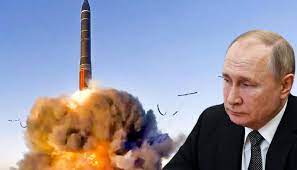
https://www.wbur.org/npr/1083696555/russia-ukraine-war-putin-nuclear-escalation-riskAs Russia’s Ukraine war intensifies, some warn nuclear escalation is possible, “At this time we see no reason to change our own alert levels,” White House press secretary Jen Psaki told reporters on Monday.
Some experts, though, are worried about the possibility of nuclear escalation. Here’s why.
The exact meaning of Putin’s order remains unclear, March 01, 2022, Geoff Brumfiel Over the weekend, Russian President Vladimir Putin gave orders to his nation’s nuclear forces. On Monday, the U.S. said it would not respond with changes to its own nuclear posture.
In a brief clip, Putin is shown speaking to two stony-faced generals about the country’s nuclear forces.
“He basically said, ‘Because of all these hostile or aggressive statements and aggressive policies, we should start this special mode of combat duty of our deterrent forces,'” says Pavel Podvig, a senior researcher at the United Nations Institute for Disarmament Research in Geneva.
It’s unclear what a “special mode of combat duty” actually is. One possibility, says Podvig, is that the order activated the nation’s nuclear command and control system.
“Normally, in peacetime, the command and control system is configured in a way that makes the transmission of an actual command very much impossible,” he says. “It’s like you could press the button, but then nothing happens, because the button is not connected to anything.”
Putin’s order may have meant he wanted the button activated.
Then again, it may not.
Podvig says a follow-up statement from the Russian Ministry of Defense implied it may just mean upping the staffing at facilities that support nuclear weapons. It could be “they just added a few more people to the crews,” Podvig says.
Russia has a lot of nuclear weapons at the ready
Russia has more nuclear weapons than any other nation on Earth, according to Hans Kristensen, director of the nuclear information project at the Federation of American Scientists.
“We estimate that they have about 4,500 or so nuclear warheads in their military stockpile,” he says.
For now, Russia’s largest nuclear weapons — aboard its submarines, bombers and intercontinental ballistic missiles — appear to be at their usual level of alert, Kristensen says. But the nation’s stockpile also includes nearly 2,000 so-called tactical nuclear weapons, which are kept in storage facilities throughout Russia.
They were developed for the purpose of fighting a limited regional battle. Sort of a nuclear war in a very small area,” says Kristensen.
The U.S. has about 100 nuclear bombs stationed across Europe that could be used for tactical nuclear warfare.
The Kremlin’s battlefield weapons can be launched on the same short-range missiles Russia is currently using to bombard Ukraine, such as its Iskander ballistic missile.
Right now, there’s no indication that the battlefield nukes have been pulled out of storage
Russia says it would use nuclear weapons only as a last resort, but some are skeptical
Russia officially says it would use nuclear weapons only if the nation’s very survival was at risk. But not everyone thinks its nuclear rules are so clear-cut.
“A lot of people have questioned whether the bar for Russian nuclear use is as high as its official statements say,” says Olga Oliker with the International Crisis Group.
In 2018, the Pentagon’s nuclear posture review warned that Russia might use a battlefield nuke to “‘de-escalate’ a conflict on terms favorable to Russia.” In other words, Russia might detonate a smaller weapon to get its opponents to back off.
That statement was somewhat controversial among arms control experts at the time. Oliker believes such action would only possibly happen in a direct war with NATO forces.
In the current conflict with Ukraine, “I think it’s very unlikely that Moscow is just going to lob a nuclear weapon at something,” she says. “Obviously it’s been a week when a lot of people’s assumptions have been challenged, but I’ll cling to this one for a while.”
The risk of miscalculation is higher than it’s been in years
Putin’s latest statements may amount to little more than nuclear saber-rattling, says Jeffrey Lewis, a senior scholar at the Middlebury Institute of International Studies at Monterey.
“Putin has had a pretty bad-news week,” he says. “The Ukrainian army is fighting back, which he didn’t expect. The Russian army is performing dreadfully. They are indiscriminately shelling civilian areas. Those things all make him look weak, and the best way to push those headlines down a little bit is a nuclear threat.”
But Lewis says there is still plenty of nuclear risk. Putin has already miscalculated in his invasion of Ukraine.
“What would happen if the Russian warning system had a false alarm in the middle of a crisis like this?” he asks. “Would Putin know it was a false alarm? Or would he jump to the wrong conclusion?”
Even if the short-range battlefield nuclear weapons are still on the shelf, thousands of Russian and American long-range missiles are ready to launch in just minutes. That threat hangs over everything as the conflict in Ukraine drags on.
1 This month
17 October, Free Public Talk on Nuclear Issues in South Australia
David Noonan will speak on public interest concerns over the new Roxby Downs Indenture Act 2026 on BHP copper-uranium mining and ore processing in SA, and on how AUKUS may face SA with a High-Level nuclear waste agenda.
Dr Jim Green will discuss international developments in the field of nuclear power including ‘small modular reactors’ and Generation 4 ‘advanced’ nuclear reactor concepts.


Help Aunty Sue Protect Her Land and Sacred Sites From Destructive Rocket Testing.
.

Australians deserve the truth
about
AUKUS – https://aukuspublicinquiry.com/

PETITION – To: Prime Minister Anthony Albanese and the Australian Labor Government

of the week – Australians for War Powers Reform (AWPR)
To see nuclear-related stories in greater depth and intensity

