UN to review Japan’s plan to release Fukushima water into Pacific
UN to review Japan’s plan to release Fukushima water into Pacific
Taskforce will ‘listen to local people’s concerns’, as government plans to release more than 1m tonnes, Guardian, Justin McCurry in TokyoFri 18 Feb 2022
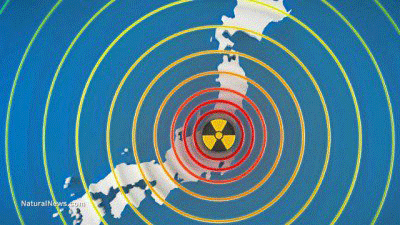
A UN nuclear taskforce has promised to prioritise safety as it launches a review of controversial plans by Japan to release more than 1m tonnes of contaminated water into the ocean from the wrecked Fukushima Daiichi nuclear plant.
Japan’s government announced last April that it had decided to release the water over several decades into the Pacific Ocean, despite strong opposition from local fishers and neighbouring China and South Korea……………
The Tokyo Electric Power company (Tepco) says its treatment technology can remove all radioactive materials from water except tritium, which is harmless in small amounts. It said the gradual release of the water, diluted with seawater, would not pose a threat to human health or the marine environment. In 2020, however, Greenpeace said the water still contained contaminants beside tritium and would have to be treated again.
The wastewater is being stored in about 1,000 tanks that officials say need to be removed so the plant can be decommissioned, an operation expected to take several decades. The tanks are expected to reach their capacity of 1.37m tonnes this summer.
The liquid includes water used to cool the damaged reactors, as well as rain and groundwater that seeps into the area.
Shaun Burnie, a senior nuclear specialist for Greenpeace East Asia, said he did not believe the IAEA would fully investigate and address safety and environmental concerns in its report.
Noting that the agency had welcomed the discharge option when it was announced last year, Burnie said: “The IAEA is not an independent agency in nuclear affairs – under statute its mission is to promote nuclear power. It has sought to justify radioactive marine pollution as having no impact and safe. But the IAEA is incapable of protecting the environment, human health or human rights from radiation risks – that’s not its job.
“The IAEA taskforce should be investigating the root cause of the contaminated water crisis and exploring the option of long-term storage and the best available processing technology as an alternative to the deliberate contamination of the Pacific.”
The IAEA team, which includes experts from South Korea and China, will report its findings at the end of April.
South Korea, which has yet to lift an import ban on Fukushima seafood introduced in 2013, has said that discharging the water would pose a “grave threat” to the marine environment. Pacific peoples have challenged Japan to prove the water is safe by dumping it in Tokyo.
Local fishers also oppose the water’s release, saying it would undo a decade’s work to rebuild their industry and reassure nervous consumers their seafood is safe………https://www.theguardian.com/environment/2022/feb/18/un-to-review-japans-plan-to-release-fukushima-water-into-pacific
Headlines that cause wars
And are designed to do just that. Rick Rozoff, 19 Feb 22, https://wordpress.com/read/feeds/113283937/posts/3838427830
Recent stories picked up and circulated by Yahoo News. The first is only missing the adjectives Young and Innocent before the word Kids.
Daily Beast
Pro-Russian Forces Shell Ukrainian Kindergarten Full of Kids
The Hill
Russia likely to launch ‘limited’ attack against Ukraine, Estonia foreign intelligence agents say
Axios
U.S. warns of Russia-sponsored hackers targeting defense contractors
NuScale small nuclear reactors – a risky proposition -Institute for Energy Economics and Financial Analysis

Report says new nuclear reactor is risky, – from Market Watch Feb. 18, 2022
NuScale design is the only small-scale reactor to win safety approval so far from the U.S. Nuclear Regulatory Commission
A new type of nuclear reactor that [it is claimed] would provide carbon-free energy to at least four states in the Western U.S. poses financial risks for utilities and their ratepayers, according to a report released Thursday that was immediately criticized by the project’s owner and the company developing the reactor.
The report by the Ohio-based Institute for Energy Economics and Financial Analysis said the small modular nuclear reactor being developed by NuScale Power in Oregon is “too expensive, too risky and too uncertain.”
The NuScale design is the only small-scale reactor to win safety approval so far from the U.S. Nuclear Regulatory Commission, and the agency is poised to issue a rule this summer that would fully certify it…………………
The report from the institute, which supports renewable energy, said it’s likely the NuScale reactor will take longer to build than estimated and that the final cost of power will be higher than anticipated and greater than the cost of power from renewable alternatives.
“The nuclear industry has been claiming that small modular reactors … are the wave of the future and are essential in the fight against climate change,” report co-author David Schlissel said. “Based on the industry’s long history of overpromising and underproducing in terms of providing low-cost power, we believe that these claims must be viewed carefully and cautiously.”………………………..
NuScale said in December it is going public via a merger with special-purpose acquisition corporation Spring Valley Acquisition Corp. SV, -0.20% in a deal with a pro forma enterprise value of about $1.9 billion. Fluor FLR, -0.05% will remain a majority stakeholder.
Extreme weather and temperatures sound alarm on climate change
Extreme weather and temperatures sound alarm on climate change
David Ritter
Extreme weather seen in Western Australia sends us an unequivocal message that governments and corporations must address the climate crisis.
Antarctica will likely set a record for lowest sea ice extent this year
Antarctica will likely set a record for lowest sea ice extent this year
Scientists are tracking what’s shaping up to be a new all-time sea ice record in Antarctica.
From eight years ago — Anti-bellum
Someone reminded me of this. As the talk was going on an organized attack by anti-Russian Ukrainians was occurring, with a few dozen people attempting to break into the building. (They can be heard in the background pounding on the glass doors in the front of the building.) The police eventually dispersed them.
From eight years ago — Anti-bellum
Taylor sidelined from energy transition, and it might be the best place for him and his FUD — RenewEconomy

Angus Taylor appeared to be genuinely miffed that no one gave him advanced notice of one of the landmark events of Australia’s rapidly accelerating clean energy transition. The post Taylor sidelined from energy transition, and it might be the best place for him and his FUD appeared first on RenewEconomy.
Taylor sidelined from energy transition, and it might be the best place for him and his FUD — RenewEconomy
Eraring closure will result in more wind, solar and batteries, and less gas — RenewEconomy

We conducted modelling to assess the impact of the early closure of the Eraring coal plant on grid reliability, costs and emissions. Here’s what it found. The post Eraring closure will result in more wind, solar and batteries, and less gas appeared first on RenewEconomy.
Eraring closure will result in more wind, solar and batteries, and less gas — RenewEconomy
Road to renewables, as CityLink switches to 100 pct Victorian wind power — RenewEconomy

Transurban’s CityLink tollways in Victoria will be powered by 100% renewable energy, sourced from Australia’s biggest wind farm. The post Road to renewables, as CityLink switches to 100 pct Victorian wind power appeared first on RenewEconomy.
Road to renewables, as CityLink switches to 100 pct Victorian wind power — RenewEconomy
Majority Indigenous-owned renewables developer launches in NT — RenewEconomy

New renewable energy developer launches in Northern Territory as one of the world’s largest majority Indigenous-owned companies of its kind. The post Majority Indigenous-owned renewables developer launches in NT appeared first on RenewEconomy.
Majority Indigenous-owned renewables developer launches in NT — RenewEconomy
Former transmission boss joins AEMO to lead Integrated System Plan — RenewEconomy

Former Powerlink boss and AEMC Commissioner will oversee the Integrated System Plan as the national grid hurtles to 100% renewables. The post Former transmission boss joins AEMO to lead Integrated System Plan appeared first on RenewEconomy.
Former transmission boss joins AEMO to lead Integrated System Plan — RenewEconomy
February 18 Energy News — geoharvey

Opinion: ¶ “Why The Future Of Long-Haul Trucking Is Battery Electric” • There is increasing consensus among European truck makers and industry stakeholders that battery electric trucks will play a dominant role in the decarbonization of road freight. Low fuel and maintenance costs make battery EVs very competitive for long-haul transport. [CleanTechnica] Battery electric truck […]
February 18 Energy News — geoharvey
The writing is on the wall ‒ Kimba radioactive concerns move to South Australia’s political centre

The controversial federal government plan to dump and store radioactive waste near Kimba on the Eyre Peninsula is the focus of new posters appearing across Adelaide’s central business district this week.
The posters ‒ an initiative of the Don’t Dump on SA (DDSA) network ‒ are part of a growing effort calling on Premier Steven Marshall to support the South Australian law, community and environment and send a clear message of opposition to Canberra ahead of the March 19 state election.
The move comes following last week’s Legislative Council vote where Liberal politicians refused to join SA Green and Labor representatives in condemning the federal waste plan.

“For over two decades there has been bipartisan opposition to federal government plans to make SA the nation’s radioactive waste zone,” said DDSA member Dr. Jim Green. “Last week Premier Marshall walked away from this protection and from the commitment that he made ahead of the last state election that he had “a much greater ambition for our state” than to be a nuclear waste dump.
“A positive outcome of the Legislative Council vote was that the Labor Party reaffirmed its opposition to the proposed nuclear dump. MLC Kyam Maher highlighted Labor’s policy that Traditional Owners should have a right of veto over nuclear projects.”
The federal waste plan at Kimba is facing growing scrutiny following recent extensive flooding of the region and a Federal Court challenge by the Barngarla Traditional Owners.
“Barngarla people have been actively excluded from the area’s community ballot and the wider SA community has not had a say,” said DDSA representative Sister Michele Madigan.
“The federal waste plan poses a very serious and long-lasting risk to people and the environment and demands the highest level of transparency and rigour. Sadly, so far it has been a political football played with moving goalposts. It is time Premier Marshall blew the whistle and demanded an end to this move.”
The posters will remain in 30+ sites around Adelaide until the election and will be complemented with a range of community outreach initiatives in the lead up to the state election.
Why nuclear submarines?
Despite so many changes over recent decades, it all comes back to whether the nation’s military should be focused on defending the continent, or if its interests are better served by helping a powerful ally further from home
From SMH 14 Feb ‘…………Why nuclear submarines?
Prime Minister Scott Morrison announced in September that Australia was dumping a $90 billion agreement with France to build 12 conventional submarines and would instead develop a fleet of at least eight nuclear-powered boats with the US and Britain under the AUKUS agreement. The nuclear submarines will arrive by 2036 at the earliest, but possibly much later, at a cost of at least $116 billion.
The decision to acquire a fleet of nuclear-powered submarines has very little to do with defending the mainland and its maritime approaches, which our current fleet of Collins-class subs could probably handle. In fact, some commentators argue conventional submarines are superior in defending the archipelago to our north because their engines can be turned off, which makes them stealthier.
………………….. Dutton is also still insisting the [nuclear] submarines will be built in Adelaide, saying the government has already “demonstrated through a number of programs a desire to build our capability … and there are tens of thousands of jobs in the economy today as a result of that”.
……………… Australian military strategist Hugh White, the principal author of Australia’s 2000 Defence White Paper, is not a fan of the AUKUS agreement, saying it has been exaggerated for two reasons. The first is because the nuclear fleet will arrive too late, and the second is it is not necessarily what is needed.
Instead of getting nuclear submarines decades down the line, White says Australia should be looking at building a new version of the Collins-class submarine, while moving as fast as it can to buy “off-the-shelf” submarines such as Germany’s Type 216 conventional submarine.
……….. Despite so many changes over recent decades, it all comes back to whether the nation’s military should be focused on defending the continent, or if its interests are better served by helping a powerful ally further from home………………..
Plutonium problems won’t go away
Plutonium problems won’t go away, By Chris Edwards, Engineering and Technology, February 15, 2022
Nuclear energy’s environmental image is as low as carbon’s,with its clean fuel potential being tarnished by legacy waste issues. Are we any closer to resolving this?
At the end of 2021, the UK closed the curtain on one part of its nuclear waste legacy and took a few more steps towards a longer-lasting legacy. A reprocessing plant, built at the cost of £9bn in the 1990s to repackage waste plutonium from pressurised water reactors in the UK and around the world for use in new fuel, finally converted the last remaining liquid residue from Germany, Italy and Japan into glass and packed it into steel containers. It will take another six years to ship it and all the other waste that belongs to the reactor owners, who are contractually obliged to take it back.
Even when the foreign-owned waste has headed back home, the UK will still play host to one of the largest hoards of plutonium in the world, standing at more than 110 tonnes. It amounts to a fifth of the world’s total and a third of the global civilian stockpile of 316 tonnes. Despite operating a smaller nuclear fleet than France’s, the UK has 1.5 times more plutonium.
It was never meant to end this way. The long-term dream was for fission-capable fuel to keep going round in a circle, only topped up with virgin uranium when necessary. The plutonium produced during fission could itself sustain further fission in the right conditions. However, fast-breeder reactors that would be needed to close the cycle remain largely experimental, even in countries such as Russia where their development continues. Driven by both safety concerns and worries about nuclear proliferation that might result from easier access to separated and refined plutonium-239, the West abandoned its fast-breeder programmes decades ago.
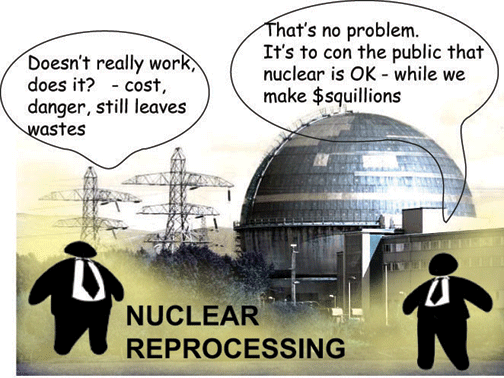
It is possible to reprocess spent fuel into so-called mixed-oxide fuel, but it is only good for one use in a conventional reactor. Other actinides build up and begin to poison the fission process. The only prospects for change lie in so-called Generation IV reactors, but these designs have yet to be tested and may continue to fall foul of proliferation concerns.
While operators around the world have mulled over the practicality of fuel reuse, containers of both processed and reprocessed fuel have lingered in storage tanks cooled by water despite, in some countries, being earmarked for deep burial for decades. In the late 1980s, the US Department of Energy (DoE) settled on Yucca Mountain in Nevada as the single destination for the country’s spent nuclear fuel, and scheduled it for opening a decade later. By 2005, the earliest possible opening date had slipped by 20 years. It remains unopened and will probably never open. In the interim, much of the fuel has lingered in water-filled cooling tanks while politicians consider more localised deep-storage sites.
Fukushima provided a wake-up call to the industry, not just about the problems of controlling reactors but their spent fuel. After the tsunami, engineers were concerned that without replenishment pumps, the water in the storage tanks for the spent fuel would evaporate. If the fuel then caught fire, it would likely release radioactive tritium and caesium into the atmosphere. In a stroke of luck, water leaked into the damaged ponds. Now the issue for operators of some older reactors is that the fuel canisters are just corroding into the water instead.Experts such as Frank von Hippel, professor of public and international affairs at Princeton University, recommend storage pools should only be used until the fuel is cool enough to be transformed into glass, immersed in concrete or both, and transferred to dry storage, preferably in a deep geological disposal facility (GDF).At a conference last November organised by the International Atomic Energy Agency (IAEA), Laurie Swami, president and CEO of Canada’s Nuclear Waste Management Organisation, claimed “there is scientific consensus on the effectiveness of deep geologic repositories” for highly radioactive waste.
The UK similarly settled 15 years ago on a plan to build its own GDF for high-level waste in tandem with the establishment of a single government-owned body responsible for organising where the waste goes, in the shape of the Nuclear Decommissioning Authority (NDA). The GDF took a small step forward at the end of 2021 when two candidate sites were announced, both close to the Cumbrian coast. The local communities have agreed in principle that the NDA can investigate where they are suitable for a set of tunnels that may extend under the Irish Sea. With the project at such an early stage, the country remains years away from opening a GDF. Finland, in contrast, has pressed ahead and expects its GDF to open in 2025, while Sweden is likely to have the second one in the world.
At the same time, there is an enormous volume of other irradiated material that cannot economically be put into deep storage. In a keynote speech at the IAEA’s conference, James McKinney, head of integrated waste management at the NDA, explained that a lot of radioactive waste is contaminated building material. The Low-Level Waste Repository at Drigg in Cumbria was designed for this kind of waste, but McKinney stressed that capacity is “precious” and in danger of running out if all the material is taken there. Over the past decade, the NDA and its subcontractors have been working to divert as much waste as possible from the Drigg site by reprocessing and repackaging it.
By bringing waste management under one umbrella instead of dividing it among power-station operators, the NDA has been able to change procurement strategies to favour the use of much more R&D for waste handling. “The destination of radioactive waste can be changed through interventions,” McKinney adds. “At this moment, we estimate some 95 per cent of potential low-level waste is being diverted away [from Drigg]. Twelve years ago, the opposite would be true.”
A recent example of this in action is the dismantling of pipes that were once installed at the Harwell research centre. More than 1,500 sections of metal pipe were delivered to oil-and-gas specialist Augean, which is using high-pressure water jets to remove radioactive scale so the metal can be recycled instead of needing long-term storage.
Getting less manageable waste away from the storage tanks presents another major challenge, particularly if it comes from the oldest reactors. For example in the UK, when spent Magnox fuel was taken out of the reactors, the magnesium cladding around it was stripped away and moved to Sellafield’s Magnox Swarf Storage Silo (MSSS). Though the swarf itself is just intermediate-level waste, Sellafield’s operator regards emptying the silo ready for transfer to long-term dry storage as one of the more hazardous projects on the site. Stored underwater to keep them cool, the packages of swarf gradually corrode and release hydrogen gas and contaminants, which can escape into the ground. Moving the waste for treatment can itself lead to more escapes.
To manoeuvre 11,000 cubic metres of waste out of the 22 chambers of the MSSS, it has taken more than two decades to design, build and install two out of three shielded enclosures and grabbing arms that can lift out pieces of the swarf and prepare it to be immobilised in concrete or glass.
The time it has taken to even begin to clean up the MSSS illustrates the core issue that faces decommissioning and clean-up programmes: the sheer difficulty of trying to handle even moderately radioactive materials in circumstances where access was never considered when these structures were first built and filled. Everything in this kind of decommissioning calls for ungainly long-distance manipulators because there is no other way to protect the clean-up crews.
As engineers struggled to deal with the Fukushima disaster in March 2011, many people in Japan thought the same thing, and expressed surprise that a country that had invested so much in robotics research had none that it could send into the reactors to even perform a survey.
Japan was not alone with this issue: no country had a dedicated nuclear-accident response robot. Work on robots began decades ago but continued only in fits and starts for the most part. After a serious incident in 1999 at an experimental reactor at Tokaimura, the Japanese Ministry of Economy, Trade and Industry set aside $36m to develop remote-controlled machines. But the projects ended within a few years.
To help deal with the immediate problems at Fukushima, the US research agency DARPA was quick to repurpose the military and disaster robots to which it had access, originally planning to send them on Navy ships across the Pacific. But it quickly emerged that this would be too slow
At a conference organised by the International Federation of Robotics Research on the 10th anniversary of the accident, Toyota Research chief scientist Gill Pratt said the first robots “got there in the overhead luggage of commercial flights”. For all of them it was a baptism of fire.
(Here this aticle continues with a discussion on robot technology – which must be remotely done and turns out to be very problematic)
………………………………………….Deep burial seems to be the easiest way to deal with long-lived waste, assuming no-one tries to dig it up without heavy protection and good intentions hundreds or thousands of years into the future. But the question of how safe it is if the repository breaches accidentally is extremely hard to answer.
Plutonium is unlikely to be the biggest problem. Although it oxidises readily to dissolve in water, the short-lived fission products such as strontium-90 and caesium-137 could be more troublesome if they escape the confines of a storage site, according to analyses such as one performed by SKB as part of Sweden’s programme to build a deep burial site there.The half-lives of these isotopes are far shorter than those of plutonium, so the risk from them will subside after a couple of hundred years rather than the thousands for plutonium. But what if they could be shortened to days or even seconds? Any radiation could then be contained or used before the waste is repackaged.
This is the promise of laser transmutation, which uses high-energy beams to displace neutrons in donor atoms that then, with luck, smash into those unstable isotopes to produce even more unstable atoms that quickly decay. In one experiment performed by Rutherford-Appleton Laboratory, a laser transmuted atoms in a sample of iodine-129, with a half-life measured in millions of years, to iodine-128. A similar experiment at Cambridge converted strontium-90 to the medical labelling chemical strontium-89.
The bad news is that the energy required to perform transmutation at scale is enormous and not all isotopes are cooperative: their neutron-capture volumes are so small the process becomes even less efficient.Nobel laureate Gérard Mourou believes careful control over high-energy pulsed lasers will bring the energy cost of transmutation down significantly. He is working with several groups to build industrial-scale systems that could begin to clean up at least some of the high-activity waste.
Even if lasers can be made more efficient, there are further problems. For one, the waste needs to be separated as otherwise the stray neutrons will transmute other elements in the sample, generating unwanted actinides. This will not only increase the cost of reprocessing, it will increase the risk of proliferation, as it will lead to plutonium that is far easier to handle and move around, the one outcome that deep burial is meant to avoid……………………https://eandt.theiet.org/content/articles/2022/02/plutonium-problems-won-t-go-away/
1 This month
17 October, Free Public Talk on Nuclear Issues in South Australia
David Noonan will speak on public interest concerns over the new Roxby Downs Indenture Act 2026 on BHP copper-uranium mining and ore processing in SA, and on how AUKUS may face SA with a High-Level nuclear waste agenda.
Dr Jim Green will discuss international developments in the field of nuclear power including ‘small modular reactors’ and Generation 4 ‘advanced’ nuclear reactor concepts.


Help Aunty Sue Protect Her Land and Sacred Sites From Destructive Rocket Testing.
.

Australians deserve the truth
about
AUKUS – https://aukuspublicinquiry.com/

PETITION – To: Prime Minister Anthony Albanese and the Australian Labor Government

of the week – Australians for War Powers Reform (AWPR)
To see nuclear-related stories in greater depth and intensity

