Australia’s credibility at a low point, with Scott Morrison’s lying and appalling performance at COP26
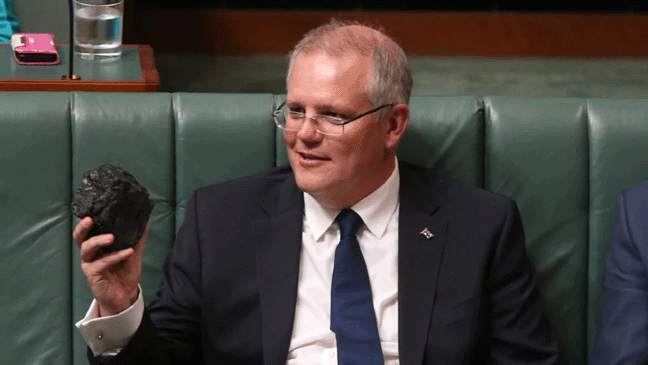
Bonne chance? Australia might need it on AUKUS nuclear submarines deal https://www.canberratimes.com.au/story/7492847/bonne-chance-australia-might-need-it/ 2 Oct 21,
The AUKUS nuclear submarines deal had better pay off, because the costs for Australia are beginning to appear far greater than first suggested.
In case Prime Minister Scott Morrison really thought some time, and some space, would quell Emmanuel Macron’s anger at the announcement – which abruptly ended a $90 billion submarines contract with France’s Naval Group – the French president disabused him of that idea on Sunday.
Mr Macron knew very well what he was doing when he spoke to Australian journalists about the AUKUS deal, and Mr Morrison’s actions. There was an air of calm calculation about his words. If his intent was to express the depth of his disappointment, the damage the nuclear submarines deal had done to the Australia-France relationship, and to raise questions about Mr Morrison’s handling of the AUKUS move, then he was bang on target.
He didn’t overplay his anger, and even couched his disapproval of Mr Morrison’s actions with a respectful recognition of Australia and France’s friendship and shared history.
With two words, he also highlighted what is becoming increasingly clear about the AUKUS nuclear submarines arrangement: As an exercise in Australian defence procurement, it appears chimeric.
“Good luck,” he said, noting that far from a signed contract, Australia right now has to wait 18 months for a review before the next steps in its new quest for submarines. Bonne chance, Australia.
This is where the nation sits less than a couple of months after the AUKUS deal, in a region with heightening geopolitical tensions and unresolved questions about Australia’s ability to defend itself. Australia is falling out with its friends (France), while its closest ally gives a different version of events in the lead-up to the AUKUS announcement (it was “clumsy”, Joe Biden says).
In hindsight, the AUKUS announcement seems true to form for Mr Morrison. It was high in marketing, fanfare and gloss, but lacking in substance, ham-fisted in execution and questionable in the respect it afforded to those who deserved it.
Add Australia’s reputation as obstructing progress in international climate talks, its pathetically bare minimum net zero by 2050 position, and its refusal to support international agreements phasing out coal, and the nation cuts an increasingly lonely figure on the world stage.
Mr Morrison’s trip overseas for both G20 and COP26 is, at this stage, disastrous. Australia’s credibility seems to be ebbing, not just because of AUKUS but on climate action, too. Middle powers cannot afford to put their reputations at risk like this.
USA and UK’s transparent persecution of Australian Julian Assange
The goal is to set a legal precedent which allows journalists who expose the crimes of the powerful to be persecuted not covertly as is normally done in ‘free democracies,’ but right out in the open. To tell journalists “We’ll just throw you in prison if you cross us.
What makes this precedent uniquely dangerous is that it is not just threatening to imprison American journalists who expose US crimes, but any journalist anywhere in the world.
Caitlin Johnstone: The Assange persecution lays out Western savagery at its most transparent https://www.rt.com/op-ed/538713-us-appeal-of-the-julian-assange/28 Oct, 2021 By Caitlin Johnstone, an independent journalist based in Melbourne, Australia. Her website is here and you can follow her on Twitter @caitozThe first day of the US appeal in the Julian Assange extradition case saw grown adults arguing in court that the US government could guarantee that it wouldn’t treat the WikiLeaks founder as cruelly as it treats other prisoners.
I wish I was kidding.
In their write-up on Wednesday’s proceedings, The Dissenter’s Kevin Gosztola and Mohamed Elmaazi report that the prosecution argued that “the High Court should accept the appeal on the basis that the U.S. government offered ‘assurances’ that Assange won’t be subjected to Special Administrative Measures (SAMs) or incarcerated in ADX Florence, a super-maximum prison in Colorado.”
What this means is that in order to overturn the January extradition ruling which judge Vanessa Baraitser denied on the basis that the notoriously draconian US prison system is too cruel to guarantee Assange’s health and safety, the prosecution has established as one of their grounds for appeal the claim that they can offer “assurances” that they would not inflict some of their most brutal measures upon him. These would include the aforementioned Special Administrative Measures, wherein prisoners are so isolated that they effectively disappear off the face of the earth, or sending him to ADX Florence, where all prisoners are kept in solitary confinement 23 hours a day.
What’s ridiculous about these “assurances,” apart from the obvious, is that within its own legal argument the US government reserves the right to reverse those assurances at any time and impose SAMs or maximum security imprisonment upon Assange if it deems them necessary. As Amnesty International explains:
They say: we guarantee that he won’t be held in a maximum security facility and he will not be subjected to Special Administrative Measures and he will get healthcare. But if he does something that we don’t like, we reserve the right to not guarantee him, we reserve the right to put him in a maximum security facility, we reserve the right to offer him Special Administrative Measures. Those are not assurances at all. It is not that difficult to look at those assurances and say: these are inherently unreliable, it promises to do something and then reserves the right to break the promise.
So the prosecution’s legal argument here is essentially “We promise we won’t treat Assange as cruelly as we treat our other prisoners, unless we decide we really want to.”
This is not just a reflection on the weakness of the extradition appeal, it’s a reflection on the savagery of all the so-called free democracies that have involved themselves in this case.
This same prosecution argued that Assange should not be denied US extradition from the UK on humanitarian grounds as in the case of activist Lauri Love, because Love suffered from both physical and psychological ailments while Assange’s ailments are only psychological. They stood before the court and made this argument even as Assange was visibly pained and unwell in his video appearance from Belmarsh Prison, which he was only able to attend intermittently due to his frail condition.
“For my newspaper, I have worked as media partner of WikiLeaks since 2009,” tweeted journalist Stefania Maurizi who attended the hearing via video link. “I have seen Julian Assange in all sorts of situations, but I have never ever seen him so unwell and so dangerously thin.”
So they’re just openly brutalizing a journalist for exposing US war crimes, while arguing that they can be trusted to treat him humanely and give him a fair trial if granted extradition. This after it has already been confirmed that the CIA plotted to kidnap and assassinate him during the Trump administration, after we learned that the prosecution relied on false testimony from a convicted child molester and diagnosed sociopath, after it was revealed that the CIA spied on Assange and his lawyers in the Ecuadorian embassy, and after intelligence asset Jeffrey Epstein famously died under highly suspicious circumstances in a US prison cell.
The worst atrocities in history have all been legal. All the worst examples of genocide, slavery, tyranny and bloodshed have been allowed or actively facilitated by the state. The persecution of Assange is geared toward entering the imprisonment of journalists into this category.
The goal is to set a legal precedent which allows journalists who expose the crimes of the powerful to be persecuted not covertly as is normally done in ‘free democracies,’ but right out in the open. To tell journalists “We’ll just throw you in prison if you cross us.”
What makes this precedent uniquely dangerous is that it is not just threatening to imprison American journalists who expose US crimes, but any journalist anywhere in the world. This is an Australian journalist in the process of being extradited from the UK for publishing facts about US war crimes in the nations it has invaded. The aim is to set up a system where anyone in the US-aligned world can be funneled into its prison system for publishing inconvenient facts.
This is the savagery of the Western world at its most transparent. It’s not the greatest evil the US-centralized empire has perpetrated; that distinction would certainly be reserved for its acts of mass military slaughter that it has been inflicting upon our species with impunity for generations. But it’s the most brazen. The most overt. It’s the most powerful part of the most depraved power structure on earth looking us all right in the eyes and telling us exactly what it is.
And if we can really look at this beast and what it is doing right now, really see it with eyes wide open, it reveals far more about those who rule over us than anything any journalist has ever exposed.
How Australia’s coal country past is scuppering its renewable energy future — RenewEconomy

Australia needs to massively scale up renewables to reach net zero, but they are handicapped by a system designed for fossil fuels. The post How Australia’s coal country past is scuppering its renewable energy future appeared first on RenewEconomy.
How Australia’s coal country past is scuppering its renewable energy future — RenewEconomy
Tony Abbott wants Australia to buy second-hand ”retired” nuclear-powered submarines, for training purposes.

Abbott calls for Australia to use retiring nuclear-powered submarines as training boats, SMH, By Anthony Galloway November 1, 2021 Australia should consider buying retiring nuclear-powered submarines from either America or Britain for training purposes and as insurance in the event of a conflict in the region in coming years, former prime minister Tony Abbott has said.
Speaking from Washington, where he is travelling in a private capacity, Mr Abbott said that he had been canvassing the idea in the US of Australia acquiring some older-model nuclear submarines “within months, rather than decades”……………
“One of the issues which I’ve been informally discussing here in Washington and elsewhere in the United States is: Might it be possible for Australia to acquire a retiring LA-class boat or two, to put it under an Australian flag, to run it if you like as an operational training boat, but it would be an addition to the order of battle in the Western Pacific should that be necessary?……………… https://www.smh.com.au/politics/federal/abbott-calls-for-australia-to-use-retiring-nuclear-powered-submarines-as-training-boats-20211101-p594yk.html
ESG – Environmental Social and Governance investing excludes nuclear power
Green finance clarifies nuclear issue, https://www.taipeitimes.com/News/editorials/archives/2021/11/02/2003767157, By Honda Chen 陳鴻達 Translated by Perry Svensson

MSCI, the world’s most reputable compiler of investment indices, generates ESG lists by first excluding firms in the nuclear power, arms, gambling and pornography industries.
The EU Taxonomy excludes nuclear power generation, and nuclear power cannot be used to account for carbon reduction efficiency.
ESG funds exclude companies that generate revenue from nuclear power.
Nuclear power cannot be regarded as green energy, so carbon reduction still requires renewable energy, energy efficiency, or carbon capture and storage technology, Environmental Protection Administration (EPA) Minister Chang Tzi-chin (張子敬) told a question-and-answer session at the Legislative Yuan in Taipei on Thursday.
This is the mainstream view worldwide, and green finance, or ESG — environmental, social and governance — investments, which have surged over the past few years, prohibit investing in nuclear power plant projects.
For example, MSCI, the world’s most reputable compiler of investment indices, generates ESG lists by first excluding firms in the nuclear power, arms, gambling and pornography industries. Only then does it look at whether a firm’s performance indicators meet sustainability requirements. Many funds based on MSCI’s ESG indices do not buy the stocks or bonds of companies in those industries.
Although most power plants in other countries are privately owned, many are publicly traded, but ESG funds exclude companies that generate revenue from nuclear power.
Over the past few years, the EU has been promoting its Green Deal, a transformation of the bloc’s energy sector, and has adopted the EU Taxonomy, a transparency tool that lists economic activities that meet sustainability standards.
Businesses that meet the standards can issue green bonds, which enjoy lower borrowing costs and fewer administrative procedures. Funds that claim to be ESG must disclose how sustainable the companies in their portfolios truly are.
The EU Taxonomy excludes nuclear power generation, and nuclear power cannot be used to account for carbon reduction efficiency.
The EU’s logic is that carbon reduction cannot be achieved to the detriment of other environmental objectives, such as eliminating radioactive waste or safeguarding biodiversity. Sustainable carbon reduction must “do no significant harm” to the environment.
By this logic, nuclear power is a major hazard in Taiwan, a densely populated country situated in an earthquake zone.
The proposed third liquefied natural gas terminal off the coast of Datan Borough (大潭) in Taoyuan’s Guanyin District (觀音) is another example of this.
Infrastructure for the project has been moved farther out to sea, far from the coastline, and the shipping lane is not to be dredged, minimizing damage to an algal reef.
In other words, if the terminal is part of the fight against air pollution, it must comply with the principle of not causing significant harm to other aspects of the environment.
The referendums that are to be held next month have either become highly politicized or distort the issue of nuclear power.
Perhaps the logic behind today’s ESG trend in global finance could help the public to better understand the issue and make more informed decisions.
Honda Chen is an associate research fellow at the Taiwan Academy of Banking and Finance.
Extreme weather events now the new normal – State of the Climate report 2021

Extreme weather events – including powerful heat waves and devastating floods – are now the new normal, says the World Meteorological Organisation. The State of the Climate report for 2021 highlights a world that is “changing before our eyes.” The 20-year temperature average from 2002 is on course to exceed 1C above pre-industrial levels for the first time. And global sea levels rose to a new high in 2021, according to the study. These latest figures for 2021 are being released early by the WMO to coincide with the start of the UN climate conference in Glasgow known as COP26.
BBC 31st Oct 2021
US and UK must stop’: Chinese diplomat warns New Zealand audience of Australia’s nuclear ambitions
US and UK must stop’: Chinese diplomat warns New Zealand audience of Australia’s nuclear ambitions, Stuff, Thomas Manch , Nov 02 2021 A senior Chinese diplomat has warned a New Zealand audience that Australia will not only acquire nuclear-powered submarines in the coming decades, but nuclear weapons.
And it was claimed Australia’s purchase of nuclear-powered submarines would mean “more nuclear arms race … more nuclear tests, and nuclear pollution” in the Pacific.
China’s deputy chief of mission in New Zealand, Wang Genhua, made the claim about Australia’s nuclear ambitions during an event about the new defence pact between Australia, the United Kingdom, and the United States – dubbed AUKUS – on Monday evening.
“Australia is going to own nuclear-powered submarines. It will be almost necessary for them to equip nuclear weapons as the next step. The step just couldn’t be prevented,”
The AUKUS pact, announced in September, has Australia acquiring nuclear-powered submarines from the UK and US in the coming decades, in a bid to counter China’s growing influence in the Asia-Pacific region. The move grates against New Zealand’s anti-nuclear stance.
China, which has expanded its footprint into the contested waters of the South China Sea, was quick to condemn the AUKUS pact as irresponsible, “Cold War zero-sum mentality” that would undermine peace in the region.
The comments from Wang come as the fallout from AUKUS continues, with French President Emmanuel Macron accusing Australia’s Scott Morrison of lying about the deal.
Morrison, along with US and UK leaders, have insisted the nuclear-powered submarines Australia intended to acquire in the coming decades would only be equipped with conventional (non-nuclear) weapons, and the countries’ nuclear proliferation obligations will be met………… https://www.stuff.co.nz/national/politics/126854210/us-and-uk-must-stop-chinese-diplomat-warns-new-zealand-audience-of-australias-nuclear-ambitions
UK Astute class nuclear submarine visits Perth
British nuclear-powered sub visits Perth
1 November 2021
A Royal Navy nuclear-powered submarine has conducted a port visit to Perth, one of the first since the announcement of AUKUS in September.
The Astute class submarine went alongside HMAS Stirling in Rockingham, WA on Friday.
The submarine has been part of the UK Carrier Strike Group deployment to the Indo-Pacific which had recently exercised with a range of RAN units alongside numerous engagements with regional partners……………. https://www.australiandefence.com.au/news/british-nuclear-powered-sub-visits-perth
Solar and wind keep getting cheaper, and crush coal, gas and nuclear on costs: Lazard — RenewEconomy

Latest LCOE report from Lazard confirms that wind and solar by far the cheapest of all energy sources, and cost of storage is falling too. The post Solar and wind keep getting cheaper, and crush coal, gas and nuclear on costs: Lazard appeared first on RenewEconomy.
Solar and wind keep getting cheaper, and crush coal, gas and nuclear on costs: Lazard — RenewEconomy Giles Parkinson & Sophie Vorrath 1 November 2021 [GOOD GRAPHS]
As world leaders meet in Glasgow for critical climate talks, they have been given a stark reminder of the lowest cost alternatives to achieve the full decarbonised grid that science says is required of major economies by the middle of next decade, at the latest.
Investment bank Lazard has released the 15th edition of its highly regarded Levelised Cost of Energy Analysis and it reinforces what is pretty much already known: Wind and solar are by far the cheapest forms of electricity generation, storage costs are falling, and now hydrogen is part of the equation.
The best illustration of the cost difference between the various technologies is this following table, which shows the various energy supply sources and their sensitivity to the cost of capital.
All technologies are affected in some way, but wind and solar, which are easily the cheapest form of generation, actually increase their advantage as the cost of capital increases. In all cases, they are five times cheaper than nuclear. Even storage and network costs don’t come close to making up the difference…………………………….. https://reneweconomy.com.au/solar-and-wind-keep-getting-cheaper-and-crush-coal-gas-and-nuclear-on-costs-lazard/—
A supporter of nuclear power has second thoughts
Can Nuclear Power Stay Relevant in a World Filled with Renewables? https://www.powermag.com/can-nuclear-power-stay-relevant-in-a-world-filled-with-renewables/ by Aaron Larson —Aaron Larson is POWER’s executive editor. 1 Nov 21, I have long been a supporter of nuclear power. I’ll admit I’m biased, having spent 13 years in the U.S. Navy’s nuclear power program and having worked for several more years in the commercial nuclear industry at the Quad Cities station. Even so, when I step back and look critically at nuclear technology, I find it to be a sound form of power generation.
I’m obviously not the only person who believes in it. Several advocacy groups tout the benefits nuclear reactors provide. The Nuclear Innovation Alliance, for example, says the world needs the “economic, flexible, secure, zero-carbon energy” that nuclear power offers, suggesting it can be scaled up “rapidly to expand energy access while halting climate change.” The truth is, however, many nuclear plants are not so “economic” and few things happen “rapidly” in the nuclear industry
Financial Challenges and Construction Delays

It’s no secret that nuclear power plants have been struggling in competitive markets. Until recently, Exelon, which operates the largest fleet of commercial reactors in the U.S. (including the plant I previously worked at), was on the verge of retiring its Byron and Dresden facilities because they were “uneconomic.”
The company claimed that “despite being among the most efficient and reliable units in the nation’s nuclear fleet,” Byron and Dresden faced “revenue shortfalls in the hundreds of millions of dollars because of declining energy prices and market rules that allow fossil fuel plants to underbid clean resources in the PJM capacity auction.”
Byron and Dresden were ultimately saved when legislation was passed by Illinois lawmakers in September. The state’s new energy bill will reportedly give Exelon $694 million in incentives to keep the plants open. Similar subsidies have been necessary to keep nuclear plants viable elsewhere, including in Ohio and New York.
When it comes to speed of deployment, there are countless examples of delayed nuclear power projects all over the world. For my purposes, I’ll focus on the only project currently in progress in the U.S., that is, the Vogtle expansion in Georgia. Southern Nuclear (a subsidiary of Southern Company) filed for an early site permit application for Vogtle Units 3 and 4 in August 2006. The Georgia Public Service Commission approved construction of the two AP1000 reactors in March 2009. Southern Company notified The Shaw Group and Westinghouse Electric Co. to proceed fully on their engineering, procurement, and construction contract in mid-April 2009.

Original plans called for Vogtle Unit 3 to be operational in 2016 and Unit 4 to enter service in 2017, but that didn’t happen. The project has had countless delays, and costs have ballooned. In a July 29-issued press release, Georgia Power, the Southern Company subsidiary that will own 45.7% of the two new units along with Oglethorpe Power Corp. (30%), Municipal Electric Authority of Georgia (22.7%), and Dalton Utilities (1.6%), said it was projecting a Unit 3 in-service date in the second quarter of 2022 and a Unit 4 in-service date in the first quarter of 2023, but even that timeline may be optimistic. In Oglethorpe’s investor briefing issued on Aug. 26, the company said its revised budget “assumes in-service dates of June 2022 and June 2023 for Unit 3 and Unit 4, respectively.”
And speaking of budgets, Georgia Power’s capital cost forecast for the project was also revised in July, pegging its share of the project at $9.2 billion. If you do the math, that works out to more than $20.1 billion in total project costs, which is 40% higher than the $14.3 billion projected in August 2008.
Progress on SMRs Has Been Equally Slow
Some nuclear power proponents feel small modular reactors (SMRs) could provide a boost to the industry. The concept has been around for decades. I remember hearing about pebble-bed small modular reactors when I was still in the Navy back in the 1990s. The idea of building moduals in a factory-type setting and shipping them to a site for final assembly seems forward-thinking. The process could be more like an assembly line, saving time and money.
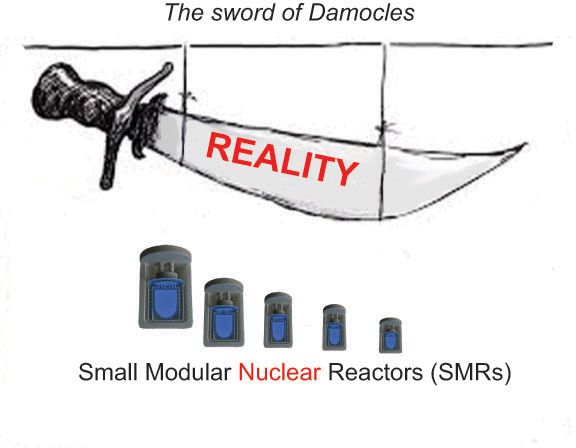
Yet, for all the hype, we still haven’t seen an SMR approved and constructed in the U.S. NuScale Power is perhaps the furthest along in the process. so I’ll focus on what it has accomplished.
POWER has been reporting on NuScale’s design since at least early 2013. The company began developing its reactor in 2000 under a Department of Energy–funded research program, and began pre-application discussions with the Nuclear Regulatory Commission (NRC) in 2008. It took until September 2020 for the NRC to finally issue a Standard Design Approval for the NuScale SMR.
While NuScale has signed several agreements with companies and countries interested in exploring SMR deployment, no one has signed on the dotted line to build one. Furthermore, it’s highly debatable whether SMR costs will be competitive with other available clean-energy options.
Insurmountable Obstacles?
A grim picture was painted for the future of nuclear power during a media event on Sept. 29 to roll out the “World Nuclear Industry Status Report 2021,” a Mycle Schneider Consulting project that provides an overview of nuclear power plant data including information on operation, production, and construction. One of the takeaways from the presentation was: “Nuclear is irrelevant in today’s electricity capacity newbuild market.”
I asked the eight-member panel of presenters if the tide could be turned. M.V. Ramana, a professor at the University of British Columbia and a contributor to the report, told me in a direct message, “I don’t think this tide can turn. These problems are structural.” I hope he’s wrong, because I believe the world needs nuclear power to be a relevant piece of a carbon-free future.
Positive developments: rise in electric cars, ever cheaper renewables, moves towards energy efficiency

| The climate emergency is the biggest threat to civilisation we have ever faced. But there is good news: we already have every tool we need to beat it. The challenge is not identifying the solutions, but rolling them out with great speed. Some key sectors are already racing ahead, such as electric cars. They are already cheaper to own and run in many places – and when the purchase prices equal those of fossil-fueled vehicles in the next few years, a runaway tipping point will be reached. Electricity from renewables is now the cheapest form of power in most places, sometimes even cheaper than continuing to run existing coal plants. There’s a long way to go to meet the world’s huge energy demand, but the plummeting costs of batteries and other storage technologies bodes well. And many big companiesmare realising that a failure to invest will be far more expensive as the impacts of global heating destroy economies. Even some of the biggest polluters, such as cement and steel, have seen the green writing on the wall. Buildings are big emitters but the solution – improved energy efficiency – is simple to achieve and saves the occupants money, particularly with the cost of installing technology such as heat pumps expected to fall. Guardian 31st Oct 2021 https://www.theguardian.com/environment/2021/oct/31/reasons-to-be-hopeful-the-climate-solutions-available-no |
New Study: Electricity would already be Cheaper today with a Full Supplyof 100% Renewables.
**Germany – renewables**
New Study: Electricity would already be Cheaper today with a Full Supply
of 100% Renewables. New short study by the Energy Watch Group (EWG) finds:
Electricity would already be cheaper today with a full supply of 100%
renewables.
In the coalition negotiations for the new German government,
both ambitious climate protection and the reduction of electricity prices
play a central role. The previous government still expects only 45%
renewables in the electricity mix by 2025.
A new short study by the Energy
Watch Group offers an answer to the rising energy costs: The study
calculates that a full supply with 100% renewables would already be
economically competitive today compared to the current energy system based
on coal, natural gas and nuclear. By 2025 at the latest, an energy system
based on 100% renewables would then be significantly cheaper than power
generation with fossil fuels.
Sonnenseite 28th Oct 2021
US military blazes trail for 100 per cent renewable energy economy
| US military blazes trail for 100 per cent renewable energy economy with carbon neutral synthetic fuel. Carbon neutral synthetic fuel whose production is powered by renewable energy is a practical way of long-term storage of renewable energy. But it is no surprise that the big energy corporations with their fossil fuel and nuclear power interests don’t advise Governments to support this – but when it can help the US military, well, it’s just chocks away chaps! The irony is that this system was researched in the UK only a few years ago at a pilot stage, and then – you’ve guessed it – completely ignored by the UK Government in favour of kooky ideas like small nuclear reactors and blue hydrogen – not to mention large nuclear power plant that take forever to be built incredible cost! 100% Renewables 31st Oct 2021 https://100percentrenewableuk.org/us-military-blazes-trail-for-100-per-cent-renewable-energy-economy-with-carbon-neutral-synthetic-fuel |
Portugal’s success in cutting greenhouse emissions through its offshore floating wind and solar plants
Portugal is the EU country that has been most successful at cutting
greenhouse gas emissions since 2005, partly through the use of floating
wind and solar plants located off its coast. Today, 65 percent of all the
electricity consumed in Portugal comes from renewable sources.
France24 30th Oct 2021
“The Australian way:” Morrison exposes Australia as climate laggard on world stage — RenewEconomy

Morrison took his climate plan to Glasgow and the world has seen it as a hollow gesture, with Fiji offering its own blueprint for Australia to follow. The post “The Australian way:” Morrison exposes Australia as climate laggard on world stage appeared first on RenewEconomy.
“The Australian way:” Morrison exposes Australia as climate laggard on world stage — RenewEconomy
1 This month.
20 September –National Day of Action in Melbourne on the International Day of Peace


Help Aunty Sue Protect Her Land and Sacred Sites From Destructive Rocket Testing.
.

Australians deserve the truth
about
AUKUS – https://aukuspublicinquiry.com/


PETITION – To: Prime Minister Anthony Albanese and the Australian Labor Government

of the week – Australians for War Powers Reform (AWPR)
To see nuclear-related stories in greater depth and intensity
 Antinuclear