Greens leader Adam Bandt says Australia should walk away from AUKUS in wake of Trump’s tariffs

ABC News, By political reporter Maani Truu, 16 Mar 25
In short:
Greens leader Adam Bandt has urged the government to walk away from the AUKUS pact with the United States, describing the imposition of steel and aluminium tariffs as a “wake-up call” to rethink Australia’s relationship with its key ally.
It comes as Trade Minister Don Farrell said the challenge going forward is figuring out what US President Donald Trump wants and to “make an offer he can’t refuse”.
What’s next?
The minor party is open to a formal agreement with Labor in the event of a hung parliament after the upcoming federal election, due on or before May 17.
Greens leader Adam Bandt says the government should get out of the AUKUS deal with the United States and explore other relationships in the wake of Donald Trump’s tariffs, warning it puts a “very big” target on Australia’s back.
The minor party has long opposed the AUKUS nuclear submarine project, which is expected to cost $368 billion, but Mr Bandt said the new tariffs imposed this week were a “wake-up call that we need to rethink our relationship with the United States”.
“We should get out of AUKUS, now is not the time to be hitching Australia’s wagon to Donald Trump — it puts Australia at risk and it is billions of dollars being spent on submarines that might never arrive,” he told ABC’s Insiders on Sunday.
Mr Bandt said the US president was a “very dangerous man” and it was “wishful thinking” to believe he would come to Australia’s aid in the event of a security threat.
Prime Minister Anthony Albanese has already ruled out walking away from the AUKUS deal as a response to the tariffs, describing it as a “good deal for Australia”.
The trilateral agreement with the US and UK would deliver Australia eight new nuclear submarines based on British design and with American technology, with the first five due by the middle of the 2050s.
The federal government had fought for an exemption to Mr Trump’s sweeping 25 per cent tariff on steel and aluminium imports, but on Wednesday the White House revealed that no country would be spared.
In the wake of the decision, Mr Albanese said it was “not a friendly act” and lashed the US president’s order as “entirely unjustified”.
But he said Australia would not respond with tariffs of its own, pivoting instead to a pre-election pitch at Australians to “buy local”……………………………………………………………………………………………
Greens open-minded to formal hung parliament deal
The Greens are preparing for the possibility of a minority government after the federal election, which is due on or before May 17.
Mr Bandt said the party would be “open minded” to striking a formal agreement with Labor if that eventuated, as was the case in 2010, categorically ruling out working with the Coalition leader.
He said his preference would be to work with Labor to get action on the cost of living crisis and climate change………………………………………………………………………………………………………………………………
he said a hung parliament would be a “once in a generation chance” to push the major parties to act…………………………. https://www.abc.net.au/news/2025-03-16/greens-adam-bandt-aukus-insiders/105057580?utm_medium=social&utm_content=sf276668174&utm_campaign=tw_abc_news&utm_source=t.co
The Coalition MP who tried to stop the solar farm that will help save thousands of local jobs

What is clear is that if the LNP had its way, and was in a position to deliver on its ideological infatuation with coal and nuclear, old energy paradigms and its obsession with “baseload”, then the smelters and the refineries would not survive beyond the end of the decade.
Giles Parkinson, Mar 16, 2025, https://reneweconomy.com.au/the-coalition-mp-who-tried-to-stop-the-solar-farm-that-will-help-save-thousands-of-local-jobs/
If you ever need an example of the idiocy and the ignorance behind the Coalition and LNP campaign against renewable energy in Australia, a good place to start would be the federal MP for Flynn, Colin Boyce.
The LNP member has staged a relentless campaign against renewables, and the proposed Smoky Creek solar project in his electorate in particular. Boyce has argued that they are “reckless”, and he has amplified numerous scare campaigns about heat islands and toxic runoffs, and even homelessness that these projects allegedly cause.
Just a few weeks ago, Boyce argued that wind and solar could not possibly provide the necessary power for the biggest employer in his own electorate, and the biggest energy consumer in the state, the Boyne Island smelter.
“The Gladstone community and the Boyne smelter rely heavily on reliable, predictable and affordable power. The reality of wind and solar output, for anyone enjoying their air-conditioning in this current heat, is that it cannot provide any of this,” Boyce wrote on his web page on January 22.
“It is not a 24-hour baseload solution. It isn’t always windy and it’s certainly not that sunny after 7pm.” Nuclear, Boyce suggested, is the only solution to replace coal fired power.
How wrong, how ill-informed, and how irresponsible can a local MP be?
Last week, Rio Tinto – the owner of the Boyne Island aluminium smelter and the Yarwun and Queensland Alumina refineries that together employ more than 3,000 people in Gladstone alone – announced the future of these assets will be secured, precisely because they have been able to sign deals for wind, solar and battery storage.
Rio Tinto last week signed 20-year off take deal with the 600 MW Smoky Creek solar farm and its huge 600 MW, 2,400 MWh DC coupled battery, adding to the previously announced contracts with the 1.4 GW Bungaban wind project and the 1.2 GW Upper Calliope solar project.
“These agreements are integral to repowering our Gladstone aluminium operations with affordable, reliable and lower carbon energy for decades to come,” said the head of Rio Tinto Australia Kellie Parker.
“For the first time, we have integrated crucial battery storage in our efforts to make the Boyne aluminium smelter globally cost-competitive, as traditional energy sources become more expensive.”
Rio Tinto says the deal with the Smoky Creek solar and battery means the company now has contracts in place for 80 per cent of its bulk energy needs in Gladstone, and 30 per cent of its “firming” requirements. But it is confident, given the plunging cost of battery storage technologies, that this gap can be readily addressed.
What is clear is that if the LNP had its way, and was in a position to deliver on its ideological infatuation with coal and nuclear, old energy paradigms and its obsession with “baseload”, then the smelters and the refineries would not survive beyond the end of the decade.
Coal fired generation is now too costly and the local coal generators are getting old, the alumina and aluminium products must compete in a world that demands low emission supplies, and nuclear is too far away – and way too expensive – to help.
Boyce’s argument against Smoky Creek is a taste of the nonsense, lies and deliberate misinformation peddled by the LNP, the Murdoch media, conservative “think-tanks” and nuclear boosters and then recycled back through frightened and ill-informed constitutents.
Boyce’s arguments against the Smoky Creek project included claims about “run -off” from solar farms affecting the barrier reef, of destroyed farming land, of businesses lost, and homelessness.
He has warned of “heat islands” (a disproved nonsense) and in 2023 wrote to the regulator warning that his constituents were “lying awake at night, concerned about the radiation and heat energy will affect their herds, their families, and their health.”
Boyce has long campaigned against Smoky Creek, standing up in Queensland state parliament in May, 2021, as the then member for Callide, complaining that the project would only employ five people on a full time basis. He didn’t consider the thousands of jobs that could be saved by the project going ahead.
That speech to parliament – you can watch the video here – was delivered less than five hours after the Callide coal generator, experienced a devastating explosion that very nearly caused a state-wide blackout, and might have were it not for the intervention of big batteries that the Coalition still dismisses as useless.
But Boyce, without a hint of irony, declared that the Callide explosion “reiterates the fact that we need baseload power.”
The biggest employer in his electorate, and the biggest consumer of energy in Australia, begs to differ. Perhaps it’s time that Boyce and his LNP colleagues listen to what they have and other experts have to say.
Giles Parkinson is founder and editor of Renew Economy, and of its sister sites One Step Off The Grid and the EV-focused The Driven. He is the co-host of the weekly Energy Insiders Podcast. Giles has been a journalist for more than 40 years and is a former deputy editor of the Australian Financial Review. You can find him on LinkedIn and on Twitter.
Australia Ramps Up Missile Arsenal Over Chinese Navy Concerns

Just the bare $74 billion
Canberra plans to strengthen the nation’s maritime defenses by equipping forces with anti-ship missiles and advanced targeting radars.
The Australian military is looking to deploy new long-range missiles amid concerns about the growing presence of Chinese warships off the country’s vast coastline.
In the latest move to defend Australia’s maritime security, the government plans to arm forces with anti-ship missiles and advanced targeting radars.
Canberra will allocate up to 74 billion Australian dollars (47 billion U.S. dollars) over the next decade for targeting technology, long-range strike capabilities, missile defense, and the manufacturing of missiles and explosives, according to official speeches and defense planning documents.
Two new types of advanced anti-ship missiles, to be fired from mobile launchers, are currently under evaluation, with a decision expected by 2026.
Future versions of one of the contenders, Lockheed Martin’s Precision Strike Missile, are expected to have a range of up to 1,000 km and could be launched from High Mobility Artillery Rocket System (HIMARS) launchers. Australia has ordered 42 HIMARS launchers from the United States, with the launchers expected to be in service by 2026-27, according to the defense department.
Mick Ryan, a retired Australian army major general, said the new missiles for the Australian army would provide a powerful strike capability and serve as a deterrent to potential adversaries………………………………………………………………………………………………………………
Australian security officials expect more frequent and stronger visits by Chinese warships to the country’s coast…………………………….. https://www.theepochtimes.com/china/australia-ramps-up-missile-arsenal-over-chinese-navy-concerns-5825315?utm_source=Aobreakingnoe&utm_medium=Aoemail&utm_campaign=Aobreaking-2025-03-17&utm_content=NL_Ao&src_src=Aobreakingnoe&src_cmp=Aobreaking-2025-03-17&cta_utm_source=Aobreakingnoecta&est=LOrwYxBGZjROUs118QpMBtE0bgLYS8gg4SGZaQDgSPefhBQmyAxNjk%2BPa9v%2FDaL7DpE6eW86a08A
27-year-old chemist discovers a process for recycling rare earths.

Gordon Edwards, 17 Mar 25 – The article copied below, translated by Google Translate, adds an optimistic note to the rise of renewables as the most affordable choice for rapidly reducing greenhouse gas emissions.
Toxic materials are often used in the construction and operation of industrial infrastructure of many kinds. This includes renewable energy equipment such as wind, solar, geothermal and other renewables.
The so-called “rare earths” (also named “lanthanides”) are a group of 17 metals in the
periodic table that have unusual properties that are ideal for use in electronic and electricity generating devices. Mining these metals is very dangerous for the workers and the environment. The metals themselves have a high chemical toxicity. But they are needed for renewable energy systems as well as many other electronic applications.
Note, however, that wind and solar do not create toxic waste. They simply make use of these naturally-occurring toxic materials that can, in principe, be recycled and used again and again. Recycling and reusing such toxic materials ought to be an essential built-in requirement of renewable energy systems.
Nuclear power, on the other hand, literally creates hundreds of highly toxic new elements that cannot be recycled or re-used for civilian purposes simply because they are too radioactive – meaning their atoms are unstable and will spontaneously disintegrate, giving off biologically damaging atomic radiation. A radioactive variety (“isotope”) of any given element is always much more toxic than the non-radioactive variety of the same element.
Even the finest stainless steal and zirconium-alloy structures used in the core of a nuclear reactor will have to be kept out of the environemnt of living things for thousands of years as radioactive waste. These originally non-radioactive metals have become intensely radioactuve.
Such is not the case with materials used in wind and solar. No new toxic materials are created, and those toxics that are used can be recycled and reused many times.
Ironically, one of the reasons why rare earths are so dangerous to mine is because of the inevitable presence of radioactive elements – uranium, thorium and their decay products – leading to excessive exposure to radon gas and radioactive dust that can be very harmful over the long term. It turns out that rare earths have a strong geochemical affinity with uranium and thorium, the two principle primordial radionuclides on Earth.
P.S.
One of the reasons why Donald Trump wants to acquire Greenland is because there is a mountain of rare earth ores near the Inuit community of Narsaq. Thanks to Nancy Covington and the International Physicians for the Prevention of Nuclear War, Canada (IPPNWC) (then called Physicians for Global Survival) I was sent to Narsaq in 2016 to explain the radioactive dangers of mining that mountain, called Kvanefjeld in Danish or Kuannersuit in Greenlandic (the native Inuit language).
ETH Chemist Discovers Process for Recycling Rare Earths
The mining of rare earths is environmentally harmful and controlled by China. Chemist Marie Perrin (27) has developed a method that could solve both problems.
“Why is the sky blue? How do clouds form?” Marie Perrin asked herself as a child. “Even then, I was very curious,” she recalls. Her curiosity not only ensured that the daughter of two scientists understood the world around her better with each passing year. It could also soon be a reason why this world is changing. The now 27-year-old and her team at ETH Zurich have developed a method for recycling rare earths.
Important Resource for the Energy Transition
Rare earths are 17 metals that are used in all modern devices: in batteries, smartphones and computers, in wind turbines and electric cars. “They’re all around us,” says Perrin, “but only one percent of all rare earths are recycled.” Recycling is important because the energy transition is requiring ever more rare earths. Their extraction is not only expensive but also highly harmful to the environment and often releases radioactivity.
There’s also a geopolitical problem looming over them: Around 70 percent of rare earths are mined in China. What this could mean for the rest of the world became clear in 2010, when a conflict arose between China and Japan. China informally stopped exports of rare earths to Japan. Prices rose by over 1,000 percent, and supply shortages arose around the world. “If you compare it to oil, the largest exporting countries have a market share of 30 to 40 percent,” explains Marie Perrin.
Lightbulbs made from ETH waste
“We were lucky to have discovered this method,” recalls Perrin. Originally, her research had nothing to do with the recycling of rare earths. But she discovered that the molecules she was studying had the potential to do just that. The chemist devoted herself to her research: “I fished old energy-saving light bulbs out of the ETH recycling bins and experimented with them in the lab,” says Perrin. Until she succeeded in separating the rare earth europium from the light bulb.
Perrin compares the process to baking pizza: Imagine mixing a pinch of salt into pizza dough. How can you recover the salt that has now dispersed throughout the dough? You need something that can distinguish and separate the elements in the dough from those in the salt.
In Marie Perrin’s case, this ingredient is called tetrathiometalate. “Using the known methods, this process had to be repeated several times,” explains Perrin. “This requires an enormous amount of resources.” With Perrin’s process, the rare earth europium can be separated from the other elements in a light bulb in a high degree of purity in a single step.
Initiative Required
Perrin’s research team published their results in the journal Nature Communications, filed a patent, and was faced with the question: What next? “Either you sell the license to larger chemical companies or you develop the technology further in-house,” explains Perrin. “It was clear to me that I wanted to do it myself.” The risk of the process gathering dust in a drawer at a large company was too great for her – as was her curiosity to find out where the technology could lead her.
Together with an old school friend and her doctoral supervisor, Marie Perrin founded the startup REEcover. The goal: to make the process scalable with light bulbs in a first step. In a second step, it will be expanded to include other of the 16 remaining rare earths. “I’m a researcher and had no entrepreneurial experience,” says the Frenchwoman. But her curiosity drives her forward here too: “There’s something new every day, which is fun.
“A Promising Future“
Our timing is good,” Perrin is aware. The European Union passed a law on critical raw materials in 2024. One of the goals of the law is to reduce dependence on rare earths from China. This is another reason why REEcover is considered one of the most promising startups at ETH.
The Lizard’s Revenge
topnrosdeS146ag, https://www.facebook.com/profile.php?id=100064594993745
Anti-nuclear activists target BHP headquarters and block Collins St to mark the 14th anniversary of the Fukushima nuclear disaster.
Just after 10am today around 20 anti-nuclear activists dressed in white radioactive suits used barrels marked with the radioactive symbols and a car decorated with anti-nuclear statements to block the BHP head office. Inside the car a man in his 60s
secured himself to the steering wheel using a bike lock.
The Desert Liberation Front, who organised the protest highlighted the relationship between uranium mined by BHP and the Fukushima disaster:
“BHP makes its billions from destroying the planet and it is not only complicit in Fukushima by supplying the uranium but is part of the push for nuclear power in Australia, a plan that puts all of us and our planet in danger of another Fukushima.”
“The 14th anniversary of the Fukushima nuclear disaster comes at a time in Australia when the Liberal Party is attempting to dress up nuclear power as safe and the Labor Party is continuing with its commitment to AUKUS, a plan that will not only bring nuclear subs to ports around the country but will also result in nuclear waste dumps on sacred land.”
“We call on all political parties and private companies operating in this country to commit to banning the mining of uranium and the banning of all forms of nuclear power, both for weapons of war and as a false alternative to renewable energy.”
The end of coal and the fake nuclear energy ‘red herring’
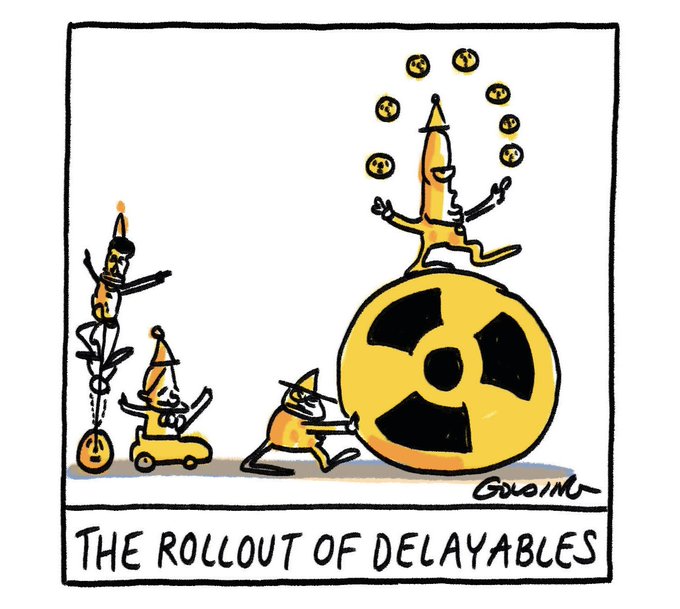
Coal has had its day as Australia’s key energy source — regardless of what politicians driving an energy debate full of distractions tell you over the next few months.
And the suggestion that nuclear energy is a viable replacement is a red herring.
John Quiggin, New Daily, 16 Mar 25
Coal-fired power is more expensive than renewable alternatives, more polluting and the power stations that use it now are old, generally obsolete and unreliable. They won’t be rebuilt. That’s not just an opinion, it’s backed by all the evidence, regardless of how many political agendas argue otherwise.
Coalition claims that nuclear energy can replace coal simply don’t stack up. It’s expensive and can’t possibly be delivered in time to replace coal-fired energy. And gas is not the stopgap solution some would like to think.
The genuine answer to deliver on Australia’s growing energy needs is to quickly manage the nation’s transition to renewables.
Yet the debate over future energy supply and power prices, which will be front and centre during the election campaign, is part of the ongoing culture wars over energy largely imported from the US.
Coal: the facts
The core of the problem is simple. The coal-fired power stations that supply about 50 per cent of electricity to Victoria, NSW and Queensland are old, unreliable and polluting.
Most are 40-50 years old, using obsolete ‘subcritical’ technology – which is constrained by the boiling point of water, and is about 34 per cent efficient. Even the newest plants at Kogan Creek and Tarong in Queensland use outdated supercritical technology, which is about 39 per cent efficient.
The state of the art in coal-fired power, still highly polluting, is ‘ultra-supercritical’ at 43 per cent efficiency but there are no Australian plants of this kind. Worse still, despite their relative youth and modernity, Kogan Creek and Tarong have been among the least reliable plants in the network.
Most of these plants are due for retirement soon: On current plans, all but a handful will be gone by 2035. Meanwhile, electricity demand is set to grow with the electrification of transport, industry and home heating and perhaps with the development of energy-hungry data centres.
There is no prospect of building new coal-fired power stations. The cost far exceeds that of solar photovoltaics and wind, even after allowing for the cost of battery storage.
Outside China and India, which had 97 per cent of new or revived coal-fired proposals in the first half of 2024, almost no one is building new coal-fired power stations.
Even in those two countries, where demand is growing rapidly, the great majority of new capacity is renewable.
There may be some role for gas in meeting peak demand, though even this is doubtful. Gas is a hugely expensive source of electricity, with the problem made worse by the way successive governments have mishandled Australia’s gas resources, selling gas cheaply to foreign buyers that might have to be bought back at a loss.
It becomes obvious the only real question — despite the imported culture wars — is how rapidly we can manage the transition to renewables and what mix of generation, storage and transmission technologies will best achieve this.
Coalition politicians like Barnaby Joyce have led campaigns against solar and wind projects and the transmission lines needed to incorporate them into the grid………………………………………………………………
Nuclear red herring
Rather than concede that its policy can only delay the transition, the Coalition has relied on the claim that nuclear power will provide a replacement for coal.
Apart from being massively expensive, nuclear power can’t possibly be delivered in time to replace existing coal-fired power stations.
Even in countries with established systems of regulation, trained workforce and ‘brownfield’ sites, construction of reactors commonly takes 15 years or more.
For Australia, starting from scratch, 20 to 25 years is more likely.
Nuclear power is, quite simply, a red herring. Senator Matt Canavan incautiously admitted as much last year, saying that while nuclear is expensive “we’re latching onto it as a silver bullet, as a panacea, because it fixes a political issue for us”.
This dishonest campaign, along with wider voter concerns about the cost of living, may be enough to get the Coalition past the next election.
But the real energy issues will remain and wishing them away with the illusory prospect of nuclear power won’t work. Australians deserve some reality in the political debate.
Professor John Quiggin is a professor of economics at The University of Queensland and a former member of the Climate Change Authority. https://www.thenewdaily.com.au/life/science/environment/2025/03/15/end-coal-nuclear
Bandt says Australia should cancel Aukus payments and leave pact.
Bandt says Australia should reconsider its relationship with the US and particularly the Aukus pact.
“It is being led by a very dangerous man, and we should get out of Aukus. Now is not the time to be hitching Australia’s wagon to Donald Trump. It puts Australia at risk, and it is billions of dollars that is being spent on submarines that might never arrive, even the United States Congress has said that they’re not building the submarines at the rate that is needed to in order to abide by the Aukus agreement.”
Bandt says that Aukus commits Australia to serving as “an attack force of the United States” and that any assumption the Trump administration is committed to standing with Australia if there was a security threat is a mistake.
“Thinking that Donald Trump will ride to our rescue if there’s any security threat, is now absolutely wishful thinking.”
Money being spent on Aukus submarines could be reallocated in defence: Bandt
Asked about whether Australia should close Pine Gap, Bandt says his “priority right now is Aukus” given that Australia has already been paying the US and UK to rebuild their shipyards.
“The prime minister and the government just gave Donald Trump the best part of $1bn in the last couple of weeks for submarines that may never arrive. And what’s happened in return? We have tariffs imposed on us and now the threat of more.
That is something that we could concretely do right now, instead of spending hundreds of billions of dollars on submarines that may never arrive.”
Pressed on the possibility of increased defence spending if Australia were to walk away from the US alliance, Bandt says the money currently being spent on nuclear submarines could be reprioritised, including to other parts of the defence force.
We have costed the Aukus contributions. It’s over the near-term, the next decade. We’re looking at $70bn being spent on it. Now, reallocating that would go a long way to ensuring that Australia has a fit for purpose defence force.
Australia’s Trump cards
by Rex Patrick | Mar 16, 2025, https://michaelwest.com.au/tariffs-australias-trump-cards/
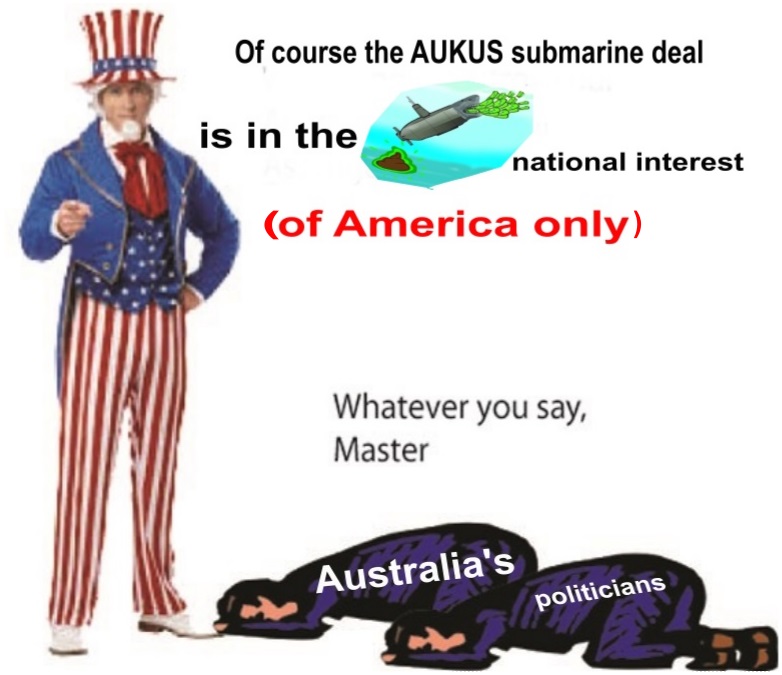
Australia does have Trump cards; North West Cape, Pine Gap, US Marine Rotational forces in Darwin, AUKUS and/or critical minerals that the US needs. Perhaps it’s also time to cancel the traitorous quantum computing development contract given to a US company over Australian companies.
These are things that we can put on the table. But doing that requires a measure of boldness. Our problem is our Prime Minister doesn’t have the ticker. Neither does the opposition leader. They are with Trump internationally as they are with the gas cartel domestically; owned and weak.
Anthony Albanese has it all wrong, writes former senator and submariner Rex Patrick. He’s trying to bribe Trump with sweeteners in response to trade tariffs. Instead, he needs to tell Trump he’s prepared to take things away.
US nuclear deterrent
Deep beneath the Indian Ocean, USS Kentucky, a nuclear-powered Ohio Class Ballistic Missile Submarine (SSBN) ploughs its way through the water. Contained within its 18,750 tonne pressure hull structure are 24 Trident ballistic missiles, each capable of carrying eight nuclear warheads to targets up to 12,000 km away.
The launch of all of USS Kentucky’s missiles would, quite literally, change the world by exacting severe destruction on whole societies.
This ability to inflict damage on an exceptionally large scale is the basis of the SSBN’s deterrent capability. Unlike silo based missiles, which are vulnerable to a first strike, or aircraft delivered nuclear weapons, which can be pre-emptively hit or shot down, SSBNs are essentially invisible. They provide certainty of response.
SSBNs serve as the ultimate nuclear deterrent. They’re extremely important to the US, whose navy possesses 14 of them. At any one time six to eight will be at sea, with four of them always on deterrent patrol. They are spread about the globe giving the US President the ability to quickly deliver return-fire with nuclear warheads at any adversary.
24/7 Operation
The primary performance metric for an SSBN is to be able to deliver its nuclear weapons with reliability, timeliness and accuracy.
The Commanding Officer of USS Kentucky must be able to loiter undetected in a place suited for the launching of weapons, be able to receive an order to launch, have an understanding of the submarine’s exact navigational position to a high degree of accuracy and have the ability to launch the weapons quickly and reliably once that order arrives.
Loitering undetected and being able to receive an order to launch is challenging. When a submarine is near the surface, their hulls can be seen by aircraft, and raised periscopes and communications masts can be seen visually and on radar. Operating a submarine at shallow depth can also result in acoustic counter-detection.
The Commanding Officer of USS Kentucky knows that deep is the place to be.
But being deep frustrates a submarine’s ability to receive communications, particularly an ‘emergency action message’.
And that’s were Very Low Frequency (VLF) communications stations come into play. In conjunction with a submarine’s buoyant wire antenna – a long wire that sits just below the sea surface – they can receive a launch command from the President.
The US has a network of these VLF communication stations around the world including in Maine, Washington state and North West Cape, Australia.
North West Cape
The VLF Communication Facility at North West Cape (NAVCOMMSTA Harold E Holt) has been in operation since 1967. Born of secrecy, it was at first exclusively US operated until 1974 when the facility became joint and started communicating with Australian submarines. In 1991 it was agreed that Australia would take full command in 1992 and US Naval personnel subsequently left in 1993.
The facility’s deterrence support role now rests on a 2008 treaty which, ratified in 2011, is formally titled the “Agreement between the Government of Australia and the Government of the United States of America relating to the Operation of and Access to an Australian Naval Communication Station at North West Cape in Western Australia”.
The station’s antenna is 360 meters high, with a number of supporting towers in a hexagon shape connected to it by wires. Considered to be the most powerful transmitter in the southern hemisphere, it transmits on 19.8 kHz at about 1 megawatt.
The station enables emergency action messages to be relayed to submerged SSBNs, like USS Kentucky, when operating in the Indian and Western Pacific oceans.
If the facility was taken out by a first strike nuclear attack, the US Air Force can temporarily deploy Hercules ‘TACAMO’ aircraft, with a long VLF wire they deploy while airborne. It’s a back-up measure with much lower transmission power capabilities.
A bedrock of certainty
After US steel and aluminium tariffs were put into play, the Australian Financial Review ran with a headline “How Australia was blindsided on the US tariffs”. The article opened with, “Australia pulled out all stops to avoid Donald Trump’s duties on steel and aluminium, but it’s impossible to negotiate with someone who doesn’t want anything”.
But the US does want something.
A fact not so well appreciated with respect to nuclear deterrence is it must be seen to be a robust and continuous capability. Onlookers must see a 24/7 capability including deployable submarines manned by well-trained crews, proven and reliable missile systems, an organised strategic command, a continuous communication system that reliably links that strategic command to the submarines with appropriate redundant communication pathways, training facilities and maintenance support.
Potential adversaries must know that they could be struck by an SSBN that could be lurking anywhere in the world’s major oceans.
Effective nuclear deterrence must be built on a bedrock of operational certainty.
Remove the transmitter keys
North West Cape forms part of that certainty.
Australia has the keys to take some certainty away. Without our cooperation the US can’t operate a certain global deterrent capability. Turning off transmissions at North West Cape reduces the effectiveness of the US nuclear deterrence while eliminating one Australian nuclear target
The North West Cape Treaty provides leverage. While the agreement has another decade to run, Article 12 provides that “either Government may terminate this Agreement upon one year’s written notice to the other Government.”
It’s open to Australia to signal or give actual notice of termination. That would focus up policy makers in Washington.
Would we do that to a mate? No, but the US is showing they are not a mate. They are not showing us the loyalty we have shown them. Other actions; abandoning Ukraine, threatening Greenland and Panama and a not so subtle push to annex Canada have also shown they are an unreliable ally who doesn’t share our values.
Trump cards
In negotiating with President Zelensky over the war in Ukraine, President Trump told him in no uncertain terms. “We’re going to feel very good and very strong. You’re, right now, not in a very good position. You’ve allowed yourself to be in a very bad position. You don’t have the cards right now with us.”
But Australia does have Trump cards; North West Cape, Pine Gap, US Marine Rotational forces in Darwin, AUKUS and/or critical minerals that the US needs. Perhaps it’s also time to cancel the traitorous quantum computing development contract given to a US company over Australian companies.
These are things that we can put on the table. But doing that requires a measure of boldness. Our problem is our Prime Minister doesn’t have the ticker. Neither does the opposition leader. They are with Trump internationally as they are with the gas cartel domestically; owned and weak.
Things have changed
Alliances are means to ends, not an end in themselves; and, as pointed out above, things have changed. We can pretend everything is okay, but that doesn’t make it so.
But the bureaucracy is unlikely to advise the Government of alternatives.
Our uniformed leaders are locked into AUKUS, a program that gives them relevance at the big table; something they wouldn’t otherwise have with the depleted Navy they’ve built out of their procurement incompetence. They’re clinging to that relevance, despite all signs showing the program is running aground.
Our spooks are in the same place. In response to calls to put Pine Gap on the table, former Home Affairs Secretary Mike Pezzullo (sacked for failing to safeguard sensitive government information) spoke out, putting the facility ahead of trade interests and Aussie jobs.
The bulk of the intelligence from Pine Gap is very usable for the US and rather less so for Australia. Senior spooks just want to maintain their own relevance in the Five Eyes club; but it’s a mistake to conflate their interest with our national interest.
We should be prepared to play our Trump cards and we should be prepared to face the national security consequences.
If that means an Australia that‘s more independent and more self-reliant, that would be a very good thing. If there’s a shock to the system, then all well and good, because in the changing world we find ourselves in, it might be the only thing that wakes the Canberra bubble from its stupor and pushes us to actually be prepared.
In these uncertain times, there are no hands more trustworthy than our own.
Rex Patrick is a former Senator for South Australia and earlier a submariner in the armed forces. Best known as an anti-corruption and transparency crusader, Rex is running for the Senate on the Lambie Network ticket next year – www.transparencywarrior.com.au.
Silent vigil against nuclear
By Castlemaine Mail, March 15, 2025
A silent vigil was held on the steps of Castlemaine’s historic Market Building on Tuesday afternoon was part of the ‘National Day of Action against Nuclear Power’ held across Australia.
The day … (Subscribers only) https://castlemainemail.com.au/latest-news/2025/03/15/silent-vigil-against-nuclear/
Poisoning the well – The toxic legacy of Cold War uranium mining in western New Mexico

Studies have shown that chronic exposure to uranium through drinking water can cause kidney damage and cardiovascular disease. When inhaled, uranium can lead to lung cancer and pulmonary fibrosis, a scarring of the lung tissue. Studies of uranium miners associate cumulative exposure to radon with higher rates of death by lung cancer.
Proving that one’s illness originated as a result of living near a mine or mill, as opposed to actually working in it, is nearly impossible, given that symptoms can take years to manifest — a lack of clear causation that is ultimately advantageous to polluters.
Near the western New Mexico town of Grants, the toxic legacy of Cold War uranium mining and milling has shattered lives, destroyed homes and created a contamination threat to the last clean source of groundwater for an entire region
SEARCHLIGHT NEW MEXICO, by Alicia Inez Guzmán, March 13, 2025 [ excellent pictures and maps]
Driving along a stretch of New Mexico Highway 605, just north of the tiny Village of Milan, it’s easy to imagine that this area has always been no-man’s-land. Little appears in the distance except for a smattering of homes and trees peppered by expanses of bone-dry scrub brush. But a hard second look reveals something else — vestiges of a mass departure. Sidewalks lead to nowhere, a dog house sits in the middle of a field next to a mound of cinder blocks, phone lines crisscross empty stretches of land and deserted propane tanks and mailboxes sit perched in front of nothing. Around the bend on one unpaved side road, a neighborhood watch sign stands sentinel where a neighborhood no longer exists…………………………………………………………………………………………………………………
This home site was once part of a cluster of five rural subdivisions interspersed with rich farm and ranchland. The Homestake Mining Company — famously known for gold mining in the Black Hills of South Dakota — took up residence here in 1958, to mill uranium. From that year until 1990, millions of tons of ore were prised from nearby mines and processed at Homestake, where the ore was ground into fine particles and leached with a solution that coaxed out pure uranium oxide, often called “yellowcake.” That uranium was then shipped off to help make America’s Cold War fleet of nuclear weapons or to power nuclear reactors. The leftover slurry was piped into two unlined earthen pits, the largest the size of 50 football fields and filled with over 21 million tons of uranium mill tailings.
Over time, the uranium tailings decayed into radon gas; meanwhile, radioactive contaminants seeped into four of the region’s aquifers. Residents compiled a list of neighbors who died of cancer — they called it the Death Map. In 2014, the U.S. Environmental Protection Agency (EPA) predicted that the probability of developing cancer was notably higher for residents who lived closest to the mill, especially if they drank the water.
In the intervening decades, Homestake attempted to hold its remaining contamination at bay rather than offer a long-term solution. That changed in 2020, when the company declared that a full cleanup of the groundwater was not feasible and instead embarked on a mass buyout and demolition of homes inside the rural subdivisions and beyond, Boomer and Billiman’s included. Homestake’s goal, ultimately, is to hand over 6,100 acres of land — almost twice the size of nearby Milan — to the U.S. Department of Energy (DOE) as part of a special federal program that takes over shuttered nuclear outfits when industry walks away. The deadline is 2035. And if this site is anything like the majority of the DOE’s other sites, the land will be rendered inaccessible to the public, with the company’s guarantee that toxins will stay inside the massive contamination zone boundary for a thousand years.
“Talk about the myth of containment,” says Christine Lowery, a commissioner in Cibola County. “The myth of reclamation as well,” she adds. For Lowery, a member of the Pueblo of Laguna who lives in Paguate, one of its six villages — itself blighted by the Jackpile-Paguate Uranium Mine, one of the world’s largest open pit uranium mines — the subtext is clear. “What they should be saying is, ‘We’ve contaminated everything we can, and there’s no way we can fix it.’”
In fact, the conditions necessary for contaminants to infiltrate a fifth aquifer in a single generation — not a thousand years — could already be in the making. The aquifer in question is the San Andres-Glorieta, so ancient that its limestone was forged from the same material as seashells before the era of the dinosaurs. It’s also the last clean source of groundwater for Milan, the county seat of Grants, many private well owners and the Pueblo of Laguna, as well as the Pueblo of Acoma, one of the longest continually inhabited communities in the United States.
According to regulators, the San Andres-Glorieta still meets standards for groundwater that is safe to use and drink. According to Homestake’s own reports, however, at least three uranium plumes are converging toward what Ann Maest, an aqueous geochemist with Buka Environmental, a Colorado-based firm, calls “a bull’s-eye of radioactive contamination.” The potential target? A geological formation called a subcrop. Here, approximately 100 feet below the surface of the earth and three miles southwest of the Homestake site, this subcrop directly connects the San Andres-Glorieta with an overlying aquifer long known to transport contamination from two uranium mills including Homestake. In 2022, the company commissioned an independent firm to study the geological feature. But according to a memo sent to state and federal regulators and written by Maest the following year, the findings were “light on interpretation” and evaded answering the most important question of all: Have those contaminants reached the San Andres-Glorieta?………………………
Gauging the extent of groundwater plumes is notoriously difficult. Topography and geology shape how groundwater moves, and sampling can underestimate the full range of a plume, leaving gaps in the data, whether that’s inadvertent or intentional. A 2022 ProPublica investigation found that regulators had been lax in their oversight of the Homestake mill, its toxic footprint and the uranium industry as a whole. Over time, a dizzying array of state and federal agencies have each overseen a different aspect of the site’s reclamation; in the past, those agencies haven’t even agreed on what that reclamation should look like.
Now, as uranium mining undergoes a national revival under initiatives that favor carbon-free nuclear energy, waste from the previous Cold War era of mining and milling endures. Homestake’s remediation — which has gone on for 49 years — exemplifies this legacy. During that time, company reports say, its collection wells have pumped out billions of gallons of contaminated water. Nearly one million pounds of uranium have been removed from the groundwater, too. Bingham says this represents 85 percent of the total uranium that was released into the environment. That’s in addition to the removal of tens of thousands of pounds of selenium and over a million pounds of molybdenum.
The company has attempted to keep pollutants that have seeped into groundwater from migrating farther away from the source. But this so-called hydraulic barrier has only addressed the symptoms of the contamination, not the cause: the tailings piles, which the company declined to relocate into a lined repository nearby. That means that some groundwater contamination continues to spread beyond Homestake’s site. The hydraulic barrier has another drawback — it has used “a massive amount of freshwater from the San Andres-Glorieta aquifer to operate,” says Laura Watchempino, a member of the Multicultural Alliance for a Safe Environment (MASE), a grassroots network of uranium-impacted communities working collectively to address the legacy of mining and milling on the health and environment of future generations. Watchempino is a former lawyer who also worked as a water quality specialist for the Pueblo of Acoma………………………………………………………………………………..
………………………………………………………………….Carver estimates that he is one of around 30 holdouts left in the five subdivisions; four of the families live in his own, Murray Acres. But few others have spent so much time fighting to hold the company accountable. “I’m 85 and it all started when I was 40,” he says.
In 1983, he was one of the plaintiffs in a lawsuit filed against the company, which argued, among other claims, that contamination of the well water had “completely destroyed the market value of the plaintiffs’ properties.” As part of the settlement, the company made small cash payments to residents and hooked them up to the municipal water system, which drew from the last clean source of water in the region, the San Andres-Glorieta. That year, the mill was designated a Superfund site, and in 1987 the company entered into a consent order with the EPA to analyze radon levels in residents’ homes, the product of uranium decaying from the tailings piles.
The mill closed in 1990, less than a decade after the uranium industry went bust. Records from the county assessor’s office show that Homestake quietly began buying a handful of homes in adjacent neighborhoods as early as 1996. (In 2001, Homestake Mining merged with the Canadian juggernaut, Barrick Gold, one of the world’s largest gold mining companies.)
“Every time someone dies or decides to move away, Homestake-Barrick Gold buys the property at a greatly reduced cost, which they can do because their ineffective groundwater remediation has devalued property many of us worked lifetimes to build,” Candace Head-Dylla, a former resident, said in a 2017 letter to the NRC.
In 2020, the company argued that it was no longer technically practical to clean up the groundwater to match its pre-mill days, Bingham wrote. So began the tangled regulatory process of applying for a less-stringent cleanup standard through the NR……………………………………
Searchlight asked the DOE for comment, but the agency declined. According to Samah Shaiq, a former DOE spokesperson, the agency is not yet responsible for the site.
The NRC denied Homestake’s application for the lower standard — the basis of the buyout — but the company remains steadfast in its desire to walk away. As part of those plans, Homestake has already scooped up approximately 455 of the estimated 523 properties that sit inside its proposed boundary, an expanse that’s nearly as large as the most contaminated area of the Rocky Flats Plant, another of the more than 100 sites under the DOE’s perpetual care, where thousands of plutonium bomb cores for the nation’s nuclear arsenal were fabricated between 1952 and 1989.
Much of Milan, along with huge swaths of land west and north, including some five miles of Highway 605, sit within this massive pie-shaped chunk, a proposed boundary that is based on the company’s groundwater modeling data. Inside are public water and electric lines, groundwater wells, septic systems and other, smaller roads, the fate of which have yet to be determined. Milan Elementary School sits only a mile away from the boundary’s southernmost rim.
When Searchlight asked how fast those plumes are migrating, drawing on a Homestake-produced simulation that’s meant to predict how contaminants move in groundwater aquifers at the site, the EPA declined to comment, because the simulation was still in draft form.
Regulators, meanwhile, are plodding through the process of determining what final act of remediation they should require before allowing Homestake to hand off the site to the DOE. But prospects for that remedy depend on whether and when the company will receive a lower cleanup threshold. If a lower standard is settled on, that remedy, whatever it may be, will fall radically short of truly protecting groundwater, advocates believe. Adding to the uncertainty is a recent announcement that the Trump administration intends to cut personnel at the EPA by up to 65 percent.
The future of the site seems all but predetermined: a wasteland in the truest sense, and a national sacrifice zone. The buyout, a prologue to this future, has fractured residents’ lives in the present. Homestake subjected sellers to nondisclosure agreements — “standard business practice,” in Bingham’s words — but to some in the community, a mechanism for silencing dissent……………………………………………………………………………………………………………………………………………
“We’ve been poisoned to the gills”
The Grants Mining District stretches from the Pueblo of Laguna to Gallup, across almost 100 miles of western New Mexico’s red bluffs. Uranium here and throughout the world is ancient even by cosmic standards………………………………………………………
…………………………..in time, more than 150 mines would be developed across this district and the greater San Mateo Creek Basin, and, today, there are a total of 261 former uranium mines statewide, making New Mexico the fourth-largest producer of uranium globally, behind East Germany, the Athabasca Basin and the Democratic Republic of the Congo, which supplied much of the uranium for the Manhattan Project.
But with the uranium boom came a wave of devastation across the greater Southwest, including in Indigenous communities like the Pueblo of Laguna, as well as the Navajo Nation, where there are more than 500 abandoned uranium mines. Workers often lived near mines and mills and would bring yellowcake home on their clothes, exposing their families to harmful radioactive dust; water sources, meanwhile, have shown “elevated levels of radiation,” according to the EPA.
In the Church Rock Chapter of the Navajo Nation, a tailings dam breached on an early July morning in 1979, sending contaminated water into the Rio Puerco. Today, it constitutes the largest release of nuclear materials in the U.S. worse even than the meltdown at Three Mile Island.
Church Rock was among the eight mills that processed uranium ore in New Mexico. Others include Homestake and, in its immediate vicinity, Bluewater and two mills at Ambrosia Lake. Workers flocked here from across the state and nation during the booming 1960s and 1970s, with Homestake alone employing 1,500 people at its peak.
After graduating from high school and intermittently through his college years, Carver worked stints at all four of those mills before opening his own business, Carver Oil. At Homestake, he worked at a site where yellowcake was processed and packaged into barrels to go to Oak Ridge, Tennessee, where it would be enriched for use in nuclear weapons. He also worked in the tailings piles.
Carver now receives benefits for spots on his lungs from the Radiation Exposure Compensation Act (RECA), a program he qualified for because of his time working in the mills. Whether his illness was compounded by living near the mill tailings and by breathing excess radon, or by drinking the water — at least until the company connected residents to a clean source — is unknown. Studies have shown that chronic exposure to uranium through drinking water can cause kidney damage and cardiovascular disease. When inhaled, uranium can lead to lung cancer and pulmonary fibrosis, a scarring of the lung tissue. Studies of uranium miners associate cumulative exposure to radon with higher rates of death by lung cancer.
Maggie Billiman, who’s from the Sawmill Chapter of the Navajo Nation, has advocated for RECA to cover people in New Mexico and parts of Arizona who lived downwind of atmospheric nuclear tests or who worked in mines after 1971, the current cutoff date. Last fall, she traveled with other Indigenous activists to Washington, D.C., as part of her efforts to expand RECA after struggling with various undiagnosed illnesses for years; several painful cysts that have yet to be biopsied were recently found on her liver and pancreas. Many doctor visits later, she’s still pursuing a clear diagnosis and treatment plan.
But whether or how one gets sick can depend on biological sex, age when exposed and the pathway a certain type of radioactive particle takes to enter the body. Proving that one’s illness originated as a result of living near a mine or mill, as opposed to actually working in it, is nearly impossible, given that symptoms can take years to manifest — a lack of clear causation that is ultimately advantageous to polluters.
Groundwater contamination from uranium mining was detected as early as 1961. Even before that, the federal government was aware that New Mexico’s waterways were already showing signs of radioactive contamination from the burgeoning uranium extraction industry. It would take another 15 years for Homestake to begin a convoluted, if limited, remediation effort: A series of collection wells would pull contaminated water out and treat it, then pump that water, along with clean water sourced from the San Andres-Glorieta, back into the subsurface.
………………………………………………………………………………………………………………………….. It’s hard to visualize such an underground fortification — on maps, it looks like a cashew-shaped moat that wraps around the west and south sides of the large tailings pile — or the timescale needed for its maintenance. In 1982, Homestake said it would “require operation for a considerable amount of time.” In response, NMED declared that Homestake had to commit to operating the system until it “can be demonstrated that contaminants in the groundwater will not exceed New Mexico Water Quality Control Commission standards off Homestake’s property in the foreseeable future.”
Advocates believe that means forever. If barrier maintenance is stopped, experts contend that highly contaminated groundwater will migrate southward and downward and eventually make its way to the subcrop, an entry point into the San Andres-Glorieta, municipal supply wells for Milan and Grants and eventually the Río San José. “This signals a bleak future for the stream system and for future generations,” Laura Watchempino warns.
Bluewater’s plume is coming from the northwest; Homestake’s plumes from the northeast. Models show that all are converging, like a Venn diagram, in a location where groundwater flows toward the subcrop. On one side, the hydraulic barrier is warding off some of that pollution, but when it stops operation completely, those contaminants will very likely infiltrate the San Andres-Glorieta, according to NMED.
In the past, it’s been difficult to discern what contaminants belong to what polluter, especially when they mingle, as is the case here. But in 2019, the USGS published the findings of a study that “fingerprinted” such mine and mill contaminants to show their point of origin……………………….
…………………………………….. “We’ve been poisoned to the gills,” says Christine Lowery, the Cibola county commissioner. “The question is: How do we recover and live with contamination?”
Alicia Inez Guzmán
Raised in the northern New Mexican village of Truchas, Alicia Inez Guzmán has written about histories of place, identity and land use in New Mexico. She brings this knowledge to her current role at Searchlight, where she focuses on nuclear issues and the impacts of the nuclear industry. The former senior editor of New Mexico Magazine, Alicia holds a Ph.D. in Visual and Cultural Studies from the University of Rochester in New York. More by Alicia Inez Guzmán https://searchlightnm.org/new-mexico-cold-war-uranium-mining-toxic-legacy-threat-homes-underground-aquifers/?utm_source=Searchlight+New+Mexico&utm_campaign=d2d0fd81fc-3%2F13%2F2025+%E2%80%93+Poisoning+the+well&utm_medium=email&utm_term=0_8e05fb0467-d2d0fd81fc-395610620&mc_cid=d2d0fd81fc&mc_eid=a70296a261
Nuclear law: Could Australia go nuclear?

Holding Redlich, 11 March 2025, Scott Schlink, Valentina Hanna
Key takeaways
- The Coalition continues to advocate for its plan to introduce nuclear into Australia’s energy mix, claiming that it will provide cheaper, cleaner and consistent power. Part of this plan includes the construction of 7 nuclear power plants across the country.
- Australia has legislated prohibitions at commonwealth, state and territory levels against the construction and operation of nuclear plants and installations.
- The House Select Committee on Nuclear Energy recently published an interim report, concluding that nuclear power generation is not a viable option for Australia’s energy needs due to the significant deployment time and costs.
- A future Coalition Government must therefore navigate through a series of social, political and economic barriers to bring nuclear energy into the mix.
……………………………………………………………………………………………………………………………………………………… https://www.holdingredlich.com/nuclear-law-could-australia-go-nuclear
New tool to cut through energy debate as price hike prompts new questions about nuclear
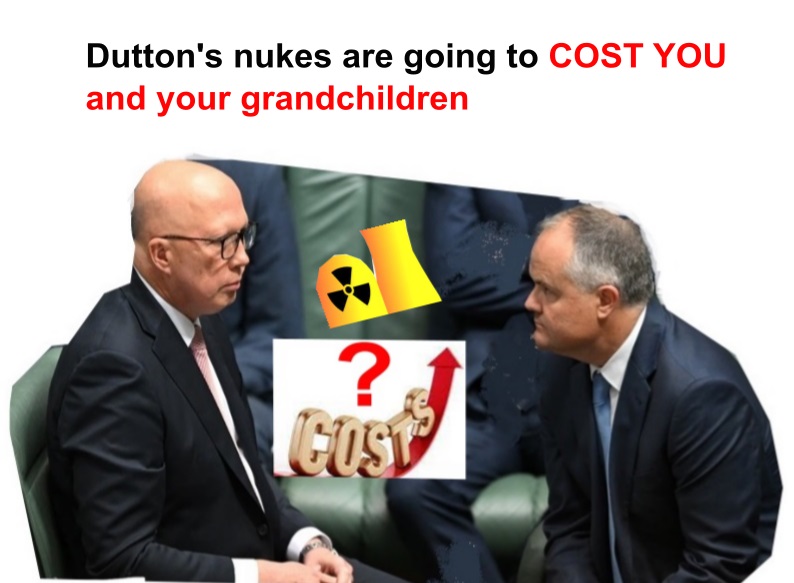
March 13, 2025 AIMN Editorial, Australians for Affordable Energy https://theaimn.net/new-tool-to-cut-through-energy-debate-as-price-hike-prompts-new-questions-about-nuclear/
Amid today’s news of energy bill spikes, Australians have a new tool to calculate how their bills would fare with a nuclear generation option.
It’s been confirmed that unreliable coal-fired electricity plants are causing 2.5-8.9 per cent energy bill increases. That has raised concerns about the Coalition’s nuclear proposal, which would keep households vulnerable to coal price spikes for many years, Australians for Affordable Energy (AFAE) warned today.
With energy costs shaping up as a key election issue, AFAE has launched a free calculator, available at afae.net.au/calculator, which provides a real-world cost estimate for households based on the proposed nuclear energy plan.
The calculator extrapolates from the Institute for Energy Economics and Financial Analysis (IEEFA) analysis to provide Australians with a clear picture of nuclear energy costs based on international examples.
The tool allows users to input their current electricity costs and household size – or use state averages if unsure – to see potential changes to their bills under various nuclear scenarios and help them make an informed decision.
“Australians are confused about the costs and timelines of building seven nuclear reactors—one of the largest government projects ever proposed. There’s widespread uncertainty in the energy debate, and our goal is to clarify exactly what nuclear power could mean for household bills, good or bad,” said AFAE spokesperson Jo Dodds.
“Cost of living will dominate the upcoming election, and Australians deserve clear answers. Our calculator helps Australians see firsthand whether nuclear energy genuinely stacks up as an affordable option.”
The Australian Energy Regulator confirmed today that power prices are predicted to go up by up to 8.9% per cent from July, forcing families and businesses already struggling with cost-of-living pressures to pay even more for essential electricity.
The price hike directly results from continued reliance on ageing coal-fired power stations. Gas prices also contribute to rising energy costs due to ongoing international volatility, adding uncertainty and pressure to wholesale electricity prices.
“Today’s announcement is another blow to households already struggling. Australians are exhausted as bills keep rising with no clear solutions in sight. Australians for Affordable Energy wants to help everyone understand what these price hikes really mean as we approach the federal election. Australians deserve better than constant uncertainty and higher costs.
“Coal is like a beloved old, beat-up car we keep throwing money at just to keep it running. Nuclear is increasingly becoming something we don’t need and can’t afford. Both drive costs higher without offering practical, affordable solutions. Australians deserve reliable, affordable electricity – not crumbling coal plants or overpriced nuclear projects decades away.”
Australians for Affordable Energy (AFAE) is dedicated to ensuring energy policies prioritise affordability and sustainability for all Australians.
“Nothing but broken promises”: ICAN Ambassador, Karina Lester calls out Australia’s inaction on the Treaty for the Prohibition of Nuclear Weapons,
ICAN Australia, 13 Mar 25
On Thursday, Yankunytjatjara-Anangu woman, second-generation nuclear test survivor, and ICAN Ambassador Karina Lester delivered a statement during the segment on Victim Assistance and Environmental Remediation and International Cooperation.
| In her powerful statement, Karina outlined the expectations from affected community members worldwide for support under Articles 6 & 7 of the TPNW, which require states parties of the TPNW work collaboratively to provide support to communities impacted by the use and testing of nuclear weapons. Karina also called out the Australian Government’s lack of action on the TPNW to date, and made clear that it is time for Australia to sign and ratify the TPNW, without delay. |
| “I am concerned and deeply saddened that my own country has yet to sign and ratify the Treaty on the Prohibition on Nuclear Weapons. My country, my traditional lands, has felt the reality of nuclear weapons use. We even launched the movement that brought us to this day here in New York – the International Campaign to Abolish Nuclear Weapons. |
Yet despite promises, despite the expectations of community members and parliamentarians, and despite the clear and urgent need, we are still waiting.
Australia is the gap in our region. And this is shameful, nothing but broken promises. Many of our friends in the Pacific Islands and those in South East Asia have joined the Treaty. We call on our government to sign and ratify, to join this community of nations in working together to abolish nuclear weapons.”
In an interview with NITV, Karina said that the impacts of the British Nuclear tests on her country are still felt today, more than 70 years later.
Yet despite promises, despite the expectations of community members and parliamentarians, and despite the clear and urgent need, we are still waiting.
Australia is the gap in our region. And this is shameful, nothing but broken promises. Many of our friends in the Pacific Islands and those in South East Asia have joined the Treaty. We call on our government to sign and ratify, to join this community of nations in working together to abolish nuclear weapons.”
In an interview with NITV, Karina said that the impacts of the British Nuclear tests on her country are still felt today, more than 70 years la
US report discusses possibility of nuclear submarine accident, if subs supplied to Australia

A report to the US Congress discusses the possibility of an accident with a nuclear-powered submarine if it supplies one to Australia.
This comes amid renewed questions over whether an AUKUS submarine deal would leave the US vulnerable, and an accident off the English coast where a tanker carrying jet fuel for the US military has hit a cargo ship.
The risk of a marine accident is one of three risks looked at around the submarines deal that is central to the the AUKUS Pillar One pact.
The congressional research report said an accident “might call into question for third-party observers the safety of all US Navy nuclear-powered ships”.
That could erode US public support and the ability of US nuclear-powered ships to make port calls around the world.
The 111-page report by the Congressional Research Service discussed the US not handing over the subs at all – although Canberra just made a $870m downpayment on them.
Keeping them might make up for the US sub fleet hitting “a valley or trough” around now till the 2030s, and shipbuilding being at a low point, it said.
Donald Trump’s pick for the top defence policy role at the Pentagon, Elbridge Colby, has said AUKUS could leave the US short and “it would be crazy to have fewer SSN Virginia-class [attack submarines] in the right place and time”.
The new research report to Congress said Pillar One was launched in 2021 without a study of the alternatives.
One alternative “would keep all US-made SSNs under the control of the US Navy, which has a proven record extending back to 1954 of safely operating its nuclear-powered ships”.
The original Pillar One pact is for the US to sell between three and five subs to Australia, then Australia to use US and UK nuclear propulsion technology to build another three-to-eight nuclear powered, conventionally armed submarines itself, for a total fleet of eight.
Australia’s Defence Minister Richard Marles said on Monday that Elbridge Colby was broadly supportive of AUKUS, if enough subs were available.
Canberra was aware of the challenge in the US around producing submarines, “and that’s why we’re contributing to the US industrial base”.
“And it’s a significant contribution and it’s going to increase the availability of Virginia class submarines for the United States.
“That’s a point which has been accepted and understood by the US Defence Secretary, Pete Hegseth, in the meeting that I had with him.”
Australia was last year included as a “domestic source” of US military production for the first time, and is aiming to ramp up making ammunition and missiles, as well as test hypersonic weapons with the US and UK.
“That’s going well in the sense that we are making the contributions, we are seeing an increase in production rates, and over the time frame in which we are looking to have our Virginia class submarines transferred to us, we are confident that this challenge can be met,” Marles told the ABC.
In the US, Trump appears most focused on building an ‘Iron Dome’ missile defence system, as he mentioned in his speech to Congress. This would be another huge pressure on military spending.
The report to Congress covered three big risks – accidents and whether Pillar One was the best option for deterrence and “warfighting cost-effectiveness”, and how the tech – the “crown jewels of US military technology” – could be kept secret, especially from China.
It debated a different “military division of labour”.
“Australia, instead of using funds to purchase, build, operate, and maintain its own SSNs, would instead invest those funds in other military capabilities – such as … long-range anti-ship missiles, drones, loitering munitions, B-21 long-range bombers, or other long-range strike aircraft” to conduct “missions for both Australia and the United States”.
The general rule was programmes should not go ahead without a sound business case, it noted.
“There is little indication that, prior to announcing the AUKUS Pillar 1 project in September 2021, an analysis of alternatives … or equivalent rigorous comparative analysis was conducted to examine whether Pillar 1 would be a more cost-effective way to spend defence resources for generating deterrence and warfighting capability”.
The report made no mention of how New Zealand, Japan, Korea and others might join AUKUS Pillar Two, an agreement for sharing advanced military tech.
Coalition’s nuclear plan most expensive option for Australia, former US climate official says
Dr Jonathan Pershing, a former US special envoy for climate change and climate negotiator under Democratic presidents, says few countries building nuclear power plants
Adam Morton Climate and environment editor, Tue 11 Mar 2025 , https://www.theguardian.com/australia-news/2025/mar/11/coalitions-nuclear-plan-most-expensive-option-for-australia-former-us-climate-official-says
A longtime senior US climate official has weighed in on Australia’s energy debate, saying “very, very few people” internationally are building new nuclear power plants and, in most cases, the combination of solar and batteries delivers “higher reliability than gas”.
Dr Jonathan Pershing, a former US special envoy for climate change and climate negotiator under Democratic presidents, was in Sydney on Monday to speak at the city’s climate action week. Asked whether nuclear power as proposed by the Coalition was a viable option for Australia, he said “almost all the numbers that I have seen suggest that that’s a more expensive option than other choices”.
“What’s really interesting is the global community’s progress on nuclear with, frankly, a bigger head start than Australia’s had, because the ban here has been in place for a long time,” he told Guardian Australia.
“Very, very few people are building new nuclear.”
Pershing, who is program director at the William and Flora Hewlett Foundation, said even if Australia was able to overcome two immediate hurdles to nuclear energy – the legislated ban and an historical lack of public support for the technology – it then faced asking taxpayers to pay “holding costs” for 10 to 20 years when it could be building the same amount of generating capacity sooner.
“The cheapest one still globally, and I think here as well, is probably a combination of solar plus batteries – and that’s firm capacity, by the way,” he said. “If we look at the way that’s been analysed, the combination of the two [solar and batteries] gets you higher reliability than you get from gas.
He cited the example of the 40-year-old Diablo Canyon nuclear plant, in California. He said it was not likely to be replaced with a new nuclear generator once it reached the end of its life because of the cost. “They’ll do some life extensions, but they don’t think it is even plausible to imagine building new capacity there,” he said. “It’s just too expensive.”
The Coalition has claimed that its proposal to slow the rollout of renewable energy, extend the life of ageing coal plants, rely more on gas-fired power and later build publicly funded nuclear plants at seven sites, mostly after 2040, would be cheaper and more reliable than Labor’s promise of sourcing 82% of Australia’s electricity from renewable energy by 2030.
Peter Dutton has said the Coalition’s claim is supported by a report by consultants at Frontier Economics. But several other independent energy experts have argued the Coalition’s plan would, in relative terms, be likely to be more expensive for consumers over the next decade, at least, and less reliable and lead to substantially higher greenhouse gas emissions.
Pershing said a another problem for Australia would be training personnel for a nuclear power industry. Technical experts would have to be brought from overseas, which isn’t the case for other types of energy generation, he said.
That expertise could come from Canada, China, France or Russia, adding that in the case of Russia, “I’m not so convinced that that’s where you’d want to go”.
Pershing said the Trump administration’s anti-climate action stance would have an effect “but, I think, less than people might imagine”. He said the change in the US was an opportunity for Australia, “depending on how it chooses to engage”.
“The thing that’s most salient is that the rest of the world has decided that the least-cost solution to provide for more energy, particularly for electricity, is through some combination of renewables technologies plus batteries,” he said, citing International Energy Agency data showing it was the cheapest and faster solution “for about 80% of the world”.
“In much of the world, demand [for energy] is rising and you’re going to have to supply that demand from something. That means transition minerals, and that means technology, and that means investment. Those are places that the Australian economy is well positioned to deliver.”
Based on Trump’s language and early actions, the US was likely to slow the construction of wind and solar power and electric vehicles while increasing its demand for critical minerals, he said. But the US was “not the primary place where things are happening”.
“The place where things are happening is across Asia, broadly, with enormous continued demand from China, demand from India, demand from Indonesia and then actually others around the world who are building on that capacity,” he said.
Regarding fossil fuel exports, Pershing said the question for Australia was how it replaced the economic value of the coal and gas it sells with other exports, and what commitments it has made that were consistent with keeping global heating to less than 2C.
Australia could, for example, build a new mutually beneficial trade relationship with Japan where Australia produced and sold zero carbon steel and other metals. Pershing said Australia would also have to deal with the future of communities, such as in the Hunter Valley and its nearby port of Newcastle, that rely heavily on coal mining and coal exports.
“I think these are difficult questions, and they’re legitimate ones for the whole society to take up,” he said. “[A change] is coming. It’s not that it won’t come, but if we don’t manage it, it’ll have enormously negative consequences for communities, and I think that’s on the collective government, civil society and thought leadership to resolve and to address”.
1 This month
7 April – WEBINAR – Australia and the Doomsday Clock – Preventing nuclear war through NoFirstUse and other policies
Online | Tuesday April 7, 4:00-5:30pm, Australian Eastern Time / 8:00-9:30am Central Europe Time
– Access the registration link
15 April – Zoom –Nuclear Power is Not the Solution
Apr 15, 2026 01:00 AM in Canberra, Melbourne, Sydney

Join the International Physicians for the Prevention of Nuclear War (IPPNW) on Tuesday, April 14th for a timely webinar exploring the risks associated with nuclear power and challenging the myth that it offers a simple, safe, carbon-free solution to the climate crisis

21 April Webinar: No Nuclear Weapons in Australia
Start: 2026-04-21 18:00:00 UTC Canberra, Melbourne, Sydney (GMT+10:00)
End: 2026-04-21 19:30:00 UTC Canberra, Melbourne, Sydney (GMT+10:00)
Event Type: Virtual
A virtual link will be communicated before the event.
Host Contact Info: australia@icanw.org

of the week – Australians for War Powers Reform (AWPR)
To see nuclear-related stories in greater depth and intensity
 Antinuclear