South Australia shortlists seven renewable hydrogen projects for massive export hub — RenewEconomy

South Australia shortlists seven projects that could deliver 1.5 million tonnes of renewable hydrogen to its proposed new hub. The post South Australia shortlists seven renewable hydrogen projects for massive export hub appeared first on RenewEconomy.
South Australia shortlists seven renewable hydrogen projects for massive export hub — RenewEconomy
Japan looks to renewables, role of nuclear elusive ahead of election — Fukushima 311 Watchdogs

Oct 29, 2021 Japan aims to increase its reliance on renewable energy in achieving net-zero emissions, but the role of nuclear power to be played toward that end appears to be elusive even in the government’s energy plan approved by the Cabinet about a week ahead of Sunday’s general election. The plan outlines ways to […]
Japan looks to renewables, role of nuclear elusive ahead of election — Fukushima 311 Watchdogs
Fukushima Daiichi Nuclear Power Plant Judges Visit Site for First Time in TEPCO Shareholders’ Derivative Suit — Fukushima 311 Watchdogs

Oct. 29, 2021In a lawsuit filed by shareholders of Tokyo Electric Power Company (TEPCO) demanding compensation from the former management over the accident at the Fukushima Daiichi Nuclear Power Plant, judges from the Tokyo District Court visited Fukushima Prefecture on March 29 and inspected the site of the plant. This is the first time that […]
Fukushima Daiichi Nuclear Power Plant Judges Visit Site for First Time in TEPCO Shareholders’ Derivative Suit — Fukushima 311 Watchdogs
Japan PM’s nuclear push faces resistance ahead of election — Fukushima 311 Watchdogs

Oct 28, 2021 KASHIWAZAKI, Japan – A decade after triple meltdowns at Fukushima forced mass evacuations and a shut-down of the nuclear industry, Japan has restarted only a third of its 33 operable reactors Prime Minister Fumio Kishida’s push to restart Japanese nuclear power plants idled after the Fukushima disaster faces stiff opposition ahead of […]
Japan PM’s nuclear push faces resistance ahead of election — Fukushima 311 Watchdogs
October 31 Energy News — geoharvey

Opinion: ¶ “Here To Stay Or Gone In 30 Years? Inside The Fight Over The Future Of The Oil Industry” • Oil is back above $80 per barrel, but production has been on the decline since the turn of the century. Even without a need to stop use of fossil fuels, the oil industry cannot […]
October 31 Energy News — geoharvey
Health impacts of nuclear accidents

Too expensive, too slow: Even the baseload argument doesn’t work for nuclear. ReNeweconomy, Mark Diesendorf 29 October 2021
”’………………………………………Health impacts of nuclear accidents
Another misleading pro-nuclear statement revived following the Fukushima Daiichi disaster in 2011 is that no excess cancer incidence has been observed around Fukushima, implying that no cancers will be induced. The logical error is to assume that the absence of evidence implies no impact.
It is still too early for most types of cancer, which have latent periods of 20–60 years, to appear around Fukushima. The only cancers likely to appear within a decade after exposure are thyroid cancer and leukemia.
A large increase in thyroid cancers has been observed in the region, but their cause is debated by some on the grounds that the increase could be the result of better screening. Leukemia is an uncommon disease and so even a large percentage increase would be impossible to verify statistically with high confidence (see UNSCEAR 2020).
Fortunately for the citizens of Tokyo, the wind was mostly blowing offshore during the meltdowns of three of the six Fukushima reactors, sending about 80 per cent of the emitted radioactive material out over the Pacific.
Soon after the disaster an exclusion zone was established around the power station and more than 100,000 people evacuated. For these reasons, Fukushima tells us very little about radiation-induced cancers.
The Chernobyl Forum, a group dominated by the International Atomic Energy Agency, estimated that the Chernobyl disaster in 1986 could be responsible for “up to 4000 cancer deaths” in Ukraine, Belarus and Russia. However, the disaster also sprayed radionuclides over large areas of Europe outside those countries.
The International Agency for Research on Cancer (Cardis et al. 2006) estimated that the disaster would be responsible for 16,000 cancer deaths in Europe by 2065.
Another estimate, by a team of medical researchers and practitioners in Ukraine, Belarus and Russia (Yablokov et al. 2006), found that the total number of deaths in their countries could be an order of magnitude higher, but a quantitative estimate was probably impossible due to uncertainties in the total quantities of radionuclides emitted, geographic distribution of radioactivity, and limitations in medical diagnosis and monitoring.
Most of the evidence that low-level radiation is carcinogenic comes from detailed studies of the survivors of Hiroshima and Nagasaki, medical professionals who worked with radiation, uranium miners, children who received CT scans, children living near nuclear power stations, and children who were exposed in utero in the bad old days when pregnant women were routinely x-rayed.
This is the basis of the linear-no-threshold model, the scientific understanding that the number of cancers induced by ionising radiation is proportional to the dose received and that there’s no threshold.
Was the Fukushima disaster “natural”?
Pro-nuclear campaigners claim that the disaster at Fukushima Daiichi was entirely the fault of the tsunami, that it was all just “a natural event”.
Yet the choice of technology cannot be exonerated, because it resulted in mass evacuation, compensation payments (huge in total but inadequate for individuals), destruction of the local agriculture and fishing industries, temporary loss of national tourism, temporary collapse of the electricity grid, massive removal of radioactive soil and vegetation, a multi-decades-long continuing process to decommission the reactors, and the need to import vast quantities of fossil fuels. (The latter would have been greatly reduced if the government’s prior commitment to nuclear energy hadn’t resulted in its neglect of renewables.)
Total costs have been estimated at over US$500 billion, while the nuclear power station was insured for only US$1.5 billion. …………………. https://reneweconomy.com.au/too-expensive-too-slow-even-the-baseload-argument-doesnt-work-for-nuclear/
Correcting Alan Finkel’s nuclear fallacies.

30 Oct 21 Friends of the Earth has written to Dr. Alan Finkel, Special Adviser to the Australian Government on Low Emissions Technology, correcting a number of his recent statements regarding nuclear power. The letter is online.
Dr. Jim Green, national nuclear campaigner with Friends of the Earth, said:
“Dr. Finkel is honest and intelligent ‒ which is more than can be said for some of the ideologues and idiots promoting nuclear power ‒ but his recent statements regarding nuclear power contain a number of inaccuracies.
“Dr. Finkel’s claim that the Fukushima disaster resulted in a “handful” of radiation deaths is inaccurate. The World Health Organization projects increases in all solid cancers, breast cancer, leukaemia and thyroid cancer. In addition, around 2,000 indirect deaths have been recorded. The economic costs amount to hundreds of billions of dollars and there is an incalculable human toll for the 160,000 evacuees from the disaster.
“Dr. Finkel’s claim that safety is the number one imperative underpinning the design of modern reactors is an industry claim that cannot be substantiated. Nuclear power is, in the words of Bob Carr, “cripplingly expensive” and far more expensive than renewables. The nuclear industry is trying to compete economically ‒ mostly by gouging taxpayers and electricity ratepayers ‒ and that is the number one imperative driving everything the industry does.
“Dr. Finkel’s comments about the ‘beauty’ of small modular reactors ignore the fact that the only SMR operating anywhere in the world, a Russian plant, was nine-years behind schedule, six times over-budget, produces power at an exorbitant A$270 per megawatt-hour, and is used to power fossil fuel mining operations in the Arctic. It is ugly in every respect.
“Dr. Finkel’s claim that high-level nuclear waste is being disposed of in a deep underground repository in Finland is false. The 2006 Switkowski report anticipated completion of this repository in 2010. Now, completion is anticipated in the mid-2020s. No waste has been disposed of.
“The only operating deep underground repository for nuclear waste is in the United States and was closed for three years after a chemical explosion in an underground waste barrel in 2014 ‒ the culmination of staggering mismanagement and regulatory failures.
“Here in Australia, the federal government is trying to establish a national nuclear waste dump on farming land near Kimba in SA despite the unanimous opposition of Barngarla Traditional Owners and NH&MRC guidelines which state that farming land should not be used for nuclear waste repositories.”
“The viability of renewables coupled with multiple storage technologies and demand management is a work in progress but there are promising signs. For example, South Australia has reached a 60% renewable share and the Liberal state government is enthusiastically pursuing a 100% net renewables target by 2030. Moreover, the SA Liberal government states that nuclear is not viable now and will not be viable for the foreseeable future.
“Calls for a discussion about nuclear power overlook the fact that there have been four inquiries over the past five years. The Prime Minister said just a few days ago that the federal government has no intention of repealing legislation banning nuclear power, and no state government is interested.
“Surely this is the time to have a breather from the seemingly endless nuclear debate, rather than starting yet another discussion?”
Scott Morrison is impressed by Bill Gates – of course – it’s about small nuclear reactors solving climate change
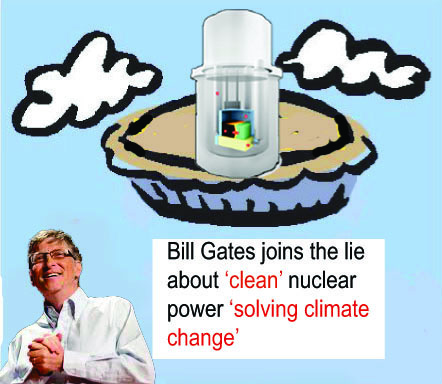
(Ed. Of course, Scott Morrison is NOT reading the genuinely well-informed book on climate – Michael E Mann’s The New Climate War )
The billionaire, the book and the PM: How Bill Gates convinced Scott Morrison on net zero, By Rob Harris October 30, 2021”……….. Gates says nuclear energy is key…….. https://www.theage.com.au/politics/federal/the-billionaire-the-book-and-the-pm-how-bill-gates-convinced-scott-morrison-on-net-zero-20211029-p59489.html#comments
Australians should remember our past and continuing uranium/nuclear environmental disasters
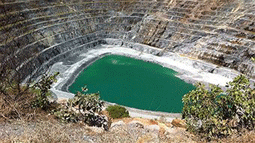
Australia has a nuclear past, we just like to forget it, St George and Sutherland Shire Leader, Chris McLennan, 29 Oct 21, No sooner did Australia announce it was going to buy a nuclear submarine fleet, there was talk of nuclear power plants as well.
Am I the only one who fears they unknowingly contracted COVID-19 or some other nasty and it has somehow warped their mind?
Nuclear this and nuclear that – everyone needs to have a nice lie down.
Australia has a poor record when it comes to nuclear power………….
One of the biggest fans of nuclear power in this country is a Senator from the Northern Territory, a veterinarian in her former life, Sam McMahon.
As someone from the Territory, she should know better
I’ll explain why in a bit.
One of the biggest fans of nuclear power in this country is a Senator from the Northern Territory, a veterinarian in her former life, Sam McMahon.
As someone from the Territory, she should know better. There are quite a few thumping great holes in the ground in her patch which need mending first.
It’s one of our dark secrets and remains one of the biggest environmental disasters in Australian history…..
Australia’s first large scale uranium mine was dug at Rum Jungle on behalf of our “Allies” in the UK and USA to fuel their nuclear weapon programs in the 1950s….
The NT Government has recently lodged plans for another go at the rehabilitation of the old mine which is today filled with water.
If it goes ahead, this will be the second go.
The mine was the first large industrial enterprise undertaken in the NT……
At Rum Jungle, a total of 863,000 tonnes of uranium ore was mined in a project under the ownership of the Commonwealth Government through the Australian Atomic Energy Commission.
The 200 hectare site closed in 1971 and was abandoned.
About $20 million was later spent trying to clean up the NT site, but the pollution continues and may continue for thousands of years.
Large volumes of radioactive mine waste (tailings) are still on the site. In 2003, an investigation of the tailings piles found that capping which was supposed to help contain this radioactive waste for at least 100 years, had failed in less than 20 years.
The latest rehabilitation efforts at Rum Jungle from 1983 to 1986 cost $18.6 million. Although at the time of the 1980s works the objectives were deemed to have been achieved, more recent studies have documented the gradual deterioration of the original rehabilitation works.
The NT and Federal Government agree there needs to be an improved rehabilitation strategy for the site.
These latest plans say the clean up would take at least five years.
No estimate was given for how much it would cost or who is going to pay for it.
The soil is contaminated, as is the groundwater and there is still waste rock needing disposal on the site.
In short, it’s a mess…….
There’s Ranger.
There is still no logical explanation as to how a big uranium mine could be allowed in the middle of perhaps Australia’s most famous national park, Kakadu, but it was.
Ranger has recently been closed and the site is somehow to be rehabilitated after more than 130,000 tonnes of uranium oxide was pulled from the place over the past three decades.
Energy Resources Australia, a subsidiary of Rio Tinto, says it has spent more than $642 million in the past eight years on rehabilitation of the mountains of tailings complicated by a lake created from a vast flooded pit.
Their work is only a few years from being finished.
Only time will tell if that scar ever heals…………. https://www.theleader.com.au/story/7485098/australia-has-a-nuclear-past-we-just-like-to-forget-it/?cs=9676
Indonesia wants non-peaceful nuclear submarines to be subject to nuclear non-proliferation treaty (surprise, surprise, Australia doesn’t agree)
Caution over nuclear treaty covering subs, Canberra Times, Dominic Giannini, 29 Oct 21,
Australian officials say they don’t believe there is merit in expanding the nuclear non-proliferation treaty to nuclear-powered submarines.
Indonesian officials have said they would seek a “fourth pillar” to include the non-peaceful usage of nuclear technology, closing a “loophole” exposed by Australia’s nuclear-submarine deal with the US and UK.
They say other countries could seek to follow Australia, which would be the first non-nuclear weapons state to acquire nuclear submarines.
Foreign affairs department officials rejected the need to expand the treaty, saying the acquisition of nuclear-propelled submarines was in accordance with Australia’s non-proliferation requirements……
The Indonesians raised concerns about the potential for an arms race in the region after Australia announced its plans to acquire nuclear-powered submarines through the AUKUS partnership…….. https://www.canberratimes.com.au/story/7488125/caution-over-nuclear-treaty-covering-subs/
The nuclear lobby’s false story on small nuclear reactors

Too expensive, too slow: Even the baseload argument doesn’t work for nuclear. ReNeweconomy, Mark Diesendorf 29 October 2021
”………………………Small Modular Reactors
The nuclear industry is nowadays creating the false impression that new reactors exist that could solve the above major problems of existing reactors while contributing to climate mitigation.
The main hypotheticals are the so-called “small modular reactors” (SMRs), small enough to be distributed around a country and modular in the sense that they could be mass-produced by the thousand in factories and erected rapidly.
However, the actual situation is that SMRs don’t exist — they are paper reactors fuelled on hot air. They could not be installed in Australia for at least 15 years, if ever. By that time, given the political will, we could have an electricity system that’s entirely powered by renewable energy, mainly solar photovoltaics (PV) and wind, supplemented by hydro.
The reason why past and current generations of commercial nuclear power reactors are very big is to obtain economies of scale. Nuclear costs have been increasing while wind and especially solar costs continue to fall.
SMRs would have to be mass-produced in hundreds, possibly thousands, to overcome the loss of economy of scale and, even then, their electricity would at best cost much the same as from existing big nuclear power reactors.
There are no orders for multiple SMRs and that’s fortunate because the risk of proliferation would be greatly increased by distributing SMRs around the countryside. Reducing proliferation risk or increasing safety or improving waste management would all increase cost……………
SMRs that simultaneously solve proliferation, safety and waste management, while reducing costs, are a dangerous fantasy. https://reneweconomy.com.au/too-expensive-too-slow-even-the-baseload-argument-doesnt-work-for-nuclear/
Tony Abbott, (highly unpopular former PM) on the pro nuclear bandwagon.

Take nuclear power to election: Abbott AAP. Paul Osborne and Matt Coughlan October 29, 2021 Former prime minister Tony Abbott says Scott Morrison should go to the election promising nuclear power as a major point of difference to Labor.
Mr Abbott’s comments came as Mr Morrison flew to Rome for this weekend’s G20 summit before attending the COP26 climate talks in Glasgow on Monday.
The Morrison government’s technology roadmap – which forms the basis of its net-zero by 2050 emissions policy – includes the prospect of small modular nuclear reactors in the future.
But Australian law currently bans nuclear power and polls show Australians remain concerned about its safety…………. https://www.aap.com.au/news/labor-warns-of-global-climate-consequences/
Another example of climate change damaging the nuclear industry -jellyfish increase clogging up cooling systems of reactors

human-induced climate change has raised ocean water temperatures, setting conditions for larger-than-usual jellyfish populations. Further, the relatively warm water near nuclear power plant discharge outlets may attract jellyfish swarms, according to one study. Also, pollution has lowered oxygen levels in sea water, which jellyfish tolerate more than other marine animals, leading to their proliferation.
Jellyfish attack nuclear power plant. Again. Bulletin, By Susan D’Agostino | October 28, 2021Scotland’s only working nuclear power plant at Torness shut down in an emergency procedure when jellyfish clogged the sea water-cooling intake pipes at the plant, according to the Scotland Herald. Without access to cool water, a nuclear power plant risks overheating, with potentially disastrous results (see: Fukushima). The intake pipes can also be damaged, which disrupts power generation. And ocean life that gets sucked into a power plant’s intake pipes risks death.
The threat these gelatinous, pulsating, umbrella-shaped marine animals pose to nuclear power plants is neither new nor unknown. (Indeed, the Bulletin reported on this threat in 2015.) Nuclear power plant closures—even temporary ones—are expensive. To protect marine life and avert power plant closures, scientists are exploring early warning system options. …………
The clash between gelatinous jellyfish and hulking nuclear power plants has a long history. These spineless, brainless, bloodless creatures shut down the Torness nuclear power plant in 2011 at a cost of approximately $1.5 million per day, according to one estimate. Swarms of these invertebrates have also been responsible for nuclear power plant shutdowns in Israel, Japan, the United States, the Philippines, South Korea, and Sweden.
Humans have unwittingly nurtured the adversarial relationship between jellyfish and nuclear power plants. That is, human-induced climate change has raised ocean water temperatures, setting conditions for larger-than-usual jellyfish populations. Further, the relatively warm water near nuclear power plant discharge outlets may attract jellyfish swarms, according to one study. Also, pollution has lowered oxygen levels in sea water, which jellyfish tolerate more than other marine animals, leading to their proliferation.
Some look at jellyfish and see elegant ballerinas of the sea, while others view them as pests. Either way, they are nothing if not resilient. Jellyfish are 95 percent water, drift in topical waters and the Arctic Ocean, and thrive in the ocean’s bottom as well as on its surface. Nuclear power plant operators might take note: Older-than-dinosaur jellyfish are likely here to stay. https://thebulletin.org/2021/10/jellyfish-attack-nuclear-power-plant-again/
Too expensive, too slow: Even the baseload argument doesn’t work for nuclear.
Too expensive, too slow: Even the baseload argument doesn’t work for nuclear. ReNeweconomy, Mark Diesendorf 29 October 2021 With the Glasgow climate summit approaching and the government’s announcement that Australia would buy nuclear-powered submarines instead of diesel, the nuclear industry and News Corp have predictably renewed their campaign for nuclear power stations in Australia.
This is of concern, because every dollar invested in nuclear power makes the climate crisis worse by diverting investment from renewable energy technologies. Having recently participated in a nuclear debate, I report here on the pro-nuclear arguments and expose their weaknesses.
The old baseload myth
Nuclear proponents still claim that electricity grids need baseload power stations, such as coal or nuclear, that can run 24/7 at full rated power, except when they break down or undergo maintenance and refuelling.
But, as readers of RenewEconomy know, the variability of wind and solar can be balanced with storage, new transmission links, demand response, and/or flexible power stations that can start up in seconds to minutes and can vary their output rapidly.
The latter include hydroelectricity with a single dam, pumped hydro (with two dams), other forms of gravitational energy storage, batteries, concentrated solar thermal with storage, and open-cycle gas turbines that can burn biofuels and green hydrogen and ammonia.
Despite the claims of proponents, modern nuclear reactors cannot compete in flexibility with the above technologies and measures. Furthermore, operating in a slightly flexible mode carries economic penalties for nuclear, whose electricity already costs 3–5 times that of wind and solar PV––see Lazard and CSIRO.
Dark doldrums (Dunkelflaute in German) are extended periods of low wind and solar. In the debate, a pro-nuclear speaker modified the baseload myth by claiming falsely that a recent report on dark doldrums by the leading German solar energy research organisation, the Fraunhofer Institute, admits that solar energy has failed.
However, the only report on dark doldrums by that institute identifies the issues and then sets out the solutions to maintaining generation reliability, namely the flexible technologies and methods listed above………………………………
The scale of the disaster resulted from the choice of nuclear technology. Yet at Kamisu, on the coast to the south of Fukushima, a wind farm located in the surf survived the tsunami and continued to generate electricity until the grid went down.
Proliferation
It’s well documented (see here and here) that India, Pakistan, South Africa and North Korea used “peaceful” nuclear energy to develop nuclear weapons and to cloak that development.
Furthermore, the UK supplemented its military-produced weapons-grade plutonium with plutonium reprocessed from its first generation of nuclear power stations. In France, the military and civil nuclear industries are entwined.
In addition, the following countries used “peaceful” nuclear energy to commence the development of nuclear weapons, but fortunately discontinued their programs: Argentina, Australia, Brazil, South Korea, Sweden and Taiwan, and probably Algeria and Libya. For Australia’s attempt in the 1960s, see the books by Richard Broinowski and Wayne Reynolds.
Nuclear submarines built by the USA and UK use highly enriched uranium that could be used directly in nuclear weapons. The AUKUS alliance could lead to increased pressure from members of the Australian Strategic Policy Institute, the Lowy Institute and others for Australia to develop nuclear weapons.
Even if the Australian government rejects that scenario, the perception exists and AUKUS could lead to a regional nuclear arms race.
Nuclear wastes
The standard pro-nuclear line is that the sum total of all the world’s nuclear wastes occupies a very small volume and therefore, by implication, is not a major problem. But nowhere in the world is there an operating, long-term, underground repository for high-level wastes.
Furthermore, the pro-nuclear line ignores the vast volumes of low-level wastes at uranium mines that are uncovered allowing radioactive dust to blow in the wind. The waste mountain at the Olympic Dam uranium-copper mine is already over 150 million tonnes.
Although the number of cancers caused annually will be very small, the total summed over thousands of years will be large.
High-level nuclear power wastes are stored temporarily in pools of water at nuclear power stations. The USA spent US$13.5 billion preparing an underground repository at an unsuitable site, Yucca Mountain, and then had to abandon it.
Finland has just commenced building its repository, Sweden is still thinking about building a final repository, and that’s about it.
Retired nuclear power stations have highly radioactive sections and are a major nuclear waste problem. The cost of decommissioning them and managing their wastes is comparable with their construction cost, but the nuclear industry only pays a fraction. …………………
Energy density
Another tactic used by nuclear supporters in recent years is based on “energy density”, the claim that 100 per cent renewable electricity scenarios would occupy vast areas of land, compete with food production and reduce biodiversity.
Yet the reality is that most wind and solar farms are erected on agricultural or marginal land. Although wind farms can span large areas, the land area actually occupied by the turbines, access roads and substation typically amounts to 1 to 2 per cent of the land spanned.
Wind farms are compatible with agriculture. Although the presence of solar farms excludes some forms of agriculture, they can be erected sufficiently high above ground for sheep to shelter beneath them. Both wind and solar farms contribute valuable rent to farmers. And, of course, rooftop solar occupies no land.
Too slow for climate mitigation
If national governments commit to net zero emissions by 2050 (which is likely to be too late for keeping global heating below 1.5 degrees), then they must achieve zero emissions from all energy (electricity, transport and heat) by about 2040. This is because energy is the least difficult sector to transition to zero emissions.
Agriculture and non-energy industrial processes will need more time to reduce emissions and, if possible, to capture carbon dioxide in order to offset emissions they cannot reduce.
Achieving zero energy emissions by 2040 entails achieving zero emissions from electricity by 2035, because electrifying transport and heat will take longer than transitioning electricity to renewables. Wind and solar farms can be planned and built in just three years.
Introducing nuclear power to Australia — including convincing the electorate, local governments and local populations, and building the infrastructure — would take at least 15 years, while taking financial resources away from renewables.
So new nuclear power stations could not contribute in time to assist the rapid electricity transition needed for climate mitigation. And once 100 per cent renewable electricity is established with the bulk of energy generation by cheap solar and wind, nuclear power could not compete economically. It’s a technology whose time has passed.Dr Mark Diesendorf is honorary associate professor, Environment & Governance Group, School of Humanities & Languages at the Faculty of Arts, Design & Architecture at UNSW. https://reneweconomy.com.au/too-expensive-too-slow-even-the-baseload-argument-doesnt-work-for-nuclear/
1 This month
17 October, Free Public Talk on Nuclear Issues in South Australia
David Noonan will speak on public interest concerns over the new Roxby Downs Indenture Act 2026 on BHP copper-uranium mining and ore processing in SA, and on how AUKUS may face SA with a High-Level nuclear waste agenda.
Dr Jim Green will discuss international developments in the field of nuclear power including ‘small modular reactors’ and Generation 4 ‘advanced’ nuclear reactor concepts.


Help Aunty Sue Protect Her Land and Sacred Sites From Destructive Rocket Testing.
.

Australians deserve the truth
about
AUKUS – https://aukuspublicinquiry.com/

PETITION – To: Prime Minister Anthony Albanese and the Australian Labor Government

of the week – Australians for War Powers Reform (AWPR)
To see nuclear-related stories in greater depth and intensity

