Questions for Ministers Taylor, Birmingham and Hunt, on their extravagant claims about ANSTO’s ”great commercial future”

I suggest a proper independent and expert review and assessment by appropriately qualified experts. It would however be essential that ANSTO and all other government entities be compelled to provide on request all necessary information for the review
The Ministers released a joint statement -Technology. Safeguarding the future of critical medicine supply, 30 September 2021
Joint media release with the Minister for Finance, Senator the Hon Simon Birmingham and the Ministerfor Health and Aged Care, the Hon Greg Hunt MP MP,,
The Morrison Government is safeguarding Australia’s sovereign capability to produce vital nuclear medicines by launching a $30 millionproject to design a new world-leading manufacturing facility to be built at Lucas Heights in Sydney.
So many questions to be answered about this:
Question: What precisely is to be involved in this design project for a new manufacturing facility?
What will the new facility comprise in an engineering and technical sense?
In any case the purchase by Australia of overseas nuclear medicine during the several occasions when the OPAL reactor at Lucas Heights was shut down proved to be a relatively easy and cost effective manner of satisfying the local consumption with no greater sovereign risk than applicable to other essential imports
country.
Acting Minister for Industry, Science and Technology Angus Taylor said the new facility will not only help to improve health care in Australia, but will also support nearly 1000 highly-skilled jobs across the country.
Questions. How will the improved health care be achieved by the new facility in light of the continued reduction in using reactor generated nuclear medicine – this goes against all the known facts?
How many of the total staff complement of ANSTO are actually involved in the production and associated services for the nuclear medicine isotopes?
The actual staff of ANSTO is more like 1,200 but their number and nature of work are really questioned despite the high government funding involved. Is this not another scheme by ANSTO to fund its large staff levels and its operational expenses?
Minister Taylor ‘s claims of expanding production of nuclear medicine, creating many high skilled jobs, collaboration with other agencies and radiopharmaceutical companes —
Questions. Please identify which major or even medium sized pharmaceutical manufacturers internationally are involved at present in the manufacture of reactor generated isotopes
Who are the main overseas customers or purchasers of the ANSTO produced isotopes?
What price do they pay for them?
Will there be any third world countries who are unable to pay for their purchase as has already been the case for some years?
What price do they pay for them?
What are the full production costs of ANSTO for these isotopes? As it is known that the sales revenue derived by ANSTO is only a fraction of the production costs calculated in a properly commercial manner how and to what extent is this subsidised by the federal government?
Minister Hunt’s claims of improved health care across the nation.
Question. Again how will the improved health care be achieved?
Claims of expanding industry – Australia a world leader in nuclear radiopharmaceuticals.
COMMENT. You cannot surely be serious when the production and use of reactor generated isotopes is in major decline worldwide due to its inherent dangerous nature and many alternative methods with far
less risk are now being used for diagnostic and treatment procedures
**********************************
CONCLUDING COMMENTS
How will this sit with the proposed but somewhat limited inquiry by ARPANSA as to the public consultations for the licensing applications by ANSTO for what appears to be an unjustified
extension of its temporary but now described as interim solid ntermediate level nuclear waste facility at Lucas Heights?
If the now new proposal described by the government as the design a new world-leading manufacturing facility is to be built at Lucas Heights then I suggest that it be the subject of a proper independent
and expert review and assessment by appropriately qualified experts which should be as wide and far ranging as possible and include all related aspects.
I suggest this review in preference to a more formal parliamentary inquiry whether self constituted or called externally which ultimately will depend on research and advice by persons who would have limited knowledge and experience of the issue under consideration.
In all probability the review will need to be carried out by overseas experts since none is available locally.
Moreover this review should prove to be far more effective and suitable than a formal inquiry process and at a much lower cost.
It would however be essential that ANSTO and all other government entities be compelled to provide on request all necessary information for the review
We must question why small modular reactors and the rebirth of nuclear energy are all the rage

These considerations should lead us to make saner and more realistic choices for our children and our children’s children
Roland Ngam • 11 October 2021, We must question why small modular reactors and the rebirth of nuclear energy are all the rage, Daily Maverick,
Small modular nuclear reactors are being widely punted as the energy source of the future. But if we are looking only at costs, solar and wind are way cheaper than small modular reactors and battery technology is way better today than it was only three years ago.
Small modular reactors (SMRs) seem to be all the rage these days. Dismiss them at your peril. I am no conspiracy theorist, but everyone is talking about them just as energy prices are spiking in Europe, the UK is struggling to supply its filling stations with fuel, the green parties want to cancel Nord Stream 2 and China is rationing electricity after recent widespread outages in 22 states.
Could it be that some of these crises — and ergo, energy panic — are artificially made in order to give fossils one last hurrah in the limelight? Nuclear energy is renewable [Ed. this is not true] , but I mean, you need fossils and a lot of capital investment to make them! Also, are those who are betting on SMRs as the technology of the future right to place their hopes in this sector rather than in greener alternatives?………………
America has been subsidising research in SMRs for more than a decade now. They paid $226-million in research grants for the light-water SMR built by Nuscale Power for Energy Northwest. The US Congress has already passed a nuclear production tax credit (PTC) act to subsidise energy from the plant for the next 10 years and the Department of Energy further approved $1.355-billion to fund the Carbon Free Power Project (CFPP), which involves investing massively in SMRs.
China already has a bunch of floating SMR powerships and started construction on a 125 MWe land-based pressurised water reactor (PWR) in Hainan province in June 2021. The project was officially launched by the Ministry of Ecology and Environment (which is another point I will get back to in a moment, i.e. that countries are pushing nuclear hard as the green solution of the future).
In the United Kingdom, SMRs are a key part of the decarbonisation strategy. Last year, Prime Minister Boris Johnson announced a £525-million investment in SMR development and Business Secretary Kwasi Kwarteng is about to approve a contract for Rolls-Royce to build a fleet of them in order to assure energy self-sufficiency, which has become a hotly debated topic after Brexit and now amidst the fuel shortages that have hit the nation.
Not to be outdone, French President Emmanuel Macron wants to make SMRs a cornerstone of his 2022 re-election campaign. It is believed that France will spend €50-million from the Euro Recovery Plan on SMR research. Industry players in the nuclear space have already announced plans for the construction of a university of nuclear research. About 30 research centres have also received funds from the France Relance plan for nuclear research. Although France is a world leader in nuclear technology, they have been caught napping by Russia, the US and China which are already way ahead of them in SMR technology.
So the race is on to scale up production of affordable commercial land-based SMRs which could potentially fill up the manufacturing companies’ order books.
Now, back to why nuclear technology is enjoying a comeback — well, it never went away, but it is enjoying a renaissance of sorts among the ever-more confident G20 leaders — because, as Maud Bregeon puts it in Nucléaire: un patrimoine industriel et écologique, even the IPCC and the UN say that “all low-carbon technologies are needed to meet our climate goals, including nuclear.
…….. is the world right to focus on SMRs as the future? If we are looking only at costs, solar and wind are way cheaper than SMRs and battery technology is way better today than it was only three years ago.
According to the International Energy Agency and the OECD Nuclear Energy Agency, the kilowatt-hour price for SMR is almost certainly always going to be higher than what bigger power plants can offer. It is for this reason that many question why South Africa’s Energy Minister is still determined to commit to new nuclear capacity in line with the integrated resource plan (IRP). That allocation could be shifted to a cheaper energy source.
Three billion dollars is a massive drop from the $10-billion that is the going rate for a big nuclear plant. However, even at $3-billion in start-up for a small plant, the average African country simply cannot afford this type of technology. By comparison, they can get going on a modular solar plant with only a few thousand dollars.
Then there is the toll that continued investment in nuclear has on the environment. In an essay titled An Obituary for Small Modular Reactors, Friends of the Earth Australia argues that “about half of the SMRs under construction (Russia’s floating power plant, Russia’s RITM-200 icebreaker ships, and China’s ACPR50S demonstration reactor) are designed to facilitate access to fossil fuel resources in the Arctic, the South China Sea and elsewhere”.
Drought-hit Namibia, which has about 5% of the world’s uranium resources has seen an increase in investments in the uranium sector. Russia (
Helpless activists in Namibia have also been trying to draw the world’s attention to the unusually high numbers of former uranium mine workers who have been dying of cancer, without much success. As investments in uranium pick up, and as some environmental activists make the case for nuclear as green technology, it is important to remember the toll that it is taking on people and ecological systems in the Global South.
These considerations should lead us to make saner and more realistic choices for our children and our children’s children. https://www.dailymaverick.co.za/opinionista/2021-10-11-we-must-question-why-small-modular-reactors-and-the-rebirth-of-nuclear-energy-are-all-the-rage/
.
Deathly Silence: Journalists Who Mocked Assange Have Nothing to Say About CIA Plans to Kill Him
Deathly Silence: Journalists Who Mocked Assange Have Nothing to Say About CIA Plans to Kill Him https://fair.org/home/deathly-silence-journalists-who-mocked-assange-have-nothing-to-say-about-cia-plans-to-kill-him/, JOHN MCEVOY,YAHOO! NEWS (9/26/21) A BOMBSHELL REPORT DETAILING THE US CENTRAL INTELLIGENCE AGENCY’S “SECRET WAR PLANS AGAINST WIKILEAKS,” INCLUDING CLANDESTINE PLOTS TO KILL OR KIDNAP PUBLISHER JULIAN ASSANGE WHILE HE TOOK REFUGE IN THE ECUADORIAN EMBASSY IN LONDON.
Following WikiLeaks‘ publication of the Vault 7 files in 2017—the largest leak in CIA history, which exposed how US and UK intelligence agencies could hack into household devices—the US government designated WikiLeaks as a “non-state hostile intelligence service” (The Hill, 4/13/17), providing legal cover to target the organization as if it were an adversarial spy agency.
Within this context, the Donald Trump administration reportedly requested “sketches” or “options” for how to kill Assange, according to the Yahoo! expose (written by Zach Dorfman, Sean D. Naylor and Michael Isikoff), while the CIA drew up plans to kidnap him. (Assange was expelled from the embassy in 2019 and has since then been in British prison, fighting a demand that he be extradited to the US to face charges of espionage—FAIR.org, 11/13/20.)
Shortly after publication, former CIA director Mike Pompeo (Yahoo! News, 9/29/21) seemed to confirm the report’s findings, declaring that the former US intelligence officials who spoke with Yahoo! “should all be prosecuted for speaking about classified activity inside the CIA.”
Ghoulish indifference
It would seem that covert plans for the state-sanctioned murder on British soil of an award-winning journalist should attract sustained, wall-to-wall media coverage.
The news, however, has been met by Western establishment media with ghoulish indifference—a damning indictment of an industry that feverishly condemns attacks on press freedom in Official Enemy states.
BBC News, one of the most-read news outlets in the world, appears to have covered the story just once—in the Somali-language section of the BBC website (Media Lens on Twitter, 9/30/21).
Neither the New York Times or Washington Post, two of the world’s leading corporate news organizations, have published any articles about Assange since July 2021.
To its credit, since the story first broke on September 26, the Guardian has reported twice on the CIA-led conspiracy to kill or kidnap Assange. But to offer perspective, during the week after Russian opposition figure Alexei Navalny was reported to have been poisoned by the Russian government, the Guardian published 16 separate pieces on the issue, including video reports and opinion pieces.
Similarly, a Nexis search of British newspapers for the word “Navalny” brings up 288 results from August 20–25, 2020. The same search for “Assange” between September 26–October 1, 2021, brings up a meager 29 results—one of which, a notable exception, was a Patrick Cockburn piece in the Independent (10/1/21).
Crucial relief
As is typical of stories that embarrass the Western intelligence services, independent media provided crucial relief to the backdrop of chilling indifference, with the Grayzone’s Aaron Maté (YouTube, 9/30/21) conducting a rigorous interview with one of the report’s authors, Michael Isikoff.
Indeed, the Grayzone (5/14/20) was the first outlet to provide evidence of a CIA-linked proposal to “kidnap or poison Assange” in May 2020. The story, however, was almost universally ignored, suggesting that, as Joe Lauria wrote in Consortium News (10/2/21), “until something appears in the mainstream media, it didn’t happen.”
One thing the corporate media cannot be accused of with regards to Assange, however, is inconsistency. After a key witness in the Department of Justice’s case against the publisher admitted to providing the US prosecution with false testimony, a detail that should
ordinarily turn a case to dust, the corporate media responded by ignoring the story almost entirely. As Alan MacLeod wrote for FAIR.org (7/2/21):
The complete uniformity with which corporate media have treated this latest bombshell news raises even more concerns about how fundamentally intertwined and aligned they are with the interests of the US government.
Even after it was revealed that the UC Global security firm that targeted Assange had also spied on journalists at the Washington Post and New York Times, neither outlet mounted any
protest (Grayzone, 9/18/20).
Perhaps most remarkably, UK judge Vanessa Baraitser relied on a falsified CNN report (7/15/19) to justify the CIA’s spying operation against Assange (Grayzone, 5/1/21). Now, CNN’s website contains no reports on the agency’s plans to kill or kidnap Assange.
The prevailing silence has extended into the NGO industry. Amnesty International, which refused in 2019 to consider Assange a prisoner of conscience, has said nothing about the latest revelations. Likewise, Index on Censorship, which describes itself as “The Global Voice of Free Expression,” hasn’t responded to the story.
The establishment media’s dismissal of Assange supports Edward Herman and Noam Chomsky’s framework of “worthy” and “unworthy” political dissidents, with Assange situated firmly in the latter camp.
The present circumstances become even more deplorable upon consideration of the corporate journalists who arrogantly diminished, or even delighted in, Assange’s concerns for his own safety.
Continue readingPrince Charles urges Australian Prime Minister Scott Morrison and other leaders to attend COP26
Prince Charles urges Australian Prime Minister Scott Morrison and other leaders to attend COP26 ABC By Jack Hawke in London 11 Oct 21, Prince Charles has urged Prime Minister Scott Morrison and other world leaders to attend the UN’s climate change conference, calling it a “last chance saloon” to save the planet.
Key points:
- Prince Charles appeared surprised to learn Prime Minister Scott Morrison may not attend the COP26 UN climate change conference
- More than 100 world leaders, including US President Joe Biden, the Queen and the Pope will attend the summit
- Prince Charles also said he shared the concerns of younger generations that not enough is being done to combat cliamte issues
World leaders including Joe Biden, Boris Johnson, the Queen and the Pope will be at the event, but Mr Morrison has not yet made a decision on whether he will attend.
The Prince of Wales was giving an interview to the BBC when he was pressed about Australia’s action on climate change ahead of the COP26 UN Climate Change Conference in Glasgow at the end of this month.
Prince Charles seemed genuinely surprised when told by the BBC’s climate editor Justin Rowlatt that Mr Morrison was still on the fence about coming.
“Is that what he says?” Charles asked……… https://www.abc.net.au/news/2021-10-12/prince-charles-scott-morrison-climate-change-cop26/100531092
Scott Morrison gets a mention on global summary of climate change leaders – and it’s not good!
Who’s who at Cop26: the leaders who hold the world’s future in their hands, Guardian 11 Oct 21,
”……..Scott Morrison
“A rogue nation on the climate” is how one Cop expert describes Australia, urging other countries to ostracise the coal exporter, which under Morrison has refused to take on new commitments on emissions. But if anything the Aukus deal appears to have buoyed the Australian prime minister’s sense that he can get away with it – he may not even attend……..” https://www.theguardian.com/environment/2021/oct/11/whos-who-at-cop26-the-leaders-who-hold-the-worlds-climate-in-their-hands
What is Cop26 and why does it matter? The complete guide
What is Cop26 and why does it matter? The complete guide
Everything you need to know about the Glasgow conference seeking to forge a global response to the climate emergency
Who’s who at Cop26: the leaders who hold the world’s future in their hands
Will China even come? Can the UK hosts outflank Brazil? A look at who will – and who may not – be at Glasgow climate summit
October 11 Energy News — geoharvey

Opinion: ¶ “Our Ocean Is Stressed Enough: Give It A Break From Drilling” • On top of record-breaking heat, record-breaking wildfires, and record-breaking drought, 144,000 gallons of oil spilled last weekend in Southern California. It is the latest in a string of disasters reminding us that our addiction to fossil fuels has devastating consequences. [CleanTechnica] […]
October 11 Energy News — geoharvey
Not even the BCA or Murdoch papers can divert Taylor from his love of gas — RenewEconomy

The Business Council and the Murdoch media come out in support of the green transition, but they can’t sway the ideological monster they created. The post Not even the BCA or Murdoch papers can divert Taylor from his love of gas appeared first on RenewEconomy.
Not even the BCA or Murdoch papers can divert Taylor from his love of gas — RenewEconomy
Imagine a world with US-China cooperation — IPPNW peace and health blog

On September 10, 2021, during an important diplomatic meeting that occurred by telephone, US President Joseph Biden and Chinese President Xi Jinping affirmed the necessity of a better relationship between their two nations. According to the official Chinese summary, Xi said that “when China and the United States cooperate, the two countries and the world […]
Imagine a world with US-China cooperation — IPPNW peace and health blog
Radioactive risks of nuclear submarines

The radioactive waste from reactors poses a difficult and expensive problem to manage health and environmental hazards for geological time periods. The governments involved in this proposal have been silent about disposal of the high and intermediate level waste that would be generated. Despite many flawed and failed attempts at interim storage, Australia has no current plan for disposal of the much smaller amount of its existing intermediate level radioactive waste.
Proposed US/UK nuclear-powered submarines for Australia jeopardise health while escalating an arms race no one can win
Joint statement by International Physicians for the Prevention of Nuclear War and its affiliates in Australia, UK and USA: Medical Association for Prevention of War (Australia); Medact (UK); Physicians for Social Responsibility (USA) 10 Oct 21, ”……. Radioactive risk
Nuclear reactors on ships and submarines have been involved in numerous accidents. The risks of accident or attack causing release of radioactive material combined with the targeting by adversaries of such vessels including while they are in port, are why many cities around the world sensibly oppose visits of such vessels to their harbours. Such incidents could cause chaos and panic, the need to evacuate large areas of cities for years, and expose tens or hundreds of thousands of people to harmful radioactive fallout.
Australia’s lack of nuclear scientific, engineering, management and regulatory capacity and experience will inevitably mean that more is likely to go wrong building and operating nuclear submarines. If something does go wrong with one of its nuclear submarines, the likelihood of it being quickly and effectively managed is reduced and the risks of radioactive release in a port city or into the marine or coastal environment is increased.
A total of 8 nuclear-powered submarines have sunk because of accidents at sea between 1963 and 2003 – two because of fires, two by weapon explosions, two by flooding, and one each from storm damage and unknown reasons. These contribute substantially to the already widespread radioactive pollution resulting from naval reactors. The most recently reported fatal accident was a fire in a Russian nuclear submarine in 2019, which killed 14 people.
The radioactive waste from reactors poses a difficult and expensive problem to manage health and environmental hazards for geological time periods. The governments involved in this proposal have been silent about disposal of the high and intermediate level waste that would be generated. Despite many flawed and failed attempts at interim storage, Australia has no current plan for disposal of the much smaller amount of its existing intermediate level radioactive waste. …. https://beyondnuclearinternational.org/2021/10/10/nuclear-submarine-deal-needlessly-raises-tensions/
Nuclear Regulatory Commission backs Linear No-Threshold model for radiation safety

NRC backs Linear No-Threshold model for radiation safety, THE HINDUK. S. ParthasarathyOCTOBER 09, 2021
This decision of U.S. Nuclear Regulatory Commission was awaited by specialists
Now it is official. The U.S. Nuclear Regulatory Commission (NRC) decisively upheld the Linear No-Threshold model to prescribe radiation safety standards, ending the protracted controversy on the topic. Radiation protection specialists worldwide were eagerly awaiting the NRC’s decision.
Over six years ago, during February 2015, Dr. Carol S. Marcus, Mr. Mark L. Miller, Certified Health Physicist, and Dr. Mohan Doss, and others, through three……….(subscribers only) https://www.thehindu.com/sci-tech/science/nrc-backs-linear-no-threshold-model-for-radiation-safety/article36918797.ece
Low dose radiation and cancer – the Linear No Threshold model holds good

The public, legislators, and journalists are often at a loss to deal with the charges and counter charges that surface in the debate over low-level radiation exposures. It does not help to listen to industry leaders, nuclear activists, or individual researchers, who, one after another, propound their competing images of the underlying truth.
It is now reasonably clear that protracted exposure does not protect against radiation-induced cancer. Rather, it is the cumulative radiation exposure from all sources that must be examined.
There is no longer a convenient excuse to avoid using the LNT to estimate consequences from real or projected releases of radioactive materials, even when the dose of concern is below 0.1 Sv.

The scientific jigsaw puzzle: Fitting the pieces of the low-level radiation debate http://bos.sagepub.com/content/68/3/13.full Bulletin of the Atomic Scientists, May/June 2012, Jan Beyea “…..One of the biggest paradoxes in the low-level radiation debate is that an individual risk can be a minor concern, while the societal risk—the total delayed cancers in an exposed population—can be of major concern…..
Deconstructing the debate The debate over radiation risks has many tentacles that extend into the fields of biology, epidemiology, medicine, sociology, and political science. The biggest tentacle penetrates directly into the political sphere, wrapping itself around arguments on energy policy and the consequences of radioactive releases like those at Chernobyl and the Fukushima Daiichi Nuclear Power Station….
Continue readingThe facts contradict the pro nuclear spin of the Minerals Council of Australia’s report, written by Ben Heard.
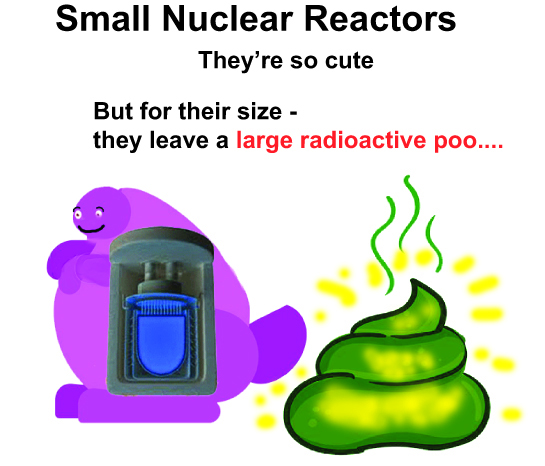
“a smaller reactor, at least the water-cooled reactors that are most likely to be built earliest, will produce more, not less, nuclear waste per unit of electricity they generate because of lower efficiencies.”
”Due to the loss of economies of scale, the decommissioning and waste management unit costs of SMR will probably be higher than those of a large reactor (some analyses state that between two and three times higher).”
Small nuclear reactors, huge costs Dr. Jim Green 11 October 2021 Even by the standards of the Minerals Council of Australia (MCA), the new report published by the country’s most influential coal lobby on the subject of small modular nuclear reactors (SMRs) is jiggery-pokery of the highest order.
Why would a mining industry body promote SMRs? After mining for some years — or at most decades — no company would want to take on the responsibility of decommissioning a nuclear reactor and managing high-level nuclear waste for millennia. No companies are cited in the report expressing interest in SMRs to power their mining operations.
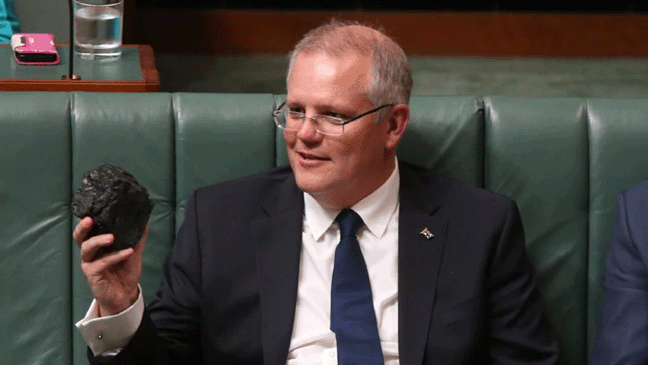
Perhaps the MCA – which infamously provided the lump of coal for Scott Morrison to wave around in parliament – thinks that promoting nuclear power will slow the transition from fossil fuels to renewables, and believes that it is in the interests of some of its member companies to slow the transition.
If so, the timing of the report isn’t great, coming in the same week as the Business Council of Australia’s report which argues for a rapid, renewables-led decarbonisation, and Fortescue’s announcement that it plans to build the world’s largest green energy hydrogen manufacturing facility in Queensland.
Perhaps the MCA is doing the bidding of the (mostly foreign-owned) uranium mining companies operating in Australia? The MCA’s CEO Tania Constable said: “Australia should take advantage of growing international interest in nuclear energy and look to expand its already significant uranium sector.”
Perhaps … but there’s no evidence that the two companies mining uranium in Australia — BHP (Olympic Dam) and Heathgate Resources (Beverley Four Mile) — are lobbying for nuclear power. And Australia’s “already significant” uranium industry could hardly be more insignificant — it accounts for about 0.2 percent of Australia’s export revenue and about 0.01 percent of all jobs in Australia.
Bob Carr’s atomic bombshell
The MCA report also came in the same week as Bob Carr’s striking about-face on nuclear power. Having previously supported nuclear power, Carr wrote in The Australian: “In 2010 one enthusiast predicted within 10 years fourth-generation reactors and small modular reactors would be commonplace, including in Australia. None exists, here or abroad.”
The MCA report says SMRs are an “ideal fit” for Australia, citing their enhanced safety, lower cost than large-scale nuclear reactors or equivalent energy production methods, and lower waste production than current reactors.
It’s all nonsense. The safety claims don’t stack up. Nor do the claims about waste. Academic M.V. Ramana notes that “a smaller reactor, at least the water-cooled reactors that are most likely to be built earliest, will produce more, not less, nuclear waste per unit of electricity they generate because of lower efficiencies.”
And a 2016 European Commission document states: “Due to the loss of economies of scale, the decommissioning and waste management unit costs of SMR will probably be higher than those of a large reactor (some analyses state that between two and three times higher).”
SMRs have a similar capacity to many existing coal and gas-fired power plants in Australia, the MCA report states, so would make an ideal replacement. Back to Bob Carr:
“Where is the shire council putting up its hand to host a nuclear power plant? Harder to find than a sponsor for a high-temperature toxic waste incinerator.
“Nobody in the Hunter Valley has urged nuclear for the Liddell site, even on the footprint of this coal-fired power plant scheduled to close. And not even invoking the prospect of a small modular reactor that 10 years back was the vanguard of the nuclear renaissance. About to be planted across the Indonesian archipelago and the rest of Asia, we were promised. Today they exist only on the Rolls-Royce drawing boards they have adorned since the 1970s.”
Economics
The MCA said in June 2020 that SMRs won’t find a market unless they can produce power at a cost of A$60-$80 per megawatt hour (MWh). That’s a big problem for enthusiasts because there’s no chance whatsoever that SMRs will produce power in that cost range.
An analysis by WSP / Parsons Brinckerhoff, prepared for the 2015/16 South Australian Nuclear Fuel Cycle Royal Commission, estimated a cost of A$225 / MWh for a reactor based on the NuScale design, about three times higher than the MCA’s target range.
CSIRO estimates SMR power costs at A$258-338 / MWh in 2020 and A$129-336 / MWh in 2030.
Russia’s floating nuclear plant is said to be the only operational SMR in the world, although it doesn’t fit the ‘modular’ definition of serial factory production.
A 2016 OECD Nuclear Energy Agency report said that electricity produced by the Russian floating plant is expected to cost about US$200 (A$273) / MWh, about four times higher than the target range cited by the MCA and more expensive than power from large reactors (US$129-198 / MWh).
Completion of Russia’s floating plant was nine years behind schedule and construction costs increased six-fold.
Yet, despite a mountain of evidence that SMRs won’t come close to producing power in the A$60-80 / MWh range, the new MCA report asserts that “robust estimates” using “conservative assumptions” suggest that SMRs will produce power at a cost of A$64-77 MWh by 2030.
One wonders who the MCA think they’re kidding.
The MCA report was written by Ben Heard, who recently closed his ‘Bright New World’ nuclear lobby website, just before taking up a full time role with consultancy Frazer-Nash. Heard promotes Canadian SMR-wannabe Terrestrial Energy in the MCA report but does not disclose his role on the company’s advisory board.
Heard also contributed two chapters on nuclear power to a 2020 book titled ‘An Australian nuclear industry: Starting with submarines’.
Dr Jim Green is lead author of a 2019 Nuclear Monitor report on SMRs and national nuclear campaigner with Friends of the Earth Australia.
US and UK begin jostling to supply Australia with nuclear submarine fleet
US and UK begin jostling to supply Australia with nuclear submarine fleet, ABC By defence correspondent Andrew Greene‘ 10 Oct 21, ‘……….In 2021, the Australian Defence Force is again considering what role the Royal Navy could play in developing its next submarines, or whether like many modern acquisitions, it will focus on interoperability with American technology.
Under the AUKUS partnership struck in September, the leaders of the United Kingdom and the United States have agreed to work with Australia on how to build a new class of nuclear-powered submarines.
Over the next 18 months, the Nuclear-Powered Submarine Task Force inside the Department of Defence will lead a study into the numerous regulatory issues involved in the ownership and operation of nuclear-powered boats.
While the design is not yet known, or what the criteria will be, for many commentators the existing British Astute-class is emerging as an early favourite for Australia to replace the Collins-class fleet
Others inside the defence industry believe any nuclear-powered Australian submarine will need to be an American boat, based on the Virginia-class so that it can be serviced at nearby US bases in Guam or Japan.
Both the British and US options have various advantages and disadvantages, which highlight the extraordinarily complex process the ADF faces to select a nuclear-powered submarine — which may never actually eventuate.
Already the regulatory challenges appear significant, as nothing is more complex and costly in the military world than nuclear-powered submarines, particularly for a country with no domestic nuclear industry.
In the United States, an eminent group of former officials and experts has written to President Joe Biden warning the AUKUS deal could threaten national security by encouraging hostile nations to obtain highly enriched uranium (HEU).
Australia insists it will uphold its commitments under the Nuclear Non-Proliferation Treaty, but the engineering sector warns it will be a steep learning curve for the Defence Department.
The now dumped Attack class submarine being designed by France’s Naval Group was based on the Barracuda class, which lost three years in development because of less complex regulatory issues associated with low enriched uranium (LEU).
“This is a very long-term effort that’ll be decades, I think, before a submarine goes in the water,” US Chief of Naval Operations Admiral Mike Gilday predicted last month………… https://www.abc.net.au/news/2021-10-10/us-and-uk-begin-jostling-for-nuclear-submarine-contract/100525756
Nuclear submarines – A step towards nuclear power and nuclear weapons?
Nuclear submarine deal needlessly raises tensions, Proposed US/UK nuclear-powered submarines for Australia jeopardise health while escalating an arms race no one can win
Joint statement by International Physicians for the Prevention of Nuclear War and its affiliates in Australia, UK and USA: Medical Association for Prevention of War (Australia); Medact (UK); Physicians for Social Responsibility (USA), Beyond Nuclear, 10 Oct 21,
”……..A step towards nuclear power and nuclear weapons?
Already, in the wake of the announced plans, there are mounting calls in Australia, including from some government MPs, for Australia to embrace nuclear power as well. Throughout the 1950s and 1960, Australia made active plans and preparations to acquire nuclear weapons. Calls that Australia needs to be prepared to acquire its own nuclear weapons, from former senior government officials and those employed by think tanks close to the government, have never gone away.
Twenty nuclear weapons could be built from the amount of HEU fuelling the nuclear reactor of each planned submarine.
The way forward
More than a leader’s word is needed to ensure that the planned submarines will not be used as the thin end of a wedge towards an expanded civil nuclear industry, such as nuclear power generation, and that the planned submarines will not be armed with US, UK or Australian nuclear weapons.
Rather than escalating a nuclear-propelled new cold war, both the UK and US should make their people and the world truly safer by pursuing a verifiable and binding agreement with other nuclear armed states to eliminate their nuclear arsenals. They should welcome and work towards joining the 2017 UN Treaty on the Prohibition of Nuclear Weapons (TPNW), which provides the only internationally agreed, treaty-codified framework for the elimination of nuclear weapons. Naval nuclear propulsion, especially with HEU, should be phased out.
There are abundant compelling reasons for all states to join the TPNW — indeed that is the best test of whether they are serious about nuclear disarmament, or not. Contrary to its support for the treaties prohibiting all other major types of inhumane and indiscriminate weapons and weapons of mass destruction — biological and chemical weapons, landmines and cluster munitions — Australia opposes the TPNW.
The best way for Australia to provide surety that any nuclear-powered submarines would not be a stepping stone towards acquiring nuclear weapons, nor have any role in the possible use of nuclear weapons, is to join the TPNW. If it continues to refuse to do so, such concerns will remain well justified.
If Australia does proceed to acquire nuclear submarines, it should insist on LEU fuel, implement stringent safeguards, the submarines should be configured so that they cannot carry nuclear weapons, and nothing about their construction or operation should impede Australia joining the TPNW.
For the full joint IPPNW statement with signatures, go here. https://beyondnuclearinternational.org/2021/10/10/nuclear-submarine-deal-needlessly-raises-tensions/
1 This month
17 October, Free Public Talk on Nuclear Issues in South Australia
David Noonan will speak on public interest concerns over the new Roxby Downs Indenture Act 2026 on BHP copper-uranium mining and ore processing in SA, and on how AUKUS may face SA with a High-Level nuclear waste agenda.
Dr Jim Green will discuss international developments in the field of nuclear power including ‘small modular reactors’ and Generation 4 ‘advanced’ nuclear reactor concepts.


Help Aunty Sue Protect Her Land and Sacred Sites From Destructive Rocket Testing.
.

Australians deserve the truth
about
AUKUS – https://aukuspublicinquiry.com/

PETITION – To: Prime Minister Anthony Albanese and the Australian Labor Government

of the week – Australians for War Powers Reform (AWPR)
To see nuclear-related stories in greater depth and intensity

