Senator Hanson-Young outlined the shambles that the nuclear waste siting process has been

This bill is a disgrace. It is an affront to community consultation, it is an affront to the best available science and it is an affront to the promise, the long-held promise, that this country would get serious about a long-term permanent solution to dealing with the waste that we have. Of course we have a responsibility. We create nuclear waste; we need to store it properly. It is of course incredibly toxic. That’s why it is difficult to do. It is also why you don’t see the Prime Minister advocating that they build a nuclear waste dump in his electorate, where Lucas Heights actually is.
This bill is a disgrace. It is an affront to community consultation, it is an affront to the best available science and it is an affront to the promise, the long-held promise, that this country would get serious about a long-term permanent solution to dealing with the waste that we have. Of course we have a responsibility. We create nuclear waste; we need to store it properly. It is of course incredibly toxic. That’s why it is difficult to do. It is also why you don’t see the Prime Minister advocating that they build a nuclear waste dump in his electorate, where Lucas Heights actually is.
This has been a disgraceful process, and still the South Australian community are left in the dark. How is this going to be transported? How often are we going to have trucks and ships full of nuclear waste coming into our state, coming into our towns? What are the people of Whyalla meant to do—not to mention the towns and communities where this dump is built?
We’re not going to. We’re going to fight this. We want a proper process. We want independent expert advice, not special favours from national ministers, and we want our state’s reputation for having a clean, green, food, wine and tourism industry protected. It’s only the Greens who are standing up for this in our state of South Australia.
HANSON-YOUNG (South Australia) Senate 21 June 21, (12:28): I rise today to speak on the National Radioactive Waste Managemn Greens and my constituents in South Australia, who, of course, are outraged that once again we see the two big parties working together to dump on our state.
This is an example of what happens when Labor and Liberal get together: they’ve got more votes on the eastern seaboard than they do in South Australia, so they dump on SA. That’s what they’re doing here today.
Continue readingSenator Rex Patrick explained why the Woomera prohibited area would be a more suitable site for a nuclear waste dump
Senator PATRICK (South Australia) Senate 21 June21, (19:50): I think Industry did make inquiries to the Department of Defence. In a two- or three-page submission, they sought to rule that out. You’ll be aware that the committee that examined this piece of legislation took a trip to Woomera and had a look at the site. I note in your speech in the second reading debate you said that Woomera was not suitable; it’s a test range. Just to inform you, Minister—you may already know this—Woomera is 13 per cent of the area of South Australia. It is twice the size of Tasmania. It’s beyond comprehension that anyone would accept from the Department of Defence the idea that you can’t fit a facility there. It is a massive area. If you look to the north-eastern corner of the Woomera prohibited area, you will find there’s a uranium mine at Roxby Downs. It’s something like 20 or 30 kilometres inside the WPA. There is a community that clearly doesn’t have any particular issue with radioactive material, noting that their livelihoods depend on that. I’m sure you’ve been up there, as I have, to Roxby and the Olympic Dam.
I also heard during your speech in the second reading debate the idea that we were going to mix a radioactive waste site with a missile firing range. This has all been dealt with by the committee. The Department of Defence advises that, whenever they conduct a missile firing, they have a safety template. So they lay out the area for which there is a danger so that if a missile, aerial vehicle or drone goes rogue it will actually most likely land in that particular safety template. The Department of Defence provided the committee with an overlay map of all of the safety templates that have been used since 2014, and there are massive areas of the Woomera prohibited area that, in actual fact, do not overlap with any test sites. It’s an area that is remote. It’s not on prime agricultural land. There is quite a thick study that shows that it’s quite feasible. It’s done all of the geological work and all of the safety work. On the idea that you can’t find a location there, this is Defence defending Defence land like no other. This is the department that came to the government in 2009 and said, ‘Let’s have a $12 billion Future Submarine project,’ and then that project got estimated up to $50 billion and then grew to $89 billion and now we have to pay an extra $10 billion to extend the life of the Collins class in order to get it to the point where it can last until the future submarines arrive sometime after 2035. This is the same department you’re talking about. It’s clearly incompetent in relation to these sorts of projects.
Any person could reasonably go up to Woomera, have a look at the sites and have a look around the airfield up there. You’ll see that there are ammunition areas and fuel storage areas, all of which are manageable from an aircraft perspective well away from the range. We’ve got the road to Roxby Downs that’s a stone’s throw from the airfield. It’s never been shut, under the various rules. There’s lots and lots of space up there. You’ve got a list of three sites that appear to be face-saving sites. Why wouldn’t you simply accept the possibility that Woomera is not a bad facility? Remember, at the start of this we ended up with the three sites that you have named in your table, in the amendments, by asking people whether they’d want to have their land as a radioactive waste management site—not by looking and asking, ‘What’s the best place to put it?’ but simply, ‘Who wants to have one—which landowner wants to sell their land at four times the market rate to have a facility?’ So they can move on and go somewhere else and leave behind a facility.
I’ve got an amendment on the sheet, and that amendment includes consultation with Indigenous parties and indeed the community. It beggars belief that the government doesn’t want to add another potential site where there could well be broad community support, where in the past proper studies have been done that say that this can go
there. It’s a government that seems to be scared of the Department of Defence and takes a two- or three-page submission to rule out something—afraid of the brass, afraid of the shiny uniforms—and basically takes at face value what they’ve said yet doesn’t listen to the community in Kimba and what their concerns are. That doesn’t seem to matter.
I’m left flabbergasted as to why it wouldn’t be considered, particularly in circumstances where there are two radioactive waste sites up in the Woomera Prohibited Area. Hangar 5 has 10,000 CSIRO drums sitting there that will have to be moved at cost. Koolymilka has defence waste that includes intermediate-level waste. That’s somehow managed to survive for 20 years—longer, actually—without causing interruption to the operations up in the Woomera Prohibited Area. So, I wonder, Minister: how do you reconcile the fact that we’ve had radioactive waste up there since the 1990s, yet Defence have been able to operate perfectly well with the two facilities that we have up there? I wonder whether you can reconcile that.
Senator PATRICK: I don’t mean to ambush you, Minister, but I have two amendments on the table that look at Woomera as a site. I don’t think it’s an unreasonable question to ask, noting that in your second reading speech you said that a radioactive waste site is not consistent with the operations at Woomera, when in fact we’ve had radioactive waste stored at Woomera since about the mid-nineties. It may well be that it will continue to be stored there, because the waste at Koolymilka is not suitable to be shifted, in which case the whole thing becomes a bit of a shambles with Defence saying, ‘We can’t have it here,’ knowing full well that it’s going to stay there. That’s the burden of my question. I don’t think it’s unreasonable to ask that question, noting I have a couple of amendments on the table that look at Woomera, which you’re knocking out for what appears to be quite shallow reasons. If you’ve gone through the process completely—not you personally, Minister—if the department has gone through the process or the minister has gone through the process properly, when that advice came back from Defence you would think that you might have challenged some of it, particularly to get an understanding of whether or not that waste will go to, presumably, Kimba. Maybe we can start with hangar 5. Hangar 5 has 10,000 drums of low-level radioactive waste that is stored very close to the range head. Perhaps you can say whether it’s the intention that that material, noting it’s in a pretty perilous state—I know CSIRO is working to tidy that up—go from hangar 5 at Woomera to the new facility? ………….
Senator PATRICK (South Australia) (20:04): In some sense, the question is as much about Woomera as it is about Kimba because if the circumstances are that you can’t store that particular type of waste—as I said, there are small amounts of plutonium stored there—then, in fact, you’re going to be in a situation where you have a facility at Kimba, presumably, but you still have a radioactive waste storage area in the very place that Defence says it can’t exist, because it’s not consistent with their operations. I wonder if that question was ever asked of Defence in order to test their assertions in relation to the claim that you can’t put this waste there. Is it the intention of the government to close the Koolymilka site at Woomera and in what time frame?
Senator Pauline Hanson was scathing in condemning the government’s nuclear waste siting process
No-one has seen a list of the radioactive waste materials to be stored in the national radioactive waste facility, opening the real possibility of mission creep over time. There is no safety case. The minister says it will be safe. How would he know?
The proposed cost of this above-ground radioactive waste dump site is estimated to cost about a third of a billion dollars, all of which will have been wasted because it’s a temporary solution. I am annoyed. The hard decision, which is the permanent dump site, has been kicked down the road like a can instead of being picked up and dealt with.
Is the movement of radioactive waste minimised for public safety by keeping the dump site close to the site of production? No. Large volumes of radioactive waste will be transported hundreds of kilometres by road into South Australia, contrary to section 9 of South Australia’s Nuclear Waste Storage Facility (Prohibition) Act 2000. Has the government resolved the conflict with section 8 of South Australia’s Nuclear Waste Storage Facility (Prohibition) Act

Where is the Marshall government in South Australia on this issue? Its silence is deafening. The next state election in South Australia is on 19 March 2022. Premier Marshall has said nothing and has not repealed South Australia’s Nuclear Waste Storage Facility (Prohibition) Act 2000. I note that the 2021-22 budget provides South Australia with $3.4 billion in new commitments, compared with $2 billion for Queensland and $377 million for Tasmania. Has the federal government bought the Marshall state government? I will let the voters in South Australia work that one out for themselves.
Is the proposed dump site near Kimba a geologically stable area? No.
Senator HANSON (Queensland—Leader of Pauline Hanson’s One Nation) Senate, 21 June 21, (18:51): I rise to speak to the National Radioactive Waste Management Amendment (Site Specification, Community Fund and Other Measures) Bill 2020. One Nation will never support the removal of judicial review from legislation. This position means One Nation has and will continue to resist pressure from the government to legislate a site in Kimba in South Australia for radioactive waste management. One Nation will always stand up for the freedoms past generations have passed on to us.
In the next 12 months there will be a general election to elect a new federal government. If Australians act like sheep, voting for the two parties and their sidekicks who want to take away their judicial rights, they are going to get wolves in government. If the two big parties had their way, a radioactive nuclear waste facility would now be under construction on the Eyre Peninsula in the middle of prime cropping land in South Australia. Just four per cent of the land in South Australia is suitable for wheat, barley and canola, but the government wants to use the prime land to build a radioactive waste facility. Up until recently, Labor agreed to the removal of judicial review in relation to site selection for a national radioactive waste storage facility. Now they champion judicial review? I ask: what grubby deal has Labor done with government to get this bill through the Senate? No wonder voters are leaving Labor and turning to One Nation.
The government has ticked every wrong box to arrive at its decision to impose a national dump site for radioactive waste on unwilling communities in South Australia.
Continue readingU.S. militarisation of the Pacific

Countering the “China Threat”–At What Price? The Pentagon is upgrading its full-spectrum dominance, with China as the primary target. Organising Notes, the Global Network Against Weapons & Nuclear Power in Space.By Koohan Paik-Mander 27 June 21
”…………………. to accommodate the JADC2, Joint All-Domain Command and Control (JADC2) even more expansive swaths of the ocean are being set aside for year-round military exercises.
The most egregious example is the MITT (Mariana Islands Training and Testing), a plan to transform over a million square miles of biodiverse ecosystems into the largest-ever range complex for bombing and firing practice. The impacted area would be larger than the states of Washington, Oregon, California, Idaho, Nevada, Arizona, Montana, and New Mexico combined.
The largest multinational open-ocean military exercises in history will take place here, home to 26 species of cetaceans. The navy itself estimates that its activities will maim or kill over 81,000 whales and dolphins per year. And that doesn’t count the ecological casualties anticipated in other existing exercise ranges, such as those around Hawaii, California, Alaska, Australia, in the Sea of Japan, and in the Bay of Bengal.
For their part, thousands of residents of the Marianas are protesting the plan to turn their ancestral archipelago into a year-round war zone. Large portions of Guam and Tinian would become dedicated firing ranges, placed right next door to towns and neighborhoods. Practice-bombing on the islet of Farallon de Medinilla, a migratory-bird hotspot, will increase from 2,150 strikes a year to 6,000 strikes a year. And most tragically, the whole of the astonishingly pristine island of Pagan is slated to undergo perpetual full-spectrum assaults from air, land, and sea. The island is expected to endure continuous bombing from mortars and missiles, its wildlife damaged by sonar, torpedoes, hand grenades, reef-crushing amphibious landing practice, and countless experimental detonations. Because of the colonial status of the Mariana islanders, they have not been able to legally demand transparency and accountability from the U.S. government…………http://space4peace.blogspot.com/2021/06/countering-china-threatat-what-price.html
Historic handback of Kakadu town to Mirarr traditional owners,
Historic handback of Kakadu town to Mirarr traditional owners, The Age By Miki PerkinJune 26, 2021, For four decades the Mirarr people, led by senior traditional owner Yvonne Margarula, have been calling for the town of Jabiru, inside World Heritage-listed Kakadu National Park, to be returned to its rightful custodians.
At a handback ceremony on Saturday, their decades-long fight for recognition of their traditional ownership over Jabiru culminated in the grant of freehold title over the town, the first of its kind in Australia.
At a handback ceremony on Saturday, their decades-long fight for recognition of their traditional ownership over Jabiru culminated in the grant of freehold title over the town, the first of its kind in Australia.
The fight for land rights in the region began in 1978, when Jabiru was built on Crown Land without the involvement of traditional owners to service the controversial Ranger uranium mine.
Ranger began operations in 1980, and was run by Energy Resources Australia, which is majority-owned by Rio Tinto.
Initially, there were plans to bulldoze the Jabiru town once the mining lease expired, but the Northern Territory government and the Gundjeihmi Aboriginal Corporation, which represents Mirarr people, have developed an ambitious plan to transform it into a tourism hub for Kakadu, and a regional centre.
The Commonwealth has promised $276 million towards the revitalisation of the town, which includes a new international airport, a five-star eco-tourism lodge, and better access to Kakadu’s natural attractions, but there have been criticisms at the speed of progress.
Justin O’Brien, the chief executive of Gundjeihmi Aboriginal Corporation said the lease handover was a historic milestone in the transition from a mining economy to tourism but the town’s future challenges should not be underestimated.
Energy Resources Australia had failed to engage in a timely way on the town’s transition, Mr O’Brien said, with former mining employee houses not ready for use, and at least 70 ERA houses vacant…….
Processing of ore at the uranium mine finished in January and the mine’s vast pits will be filled in over the next five years, but there are concerns about the rehabilitation process.
Australian Conservation Foundation nuclear campaigner Dave Sweeney welcomed the tenure change but said there were profound challenges ahead for the costly and complex mine rehabilitation, which is set to be completed by 2026.
“There has been 40 years of industrial activity involving heavy metals and radioactive materials in a wet-dry tropical place, surrounded by a World-Heritage listed area,” Mr Sweeney said. “To bring that up to a standard where it could be reincorporated into the surrounding area is a very, very high bar.”
In a statement, Energy Resources Australia extended its congratulations to Mirarr traditional owners and said that after 40 years of production its priority was to successfully rehabilitate Ranger to a standard that could be incorporated into Kakadu National Park.
In the mid-1990s, Ms Margarula and other Mirarr people mounted a high-profile campaign to oppose the Jabiluka uranium mine. Elders also lodged the Jabiru native title claim which was decided by the Federal Court in 2016 after one of Australia’s longest-running native title matters. The court granted native title to the Mirarr.
In 2017, researchers published their findings about a wealth of artefacts on Mirarr country which indicated humans reached Australia at least 65,000 years ago — up to 18,000 years earlier than archaeologists previously thought. https://www.theage.com.au/environment/sustainability/historic-handback-of-kakadu-town-to-mirarr-traditional-owners-20210625-p584c7.html
High school lobbyists ‘thrilled’ as Winnipeg unanimously supports ban on nuclear weapons,
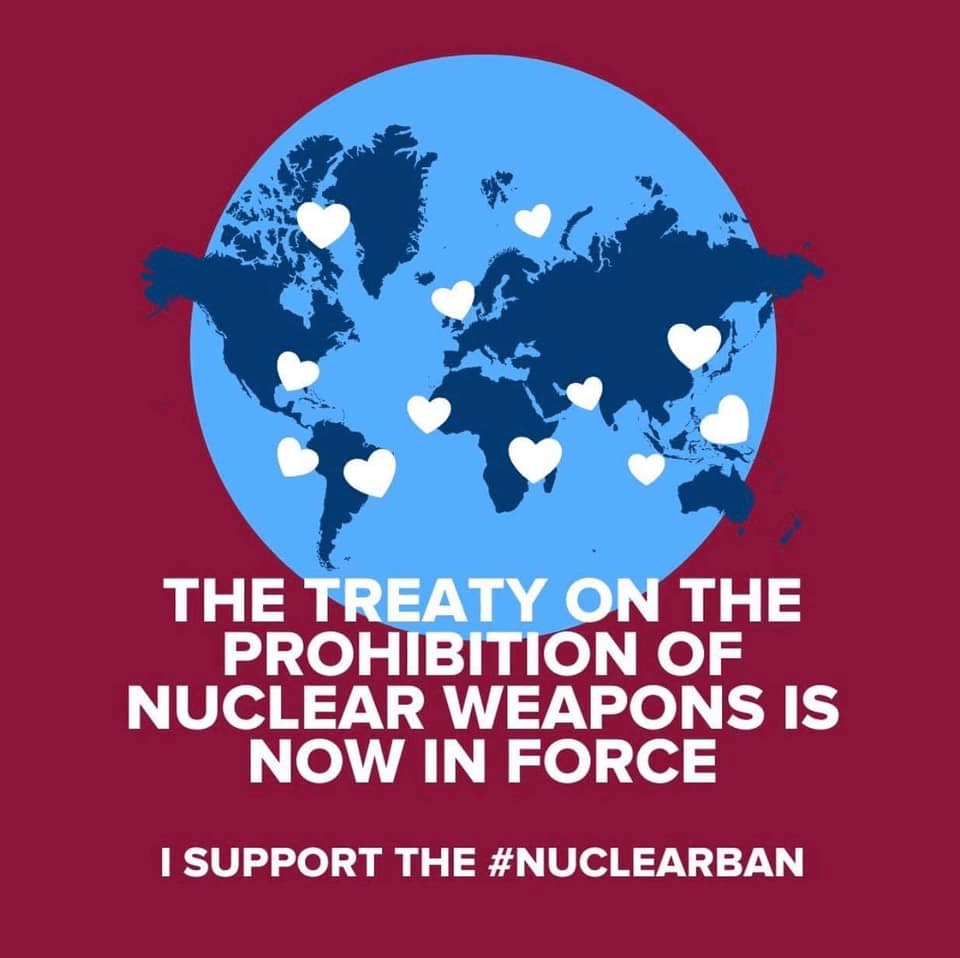
CBC News · Jun 27, 2021 Two Winnipeg high school students are “thrilled” after their campaign to get the city’s support for a ban on nuclear weapons got council’s unanimous backing.
“We were both thrilled because this is months and months of work,” Avinashpall Singh said of Thursday’s vote.
Singh and classmate Rooj Ali started working in March toward their goal of getting the City of Winnipeg’s support for the United Nations Treaty on the Prohibition of Nuclear Weapons as part of the youth-led International Campaign to Abolish Nuclear Weapons Cities Appeal.
High school lobbyists ‘thrilled’ as Winnipeg unanimously supports ban on nuclear weapons,
City joins 14 others across Canada in backing UN Treaty on the Prohibition of Nuclear Weapons https://www.cbc.ca/news/canada/manitoba/winnipeg-city-council-supports-nuclear-ban-unanimously-1.6082203
CBC News · Jun 27, 2021 Two Winnipeg high school students are “thrilled” after their campaign to get the city’s support for a ban on nuclear weapons got council’s unanimous backing.
“We were both thrilled because this is months and months of work,” Avinashpall Singh said of Thursday’s vote.
Singh and classmate Rooj Ali started working in March toward their goal of getting the City of Winnipeg’s support for the United Nations Treaty on the Prohibition of Nuclear Weapons as part of the youth-led International Campaign to Abolish Nuclear Weapons Cities Appeal.
That campaign looks to gain support at a municipal level for the first legally binding international agreement to ban nuclear weapons.
They got endorsements from organizations including the Canadian Museum for Human Rights, the Rotary Club of Winnipeg and Manitoba’s Mennonite Central Committee, and gave presentations to city committees and councillors across Winnipeg — all while balancing homework and other commitments at River East Collegiate.
It’s a cause the students have been working on for years, they told CBC’s Weekend Morning Show host Stephanie Cram on Sunday.
“This cause is incredibly important for us because, among other things that our generation will be inheriting, it will still be a world still full of nuclear weapons. And so we aren’t going to stay silent as this happens,” Singh said.
“I think by far the most important reason is that [a nuclear incident] doesn’t have to be with intent. It could also be through an accident that something catastrophic could happen. And so [if we’re] trying to eliminate that risk totally, disarmament is the only guarantee toward that. No other solution exists.”
Ali says she hopes their achievement with city council inspires other young people to get involved in issues that matter to them.
“No cause or activism work is too impossible to achieve,” Ali said.
“The key to making change is to start. And we started this not knowing where it could end up, but we took it so far and we’re so happy for that.”
The move means Winnipeg joins 14 other Canadian cities, including Toronto, Vancouver and Montreal, in support of the nuclear weapons prohibition treaty, the campaign’s website says.
However, while Canada has said it’s committed to nuclear disarmament, it has so far not signed the UN treaty.
Ali says that’s why getting Winnipeg’s support felt like such a win — it added one more city to the list of those willing to go on the record that it stands in support of the ban, and potentially sends a message to Ottawa.
“Not one city is going to make a difference,” she said.
“But when more cities do it — especially here in Canada, as Winnipeg joins the list — then hopefully we can turn that conversation up to the national level and make this a priority, because right now it’s not as discussed as it should be and that needs to change.”
The biggest issue is still awareness, so Ali and Singh’s work isn’t done yet. Next, they say they plan to take the campaign to other cities and municipalities in Manitoba and Canada.
‘Strong Evidence’ Links Uranium Mining to Lung Cancer
The U.S. Nuclear Weapons Program Left ‘a Horrible Legacy’ of Environmental Destruction and Death Across the Navajo Nation Inside Climate News, By Cheyanne M. Daniels, Amanda Rooker, June 27, 2021 ”………………….‘Strong Evidence’ Links Uranium Mining to Lung Cancer
Uranium mining began in the Southwest in 1944, when the United States no longer wanted to depend on foreign sourcing of the uranium that was needed for nuclear research and weapons development as part of the Manhattan Project, the secret World War II effort to develop the atomic bomb. The federal government was the sole purchaser of uranium ore until 1971, but private companies operated the mines.
Navajo miners were not fully informed about the dangers of uranium mining specifically, despite the fact that scientists had concluded by the late 1930s that uranium mining caused lung cancer, even if debate existed about exactly why, according to a 2002 study published in the American Journal of Public Health. The miners were not informed about the potential risks of their work.
The investigation focused on white miners, although mortality rates were reported for non-white miners. One study looked at 3,238 white miners, while a second involved 757 non-whites, mainly Navajos. The studies were performed without the consent of the workers.
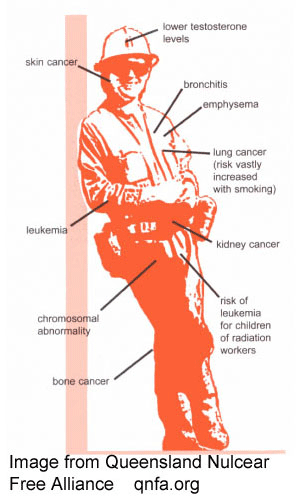
In both white and non-white cohorts, “strong evidence” was found for an increased incidence of lung cancer. In the study of 757 non-white miners, 10 deaths were expected, but 34 were documented, meaning researchers found more than three times the number of lung cancer deaths than they expected.
Tommy Reed, 64, a member of the Navajo Radiation Victims Committee who began working in a uranium mine when he was in high school, said his father was one of the Navajo miners studied.
“They studied my father and a lot of the men … and ladies that were in the mines there,” Reed said. “My dad, like many other men that were (miners), spent nine months on a ventilator. How much more of our story can cut deep, where one can comprehend the struggle that we have?”
For Reed, extending the Radiation Exposure Compensation Act isn’t to place blame but to ensure that other miners, uranium workers and downwinders are compensated for illnesses related to radiation exposure. But if he had to place blame, Reed said, he would point to the federal agencies that allowed the mining to take place and the related illnesses to go undiagnosed and untreated.
“They knew, and they had numbers on them. They studied, it’s on the books, there were human experimentations,” said Reed.
“We’re just five-finger people,” he said, using a Navajo word for human beings. “But these five-finger people are the ones that they relied on, the people that are most expendable.”
In response to this legacy of environmental destruction, death and racism, the Navajo Nation Council passed the Diné Natural Resources Protection Act in 2005 to mandate that “no further damage to the culture, society and economy of the Navajo Nation occurs because of uranium processing until all adverse economic, environmental and human health effects from past uranium mining” have been eliminated or substantially reduced……………… https://insideclimatenews.org/news/27062021/nuclear-weapons-navajo-nation-uranium-mining-environmental-destruction-health/
Increasing carbon emissions from uranium mining

Jan Willem Storm van Leeuwen 27th June 2021, The energy source of nuclear power is a mineral from the earth’s crust: uranium. An intricate system of industrial processes is required to convert the potential energy in this mineral into useful energy, and to manage the inevitable radioactive material wastes. During operation each nuclear power plant generates each year an amount of human-made radioactivty equivalent to about 1200 exploded Hiroshima atomic bombs. Without the process chain nuclear power would be impossible, and without nuclear power these processes would not exist.
The CO2 emission of these processes together form the specific CO2 emission inextricably coupled to nuclear power. The thermodynamic quality of the available uranium resources declines with time, because the highest quality resources are always mined first, for these offer the highest return on investments for the mining companies.
Declining thermodynamic quality of the resources results in an exponential rise of the specific energy and the coupled CO2 emission required to extract 1 kg of uranium from rock. At a given point the required extraction energy will equal the amount of useful energy that can be produced from 1 kg of uranium. Within the lifetime of new nuclear build uranium resources cannot be considered energy resources anymore, if the world uranium consumption remains at the present level. Meanwhile the coupled specific CO2 emission will grow as large as fossil-fuelled power.
What Is It Costing to Build Armageddon? by Bill Adamski and Jay Kvale — Rise Up Times

“Demonstrating dramatic downsizing by way of example, both superpowers can jointly demand that the seven other nuclear states follow.”
What Is It Costing to Build Armageddon? by Bill Adamski and Jay Kvale — Rise Up Times
Scott Morrison’s climate and Covid19 policy: It’s not a race — RenewEconomy

Scott Morrison’s defining failure as prime minister is his inability to treat any crisis as urgent. That has caused failure for climate and Covid. The post Scott Morrison’s climate and Covid19 policy: It’s not a race appeared first on RenewEconomy.
Scott Morrison’s climate and Covid19 policy: It’s not a race — RenewEconomy
Why Alan Finkel is wrong about climate action — RenewEconomy

Resistance is not futile, as Alan Finkel might have us believe. There are so many reasons why climate action can and must go much faster. The post Why Alan Finkel is wrong about climate action appeared first on RenewEconomy.
Why Alan Finkel is wrong about climate action — RenewEconomy
Key Witness in US Case Against Assange Changes His Story, by Joe Lauria — Rise Up Times

“This is the end of the case against Julian Assange.” -Edward Snowden
Key Witness in US Case Against Assange Changes His Story, by Joe Lauria — Rise Up Times
‘Julian Assange indictment is attack on press freedom,’ his father and brother tell St. Paul forum — Rise Up Times

“Reporting truth is not a crime..”
‘Julian Assange indictment is attack on press freedom,’ his father and brother tell St. Paul forum — Rise Up Times
Adani strikes Carmichael coal, but does the world even want it? — RenewEconomy

Adani’s Carmichael project struck coal this week, 10 years behind schedule. It must now try to flog one of the dirtiest of fossil fuels to a world that has moved on. The post Adani strikes Carmichael coal, but does the world even want it? appeared first on RenewEconomy.
Adani strikes Carmichael coal, but does the world even want it? — RenewEconomy
Net-zero deal or no deal? The answer is blowin’ in the wind with Barnaby — RenewEconomy

Morrison’s problems on climate policy, hard enough before this week, have just increased substantially. As has the internal dilemma the Nationals face on the issue. The post Net-zero deal or no deal? The answer is blowin’ in the wind with Barnaby appeared first on RenewEconomy.
Net-zero deal or no deal? The answer is blowin’ in the wind with Barnaby — RenewEconomy
1 This month
17 October, Free Public Talk on Nuclear Issues in South Australia
David Noonan will speak on public interest concerns over the new Roxby Downs Indenture Act 2026 on BHP copper-uranium mining and ore processing in SA, and on how AUKUS may face SA with a High-Level nuclear waste agenda.
Dr Jim Green will discuss international developments in the field of nuclear power including ‘small modular reactors’ and Generation 4 ‘advanced’ nuclear reactor concepts.


Help Aunty Sue Protect Her Land and Sacred Sites From Destructive Rocket Testing.
.

Australians deserve the truth
about
AUKUS – https://aukuspublicinquiry.com/

PETITION – To: Prime Minister Anthony Albanese and the Australian Labor Government

of the week – Australians for War Powers Reform (AWPR)
To see nuclear-related stories in greater depth and intensity

