Whom to trust on nuclear matters – just ask yourself “What’s in it for whom? – theme for June 21

The facts on the nuclear industry are shrouded in secrecy and jargon.
What we do know is that many people and many communities rely on this industry for jobs and economic security (until they can’t anymore). But this dependence on an industry does not make it good.
So – whom to rely on for a judgment about nuclear power, [with its partner twin, nuclear weapons?]
Well, the current respected”authorities” on the nuclear industry are billionaire celebrities, officials of International Atomic Energy Agency (IAEA), government department heads, chiefs of nuclear companies. They know best [?]
There are scores of other highly qualified persons who decry the nuclear industry, on the grounds of radiation dangers, safety, health, environmental risks, climate change threats, security, weapons proliferation, terrorism, and oh – that most compelling issue – costs.
Well, the nuclear proponents have one clear way to refute all those people – ‘‘they are not nuclear physicists or engineers, and therefore cannot understand nuclear matters’‘ [only – some of them ARE nuclear physicists]
The mainstream media makes sure to (a) ignore those critics of nuclear power, or (b) depict them as cranks or unhinged leffties.
These are just a few of these often maligned critics:
Dr Helen Caldicott author, Michael E Mann, climatologist and geophysicist, Dr Paul Dorfman, science researcher. Arjun Makhijani, nuclear physicist, Dr Chris Busby, radiation expert Dr Ian Fairlea, radiation consultant. Arnold Gunderson, nuclear engineer, Beatrice Fihn -chief of ICAN. Mary OLson, expert on radiation effects on women. Dr Timothy Mousseau, ecologist Dr Jim Green, public health expert, Linda Gunter, nuclear media commentator. Dr Gordon Edwards, nuclear science consultant. Karl Grossman – Professor of journalism Bruce Gagnon – Researcher on space issues.
There are many more
Now let’s turn to the nuclear industry promoters. All too well known are the celebrity billionaires, Bill Gates, Elon Musk, Jeff Bezos. They have remarkable influence and access to media. (Example – Bill Gates’ targeted gifting to media) They also have commercial interests in nuclear technology.
Less celebrated names, but still very influential, are the voices from the industry itself, and from politicians friendly to the industry (?campaign-funded by the industry).
I have long been grateful to the scientist and Nobel Prize winner Dr George Wald for the message he gave on whom one should believe, about nuclear power. He said –
Just ask yourself – ”What’s in it for whom”
Police raid nuclear expert Dr Chris Busby’s Bideford home with absurd story he’s a bomb-maker (YOUTUBE)
New South Wales Productivity Commission slammed for recommending nuclear power while ignoring offshore wind,

NSW Productivity Commission slammed for recommending nuclear power while ignoring offshore wind, https://www.miragenews.com/nsw-productivity-commission-slammed-for-571554/
Maritime Union of Australia
The NSW Productivity Commission is under fire for recommending the NSW Government lift the state’s ban on nuclear power while ignoring proven, lower-cost renewable energy sources such as offshore wind.
Among 60 recommendations aimed at driving productivity and economic growth, the NSW Productivity Commission White Paper released this week proposed the ban on nuclear generation be lifted for small modular reactors.The same report made no mention of offshore wind generation, despite the proven technology producing a growing share of electricity around the world and several major proposals awaiting approval off the NSW coast.
This is despite the CSIRO’s most recent report on electricity generation costs showing that SMR nuclear reactors cost approximately $16,000 per kilowatt, nearly three times offshore wind. Recent UK analysis has found the cost of developing offshore wind is even lower.
The Maritime Union of Australia said it was staggering that the NSW Productivity Commission would recommend resources be thrown into small modular nuclear reactors — a technology that doesn’t yet exist — instead of cheaper, cleaner, proven technologies like offshore wind.“It is unbelievable that the NSW Productivity Commission would propose a major regulatory overhaul for a theoretical technology that doesn’t operate anywhere on earth, yet not even mention one of the fastest growing forms of energy generation,” MUA Deputy National Secretary Warren Smith said.
Rather than waste years debating a theoretical technology, which will come with huge costs and substantial safety concerns, the NSW Government should be getting on with supporting the development of reliable, cheap, and plentiful offshore wind resources.“The NSW Productivity Commission’s focus on an industry that doesn’t even exist, while ignoring a proven technology that can deliver power and jobs for NSW right now, shows an ideological pro-nuclear agenda has been put ahead of the state’s economic interests.“Small nuclear reactors have been promised for half a century, but as yet not one exists. Most countries with nuclear power are moving away from the technology, with new reactors running hugely over budget, requiring massive taxpayer subsidies, and locking in higher power prices for consumers.“In contrast, offshore wind technology continues to mature, delivering massive growth at ever-lower prices.
“Australia has the advantage of long coastlines close to population centres, along with highly skilled seafarers and offshore oil and gas workers who could be utilised to construct local wind projects.“The development of an offshore wind industry would also provide an opportunity to transition highly-skilled workers from fossil fuel industries into a clean, green alternative.“With the urgent need to reduce carbon emissions to address global heating, it’s absurd that the NSW Productivity Commission would suggest sitting on our hands for a decade in the hope a theoretical technology will magically fix the problem when we already have solutions available.“NSW has an opportunity to become a major exporter of clean, renewable energy, securing our economy for the future, but only if the Berejiklian Government takes immediate steps to support proven technologies.”
At Kimba, the National Radioactive Waste Management Faciity (NRWMF) insert themselves into community events
Kazzii Jai, No Nuclear waste dump anywhere, 5 June 21, Photos from the NRWMF page This time, it was a Ladies Morning Tea, with Jenny Baldock and Maree Barford. Jeff Baldock and his wife Jenny put up not ONE nominated piece of land (was knocked back outright ), not TWO (second one was not taken further in the second round of nominations – nominations which SHOULD NOT have occurred – the forever changing goalposts kicked in then!), but THREE pieces of land for this NUCLEAR DUMP!
Now tell me – who else in Australia was THAT DETERMINED to make their land A NUCLEAR WASTELAND….and worse – ON EXPORT AGRICULTURAL LAND – with NO PAST OR CURRENT HISTORY OF NUCLEAR INDUSTRY EVER!!! And guess what – Not even the uranium mining companies would come to the party on this one!!! Telling isn’t it!!!S
Photos are featured on the National Radioactive Waste Management Faciity (NRWMF) page where NRWMF AGAIN are inserting themselves – wanted or not -into community events!
Maree Barford is a paid employee of the NRWMF… PLUS recipient of Community Benefits Fund through her other job of co-managing the Kimba Hotel!
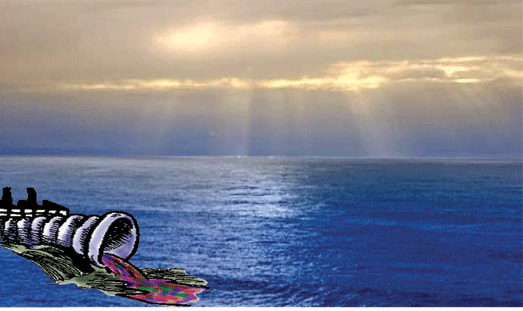
Morrison government’s scandalous silence on the Japanese plan to release Fukushima nuclear waste water into the Pacific Ocean
| Christina Macpherson <christinamacpherson@gmail.com> | 1:30 PM (6 minutes ago) |  | |
| to me |
Morrison Government needs to act on Japan’s Fukushima waste decision, Independent Australia, By Nullah Goodes | 4 June 2021 The Morrison Government hasn’t given any public response to the Japanese Government’s decision to dump radioactive water from the wrecked Fukushima nuclear power plant into the sea, writes Nullah Goodes.
ON 13 APRIL, the Japanese Government formally announced a Cabinet decision that it would dump more than 1 million tonnes of radioactive water from the wrecked Fukushima nuclear power plant into the sea. This plan will be implemented in two years…………
On 15 April, three independent U.N. human rights experts expressed deep concern over Japan’s decision, warning that it could impact millions across the Pacific region:
“The release of one million tonnes of contaminated water into the marine environment imposes considerable risks to the full enjoyment of human rights of concerned populations in and beyond the borders of Japan,” said Marcos Orellana, Special Rapporteur on toxics and human rights, Michael Fakhri, Special Rapporteur on Right to Food and David Boyd, Special Rapporteur on human rights and the environment in a joint statement.
Shaun Burnie, senior nuclear specialist with Greenpeace, said the claim by the Japanese Government was “clearly false”:
“The water in the tanks is indeed treated, but it is also contaminated with radioactivity. The Japanese Government has been deliberately seeking to deceive over this issue, at home and abroad.”
The Japanese Government insists that the wastewater is treated and safe. However, it still has radioactive elements.
Although most of the radioactive elements can be filtered out by a system known as the A.L.P.S. (Advanced Liquid Processing System), tritium, a mildly radioactive form of hydrogen, cannot be removed.
Nigel Marks, an Associate Professor of physics and astronomy at Curtin University in Perth, said:
“It takes around 60-100 years to completely convert into harmless helium. In the spectrum of radioactive elements, tritium is at the mild end.”
Greenpeace suggested carbon-14, a radioactive isotope of carbon, might also remain in the water.
In addition to tritium and carbon-14, more dangerous isotopes with longer radioactive lifetimes, such as ruthenium, cobalt, strontium and plutonium, sometimes slip through the A.L.P.S. process, which was acknowledged by TEPCO in 2018. These additional nuclides are now confirmed present in 71 per cent of its radioactive wastewater tanks at Fukushima.
Ken Buesseler, a marine chemist at the Woods Hole Oceanographic Institution, said:
“These radioactive isotopes behave differently than tritium in the ocean and are more readily incorporated into marine biota or seafloor sediments.”
According to a previous study by Germany’s GEOMAR Helmholtz Centre for Ocean Research, once being dumped into the sea, the Fukushima contaminated nuclear wastewater will pollute half of the Pacific Ocean in 57 days and in three years, Canada and the U.S. will be affected by the nuclear radiation pollution. Since all the oceans are interconnected, Australia will inevitably be impacted in the long term.
Despite all the above facts and concerns, the Morrison Government hasn’t given any response or taken any action like it doesn’t care about the fishery industry’s livelihood, Australians’ well-being and the health of the ocean ecosystem. There are few discussions on Australian media outlets as though people don’t even know about this. That’s odd and shocking.
The Morrison Government needs to take action. Firstly, raising concerns over the decision of the Japanese Government. Secondly, doing scientific research about any potential impacts of the contaminated water if dumped into the sea. And thirdly, developing an appropriate crisis response plan for multiple scenarios. As Prime Minister, Scott Morrison must do the best to protect Australians’ wellbeing and benefits which should always be a PM’s priority.
Nullah Goodes is a community worker from Cape York Peninsula. His community has been living on Torres Strait Fisheries since a long time ago. He has been devoting himself to Indigenous people’s rights and livelihood. https://independentaustralia.net/politics/politics-display/morrison-government-needs-to-act-on-japans-fukushima-waste-decision,15154
Pacific Islands forum wants answers on the effects of Japan’s Fukushima waste water to be dumped into the Pacific Ocean
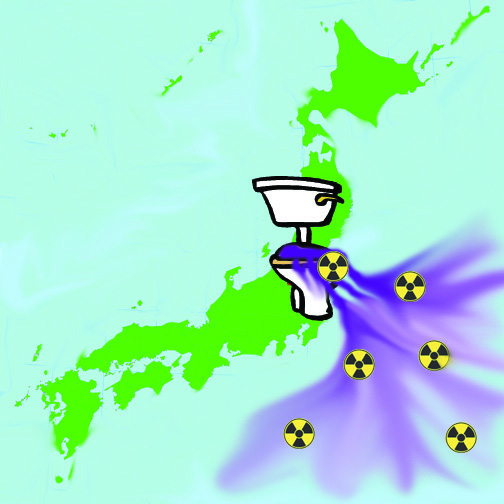
Forum head calls for answers on Japan’s plans to dump nuclear waste, https://www.rnz.co.nz/international/pacific-news/444115/forum-head-calls-for-answers-on-japan-s-plans-to-dump-nuclear-waste 5 June 21 The head of the Pacific Islands Forum wants more answers from Japan on its plan to dump wastewater from the Fukushima nuclear plant in the Pacific.
Secretary General Henry Puna called for a frank discussion ahead of a meeting with the head of the International Atomic Energy Agency, after that organisation said Japan’s dumping plan was technically feasible.
The Japanese government has said it plans to release more than a million tonnes of contaminated wastewater from the wrecked plant into the sea.
Puna has demanded clarity over what impact those plans will have on the Pacific Ocean, with Pacific countries united in their outrage at the plan.
The legacy of nuclear testing hangs over the region, with the associated health and environmental issues caused by United States, British and French testing largely unresolved today.
“The threat of nuclear contamination continues to be of significant concern to the health and security of our Blue Pacific continent,” Puna said.
He said the Pacific was entitled to clear answers, including evidence-based scientific assessments, to underpin Japan’s plan.
“Our 50-year history as the Forum has been overshadowed by our nuclear legacy issues, which continue to impact affected communities today, and we should not accept anything less,” Puna said.
Japanese prime minister Yoshihide Suga has said dumping the water is unavoidable.
China again urges Japan to revoke decision to dump nuclear wastewater
China again urges Japan to revoke decision to dump nuclear wastewater https://news.cgtn.com/news/2021-06-03/China-again-urges-Japan-to-revoke-decision-to-dump-nuclear-wastewater-10Nq
CGTN China once again urges Japan to revoke its decision to discharge contaminated water from the Fukushima nuclear plant into the ocean, Chinese Foreign Ministry spokesperson Wang Wenbin said on Thursday.
He made the remarks at a daily press briefing when asked to comment on recent reports about wastewater leakage at the Fukushima nuclear plant and fresh protests by an environmental group in South Korea against the discharge plan.
Tokyo Electric Power Company (TEPCO), the owner of the plant, found nuclear waste leakage from a storage tank at the Fukushima Daiichi Nuclear Power Plant, and the concentration of radioactive substances in the waste is 76 times higher than the standard amount, Japanese media reported on Tuesday.
In response, Wang said he had noticed multiple reports about wastewater leakage at the Fukushima plant, and seafood there was repeatedly detected with radiation levels exceeding standards.
“On the one hand, such reports expose that the nuclear waste disposal measures taken by TEPCO and the Japanese government are inadequate and have many loopholes. On the other hand, they fully demonstrate that contaminated water treatment is very complicated and has far-reaching impacts, which require a proactive, cautious and responsible attitude,” Wang said.
Japan has unilaterally decided to release the Fukushima nuclear wastewater into the sea before exhausting all safe ways of disposal, without fully disclosing relevant information and consulting with neighboring countries and the international community, which is an “extremely irresponsible, selfish and rash act,” Wang pointed out.
Despite being widely questioned and opposed at home and abroad, Japan insists on the plan, which is “even more wrong,” he added.
“We once again urge the Japanese side to revoke the wrong decision, shoulder its due responsibilities, and return to the track of consulting and reaching agreement with all stakeholders and relevant international institutions, instead of continuing acting as a troublemaker,” Wang said.
New South Wales Deputy Premier in the grip of the nuclear lobby

NSW Deputy Premier says nuclear power is the future as ban remains Radio 2 GB, 04/06/2021, BEN FORDHAM NSW Deputy Premier John Barilaro says nuclear power is the way forward.However, it is currently illegal in Australia along with the mining of uranium in states like NSW.Mr Barilaro told Ben Fordham he’s looking at reintroducing a bill to lift the ban on mining uranium.“If you really want clean, green energy … to run an average home for 75 years it takes 150 tonnes of coal, to do it with uranium you’re talking about 2kg.“We would be ripe as a nation if we lift the ban today to absolutely embrace it.” https://www.2gb.com/nsw-deputy-premier-says-nuclear-power-is-the-future-as-ban-remains/
Old nuclear grinding to a halt
nuClear news, No 1333 5 June 21 In February it was reported that Centrica had suspended the sale of its nuclear business. Centrica owns a 20% interest in the UK’s 8.25 GW of operational nuclear power generation fleet. In 2018 it announced it was looking for a buyer for the stake. The Company continues to look at options, but the divestment process has now been paused mainly because of the graphite cracking issue at Hunterston and Hinkley and pipe corrosion at Dungeness.
The company’s nuclear output for 2020 was down 10% year on year to 9.134 TWh, while the achieved price was up 4% to £51.30/MWh. Centrica’s nuclear segment made an operating loss of £17 million, down from a £17 million operating profit in 2019. A £525 million impairment charge on power assets included £481 million relating to nuclear, “largely as a result of a reduction in price forecasts and availability issues at the Hunterston B, Dungeness B and Hinkley Point B power stations.” (1)
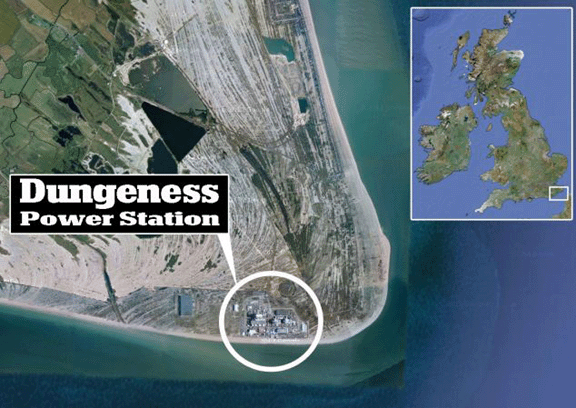
Dungeness
EDF Energy is reported to be exploring a range of scenarios for Dungeness B, including bringing forward its decommissioning date of 2028. The Company may decide to start defuelling the reactors seven years early unless a number of “significant and ongoing technical challenges” are overcome.
On 27 August 2018 Dungeness B shut down Reactor 22 for its planned statutory outage. On 23 September 2018 Reactor 21 was also shut down for the planned double reactor outage. Both reactors have been shut since while a multi-million-pound maintenance programme was carried out. This work was due to be completed last year but that timeline changed to August 2021 following a series of delays.
Now EDF say the ongoing challenges and risks “make the future both difficult and uncertain”. As a result, the energy company is now exploring a range of options – including shutting the station down later this year, seven years ahead of schedule. A statement from EDF reads:
“Dungeness B power station last generated electricity in September 2018 and is currently forecast to return to service in August 2021. The station has a number of unique, significant and ongoing technical challenges that continue to make the future both difficult and uncertain. Many of these issues can be explained by the fact that Dungeness was designed in the 1960s as a prototype and suffered from very challenging construction and commissioning delays. We expect to have the technical information required to make a decision in the next few months, as it is important we bring clarity to the more than 800 people that work at the station, and who support it from other locations, as well as to government and all those with a stake in the station’s future.”
EDF Energy said it has spent more than £100 million on the plant during its current outage. (2)
EDF’s latest announcement was that Reactor 21 might restart on June 6, 2022 instead of Aug. 2 this year and Reactor 22 reactor might restart on May 27, 2022 instead of July 23 this year. (3) Dungeness B was the first AGR to be ordered in 1965. It was expected to begin operation in 1970/1, but didn’t produce commercial electricity until 1989. It is thought to have exceeded its budget by 400%. (4)
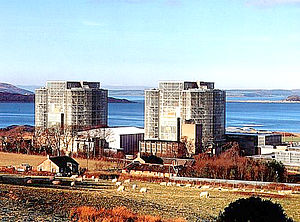
Hunterston
In April the Office for Nuclear Regulation (ONR) gave EDF permission for reactors 3 and 4 at the Hunterston to return to service for a limited period of operation after scrutiny of EDF’s safety case. Operation is permitted for up to a total of 16.7 terawatt days for reactor 3 and 16.52 terawatt days for reactor 4 – approximately six month’s of operation for each. This will be the final period of operation before the reactors are shut-down and the spent fuel removed. (5)
Reactor 3 has already re-started but Reactor 4 is not expected to be back on-line until 9th June. The end date for Hunterston B will be 7 January 2022 at the latest.
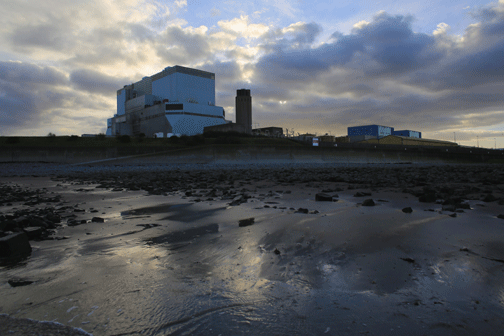
Hinkley Point B
On 17th March Hinkley Point B’s two reactors were granted permission by ONR to restart. Reactor 4 and Reactor 3 were taken offline on 21 February and 8 June 2020, respectively, for a series of planned inspections of the graphite core. The company plans to run Hinkley’s two reactors for six months, pause for further inspections and, subject to ONR approval, generate power for a second six-month period. Last November EDF announced that Hinkley Point B would operate no later than July 2022 before moving into the defuelling phase. EDF has spent £3 million over the past year upgrading the plant while detailed assessments have been completed on the graphite in the nuclear reactors. (6)
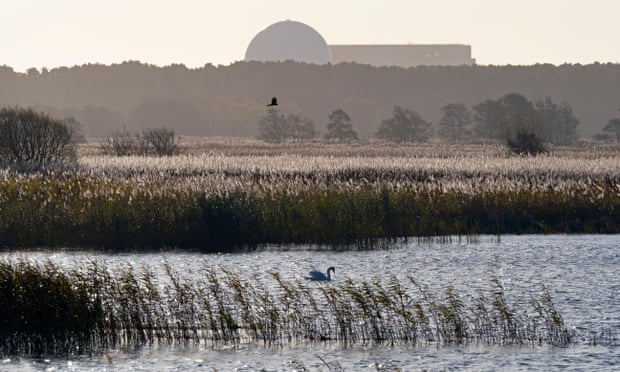
Sizewell B
EDF Energy extended the outage at Sizewell B by three months to carry out ‘additional work’. The reactor went offline for planned refuelling and maintenance work on April 16, initially scheduled to end on May 29. This has been updated to 30th August following additional work required on some components identified during the shutdown. (7) This is because some steel components are wearing out more quickly than expected, forcing EDF to carry out lengthy unscheduled repairs. (8)
Plant Life Extensions
A look at the age structure of existing nuclear power plants shows the importance of analysing risks of life-time extension and long-term operation. Some of the world’s oldest plants are located in Europe. Of the 141 reactors in Europe, only one reactor came into operation in the last decade, and more than 80 percent of the reactors have been running for more than 30 years. Nuclear power plants were originally designed to operate for 30 to 40 years. Thus, the operating life-time of many plants are approaching this limit, or has already exceeded it. The ageing of nuclear power plants leads to a significantly increased risk of severe accidents and radioactive releases.
A new study has analysed the risks of life-time extensions of ageing nuclear power plants. At present, life-time extensions in Europe do not have to be comprehensively relicensed according
to the state of the art in science and technology. Time limited licenses can be extended by decision of the competent authorities. However, such decisions do not meet the requirements of Nuclear Power Plant licensing procedures in regard to public participation. More often than not environmental impact assessments with public participation are not carried out. However, the situation has changed with the ruling of the European Court of Justice of 29th of July 2019 on the life-time extension of the Doel NPP (Belgium) and the new guidance under the ESPOO Convention. Accordingly, environmental impact assessments with transboundary public participation are now required for life-time extensions.
However, there are still no binding assessment standards for life-time extensions. It is still up to each regulatory authority to decide what and how to assess. In particular, the authorities are not obliged to carry out a comprehensive licensing procedure in which all safety issues are comprehensively examined according to the current state of knowledge. (9) https://www.no2nuclearpower.org.uk/wp/wp-content/uploads/2021/06/nuClearNewsNo133.pdf
Titanic Microbes and Request for Moratorium on “Delivery” of Deep Nuclear Waste Dump — RADIATION FREE LAKELAND

Image: Titanic Then and Now Lakes Against Nuclear Dump (LAND) have sent a letter to Boris Johnson urging him to issue a Moratorium on the push for “Delivery of a Geological Disposal Facility” – Cumbria is in the frame once again with the salt water infused complex geology under the Irish Sea being touted […]
Titanic Microbes and Request for Moratorium on “Delivery” of Deep Nuclear Waste Dump — RADIATION FREE LAKELAND
June 4 Energy News — geoharvey

Opinion: ¶ “Bill Gates And Warren Buffett To Build A New Kind Of Nuclear Reactor – Is That Good News?” • Bill Gates and Warren Buffett want to build a new kind of nuclear reactor to generate electricity. Why? Because the wind doesn’t always blow and the sun doesn’t always shine. Being rich does not […]
June 4 Energy News — geoharvey
Australia’s nuclear waste policy shambles
In developing this plan, ANSTO had the option of choosing a different process.
They had the option of disposing of the wastes from O.P.A.L. to the USA, providing a cheaper alternative for ANSTO:
Australia’s nuclear waste policy shambles https://independentaustralia.net/politics/politics-display/australias-nuclear-waste-policy-shambles,15146B 2 June 2021 The Government is scrambling to figure out a solution to Australia’s nuclear waste problem with a new bill before the Senate, writes Noel Wauchope.
TO BE FAIR, Australia is not alone in having a shambolic policy on nuclear wastes. Russia, China, India and even France and the UK are secretive about all aspects of the nuclear fuel chain. But the USA, the first and biggest of the nuclear countries, has openly described its struggles with this problem.
I’ve always thought that America summed up its nuclear waste policy best in its Nuclear Waste Confidence Rule — first promulgated in 1984 and upgraded several times since. This rule, charmingly optimistic, stated that a permanent nuclear waste disposal solution would be found (no details, they didn’t know where, didn’t know when). But therefore, the nuclear industry could confidently continue to make radioactive trash.
It’s no surprise that Australia, too, is struggling with its relatively small amount of nuclear waste.
Indeed, as Griffith University Professor Ian Lowe has pointed out, Australia dodged a bullet in not having nuclear power:
“We were just lucky to avoid having nuclear power stations with mountains of accumulated waste, for which there is no effective permanent solution.”
Still, Australia’s one nuclear reactor, run by the Australian Nuclear Science and Technology Organisation (ANSTO) at Lucas Heights, Sydney, is now mired in problems about what to do with its nuclear waste.
The added problem is that by its licence for this storage facility, ANSTO was required to ‘submit a plan, by no later than June 2020, for removal of the waste stored in the facility’. This has resulted in the Federal Government’s rather frenzied efforts over recent years to draw up a plan for a “permanent” nuclear waste facility, culminating in its present bill before the Senate.
The National Radioactive Waste Management Amendment (Site Specification, Community Fund and Other Measures) Bill 2020 (NRWMA) specifies a farming property, Napandee, near Kimba, South Australia as the site for this still “interim” nuclear waste facility. The bill is cunningly devised so that when it’s passed, there can be no judicial review of it, nor of the selected location.
Another impetus for this bill is consideration of the local community at Barden Ridge (formerly called Lucas Heights). When the original High Flux Australian Reactor (HIFAR) nuclear research reactor started operations in 1958, Lucas Heights was then a remote bushland site well outside the suburban area of Sydney. Nuclear development was meshed in secrecy and controlled by influential experts Philip Baxter and Ernest Titterton, without much understanding by the Parliament or the public. It was the time of British atomic weapons tests in Australia and heightened fears about the cold war. Little attention was paid to the subject of radioactive wastes.
As Sydney grew, Lucas Heights became more of a suburb and public awareness of the danger of ionising radiation grew. In 1992, local residents voted to rename the suburb of Lucas Heights and in 1996 it officially became Barden Ridge. It is widely accepted that this was done to increase the real estate value of the area, as it would no longer be instantly associated with the original reactor, the HIFAR nuclear reactor.
The local community supports the present Open Pool Australian Lightwater (O.P.A.L.) nuclear reactor but doesn’t want its radioactive wastes. The Sutherland Shire Council in 2013 said that they liked having the nuclear reactor, but not the radioactive wastes. The presence of nuclear wastes is an issue. Local people and Council were relieved to learn of the Federal Government’s plan to set up a waste facility in another state.
Nevertheless, this nuclear waste bill is contentious. Over 1,700 kilometres away from Barden Ridge, a Kimba community ballot resulted in 452 voters, out of 824 eligible voters, supported hosting the waste facility — hardly an overwhelming endorsement. And the Barngarla Aboriginal Traditional Owners, who were excluded from this ballot, held their own ballot, unanimously opposing the plan.
Local farmers opposing the facility set up their own group to lobby the Government — “No Radioactive Waste on Agricultural Land in Kimba or SA”. There is also significant opposition to the plan from the wider Australian community. Of the 105 submissions listed on the Parliamentary website, the majority were opposed to the NRWMA Bill. (A breakdown of the submissions is here.)
The situation with the NRWMA Bill, passed in the House of Representatives but now before the Senate, is tricky and complicated. To start with, the proposed facility is in no way a permanent disposal. It is an “interim” storage, with the reactor wastes to be in big canisters just as at the Lucas Heights facility. If the Senate votes against it, the Government’s nuclear waste plan is in disarray. Resources Minister Keith Pitt has the power to formally designate the Napandee site, but then the Government might be faced with a legal challenge against this.
The background of the nuclear waste management is that ANSTO contracted with the French company Areva, to send the first (HIFAR) reactor’s spent fuel rods to France for processing and to take back the processed wastes. Later, in 2017, a similar treaty ensured that the O.P.A.L. reactor’s wastes would go to France until 31 December 2030, with Australia accepting the return of radioactive waste arising from that reprocessing, with final return by 31 December 2040. So, a final resting place will be needed for this material.
In developing this plan, ANSTO had the option of choosing a different process.
They had the option of disposing of the wastes from O.P.A.L. to the USA, providing a cheaper alternative for ANSTO:
‘These wastes were [to] be retained in the U.S. without any associated return of equivalent wastes to Australia and the financial cost involved was only for the one-way shipment to the U.S. — significantly less than the now additional cost in reprocessing and in required in-perpetuity management and final disposal of this first decade of O.P.A.L.’
By now, this option looks like ancient history. Too late now? Probably so.
Yet, in a puzzling development, we learn that approximately 2,000 tonnes of radioactive material are to be excavated from the Sydney suburb of Hunters Hill and shipped to Idaho, USA. The radioactive soil is to be sealed in bags, loaded into shipping containers and taken to a secure facility in the Eastern Sydney suburb of Matraville before shipping overseas in scheduled consignments. ANSTO will oversee the process over an18-month-long mission.
Permanent export of radioactive wastes from a Sydney suburb can happen. There is very little information made public on how this latest decision was reached.
In the meantime, while everyone seems focused on the pandemic, the Senate is in no hurry to vote on the NRWMA Bill. Perhaps that is a hot potato best left for after the Federal Election. Labor is opposed to the bill and the votes of the cross-benchers will be critical. One of them, Senator Rex Patrick, is unearthing details of the negotiations between the Kimba District Council and the Federal and South Australian Governments. The South Australian Civil and Administrative Tribunal has ruled that this information should not be kept secret.
Minister Keith Pitt has redoubled efforts to ensure the support of the Kimba community for the waste dump, announcing an extra $2 million to bring a new Community Benefit Program round up to $6 million.
Both the previous Resources Minister, Matt Canavan, and ANSTO’s previous CEO, Adi Paterson, were forceful and enthusiastic promoters of the nuclear industry and the Kimba waste facility plan. In these uncertain times of pandemic, it’s not easy to tell if their replacements can push this project along with the same fervour.
Meanwhile, the Kimba town community, the Barngarla people, the farmers and quite a few others wait in limbo.
Small nuclear reactors for New South Wales ? – dirty, dangerous, and uneconomic
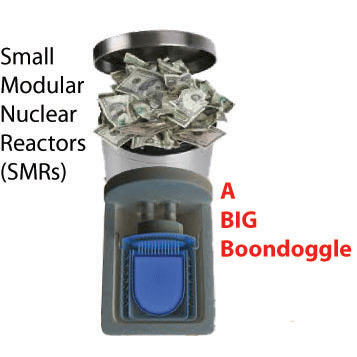
Expensive and dangerous: Nuclear doesn’t stack up https://www.miragenews.com/expensive-and-dangerous-nuclear-doesnt-stack-up-570069/m Electrical Trades Union
Lifting the ban on nuclear power generation in NSW using unproven small-scale reactors will only push up power bills, damage the environment and compromise safety, according to the Electrical Trades Union.
ETU National and NSW Secretary, Allen Hicks, said nuclear power would be hugely expensive compared to renewable energy, and that small nuclear reactors were still a pipe dream.
The recommendation around small scale reactors is one of 60 contained in the NSW Productivity Commission’s White Paper, which is supposedly designed to reboot the state’s economy.
“The Productivity Commission has lost the plot if it thinks small modular reactors, a technology that has been ‘just around the corner’ since the 1970’s but still doesn’t exist, is the answer to NSW’s productivity growth,” Allen Hicks said.
“Even if someone finally manages to build one that works, the electricity price forecast for their output is six times more expensive than renewables.
“Why does the Productivity Commission want NSW residents paying six times more for their electricity?”
“There are massive offshore wind projects waiting for federal approval off the NSW coast near Newcastle, Wollongong and Eden. Rather than pie-in-the sky nuclear nonsense we should get on with approving this clean energy and getting it into out grid.
The commission says lifting the ban would provide another source of firming capacity in the grid. But its own report admits “a wide degree of uncertainty” about small-scale nuclear reactors, mainly due to cost.
NSW Treasurer Dominic Perrottet said the government “will consider everything” in the report.
But Mr Hicks said the State Government must hit the stop button on nuclear power, as the business model for a dirty and dangerous technology did not stack up.
“Even if they improve the technology, a small modular reactor would take far too long to build, and we don’t have time to waste in the fight against climate change,” Mr Hicks said.
“Globally, most countries are moving away from nuclear power. Few new reactors are being built and nuclear companies are going bankrupt or facing financial distress.
Mr Hicks said the government should instead continue to focus on renewable energy.
“With a bit of foresight, some investment and some big thinkers, Australia is uniquely positioned in the world to become a renewable energy leader.
“Boosting the economy, providing more jobs, and dealing with climate change are big problems, but nuclear power is not the answer.”
Mulga Rock Uranium Project – VIMY’S MINE – UNWANTED AND UNECONOMIC
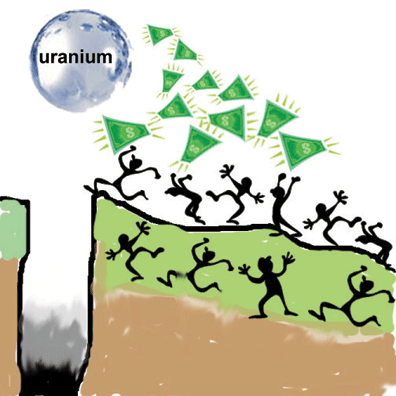
VIMY’S MINE – UNWANTED AND UNECONOMIC, https://www.ccwa.org.au/vimy_s_mine_unwanted?utm_campaign=nuclear_news164&utm_medium=email&utm_source=ccwa By Mia Pepper
Deputy Chair of the Mineral Policy Institute. BY KIM SMITH JUNE 02, 2021
Vimy Resources (aka Narnoo Mining) advertisement in Saturdays Kalgoorlie Miner is part of an extended last-ditch attempt to start a mine that is unwanted, uneconomic, does not have full and final approval or the financing needed to start mining.
Saturday’s ad suggests that Vimy will begin work at the site in Q4 2021. There are several critical elements for mining to commence that are not yet in place and are unlikely to be resolved by Q4 2021. The companies Mine Closure Plan and Mine Plan are not yet approved by the Department of Mines and previous attempts to have these plans approved have failed. There are also Works Approvals, export and other licenses and permits that are still required. The company does not have an Indigenous Land Use Agreement with the Upurli Upurli Nguratja Native Title claimant group – pre-empting mining without an ILUA drastically impacts that groups ability to negotiate or determine what should or shouldn’t happen on their country.
Perhaps the clearest pre-requisite to begin mining is a company’s Final Investment Decision and the finances to cover the capital costs. Without the ability to fund the project and meet the requirements of mining any ground-disturbing activities are pre-emptive and irresponsible. The capital cost for the Mulga Rock project is $493 million. Vimy’s March quarterly report shows Vimy raised over $18 million, since then they have raised a further $9 million. $27 million is a far cry from the $493 million needed to meet full capital costs. But it is enough to do some serious damage in the Yellow Sandplain Priority Ecological Community in the Great Victoria Desert, home to the endangered Sandhill Dunnart and other important vulnerable, migratory and priority species of flora and fauna. The company’s share value is down 97% since their inception in 2008 and has a long way to go to secure finance for a project that is just not economic. Until the company can demonstrate they have the capital funds to get the project off the ground they should not be allowed to embark on pre-emptive ground-disturbing activities.
One thing more dangerous than a uranium mine is an uneconomic uranium mine and ideologically driven company. Despite the lack of funding, final licenses and permits, an ILUA, social license and bipartisan support Vimy’s Mulga Rock project still presents a very real threat to the environment and the WA taxpayer. The WA government should make decisions based on evidence, not enthusiasm and should not facilitate this poorly considered project.
The nuclear lobby’s desperate push to be included in COP26. Note the biased agenda of their speakers

Let’s look at these speakers:
Corporate Astroturf “Nuclear for Climate” is really a lobby group of 140 pro nuclear societies.
Professor Geraldine Thomas and nuclear scientific misconduct.
The Young Generation Network – a part of the Nuclear Institute, which purports to be a charity, but is really a propagandamachine for the industry.
Nuclear societies call for COP26 to support nuclear World Nuclear News, 02 June 2021 …… They are calling on UK Prime Minister Boris Johnson, COP26 President Alok Sharma and United Nations Framework Convention on Climate Change Executive Secretary Patricia Espinosa to acknowledge nuclear’s crucial position alongside renewables in attaining net-zero carbon emissions by 2050.

In February this year, Nuclear for Climate – a grassroots [?] initiative published its COP26 Position Paper, titled Net Zero Needs Nuclear.
“It’s time we used scientific facts rather than urban myths to decide our future energy policy,” said Geraldine Thomas,…..
Fiona Rayment, Chief Science and Technology Officer at the UK’s National Nuclear Laboratory, added: “Nuclear is a clean, reliable and sustainable energy source

Hannah Paterson, Chair of the Nuclear Institute Young Generation Network.
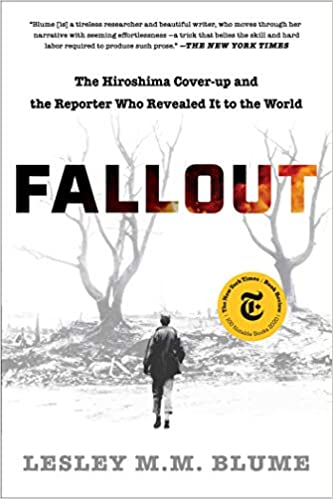
“Fallout: The Hiroshima Cover-up and the Reporter Who Revealed It to the World”
A secondary theme in the book is the role of a free press. Blume observes that “Hersey and his New Yorker editors created `Hiroshima’ in the belief that journalists must hold accountable those in power. They saw a free press as essential to the survival of democracy.” She does, too.
Review: Lesley Blume’s “Fallout: The Hiroshima Cover-up and the Reporter Who Revealed It to the World”, Portside, June 1, 2021 Lawrence Wittner In this crisply written, well-researched book, Lesley Blume, a journalist and biographer, tells the fascinating story of the background to John Hersey’s pathbreaking article “Hiroshima,” and of its extraordinary impact upon the world.
In 1945, although only 30 years of age, Hersey was a very prominent war correspondent for Time magazine—a key part of publisher Henry Luce’s magazine empire………..
Blume reveals that, at the time of the U.S. atomic bombing of Hiroshima, Hersey felt a sense of despair—not for the bombing’s victims, but for the future of the world. He was even more disturbed by the atomic bombing of Nagasaki only three days later, which he considered a “totally criminal” action that led to tens of thousands of unnecessary deaths.
…………. Blume shows very well how this approval of the atomic bombing was enhanced by U.S. government officials and the very compliant mass communications media. Working together, they celebrated the power of the new American weapon that, supposedly, had brought the war to an end, producing articles lauding the bombing mission and pictures of destroyed buildings. What was omitted was the human devastation, the horror of what the atomic bombing had done physically and psychologically to an almost entirely civilian population—the flesh roasted off bodies, the eyeballs melting, the terrible desperation of mothers digging with their hands through the charred rubble for their dying children.
The strange new radiation sickness produced by the bombing was either denied or explained away as of no consequence. “Japanese reports of death from radioactive effects of atomic bombing are pure propaganda,” General Leslie Groves, the head of the Manhattan Project, told the New York Times. Later, when, it was no longer possible to deny the existence of radiation sickness, Groves told a Congressional committee that it was actually “a very pleasant way to die.”
When it came to handling the communications media, U.S. government officials had some powerful tools at their disposal. In Japan, General Douglas MacArthur, the supreme commander of the U.S. occupation regime, saw to it that strict U.S. military censorship was imposed on the Japanese press and other forms of publication, which were banned from discussing the atomic bombing. As for foreign newspaper correspondents (including Americans), they needed permission from the occupation authorities to enter Japan, to travel within Japan, to remain in Japan, and even to obtain food in Japan. American journalists were taken on carefully controlled junkets to Hiroshima, after which they were told to downplay any unpleasant details of what they had seen there.
In September 1945, U.S. newspaper and magazine editors received a letter from the U.S. War Department, on behalf of President Harry Truman, asking them to restrict information in their publications about the atomic bomb. If they planned to do any publishing in this area of concern, they were to submit the articles to the War Department for review…………
Hersey had concluded that the mass media had missed the real story of the Hiroshima bombing. And the result was that the American people were becoming accustomed to the idea of a nuclear future, with the atomic bomb as an acceptable weapon of war. Appalled by what he had seen in the Second World War—from the firebombing of cities to the Nazi concentration camps—Hersey was horrified by what he called “the depravity of man,” which, he felt, rested upon the dehumanization of others. Against this backdrop, Hersey and Shawn concluded that he should try to enter Japan and report on what had really happened there……….
Hersey arrived in Tokyo on May 24, 1946, and two days later, received permission to travel to Hiroshima, with his time in that city limited to 14 days.
Entering Hiroshima, Hersey was stunned by the damage he saw. In Blume’s words, there were “miles of jagged misery and three-dimensional evidence that humans—after centuries of contriving increasingly efficient ways to exterminate masses of other humans—had finally invented the means with which to decimate their entire civilization.” Now there existed what one reporter called “teeming jungles of dwelling places . . . in a welter of ashes and rubble.” As residents attempted to clear the ground to build new homes, they uncovered masses of bodies and severed limbs. A cleanup campaign in one district of the city alone at about that time unearthed a thousand corpses. Meanwhile, the city’s surviving population was starving, with constant new deaths from burns, other dreadful wounds, and radiation poisoning.
Given the time limitations of his permit, Hersey had to work fast. And he did, interviewing dozens of survivors, although he eventually narrowed down his cast of characters to six of them.
……… Ross and Shawn decided to keep the explosive forthcoming issue a top secret from the magazine’s staff.
Given the time limitations of his permit, Hersey had to work fast. And he did, interviewing dozens of survivors, although he eventually narrowed down his cast of characters to six of them.
……… Ross and Shawn decided to keep the explosive forthcoming issue a top secret from the magazine’s staff.
Groves believed that the Japanese deserved what had happened to them, and could not imagine that other Americans might disagree. ………. and he believed that an article that led Americans to fear nuclear attacks by other nations would foster support for a U.S. nuclear buildup.
The gamble paid off. Although Groves did demand changes, these were minor and did not affect the accounts by the survivors…….
On August 29, 1946, copies of the “Hiroshima” edition of the New Yorker arrived on newsstands and in mailboxes across the United States, and it quickly created an enormous sensation, particularly in the mass media. Editors from more than thirty states applied to excerpt portions of the article, and newspapers from across the nation ran front-page banner stories and urgent editorials about its revelations. Correspondence from every region of the United States poured into the New Yorker’s office. A large number of readers expressed pity for the victims of the bombing. But an even greater number expressed deep fear about what the advent of nuclear war meant for the survival of the human race.
Of course, not all readers approved of Hersey’s report on the atomic bombing. Some reacted by canceling their subscriptions to the New Yorker. Others assailed the article as antipatriotic, Communist propaganda, designed to undermine the United States. Still others dismissed it as pro-Japanese propaganda or, as one reader remarked, written “in very bad taste.”
………………………… The conclusion drawn by Blume in this book is much like Hersey’s. As she writes, “Graphically showing what nuclear warfare does to humans, `Hiroshima’ has played a major role in preventing nuclear war since the end of World War II.”
A secondary theme in the book is the role of a free press. Blume observes that “Hersey and his New Yorker editors created `Hiroshima’ in the belief that journalists must hold accountable those in power. They saw a free press as essential to the survival of democracy.” She does, too.
………… Blume has written a very illuminating, interesting, and important work—one that reminds us that daring, committed individuals can help to create a better world.https://portside.org/2021-06-01/review-lesley-blumes-fallout-hiroshima-cover-and-reporter-who-revealed-it-world
1 This month
17 October, Free Public Talk on Nuclear Issues in South Australia
David Noonan will speak on public interest concerns over the new Roxby Downs Indenture Act 2026 on BHP copper-uranium mining and ore processing in SA, and on how AUKUS may face SA with a High-Level nuclear waste agenda.
Dr Jim Green will discuss international developments in the field of nuclear power including ‘small modular reactors’ and Generation 4 ‘advanced’ nuclear reactor concepts.


Help Aunty Sue Protect Her Land and Sacred Sites From Destructive Rocket Testing.
.

Australians deserve the truth
about
AUKUS – https://aukuspublicinquiry.com/

PETITION – To: Prime Minister Anthony Albanese and the Australian Labor Government

of the week – Australians for War Powers Reform (AWPR)
To see nuclear-related stories in greater depth and intensity

