Lidia Thorpe erupts in a fiery outburst at an American pro-nuclear activist during her visit to Parliament, (Media coverage of Dutton’s nuclear campaign- example 2)
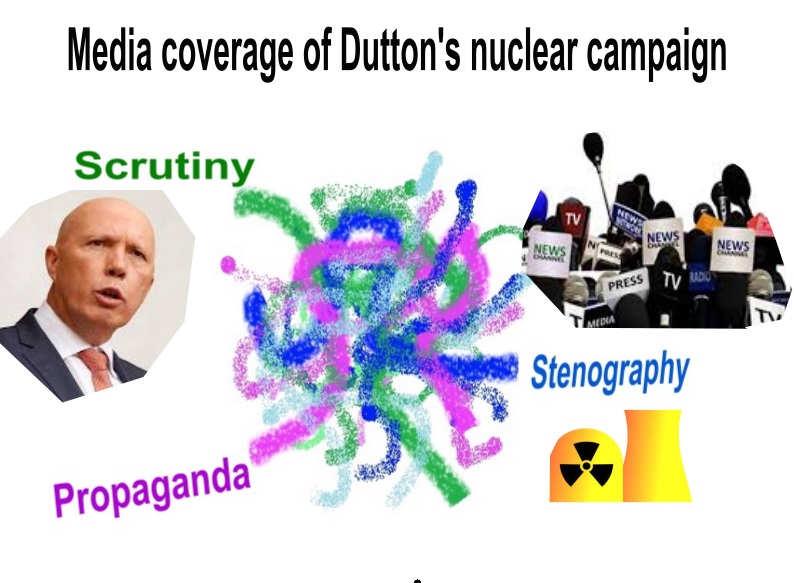
This article, despite “fiery” language , is the STENOGRAPHY style of journalism – i.e – tells us what was said and done, without being propaganda, but also without examining, scrutinising, what was said.
- American visitor Grace Stanke heckled by Thorpe
- Ms Stanke’s sponsor, Dick Smith, welcomes publicity
The 22-year-old is touring Australia advocating nuclear energy, in a trip partly funded by entrepreneur Dick Smith.
Mr Smith told Daily Mail Australia that Ms Stanke is ‘obviously very capable’ and he will meet her at a dinner in Sydney on Wednesday night.
In reaction to Sen Thorpe’s outburst, Mr Smith said: ‘That’s going to create some publicity for this important issue, I think it’s good.
‘I’m very concerned about climate change for our grandchildren and we need as much discussion as possible.
‘My strong view is that the only way we can reduce carbon to very low levels is nuclear.’
He added that he had a ‘lot of Leftie friends that are completely and utterly opposed to nuclear and it’s like a religion with them’.
‘I’m pro-renewables but it’s delusional to run the country on them.’
The businessman has previously come out in support of Opposition leader Peter Dutton’s nuclear plan.
Last year Mr Dutton pledged to build seven publicly-owned nuclear power plants in Australia if elected, with the first predicted to come online from the mid-to-late 2030s, as they require meticulous development.
He has argued nuclear will be crucial to stopping blackouts and lowering electricity bills as it can provide relatively cheap baseload power in the same way coal did, without the pollution.
He also said his $331billion plan will be 44 per cent cheaper than Labor’s program to almost replace coal and gas power with solar and wind energy within 15 years.
Labor’s plan is for renewable energy to comprise 82 per cent of Australia’s energy generation by 2030, rising to 98 per cent by 2040 based on solar and wind.
Both sides of politics support a goal of net zero carbon dioxide emissions by 2050, but the Coalition sees nuclear making up 38 per cent of Australia’s electricity generation by that time, with solar and wind energy making up 49 per cent.
Media coverage of Dutton’s nuclear campaign, Example No 1.
6 Feb 25
Dr Victoria Fielding divides journalism on Dutton’s nuclear campaign into three types – scrutiny, stenography or propaganda:
- Scrutiny – a useful form of journalism that critically assesses the viability of the nuclear policy.
- Stenography – just repeating the plan without scrutiny.
- Propaganda (news presented to look like news but what is actually a form of political advocacy, aiming to persuade readers to support Dutton’s nuclear plan, or ).
So – I’m starting today – with this item – Lidia Thorpe crashes pro-nuclear press conference fronted by ex Miss America winner Grace Stanke.
It’s not that easy to categorise news items. I think that there should be another type * Read Between The Lines. I think that this article by Jessica Wang could belong in that group. However, using Dr Fielding’s groups —
Lidia Thorpe crashes pro-nuclear press conference fronted by ex Miss America winner Grace Stanke. – fits narrowly into *Propaganda – because:
“heckling” is seen here as a “bizarre encounter” – although heckling is a time-honoured political activity in Australia. The pro-nuclear message from Nuclear For Australia is repeated without comment or analysis, So this news item is close to Stenography , too, (but with that possible element of Read Between The Lines. )
Lidia Thorpe crashes pro-nuclear press conference fronted by ex Miss America winner Grace Stanke
“We had standing room only in Morwell … we had a really good reception in the room,” said Mr Shackel.
“We thought it was a really successful event, and … people showed a huge standard of support in that community.”
[REALITY: Questions from the floor were not permitted…….. Security was tight for the event, with tickets and bags checked upon arrival. Tickets were not available at the door……..here were some who felt the Morwell event became little more than a Yankee talkfest. https://latrobevalleyexpress.com.au/news/2025/02/04/morwell-hears-from-miss-america-on-nuclear/]
The firebrand senator crashed a press conference fronted by 2023 Miss America Grace Stanke, who called for bipartisan support on nuclear energy.
Jessica Wang, February 5, 2025, more https://www.news.com.au/national/politics/lidia-thorpe-crashes-pronuclear-press-conference-fronted-by-ex-miss-america-winner-grace-stanke/news-story/4a49832f5bbedbb6b5fc8a0137a3df1f
Firebrand independent senator Lidia Thorpe has heckled a pro-nuclear press conference fronted by former Miss American and nuclear engineer Grace Stanke, yelling: “We don’t want nuclear in this country”.
The bizarre encounter unfolded just before the well-attended press conference on Wednesday, which was organised by Nuclear for Australia and slated to start at the Mural Hall in Parliament House, Canberra.
Walking past the Nuclear for Australia sign on her way to the elevator, Senator Thorpe yelled that nuclear would “poison your children’s children,” and said “You have no consent”.
The press conference began shortly after, with no acknowledgment of Senator Thorpe’s outburst.
Ms Stanke, who won the Miss American 2023 and is employed by US nuclear energy giant Constellation Energy, urged the Australian government to work with the Australian people, industry and manufacturers, instead of trying to wedge opposition.
The nuclear-advocate is currently on a nationwide speaking tour visiting communities which will be affected by Peter Dutton’s plan to build seven nuclear reactors by 2050.
“The one thing that was the most shocking part of this tour so fair is how split it has been in terms of a political conversation, coming from America with nuclear energy is relatively bipartisan, and to I go so far as to say nonpartisan” she said.
“Because of that I think it’s so important to mention that here in Australia, this conversation is must be discussed, not only to help build and bridge bipartisan support, but to continue educating the Australian people so they can make informed decisions.”
She said had the nuclear debate began 10 to 20 years earlier, Australians would have a different “base level of knowledge”.
Nuclear for Australia founder Will Shackel also defended an event attended by himself and Ms Stanke last week which had been criticised for solely promoting the Coalition’s nuclear election bid.
The event, which was funded by electronics mogul Dick Smith, took place in the Victorian town of Morwell in the Latrobe Valley, where the Coalition are proposing to construct a reactor at the site of the Loy Yang power station.
“I think it would have been easier from the context that people wouldn’t have been citing The Simpsons as a source,” she said.
“We had standing room only in Morwell … we had a really good reception in the room,” said Mr Shackel.
“We thought it was a really successful event, and … people showed a huge standard of support in that community.”
Australian nuclear news headlines February 4 – 11
Headlines as they come in:
- Explained: Why nuclear power has been banned in Australia for more than 25 years.
- Briefer Flawed ‘assessment’ of Osborne / Port Adelaide nuclear submarine site ignores accident risk (David Noonan, Feb. 2025)
- My favourite despicable Australian politician (Richard Marles).
- Honest Government Ad | Nuclear – https://www.youtube.com/watch?v=JBqVVBUdW84
- How Australia’s CANDU Conservatives Fell in Love with Canadian Nuclear.
- Coalition trying to brainwash Queenslanders into nuclear.
- .Pro-nuclear lobby group ramps up social media ad spend by nearly 150 pct
- Lidia Thorpe erupts in a fiery outburst at an American pro-nuclear activist during her visit to Parliament. (Media coverage example 2 at..)
- Media coverage of Dutton’s nuclear campaign, Example No 1
- Lidia Thorpe crashes pro-nuclear press conference fronted by ex Miss America winner Grace Stanke
- Morwell hears from Miss America on nuclear .
- New UK data sends nuclear warning for Australia .
- Lies, damned lies and Coalition energy economics: Dutton’s latest nuclear claim slammed .
- ‘No idea what he’s talking about’: Dutton’s nuclear plan could raise – not cut – electricity bills, experts warn .
- Nuclear curious? Here’s what you need to know about the Coalition’s energy claims.
- The paradox of recent politics.
Morwell hears from Miss America on nuclear

Intriguing coverage of the Miss America pro-nuclear blitz….
Questions from the floor were not permitted……. Security was tight for the event……… the selected few who did not entirely agree with what was being said quietly walked out.
By LIAM DURKIN, https://latrobevalleyexpress.com.au/news/2025/02/04/morwell-hears-from-miss-america-on-nuclear/
COMMUNITY passion was evident on Sunday night, as locals congregated to hear from international nuclear experts in Morwell.
The Nuclear for Australia roadshow made its way to the Latrobe Valley, with more than 200 people cramming into the function centre of the Italian Australian Club.
The panel discussion was headlined by former Miss America and nuclear engineer Grace Stanke.
Ms Stanke spoke for around half-an-hour, detailing her career and attempting to spell out some misconceptions surrounding a possible nuclear future for the Latrobe Valley.
She was followed by UBH Chief Nuclear Officer, Mark Schneider, speaking on the finer points of nuclear operations, and University of Adelaide Adjunct Nuclear Law Lecturer, Kirsty Braybon on what would need to take place for nuclear to be given the green light at federal level.
Well-known local union delegate Mark Richards (of the Mining Energy Union) also spoke briefly.
The panel then took questions, although these were selected by the emcee through an online system.
Questions from the floor were not permitted.
Nationals MPs Darren Chester and Danny O’Brien were in attendance, as was Latrobe City Mayor, Dale Harriman and deputy mayor, Sharon Gibson.
Security was tight for the event, with tickets and bags checked upon arrival. Tickets were not available at the door.
Crowd behaviour was first rate, and the selected few who did not entirely agree with what was being said quietly walked out. One man did however mutter a few unpleasantries on his way to the exit.
With Ms Stanke and Mr Schneider both hailing from the United States, their speeches focussed greatly on nuclear in their home country. As a result, it was understandable there were some who felt the Morwell event became little more than a Yankee talkfest.
For the majority however, most reported finding the evening informative and insightful.
Full coverage of the seminar will feature in next week’s Express.
Nuclear curious? Here’s what you need to know about the Coalition’s energy claims
Peter Dutton says building nuclear reactors will bring down power prices but experts doubt it and say it will cost the climate too
Graham Readfearn, https://www.theguardian.com/australia-news/2025/feb/04/nuclear-power-liberal-coalition-energy-power-plan-details
Peter Dutton says the Coalition would slow down the rollout of renewable energy and and instead eventually spend tens of billions of taxpayer dollars to build nuclear power plants at seven sites across the country.
He claimed “power prices will be cheaper under us in the near term” and that his policy would be expected to lead to “a 44% reduction, or of that order, being passed through in energy bill relief” – that is, a dramatic and unprecedented cut in household power bills.
Does this stack up? Here’s what you need to know about the Coalition’s plans, the risks it poses to the country’s electricity supply and its climate targets.
What does the Coalition say it will do?
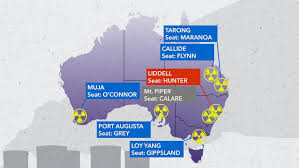
The Coalition wants to build large nuclear reactors at the sites of five coal-fired power stations – Liddell and Mount Piper in New South Wales, Tarong and Callide in Queensland, and Loy Yang in Victoria.
Small modular nuclear reactors, which are not yet commercially available anywhere, are proposed at the sites of Northern power station in South Australia and Muja power station in Western Australia.
All the reactors would be taxpayer-funded. The Coalition claims it could have smaller units working by 2035 and the first large reactor working by 2037.
How long would it take?
Most energy experts, including those from the CSIRO, say the Coalition’s timeline is unrealistic.
They argue it is highly unlikely Australia could do everything necessary – including creating a regulatory system, developing a skilled workforce, completing geological and environmental work and commissioning and building a nuclear reactor, with community approval – before the early 2040s, if not later.
The Coalition would also have to overturn a legislated federal ban on nuclear energy and convince the states to overturn their bans. Most state premiers and opposition leaders are opposed to introducing a nuclear energy system.
With Labor, the Greens and some independents opposed to nuclear energy, repealing federal laws would be a major obstacle.
The Nationals senator Matt Canavan has claimed the Coalition was “not serious” about building nuclear and it was being backed because it “fixes a political issue”.
Would building nuclear reactors keep the lights on?
Many of Australia’s coal plants are old.
On average, coal plants are forced offline through unplanned outages for about 10% of the year. Australia’s electricity market operator expects 90% of coal-fired power stations to be closed by 2035 – two years before the Coalition claims its first nuclear plant would be producing power.
The Coalition’s plan would mean requiring ageing coal plants to run for longer, increasing the risk of unplanned outages unless there was significant new spending on maintenance.
Experts say promising to build taxpayer-funded nuclear plants could also lead to investors deciding not to build the solar, wind, batteries and pumped hydro currently planned, and needed now, to replace much of the electricity from coal.
Would nuclear power really bring down the cost of living?
The Coalition has provided no evidence to back up its claim that its proposal could bring electricity prices down.
Dutton has claimed that modelling by Frontier Economics judged the Coalition’s plan to be 44% cheaper than Labor’s policy of running the grid overwhelmingly on renewable energy, and that this meant power bills would be cut by 44%.
This claim has no basis in fact. Frontier’s own modelling report said it had not modelled the impact of a nuclear plan on prices.
The modelling used by the Coalition is based on an electricity system producing 31% less electricity than Labor’s preferred renewables-based approach.
More than half of a household’s electricity bill is related to factors outside the Coalition’s plans, such as the cost of local poles and wires, or the costs passed on by retailers.
Overseas, particularly in western democracies, nuclear plants have become notorious for large cost blowouts and delays.
The Coalition says its plan would cost less because it would avoid having to build some of the new towers and power lines needed to connect the new solar, wind and battery farms planned across the country.
But CSIRO analysis found even if Australia had an established nuclear program with a suite of reactors, the electricity would cost at least 50% more than power from solar and wind backed by battery and other energy infrastructure needed to ensure the power grid remained reliable even when the wind wasn’t blowing and the sun wasn’t shining.
What will the Coalition’s nuclear plan mean for the climate crisis?
About a third of Australia’s greenhouse gas emissions come from burning coal and gas to produce electricity. Cleaning up the grid is essential to cutting Australia’s climate pollution and meeting its international commitments.
The Coalition’s plan assumes that for the next 20 years or so there would be significantly less renewable energy and significantly more electricity from coal and gas-fired power stations than proposed by regulators and backed by the Labor government.
Not surprisingly, this would mean higher emissions. This point was reinforced in modelling supported by the Coalition released in late 2024. It found that Dutton’s proposal would lead to substantially higher pollution between now and 2048 than on the current path.
Independent analysis has backed this up, suggesting the Coalition’s plan would lead to an extra 1.7bn tonnes of CO2 being emitted by 2050. This is equivalent to about four years’ worth of emissions released across the entire Australian economy.
The Coalition’s plan also assumes slower decarbonisation in other parts of the economy. It suggests fewer people would buy electric vehicles than under Labor, and fewer rooftop solar panels would be installed.
The Coalition has aligned its plan to a scenario laid out by the Australian energy market operator that is in line with global heating of about 2.6C by 2100.
Lies, damned lies and Coalition energy economics: Dutton’s latest nuclear claim slammed
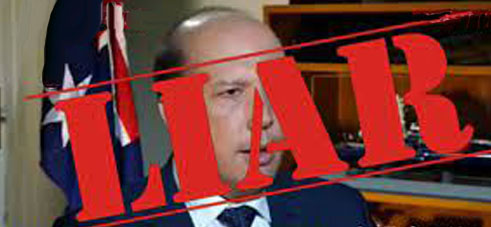
“Mr Dutton is either dangerously ill‑informed or he is lying to the Australian public.
Sophie Vorrath, Feb 3, 2025, https://reneweconomy.com.au/lies-damned-lies-and-coalition-energy-economics-duttons-latest-nuclear-claim-slammed/
Blink and you might have missed it, but Peter Dutton delivered another toe-curling example of energy policy hokum on Sunday morning, as the first guest of the first episode of the ABC’s Insiders program for 2025.
In amongst other well-spun lies – such as the claim Labor’s energy policy requires 28,000km of new transmission to be built – the leader of the federal opposition appeared to say that electricity bills would be 44 per cent cheaper under a Coalition government than under Labor.
“[Frontier Economics] look[d] at our energy policy compared to Labor’s, they judge[d] that it’s 44 per cent cheaper than Labor’s,” Dutton says.
When Insiders host David Speers points out that the 44% figure – itself hotly contested, as is Frontier’s Economics’ entire approach to modelling nuclear costs for Australia – relates to the cost of building nuclear between now and 2050 and not the power price impact, Dutton fudges further.
“If you’re delivering a model that’s 44% cheaper, that translates into cheaper power prices,” he says.
Pushed on this point, Dutton says, “If you apply the economics, so if there’s a 44% reduction in the model of delivering an energy system, you would expect a 44% reduction, or of that order, being passed through in energy bill relief.”
Pushing once more, Speers says: “But Frontier didn’t tell you that that number, you’re just, you’re just drawing that assumption yourself.”
Dutton: “Again, David, I mean, that’s that’s the economics of it. …All other variables being equal, if you have a 44% reduction in the overall cost to deliver that model, that is going to translate into that price reduction for households and for businesses, and that’s what we must do.”
Happily for Dutton, the discussion switches away from energy at this point, leaving his highly questionable application of “the economics of it” more or less unchallenged.
Unhappily for Dutton, certain energy market experts and actual economists are not having it.
The Smart Energy Council has responded on Monday by publishing the findings of its own analysis and calculations, using – it says – the same assumptions put forward by the federal Coalition and the nuclear policy costings of Frontier Economics. It also uses modelling from the Institute of Energy Economics and Analysis (IEEFA).
This analysis finds that for Australia’s 4 million (and counting) solar homes, power bills would go up more than $1,100 a year under Dutton’s nuclear policy. For non-solar homes, power bills would increase by an average $665 a year – a 30% jump.
The SEC says the hike in energy costs for solar homes of between $1,181 to $2,468 a year would come from lost energy savings, with “always on” nuclear likely to knock out rooftop solar for an average 67% of the year, forcing consumers on to higher nuclear power prices.
For both solar and non-solar homes, part of the jump in energy bills would come from the fact that nuclear power is a more expensive form of generation – as shown in IEEFA’s report, Nuclear in Australia would increase power bills.
The IEEFA report finds that for a nuclear plant with similar costs to those reported for Sizewell C in the UK to be commercially viable in Australia, wholesale energy prices would need to rise by $98 to $168 per megawatt-hour, relative to 2023-24 levels, to enable cost recovery.
This equates to a 74% to 127% rise in wholesale prices, which would see average household power bills across the states in the National Electricity Market increase by between $561 and $961 (with GST), assuming electricity retailers don’t add a margin on top.
“The latest reported cost blow-out for the UK’s proposed Sizewell C nuclear plant further underlines that the Coalition’s proposal to bring nuclear power to Australia is unrealistic,” say the report’s authors, Tristan Edis and Johanna Bowyer.
“Sizewell C’s revised capital cost estimate is about 2.5 times the capital cost used in the Coalition’s modelling.”
And then there are the other, other costs to Dutton’s nuclear policy plan – including the further cost to taxpayers of propping up old coal plants and relying more heavily on expensive gas.
As SEC chief John Grimes put it in a joint press conference with federal energy minister Chris Bowen on Monday, Dutton’s plan to build nuclear is more accurately – for the next decade, at least – a coal keeper, gas booster and renewables stopper program.
“Billions of dollars to go into coal to keep it in the system for as long as possible… [and] a massive scaling up of the amount of fossil gas, the most expensive fuel in the energy system. And a solar stopper program, a cap of 54 percent on renewable energy, solar and wind, by 2050,” Grimes said on Monday.
“Peter Dutton, he has a plan that will double power bills for ordinary Australians. We think that that is outrageous. We’re here today to call it out.
“Mr Dutton is either dangerously ill‑informed or he is lying to the Australian public.
“We know that his plan… will effectively transfer wealth from homeowners to the big fossil fuel companies. Peter Dutton’s plan delivers for his rich fossil fuel mates. But his plan, his power plan, is a big stop in the road, a stop for solar, a stop for wind, a stop for batteries, a stop for EVs, a stop for ordinary Australians slashing their power bills with solar,” Grimes said.
“A stop for the effective transition of our economy and the massive environmental benefits that that delivers, and economic benefits as well.”
‘No idea what he’s talking about’: Dutton’s nuclear plan could raise – not cut – electricity bills, experts warn
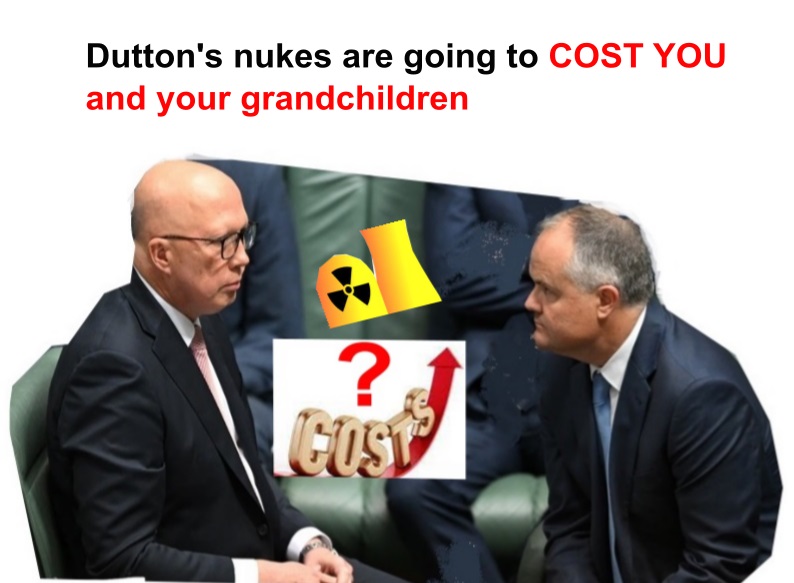
Opposition leader claims a 44% cost reduction compared with Labor’s plan would be passed on to Australian household bills, but not everyone agrees
Graham Readfearn, 4 Feb 25, https://www.theguardian.com/australia-news/2025/feb/04/no-idea-what-hes-talking-about-duttons-nuclear-plan-could-raise-not-cut-electricity-bills-experts-warn
Energy experts have rubbished claims by Peter Dutton that his plan to slow the rollout of renewable energy while waiting more than a decade for taxpayer-funded nuclear plants could bring down electricity bills in the short term.
Dutton said if there was “a 44% reduction in the model of delivering an energy system, you would expect a 44% reduction, or of that order, being passed through in energy bill relief”.
However, that was a “complete misunderstanding “of the Coalition’s own policy, according to Dr Dylan McConnell, an energy systems expert at the University of New South Wales. “He has no idea what he is talking about,” McConnell said.
Speaking to the ABC’s Insiders program on Sunday, Dutton said “power prices will be cheaper under us in the near term as well as in the medium to longer term as well”.
If elected, the Coalition would have to overturn federal and state bans on nuclear power; it claims it could have the first plants built by 2037. Experts, including the CSIRO, say the early 2040s is a more realistic timeframe.
The Coalition has not revealed any details on its near-term plans for electricity generation but Dutton said “we’re going to have to do a lot more with gas, with coal, in the system”.
Analysis by McConnell suggested the Coalition’s reliance on more coal and gas would add 1.7bn tonnes of CO2 to the atmosphere by 2050, compared with Labor’s plan.
Data from the CSIRO suggests using gas for power generation is more expensive than coal, and solar and wind. Nuclear electricity would be at least 50% more expensive than renewables, the CSIRO has said.
Gas prices tripled when the Coalition was in power, according to Tristan Edis, an analyst at Green Energy Markets.
He said energy prices were likely to fall over the next two years after the inflation caused by Russia’s invasion of Ukraine subsides.
“Beyond this two-year period, it is difficult to understand how the Coalition will lower power prices if they intend to simply rely on the power plants which are already in place and not foster additional competition,” he said.
“The coal plants are getting old and banks are reluctant to finance refurbishment costs. If we rely on additional gas, that will push up power prices, not reduce them – because gas is expensive.
Edis said the Coalition’s costs for building a 1GW nuclear plant had been set at $1bn, which was “unrealistically low” and could be at least double that. This would push up wholesale electricity prices and household bills, he said.
Frontier Economics released modelling, backed by the Coalition, that compared the cost of Labor’s preferred renewables-based plan with an electricity system that anticipates less demand for electricity and includes nuclear.
Of Dutton’s claim that modelling showed the Coalition’s approach would cost 44% less than Labor’s plan, McConnell was doubtful.
“That’s a clear misunderstanding of what makes up an electricity bill and what the [modelling report] shows.”
He said only about 45% of a household electricity bill related to the cost of the electricity system and the wholesale costs that relate to the cost of the system referred to by Dutton. The rest related to the costs of local poles and wires, retail costs and environmental charges.
Danny Price, managing director of Frontier Economics, defended Dutton’s comments, saying if he was referring to the energy costs portion of people’s bills then the lower cost should transfer to households.
But on the impact on households’ overall electricity bills, “it’s a much more complicated question” he said, because of uncertainties around how prices are set in the market.
For that reason, his company had not attempted to forecast what the Coalition’s plan would do for people’s electricity bills or to electricity prices.
New UK data sends nuclear warning for Australia

February 4, 2025, https://esdnews.com.au/new-uk-data-sends-nuclear-warning-for-australia/
By Tristan Edis and Johanna Bowyer, Institute for Energy Economics and Financial Analysis (IEEFA)
The UK’s Financial Times recently reported that the 3,260MW Sizewell C project —expected to be the UK’s next nuclear power plant—is now likely to cost around GBP40 billion, or $80 billion in Australian dollars, to construct. That equates to $24,540 per kilowatt of capacity.
Related article: The Coalition reveals the cost of its nuclear power plan—but the devil is in the missing detail
Sizewell C’s latest cost blow-out offers further confirmation that the opposition Liberal-National Coalition’s costing for its proposal to build nuclear power plants in Australia is far too low at $10,000 per kilowatt, and completely unrealistic. It supports IEEFA’s findings on the cost of construction for other nuclear power plants, detailed in our September 2024 report Nuclear in Australia would increase household power bills. The Sizewell C reactor’s newly estimated capital cost is about 2.5 times the capital cost used in the Frontier Economics modelling that has underpinned the Coalition’s plans.
At present, the UK Government is yet to commit to construction of Sizewell C and an official costing for the project is yet to be released. But the latest information in Financial Times, which has reportedly come from government and industry sources close to the project, reinforces the findings from our prior report: that for nuclear power to be viable in Australia, large increases in power prices would be required.
If the reported $80 billion cost only covers the plant’s construction and doesn’t account for the substantial debt interest costs likely to be accumulated over the targeted nine-year construction period, then Sizewell C would need the wholesale power price to rise to average out at around $300/MWh to be commercially viable. Even if this debt interest cost is accounted for in the $80 billion cited by the Financial Times, then it would still need the wholesale power price to rise to around $230/MWh.
By comparison, according to the Australian Competition and Consumer Commission (ACCC), over the 2023-24 financial year electricity retailers across Australia’s National Electricity Market needed to pay $132/MWh on average for wholesale energy to service their household customers.
Shadow Treasurer Angus Taylor has asserted on repeated occasions that any government investment in nuclear power plants would be made on the requirement that they were “commercially viable”, with no subsidies provided that would hit the government’s budget.
So, for a nuclear plant with similar costs to those reported for Sizewell C to be commercially viable in Australia, wholesale energy prices would need to rise by $98 to $168/MWh, relative to 2023-24 levels, to enable cost recovery. This equates to a 74% to 127% rise in wholesale prices, which would be charged on to household electricity consumers.
Related article: Not in my green backyard: Only 5% of people in renewables zones would live near nuclear
Such wholesale prices would mean that average household power bills across the states in the National Electricity Market would increase by between $510 and $874 per year prior to application of GST. Once GST is added then the increase will be between $561 and $961 – assuming electricity retailers don’t add a margin on top. This is based on ACCC data, which indicates average household annual consumption is 5.2MWh.
More nuclear news in the time of Trump

I quote Hannah Arendt because her message is so timely right now. The Anglophone world, led by Donald Trump, is about to descend into a morass of lies, deceptions, omissions. Already, climate scientists in America wonder whether or not to speak out. Here in Australia, we rightly condemn anti-semitism, but no-one dares to speak out against Israel’s genocide of Palestinians. Similarly, no mention of Ukraine gives the full picture. Who dares speak of the positive achievements of China? It is de rigueur to condemn everything about China. I fear that journalists of integrity are losing their jobs in the USA, and are threatened in other countries, too.
I still realise that in nuclear dangers, the big one, nuclear war, is looming in the context of the Middle East, of Ukraine, and of the visceral hatred of Russia and China. But I do feel relief in now deciding rather than wading through those morasses, – to concentrate on more strictly nuclear issues.
TOP STORIES.
AI’s Energy Demands Threaten a Nuclear Waste Nightmare.
Drones, Nukes, and the Myth of Reactor Safety.
China AI startup rattles US new nukes plan.
Open source vs. closed doors: How China’s DeepSeek beat U.S. AI monopolies.
An “American Iron Dome”: Perhaps the Most Ridiculous Trump Idea Yet.
Climate. Climate change made LA fires worse, scientists say. The surface of our oceans is now warming four times faster than it was in the late 1980s. Leaders in the Pacific raise alarm over ‘direct impact’ of Trump’s climate retreat and aid freeze.
Noel’s notes. Dangerous climate radical, Lloyd’s of London, threatens the world economy.
AUSTRALIA. “Nuclear for Australia” – a CHARITY ? Whaa-at !
Nuclear waste. AUKUS agency’s reckless indifference. Dutton’s nuclear plan requires ‘huge’ new bureaucracy– ALSO AT https://antinuclear.net/2025/02/02/duttons-nuclear-plan-requires-huge-new-bureaucracy/ Dutton defends nuclear costings as opponents warn of power bill hit . More Australian nuclear news at https://antinuclear.net/2025/02/03/australian-nuclear-news-27-january-to-3-february/
NUCLEAR ITEMS.
ART and CULTURE. Pentagon Warns China Developing Love, The Greatest Weapon Of All.
ECONOMICS. NuScale Power Corporation (SMR) Stock Plunges 25% Amid DeepSeek AI Concerns and Reevaluation of AI-Driven Energy Demand. Vistra, Constellation lead S&P losers as DeepSeek market rout takes down nuclear plays.
ENERGY. Power stocks plunge as energy needs called into question because of new China AI lab. Renewables to dominate future EU energy supply despite nuclear buzz – German engineers.
| ENVIRONMENT. Hinkley Point C owner warns fish protection row may further delay nuclear plant. |
| EVENTS. Anti-Nuclear War Activists Roll Out Counter Version of Doomsday Clock: The Peace Clock. Save Severn Estuary’s Fish: Demand Action from Hinkley — Sign the petition. 23 February GLOBAL DAY OF ACTION TO CLOSE BASES. – https://worldbeyondwar.org/closebases/ April 19-26: SHUT DOWN DRONE WARFARE, Spring Action Week, NM, 2025. Make your State a Nuclear Free Zone. |
| HEALTH. Social effects– Towns near Fukushima plant struggle to attract families with children. Radiation. 40% of workers cite radiation concerns at Fukushima plant. |
| MEDIA. Media coverage of Dutton’s nuclear ‘plan‘: Scrutiny, stenography or propaganda https://www.youtube.com/watch?v=yzZO66-3HfU |
| PLUTONIUM Hot Plutonium Pit Bomb Redux. Radioactive Plutonium In Sahara Dust Came From An Unexpected Source |
| SPACE. EXPLORATION, WEAPONS. Nuke Mars, Elon? Not with your Outer Space Treaty. |
| TECHNOLOGY. The Evolution of the Militarized Data Broker. How a Chinese nerd destroyed the US AI biosphere. https://www.youtube.com/watch?v=NzrpMohWkmY DeepSeek: how a small Chinese AI company is shaking up US tech heavyweights. Do AI and Nukes Mix? Hint: Keep ‘Human Decision in the Loop’. |
| URANIUM. Concerns about Agnew Lake Uranium Mine Unheard at Nuclear Commission Meeting. |
| WASTES. Sweden building world’s second nuclear waste storage site amid safety concerns. Potential UK nuclear waste sites identified |
| WAR and CONFLICT. Russia claims nuclear plant targeted during massive Ukrainian drone attack. Closer than ever: It is now 89 seconds to midnight. |
| WEAPONS and WEAPONS SALES. Israel sends missiles to Ukraine – Axios. The Guardian view on Star Wars II: US plans for missile shield risk nuclear instability. Trump orders ‘Iron Dome for America’ in sweeping missile defense push. General in Charge of Nuclear Weapons Says Heck, Let’s Add Some AI. Government announces dangerous new plan for more plutonium at Livermore Lab. Sole control -No US president should be allowed to unilaterally authorize a first strike of nuclear weapons. |
The paradox of recent politics
Crispin Hull, 2 February 25
A paradoxical realignment is under way in Australian and US politics.
Until recently, the Republican Party in the US and the Liberal Party in Australia were the parties of business, entrepreneurs, the professions, and the relatively wealthy. And the Democrats and Labor were the parties of the worker. The Democrats and Labor were always wary of new technology because it invariably costs jobs.
It was a fairly straight-forward labour-capital divide.
Then came some big changes: the rise of China; the threat of global heating; the social revolutions relating to identity (race, gender, nationality, and religion); and the collapse of organised labour.
Global heating was seen by Republicans and Liberals as some trendy, leftie anti-capital nonsense. They saw, with some justification, the rise of China as menacing. They attracted working-class votes based on nationalism and opposition to social causes on racial and sexual equality.
Those changes have thrown up some irreconcilable contradictions.
Private-Sector Economic Rationalist Peter Dutton has a plan under one arm to axe 36,000 “Canberra” public servants. Under the other arm Commissar Dutton he has a plan for massive public ownership of the means of energy production and management with seven nuclear power stations – just so his mates can keep up the profitable burning of fossil fuels for a few more years.
No sensible private-sector organisation will go near the nuclear plan, for obvious reasons. Moreover, only a third of federal public servants work in Canberra. But it sounds good to cut “Canberra” public servants. As if they do nothing – aside from, say, running air-traffic control; policing the borders; running Medicare, the Pharmaceutical Benefits Scheme, and the defence forces; doing weather forecasts; and generally making society tick.
It leaves Labor, the party that has usually been unenthusiastic about entrepreneur-driven new technology, embracing and financing private-sector investment in new energy………………………………………………………….
Labor, the party of the environment, has now shelved legislative protection for endangered species and approved dozens of extensions to coal and gas projects while putting its hand on its heart saying it has approved no “new” coal or gas projects.
Despite election promises, Albanese, who “goes after Tories”, has delivered a corruption watchdog that bares its gums in private. And his whistle-blower-protection promises have evaporated. His political finance “reforms” tinker about the edges while continuing to allow big corporations and unions to be puppet-masters.
It is a government that clears the in-tray by moving things into the too-scared basket.
Dutton, meanwhile, the friend of the Australian Jewish Community, cynically weaponises and politicises antisemitic attacks in Australia so he can argue that Albanese is “weak” while stirring up divisions for his own ends. With any luck it will back-fire because the Jewish community is a bit more sophisticated and understanding of the nuances of public policy than the former Queensland policeman.
The attacks, of course, are not coming from racialised Muslims, but far-right, nationalist, self-labelled “Christian” neo-Nazis.
Surely these things mean that Dutton and Albanese have disqualified themselves from leading a majority government. Surely, events of the past three years tell us that a cross-bench holding the balance of power in the House of Representatives will improve government.
If Albanese is Prime Minister, they will demand action on obvious things on pain of being thrown out of office. If Dutton is Prime Minister, they will demand detail, justification, and costings for his nuclear policy or to drop it – again on pain of being removed from office.
How else can the major parties be weaned off the insidious corporate, union, and lobby-group influencers that conspire against the public interest?
The glimmer of hope here is Labor’s massive support of renewable energy. The Australian Energy Market Operator reported this month that coal’s share of electricity generation had fallen below half for the first time. Coal-fired power stations are becoming less reliable and less economic.
The economics are so obvious that households are taking up solar at an unforeseen rate. And they are telling everyone about their zero power bills. So, it is on an unstoppable roll. https://www.crispinhull.com.au/2025/02/03/the-paradox-of-recent-politics/?utm_source=mailpoet&utm_medium=email&utm_campaign=crispin-hull-column
Dutton defends nuclear costings as opponents warn of power bill hit
“Peter Dutton wants to force millions of Australians to switch off the solar they bought, make them pay for more expensive nuclear power, and use their taxes to build nuclear reactors,”
The Age, By Shane Wright, February 2, 2025
Opposition Leader Peter Dutton has claimed his nuclear energy policy would cut power bills by 44 per cent, but analysis by the renewables sector warns it could actually drive up electricity costs by more than $1000 a year for millions of Australians with rooftop solar panels.
Ahead of an election that will be dominated by cost-of-living issues, Dutton said while it would take time for energy prices to fall under his $331 billion plan to build seven government nuclear plants, they would ultimately drive down costs for consumers and business owners.
Modelling commissioned by the Coalition for its plan to build the reactors by the mid-2040s asserts total costs will be 44 per cent lower compared to the mass rollout of renewables. The same modelling did not estimate a reduction in retail power prices.
But Dutton told the ABC’s Insiders program on Sunday it was “economics” that lower construction and production costs would lead to a large drop in prices paid by consumers…………………
The modelling, however, has come under fire for its underlying assumptions, including an effective lid on the amount of renewable energy. Renewable energy under the Coalition’s modelling reaches 54 per cent of the total power market by 2050. By the end of last year, it had already hit 46 per cent.
Research to be released on Monday by the Smart Energy Council warns that millions of rooftop solar systems would have to shut off every day to allow the baseload power generated by nuclear reactors to fit into the grid.
It found that non-solar households could pay an extra $665 a year in power prices, while for those with rooftop solar, the bill shock could be more than $1000. Rooftop solar households were forecast to pay an extra $1262 a year in NSW, $1108 in Victoria and $1419 in south-east Queensland.
The higher costs to the more than 4 million rooftop solar households were in part because they would be blocked from feeding power into the energy market, the council said. As nuclear needed to be run constantly, if there was too much energy in the market, the first to be turned off would be rooftop solar, which was the easiest to prevent competing against nuclear.
Smart Energy Council chief executive John Grimes said every person who had invested in rooftop solar would pay far more for their energy if expensive nuclear power was forced into the grid.
“Peter Dutton wants to force millions of Australians to switch off the solar they bought, make them pay for more expensive nuclear power, and use their taxes to build nuclear reactors,” he said.
“We know that power bills are going to soar for all Australians because Peter Dutton wants to cap cheap, clean renewable energy and substitute it with expensive, unreliable, polluting coal and gas, while we wait a couple of decades to build their nuclear fantasies.”
The battle over electricity prices is part of a broader debate over the size of government, with Dutton accusing Prime Minister Anthony Albanese of overseeing a $347 billion increase in spending and a 36,000 lift in public servants…………………….
Pressed on where he would cut spending, Dutton ruled out an audit but signalled that voters would have to wait until after the election to get final details………
Treasurer Jim Chalmers said part of the increase in spending and public servants included the indexation of the aged pension and extra resources to the Veterans’ Affairs Department, Medicare and to lift housing construction.
He accused Dutton of trying to hide his planned cuts because he knew people would not support them.
“It is extraordinary that he’s saying to the Australian people he wants to cut $350 billion, but they will have to wait until after the election before he would tell them what that is,” he said.https://www.theage.com.au/politics/federal/dutton-defends-nuclear-costings-as-opponents-warn-of-power-bill-hit-20250202-p5l8wu.html
Australian nuclear news 27 January to 3 February.
Headlines as they come in:
- “Nuclear for Australia” – a CHARITY ? Whaa-at !
- Nuclear waste. AUKUS agency’s reckless indifference.
- Dutton’s nuclear plan requires ‘huge’ new bureaucracy– ALSO AT https://antinuclear.net/2025/02/02/duttons-nuclear-plan-requires-huge-new-bureaucracy/
- Dutton defends nuclear costings as opponents warn of power bill hit .
- Why nuclear energy is not worth the risk for Australia.
- Briefing paper from UK trip shows nuclear waste discussions held, as location for AUKUS submarine waste remains undecided.
- Australia’s new chief scientist open to nuclear power but focused on energy forms available ‘right now’.
- Dutton’s atomic power bill for a ‘nuclear family’ could be nearly $39K.
- Geoscience Australia declares Darwin, Latrobe Valley high-risk earthquake zones/
- Former Miss America’s Australian nuclear tour clouded by Chinese AI blow to her employer.
- Former US beauty queen and nuclear energy expert Grace Stanke promotes nuclear in WA.
“Nuclear for Australia” – a CHARITY ? Whaa-at !
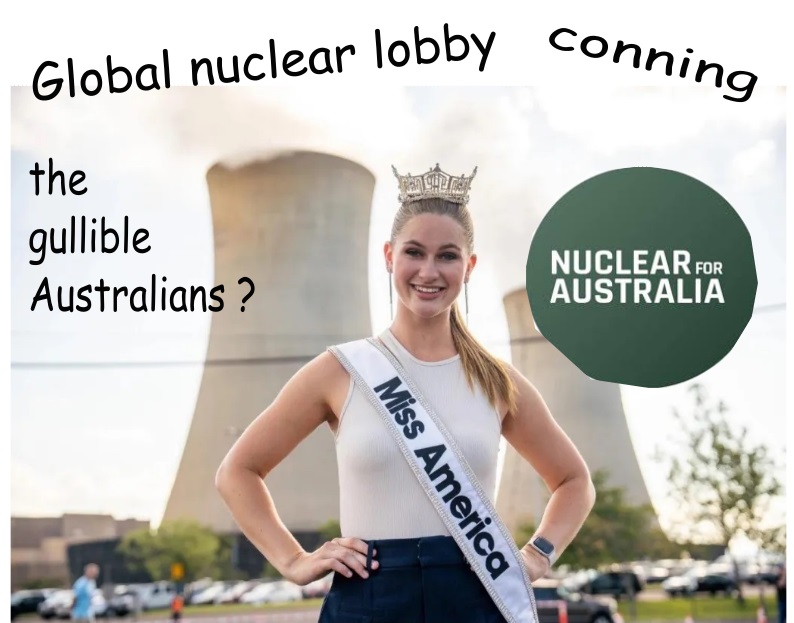
“Nuclear for Australia” charity(?!?!) total revenue – $211,832. But no Financial Report was provided, even though the ACNC “encourages them to do so”. Stunts like fishing for three-eyed fish over in the USA and touring Australia with Miss America – makes you wonder what other charities get up to in Australia.
Charity size:
SmallIs the charity an incorporated association?:No
Fundraising online:Yes
Does the Charity intend to fundraise in the next reporting period?:Yes
Charity programs
Nuclear Education
Program classification:
Community informationProgram locations:
- Brisbane QLD, Australia
- Australia
Program operated online:YesProgram beneficiaries:
- General community in Australia
Description of the charity’s activities and outcomes:
Nuclear for Australia established a team of nuclear experts to help educate Australians, ran a national education campaign on nuclear power through paid social media advertising, produced organic social media content and shared information through the traditional media.
Nuclear waste. AUKUS agency’s reckless indifference
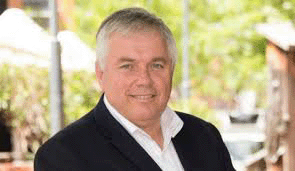
Last Friday, government solicitors acting for the Australian Submarine Agency sent me a warning against publishing some embarrassing information about their conduct.
Neither I (Rex Patrick) nor Michael West Media will be subject to their bullying, however.
The Australian Submarine Agency deals with high-level Defence secrets and fissile material, yet it has been caught ignoring security obligations while threatening Rex Patrick, who reports on their conduct.
by Rex Patrick | Feb 3, 2025, https://michaelwest.com.au/aukus-agency-reckless-on-nuclear-waste/
Last Friday, government solicitors acting for the Australian Submarine Agency sent me a warning against publishing some embarrassing information about their conduct.
Neither I nor MWM will be subject to their bullying, however.
The Australian Government has undertaken to accept responsibility for the spent nuclear fuel from our planned AUKUS submarines. This is no light undertaking. It’s more than a lifetime obligation; indeed,
it’s an obligation that will last tens of thousands of years.
The Government has announced that this high-level radioactive waste will be stored on Defence land.
As reported in MWM, in February 2023, the Australian Submarine Agency awarded a contract for nearly $400K to former Defence Department Deputy Secretary Steve Grzeskowiak to find a suitable Defence location
The very expensive irony that lurked behind this contract was the fact that Grzeskowiak had, when he was inside Defence, looked for a location on Defence land to store low-level radioactive waste and had been unable to find a suitable site.
According to Grzeskowiak, there wasn’t a single spot anywhere across the vast Defence estate that was suitable for storing low-level radioactive material. Yet he was now the go-to person who would, through some miraculous divination, find the Australian Submarine Agency a location across the very same territory.
Document request
In December 2023, I requested Mr Grzeskowiak’s report under our Freedom of Information laws. I was refused access on the basis the report was a Cabinet document.
But here’s the interesting thing. I knew that the report had been being worked on by multiple agencies, so I requested related documents from the Australian Nuclear Science and Technology Organisation (ANSTO), the Australian Radiation Protection and Nuclear Safety Agency (ARPANSA), Geoscience Australia (GA), the Department of Industry, Science and Resources (DISR) and the Department of Prime Minister and Cabinet (PM&C).
What those documents showed me was the report was not, at least until after I made my FOI request, developed on the Government’s CabNet+ system.
I’m now in a legal fight at the Administrative Review Tribunal, pressing my case for the report to be made public.
The Cabinet Handbook, the bible for Cabinet’s processes, makes it crystal clear that cabinet documents must be prepared on a special CabNet+ system.
The protective security framework of the Government also commands that Cabinet documents are stored on CabNet+.
Despite this, the Australian Submarine Agency didn’t do that.
Why? I can’t publish their evidence in the proceeding until the matter has been heard in the Tribunal, but what I can say is that it’s a case of reckless indifference to the rules.
It begs the question, will the Australian Submarine Agency also play fast and loose with the rules in relation to our highly classified data or our allies’ highly classified data?
“The Australian Submarine Agency is under a great deal of pressure to “get the job done”.
There are unquestionably a lot of unrealistic expectations coming down from the top. Will they follow the rules when it comes to nuclear safety, or will they bend and break the rules when they find it expedient to meet a politically driven objective?
Legal arguments
In their legal submissions, the Australian Government asserts: “The fact that the document was not created within the ‘CabNet’ system is not indicative one way or the other as to the intention of the authors.”
Actually, the rules of Cabinet are very strict. A document must meet two tests to qualify as a cabinet document 1) it must have been bought into existence for the dominant purpose of submission for consideration by the Cabinet, and 2) it must have been submitted to Cabinet.
I am satisfied it meets the second test but not the first.
To meet the first test the Government has to present objective evidence to the Tribunal that a minister so commissioned the document for consideration by Cabinet.
“They have not done so.”
And the fact that the document, in breach of the rules, just floated around on a government network not authorised to hold Cabinet documents for months on end will work against the Australian Submarine Agency in the end.
Hypocrisy
In response to insistence from Prime Minister Anthony Albanese that Peter Dutton should disclose the intended location of seven nuclear power stations, the Opposition Leader did so.
But Albanese is refusing to be transparent about the intended location of a high-level radioactive waste dump. His government wants to block public debate for as long as possible and then present people with a fait accompli.
It’s yet to be seen whether the Government will win on its claim that the report I’m after is a Cabinet document. But in the end, if it were determined that the report is that, there would still be nothing to stop Albanese from being true to his past rhetoric about the importance of government transparency and releasing the report to inform public debate.
“Australians have a right to know. The fact that the Prime Minister hasn’t already done this says a lot.”
For me, given that the Government has cautioned me against publishing details that reveal security incompetence inside the Australian Submarine Agency, I’ll wait for the knock on the door from the Federal Police. I’m not going to be intimidated.
There’s a vital democratic principle to be defended – the right to publish embarrassing information about government. The only way to protect that right, especially in the face of Government bullying, is to publish.
1 This month
Chernobyl: The Lost Tapes – A good documentary on Chernobyl on SBS available On Demand for the next 3 weeks– https://www.sbs.com.au/ondemand/tv-program/chernobyl-the-lost-tapes/2352741955560
15 April – Zoom –Nuclear Power is Not the Solution
Apr 15, 2026 01:00 AM in Canberra, Melbourne, Sydney

Join the International Physicians for the Prevention of Nuclear War (IPPNW) on Tuesday, April 14th for a timely webinar exploring the risks associated with nuclear power and challenging the myth that it offers a simple, safe, carbon-free solution to the climate crisis

21 April Webinar: No Nuclear Weapons in Australia
Start: 2026-04-21 18:00:00 UTC Canberra, Melbourne, Sydney (GMT+10:00)
End: 2026-04-21 19:30:00 UTC Canberra, Melbourne, Sydney (GMT+10:00)
Event Type: Virtual
A virtual link will be communicated before the event.
Host Contact Info: australia@icanw.org

of the week – Australians for War Powers Reform (AWPR)
To see nuclear-related stories in greater depth and intensity
 Antinuclear
