New developments: particle accelerators could make Lucas Heights’ Opal nuclear reactor obsolete. And the pro Kimba waste dump argument useless.

Greg Phillips , Nuclear Fuel Cycle Watch Australia, 14 May 21
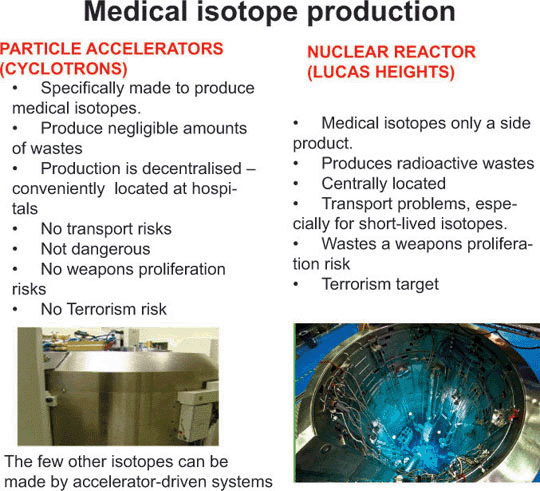
Lest we forget. The majority of the radioactivity they want to send to SA/Kimba is from the production of medical isotopes using a method that should be replaced by much cleaner/safer/reliable accelerator/cyclotron methods:”Pallas’s original business case was mainly based on the production of technetium-99m, which is obtained from molybdenum-99 via a generator. Despite the initially favorable forecasts for this reactor isotope, the business case ultimately did not hold up. This is partly due to the rise of the cyclotron, the linear particle accelerator (linac), and the advent of new large-scale production techniques, based on systems or reactors driven by particle accelerators, such as SHINE.
In the current market, the major role of research reactors is mainly determined by the production of technetium-99m, a SPECT isotope and by far the most widely used medical isotope in radiodiagnostics. But new suppliers will soon be entering the market, including SHINE, producers with cyclotrons, and a series of suppliers with linacs.More important than the future production of technetium-99m is the amazing innovative power of the accelerator technology.
For example, the PET isotope rubidium-82 has been marketed fairly recently for measuring the blood flow in the heart muscle. However, this treatment will soon face competition from the even more efficient PET drug fluorine-18 Flurpiridaz.
Although these treatments are more expensive than traditional technetium-99 (SPECT) treatment, they can compete because the imaging is very accurate and takes place in “real time”. This means that one treatment suffices, saving costs.
Pallas’ latest business case focuses mainly on the production of therapeutic isotopes for the treatment of cancer and tumors, with beta-emitter isotopes such as lutetium-177 and yttrium-90 in particular determining the picture in this growing market. But here too the question applies: can Pallas really withstand the innovative power of accelerator technology? Then it is not so much about SHINE, which can certainly become a formidable competitor of reactor manufacturers for the production of lutetium-177 (and later also yttrium-90), but mainly about the advance of new generations of therapeutic accelerator isotopes. For example, alpha emitters, and a new class of beta emitters, will conquer an increasing part of the current beta emitter market. …” more https://www.technischweekblad.nl/opinie-analyse/pallas-versus-de-innovatiekracht-van-versnellertechnologie?fbclid=IwAR2T6Ns_xt27fPBsbTHP0BkNG6x0Xk3x-nbaSJshNSQrZ2W5Q21C4GdvwY0 https://www.facebook.com/groups/1021186047913052
Ionising radiation was proven to be bad for dogs. Does that mean it’s good for humans?

The effects of ionizing radiation on domestic dogs: a review of the atomic bomb testing era, Wiley Online Library , Gabriella J. SpatolaElaine A. Ostrander Timothy A. Mousseau 13 May 2021 https://doi.org/10.1111/brv.12723
ABSTRACT
Dogs were frequently employed as laboratory subjects during the era of atomic bomb testing (1950–1980), particularly in studies used to generate predictive data regarding the expected effects of accidental human occupational exposure to radiation. The bulk of these studies were only partly reported in the primary literature, despite providing vital information regarding the effects of radiation exposure on a model mammalian species. Herein we review this literature and summarize the biological effects in relation to the isotopes used and the method of radionuclide exposure. Overall, these studies demonstrate the wide range of developmental and physiological effects of exposure to radiation and radionuclides in a mid‐sized mammal.
………………………………………………III. CONCLUSIONS
Domestic canines commonly share the same environment, lifestyle, and exposure to pollutants as their human counterparts (Mazzatenta et al., 2017; Ostrander et al., 2017). Coupled with their larger body size and longer lifespan compared to other frequently used model organisms, this makes the canine model a useful tool in studying radiation‐induced diseases.- Frequent effects of radiation exposure in dogs include haematological changes, infertility, and cancer of the bone, liver, lung, and blood, among others. Effects depend on the radionuclide, method of exposure, age at exposure, dose rate, and total exposure dose.
With an increasing demand for nuclear power comes a higher risk of nuclear accidents, and studies of radiation exposures in domestic dogs have provided valuable information for understanding the repercussions for accidentally exposed populations.- Although experiments done in a laboratory setting have proved illuminating, more studies are needed on natural populations affected by past radiological disasters in order to further our understanding of how laboratory results may apply, as such populations are affected by potentially confounding environmental factors. In addition, the vast background knowledge provided by early radiation studies on dogs could allow meaningful conclusions to be drawn regarding the application of laboratory results to natural populations……………… https://onlinelibrary.wiley.com/doi/10.1111/brv.12723#.YJ5JV_2vd9I.twitter
South Korean fishermen sue Japanese government over Fukushima nuclear plant water

South Korean fishermen sue Japanese government over Fukushima nuclear plant water, https://www.wionews.com/world/south-korean-fishermen-sue-japanese-government-over-fukushima-nuclear-plant-water-384768 WION Web TeamSeoul, South Korea, May 13, 2021,
South Korean fisheries associations filed a lawsuit against the Japanese government at a local court on Thursday, seeking compensation for the planned release of contaminated water from the Fukushima nuclear power plant, the Yonhap news agency reported.
The National Federation of Fisheries Cooperatives of Jeju Island and a shipowners’ association told a news conference outside the Jeju District Court they were demanding about 10 million won ($8,800) per day from the Japanese government and Tokyo Electric Power Company Holdings.
Local fishing communities worry that years of work to convince consumers that Fukushima’s seafood is safe will be wiped out by the release.
Japan’s government said in April it would release more than 1 million tonnes of treated water from the Fukushima site in stages starting in about two years…….
Environmental groups like Greenpeace, which opposes nuclear power, say radioactive materials like carbon-14 that remain in the water can “be easily concentrated in the food chain”.
They allege accumulated doses over time could damage DNA, and want to see the water stored until technology is developed to improve filtration.
Hamas Targets Israeli Oil And Nuclear Facilities With Rocket Attacks
Hamas Targets Israeli Oil And Nuclear Facilities With Rocket Attacks, Oil Price By ZeroHedge – May 14, 2021 Hamas’ militant wing, the Al-Qassam Brigades, announced earlier this week that it is deliberately targeting Israel’s secretive Dimona nuclear reactor site, known as the Shimon Peres Negev Nuclear Research Center, which lies east of the the Gaza Strip far into the Negev Desert.
It was on Wednesday that Qassam Brigade spokesmen said they were “directing a rocket strike involving 15 rockets for Dimona” – and since then it appears rockets have fallen generally in the southerly area – but there’s since been no reports of direct hits anywhere on the complex, or damage to the site……….
“On Tuesday, at least one rocket appeared to score a direct hit, damaging an Ashkelon facility connected to the Trans-Israel pipeline running from the Mediterranean to the Red Sea,” Newsweek observed, and continued:
“The military wing of Palestinian Islamist movement Hamas has targeted Israel’s nuclear facility, key oil facilities and other sites across the country amid a violent escalation between the two sides.”…… https://oilprice.com/Geopolitics/Middle-East/Hamas-Targets-Israeli-Oil-And-Nuclear-Facilities-With-Rocket-Attacks.html
Chernobyl. Tons of nuclear fuel in the wrecked plant’s basement have started to react again, and it’s showing no signs of stopping.

Chernobyl’s nuclear fuel is ‘smoldering’ again and could explode, https://www.livescience.com/chernobyl-smoldering-nuclear-reactions-again.html By Brandon Specktor – Senior Writer 14 May 21,
Tons of nuclear fuel in the wrecked plant’s basement has started to react again, and it’s showing no signs of stopping.
Nuclear reactions are smoldering again in an inaccessible basement of the wrecked Chernobyl nuclear power plant in Ukraine, according to news reports.
Researchers monitoring the plant — which infamously exploded in a deadly 1986 meltdown — have detected a steady spike in the number of neutrons in an underground room called 305/2. The room is full of heavy rubble, concealing a radioactive mush of uranium, zirconium, graphite and sand that oozed into the plant’s basement like lava, before hardening into formations called fuel-containing materials (FCMs).
Rising neutron levels indicate that these FCMs are undergoing new fission reactions, as neutrons strike and split the nuclei of uranium atoms, creating energy.
For now, this radioactive waste is smoldering “like the embers in a barbecue pit,” Neil Hyatt, a nuclear materials chemist at the University of Sheffield in the U.K., told Science magazine. However, it’s possible that those embers could fully ignite if left undisturbed for too long, resulting in another explosion.
This potential explosion wouldn’t be anywhere near as devastating as the one that shattered the plant in 1986, which resulted in thousands of deaths and spewed a radioactive cloud over Europe, Maxim Saveliev, a senior researcher with the Institute for Safety Problems of Nuclear Power Plants (ISPNPP) in Kyiv, Ukraine, told Science. If the nuclear material ignites again, the blast will be largely contained within the steel and concrete cage known as the Shelter, which officials built around the plant’s ruined Unit Four reactor one year after the accident.
Still, even a contained explosion would make the long-term mission of removing the plant’s FCMs much harder, Saveliev said. The Shelter is old and could easily crumble from the force of an explosion, filling the area with heavy debris and radioactive dust. (The Shelter itself is contained in a larger steel structure called the New Safe Confinement, which was completed in 2018.)
Neutron levels have been steadily rising in room 305/2 for four years, Saveliev said, and could continue rising for several more years without incident. It’s possible these nuclear nuggets will fizzle out on their own in that time. But if neutron levels keep rising, scientists will have to intervene.
That is more easily said than done, of course; plant managers have yet to figure out how to access the tons of radioactive material buried below the room’s thick layers of concrete debris. Radiation levels are too high for humans to endure, but radiation-resistant robots might be able to drill through the rubble and install neutron-absorbing control rods into the room, according to the ISPNPP.
Ukraine hopes to present a detailed plan for the removal of Chernobyl’s still-smoldering FCMs by September, Science reported.
Batteries in the ‘burbs, cheaper EVs and job training in Labor’s budget response — RenewEconomy

Albanese pledges $100 million for new clean energy apprenticeships in Labor’s alternative budget plan. The post Batteries in the ‘burbs, cheaper EVs and job training in Labor’s budget response appeared first on RenewEconomy.
Batteries in the ‘burbs, cheaper EVs and job training in Labor’s budget response — RenewEconomy
Look, no gas! South Australia to build country’s first all-electric hospital — RenewEconomy

South Australia says new women’s and children’s hospital in Adelaide will not be connected to the gas network and won’t use fossil fuels. The post Look, no gas! South Australia to build country’s first all-electric hospital appeared first on RenewEconomy.
Look, no gas! South Australia to build country’s first all-electric hospital — RenewEconomy
Plans for big solar thermal micro-grid at Mt Isa gain momentum — RenewEconomy

Plans to power to remote Queensland mining hub with a mix of concentrated solar thermal, solar PV, gas and battery storage advance with call for contractors. The post Plans for big solar thermal micro-grid at Mt Isa gain momentum appeared first on RenewEconomy.
Plans for big solar thermal micro-grid at Mt Isa gain momentum — RenewEconomy
Taylor’s Kurri Kurri “gas” plant to run on dirty diesel first — RenewEconomy

Environmental Impact Statement for the gas plant proposed for the NSW Hunter region by Angus Taylor reveals it would run for 6 months on diesel, before switching to mostly gas. The post Taylor’s Kurri Kurri “gas” plant to run on dirty diesel first appeared first on RenewEconomy.
Taylor’s Kurri Kurri “gas” plant to run on dirty diesel first — RenewEconomy
May 14 Energy News — geoharvey

Opinion: ¶ “‘An 8th-Grader Could Have Hacked’ The Colonial Pipeline” • Its owners should not be surprised that the Colonial Pipeline was hacked. An outside audit of its cyberattack defenses, delivered to the company more than three years ago, described “atrocious” information management practices and “a patchwork of poorly connected and secured systems.” [CleanTechnica] Colonial […]
May 14 Energy News — geoharvey
Nuclear industry survives on its false claim that it helps the fight against climate change

April 28th, 2021, by Paul Brown, The nuclear industry’s unfounded claims let it rely on “dark arts”, ignoring much better ways to cut carbon emissions.
Nuclear industry’s unfounded claims let it survive, https://climatenewsnetwork.net/nuclear-industrys-unfounded-claims-let-it-survive/
– It is the global nuclear industry’s unfounded claims – not least that it is part of the solution to climate change because it is a low-carbon source of electricity – that allow it to survive, says a devastating demolition job by one of the world’s leading environmental experts, Jonathan Porritt.
In a report, Net Zero Without Nuclear, he says the industry is in fact hindering the fight against climate change. Its claim that new types of reactor are part of the solution is, he says, like its previous promises, over-hyped and illusionary.
Porritt, a former director of Friends of the Earth UK, who was appointed chairman of the UK government’s Sustainable Development Commission after years of campaigning on green issues, has written the report in a personal capacity, but it is endorsed by an impressive group of academics and environmental campaigners.
His analysis is timely, because the nuclear industry is currently sinking billions of dollars into supporting environmental think tanks and energy “experts” who bombard politicians and news outlets with pro-nuclear propaganda.
Porritt provides a figure of 46 front groups in 18 countries practising these “dark arts”, and says it is only this “army of lobbyists and PR specialists” that is keeping the industry alive.
First he discusses the so-called levelized cost of energy (LCOE), a measure of the average net present cost of electricity generation for a generating plant over its lifetime.
“The case against nuclear power is stronger than it has ever been before”
n 2020, the LCOE of producing one megawatt of electricity in the UK showed huge variations:
- large scale solar came out cheapest at £27 (US$38)
- onshore wind was £30
- the cheapest gas: £44
- offshore wind: £63
- coal was £83
- nuclear – a massive £121 ($168).
Porritt argues that even if you dispute some of the methods of reaching these figures, it is important to look at trends. Over time wind and solar are constantly getting cheaper, while nuclear costs on the other hand are rising – by 26% in ten years.
His second issue is the time it takes to build a nuclear station. He concludes that the pace of building them is so slow that if western countries started building new ones now, the amount of carbon dioxide produced in manufacturing the concrete and steel needed to complete them would far outweigh any contribution the stations might make by 2050 to low carbon electricity production. New build nuclear power stations would in fact make existing net zero targets harder to reach.
“It is very misleading to make out that renewables and nuclear are equivalently low-carbon – and even more misleading to describe nuclear as zero-carbon, as a regrettably significant number of politicians and industry representatives continue to do – many of them in the full knowledge that they are lying”, he writes.
He says that the British government and all the main opposition political parties in England and Wales are pro-nuclear, effectively stifling public debate, and that the government neglects the most important way of reducing carbon emissions: energy efficiency.
Also, with the UK particularly well-endowed with wind, solar and tidal resources, it would be far quicker and cheaper to reach 100% renewable energy without harbouring any new nuclear ambitions.
The report discusses as well issues the industry would rather not examine – the unresolved problem of nuclear waste, and the immense time it takes to decommission nuclear stations. This leads on to the issue of safety, not just the difficult question of potential terrorist and cyber attacks, but also the dangers of sea level rise and other effects of climate change.
Failed expectations
These include the possibility of sea water, particularly in the Middle East, becoming too warm to cool the reactors and so rendering them difficult to operate, and rivers running low during droughts, for example in France and the US, forcing the stations to close when power is most needed.
Porritt insists he has kept an open mind on nuclear power since the 1970s and still does so, but that they have never lived up to their promises. He makes the point that he does not want existing nuclear stations to close early if they are safe, since they are producing low carbon electricity. However, he is baffled by the continuing enthusiasm among politicians for nuclear power: “The case against nuclear power is stronger than it has ever been before.”
But it is not just the politicians and industry chiefs that come in for criticism. Trade unions which advocate new nuclear power because it is a heavily unionised industry when there are far more jobs in the renewable sector are “especially repugnant.”
He also rehearses the fact that without a healthy civil nuclear industry countries would struggle to afford nuclear weapons, as it is electricity consumers that provide support for the weapons programme.
The newest argument employed by nuclear enthusiasts, the idea that green hydrogen could be produced in large quantities, is one he also debunks. It would simply be too expensive and inefficient, he says, except perhaps for the steel and concrete industries.
Porritt’s report is principally directed at the UK’s nuclear programme, where he says the government very much stands alone in Europe in its “unbridled enthusiasm for new nuclear power stations.”
This is despite the fact that the nuclear case has continued to fade for 15 years. Instead, he argues, British governments should go for what the report concentrates on: Net Zero Without Nuclear. – Climate News Network
Please explain: NT Labor slams budget for Kakadu’s missing $216m
Please explain: NT Labor slams budget for Kakadu’s missing $216m NT News, 12 May 21
Despite promising $216m would be spent on new infrastructure at Kakadu, NT Labor claim the federal government have spent barely any and are demanding to know why.–PLEASE EXPLAIN: NT LABOR SLAMS BUDGET FOR KAKADU’S MISSING $216M…. (subscribers only)
Senior Morrison government ministers support Iluka’s plan to reprocess rare earths (no mention of what they would do with the radioactive wastes)
Iluka finds favour in bid to build rare earths refinery, W.A. Today, By Nick Toscano, May 11, 2021
A proposal to build the country’s first full-scale rare earths refinery has secured the support of senior Morrison government ministers, as Australia works to position itself as a key supplier of raw ingredients in smartphones, electric cars and wind turbines.
The board of ASX-listed Iluka Resources, a $3.6 billion company, is assessing the feasibility of developing a refinery at Eneabba in Western Australia to process rare earths – a group of elements used in a range of high-tech products and military weapons systems…….. https://www.watoday.com.au/business/companies/iluka-finds-favour-in-bid-to-build-rare-earths-refinery-20210511-p57que.html
How Bill Gates bankrolls the news agenda

Nowhere does this concern loom larger than with the Gates Foundation, a leading donor to newsrooms and a frequent subject of favorable news coverage.
During the pandemic, news outlets have widely looked to Bill Gates as a public health expert on covid—even though Gates has no medical training and is not a public official.
PolitiFact and USA Today (run by the Poynter Institute and Gannett, respectively—both of which have received funds from the Gates Foundation) have even used their fact-checking platforms to defend Gates from “false conspiracy theories” and “misinformation,” like the idea that the foundation has financial investments in companies developing covid vaccines and therapies. In fact, the foundation’s website and most recent tax forms clearly show investments in such companies, including Gilead and CureVac.
critical questions about journalists’ tendency to cover the Gates Foundation as a dispassionate charity instead of a structure of power.
Journalism’s Gates keepers, Columbia Journalism Review, By Tim Schwab AUGUST 21, 2020 ,
LAST AUGUST, NPR PROFILED A HARVARD-LED EXPERIMENT to help low-income families find housing in wealthier neighborhoods, giving their children access to better schools and an opportunity to “break the cycle of poverty.” According to researchers cited in the article, these children could see $183,000 greater earnings over their lifetimes—a striking forecast for a housing program still in its experimental stage.
If you squint as you read the story, you’ll notice that every quoted expert is connected to the Bill & Melinda Gates Foundation, which helps fund the project. And if you’re really paying attention, you’ll also see the editor’s note at the end of the story, which reveals that NPR itself receives funding from Gates.
NPR’s funding from Gates “was not a factor in why or how we did the story,” reporter Pam Fessler says, adding that her reporting went beyond the voices quoted in her article. The story, nevertheless, is one of hundreds NPR has reported about the Gates Foundation or the work it funds, including myriad favorable pieces written from the perspective of Gates or its grantees.
And that speaks to a larger trend—and ethical issue—with billionaire philanthropists’ bankrolling the news. The Broad Foundation, whose philanthropic agenda includes promoting charter schools, at one point funded part of the LA Times’ reporting on education. Charles Koch has made charitable donations to journalistic institutions such as the Poynter Institute, as well as to news organizations such as the Daily Caller News Foundation, that support his conservative politics. And the Rockefeller Foundation funds Vox’s Future Perfect, a reporting project that examines the world “through the lens of effective altruism”—often looking at philanthropy.
As philanthropists increasingly fill in the funding gaps at news organizations—a role that is almost certain to expand in the media downturn following the coronavirus pandemic—an underexamined worry is how this will affect the ways newsrooms report on their benefactors. Nowhere does this concern loom larger than with the Gates Foundation, a leading donor to newsrooms and a frequent subject of favorable news coverage.
I recently examined nearly twenty thousand charitable grants the Gates Foundation had made through the end of June and found more than $250 million going toward journalism. Recipients included news operations like the BBC, NBC, Al Jazeera, ProPublica, National Journal, The Guardian, Univision, Medium, the Financial Times, The Atlantic, the Texas Tribune, Gannett, Washington Monthly, Le Monde, and the Center for Investigative Reporting; charitable organizations affiliated with news outlets, like BBC Media Action and the New York Times’ Neediest Cases Fund; media companies such as Participant, whose documentary Waiting for “Superman” supports Gates’s agenda on charter schools; journalistic organizations such as the Pulitzer Center on Crisis Reporting, the National Press Foundation, and the International Center for Journalists; and a variety of other groups creating news content or working on journalism, such as the Leo Burnett Company, an ad agency that Gates commissioned to create a “news site” to promote the success of aid groups. In some cases, recipients say they distributed part of the funding as subgrants to other journalistic organizations—which makes it difficult to see the full picture of Gates’s funding into the fourth estate.
Continue readingNO, ANSTO, a nuclear reactor is NOT the only, nor the best, way to produce medical Technetium TC99
NorthStar Medical Radioisotopes Receives Electron Beam Accelerators for First-of-its-Kind Advanced Medical Radioisotope Production.
NorthStar, leading the way as the sole U.S. commercial supplier of molybdenum-99 (Mo-99), continues expansion efforts for increased capacity and ongoing reliable supply for diagnostic imaging −BELOIT, Wis.–(BUSINESS WIRE), 12 May 21, —NorthStar Medical Radioisotopes, LLC, a global innovator in the development, production and commercialization of radiopharmaceuticals used for medical imaging and therapeutic applications, announced that it has achieved a major milestone in its efforts to expand U.S. production capacity for the important medical radioisotope, molybdenum-99 (Mo-99). The Company has received two custom-built IBA Rhodotron®TT 300-HE (High Energy) electron beam accelerators at its facility in Beloit, Wisconsin. The accelerators are critical components in a first-of-its-kind commercial-scale process to produce Mo-99, the parent radioisotope of technetium-99m, the most widely used medical imaging radioisotope, informing healthcare decisions for approximately 40,000 U.S. patients daily.
NorthStar Medical Radioisotopes is the sole commercial U.S. producer of the important medical radioisotope Mo-99 and the only company in the world to use environmentally friendly Mo-99 production processes that are non-uranium based. For over two years, NorthStar has provided the United States with reliable Mo-99 supply, which is used in its RadioGenix® System (technetium Tc 99m generator) to produce Tc-99m. NorthStar is aggressively expanding and establishing dual production and processing hubs for additional Mo-99 capacity to better meet customer demand and to ensure reliable, sustainable U.S. supply. Two facility expansion projects are nearing completion in Beloit, Wisconsin, to augment current Mo-99 production and processing in Columbia, Missouri, conducted in partnership with the University of Missouri Research Reactor (MURR®). NorthStar’s Isotope Processing facility in Beloit will enable it to more than double its current Mo-99 processing and is nearing completion, with FDA approval anticipated in 2022. The Company’s Accelerator Production facility in Beloit will add significant Mo-99 capacity, enable flexible production scheduling and minimize customer supply risks.
Delivery of these electron beam accelerators to advance Mo-99 production marks a tremendous milestone event for NorthStar, nuclear medicine and the patients who rely on diagnostic imaging studies for their health,” said Stephen Merrick, President and Chief Executive Officer of NorthStar Medical Radioisotopes. “Using electron beam accelerators is one of the most efficient methods of producing Mo-99, and like other NorthStar processes, it is non-uranium based and environmentally friendly. This production method will increase capacity, provide additional production days, and minimize supply risks. Additionally, electron beam accelerators can be used to produce therapeutic radioisotopes such as actinium-225 and copper-67. We anticipate that testing of these accelerators will begin this year, with commercial accelerator production commencing in 2023, pending appropriate licensure and FDA approval.”……………
Delivery of these electron beam accelerators to advance Mo-99 production marks a tremendous milestone event for NorthStar, nuclear medicine and the patients who rely on diagnostic imaging studies for their health,” said Stephen Merrick, President and Chief Executive Officer of NorthStar Medical Radioisotopes. “Using electron beam accelerators is one of the most efficient methods of producing Mo-99, and like other NorthStar processes, it is non-uranium based and environmentally friendly. This production method will increase capacity, provide additional production days, and minimize supply risks. Additionally, electron beam accelerators can be used to produce therapeutic radioisotopes such as actinium-225 and copper-67. We anticipate that testing of these accelerators will begin this year, with commercial accelerator production commencing in 2023, pending appropriate licensure and FDA approval.”….https://www.businesswire.com/news/home/20210511005048/en/
1 This month
17 October, Free Public Talk on Nuclear Issues in South Australia
David Noonan will speak on public interest concerns over the new Roxby Downs Indenture Act 2026 on BHP copper-uranium mining and ore processing in SA, and on how AUKUS may face SA with a High-Level nuclear waste agenda.
Dr Jim Green will discuss international developments in the field of nuclear power including ‘small modular reactors’ and Generation 4 ‘advanced’ nuclear reactor concepts.


Help Aunty Sue Protect Her Land and Sacred Sites From Destructive Rocket Testing.
.

Australians deserve the truth
about
AUKUS – https://aukuspublicinquiry.com/

PETITION – To: Prime Minister Anthony Albanese and the Australian Labor Government

of the week – Australians for War Powers Reform (AWPR)
To see nuclear-related stories in greater depth and intensity

