“Global leader in extinction:” ACF attacks collapse in Coalition environment budget — RenewEconomy

Ahead of the federal budget, ACF slams the Morrison government for a lack of spending on the environment and climate measures. The post “Global leader in extinction:” ACF attacks collapse in Coalition environment budget appeared first on RenewEconomy.
“Global leader in extinction:” ACF attacks collapse in Coalition environment budget — RenewEconomy
CEP taps RACV Solar to kick off massive battery-backed solar network in NSW — RenewEconomy

CEP.Energy signs up RACV Solar as EPC partner on installation of 2.62MW solar, 4MW/10MWh battery storage at Narellan Town Centre in south-west Sydney. The post CEP taps RACV Solar to kick off massive battery-backed solar network in NSW appeared first on RenewEconomy.
CEP taps RACV Solar to kick off massive battery-backed solar network in NSW — RenewEconomy
Installing solar panels over canals could yield water, land, air and climate payoffs — RenewEconomy

Building smart solar developments on canals can make power and water infrastructure more resilient while saving water, reducing costs and helping to fight climate change. The post Installing solar panels over canals could yield water, land, air and climate payoffs appeared first on RenewEconomy.
Installing solar panels over canals could yield water, land, air and climate payoffs — RenewEconomy
May 10 Energy News — geoharvey

Opinion: ¶ “Six Innovative Funding Methods To Achieve Climate Action And Equity In US Cities” • US city budgets are tighter than ever due to COVID-19. Nevertheless, as cities increasingly recognize that climate action can deliver multiple benefits, they are finding innovative funding methods to simultaneously address inequity and climate. [CleanTechnica] Grand Rapids (Ben Zelenka, […]
May 10 Energy News — geoharvey
Australian and overseas nuclear news this week

Growing number of Asian countries ravaged by fresh coronavirus waves. World Health Organisation updates its coronavirus advice, acknowledging aerosol transmission as the major source of infection. Covid-19: hopes for ‘Herd Immunity’ fade as virus hurtles toward becoming endemic. Biden’s proposal to waive patent rights for vaccine production has raised quite a storm.
Climate change: how bad could the future be, if we do nothing?
And now – to nuclear issues. There have been a number of important articles this week, on nuclear weapons in space – the militarisation of space. It’s ironic that a big news discussion has also gone on, about an ”out-of-control” Chinese rocket, that could have hit land and caused havoc. Ever ready to put a comforting Western spin on the news, this incident was used by the media to show how very safe U.S. rockets are, in comparison with those reckless Chinese efforts.
Many space rockets planned, thousands of satellites, thousands of space debris –what could possibly go wrong?
AUSTRALIA.
Australia risks bringing on a nuclear war with China : Urgent need to change foreign policy. Nobel prize winner Beatrice Fihn urges Australia to join the Nuclear Weapon Ban Treaty, as public support for it grows. Boris Johnson tells Morrison – ”Ditch coal and go nuclear”. Gun totin’ gay-marriage opposing, sports-rorting Senator Bridget McKenzie leads the National Party’s push on behalf of the nuclear lobby.
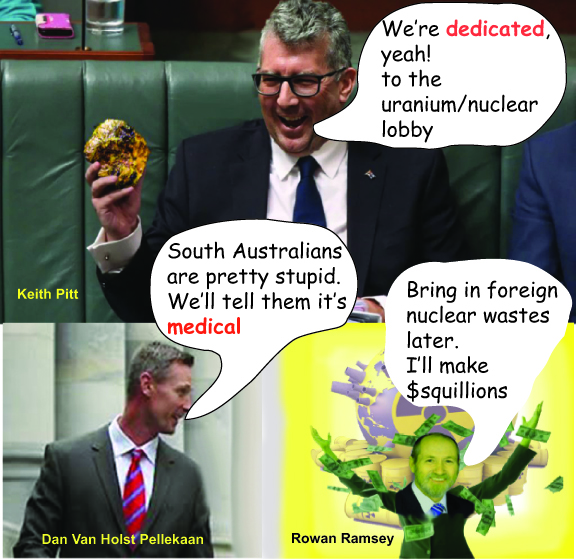
Minister Keith Pitt – desperate times, desperate measures – to get Kimba nuclear waste dump. Angus Taylor, Energy Minister – incompetent and ignorant – SO – VOTE HIM OUT.
INTERNATIONAL
Nuclear weapons have triggered a new geological era. The Fateful Choice: Nuclear Arms Race or Nuclear Weapons-Free World . Amidst Pandemic and Economic Sufferings, 2020’S Global Military Spending Reached Highest Level in Decades. Amid Widespread Disease, Death, and Poverty, the Major Powers Increased Their Military Spending in 2020.
Faster glacier melting raises hunger threat.
Hypocrisy, climate bullshit, and the push for hydrogen+fossil fuels.
Bitcoin’s dirty little secret – its danger to the environment and the climate.
Minister Keith Pitt – desperate times, desperate measures – to get Kimba nuclear waste dump
 | |||
Kazzi Jai No nuclear waste dump anywhere in South Australia, 9 May 21
DESPERATE TIMES CALL FOR DESPERATE MEASURES!!….”Kimba community to receive $2 million funding boost8 May 2021Joint media release with Rowan Ramsay MP, Member for Grey
The Kimba community will benefit from an additional $2 million investment in services and infrastructure under a new round of the Community Benefit Program announced by the Coalition Government.”So….this PRESS RELEASE by Minister Pitt was released YESTERDAY SATURDAY 8TH MAY 2021. Interesting timing given that the Senate reconvenes THIS COMING TUESDAY 11TH MAY 2021!
More money to build public toilets?….Can’t have TOO MANY toilets!!….Or what OTHER Community Benefits projects would they be considering…..given that the GRANT money is not to be used for COMPETITIVE ADVANCEMENT or PERSONAL GAIN. Not looking at anyone specific there – maybe a certain MAYOR, and a certain other person EMPLOYED directly by the department from last Grant Round!!What really intrigues me is that Kimba Council released a public document 30th April 2021 regarding their ANNUAL BUSINESS PLAN AND BUDGET 2021-22 PUBLIC CONSULTATION DRAFT….and in it stated, under Non-Financial Performance Measures – 2021-22 (page 10)…
“Lobby Australian Radioactive Waste Agency and the Minister for resources, Water & Northern Australia for grant funding promised as part of stage 2 of the establishment of the Nuclear Waste Facility. (Strategy3.1)“Feedback due 17th May 2021.So…..this announcement throws up a number of questions. Firstly, “lobby” is a term used to “try to influence the decision-making of a government or opposition representative in the exercise of their official functions”. Does this mean that the Kimba Council had no idea that the money was to be released as part of the continued Stage 2 – which Hawker now is no longer a part of?
Remember Matt Canavan (the previous minister) only announced the so called “New Community Benefit Program 2019-22” JUST MOMENTS BEFORE THE KIMBA AND HAWKER BALLOTS STARTED – on October 8th 2019!! So it isn’t an annual anticipated thing!!….especially when they named the Community Benefit Program 2019 – 22!! Of course Matt Canavan then jumped ship and resigned his ministry on 3rd February 2020.
Is it AGAIN to sway people in Kimba that they are “special”? Remember that $2 million is chicken feed in the grand scheme of things – even the total which would be now $6 million is chicken feed given what they intend doing – making the CURRENT EXPORT PRODUCING AGRICULTURAL LAND OF KIMBA A NUCLEAR WASTELAND….which is over 1700 KMS AWAY from the industrial producer of this nuclear waste – Lucas Heights!!Or is it a way of convincing people that sellout RAMSEY is worth re-electing in this coming Election Year for the Federal Government? (The latest that a Federal Election can be held will be next year May 2022.)
Australia risks bringing on a nuclear war with China. Urgent need to change foreign policy.
Nuclear’: Grim prediction for what war with China would look like, Yahoo News. Brooke Rolfe· News ReporterSat, 8 May 2021
Australia’s escalating rift with China could see the hypothetical prospect of war swiftly become a reality if the government doesn’t urgently rethink its approach, according to Hugh White, a leading expert on Australia’s strategic defence………..
Now our government has begun, with disconcerting nonchalance, to talk of war,” he wrote in The Saturday Paper.
“And yet our government seems to have no idea how serious, and dangerous, our situation has become, and has no viable plan to fix it. This must count as one of the biggest failures of statecraft in Australia’s history.”………..
“It would be a war the US and its allies would have no clear chance of winning. Indeed, it is not even clear what winning a war with a country such as China means. And it would very likely become a nuclear war,” he wrote.
Recent reports from the government saying Australia’s troops should be ready for a military conflict suggest Prime Minister Scott Morrison and Defence Minister Peter Dutton are prepared to go to war with China, Prof White noted.
He urged against any notion of heated conflict and implored the Federal Government to rethink its relationship with China from the ground up.
China’s inevitable rise needs to be accepted, combined with “a new order in Asia” which includes the rise of India and Indonesia.
“Australia must conceive a new relationship with China, one that takes account of this reality and works to balance and protect the full range of our interests … this would require hard work, deep thought and subtle execution. It would mean a revolution in our foreign policy.”…….
He urged against any notion of heated conflict and implored the Federal Government to rethink its relationship with China from the ground up.
China’s inevitable rise needs to be accepted, combined with “a new order in Asia” which includes the rise of India and Indonesia.
“Australia must conceive a new relationship with China, one that takes account of this reality and works to balance and protect the full range of our interests … this would require hard work, deep thought and subtle execution. It would mean a revolution in our foreign policy.” https://au.news.yahoo.com/nuclear-grim-prediction-for-what-war-with-china-would-look-like-051637841.html
Many space rockets planned, thousands of satellites, thousands of space debris -what could possibly go wrong?

To read the news, you’d think that only China was the naughty nation that had accidents in space. Indeed, it’s all written up to convey the message that USA space stuff is utterly safe.
Reminds me of when the nuclear lobby tried to put across the idea that the Fukushima disaster was proof of the safety of U.S. nuclear technology.
Wikileaks lists spaceflight accidents and incidents.
Thousands of satellites in orbit (not all functioning) There are at least 6,900 satellites now in orbit around Earth, with 4000 still functioning.
Space debris
Number of debris objects regularly tracked by Space Surveillance Networks and maintained in their catalogue – About 28160
Estimated number of break-ups, explosions, collisions, or anomalous events resulting in fragmentation -More than 560
Total mass of all space objects in Earth orbitMore than 9300 tonnes.
NASA slams rocket risk, The Age, print version 10 May 2021, Remnants of China’s biggest rocket have landed in the Indian Ocean,with the bulk of its components destroyed on re-entry into the atmosphere according to Chinese state media., fencing days of speculation over where the debris would hit….
The coordinates given by the media yesterday, citing the China Manned Space Engineering Office, put the point of impact west of the Maldives archipelago.The Long March launched last week was the second deployment of the 5B variant since its maiden flight in May 2020 last year pieces from the first Long March 5B fell on Ivory Coast, damaging several buildings. No injuries were reported.
During the rocket’s flight, Harvard based astrophysicist Jonathon McDowellsaid the debris zone could have been as far north as New York, Madrid or Beijing, and as far south as southern Chile and New Zealand.
*************************************
large chunks of the NASA space station Skylab fell from orbit in July 1979 and landed in Australia
Standing up to the USA’s militarisation of space

U.S. push for space weaponisation must be challenged, Independent Australia While most of the world supports outlawing space weaponry, the U.S. Government is still pushing to militarise space, writes Karl Grossman.
RETIRED U.S. Army Colonel John Fairlamb stated in a piece in The Hill, the Washington, DC news website:
Fairlamb knows the issue with the weaponisation of space. His background includes being an International Affairs Specialist for the Army Space and Missile Defense Command and Military Assistant to the U.S. Secretary of State for Political-Military Affairs. He is familiar with war first-hand: he was a company commander in Vietnam and holds a doctorate in Comparative Defense Policy Analysis.
In his opinion column headed ‘The U.S. should negotiate a ban on basing weapons in space’, Fairlamb wrote:
Given the implications for strategic stability, and the likelihood that such a decision [to deploy weapons in space] by any nation would set off an expensive space arms race in which any advantage gained would likely be temporary, engaging now to prevent such a debacle seems warranted.
It’s time for arms control planning to address the issues raised by this drift toward militarisation of space. Space is a place where billions of defence dollars can evaporate quickly and result in more threats about which to be concerned. Russia and China have been proposing mechanisms for space arms control at the United Nations for years; it’s time for the U.S. to cooperate in this effort.
Indeed, if weapons are deployed in space – and for decades, including during the Reagan Administration’s “Star Wars” (officially named the Strategic Defense Initiative) push, now likely again with the Trump Administration’s creation of a U.S. Space Force and its mission to “dominate” space – there will be no return.
Space weaponisation ‘cannot be walked back’. And the world is at a crossroads.
Russian Foreign Minister Serge Lavrov two weeks ago called tor talks to create an ‘international legally binding instrument’ to ban the deployment of “any types of weapons” in space.
Lavrov declared:
We consistently believe that only a guaranteed prevention of an arms race in space will make it possible to use it for creative purposes, for the benefit of the entire mankind. We call for negotiations on the development of an international legally binding instrument that would prohibit the deployment of any types of weapons there, as well as the use of force or the threat of force.”
He made the statement on 12 April, the International Day of Human Space Flight, marked this year by the 60th anniversary of Russian Yuri Gagarin’s space flight, the first by a person in space.
The U.S., the United Kingdom and the then Soviet Union joined decades ago in drafting the Outer Space Treaty of 1967 that designated space as a “global commons” for peaceful purposes. The treaty bans the deployment of weapons of mass destruction in space. It’s been signed by most nations on Earth.
Russia and China – along with U.S. neighbour Canada – have led in a move to expand the Outer Space Treaty by outlawing the deployment of any weapons in space.
During the period of Reagan’s “Star Wars” and in years since, the U.S. has been working on developing space weaponry that has included hypervelocity guns and particle beam and laser weapons.
The Prevention of an Arms Race in Outer Space (PAROS) treaty has been pushed by Canada, Russia and China to broaden the Outer Space Treaty.
PAROS has worldwide support. But through a succession of U.S. administrations – Republican and Democrat – the U.S. Government has voted against the PAROS treaty at the Conference on Disarmament of the United Nations. Because conference decisions must be supported by consensus, the U.S. has effectively vetoed the enactment of the PAROS treaty.
The day after Lavrov’s statement, the Chinese Foreign Ministry joined Russia in its plea.
Deputy director of the Chinese Ministry of Foreign Affairs Information Department Zhao Lijian said on 13 April:
“We are calling on the international community to start negotiations and reach agreement on arms control in order to ensure space safety as soon as possible. China has always been in favour of preventing an arms race in space; it has been actively promoting negotiations on a legally binding agreement on space arms control jointly with Russia.”
As for the Biden Administration and space militarisation, spokesperson Jen Psaki tweeted: ‘We look forward to the continuing work of Space Force…’…..
The comments from retired Army Colonel John Fairlamb are quite excellent as he calls for the U.S. to seriously enter into negotiations with Russia and China on PAROS. Both those nations for years have been offering to enter into negotiations at the U.N. to close the door to the barn before the horse gets out. In other words, develop a new treaty that prevents a space arms race before it happens. Sadly, the U.S. due to aerospace industry greed and dreams of space domination has been blocking this much need treaty development process.
Some might see Mr Fairlamb’s comments as representing the U.S. military – as if a sea change was happening inside the Pentagon – on this very important issue.
The comments from retired Army Colonel John Fairlamb are quite excellent as he calls for the U.S. to seriously enter into negotiations with Russia and China on PAROS. Both those nations for years have been offering to enter into negotiations at the U.N. to close the door to the barn before the horse gets out. In other words, develop a new treaty that prevents a space arms race before it happens. Sadly, the U.S. due to aerospace industry greed and dreams of space domination has been blocking this much need treaty development process.
Some might see Mr Fairlamb’s comments as representing the U.S. military – as if a sea change was happening inside the Pentagon – on this very important issue.
Alice Slater, a member of the boards of both the Global Network and the organisation World BEYOND War, said
The U.S. mission to dominate and control the military use of space has been, historically and at present, a major obstacle to achieving nuclear disarmament and a peaceful path to preserve all life on Earth. Reagan rejected Gorbachev’s offer to give up “Star Wars” as a condition for both countries to eliminate all their nuclear weapons. Bush and Obama blocked any discussion in 2008 and 2014 on Russian and Chinese proposals for a space weapons ban in the consensus-bound Committee for Disarmament in Geneva.
At this unique time in history, when it is imperative that nations of the world join in cooperation to share resources to end the global plague assaulting its inhabitants and to avoid catastrophic climate destruction or Earth-shattering nuclear devastation, we are instead squandering our treasure and intellectual capacity on weapons and space warfare. https://independentaustralia.net/politics/politics-display/us-push-for-space-weaponisation-must-be-challenged,15066#.YJcE8NQEv74.twitter
20 tonne space rocket out of control, but luckily landed in the Indian Ocean, rather than on land.
Out-of-control Chinese rocket finally lands in Indian Ocean near the Maldives, https://www.9news.com.au/world/chinese-rocket-expected-to-crash-into-earth-this-weekend/4b39859c-cfc4-4f3c-b9e2-f294e1bb65f4 By CNNJoe Attanasio May 9, 2021 A large Chinese rocket that was orbiting earth out of control has finally made impact, landing in the Indian Ocean close to the Maldives and drawing sharp criticism from NASA.
According to China Manned Space Engineering Office, the rocket made impact about 12.24pm AEST, roughly two hours earlier than predicted.Most of the remnants of the vessel burned up during re-entry to earth’s atmosphere, officials said, putting to bed week-long fears over the potential damage the rocket could have caused if it struck land.What was left of the spacecraft landed at open sea, at 72.47 degrees east longitude and 2.65 degrees north latitude.The Long March 5B rocket, which was around 30 metres tall and weighed 20 tonnes, entered earth’s low orbit earlier this morning.
It travelled at more than 30,000 kilometres an hour, was more than 10 stories tall, and weighed roughly the same as a full garbage truck, causing many to raise concerns about the impact its landing could have hadThe rocket launched a piece of the new Chinese space station into orbit on April 29 but then was left to hurtle through space uncontrolled until Earth’s gravity began pulling it back to the ground.
That approach is a break with what officials call “best practice” compared with what other space agencies do.
NASA Administrator Bill Nelson criticised China over the re-entry, saying spacefaring nations needed to minimise risk and maximise transparency in such situations.”It is clear that China is failing to meet responsible standards regarding their space debris,” he said, in a statement.”It is critical that China and all spacefaring nations and commercial entities act responsibly and transparently in space to ensure the safety, stability, security, and long-term sustainability of outer space activities.”Despite recent efforts to better regulate and mitigate space debris, Earth’s orbit is littered with hundreds of thousands of pieces of uncontrolled junk, most of which are smaller than 10 centimetres.Objects are constantly falling out of orbit, though most of them burn up in the Earth’s atmosphere before they have a chance to make an impact on the surface.
Remembering Father Daniel Berrigan, a Prophet of Peace — Rise Up Times

Advice to parents, teachers, priests, ministers, et al: The young people will be different if you are different. They are moved by example, as I have been.
Remembering Father Daniel Berrigan, a Prophet of Peace — Rise Up Times
Together we can create a global solution to the COVID-19 pandemic — IPPNW peace and health blog
IPPNW has co-signed the following letter to the 2021 G20 Summit in partnership with the Coalition of Global Health, Primary Care and Social Work Professionals, initiated by the World Federation of Public Health Associations. The same letter was sent to the 2021 G7 Summit. Geneva 20 April 2021 Open Letter To: Hon. Mario DraghiPrime Minister […]
Together we can create a global solution to the COVID-19 pandemic — IPPNW peace and health blog
May 9 Energy News — geoharvey

Opinion: ¶ “California Energy Commission Proposal Makes Important Climate Progress, But Falls Short Of Widely Supported All-Electric Building Code” • The California Energy Commission released its official proposal for the 2022 California Energy Code, which, if finalized, will help advance the state toward pollution-free homes and buildings. [CleanTechnica] San Francisco (Timo Strohmann, Unsplash) ¶ “Oil, […]
May 9 Energy News — geoharvey
The nuclear menace from under the seas and from high in the sky- theme for May 21
Why would anyone persist in pushing Small Nuclear Reactors (SMRs) and pretending that they can solve climate change, when they clearly cannot?
Well, the answer is – if you’re a toxic macho nuclear zealot or a nuclear weapons corporation – ( Lockheed Martin, Raytheon Technologies, Northrop Grumman, Boeing, and General Dynamics etc)- this myth about SMRs is manna from heaven.
It means that the tax-payer, not private enterprise investors, will take over the SMR push – and the military-industrial-complex will race away with nuclear sites and weapons in space, and with powerful killer nuclear submarines.

Meanwhile those billionaire nuclear gurus – Elon Musk, Bill Gates, Jeff Bezos, , Richard Branson, Jack Ma and othes , will be laughing all the way to the bank, as they promote ”peaceful, nuclear-powered” space travel.
The global media promotes the joy and delight of space travel, rarely acknowledging its intimate connection with militarism. And there’s a crazy sort of national pride – hubris in being in the space race.
The space race to what? Apart from the obvious – nuclear war and annihilation, there’s the danger of ecosystem plutonium pollution from accidents and leaks, drastic accidents, and the gobbling up of public funds that might otherwise go to the public good – health, education, welfare, climate ation – heck – even good international relations!
The USA and Russia have long been in a toxic competition to militarily control the world especially by nuclear submarines. There’s a strange and unwarranted confidence that nuclerar submarines are ”clean” and somehow ”safe”. That’s because they release their radioactive trash unseen, into the world’s ocean waters. When they have an accident, well they just sink, and their poisonous mess is invisible. Dead nuclear submarines seem to be no trouble, hidden on the sea floor. Now that the world has become (a bit) aware of the radioactive danger of nuclear submarines, the dead ones lie in port, as nobody really knows what to do with them, how to clean up the nuclear mess.
In this time of pandemic, it is urgently necessary to put the brakes on NATO, and Russia – in regard to the increasing danger to the world, of nuclear submarines. Even more than cruise ships, they can be a hot-bed of coronavirus – making them even more unsafe in a number of ways.
Gun totin’ gay-marriage opposing, sports-rorting Senator Bridget McKenzie leads the National Party’s push on behalf of the nuclear lobby.

Sky News.6 May 21, Nationals Senator Bridget McKenzie, Nationals Senators earlier this year drafted legislation which would allow the Clean Energy Finance Corporation to invest in nuclear power. Ms McKenzie told Sky News host Alan Jones “we’re still waiting” for Energy Minister Angus Taylor to put the legislation through parliament and spark debate on the issue.

1 This month
17 October, Free Public Talk on Nuclear Issues in South Australia
David Noonan will speak on public interest concerns over the new Roxby Downs Indenture Act 2026 on BHP copper-uranium mining and ore processing in SA, and on how AUKUS may face SA with a High-Level nuclear waste agenda.
Dr Jim Green will discuss international developments in the field of nuclear power including ‘small modular reactors’ and Generation 4 ‘advanced’ nuclear reactor concepts.


Help Aunty Sue Protect Her Land and Sacred Sites From Destructive Rocket Testing.
.

Australians deserve the truth
about
AUKUS – https://aukuspublicinquiry.com/

PETITION – To: Prime Minister Anthony Albanese and the Australian Labor Government

of the week – Australians for War Powers Reform (AWPR)
To see nuclear-related stories in greater depth and intensity

