OECD says Australia is 2nd dirtiest economy per capita, tells it to clean up — RenewEconomy

The OECD’s criticism of Australia’s climate record comes two months before former finance minister Matthias Cormann takes over as secretary-general. The post OECD says Australia is 2nd dirtiest economy per capita, tells it to clean up appeared first on RenewEconomy.
OECD says Australia is 2nd dirtiest economy per capita, tells it to clean up — RenewEconomy
A fossil fuel frenzy is drinking Australia’s finite water resources — RenewEconomy

Water is our life support system in a drying continent, yet the coal and gas industries consume prodigious amounts of water each day. The post A fossil fuel frenzy is drinking Australia’s finite water resources appeared first on RenewEconomy.
A fossil fuel frenzy is drinking Australia’s finite water resources — RenewEconomy
Fukushima” is not over: Japanese NGOs raise concern over the ongoing nuclear disaster
Fukushima” is not over: Japanese NGOs raise concern over the ongoing nuclear disaster, Friends of the Earth Japan, Pacific Asia Resource Center (PARC), 14 Apr 21,
On the 10th anniversary of one of the worst nuclear accidents at Fukushima Daiichi Nuclear Power Station, and amid the controversial decision of the Japanese government to dump “treated” radioactive water into the ocean, Japanese NGOs Friends of the Earth Japan and Pacific Asia Resource Center (PARC) co-produced a documentary film Fukushima 10 Years Later: Voices from the continuing nuclear disaster. The film sheds light on the ongoing suffering of victims of the accident and poses critical questions about the Japanese government’s poor responses to the accident.
While then-Prime Minister Abe vainly declared to the world that “the situation in Fukushima is completely under control”, nuclear decays are continuing inside the molten fuel rods, and the exploded plants are still emitting radioactive particles to this day. In the meanwhile, evacuees are torn apart in limbo, with grim hopes of returning to their homeland, continued fear of radioactive fallout, and a dire socio-economic situation. Fisherfolk, who overcame the initial fear of ocean contamination, are forced to relive the experience each time TEPCO and the Japanese government repeatedly choose to release contaminated water into the ocean.
This happens all under the propaganda that Fukushima is pressing ahead with “Fukkou (Recovery)”.
This video aims to highlight the current situation of the victims of the man-made disaster, and challenge the government propaganda of Fukushima’s Recovery.
Fukushima 10 Years Later: Voices from the continuing nuclear disaster
Produced by Friends of the Earth Japan and Pacific Asia Resource Center
Supervised by HOSOKAWA Komei (Citizens’ Commission on Nuclear Energy)
Directed by MATSUMOTO Hikaru (Friends of the Earth Japan)
Running time: 43 min.
The English subtitled version of the film is now available on Vimeo on Demand and will cost USD 5.75 to rent and USD 47.50 to purchase.
https://vimeo.com/ondemand/fukushima10years
For further information on the film, please contact OKUMURA Yuto, Pacific Asia Resource Center.
E-mail: video@parc-jp.org
Yuto Okumura,Pacific Asia Resource Center (PARC)
Nuclear Alert: Iran and Israel Playing High-Stakes Poker with Nuclear Power and Nuclear Weapons
Nuclear Alert: Iran & Israel Playing High-Stakes Poker with Nuclear Power & Nuclear Weapons Fairewinds, Maggie Gunderson, 14 Apr 21, Fairewindsy now, Fairewinds is sure you know that an explosion at an Iranian nuclear enrichment plant has slowed Iran’s progress to enrich uranium. The crisis shows a very blurry line between Civilian Atomic Power and Military Atomic Bombs!………..
For decades, we are informed there is no correlation between weapons and civilian power. This standoff between Iran and Israel highlights the strong connection between nuclear weapons and nuclear power, like hand-in-glove.
The borderline between bomb-grade uranium and civilian power-grade uranium is determined by how much the isotope Uranium-235 (U-235) is enriched. Traditionally, if uranium enrichment is above 20%, that is considered the low-end of weapons-grade enrichment, which falls between 20% and 100% enrichment for bombs. Therefore, the higher the percent of enrichment of U-235, the easier it is to manufacture a nuclear bomb.
To be cost-effective, the nuke industry claims its U-235 must be more enriched to prevent atomic power reactors from refueling as often. Currently, uranium fuel used worldwide in operating nuclear power plants is enriched to about 6%. But the nuclear industry’s new designs for proposed Small Modular Reactors (SMRs) will use fuel enriched to about 20%.
Yes, as Fairewinds quoted above, SMRs will use nuclear fuel that is “one step away from weapons-grade uranium” used to make bombs!
At Fairewinds, we have two questions today:
- First, what are Iran’s plans for gaining that much enrichment? Iran claims that this centrifuge produced fuel is for peaceful purposes only, then why does the uranium have to be enriched to almost bomb-grade? Is Iran building SMRs?
- Where does that place the United States in world politics with its creation of SMRs? The U.S. plans to build tens of thousands of these allegedly new Small Modular Reactors. Moreover, SMRs use HALEU fuel (High-Assay Low-Enriched Uranium) enriched to almost 20% Uranium-235.
- How does this action make the U.S. any different from what Iran is doing when the U.S. SMRs will contain high-test Uranium identical to what is being enriched in Iran?
- Is this federal push for this new SMR design some type of ploy to spread atomic bomb-grade fuel all over the world?
- The U.S. nuclear power industry is looking at SMRs as its latest cash cow, expecting to sell and build SMRs all over the world! What kind of international threat is this if thousands of proposed SMRs are located all over the U.S. and worldwide?

As a result of the attack on its enrichment facility, Iran has further changed its mind and said it would enrich uranium to 60%. According to the BBC:
Iran will produce 60%-enriched uranium in retaliation for a suspected Israeli attack on a nuclear site, President Hassan Rouhani says, bringing it closer to the purity required for a weapon. … But he reiterated that Iran’s nuclear activities were “exclusively peaceful”.
France, Germany and the U.K. expressed “grave concern” at the move, saying Iran had “no credible civilian need for enrichment at this level”.
Fairewinds is clear that the 20% enriched fuel planned to be used in SMRs is only one easy step away from creating bomb-grade atomic fuel! Now that Iran has informed the world that it intends to enrich its uranium to 60%, scientists worldwide know that there is no peaceful civilian atomic reactor of any kind using U-235 enriched to 60%!
Fairewinds hopes that diplomats will resolve this enrichment conundrum before the military situation escalates further. https://www.fairewinds.org/demystify/nuclear-alert-iran-israel-playing-high-stakes-poker-with-nuclear-power-nuclear-weapons
South Australia to introduce “flexible” export option for rooftop solar — RenewEconomy

South Australia to test “flexible” exports for solar households in a trial that is expected to become standard throughout the country. The post South Australia to introduce “flexible” export option for rooftop solar appeared first on RenewEconomy.
South Australia to introduce “flexible” export option for rooftop solar — RenewEconomy
South Korea aims to fight, at International Tribunal, Japan’s plan to empty Fukushima water into Paific Ocean
S Korea aims to fight Japan’s Fukushima decision at tribunal, https://www.aljazeera.com/news/2021/4/14/s-korea-aims-to-fight-japans-fukushima-decision-at-tribunal15 Apr S Korea A
Moon Jae-in asks officials to look at ways to refer Japan’s Fukushima decision to the International Tribunal for the Law of the Sea.
South Korean President Moon Jae-in has ordered officials to explore petitioning an international court over Japan’s decision to release water from its Fukushima nuclear plant, his spokesman said, amid protests by fisheries and environmental groups.
Moon said officials should look into ways to refer Japan’s move to the International Tribunal for the Law of the Sea, including filing for an injunction, spokesman Kang Min-seok told a briefing.
Japan unveiled plans on Tuesday to release more than 1 million tonnes of contaminated water into the sea from the plant, which was crippled by a 2011 earthquake and tsunami, starting in about two years after filtering it to remove harmful isotopes.South Korea protested strongly against the decision, summoning Koichi Aiboshi, Tokyo’s ambassador in Seoul, and convening an intra-agency emergency meeting to craft its response.
Moon also expressed concerns about the decision as Aiboshi presented his credentials, having arrived in South Korea in February for the ambassador’s post.“I cannot but say that there are many concerns here about the decision as a country that is geologically closest and shares the sea with Japan,” Moon said, asking Aiboshi to convey such worries to Tokyo, according to Kang.An aerial view shows the storage tanks for treated water at the tsunami-crippled Fukushima Daiichi nuclear power plant in Okuma town, Fukushima prefecture, Japan February 13, 2021 [Kyodo via Reuters]South Korea’s foreign ministry issued a statement saying it had raised similar concerns with the United States after the Department of State said Japan’s decision was “transparent” and in line with global safety standards.
The ministry also said it shared “strong regret and serious concerns” about the water’s planned release at a video conference on Wednesday with Chinese officials on maritime issues.
A series of protests against the move by politicians, local officials, fishermen and environmental activists took place in South Korea on Wednesday, including in front of the Japanese embassy in Seoul and consulates in the port city of Busan and on Jeju island.
A coalition of 25 fisheries organisations staged a rally and delivered a written protest to the embassy, urging Tokyo to revoke the decision and Seoul to ban imports from Japanese fisheries.
“Our industry is on course to suffer annihilating damage, just with people’s concerns about a possible radioactive contamination of marine products,” it said in a statement.
The progressive minor opposition Justice Party and some 30 anti-nuclear and environmental groups called Japan’s move “nuclear terrorism,” and said they sent the Japanese embassy a list of signatures of more than 64,000 people opposed to the move collected from 86 countries since February.
The nuclear industry – a vortex of corruption
Part two | Nuclear energy in Africa
The second in this three-part series looks at how power purchase agreements raise the cost of electricity for consumers and act as major sources of inflationary pressure in economies. New Frame, By: Neil Overy, 1 Dec 2020
A vortex of corruption
Another issue that needs to be seriously considered when evaluating the cost of nuclear power is corruption. A 2013 survey of corruption in the nuclear industry by Richard Tanter from the University of Melbourne found “widespread and often deep corruption” in the nuclear industry, saying that national and international nuclear regulatory regimes were “virtually completely ineffective”.
In recent years, the industry has been rocked by several corruption scandals.
In 2014, a massive corruption scandal involving South Korean nuclear vendor Korea Hydro & Nuclear Power, a subsidiary of Korea Electric Power Company, resulted in dozens of employees receiving a cumulative total of 258 years in prison for fraud and corruption. Many of these charges related to the supply of counterfeit equipment, some of it safety-related, to nuclear power stations in South Korea and the United Arab Emirates.
In July, five people were arrested in Ohio in the United States, including the Ohio house speaker, for receiving $60 million from an embattled nuclear energy operator in exchange for securing the passage of a $1.5 billion bailout for the operator.
A month later, Brazilian federal prosecutors charged a subsidiary of EDF and Brazilian nuclear company Eletronuclear with corruption.
The construction and ongoing maintenance of nuclear power stations are areas particularly susceptible to corruption for two specific reasons. First, because they are megaprojects they are massively complicated enterprises that involve potentially hundreds of contractors and subcontractors, which creates fertile conditions for corruption. Second, these fertile conditions are exacerbated by the secrecy that surrounds nuclear power. While this secrecy is supposedly designed to stop the spread of nuclear technology or the capture of nuclear materials, it fosters an environment that is shielded from scrutiny and public oversight.
While Africa has no recent experience of nuclear power plant construction, other recent megaprojects on the continent – the Lesotho Highlands Water Project, the Lauca Dam in Angola, the Mambilla Hydropower Project in Nigeria, and the construction of the Medupi and Kusile power stations in South Africa – show how corruption can become entrenched in megaprojects on the continent.
In this regard, it is worth remembering that Transparency International’s Corruption Perception Index for 2019 found that sub-Saharan Africa was the worst performing region in the world, followed closely by North Africa. There is clearly good reason to be concerned about possible corruption in any nuclear deals concluded on the continent. South Africa’s recent unlawful deal between former president Jacob Zuma’s government and Rosatom shows just how real this danger is.
Part three looks at the costs associated with nuclear waste disposal, decommissioning nuclear power stations and major nuclear accidents. https://www.newframe.com/part-two-nuclear-energy-in-africa/
The fiasco of nuclear preprocessing: UK, Japan, USA.
Part one | The slow violence of SA’s nuclear waste,
Part one of this four-part story considers the imminent danger involved in storing used radioactive materials, a dilemma growing at a rate of more than 32 tonnes a year. New Frame , By: Neil Overy, 8 Mar 21
”……………..This is a process by which fission products are chemically separated out of used fuel rods to extract any unused uranium. This alleged solution to the problem of high-level waste has been one of the illusionary solutions Eskom has regularly mooted and just as regularly abandoned because of the colossal costs and serious dangers involved in reprocessing.
In the United Kingdom, the Thermal Oxide Reprocessing Plant, opened at huge cost in 1994, closed in 2018 having reached none of its intended reprocessing targets. Its decommissioning is now set to cost taxpayers at least $5.5 billion and take up to 100 years to complete. In Japan, construction of the Rokkasho Reprocessing Plant began in 1993 and was supposed to be completed by 1997. Incredibly, the plant is still not complete – its completion date has been postponed 25 times – and it is now expected to be operational in 2023, 26 years late and tens of billions of dollars over budget.
Even when operational, large quantities of dangerously radioactive waste, which needs to be stored for thousands of years, remains. Some of this waste is separated plutonium, a fissile material used in nuclear bombs, which presents a very serious security risk. This is precisely why reprocessing has never been authorised in the United States. As the Union of Concerned Scientists conclude, reprocessing is “dangerous, dirty and expensive”. Quite clearly, reprocessing is not an option South Africa should consider. …… , https://www.newframe.com/part-1-the-slow-violence-of-sas-nuclear-waste/?fbclid=IwAR0TEdv3xITKJISxqQs_UwdO9JB4m5LkPABzUl9b6R_nYVZKdL2S2ikp-MA
South Africa’s mismanagement of nuclear waste
Part one | The slow violence of SA’s nuclear waste,
Part one of this four-part story considers the imminent danger involved in storing used radioactive materials, a dilemma growing at a rate of more than 32 tonnes a year. New Frame , By: Neil Overy, 8 Mar 21
Where will South Africa permanently and safely store the radioactive nuclear waste produced by the Koeberg nuclear power station in Cape Town? This critical question remains worryingly unanswered, despite the government’s intention to create even more high-level waste by extending the life of Koeberg 20 years past its original decommissioning date, and by building an additional 2 500MW of new nuclear power in South Africa.
The South African story of what to do with this high-level waste is one characterised by endless broken promises, gross mismanagement, ineptitude and pie-in-the-sky “solutions”. This catalogue of failures means there is now so much high-level waste stored at Koeberg that Eskom is having to build a transient interim storage facility (TISF) at the site, just 25km from Cape Town. That this site is both “transient” and “interim” perfectly illustrates that Eskom, or any other operator of nuclear power plants for that matter, has no long-term answer to the question of what to do with high-level nuclear waste.
Three categories of radioactive waste are produced by nuclear power stations – low-level waste, intermediate-level waste and high-level waste.
Continue readingUS cannot afford a world war with Russia — THE WEICHERT REPORT

Brandon J. Weichert’s newest op-ed at The Asia Times shows how bad the US policy toward Russia and Eastern Ukraine really is.
US cannot afford a world war with Russia — THE WEICHERT REPORT
Australia’s democracy threatened, damaged, by News Corpse’s media domination, and government cuts to the ABC

Media concentration by Murdoch, Nine and Stokes, and ABC cuts, a danger to democracy – report https://www.michaelwest.com.au/media-concentration-by-murdoch-nine-and-stokes-and-abc-cuts-a-danger-to-democracy-report/A
by Elizabeth Minter | Apr 12, 2021 | The heavy concentration of media ownership in Australia corrodes democracy. The antidote is a thriving public broadcaster, but by 2023, Coalition cuts to the ABC will add up to $1 billion. Elizabeth Minter reports.
“[Australia’s] highly concentrated media ownership has had a corrosive impact on democracy. It has skewed public debate, favouring the interests of the wealthy and powerful over the public good.
This has been clearly evidenced in the national debates on climate change policy, where the scale of News Corp’s climate misinformation has hindered climate policy, encouraged negative sentiments towards climate action, and actively driven a political wedge into our public debate. This would not have been possible in a more diverse media landscape.”
So states the report “Who controls our media“, a report into Australia’s media ownership commissioned by GetUp!
Rupert Murdoch’s News Corp owns 59% of the metropolitan and national print media markets by readership — up from 25% in 1984. Nine Entertainment is the second-largest media owner, with a combined 23% readership share.
These two corporations control Australia’s two national mastheads and two daily newspapers in Sydney and Melbourne are controlled by News and Nine. The remaining capital cities have only one daily paper.
Furthermore, “the predominance of News Corp in cross-media settings is unprecedented in liberal democracies”.
At the same time that media ownership has become more concentrated, the budgets of the nation’s public broadcasters, which are key to media diversity, have been slashed, the report notes.
More than $600 million was cut from the ABC over the past seven years. In the decade to 2023/24, the Coalition will have cut the ABC’s budget by just over $1 billion.
Just three corporations – News Corp, Nine, and Seven Media Holdings — collect 80% of Australian free-to-air and subscription TV revenues, with News Corp picking up 40%, almost double that of the next in line Nine.
And just three corporations — News Corp, Nine and Southern Cross Media (and their associated entities) — control almost 90% of the lucrative metropolitan radio licences across the nation.
Dangerous interpretation of news
The report notes that billionaire media moguls like Rupert Murdoch heavily promote an “increasingly dangerous interpretation of what news represents. They measure the worth of news not by its invaluable contributions to the health of our democracy, but by its monetary worth.”
Former UK prime minister David Cameron admitted in Parliament that “we all did a bit too much cosying up to Rupert Murdoch”.
As for the News Media Bargaining Code, the biggest winners are the large media companies. The code only applies to media entities with revenues greater than $150,000, thus barring smaller news institutions, especially community or locally led initiatives, which mostly need help.
The Code also doesn’t mandate how much should be paid, and there is no transparency around the deals, meaning it is impossible for the public to have a clear idea of what resources will be invested in journalism.
The report notes that leaving Google and Facebook to decide which media companies to fund has resulted in deals being signed only with the biggest organisations. Early estimates suggest that News Corp, Nine, and Seven West Media together stand to gain 90% of Facebook’s total revenue under the code.
News Corp and Nine’s cross-media dominance was made possible when the Australian Government repealed the ‘two out of three’ rule in 2017. Traditionally media corporations were only allowed to own media in two out of the three media markets — print, radio and television — but not all three.
The report was written by Benedetta Brevini, Associate Professor of Communication at the University of Sydney, and Michael Ward, a former senior executive with the ABC who is researching Australian media as part of a PhD at the University of Sydney.
The problem of plutonium programs
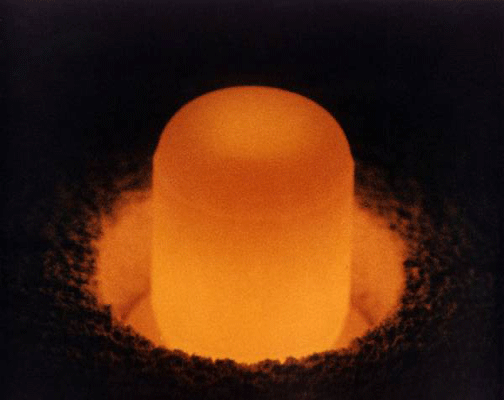
Plutonium programs in East Asia and Idaho will challenge the Biden administration, Bulletin of the Atomic Scientists, By Frank N. von Hippel | April 12, 2021 Among the Biden administration’s nuclear challenges are ongoing civilian plutonium programs in China and Japan. Also, South Korea’s nuclear-energy research and development establishment has been asserting that it should have the same “right” to have a plutonium program as Japan. These challenges have been compounded by a renewed push by the Energy Department’s Idaho National Laboratory to revive a plutonium program that was shut down in the 1980s. These foreign and domestic plutonium programs are all challenges because plutonium is a nuclear-weapon material.
Henry Kissinger’s State Department quickly discovered that the governments of Brazil, Pakistan, South Korea, and Taiwan—all under military control at the time—had contracted for French or German spent-fuel “reprocessing” plants. The United States intervened forcefully and none of these contracts were fully consummated…………………..
…………….A possible path forward. During the Trump administration, the Energy Department fell back into the never-never land of plutonium-fueled reactors from which the United States extracted itself in the 1980s. Fortunately, the big-dollar commitments to the Versatile Test Reactor and the Natrium Reactor have not yet been made, and the Biden administration could use the excuse of budget stringency not to make those commitments.
In South Korea, the Biden administration will have to deal with the completion of the Idaho National Lab–Korea Atomic Energy Research Institute Joint Fuel Cycle Study. Although there will no doubt be obfuscation in the report, the conclusions of the 10-year study should have been obvious from the beginning: reprocessing is hugely costly, creates proliferation risks, and complicates spent fuel disposal. Fortunately, the anti-nuclear-energy Moon administration is unlikely to push for reprocessing. It will be much more interested in the opportunities that the Biden administration can provide to advance the Korean Peninsula denuclearization agenda. It should therefore be politically relatively easy for the Biden Administration to terminate cooperation on pyroprocessing.
China’s reprocessing and fast-neutron reactor program may be driven in part by China’s interest in obtaining more weapon-grade plutonium to build up the size of its nuclear arsenal. If that is the case, China’s incentive to build up could be reduced through nuclear arms control. Specifically, if China is building up its nuclear arsenal out of concern about the adequacy of its nuclear deterrent in the face of an unconstrained US missile-defense buildup, then the United States could examine the possibility of an agreement to limit missile defenses as an alternative to an open-ended, offense-defense arms race. That was the path of wisdom that the United States and Soviet Union chose with their 1972 Anti-Ballistic Missile Treaty.
In Japan, the Biden administration will be faced with the continued unwillingness of the powerful Ministry of Economics, Trade, and Industry to wind down Japan’s dysfunctional plutonium program. But, if a linkage could be made between constraining China’s nuclear buildup and ending Japan’s hugely costly reprocessing program, that might help tip the balance in Japan’s internal debate over reprocessing. https://thebulletin.org/2021/04/plutonium-programs-in-east-asia-and-idaho-will-challenge-the-biden-administration/?utm_source=Newsletter&utm_medium=Email&utm_campaign=MondayNewsletter04122021&utm_content=NuclearRisk_EastAsia_04122021
Can cryptocurrency be justified in a climate catastrophe? — RenewEconomy

A new “crypto climate accord” wants to clean up Bitcoin. But the calls for government regulation, bans and taxation are growing. The post Can cryptocurrency be justified in a climate catastrophe? appeared first on RenewEconomy.
Can cryptocurrency be justified in a climate catastrophe? — RenewEconomy
Bitcoin mining and cryptocurrency in general are having what could very loosely be sort of described as a ‘coming of age’ moment. It’s loose because advocates of these digital currencies, which obtain ‘trust’ from requiring massive amounts of energy to generate (‘proof of work’), don’t seem to be handling the challenges of dealing with key issues like climate and environment particularly well.
This was explored recently in RenewEconomy, in this post detailing how there are many Bitcoin mining operations running massive server farms that either exist on carbon intensive grids, or even directly use fossil gas on mining sites where that gas would have otherwise been flared.
And last week, we covered a piece of research that predicted Bitcoin’s energy consumption will match that of Australia’s by the year 2024.
“Under the Paris Agreement, China is devoted to cut down 60 per cent of the carbon emission per GDP by 2030 based on that of 2005. However, according to the simulation results of the [blockchain carbon emission] model, we find that the carbon emission pattern of Bitcoin blockchain will become a potential barrier against the emission reduction target of China”, the researchers found. It’s significant, because the fate of China on energy and climate decides, by and large, the fate of the world.
Part of the reason interest has increased in Bitcoin was a significant purchase of it by Tesla. CEO Elon Musk is a well-known fan of cryptocurrency, including Dogecoin, an alternative to the more mainstream Bitcoin. But scrutiny of its extreme energy consumption, alongside a lack of any real sustainability or environment initiatives across the industry of Bitcoin miners, has led to nearly months now of constant criticism (including from this author).
Now, a new initiative is attempting to change that at a surprisingly ambitious and fundamental level. Last week, a range of organisations launched the ‘Crypto Climate Accord’, aiming to decarbonise the entire cryptocurrency industry, including Bitcoin trading house Coinshares.
Among the partners are the Rocky Mountain Institute (RMI), well-regarded among energy experts, and representations from the United Nations Framework Convention on Climate Change (UNFCCC). Energy Web and the Alliance for Innovative Regulation (AIR) are involved too, as are the cryptocurrency companies.
“The Accord intends to achieve this by working collaboratively with the cryptocurrency industry — including all blockchains — to transition to 100% renewable energy by 2025 or sooner. While many organisations are individually taking steps to decarbonise their operations, the Accord recognises that an industry-wide coalition and scalable solutions can quickly multiply impact.”
Total decarbonisation of power by 2025 comes along with full decarbonisation of all business operations by 2040, and with the active removal of historical emissions from the Earth’s atmosphere by 2040. These are both genuinely ambitious goals, and they seem to be closely tied to international climate diplomacy. It is a far cry from the decentralised, regulation-hating, unaccountable world of Bitcoin mining as it exists today.
While this seems like a step in the right direction, it is very likely its advocates will be swimming against the tide. The very philosophy of collective action to take responsibility for the externalities of profit-making business is contrary to the libertarian values of individual freedom. Some participants may not be all that invested. “Coinshares less than two weeks ago was arguing more energy consumption is about the best thing ever. I’m not sure how this is inspired by the Paris Agreement if they’ve clearly never read it or don’t understand it”, wrote Alex De Vries, author of the Digiconomist blog.
Meanwhile, Bitcoin seems only to be getting hungrier for energy, and there doesn’t seem to be much effort to direct that big ship towards clean power sources only. Cheap coal and gas will likely get cheaper, as they both get displaced from grids by renewable energy.
The Centre for Global Development just released a new analysis showing that mining a single Bitcoin is equivalent to the total annual energy usage of 18 Americans, or 2,199 Tanzanians.
They recommend a range of policy options to forcibly clamp down on the problem, including a ban of large mining operations and taxing mining activity. Neither of these will be welcomed by the industry. “The most hopeful case for the environment is that the price of bitcoin falls low enough to push most miners out of business, leaving behind only those with access to cheap renewable energy and the most efficient mining rigs”, they write.
The question is whether voluntary accords or forcible regulation win out in cleaning up Bitcoin. The alternative is very ugly – a major new threat to climate action at a sensitive time indeed.
Israel appears to confirm it carried out cyberattack on Iran nuclear facility
Shutdown happened hours after Natanz reactor’s new centrifuges were started, Guardian, Martin Chulov Middle East correspondentMon 12 Apr 2021 Israel appeared to confirm claims that it was behind a cyber-attack on Iran’s main nuclear facility on Sunday, which Tehran’s nuclear energy chief described as an act of terrorism that warranted a response against its perpetrators.
The apparent attack took place hours after officials at the Natanz reactor restarted spinning advanced centrifuges that could speed up the production of enriched uranium, in what had been billed as a pivotal moment in the country’s nuclear programme.
As Iranian authorities scrambled to deal with a large-scale blackout at Natanz, which the country’s Atomic Energy Agency acknowledged had damaged the electricity grid at the site, the Israeli defence chief, Aviv Kochavi, said the country’s “operations in the Middle East are not hidden from the eyes of the enemy”.
Israel imposed no censorship restrictions on coverage as it had often done after similar previous incidents and the apparent attack was widely covered by Israeli media. Public radio took the unusual step of claiming that the Mossad intelligence agency had played a central role.
Israeli Prime Minister Benjamin Netanyahu said later Sunday that “the struggle against Iran and its proxies and the Iranian armament efforts is a huge mission”…..
The unexplained shutdown is thought to be the latest in a series of exchanges between the two arch-enemies, who have fought an extensive and escalating shadow war across the Middle East over more than decade, centred on Iran’s nuclear programme and its involvement in matters beyond its borders.
Clashes have more recently been fought in the open, with strikes against shipping, the killing of Iran’s chief nuclear scientist, hundreds of airstrikes against Iranian proxies in Syria, and even a mysterious oil spill in northern Israel, which officials there have claimed was environmental sabotage.
Natanz has remained a focal point of Israeli fears, with an explosion damaging a centrifuge assembly plant last July, and a combined CIA and the Mossad cyber-attack using a computer virus called Stuxnet in 2010 that caused widespread disruption and delayed Iran’s nuclear programme for several years.
Iran’s nuclear chief, Ali Akbar Salehi, urged the international community and the International Atomic Energy Agency (IAEA) to take action against the perpetrators of the attack. He confirmed that a “terrorist attack” had damaged the electricity grid of the Natanz site. The IAEA said it was aware of the reports but declined to comment further…………
Western officials believe Israel has become increasingly brazen in its attempts to disrupt the Iranian programme, pointing to the killing of the country’s leading nuclear scientist, Mohsen Fakhrizadeh, last November, who was shot dead along with his bodyguards on a rural highway. Iran claims that artificial intelligence was used to identify Fakhrizadeh, who was gunned down by a remotely operated automatic weapon. The small lorry carrying the weapon then exploded…………… https://www.theguardian.com/world/2021/apr/11/israel-appears-confirm-cyberattack-iran-nuclear-facility
Why a quick return to the Iran nuclear deal is needed to avoid a real nuclear crisis
Why a quick return to the Iran nuclear deal is needed to avoid a real nuclear crisis, Bulletin of the Atomic Scientists , By Seyed Hossein Mousavian | April 11, 2021 Ambassador Seyed Hossein Mousavian is a Middle East Security and Nuclear Policy Specialist at Princeton University and a former chief of Iran’s National Security Foreign Relations Committee. His book, A Middle East Free of Weapons of Mass Destruction, was published in May 2020 by Routledge. His latest book, A New Structure for Security, Peace, and Cooperation in the Persian Gulf, was published in December 2020 by Rowman & Littlefield Publishers. About 80 days after President Biden’s inauguration, Iran and the world powers held the first round of nuclear talks in Vienna aimed at reviving the Iran nuclear deal known as the Joint Comprehensive Plan of Action, or JCPOA. Diplomats involved in the talks agreed on Friday that initial steps in two working groups designed to bring both the United States and Iran back into compliance with JCPOA were positive and would continue next week.
Still, the Biden administration will need to maneuver around multiple political obstacles if it is to rejoin the nuclear deal in a timely fashion. And if the United States does not quickly rejoin, there is a real possibility that the talks will collapse, that Iran will proceed with its uranium-enrichment program, and that a dangerous crisis will needlessly be created………………
about three months after taking office, the Biden administration still has not rejoined the deal. There appear to be three principal obstacles to a quick US re-entry:
First, the administration is divided. According to Foreign Policy magazine, the Biden administration’s negotiator with Iran, Robert Malley, and Deputy National Security Advisor Jonathan Finer are in favor of rejoining, but Secretary of State Blinken and National Security Advisor Jake Sullivan favor a harder line.
Second, the powerful pro-Israel lobby has joined in pressing the Biden administration not to rejoin the JCPOA.
Third, congressional Democrats are divided…………….
to resolve the crisis peacefully, new nuclear talks would be required, and the US would have to make enough concessions to convince Iran not to pursue a nuclear bomb.
It would be far better to avoid such a dangerous crisis by returning to President Biden’s original plan for the US to quickly rejoin the JCPOA and raze the sanctions that President Trump imposed in exchange for Iran coming back into full compliance with the agreement. Then, the two countries could begin to negotiate on the other issues that divide them. https://thebulletin.org/2021/04/why-a-quick-return-to-the-iran-nuclear-deal-is-needed-to-avoid-a-real-nuclear-crisis/?utm_source=Newsletter&utm_medium=Email&utm_campaign=MondayNewsletter04122021&utm_content=NuclearRisk_IranDealQuickReturn_04112021
1 This month
17 October, Free Public Talk on Nuclear Issues in South Australia
David Noonan will speak on public interest concerns over the new Roxby Downs Indenture Act 2026 on BHP copper-uranium mining and ore processing in SA, and on how AUKUS may face SA with a High-Level nuclear waste agenda.
Dr Jim Green will discuss international developments in the field of nuclear power including ‘small modular reactors’ and Generation 4 ‘advanced’ nuclear reactor concepts.


Help Aunty Sue Protect Her Land and Sacred Sites From Destructive Rocket Testing.
.

Australians deserve the truth
about
AUKUS – https://aukuspublicinquiry.com/

PETITION – To: Prime Minister Anthony Albanese and the Australian Labor Government

of the week – Australians for War Powers Reform (AWPR)
To see nuclear-related stories in greater depth and intensity

