There is new hope for freedom for Julian Assange
| JULIAN ASSANGE COULD FINALLY WALK FREE—IF WE SEIZE THE MOMENT https://arena.org.au/julian-assange-could-finally-walk-free-if-we-seize-the-moment/ |
ARENA ONLINE, SCOTT LUDLAM, 27 MAR 2021
For the first time in more than a decade there’s cause for hope. The tortuous chain of cause and effect that saw Australian publisher Julian Assange go from global news sensation to a freezing cell in a London prison may at last be ended if the Biden administration decides to make a principled break with the fateful decisions of President Donald Trump.
Trump’s decision in 2019 to prosecute Assange for espionage placed Assange at risk of a maximum prison sentence of 175 years. It crossed a line that President Obama’s administration had been unwilling to step over—not through any love of WikiLeaks but for the simple reason that accusing publishers of espionage ran headfirst into the principle of press freedom enshrined in America’s First Amendment. The ‘New York Times’ problem, they called it: if Assange goes to jail then so should the editor of the New York Times. The leaks at the centre of the case led to dozens of public interest stories in the Times and other publications around the world, including this one.
In January 2021 there was an unexpected turn: a London Magistrate’s Court decided to reject Trump’s request to extradite Assange from the United Kingdom to the United States. The election result and the court’s decision provide the circuit breaker this terrible miscarriage of justice so desperately needs.
Trump, and his accomplices in the Department of Justice and Department of State, are gone. On their way out the door they filed an appeal in the UK courts—a matter of routine, according to most observers—and there the matter rests.
President Biden’s pick for US attorney general, Merrick Garland, told the Senate judiciary committee of his commitment to the protection of rights, to fair treatment of the press, and to the exercise of prosecutorial discretion. It is impossible to reconcile any of these priorities with the continuation of the former president’s dangerous conflation of journalism and espionage.
President Trump relished open hostility to the media, treating the press as ‘the enemy of the people’. He had an ally in Prime Minister Scott Morrison, who showed zero interest in stepping up to help an Australian citizen in trouble. But now, far from Canberra, the ground is shifting.
In the United States, moves are afoot across civil society, the press and the legal profession to bring this dangerous episode to a close. Organisations with global reach, including Amnesty International, Reporters Without Borders and Human Rights Watch, have recognised the threat of this prosecution and stepped up a lobbying campaign to ensure the Biden administration drops the case. There is renewed energy around the world, from the Media, Entertainment & Arts Alliance—Assange’s union here in Australia—to the remarkable work the US-based Courage Foundation is doing to help focus the mind of the incoming attorney general. Now is the time to raise our voices, to demand lawmakers here urge their American counterparts to let Julian Assange walk free and reunite with his family after more than ten years.
‘Transparency in government remains a vital national interest in a democracy, Garland has said. On 29 March his justice department is due to publish more details on its grounds for appeal. That’s how long we have to ensure that these words mean something.
—
Australian government, along with others, supports USA in promoting conflict with China
Biden, alongside Morrison, Modi and Suga, continues conflict with China, Independent Australia, By Vijay Prashad | 29 March 2021 The U.S. is determined to maintain its dominance over the world and is unlikely to forfeit that without a fight, writes Vijay Prashad.
ON MARCH 12, the heads of government of four countries, Australian Prime Minister Scott Morrison, Indian Prime Minister Narendra Modi, Japanese Prime Minister Yoshihide Suga and the United States President Joe Biden, met for a virtual meeting of the Quadrilateral Security Dialogue, better known as the Quad.
Modi’s opening remarks illustrate the emptiness of the public agenda; he called the Quad “a force for global good” with no details beyond a list of areas of collaboration, which were “vaccines, climate change and emerging technologies”. There was no direct mention of China during the meeting.
n the details relating to the launching of “an ambitious new joint partnership that is going to boost vaccine manufacturing,” a more disturbing agenda revealed itself. The vaccines are meant for Southeast Asia, which is a core area of U.S. contest against China, and the “emerging technologies” refers to the U.S. desire to substitute products from its own high-tech firms and supplant the attractiveness of the Chinese high-tech industry.
The goal of the Quad is to deepen the military and economic pressure against China.
The Quad was created in the aftermath of the tsunami of 2004 and then deepened by President Barack Obama as central to his “pivot to Asia“. But it did not take off until the U.S. Administration of Donald Trump began to rely upon this grouping to tighten pressure on China. It is for that reason that in late 2020, Trump gave the heads of governments of Australia, Japan and India the highest U.S. military decoration, the Legion of Merit.
These three partners are key players in the U.S. Government’s pressure campaign against China.
U.S. primacy in the region
In early January 2021, the U.S. Government declassified a 2018 document prepared for the Trump Administration, called the ‘U.S. Strategic Framework for the Indo-Pacific’. The text clearly states that the U.S. objective in Asia is to:
‘Maintain U.S. primacy in the region.’
The idea of “primacy” has a long history in U.S. foreign policy, going back to the early days after World War II. The United States government, in a series of documents, stated that it would seek to be the leading power in the world and it would shape the creation of global institutions to benefit the United States above all else.
The drafters of the 2018 policy from the U.S. National Security Council noted that the “threat” from China was not from its military.
Rather, the United States worried about Chinese developments in:
‘… cutting-edge technologies, including artificial intelligence and bio-genetics.’
The U.S. Government’s objective, according to the document, was to maintain ‘American industry’s innovation edge vis-à-vis China,’ which does not mean only to enhance U.S. industry, but also to prevent China from getting access to technology and finance.
The war in the Pacific promoted by the U.S. is not irrational.
As this document further points out:
‘Loss of U.S. preeminence in the Indo-Pacific would weaken our ability to achieve U.S. interests globally.’
President Joe Biden’s Administration, which inherits this document, will not set it aside.
All signs show that Biden will continue to push the general line that the U.S. must undermine Chinese scientific and technological development; this goal will be achieved not by the encouragement of U.S. industry but by military threats and by the attempted use of U.S. alliances to exclude Chinese firms from doing business in other countries……… https://independentaustralia.net/politics/politics-display/biden-alongside-morrison-modi-and-suga-continue-conflict-with-china,14939
The folly of USA provoking war with China
| Dragon’s threat real or imagined, but nuclear war will be a folly! The Pioneer, Monday, 29 March 2021 | Gwynne Dyer After a prolonged absence, the tradition of raising a bogey is back, though now it’s a Chinese threat in the Pacific, not a Russian threat in the Caribbean. In the early decades of the Cold War, this was the season when the North Atlantic Treaty Organisation (NATO) defence chiefs would announce their spending plans for the next year and they would almost always “discover” some new threat from the erstwhile Soviet Union to justify the money. In the US, for instance, the Intelligence services traditionally found a Soviet armoured brigade hiding in Cuba every February or March. After a prolonged absence, the tradition is back, though now it’s a Chinese threat in the Pacific rather than a Russian threat in the Caribbean. Last week, Admiral Philip Davidson of the US Navy told the Senate Armed Services Committee that the Chinese were getting ready to invade Taiwan within the next six years. “I worry that they’re accelerating their ambitions to supplant the US and our leadership role in the rules-based international order…by 2050,” said the Admiral. “Taiwan is one of their ambitions before that, and I think the threat is manifest during this decade — in fact, in the next six years.” Then, should we expect a war with China by the 2027? Since the US Navy could not stop a Chinese amphibious invasion of Taiwan by conventional weapons alone — it’s too far from the US, too close to China and Beijing has lots of ship-killing missiles — it would necessarily be a nuclear war, or else America would just have to abandon its not-quite-ally………………….. By the final stage of the Cold War the political and military establishments on both sides had sobered up and were very careful in their choice of words. They didn’t make idle threats, they stopped fabricating “spring surprises”, and they did not assume that the other side would know when they were just chest-thumping for domestic political purposes.That generation, which eventually managed to turn the monstrous doomsday machine off, is gone now. In their place is a generation of senior politicians and military officers who don’t truly fear major war. It hasn’t happened within living memory, and they do not really believe it still could. Their counterparts in China and Russia are less vocal, but almost certainly the same.Compared to those who held their jobs on both sides at the end of the Cold War, they are little boys at play, but it’s the same old game. War between nuclear-armed powers would be insane, but it is not impossible. And they are doing this in the midst of a global pandemic. Moreover, they are talking like this in the opening phase of a huge climate and environmental crisis that will require a high level of global cooperation to survive. There is a cycle of learning and forgetting again in both military and political affairs and we are hitting the “forgetting” phase at just the wrong time.Gwynne Dyer’s new book is ‘Growing Pains: The Future of Democracy and Work’. The views expressed are personal. https://www.dailypioneer.com/2021/columnists/dragon—s-threat-real-or-imagined–but-nuclear-war-will-be-a-folly-.html |
A ‘deluded imperial fantasy’ — Beyond Nuclear International

UK announces huge increase in nuclear missiles for “Global Britain”
A ‘deluded imperial fantasy’ — Beyond Nuclear International
Batteries and renewables will outmatch coal and gas for reliable and cheap power, experts say — RenewEconomy

Business model underpinning coal and gas is collapsing, and the good news is that batteries and renewable energy can step in and keep the grid secure. The post Batteries and renewables will outmatch coal and gas for reliable and cheap power, experts say appeared first on RenewEconomy.
Batteries and renewables will outmatch coal and gas for reliable and cheap power, experts say — RenewEconomy
Australia still addicted to coal despite huge growth in wind and solar — RenewEconomy

New report shows record fall in coal generation in 2020 across the world, as wind and solar grow. But Australia highlights why the pace of change is still not quick enough. The post Australia still addicted to coal despite huge growth in wind and solar appeared first on RenewEconomy.
Australia still addicted to coal despite huge growth in wind and solar — RenewEconomy
Gas led recovery? AEMO says gas use in grid may all but disappear in 20 years — RenewEconomy

Coalition’s gas-led recovery plans look increasingly tenuous after AEMO report shows gas use in grid may nearly disappear within 20 years. The post Gas led recovery? AEMO says gas use in grid may all but disappear in 20 years appeared first on RenewEconomy.
Gas led recovery? AEMO says gas use in grid may all but disappear in 20 years — RenewEconomy
March 28 Energy News — geoharvey

Opinion: ¶ “The Real Reason Humans Are The Dominant Species” • From the time early humans first made fire to the fossil fuels that drove the industrial revolution, energy has played a central role in our development as a species. But the way we power our societies has also created humanity’s biggest challenge. It’s one […]
March 28 Energy News — geoharvey
Still hoping that WordPress can be workable, but it looks unlikely.
I can’t believe that WordPress’s new Block editor really eliminates useful features of the old Classic editor. I’m hoping that they just made it more difficult to find them ‘
Well, I was given a hint on how to change my posxts from the vile new WordPress Block editor, – back to the user-friendly Classic editor.
But no – darned if they haven’t plugged off that escape hole. So we are all stu ck with the new unfriendly one.
New Zealand speaks out against UK’s expansion of nuclear weaponry. Toady Australian govt stays silent
| New Zealand ‘disappointed’ over United Kingdom’s plans to expand nuclear arsenal, Stuff, Thomas Manch, Mar 26 2021 New Zealand says the United Kingdom’s plan to boost its nuclear armoury by 35 warheads “undermines” the global disarmament effort.The United Kingdom had previously committed to reducing its nuclear arsenal to 180 weapons. But after a review its defence and foreign policy upon leaving the European Union, the country decided to embrace nuclear weapons as a “deterrent” and increase its arsenal from “up to 225” warheads to “up to 260”. Disarmament and Arms Control Minister Phil Twyford told Stuff that New Zealand officials had contacted their counterparts in Britain to express their disappointment.”On so many foreign policy issues, the Brits are our mates, basically. But this is very disappointing. And it comes to the time when the world is hoping that nuclear disarmament is going to get back on the agenda,” he said.He said the British bid to increase their arsenal undermined the decades-old Treaty on the Non-Proliferation of Nuclear Weapons, to which Britain was a signatory. “The non-proliferation treaty is based on the idea that the nuclear weapon states including Britain will reduce their arsenals, and in return for that other countries won’t develop nuclear weapons, that’s the bargain that was struck. “[This] undermines the efforts of countries around the world, including New Zealand, to promote the disarmament.”New Zealand has long been an advocate for nuclear disarmament, after the country declared itself a nuclear-free zone in the 1980s, banning nuclear armed and propelled ships from its waters.”There’s no doubt that heightened strategic rivalry has made the international climate much more difficult than in recent years, for a whole host of different multilateral things, including trade, but certainly disarmament and arms control. But the answer to that is not to start some new arms race. The answer is to redouble our efforts to negotiate.”I know that it won’t just be New Zealand, it will be lots of other countries that are saying to the Brits, ‘This is not the direction we should be heading in’.”Twyford said the world was in “quite a risky, vulnerable situation”, as efforts to reduce the nuclear arsenal held by both the United States and Russia – 90 per cent of the world’s warheads – had slowed.New Zealand would be pushing for countries to sign up to the new Treaty on the Prohibition of Nuclear Weapons in the coming year, he said. This new treaty asked countries to declare that nuclear weapons were illegal under international law……… https://www.stuff.co.nz/national/politics/124666703/new-zealand-disappointed-over-united-kingdoms-plans-to-expand-nuclear-arsenal |
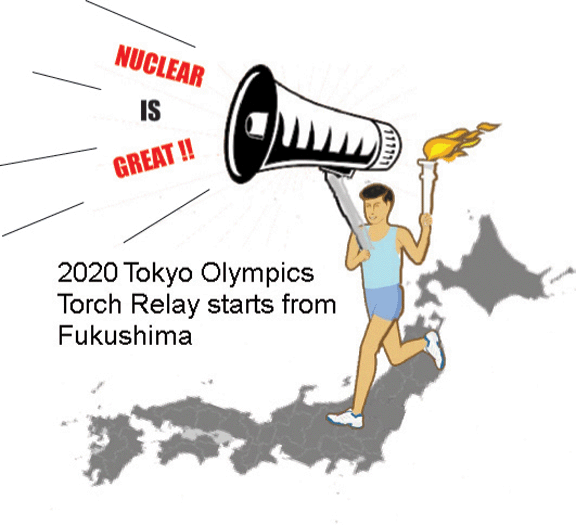
Tokyo Olympic Games torch relay starts, but most Japanese want it cancelled
Tokyo Olympic torch relay begins in Fukushima as Japan tries to boost confidence in the delayed event
ABC, By North Asia correspondent Jake Sturmer and Yumi Asada in Fukushima, 26 Mar 21, “………..Japan remains sceptical of the scandal-ridden Games
Organisers hope this relay — and stories like Reina’s — will shift the mood in favour of the Olympics in Japan.
Opinion polls have consistently shown that a majority of Japanese want the Games postponed or cancelled.
Sexism scandals haven’t helped either.
The president of the Organising Committee, Yoshiro Mori, resigned after saying women talked too much in meetings.
Then the creative director of the opening and closing ceremonies Hiroshi Sasaki resigned after suggesting well-known Japanese comedian Naomi Watanabe could play a role in the ceremonies as an ‘Olympig’…………. https://www.abc.net.au/news/2021-03-25/tokyo-olympics-torch-relay-begins-after-pandemic-delay/100025394
The nuclear weapons issue is a women’s issue
During Women’s History Month, thank women for preventing nuclear disaster (Commentary)https://www.syracuse.com/opinion/2021/03/during-womens-history-month-thank-women-for-preventing-nuclear-disaster-commentary.html 26 Mar 21, By Wendy Yost | Syracuse Peace Council Wendy Yost, of Syracuse, writes on behalf of the Nuclear Free World Committee of the Syracuse Peace Council.
Depending on how old you are, you may remember the 1950s and ’60s “duck and cover” drills in elementary school and signs leading to the atomic bomb shelters in public buildings. Or you may remember the Cuban Missile crisis when the world came dangerously close to nuclear war. Then, and now, most of us probably had or have no true idea of the devastation that such a war would bring.
During Women’s History month, we should thank women for bringing some sanity to the insanity of the Cold War. In 1961 Bella Abzug and Dagmar Wilson founded “Women Strike for Peace.” Their goal was to stop nations from nuclear testing. The movement brought 50,000 women in 60 different cities together in protest. Coretta Scott King served as the organization’s delegate to an international disarmament conference in 1962. The public pressure brought by these women and the near-disaster of the Cuban Missile crisis helped bring the Soviet Union, United Kingdom and U.S. together to sign the Limited Nuclear Test Ban Treaty, prohibiting nuclear testing underwater, in outer space and in the atmosphere in 1963. This marked the beginning of a series of hard-won international agreements that have helped prevent nuclear war since the 1960s.
Bella Abzug framed the nuclear issue as a women’s issue in saying “… We are entitled to our shared economic resources of the country. We are entitled to equal pay for comparable work … We are entitled to have some hope for our family with a decent environment. We are permanently entitled to world peace, which is the only way in which we can rebuild and restructure this society to make it for all people.”
These words ring true for our time. In 2021, women are disproportionately impacted by the pandemic in lost wages and increased responsibilities for childcare, education, and emotional support for stressed kids. While our predominantly male Congress has debated the country’s ability to afford childcare subsidies, extended unemployment benefits, child tax credits and support to reopen schools safely, our government spends approximately $67.5 billion per year on nuclear weapons. At the same time, the world has become less safe from nuclear weapons as international agreements have ended and diplomacy has been hollowed out and denigrated by the Trump administration.
There are hopeful signs as the Biden administration has recommitted efforts to end the nuclear threat by already negotiating an extension of the New START Treaty with Russia, reviving efforts to negotiate with Iran over nuclear weapons, and committing to reduced U.S. expenditures on nuclear weapons of annihilation. Notably, Biden has nominated several women to senior positions that involve nuclear non-proliferation including Bonnie Jenkins as Undersecretary of State for Arms Control and Mallory Stewart as Senior Director for Arms Control and National Non-Proliferation for the National Security Council. These appointments are historic in nature for appointing women to top positions who have spent their careers working for peace, security and nuclear non-proliferation.
Let’s have Women’s History Month in 2021 be a time for women (and men) commit to making history by working for a world that is safe from nuclear weapons and a world where resources are committed to life-affirming programs and policies. This means supporting, expecting and demanding that the new administration meet and exceed its commitments to quell the threat of nuclear war. Visit preventnuclearwar.org and or peacecouncil.net/programs/nuclear-free-world-committee to learn more and take action.
Morrison government seeks greater powers to direct taxpayer funds into gas pipelines — RenewEconomy

Forms to the NAIF, designed to give the Morrison government a greater ability to channel its $5 billion funds into gas infrastructure, pass the lower house. The post Morrison government seeks greater powers to direct taxpayer funds into gas pipelines appeared first on RenewEconomy.
Morrison government seeks greater powers to direct taxpayer funds into gas pipelines — RenewEconomy
Why Australia doesn’t need new baseload to replace old coal — RenewEconomy

As federal parliament prepares to undertake yet another review of Australia’s future energy system needs, experts explain why new baseload is not one of them. The post Why Australia doesn’t need new baseload to replace old coal appeared first on RenewEconomy.
Why Australia doesn’t need new baseload to replace old coal — RenewEconomy
Forcing gas generation into NSW is a loser policy — RenewEconomy

The federal government’s attempts to force new gas generation into NSW is sign of just how badly it’s running energy policy. In truth, there is no real policy. The post Forcing gas generation into NSW is a loser policy appeared first on RenewEconomy.
Forcing gas generation into NSW is a loser policy — RenewEconomy
1 This month
17 October, Free Public Talk on Nuclear Issues in South Australia
David Noonan will speak on public interest concerns over the new Roxby Downs Indenture Act 2026 on BHP copper-uranium mining and ore processing in SA, and on how AUKUS may face SA with a High-Level nuclear waste agenda.
Dr Jim Green will discuss international developments in the field of nuclear power including ‘small modular reactors’ and Generation 4 ‘advanced’ nuclear reactor concepts.


Help Aunty Sue Protect Her Land and Sacred Sites From Destructive Rocket Testing.
.

Australians deserve the truth
about
AUKUS – https://aukuspublicinquiry.com/

PETITION – To: Prime Minister Anthony Albanese and the Australian Labor Government

of the week – Australians for War Powers Reform (AWPR)
To see nuclear-related stories in greater depth and intensity

