‘I was exposed to evil in British nuclear tests’

Kirsteen O’Sullivan & Marcus White, 15 Jan 25, https://www.bbc.com/news/articles/cvgpp5ze28ro?fbclid=IwY2xjawH5E-JleHRuA2FlbQIxMQABHegxfVRLO66gQNKipt3Y5f9BWzRPbu0h6QWkys9CWH2yBTjZhE1YRCwhmA_aem_E7q8FCNDKoWD6DMMToVaoQ
A nuclear test veteran who witnessed the detonation of several British atomic bombs in the 1950s has said he was “exposed to evil”.
Robert James, 87, was an RAF firefighter stationed in Maralinga in Australia, where seven major UK tests took place.
Mr James, from Fordingbridge, Hampshire, said many service personnel had suffered fatal illnesses as a result and he was angry that the UK government had still not offered compensation.
The Ministry of Defence (MoD) said ministers were continuing to discuss issues with families.
Veterans’ campaign groups have said British service personnel were lined up and deliberately exposed to bomb tests to see what effect they would have.
Mr James said many of his comrades had died as a result of cancers and diseases associated with radiation exposure.
He said: “A lot of the guys suffered a lot. There’s lads dying every day… and after having long illness.
“We were exposed to evil, we were exposed to radiation. That’s pretty serious and I think that warrants compensation.
“Not only for people that are surviving like myself but the families that have suffered where their husbands or fathers died.”
In 2019, the Labour Party, then led by Jeremy Corbyn, pledged £50,000 for each surviving British nuclear test veteran.
Sir Keir Starmer met veterans in 2021, before becoming Prime Minister, but made no promises – and the 2019 offer was not in the 2024 manifesto.
However, the current Defence Secretary John Healey posted on his website in 2021: “UK remains the only nuclear power that refuses them recognition or compensation, unlike the US, France, Canada and Australia.”
Mr James said: “Don’t go back on your word, Mr Starmer… You promised us full compensation and recognition. Keep to your word.”
Lack of detail Dutton Launches Much to Do About Nothing campaign

January 17, 2025 John Lord Australian Independent Media
You might remember the relentless scrutiny that Peter Dutton applied during the Voice referendum regarding Labor’s proposal. He would challenge the Prime Minister each day, demanding more specifics when many felt the key points were already apparent. Like Tony Abbott or Donald Trump, Dutton seems poised to adopt a campaign strategy that embraces a lack of detail in the upcoming election. He plans to present broad, sweeping outlines of potential policies and actions he might pursue in office rather than delving into the intricacies and specifics many voters desire.
A prime example of the shortcomings in leadership is Peter Dutton’s vague and often frustrating approach to nuclear policy, which raises more questions than it answers. The most effective leaders possess a vast reservoir of accurate information, readily available for reference at any moment. John Howard exemplified this quality, as did Kim Beazley and Peter Costello. In recent times, however, there have been few who can match this standard. Julia Gillard stood out for her sharp insights, while Kevin Rudd’s exceptionally agile mind distinguished him from his peers. Anthony Albanese, in particular, demonstrates an extraordinary ability to recall even the slightest of details; a skill honed during his tenure as Minister for Infrastructure, where he developed an almost uncanny depth of knowledge.
It is precisely in this area that Peter Dutton is likely to struggle. During the frenetic pace of an election campaign, when rapid-fire questions bombard a candidate at their most vulnerable, his lack of depth in detail will become apparent. In politics, it is always the meticulous attention to detail that can make or break a leader…………………………………………….
Dutton emerged from a long yawn to play catch-up politics on Sunday, 12 January, to launch the Coalition’s unofficial election campaign.
During a 38-minute hastily put-together address at a rally in Melbourne, he depicted the forthcoming election as a pivotal “sliding doors moment” for the future of Australia. At this event, he unveiled the Coalition’s rallying cry, “Let’s get Australia back on track,” which resonated with the audience eager for detail. Alongside this slogan, Dutton introduced a new brochure that detailed twelve key governing priorities designed to steer the country in a different direction. In his speech, he strongly criticised the current Labor government, labelling it one of the most “incompetent governments” Australia has ever seen (after only three years, he had forgotten his own) and described the leadership of Prime Minister Anthony Albanese as among the weakest in the nation’s history……..
So, with little detail, Dutton launched his Much to Do About Nothing campaign.
Michelle Grattan wrote about Dutton’s launch:
“What it wasn’t, though, was detailed. The specifics of what a Dutton government would do, and how it would do it, remain unclear.”…… https://theaimn.net/lack-of-detail-dutton-launches-much-to-do-about-nothing-campaign/
TODAY. The world’s blind eye to the nightmare problem of nuclear waste disposal

January 18, 2025 https://theaimn.net/the-worlds-blind-eye-to-the-nightmare-problem-of-nuclear-waste-disposal/
Now if you were to ask an old-fashioned housewife, to prepare a complicated dinner with strong-smelling crayfish, seafoods and vegetables, , she would probably first make sure that there was a suitable garbage bin at hand.
But that’s not the way that the magnificent men in their nuclear machines thought, about the garbage from their concoctions. The American (pro-nuclear) historian Spencer Weart explains how, in the 1950s:
“the press and the public gave the matter only passing attention, preferring to leave nuclear sanitary engineering to officials. Officials left it to nuclear experts, and most nuclear experts left it alone.”
So, they left it alone for a long time.
The authority on matters nuclear – the Atomic Energy Commission – mentioned atomic wastes as a “cumbersome” problem, – going along with the view that it was not a major issue, and technolological development would solve it in the future. The British Ministry of Supply, in 1949, concluded that nuclear waste dumped into sea was “only slightly radioactive and the amount too small ‘to have any harmful effect on fish or on human life.’
Still, even in 1950, one report in the New York Times – “Atomic ‘Cemetery’ Needed for Waste,” a argued that “some kind of national burying place will be needed for the lethal substances;” and warned of the dangers of dumping atomic wastes into the oceans.- “[i]f fish ate the material, scientists fear it might find its way into food used by humans.”
“Expert” thinking about nuclear waste moved on , in the 1950s, to the idea that it could be beneficial. It could be used to generate electricity. It could have a military use -it could be used to create “a lethal radioactive ‘ line’ along a frontier. behind a river, across a peninsula, that would deny an area to the enemy.” In 1956, Lewis L. “Strauss, the head of the U.S. Atomic Energy Commission said the term ‘atomic waste’ is a misnomer”.
So developed one of the nuclear lobby’s favourite themes over the decades – “Not a Waste, but a Resource”.
However, from 1957 onwards, there was a growing public realisation especially in Europe, that nuclear wastes are dangerous, especially to health, and opposition increased to the dumping of wastes at sea..
It was not until 1993 that nuclear waste dumping at sea was banned, by international treaties – and it’s still not enforced everywhere. So, it has taken the nuclear experts and the various authorities, world-wide, a very long time to take action against the nuclear industry’s most egregious crime against nature
So, where are we today?
Writing in the Bulletin of the Atomic Scientists, “Becoming a responsible ancestor“– Daniel Metlay gives the most comprehensive account of the USA’s policies, and the authorities’ continuing struggles to tackle the Gordian knot of nuclear wastes. And that’s just from the peaceful nuclear power industry.
On the nuclear weapons industry, also in the Bulletin, Cameron Tracy writes on the- Risks of geologic disposal of weapons plutonium.
Apart from the American experience, the media tells us, generally in glowing, optimistic terms, of the progress of super-costly deep underground facilities in Finland, and soon to come, in Sweden and France.

As if the American or “Western” history of nuclear waste were the whole story, we learn little or nothing about nuclear waste management in Russia, China, India, North Korea, South Korea, Japan (except for Fukushima). On the rare occasions when the Western media has mentioned Russia’s nuclear waste history, it is to gloat over what a mess Russia has made of it.
However, the US National Academy of Science and its Russian counterpart met in 1992 , leading to a U.S-Russia pledge in 2000 to reciprocally dispose of 34 metric tons of excess weapons plutonium. It was a complicated co-operative effort which fell apart completely by 2016.
The nuclear waste industry bumbles on, with prospects of profits for waste management companies like Holtec, and of “jobs , jobs’, Jobs”. Is the nuclear behometh just too big to be stopped?
There are two questions about nuclear wastes that are never asked by the “experts”, let alone answered by them:
- Why not stop making more nuclear trash?
- Why do the nuclear-power countries not work together, co-operate, in getting rid of the existing global problem of nuclear trash?
Nukes kill kids
Dr Tony Webb, 17 Jan 25
One moment from my work in the USA in the early 1980s stands out in my memory. I’d driven from Chicago to Cleveland at the invitation of the Health and Safety Officer of the US Boilermakers Union to speak to the members meeting held on the night ahead of the recruitment of members for work on the annual ‘clean-up’ of the local Nuclear Power plant. The hired workers would be ‘radiation sponges’ – short-term casuals recruited for the ‘dirty jobs’ that would result in significant radiation exposures sometimes up to the permitted annual exposure limit and ‘let go’ if they reached that limit. The practice offered some protection to the company’s full -time employees whose skills would be needed on an ongoing basis and whose exposures needed to be kept below the limit. The meeting was well attended , rowdy, with a lot of questions and discussion which spilled over into the carpark after the meeting closed. I noticed one man hanging back from the circle and invited him to join and share his thoughts. As I recall them the essences was:
“I will be going in to apply for work tomorrow. I understand what you shared about the risks . . . no safe level of exposure and chance of getting cancer perhaps 20 years from now . . . It will put a roof over my family’s heads and food on the table . . . BUT my wife and i have had all the family we want. If we hadn’t, what you shared about the genetic risks, the damage to our children and future generations . . . no I wouldn’t be going . . . “
It is a sad fact that workers, both men and women will choose, often from necessity, to put their health at risk from the work environment. What is however consistent in my experience of working on radiation and other occupational health and safety issues is that they are far more concerned, cautious and likely to prioritise safety when it comes to risks to their children.
We now have solid evidence that workers in nuclear power plants routinely exposed to radiation face significantly increased cancer risks, risks of cardiovascular disease including heart attacks and strokes, dementia and potentially other health effects. There is also an increased risk of genetic damage that can be passed on to their children and future generations. But perhaps most significant of all there is now solid evidence of increased rates of leukaemia in children living close to nuclear power plants.
To put it simply and in language that will resonate with workers and their families in the communities around the seven nuclear power plant sites the federal Liberal-National Coalition proposes to build if elected to government; nuclear kills kids. It matters little whether or not these nuclear plants can be built on time, within budget, make a contribution to climate change, reduce electricity prices, or secure a long-term energy future; these nuclear power plants will kill kids who live close by. They cannot operate without routine releases of radioactive material into the environment and our young will be exposed and are particularly susceptible to any exposure that results.
Now add to that if you care that women are more susceptible than men, that workers in these plants face greater exposure and health risks than adults in the community, that nuclear plants have and will continue to have both major accidents and less major ‘incidents’ resulting in radiation releases, community exposures and consequent health damage. Add also that quite apart from the workers and others exposed when these plants need to be decommissioned, the radioactive wastes resulting from perhaps 30-50 years life will need to be safely stored and kept isolated from human contact for many thousands of years longer than our recorded human history. And, again if you care, also add in the concerns around proliferation of nuclear weapons which historically has occurred on the back of, enabled by and sometimes concealed by countries’ developing so called peaceful nuclear power.
All these arguments add weight to the absurdity of Australia starting and the world continuing down this nuclear power path. But if we want a single issue that strikes at the heart of human concerns it is this – and forgive me saying it again, it needs to be repeated many times until the electorate in Australia hears it loud and clear – Nuclear Kills Kids
Submarine nuclear core project faces ‘challenges’
The Core Production Capability programme, tasked with delivering safe
nuclear reactor cores for the UK’s submarine fleet, remains under pressure
as highlighted in the latest Infrastructure and Projects Authority (IPA)
Annual Report.
Maintaining its Red rating, the programme faces critical
challenges in achieving key milestones crucial to sustaining the Continuous
At Sea Deterrent (CASD). According to the report, the programme is
fundamental to providing the Royal Navy with the capability to propel the
Dreadnought-class submarines and a “modern, safe, and sovereign
capability to manufacture further cores” for a future fleet of attack
submarines.
This capability is also essential for fulfilling the UK’s
commitments under the AUKUS defence partnership.
UK Defence Journal 17th Jan 2025 https://ukdefencejournal.org.uk/submarine-nuclear-core-project-faces-challenges/
Lack of detail Dutton Launches Much to Do About Nothing campaign
January 17, 2025 John Lord, AIM,
You might remember the relentless scrutiny that Peter Dutton applied during the Voice referendum regarding Labor’s proposal. He would challenge the Prime Minister each day, demanding more specifics when many felt the key points were already apparent. Like Tony Abbott or Donald Trump, Dutton seems poised to adopt a campaign strategy that embraces a lack of detail in the upcoming election. He plans to present broad, sweeping outlines of potential policies and actions he might pursue in office rather than delving into the intricacies and specifics many voters desire.
A prime example of the shortcomings in leadership is Peter Dutton’s vague and often frustrating approach to nuclear policy, which raises more questions than it answers. The most effective leaders possess a vast reservoir of accurate information, readily available for reference at any moment. John Howard exemplified this quality, as did Kim Beazley and Peter Costello. In recent times, however, there have been few who can match this standard. Julia Gillard stood out for her sharp insights, while Kevin Rudd’s exceptionally agile mind distinguished him from his peers. Anthony Albanese, in particular, demonstrates an extraordinary ability to recall even the slightest of details; a skill honed during his tenure as Minister for Infrastructure, where he developed an almost uncanny depth of knowledge.
It is precisely in this area that Peter Dutton is likely to struggle. During the frenetic pace of an election campaign, when rapid-fire questions bombard a candidate at their most vulnerable, his lack of depth in detail will become apparent. In politics, it is always the meticulous attention to detail that can make or break a leader.
Albanese hit the road running soon after the Christmas dinner table had been cleared and the crockery put away………………………………………………………………………….
Dutton by contrast
Dutton emerged from a long yawn to play catch-up politics on Sunday, 12 January, to launch the Coalition’s unofficial election campaign.
During a 38-minute hastily put-together address at a rally in Melbourne, he depicted the forthcoming election as a pivotal “sliding doors moment” for the future of Australia. At this event, he unveiled the Coalition’s rallying cry, “Let’s get Australia back on track,” which resonated with the audience eager for detail……………………………………..
The Coalition’s slogan will compete with Albanese’s “Building Australia’s future,” which he promoted during his recent campaign in Queensland, the Northern Territory, and Western Australia.
So, with little detail, Dutton launched his Much to Do About Nothing campaign………………………. https://theaimn.net/lack-of-detail-dutton-launches-much-to-do-about-nothing-campaign/
Dutton’s new nuclear nightmare: construction costs continue to explode
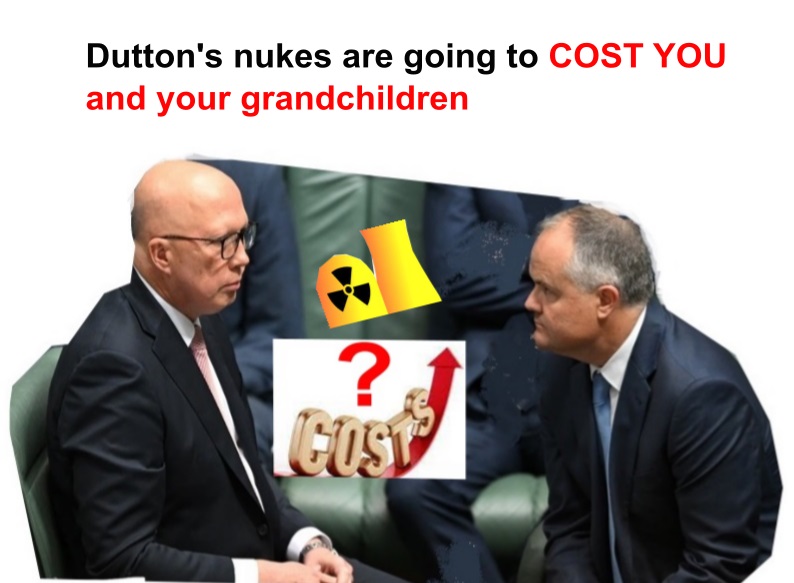
The latest massive cost blowout at a planned power station in the UK demonstrates the absurdity of Peter Dutton’s claims about nuclear power in Australia.
Bernard Keane and Glenn Dyer. 16 Jan 25, https://www.crikey.com.au/2025/01/16/peter-dutton-nuclear-power-construction-costs/?utm_campaign=daily&utm_medium=email&utm_source=newsletter
Peter Dutton’s back-of-the-envelope nuclear power plan has suffered another major hit, with new reports showing the expected cost of the newest planned UK nuclear power plant surging so much its builder has been told to bring in new investors.
The planned Sizewell C nuclear plant in Suffolk, to be built by French nuclear giant EDF in cooperation with the UK government, was costed at £20 billion in 2020. According to the Financial Times, the cost is now expected to double to £40 billion, or $79 billion.
The dramatic increase in costs is based on EDF’s experience with Hinkley Point C, currently being built in Somerset, which was supposed to commence operations this year but will not start until at least 2029. It was initially costed at £18 billion but is now expected to cost up to £46bn, or $90 billion.
So dramatic are the cost blowouts that EDF and the UK government have been searching, with limited success, for other investors to join them in funding Sizewell.
Meanwhile across the Channel, France’s national audit body has warned that the task of building six new nuclear reactors in France — similar in scale to Peter Dutton’s vague plan for seven reactors of various kinds around Australia — is not currently achievable.
The French government announced the plan in 2022, based on France’s long-established nuclear power industry and its state-owned nuclear power multinational EDF, with an initial estimate of €51.7 billion. That was revised up to €67.4 billion ($112 billion) in 2023. It is still unclear how the project will be financed, with little commercial interest prompting the French government to consider an interest-free loan to EDF.
The cour de comptes also noted the “mediocre profitability” of EDF’s notorious Flamanville nuclear plant, which began producing electricity last year a decade late and 300% over budget. It warned EDF’s exposure to Hinckley was so risky that it should sell part of its stake to other investors before embarking on the construction program for French reactors. The entire program was at risk of failure due to financial problems, the auditors said.
That France, where nuclear power has operated for nearly 70 years, and where EDF operates 18 nuclear power plants, is struggling to fund a program of a similar scale to that proposed by Dutton illustrates the vast credibility gap — one mostly unexplored by a supine mainstream media — attaching to Dutton’s claims that Australia, without an extant nuclear power industry, could construct reactors inside a decade for $263 billion. Based on the European experience — Western countries that are democratic and have independent courts and the rule of law, rather than tinpot sheikhdoms like the United Arab Emirates — the number is patently absurd.
Backed by nonsensical apples-and-oranges modelling by a Liberal-linked consulting firm that even right-wing economists kicked down, the Coalition’s nuclear shambles is bad policy advanced in bad faith by people with no interest in having their ideas tested against the evidence. The evidence from overseas is that nuclear power plants run decades over schedule and suffer budget blowouts in the tens of billions — and that’s in countries with established nuclear power industries and which don’t suffer the kind of routine 20%+ infrastructure cost blowouts incurred by building even simple roads and bridges in Australia.
But good luck finding any of that out from Australian journalists.
Peter Dutton’s “always on” nuclear power is about as reliable as wind and solar – during a renewables drought

France’s nuclear fleet has particularly struggled in recent years. According to the World Nuclear Industry Status Report, its 55 reactors were subject to outages lasting between five days and a year in 2023 and only one reactor, Saint Alban-2, produced all year round.
Renew Economy, Royce Kurmelovs, Jan 14, 2025
One of Peter Dutton’s key selling points for nuclear power, its “always on” reliable generation of electricity, has been put to the test in a new analysis, which found that a fleet of modern nuclear plants is, on balance, about as reliable as a fleet of wind and solar farms – if those wind and solar farms were in the midst of a very bad renewable energy drought.
The analysis by David Osmond, a senior wind engineer who runs weekly simulations of Australia’s main electricity grid, compared outages experienced by solar and wind during renewables droughts – known as “dunkelflaute” – to outages in nuclear energy generators.
For the renewable energy side of the equation, Osmond draws on Griffith University modelling of 42 years of synthetic wind and solar data quantifying the risk of renewable energy droughts to Australia’s future energy supply.
The nuclear side of the equation is based on Osmond’s own analysis of seven years of daily nuclear fleet data since 2018 from European countries with four or more reactors.
Noting there has been more investigation into renewable droughts and the reliability of solar and wind in Australia than nuclear, Osmond sought to examine the “worst case scenario” for nuclear – periods with simultaneous issues with multiple reactors.
Using fleet data grouping outage periods into peak and off-peak months, Osmond found that during its “worst week” in any month, nuclear experienced a reduction to 8% to 70% of average output, and 44% to 77% in peak months – comparable to the “worst week” experienced by renewable energy over the modelled 42 years.
Nuclear isn’t 100% reliable,” Osmond writes on BlueSky. “Multiple outages can occur simultaneously, even during peak demand months.
“Analysis of European nuclear data suggests weekly fleet output during peak season can drop below 60% of average levels. This is comparable to the effect of a bad renewable drought on wind+solar generation in Australia.”
Osmond says that when it comes to wind and solar, the data shows “the worst week for wind and solar is likely to be about 50 percent of the long-term average” making the two technologies roughly comparable.
“I found for the countries that I studied, most of the nuclear outages in the last eight years of data I looked at was equivalent to a renewable drought in Australia,” Osmond said.
“When I looked at the data for nuclear, the worst week for nuclear in peak season, for most countries, seemed to be about 60 percent of average.”…………………………………………………………
Nuclear outages can occur either on a schedule where maintenance needs to be carried out, or may be “forced” either through the discovery of a problem, a technical fault, an emergency or an external factor that knocks one or several reactors offline, sometimes simultaneously.
Some reactors like Finland’s new Olkiluoto 3 – a reactor that took 18 years to build and forced its French developer to be bailed out – have experienced technical faults that have periodically sent it offline. And According to Professor M.V. Ramana, a physicist from the University of British Columbia and author of the book Nuclear is Not the Solution, says that nuclear plants are also vulnerable to climate impacts.
“Nuclear plant operations are being challenged by hurricanes, forest fires – things of that sort,” Professor Ramana says. “But that trend has not led to as dramatic declines in power capacity as was the case in France.”
In August 2022 a combination of drought and heatwaves forced half the reactors offline as the water in rivers warmed to the point where it could not be used for reactor cooling.
“Nuclear plans will need an external source of water for cooling,” Professor Ramana says. “The challenge is much more for nuclear power plants that are inland where they have to rely on lakes or rivers, where the temperature can go up much more in summer.
“And that’s what we’re seeing in the case of countries like France and Western Europe in general. Even the French authorities expect that this problem is going to get worse, so they are making plans for that.”
France’s nuclear fleet has particularly struggled in recent years. According to the World Nuclear Industry Status Report, its 55 reactors were subject to outages lasting between five days and a year in 2023 and only one reactor, Saint Alban-2, produced all year round.
The report found that on any given day, at least 11 units were offline across all of France with the highest number of reactors shut down on the same day reaching 28. When it came to partial days offline, 19 or more units were offline for least part of the day for 252 days, or 69% of the year.
Though nuclear has a higher capacity factor – the ratio of energy output over a given time – than solar and wind, Osmond says much of the discussion of nuclear in Australia has falsely assumed it is 100% reliable.
These assumptions will skew any modelling, he says, as they do not account for what it takes to manage the variability of both technologies.
“If you want a solution that doesn’t rely on gas, you can overbuild renewables,” Osmond said. “If you build renewables to cover twice your annual needs, that means even on your worst year, you’ll have enough generation.”
“Likewise, if you wanted to rely entirely on nuclear you’d need to overbuild your nuclear so that if you have multiple simultaneous outages, you can make sure you’ll have enough power during those occasions or where power is extreme.”
“Of course having 50% overbuild of nuclear is far more expensive than 100% overbuilding of renewables.” https://reneweconomy.com.au/peter-duttons-always-on-nuclear-power-is-about-as-reliable-as-wind-and-solar-during-a-renewables-drought/
Destroyed Assange Files: Why Judge’s Rebuke Against Crown Prosecution Service Was So Significant.

“This is a significant victory in a long battle to get the truth out on the involvement of CPS in keeping Julian in arbitrary detention that later turned into political imprisonment, according to UN bodies and the Parliamentary Assembly of the Council of Europe.”
An unknown number of emails were apparently deleted after one of the U.K.’s lead prosecutor in the case, Paul Close, retired from the CPS. The deletions occurred despite the fact that the case against the award-winning journalist and publisher of the news and transparency website WikiLeaks was still active.
the dissenter, Mohamed Elmaazi, 14 Jan 2025,
A British judge issued an unusually critical rebuke against the Crown Prosecution Service of England and Wales.
A British judge issued an unusually critical rebuke against the Crown Prosecution Service of England and Wales (CPS) for its handling of freedom of information requests related to Sweden’s failed attempt to extradite WikiLeaks founder Julian Assange.
The decision by the United Kingdom’s information rights tribunal was made public on January 10. It followed an appeal by Italian investigative journalist Stefania Maurizi, who argued that the CPS failed in its duty to properly explain why a senior prosecutor’s emails were allegedly deleted or destroyed.
In writing the decision for the three-member tribunal, First-Tier Tribunal (FTT) Judge Penrose Foss pierced the veil of deference that is often shown to governmental bodies in England and Wales by the U.K.’s data protection regulator, the Information Commissioner’s Office (ICO). Foss was quite blunt in her criticism of the CPS’s handling of multiple Freedom of Information Act (FOIA) requests that Maurizi had submitted as early as 2015.
It is uncommon for the CPS to be a respondent in FOIA appeals. A review of FTT decisions regarding information rights cases since 2009 shows the CPS as a respondent in 16 out of 3,167 cases (0.5 percent). This includes two appeals filed by Maurizi.
The decision establishes a precedent that may make it easier for future FOIA requests to be successful in the long run, according to Estelle Dehon KC of London’s Cornerstone Barristers, who represented Maurizi.
When the information rights tribunal comes across instances of a public authority’s failure to comply with FOIA obligations it “has been known to be quite trenchant in its criticism,” Dehon, told The Dissenter. But it is “unusual in the run of cases that are specific to Stefania’s FOIA requests” for the tribunal to be as critical as it was last week, she added.
“What we can do now is say to the ICO, look at the quality of the search process [conducted by a public body when a FOIA request is made]. If the search process was poor, then that is an indication that the information is being, or might be, held despite the public authority’s claims to the contrary,” Dehon said.
Kristinn Hrafnsson, WikiLeaks’ editor-in-chief, told The Dissenter, “This is a significant victory in a long battle to get the truth out on the involvement of CPS in keeping Julian in arbitrary detention that later turned into political imprisonment, according to UN bodies and the Parliamentary Assembly of the Council of Europe.”
The tribunal ordered the CPS to confirm whether it holds information as to “when, how and why” it destroyed or deleted any “hard or electronic copies of emails” with the Swedish Prosecution Authority by February 21 at 4 p.m. If they have any such information they must provide it to Maurizi or otherwise explain why they are exempt from doing so.
‘Unfounded’ Assumptions Prevented Adequate Search For Records
“Overall, based on the evidence before us, our concern is that over a number of years the CPS has not properly addressed itself at least to recording, if not undertaking, adequate searches in relation to the CPS lawyer’s emails, with the result that, in 2023, when it has purported to answer [Maurizi’s] 2019 [FOIA] Request, it has not been able to give a clear and complete account,” the Tribunal stated in its decision.
The tribunal noted that the CPS’s approach “appears to have been informed by a combination of unfounded and incorrect assumptions or speculation, flawed corporate memory, and unreliable anecdotal instruction, much, but not all, of that resting inevitably in the natural succession of employees through the organisation over time.”
“The cumulative effect of those things, taken together with what we find to be (1) imprecisely worded questions and a failure to drill down into answers, and (2) the absence of any clear and complete audit trail of enquiries and responses at each stage, has very likely prevented adequate searches and has certainly prevented a full and satisfactory account of matters.”
An unknown number of emails were apparently deleted after one of the U.K.’s lead prosecutor in the case, Paul Close, retired from the CPS. The deletions occurred despite the fact that the case against the award-winning journalist and publisher of the news and transparency website WikiLeaks was still active.
…………………………………………………………………….. Taking Aim At the UK’s Data Protection Regulator
The tribunal was quite critical of the ICO for its willingness to accept that every reasonable step had been taken by the prosecution to search for the information Maurizi requested.
…………………………………………………………………. The tribunal found that claims made by the government were contradictory and lacking in evidence to support them and even found “no evidence as to what searches were undertaken” in relation to Maurizi’s earlier FOIA requests.
……………………………………….The tribunal’s decision represents the latest victory for Maurizi who has filed multiple FOIA requests and appeals over the U.K. and Swedish governments’ handling of Assange’s extradition case. Dehon summarized the decision succinctly, “The tribunal concluded the CPS likely still holds some information explaining what took place. Hopefully that will finally be disclosed.”
“So far we have learned that the CPS overstepped and dictated how the Swedish prosecutor’s office handled the case with the obvious intent to keep Julian in limbo and maintain for years his unlawful detention,” Hrafnsson said. “The world needs to know who dictated CPS staff to handle the case in this manner both inside the U.K. establishment at its initiative and with input from other governments. It is unacceptable that government files in the U.K. are disappeared in an effort to hide the truth from the public.”
Hrafnsson believes that the missing files, or “at least their fate,” will ultimately “shed light on the real story behind the political persecution of Julian Assange.”
………………………………………………………………………………………. more https://thedissenter.org/destroyed-assange-files-why-judges-rebuke-against-crown-prosecution-service-was-so-significant/
Virginia, we have a problem

14 Jan 2025, |Peter Briggs, https://www.aspistrategist.org.au/virginia-we-have-a-problem/
Australia’s plan to acquire Virginia-class submarines from the United State is looking increasingly improbable. The US building program is slipping too badly.
This heightens the need for Australia to begin looking at other options, including acquiring Suffren-class nuclear attack submarines (SSNs) from France.
The Covid-19 pandemic dramatically disrupted work at the two shipyards that build Virginias, General Dynamics Electric Boat at Groton, Connecticut, and Huntington Ingalls Industries’ yard at Newport News, Virginia. It badly hindered output at many companies in the supply chain, too. With too few workers, the industry has built up a backlog, and yards are filling with incomplete submarines.
Within six years, the US must decide whether to proceed with sale of the first of at least three and possibly five Virginias to Australia, a boat that will be transferred from the US Navy’s fleet.
Nine months before the transfer goes ahead, the president of the day must certify that it will not diminish USN undersea capability. This certification is unlikely if the industry has not by then cleared its backlog and achieved a production rate of 2.3 a year—the long-term building rate of two a year for the USN plus about one every three years to cover Australia’s requirement.
The chance of meeting that condition is vanishingly small.
The situation in the shipyards is stark. The industry laid down only one SSN in 2021. It delivered none from April 2020 to May 2022. The USN has requested funding for only one Virginia in fiscal year 2025, breaking the two-a-year drumbeat, ‘due to limits on Navy’s budget topline and the growing Virginia class production backlog’.
As of January 2025, five of 10 Block IV Virginias ordered are in the yards, as are five of 12 Block Vs for which acquisition has been announced. (Work has not begun on the other seven Block Vs.)
The building time from laying down until delivery has increased from between 3 and 3.5 years before the pandemic to more than 5 years. The tempo is still slowing: the next Virginia, USS Iowa, is due to be delivered on 5 April 2025, 5.8 years after it was laid down.
On the original, pre-pandemic schedule, all the Block IVs could probably have been delivered to the USN by now. This is a gap that cannot be recovered in a few years, despite all the expensive manpower training and retention programs in hand.
Exacerbating the problem for the yards, the Block V submarines are 30 percent larger, and more complex to build, making a return to shorter build times unlikely. Speaking to their shareholders in October, the chief executives of Huntington Ingalls and General Dynamics blamed their slowing delivery tempo on supply chain and workforce issues. HII says it is renegotiating contracts for 17 Block IV and Block V Virginias.
Furthermore, Electric Boat has diverted its most experienced workers to avoid further slippage in building the first two ballistic missile submarines of the Columbia class, the USN’s highest priority shipbuilding program, in which the Newport News yard also participates.
It gets worse. Many USN SSNs that have joined the US fleet over the past few decades are unavailable for service, awaiting maintenance. The pandemic similarly disrupted shipyards that maintain the SSNs of the Los Angeles and Virginia classes. In September 2022, 18 of the 50 SSNs in commission were awaiting maintenance. The Congressional Budget Office reports lack of spending on spare parts is also forcing cannibalisation and impacting the availability of Virginia class SSNs.
Australia’s SSN plan must worsen the US’s challenge in recovering from this situation, adding to the congestion in shipyards and further over loading supply chains already struggling to deliver SSNs to the USN.
A US decision not to sell SSNs to Australia is inevitable, and on current planning we will have no stopgap to cover withdrawal of our six diesel submarines of the Collins class, the oldest of which has already served for 28 years.
In the end, Australia’s unwise reliance on the US will have weakened the combined capability of the alliance. And Australia’s independent capacity for deterrence will be weakened, too.
As I wrote in December, it is time to look for another solution. One is ordering SSNs of the French Suffren class. The design is in production, with three of six planned boats delivered. It is optimised for anti-submarine warfare, with good anti-surface, land-strike, special-forces and mining capability. It is a smaller design, less capable than the Virginia, but should be cheaper and is a better fit for Australia’s requirements.
Importantly, it requires only half the crew of a Virginia, and we should be able to afford and crew the minimum viable force of 12 SSNs.
Let’s build on the good progress in training, industry and facility preparations for supporting US and British SSNs in Australia, all of which should continue, and find a way to add to the alliance’s overall submarine capability, not reduce it.
AUKUS: Flawed and Sinking

January 13, 2025 Dr Binoy Kampmark, https://theaimn.net/aukus-flawed-and-sinking/
A stillborn agreement treated as thrivingly alive; an understanding celebrated as consensual and equal. The AUKUS security arrangement between Australia, the United Kingdom and the United States, envisaging the transfer and building of nuclear-powered submarines to the Royal Australian Navy, continues operating in haphazard fashion. So far, the stream has flown away from Australia and into the military industrial complexes of the UK and the US, both desperate to keep the production of these absurd boats steady.
Australia has yet to see the fabled white elephants of the sea and remain at the mercy of the US Congress. In the meantime, the country is becoming garrisoned, billeted and appropriated to Washington’s geopolitical vanities. Not being a natural enemy and adversary in any sense, and being the most lucrative trading partner, China has become a fantastically idiotic target for Canberra’s foreign policy dunces.Announced in September 2021 as “an enhanced trilateral security partnership,” AUKUS has hobbled and stuttered its way into 2025. Commentary from the pompom holders for war at such outlets as The Economist continue with such mild remarks as “ambitious but expensive”. The Australian, armed and eager to do battle in print and digital media against the Yellow Peril, features an article about feeding the military industrial complex by politely calling it “a defence revolution.”
19FortyFive fastens onto the idea that Australia’s naval modernisation is central in this endeavour, though never mentions the obvious beneficiary. (In two words: not Australia.) “Nevertheless, AUKUS allows for a broader integration of technological advances in its partners and much-needed modernization of the Australian navy.”
This optimistic glow, despite the limping, the delays, and the blunders, can also be found in Australian Defence. The military industrial complex never needs concrete reasons to exist. It’s a creature onto itself. “Global firms are partnering with Australian based entities in a bid to position themselves for lucrative AUKUS submarine contracts, despite law reforms needed to progress.” One of them is the Texas-based Fluor Corporation, an engineering and construction firm proud, in the words of its Australia & New Zealand president, Gillian Cagney, of its “thousand engineers who have nuclear capability.” Cagney, like most chiefs and CEOs in this line of work, is good at saying nothing about nothing in particular. When doing so, the language can be guaranteed a good mauling. “We have that experience and capability that we will be supporting the joint venture to bring to bear and making sure we’re bringing the best in class globally.”
Even then, Cagney concedes that the whole business of nuclear-powered submarines for the RAN, known in military planning circles as “Pillar One”, is dicey. Hardly a reason to panic, as this tortured statement testifies: “One of the things as Worley Fluor Australia we are able to do is in multiple sectors globally is to ramp up to meet our customers needs so it’s no different.”
From the United States Studies Centre, that comfortable, uncritical bastion of Pax Americana, a senior research associate, Alice Nason, is found telling France’s Libération that hiccups are bound to take place when the tasks are large. “In a project of this size, length and complexity of AUKUS, it’s no surprise that disruptions and delays are going to arise.” The truism here is intended to excuse the unpardonable. Why projects of such scale are ever needed is left dangling in ether.
These dreary excuses for justifications dressed up as analysis never hide the fundamental defect of AUKUS. It remains, almost entirely, governed by US domestic and foreign interests. It says almost nothing about Australia’s needs, merely speaking to confected Australian fears. It advances the agenda of insecurity, not security. The analysts, lined up from one row to another, cannot assure anybody about what Congress will do if the submarine supply quota lags, or if there will be a war over that strip of territory known as Taiwan.
No publication, however lovingly disposed to the business of war, can avoid the teasing worries. Even that pro-Washington, and US defence industry funded outlet based in Canberra, the Australian Strategic Policy Institute, has gone so far as to consider a heresy. In December, it ran an article by Peter Briggs, past president of the Submarine Institute of Australia, suggesting that Canberra consider acquiring “at least 12 submarines of the French Suffren design. The current AUKUS plan for eight nuclear-powered attack submarines (SSNs) has always been flawed, and now its risks are piling up.” And so we return to where we began: a Franco-Australian agreement to acquire submarines that was sunk in 2021 by Prime Minister Scott Morrison.
All in all, forget the submarines, Pillar One, or whatever pillar the strategists tie themselves in knots about. Focus, instead, on the second “pillar”. Australia has become captive – aided through its dim bulbed representatives – of an empire that fears growing old, haggard and weak. It has been enlisted as servitor, grounds keeper and nurse. Retirees from the US Navy are being given astronomical sums in consultancy fees to divulge wisdom they do not have on junkets Down Under. Think tankers from Australia purporting to be academics make similar trips to Washington to celebrate a failing agreement with treasonous delight. The price Australia is paying is already savagely burdensome. It may well, in the long run, prove worse.
Leaked polling shows regional support for renewables.
Colin Packham, January 14th, 2025, https://www.theaustralian.com.au/business/mining-energy/leaked-polling-shows-regional-support-for-renewables/news-story/aeba90ecc98aaa1f39698cfdaa237459
Leaked polling commissioned by renewables industry body The Clean Energy Council has found regional voters support renewable energy rather than nuclear power due to concerns about environmental impacts and the promise of economic opportunities from large-scale wind and solar projects.
Should the polling — seen by The Australian but not yet released publicly — be accurate, it indicates the Coalition has just months to reverse the sentiment ahead of an election where the opposition hopes to sway voters with its centrepiece strategy of building seven nuclear power stations.
A record number of Australians are struggling to pay their utility bills, a situation the Coalition hopes will result in a friendly swing to it when voters return to the polls. But, the research by Freshwater Strategy — a widely respected polling firm — shows regional voters remain concerned about nuclear energy despite also holding misgivings about renewables.
The poll showed regional respondents believed renewables would deliver larger benefits for them than metropolitan voters, as the transition sees a spree of new jobs and offers of financial sweeteners.
Both regional and metropolitan voters said they believed nuclear power is environmentally damaging, a stance which fuelled their broad concern about the fuel source.
The concern over nuclear power was sharper with Labor and Greens voters. Voters who identified as Coalition voters had a far weaker commitment to renewables than Greens voters.
Such a sentiment would aid the Coalition in cementing its standing with its core voter base, but the polling also found those yet to make up their minds about voting intentions had a favourable view on renewables.
These swing voters strongly believed renewables would lower power bills, the polling found.
The Coalition has insisted nuclear will lower power bills and remains the only feasible way Australia is going to meet its net zero emissions by 2050 commitment.
Recent polling shows the Coalition ahead in a two-party preferred vote as years of high inflation and 13 interest rate rises has led to simmering anger among voters.
The federal Labor government hopes for some reprieve from the Reserve Bank of Australia via an interest rate cut or two by May. Labor must return to the polls by May and the market has in recent weeks ramped up bets of a loosening of fiscal policy at the central bank’s meeting in February.
Labor hopes its re-election prospects will be bolstered and has committed Australia to a rapid transition away from coal. Labor has cemented its plan to have renewables generate 82 per cent of the country’s electricity by 2030 — a commitment which requires significant amounts of new wind, solar and batteries.
Some 100,000km of high voltage transmission lines will also need to be built by 2050 if Australia is to meet net-zero emissions targets, which threatens to cause significant upheaval to regional communities.
States and territories have steadily increased their financial compensation offers to affected communities but pockets of opposition remain.
Federal Energy Minister Chris Bowen continues to insist Australia will meet its 2030 targets, though independent figures have said the timetable is increasingly unlikely.
Colin Packham Colin Packham is the energy reporter at The Australian. He was previously at The Australian Financial Review and Reuters in Sydney and Canberra.
Nuclear radiation took her father’s eyesight. Now Karina’s fighting Dutton’s nuclear reactors
TV Channel 9 Jan 11, 2025, The Morning Edition podcast
When opposition leader Peter Dutton proposed nuclear energy reactors on almost every mainland state in June last year, he reignited divisive public debate. It’s a debate Indigenous Australians are unwillingly at the heart of. A story that starts in the 1950s, when radioactive fallout from bomb tests caused illness among Aboriginal communities that were not adequately protected by the government of the day. Today, audio producer Julia Carr-Catzel brings us a special edition of The Morning Edition on the resistance in Aboriginal communities to a potential nuclear energy industry in Australia. Aboriginal and Torres Strait Islander listeners are advised that this podcast contains names of people who have died.
Amazon Is Censoring My Most Recent Magazine Issue
Caitlin Johnstone Jan 14, 2025
Without explanation Amazon has blocked and unpublished my last issue of JOHNSTONE magazine which features my painting of Luigi Mangione on the cover. The link to order it is now dead. When I asked for an explanation or appeal they just sent a template response referring me back to their publishing rules.
So that’s annoying. The pay-what-you-want ebook of the issue is still available for anyone who wants it.
❖
In her bid to secure her confirmation as Trump’s next Director of National Intelligence, Tulsi Gabbard is now pledging to support Section 702 of the FISA Act. This notorious law allows for the warrantless surveillance of Americans, and in congress Gabbard had previously fought to repeal it.
This is how the national security state works. You don’t change the machine, the machine changes you. Anyone who starts off opposing the imperial status quo of authoritarianism, warmongering and corruption either finds themselves excluded from the halls of power or adapts new positions in favor of the status quo.
The Australian political-media class has been rending its garments over a ridiculously fake incident of antisemitic graffiti at a synagogue in Sydney, which features both swastikas and the words “Free Palestine” right next to each other.
It’s weird how few people I see calling this what it so obviously is. Apparently we’re all supposed to take very seriously the idea that either (A) Nazis are spray painting the words “Free Palestine” next to their swastikas, or (B) that supporters of Palestinian rights are spray painting Nazi symbols next to their pro-Palestinian slogans. Apparently we’re all truly expected to pretend we don’t know some Israel supporter did this themselves to provide political cover for the genocide in Gaza.
It is always okay to express skepticism about dubious incidents of “antisemitism” in today’s political environment. Israel’s supporters are shitty, evil people who support genocide, and faking antisemitic incidents is a standard hasbara tactic with a well-documented history…………………………………… https://www.caitlinjohnst.one/p/amazon-is-censoring-my-most-recent?utm_source=post-email-title&publication_id=82124&post_id=154758013&utm_campaign=email-post-title&isFreemail=true&r=1ise1&triedRedirect=true&utm_medium=email
❖
Critical Archival Encounters and the Evolving Historiography of the Dismissal of the Whitlam Government (Part 6
By AIMN Editorial on January 12, 2025, By Jenny Hocking Continued from Part 5
The Lost Archive: Government House Guest Books
In 2010, I first requested access to the Government House guest books held by the Archives, which provide the details of visits and visitors to “their Excellencies” at Yarralumla. The catalogue lists a total of twenty-nine files, enumerated consecutively, constituting visitor books from May 1953 to February 1996. The guest books appear regularly from July 1961 until July 1974, before stopping altogether until December 1982.
The Archives insisted that the guest books for this period had never been transferred from Government House and they now appeared lost since neither institution claimed to hold them. What is puzzling in this regard is that Archives’ enumeration system, which numbers each file consecutively, has two consecutive numbers assigned yet not included in the catalogue corresponding to the missing dates, suggesting two missing files given identification numbers by the Archives which are no longer listed.
. The only other gap in these books, for a much shorter period between 1960 and 1961, has no such missing consecutive numbers in the catalogue which might accommodate a lost file…………………………………………………………………………………………
These missing guest books add fuel to the longstanding speculation that security and defence officials, notably the Chief Defence Scientist Dr John Farrands as the recognised authority on Pine Gap and the Joint Facilities, had briefed Kerr in the week before the dismissal about mounting security and defence concerns over Whitlam’s exposure of CIA agents working at Pine Gap, and his planned Prime Ministerial statement on this in the House of Representatives on the afternoon of 11 November 1975. …………………
The Burnt Archive: Sir John Kerr’s Prominent Supporters
In 1978, soon after Kerr left office, a cache of letters “of outstanding value” to Kerr was accidentally reduced to ashes in the Yarralumla incinerator……………….
Among his correspondents was the Queen’s second cousin, Lord Louis Mountbatten, Prince Philip’s uncle and King Charles III’s great mentor; the former Governor-General and distant royal relation, Viscount De L’Isle; and other prominent individuals supporting Kerr’s dismissal of Whitlam. These names alone indicate that these burnt letters were as important to history as they were to Kerr. …………..
…………… We now know, thanks to letters released in 2020 following the High Court’s decision in my legal action, that King Charles also fully supported Kerr’s actions…………………………..
Until their release in 2020 following the High Court’s decision in the Palace letters case they constituted the most significant “unattainable archive” in the dismissal panoply of secrets. The release of the letters signalled a rare moment of forced archival transparency in the face of determined refusals of access, and the harbinger of a significant historical re-evaluation of the dismissal in which they played a pivotal role.
What is critical for this discussion is that the closures of these otherwise public archives, both the Mountbatten papers and the Palace letters, were enabled by and remained hidden because of a claimed “convention” of Royal secrecy………………………………………………..
And so, this was how Kerr had labelled his letters to and from the Queen, as they had always been labelled, as “personal”. The only way to challenge the denial of access to personal records was to take a Federal Court action, a daunting and lengthy process. In 2016, with the support of a pro bono legal team, I commenced proceedings against the National Archives of Australia in the Federal Court, arguing that these Palace letters were not personal and should be publicly available, and seeking their release.
Four years and three court hearings later, the High Court found in a 6:1 decision that the Palace letters are not personal, leading to their release in full. …………………………………………………………………………………………………………………………..
A more complete history of the dismissal has emerged in fragments, still marred by partisan recollection, misplaced archives, and continuing secrecy. First, that Kerr was in secret contact with Fraser before he dismissed Whitlam; second, the definitive role of High Court justice Sir Anthony Mason, and finally, only in the last decade has the extent of royal involvement in Kerr’s decision become clear………………………………………….more https://theaimn.net/critical-archival-encounters-and-the-evolving-historiography-of-the-dismissal-of-the-whitlam-government-part
1 This month
Chernobyl: The Lost Tapes – A good documentary on Chernobyl on SBS available On Demand for the next 3 weeks– https://www.sbs.com.au/ondemand/tv-program/chernobyl-the-lost-tapes/2352741955560
15 April – Zoom –Nuclear Power is Not the Solution
Apr 15, 2026 01:00 AM in Canberra, Melbourne, Sydney

Join the International Physicians for the Prevention of Nuclear War (IPPNW) on Tuesday, April 14th for a timely webinar exploring the risks associated with nuclear power and challenging the myth that it offers a simple, safe, carbon-free solution to the climate crisis

21 April Webinar: No Nuclear Weapons in Australia
Start: 2026-04-21 18:00:00 UTC Canberra, Melbourne, Sydney (GMT+10:00)
End: 2026-04-21 19:30:00 UTC Canberra, Melbourne, Sydney (GMT+10:00)
Event Type: Virtual
A virtual link will be communicated before the event.
Host Contact Info: australia@icanw.org

of the week – Australians for War Powers Reform (AWPR)
To see nuclear-related stories in greater depth and intensity
 Antinuclear