Legacy of Maralinga bomb tests -a reminder of need for safety in matters nuclear
 Sixty years on, the Maralinga bomb tests remind us not to put security over safety, The Conversation Liz Tynan, Senior Lecturer and Co-ordinator Research Student Academic Support, James Cook University September 26, 2016 It is September 27, 1956. At a dusty site called One Tree, in the northern reaches of the 3,200-square-kilometre Maralinga atomic weapons test range in outback South Australia, the winds have finally died down and the countdown begins……….
The count reaches its finale – three… two… one… FLASH! – and all present turn their backs. When given the order to turn back again, they see an awesome, rising fireball. Then Maralinga’s first mushroom cloud begins to bloom over the plain – by October the following year, there will have been six more.
RAF and RAAF aircraft prepare to fly through the billowing cloud to gather samples. The cloud rises much higher than predicted and, despite the delay, the winds are still unsuitable for atmospheric nuclear testing. The radioactive cloud heads due east, towards populated areas on Australia’s east coast.
Power struggle
While Australia was preparing to sign the Maralinga agreement, the supply minister, Howard Beale, wrote in a top-secret 1954 cabinet document:
The British carried out two clean-up operations – Operation Hercules in 1964 and Operation Brumby in 1967 – both of which made the contamination problems worse.
Legacy of damage
The damage done to Indigenous people in the vicinity of all three test sites is immeasurable and included displacement, injury and death. Service personnel from several countries, but particularly Britain and Australia, also suffered – not least because of their continuing fight for the slightest recognition of the dangers they faced. Many of the injuries and deaths allegedly caused by the British tests have not been formally linked to the operation, a source of ongoing distress for those involved.
Decades later, we still don’t know the full extent of the effects suffered by service personnel and local communities. Despite years of legal wrangling, those communities’ suffering has never been properly recognised or compensated.
Why did Australia allow it to happen? The answer is that Britain asserted its nuclear colonialism just as an anglophile prime minister took power in Australia, and after the United States made nuclear weapons research collaboration with other nations illegal, barring further joint weapons development with the UK. …..Six decades later, those atomic weapons tests still cast their shadow across Australia’s landscape. They stand as testament to the dangers of government decisions made without close scrutiny, and as a reminder – at a time when leaders are once again preoccupied with international security – not to let it happen again. https://theconversation.com/sixty-years-on-the-maralinga-bomb-tests-remind-us-not-to-put-security-over-safety-62441?fbclid=IwAR3-AXJA_-RZTlr1AW6qxgcFRPuOX5IIi163L75vLWXFyIOcZGKxbet5DDE
The American election- what will the nuclear order look like after this?
 THE U.S. ELECTION AND NUCLEAR ORDER IN THE POST-PANDEMIC
  WORLD Limitless Life, LEON V. SIGAL, SEPTEMBER 29 2020Abstract
U.S. power and prestige may have diminished in recent years, but the United States still plays a pivotal role in international institutions, alliances, and mass media, so who becomes its president and which party controls Congress matter a lot for the global nuclear order. However unlikely it is that Donald Trump’s expressed desire to contest the election’s outcome could succeed, whether the nation can avert a violent backlash among disappointed partisans is less clear.
Nuclear weapons are often thought to be the esoteric domain of experts. Yet one need only recall that although mass activism does not guarantee policy change, three of the most significant developments in recent decades – the ban on above-ground nuclear tests, the INF
Treaty, and the collapse of the Berlin Wall – would not have happened without mass protests in many countries. And citizen involvement, organized by NGOs, can even facilitate monitoring of arms agreements and nuclear developments in some countries.
positive change to the global nuclear order will continue to be marginal and fitful. This makes the international milieu critical for the nuclear future – a milieu that a president can influence but not determine.
President Trump’s reelection is likely to have a pernicious effect on that milieu, hindering international cooperation to limit nuclear weapons and accelerating a qualitative arms race that could endanger crisis stability. Yet two of Trump’s more positive impulses are likely to continue. He is unlikely to increase the risk of an intense crisis leading to nuclear war because he wants to avoid U.S. involvement in any wars, not start new ones. He will also try to sustain negotiations
with North Korea to curb nuclear developments there, though whether he is prepared to satisfy Pyongyang’s stiffer demands remains in doubt.
His opponent, Joseph Biden, will face those same demands. Personnel is policy, and the Biden administration will likely be staffed with officials who served under President Obama. That means a return to shoring up alliances and international cooperation. It also means continuity with Obama’s nuclear policies. Whether he will curtail Obama’s modernization plans is not clear, but in contrast to Trump, he will try his best to restore the JCPOA, which could head off nuclear
weapons development not only in Iran but also in Saudi Arabia. He will also strive to save START, seek technical talks with China, and not abandon the Open Skies accord……….. https://wordpress.com/read/feeds/2663585/posts/2938659215
China’s zero emissions target is contrasted with Australia’s inaction on global heating
China’s escalation is also set to have implications for Australia’s diplomatic position in the Pacific, where it has been attempting to manage China’s rising influence among some of its closest neighbours.
“From both sides of Parliament Australian politicians aren’t understanding it, they approach climate change like it’s just another issue for our Pacific counterparts. What Australian politicians 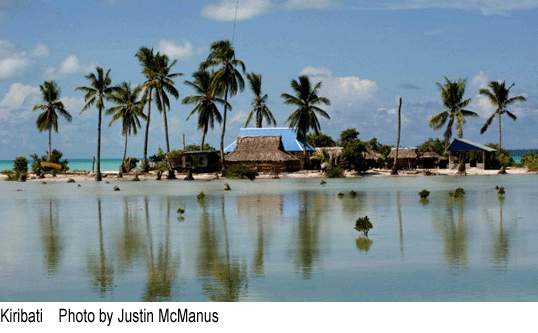 do often miss is this issue is personal,” said Professor Bamsey.
“It concerns Pacific politicians when they get out of bed, they can see the changes to the future of their country when they look out the window.”
China’s zero emissions target puts Australia on notice, The Age, By Eryk Bagshaw and Mike Foley, September 30, 2020 — Australia’s former top climate diplomat has warned China’s net-zero emissions target will leave Australia behind, threatening future trade deals and its influence in the Pacific as the Morrison government becomes wedged between the US and China on climate action.
Howard Bamsey, who was Australia’s special envoy on climate change during the Rudd government, said the announcement from President Xi Jinping last week had turned the politics of emissions reduction into a sharp economic and diplomatic issue.
Professor Bamsey, who was also Australia’s ambassador for the environment under the Howard government, said the new policy “pulls the rug out from under the argument” that Australia’s domestic climate goals do not need to accelerate because China was yet to increase its ambitions.
“It’s clear now China is accepting a leadership role,” he said. “Xi made the announcement. That carries all the weight of the state and party.”
The coronavirus has forced this year’s United Nations Glasgow Climate Change Conference to be rescheduled to November 2021, turning Australia’s international emissions obligations into a major election flashpoint. The earliest month a federal election can be held is August 2021 and voters are expected to go to the polls by the end of next year.
China, which is simultaneously the world’s largest polluter and biggest producer of renewable energy, pledged to go carbon neutral by 2060 at the UN General Assembly last week………… Continue reading
Why green hydrogen could be cheaper than fossil fuels in just a few years — RenewEconomy

Cheap and abundant solar means Australia ‘perfectly placed’ to lead global renewable hydrogen industry, with prices below fossil fuels within reach. The post Why green hydrogen could be cheaper than fossil fuels in just a few years appeared first on RenewEconomy.
Why green hydrogen could be cheaper than fossil fuels in just a few years — RenewEconomy
Seasonal energy storage is a tricky issue for our renewable future — RenewEconomy

As battery and pumped hydro developers try to figure out the storage equation for Australia’s grid, there is still not enough focus on demand management. The post Seasonal energy storage is a tricky issue for our renewable future appeared first on RenewEconomy.
Seasonal energy storage is a tricky issue for our renewable future — RenewEconomy
Cannon-Brookes says Hornsdale battery proof that technology change will be rapid — RenewEconomy

Billionaire Mike Cannon-Brookes issues fresh plea to governments to not underestimate the pace of change in clean energy technologies. The post Cannon-Brookes says Hornsdale battery proof that technology change will be rapid appeared first on RenewEconomy.
Cannon-Brookes says Hornsdale battery proof that technology change will be rapid — RenewEconomy
A rapid Chinese energy transition is far more feasible than you think — RenewEconomy

China’s goal is to hit net zero emissions by the year 2060, which means an incredible, deep shift in just a few decades. The post A rapid Chinese energy transition is far more feasible than you think appeared first on RenewEconomy.
A rapid Chinese energy transition is far more feasible than you think — RenewEconomy
September 30 Energy News — geoharvey

Science and Technology: ¶ “Two-Fifths Of Plants At Risk Of Extinction, Says Report” • Two-fifths of the world’s plants are at risk of extinction, scientists have warned. Researchers say they are racing against time to name and describe new species, before they disappear. Plants hold huge promise as medicines, fuels and foods, says a report […]
September 30 Energy News — geoharvey
Turnbull says gas is “bonkers”, Australia may have to face frontier carbon taxes — RenewEconomy

Turnbull says there is no such thing as cheap gas on the east coast of Australia, because of the cost of getting it out of the ground. The post Turnbull says gas is “bonkers”, Australia may have to face frontier carbon taxes appeared first on RenewEconomy.
Turnbull says gas is “bonkers”, Australia may have to face frontier carbon taxes — RenewEconomy
“Australia is not an exception:” Gummer slams climate go-slow in Canberra — RenewEconomy

Former UK climate minister John Gummer says Australian politicians still haven’t accepted that climate change is happening and that they have a responsibility to act. The post “Australia is not an exception:” Gummer slams climate go-slow in Canberra appeared first on RenewEconomy.
“Australia is not an exception:” Gummer slams climate go-slow in Canberra — RenewEconomy
Bringing clean energy to regional Victorian communities — RenewEconomy

The Victorian Government is helping local businesses use more renewable energy technologies that reduce electricity costs, create jobs and support clean power. The post Bringing clean energy to regional Victorian communities appeared first on RenewEconomy.
Bringing clean energy to regional Victorian communities — RenewEconomy
Plans revealed for two new big solar farms in South Australia — RenewEconomy

S.A-based Green Gold Energy reveals plans for two new solar farms totalling more than 300MW in south east region of state. The post Plans revealed for two new big solar farms in South Australia appeared first on RenewEconomy.
Plans revealed for two new big solar farms in South Australia — RenewEconomy
Morrison government refuses to sign leaders’ pledge on biodiversity
|
Scott Morrison declined as 10-point plan calls for commitments considered inconsistent with government policy, Guardian Lisa Cox 28 Sept 20, The Morrison government has said it refused to sign a global pledge endorsed by 64 countries committing them to reverse biodiversity loss because it was inconsistent with Australia’s policies. Emmanuel Macron, Angela Merkel, Justin Trudeau, Jacinda Ardern and Boris Johnson are among world leaders who signed the Leaders’ pledge for nature which was launched on Monday ahead of a major UN summit on biodiversity being hosted virtually from New York. The summit is working towards a Paris-style global agreement on nature. The federal government was invited to sign but refused because the 10-point plan calls for commitments that are inconsistent with Australian policy – including a greater ambition to reduce greenhouse gas pollution and reach net zero emissions by 2050…….. Apart from Australia, other countries that didn’t sign the pledge include the United States, Brazil, China, Russia and India. The pledge warns humanity is in a state of “planetary emergency” due to the intertwined crises of biodiversity loss, ecosystem degradation and climate change. It states that the decline of the natural world is accelerating at an unprecedented rate. “Nature fundamentally underpins human health, wellbeing and prosperity,” the pledge states. “We need to appropriately value nature and the services it provides as we make decisions and recognise that the business case for biodiversity is compelling.” Australia was recently singled out for mammal extinction in a UN report that found the world had failed to meet a single target to slow the loss of the natural world and preserve land and marine ecosystems. The pledge promises a stronger global effort to reduce deforestation, halt unsustainable fishing practices, eliminate environmentally harmful subsidies and begin the transition to sustainable food production systems and a circular economy during the next decade. Leaders promised to ensure “biodiversity, climate and the environment as a whole” were at the heart of responses to the economic crisis brought on by the Covid-19 pandemic. “Against the backdrop of Covid-19, which has crippled the world’s economies and pressured governments everywhere to begin the process of rebuilding and renewing, decisions made now will have ramifications for all of us and for generations to come,” the pledge states. Labor’s environment spokeswoman, Terri Butler, said the prime minister, Scott Morrison, should explain why Australia would not commit to a stronger effort to protect wildlife. “Australia is in the midst of an extinction crisis, 3 billion animals have died or were displaced by last summer’s bushfires and 12m hectares of land burnt . But the Morrison government doesn’t think we have a problem,” Butler said. The Greens environment spokeswoman, senator Sarah Hanson-Young, said a global target on extinction, similar to the Paris target, was necessary to stem the rapid loss of biodiversity. She said Australia was “squandering an opportunity” to take a leading role after the bushfire crisis, which accelerated the loss of habitat and wildlife and has forced the government to consider new threatened listings for iconic species, including the koala. “Our biodiversity is under significant threat and with it our tourism industry and local economy,” Hanson-Young said. “Australia’s lack of commitment at this summit is shameful and ultimately will be bad for our economy, as well as our environment.”…….. https://www.theguardian.com/environment/2020/sep/29/australia-joins-us-china-and-russia-in-refusing-to-sign-leaders-pledge-on-biodiversity |
|

Exposed! Extinction Rebellion fact checks pro-nuclear front groups

XR reveal climate-denying behind pro-nuclear front groups
Exposed! — Beyond Nuclear International
Extinction Rebellion fact checks pro-nuclear front groups https://wordpress.com/read/feeds/72759838/posts/2936415505 Beyond Nuclear International, 28 Sept 20,
The following is a statement from Extinction Rebellion, UK, in light of misrepresentations of their movement by a former team member now working for a pro-nuclear front group. It alleges that Environmental Progress, its new employee, Zion Lights, its founder, Michael Shellenberger, and the group’s predecessor, Breakthrough Institute (still operating as well) have ties to big corporations and to climate denial.There have been a number of stories in the press in the last few weeks with criticisms about Extinction Rebellion by Zion Lights, UK director of the pro-nuclear lobby group Environmental Progress. It appears that Lights is engaged in a deliberate PR campaign to discredit Extinction Rebellion.
For any editors who might be considering platforming Lights, we would like to make you aware of some information about the organisation she works for and her employer, Michael Shellenberger.
ENVIRONMENTAL PROGRESS & MICHAEL SHELLENBERGER
Environmental Progress is a pro-nuclear energy lobby group. While the group itself was only established in 2016, its backers and affiliates have a long and well-documented history of denying human-caused climate change and/or attempting to delay action on the climate crisis. A quick look at groups currently promoting Zion Lights through their social media channels include climate deniers and industry lobbyists such as The Global Warming Policy Foundation and the Genetic Literacy Project (formerly funded by Monsanto).*
The founder of Environmental Progress, Michael Shellenberger, has a record of spreading misinformation around climate change and using marketing techniques to distort the narrative around climate science. He has a reputation for downplaying the severity of the climate crisis and promoting aggressive economic growth and green technocapitalist solutions.
Shellenberger appeared on the Tucker Carlson Show on Fox News just last week to say that the forest fires currently raging in California are due to “more people and more electrical wires that they’ve failed to maintain because we’ve focused on other things like building renewables” and we’ve been “so focused on renewables, so focused on climate change.”
In his recent book Apocalypse Never: Why Environmental Alarmism Hurts us All, Shellenberger argues that there are no limits to growth and that environmental problems can be solved by everyone getting richer. The book has been widely criticised by many respected scientists both for its central premise and its misunderstanding, misinterpretation and misuse of the facts. (See here and here.)
His stance on fundamental and vitally important points of scientific consensus around the climate crisis is flat out wrong. In his essay promoting his book published in June of this year on the Environmental Progress website and The Australian – ‘On behalf of environmentalists, I apologise for the climate scare’ – he claims that “climate change is not making natural disasters worse” and that “Humans are not causing a ‘sixth mass extinction”. He also argues that “fires have declined 25% around the world since 2003,” and, “The build-up of wood fuel and more houses near forests, not climate change, explain why there are more, and more dangerous, fires in Australia and California.” These claims contradict reports from the IPCC and misrepresent the discussion taking place in the scientific community.
One science advisor with Environmental Progress, respected MIT climate expert Professor Kerry Emanuel, spoke publicly about being “very concerned” about the essay, and felt unsure whether he would remain involved with the organisation.
The article was published in Forbes, before being pulled offline the same day for violating its code of ethics around self-promotion.
A key tactic from the climate delayer playbook used in the essay is that of the repentant environmentalist, according to investigative journalist, Paul Thacker. After gaining credibility by aligning themselves with a section of the environmental movement, the repentant environmentalist then performs a volte face and attacks their former position.
This tactic has also been used by Zion Lights, who first overstated her role within Extinction Rebellion (she was a member of the media team, not ‘co-lead’ as stated on the Environmental Progress website) and then denounced the movement following an apparent change of heart.
BREAKTHROUGH INSTITUTE
Shellenberger is co-founder of the Breakthrough Institute, a lobbying group masquerading as a “think tank”. The Breakthrough Institute has “a clear history as a contrarian outlet for information on climate change [which] regularly criticises environmental groups”, according to Paul Thacker. Breakthrough has also been described as a “program for hippie-punching your way to fame and fortune.”
Shellenberger co-founded the Breakthrough Institute with Ted Nordhaus, nephew of economist, William Nordhuas. William Nordhaus features in Merchants of Doubt – Naomi Oreskes and Erik Conway’s examination of the PR strategies used both by the tobacco and fossil fuel industries. His interventions in the 1990s helped set back essential action on climate change by decades.
Other figures associated with Shellenberger and the Breakthrough Institute include:
Owen Paterson, one of the UK’s most prominent climate deniers who helped with the UK launch of the group’s Ecomodernist manifesto in 2015.- Matt Ridley, coal mine owner, once hereditary Conservative Peer and famous climate delayer / ‘lukewarmist’ who spoke at the UK launch event. Continue reading



The danger of a catastrophic war against China – or Iran, or Russia
 Provocation on the High Seas: U.S. Naval Adventures Near the Shores of Russia, China and Iranby https://www.counterpunch.org/2020/09/25/provocation-on-the-high-seas-u-s-naval-adventures-near-the-shores-of-russia-china-and-iran/?fbclid=IwAR3aA7GT52EdGN66LcYfQzrWYby-J9MqmSRI9xaU0gz7TyVLcRXJMa9z6GM EVE OTTENBERG The war on terror is slowly ending. The U.S. military will try to keep bases in Iraq and Afghanistan, but with most troops gone in the next few years, the lives of the few who remain will be at constant risk. Pressure will mount to get those soldiers out. But Pentagon bureaucrats and brass are masters of institutional infighting, and, apparently, ignoring presidential orders they don’t like, so who knows how that will turn out? One thing is sure: the military’s focus has shifted, from the Middle East to Russia and China. That means U.S. soldiers and materiel will continue to be in places they shouldn’t, in ever greater numbers, namely the Black Sea and the South China Sea. Provocation on the High Seas: U.S. Naval Adventures Near the Shores of Russia, China and Iranby https://www.counterpunch.org/2020/09/25/provocation-on-the-high-seas-u-s-naval-adventures-near-the-shores-of-russia-china-and-iran/?fbclid=IwAR3aA7GT52EdGN66LcYfQzrWYby-J9MqmSRI9xaU0gz7TyVLcRXJMa9z6GM EVE OTTENBERG The war on terror is slowly ending. The U.S. military will try to keep bases in Iraq and Afghanistan, but with most troops gone in the next few years, the lives of the few who remain will be at constant risk. Pressure will mount to get those soldiers out. But Pentagon bureaucrats and brass are masters of institutional infighting, and, apparently, ignoring presidential orders they don’t like, so who knows how that will turn out? One thing is sure: the military’s focus has shifted, from the Middle East to Russia and China. That means U.S. soldiers and materiel will continue to be in places they shouldn’t, in ever greater numbers, namely the Black Sea and the South China Sea.
Lest you fear that peace might break out in the Middle East, there’s always the possibility of a U.S. assault on Iran. That chance greatly increased with the Trump regime’s monumental blunder of smashing the Iran nuclear treaty. Trump clearly thought his high-handed rejection would cow the Iranians. He was wrong. In an apparent rage, he ratcheted up sanctions, threats, insults and then – an assassination, the logical conclusion of which was war, had Trump not come to his senses. Since then things have cooled down a bit, though not enough to stop the Trump regime from interfering with Iran’s oil trade with Venezuela or from making preposterous accusations about Iranian plots against the U.S. ambassador to South Africa, an official with no relation to Iran, known mostly for her business in expensive handbags and for donating to Trump. What the idiotically bellicose U.S. policy toward Iran – including the recent U.S. push for more sanctions – has mainly achieved is a warm embrace between Iran and China. And that’s not a matter susceptible to piracy on the high seas – the preferred U.S. approach to tankers taking Iranian fuel to Caracas. Nor will wild charges about planned assassinations of obscure, random U.S. bureaucrats affect this relationship. The Trump regime has blustered, threatened, insulted and caused the great Iran-China friendship to sink deep roots and blossom. Lest you fear that peace might break out in the Middle East, there’s always the possibility of a U.S. assault on Iran. That chance greatly increased with the Trump regime’s monumental blunder of smashing the Iran nuclear treaty. Trump clearly thought his high-handed rejection would cow the Iranians. He was wrong. In an apparent rage, he ratcheted up sanctions, threats, insults and then – an assassination, the logical conclusion of which was war, had Trump not come to his senses. Since then things have cooled down a bit, though not enough to stop the Trump regime from interfering with Iran’s oil trade with Venezuela or from making preposterous accusations about Iranian plots against the U.S. ambassador to South Africa, an official with no relation to Iran, known mostly for her business in expensive handbags and for donating to Trump.
What the idiotically bellicose U.S. policy toward Iran – including the recent U.S. push for more sanctions – has mainly achieved is a warm embrace between Iran and China. And that’s not a matter susceptible to piracy on the high seas – the preferred U.S. approach to tankers taking Iranian fuel to Caracas. Nor will wild charges about planned assassinations of obscure, random U.S. bureaucrats affect this relationship. The Trump regime has blustered, threatened, insulted and caused the great Iran-China friendship to sink deep roots and blossom. It probably would have anyway, but Trump surely deserves credit for nourishing it. As Time reported on July 29, Iran is negotiating a 25-year deal with China, with “billions of dollars worth of Chinese investments in energy, transportation, banking and cybersecurity in Iran.” There also could be “weapons development and intelligence sharing and joint military drills.” In short, this $400 billion deal is huge and alarm bells are ringing frantically in Washington. They shouldn’t be. If the Trump regime had been paying attention, they would have seen this coming, because it’s the logical outcome of their absurd hostility to both countries. But then, cultural illiteracy regarding Iran is a feature of Republican policy in the Middle East. After all, the Bush regime invaded, conquered and destroyed Iraq – war crimes whose main beneficiary was Iran, which had no love, to say the least, for Saddam Hussein and was more than happy to cement its brotherhood with newly ascendant Iraqi Shia. This is the sort of stuff any high schooler could have alerted the Bush regime to in advance. But alas, the GOP’s geopolitical geniuses had no use for even high school wisdom. To ensure we all got that point, the Trump regime quickly pounced on one of Obama’s few decent and intelligent moves in the Middle East – the Iran nuclear treaty – and shredded it. Still, the U.S. military’s focus has shifted. That shift started with Obama’s odious “pivot to China.” According to Chinese State Councilor Wang Yi, quoted by Russia Today, U.S. intervention in the South China Sea is “the main driver of militarization there.” Currently several countries in the region claim territory in the South China Sea – China, Vietnam, Malaysia, the Philippines, Indonesia and Brunei. Some of these claims overlap, thus causing disputes, RT reports. The U.S. stirs the pot with its “freedom of navigation” military patrols. Naturally this intervention has led to incidents between the Chinese and U.S. militaries. And worse could happen any time. China regards the South China Sea as its backyard and the U.S. presence there as a provocation. After all, how would Washington react to Chinese military patrols in the Gulf of Mexico? That is the territorial equivalent of what the U.S. does to China, though Washington refuses to recognize this in its quest for global dominance. It’s the same with U.S. aggression in the Black Sea, where the target is Russia. In August, the U.S. held military drills in the Black Sea, known, in the not too distant past, as the shores of Russia. Earlier, Andrei Krasov of the State Duma Defense Committee told the Interfax agency: “The actions of American reconnaissance aircraft will not remain without reaction.” Indeed, in late July, Russia reported intercepting an American reconnaissance flight over the Black Sea. Two much of this sort of stuff could lead to war. So what we have here is the U.S. fishing in troubled waters. NATO has already nearly surrounded Russia, which now boasts supersonic nuclear weapons. In response, Trump recently revealed that the U.S. has some sort of secret “super” weapon. Which only makes the Black Sea brinksmanship more dangerous. Both adversaries are armed to the teeth. To make matters worse, Trump has ripped up all nuclear treaties with Russia except START – and that is at death’s door. A war with either Russia, China or Iran would be catastrophic, as anyone with a brain knows. Nor would it solve any of the myriad disasters currently besetting the U.S.: an out-of-control pandemic, with more fatalities than any other country in the world and no end in sight; economic collapse, with tens of millions jobless and millions facing eviction and homelessness in a few months; a climate taking revenge on fossil fuel capitalism by burning up large swaths of the globe, including the American West Coast; other human-induced, climate change, extreme weather events elsewhere in the U.S., like the currently soggy Gulf Coast; the rise of violent, over-armed, know-nothing, radical right-wing vigilantes; racial unrest. And those are just the big, obvious monster weeds in the American front yard. Washington should take a page from Voltaire and tend its own garden. Forget about the Black Sea, the South China Sea and the Gulf of Oman. Now is not the time for new conflict. Because as every school child knows, never is the only time for nuclear war. |
|
1 This month


Help Aunty Sue Protect Her Land and Sacred Sites From Destructive Rocket Testing.
.

Australians deserve the truth
about
AUKUS – https://aukuspublicinquiry.com/

PETITION – To: Prime Minister Anthony Albanese and the Australian Labor Government

of the week – Australians for War Powers Reform (AWPR)
To see nuclear-related stories in greater depth and intensity

