Nuclear energy inquiry draws emotional response in Port Augusta

By Annabel Francis and Arj Ganesan, ABC North and West SA, 7 Dec 24
In short:
The select committee conducting an inquiry into nuclear power generation in Australia has triggered strong opinions from both sides of the fence.
Aboriginal leaders, resident representatives, and leaders from the mining and energy sector have spoken during a hearing at Port Augusta.
What’s next?
Should the opposition win the next election, it has promised to hold a two-and-a-half year consultation period over its nuclear plans.
The federal government’s select committee inquiry into nuclear power generation at Port Augusta has stirred strong emotions among those making a submission.
For anti-nuclear activist and Yankunytjatjara Anangu woman Karina Lester, it is a debate she is tired of having.
“Governments change, committee members change … organisations, company members, CEOs of companies change,” Ms Lester said.
“Those of us that are in the frontline are constantly needing to remind governments of the impacts of nuclear in our communities.
“Aboriginal people of South Australia have always said no to nuclear.”
Ms Lester, who gave evidence at a select committee hearing in Adelaide, describes herself as a survivor of the Emu Field nuclear tests.
She said Indigenous people had seen the impacts of nuclear technology first-hand.
Her father, Yami Lester, went blind at the age of 16 following British weapons testing in Maralinga in South Australia in the 1950s.
Ms Lester said she feared Indigenous groups would suffer if the federal opposition’s nuclear plans went ahead.
“Aboriginal communities are always the solution or pressured to be the solution for the waste issues,” she said.
“The history shows us that locations identified are locations that are First Nations or Aboriginal people’s traditional lands.”
Port Augusta’s former coal power station was one of seven sites that was earmarked as a possible location for the opposition’s nuclear energy plan.
The Nukunu Wapma Thura Aboriginal Corporation, which holds native title over the proposed site, has voiced strong opposition to any nuclear proposal.
“Aboriginal people throughout the region and state of South Australia have historically and overwhelmingly opposed nuclear energy, and the storage of its waste,” a spokesperson said.
Greg Bannon from the Flinders Local Action Group gave evidence at the public hearing in Port Augusta about the potential risk of a nuclear accident.
He has opposed nuclear technology for decades and said the time to switch to nuclear energy had passed. “I think it’s old technology, and I don’t think we need it,” he said.
Mr Bannon said any accident or error would not only have a devastating impact on the local community but also on vulnerable marine ecologies, such as the giant Australian cuttlefish that aggregates about 50 kilometres away from Port Augusta……………………………https://www.abc.net.au/news/2024-12-06/nuclear-energy-hearing-emotional-port-augusta/104694596
Baseload power generators not needed to guarantee supply, say science and engineering academies
Sören Amelang, Dec 5, 2024 https://reneweconomy.com.au/baseload-power-generators-not-needed-to-guarantee-supply-say-science-and-engineering-academies/
An energy system dominated by solar and wind energy does not require baseload power stations to guarantee supply security, German research academies have said.
“The academy project ‘Energy Systems of the Future’ (ESYS) has concluded that a secure energy supply is also possible without baseload power plants,” said the National Academy of Science and Engineering (acatech), the German National Academy of Sciences (Leopoldina), and the Union of the German Academies of Sciences and Humanities.
Baseload power plants supply electricity continuously, whereas so-called residual load plants run only intermittently when needed.
“A combination of solar and wind energy with storage, a flexible hydrogen system, flexible electricity demand and residual load power plants will be necessary for a climate-friendly and reliable electricity supply,” the academies said.
The German government plans to use hydrogen-fuelled gas turbine plants to back up its renewables-based future electricity system.
The researchers modelled the potential of four baseload technologies: nuclear power plants, geothermal energy, natural gas power plants with CO2 capture, and nuclear fusion power plants.
Their results showed that baseload plants could become part of future energy systems if they save costs – a scenario the scientists consider unlikely. Baseload plants’ greatest impact on the overall system is that their surplus electricity could be used to run electrolysers, which would turn electricity into hydrogen, they said.
“For baseload power plants to lead to a substantial cost reduction, their costs would have to fall significantly below the level forecast today,” said Karen Pittel, who heads the ifo Institute’s Center for Energy, Climate and Resources, and is also deputy chair of the ESYS board of directors.
“In fact, we estimate that the risks of cost increases and delays in baseload technologies tend to be even higher than with the further expansion of solar and wind energy.”
Nuclear energy debate draws stark gender split in Australia ahead of next year’s election.
Lisa Cox, 5 Dec 24, https://www.theguardian.com/environment/2024/dec/04/nuclear-energy-debate-draws-stark-gender-split-in-australia-ahead-of-next-years-election
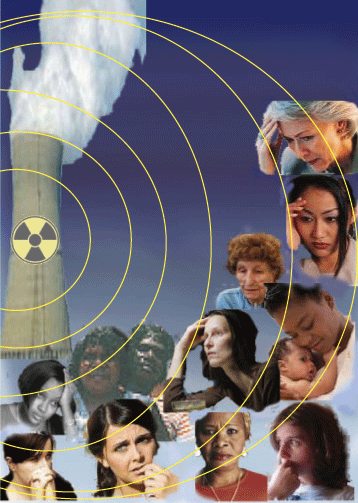
Survey finds 25 percentage point gender gap across all age brackets on whether nuclear power would be positive for the country, with majority of men saying it would.
New data points to a stark gender split in attitudes towards nuclear energy, with women much more likely to say they don’t support it or think the risks are too great.
Research company DemosAu surveyed 6,000 people on behalf of the Australian Conservation Foundation and found 26% of women thought nuclear energy would be good for Australia, compared with 51% of men.
DemosAu head of research, George Hasanakos, said the 25 percentage point gender gap was “the sharpest divide in attitudes between men and women” that the research firm had seen on any issue.
The polling found the split was pronounced regardless of the age of the people surveyed, with young men and women just as divided as those from older generations.
While 51% of men agreed nuclear energy would be good for Australia, that support dropped when asked if they would be happy to live near a nuclear plant.
A reported 38% of men agreed they would support a nuclear plant being located close to their city, with 44% disagreeing and 18% neutral. Among women, just 18% agreed they would be happy to have a nuclear plant near their city, with 63% disagreeing and 19% neutral.
“Men support nuclear much more than women,” the ACF chief executive, Kelly O’Shanassy, said.
“But as soon as you ask men more details such as ‘Would you be happy to live next door to a plant?’ or ‘Do you think one will be built within the next decade?’ – that level of support really comes down.”
The report found female respondents were more likely to answer “neutral” compared with male respondents. It identified this as both “a risk and opportunity for campaigners on both sides of the issue” as Australia approaches a federal election but said pro-nuclear campaigners would have to contend with widely held safety concerns about nuclear among women.
On the subject of transporting nuclear waste, the poll found 57% of women and 43% of men said it wasn’t worth the risk.
The prime minister, Anthony Albanese, has said the next election will be a referendum on nuclear power.
The Coalition has proposed seven sites where it says it would eventually replace coal-fired power plants with nuclear plants but not how much this would cost. The government has rejected the idea and the federal House of Representatives is conducting an inquiry into the consideration of nuclear power in Australia.
Multiple energy analysts have argued nuclear energy would be more expensive than other options and a nuclear industry would not be possible in Australia until after 2040.
O’Shanassy said among the report’s more interesting findings was that despite the gender gap on many aspects of nuclear, men and women were aligned in the view that renewables were cheaper.
A reported 47% of men agreed renewables would deliver cheaper energy, compared with 31% who disagreed (with 22% neutral).
While 47% of women also agreed renewables would deliver cheaper energy, 20% disagreed and 33% were neutral.
In separate data, the climate advocacy organisation 1 Million Women surveyed an additional 3,351 women among its own supporters and found 93% were concerned about nuclear.
“Nuclear energy is a distraction to meaningful climate solutions and women don’t have the time or patience to entertain the Coalition’s proposal,” its founder, Natalie Isaacs, said.
Peter Dutton cops backlash over push to build seven nuclear power stations in Australia

Opposition wants nuclear power plants over Anthony Albanese’s renewables
Daily Mail 4th Dec 2024, By BRETT LACKEY FOR DAILY MAIL AUSTRALIA
Aussies have hit back at plans to build nuclear power stations in the country as the Coalition ramps up its push to establish seven sites as part of its election promise.
Parliament’s House Select Committee on Nuclear Energy is investigating the proposal and is travelling around the country hearing views from local communities.
At a meeting in Traralgon in Victoria’s Gippsland region on Tuesday angry locals fired up at the plan, which would see one of the new nuclear plants built at the currently winding down Loy Yang coal plant just 10 minutes out of town.
The other six locations Peter Dutton has outlined for nuclear plants are at the coal plant sites of Tarong and Callide in Queensland, Liddell and Mount Piper in NSW, Port Augusta in SA and Muja in WA.
‘We do not need nuclear in Australia. We need to be pushing more renewable energy and the technology will develop more and more as we go to keep the lights on,’ president of community group Voices of the Valley, Wendy Farmer, told the meeting.
Shadow energy minister Ted O’Brien, also the committee’s deputy chair, asked if it was ‘just a no’ from Ms Farmer or if she was interested in studying whether nuclear could be a safe and effective form of electricity.
‘The Coalition have told us that they would consult with us for two and a half years but then they would go ahead with nuclear, whether we wanted it or not and our community would have no rights of veto,’ Ms Farmer fired back.
‘How can we trust the Coalition to have an independent study when you say proposal but where’s the proposal?’
Darren McCubbin, the CEO of Gippsland Climate Change Network, got a standing ovation when he told the meeting renewables were ‘ready to go’ while nuclear power stations would require years of consultations and reports.
‘I’d like to congratulate Mr O’Brien for recognising that we don’t have the science, that we need a work plan, that we need two and a half years of consultation,’ Mr McCubbin said.
‘Good on him for coming here and saying we don’t know the answers and we need to find them because they don’t have the answers.’
Mr McCubbin pointed to the 2GW of Victorian offshore wind power projects slated to be online by 2032, which would increase to 5GW by 2035.
Look right now we’ve got a stream towards renewables, we’ve got targets in place. We’ve got an industry waiting to go, we’ve got people coming from all over the world looking in Gippsland and saying we have a way of transitioning out [of coal-fired electricity].
‘We’ve got the science, we’ve got the community [support]. We’ve had Star of the South [wind farm project] here for five years doing community consultation and I appreciate that you recognise you haven’t done that.
‘So we’re ready to go and putting things off for two and a half years to have work plan after work plan and work plan is not a solution for jobs and growth within our region.’
A recent Demos AU poll of 6709 adults between July 2 and November 24 found that 26 per cent of women said nuclear would be good for Australia, compared with 51 per cent of men.
But only one in three of the men surveyed were willing to live near a nuclear plant.
Almost two-thirds (63 per cent) of women said they don’t want to live near a nuclear plant and more than half (57 per cent) said transporting radioactive waste isn’t worth the risk.
The report card follows polling by Farmers For Climate Action that found 70 per cent of rural Australians support clean energy projects on farmland in their local areas and 17 per cent were opposed.
That support came with conditions, including proper consultation and better access to reliable energy.
Sanne de Swart, co-ordinator of the Nuclear Free Campaign with Friends of the Earth Melbourne, claimed nuclear electricity would ‘increase power bills, increase taxes and increase climate pollution’.
The independent Climate Council said it was concerned the coalition was relying on one private sector ‘base case‘ for nuclear costings rather than expert advice such as from the Australian Energy Market Operator.
‘What’s crucial is that any new investment is made at the least cost to Australian consumers,’ a council spokesperson said. ‘Only renewables – solar, wind, hydro – together with energy storage is capable of delivering on this, and it’s being built right now,’ the council said.
Minister for Climate Change Chris Bowen recently took a swipe at Peter Dutton and the Coalition’s nuclear proposal saying that it would take too long to get the plants up and running.
‘Net zero by 2050 is not optional. Which means the critical decade is now.’
With six years to go to reach the legislated target of a 43 per cent reduction in greenhouse gas emissions, he said the nation was on track to meet it and to make 82 per cent renewable electricity in the national grid by 2030.
On Wednesday the House Select Committee was told legal requirements to make the former coal sites safe to build nuclear reactors will take decades of rehabilitation before they can be used.
‘We’re talking significant periods of time of two or three decades,’ Victoria’s Mine Land Rehabilitation Authority chief executive Jen Brereton said. https://www.dailymail.co.uk/news/article-14154479/Australia-nuclear-power-plant-locations-backlash.html
TODAY. Surprise ! surprise! – the nuclear lobby has co-opted an ex-politician with a dubious history – Tony Blair
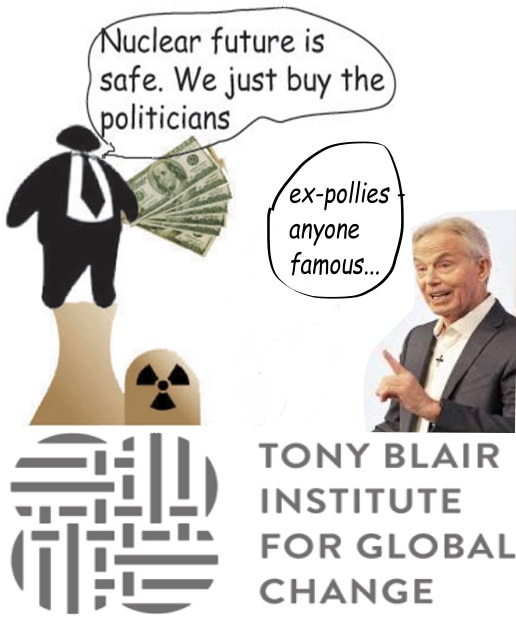
Ross Clark, writing in The Spectator, bemoans the fact that the Tony Blair Institute, as it touts nuclear power, dismisses the problems of safety and costs. Tom Pashby, writing in The New Civil Engineer, goes further in criticism, looking more deeply at the problems that Blair ignores: nuclear’s poor performance in comparison with renewables, and the shady pressure of industry-dominated think tanks, and the military lobby.
For a shady industry dominated think tank – you couldn’t find a better example than the Tony Blair Institute for Global Change (TBI). Tony Blair set up the TBI in 2017. Its purpose – “to help governments and leaders make their vision for development a reality. Providing analysis, commentary and lessons from their work with governments in fragile, developing and emerging states” It started out as a general do-gooder think tank, with a strong religious slant. It is a non-profit, and Blair does not receive a salary, but its analysts are paid for their work.
Over time, Blair and his Institute have been been accused of profiting from business and consultancy roles, and of conflicts of interest. The Tony Blair Institute confirmed that it had received donations from the U.S. State Department and Saudi Arabia. In 2024, the Tony Blair Institute provided paid work for the authoritarian regime in Azerbaijan when Azerbaijan hosted the COP29 Climate conference. There is a remarkable lack of transparency about Blair’s earnings from his own consultancy and speaking roles.
Even when Prime Minister, Blair was already helping BAE weapons corporation to make lucrative deals with corrupt regimes in Egypt. Later, as Peace Envoy, Blair made much money bolstering business opportunities with Egypt and other repressive regimes, Saudi Arabia, the UAE, Kazakhstan, Kuwait Colombia . Blair came to:
“epitomise the corruption at the heart of British public life. That’s not to say he’s done anything illegal. And it’s not just about the vast income, the seven houses, the £2m retainer with JP Morgan or the trading of influence and advocacy with corrupt authoritarian governments – all based on the contacts he built up as an elected British political leader.“
That was all over 10 years ago. Fast forward to now, and the Tony Blair Institute for Global Change (TBI) has become something much more influential and dangerous. Kiran Stacey, writing in The Guardian writes:
“the former prime minister has arguably become more powerful thanks to the work of the Tony Blair Institute for Global Change (TBI), which has exploded in size and revenue during the last few years. Its accounts show it made over $81m (£65m) in revenue in 2021, a 78% increase on the previous year.”
“This is an organisation bankrolled by billionaires, which continues to advise and take money from the murderous Saudi government. What’s worse, its solutions reflect these corporate interests“
Tony Blair has become far more powerful now, than he was as Prime Minister. He is keen for the TBI to expand its interests to many more countries. Blair is known to have a strong influence on UK Prime Minister Keir Starmer.
And guess what – Blair – with his enthusiasm for new technology, is besties with Elon Musk – surely a good step for Blair, to get in good with President Trump – great for his Institute and for the global nuclear lobby!
The seven ways the Federal Coalition could cook the books on nuclear costings

December 5, 2024, The AIM Network, Climate Council, https://theaimn.com/the-seven-ways-the-federal-coalition-could-cook-the-books-on-nuclear-costings/
Australians are being kept in the dark about the true costs of the Federal Coalition’s risky and expensive nuclear scheme.
The Federal Coalition’s heavy reliance on the first of two Frontier Economics reports paints a damning picture of the methods they may use to fudge the nuclear numbers and mislead Australians. We’ve already seen them cherry-pick numbers and use them to make misleading claims in Parliament.
Climate Councillor and economist Nicki Hutley said: “The Federal Coalition’s nuclear scheme would cost Australians a bomb. It’s a risky, expensive fantasy that would see Australians paying more than $100 billion for a fraction of the electricity we need. The real danger is delaying real solutions–like building more renewables, which is the most affordable way to keep the lights on.”
The Climate Council has identified five furphies Australians are likely to see in the Federal Coalition’s nuclear costings:
1) Comparing apples with oranges: We’ve already seen the Federal Coalition use inaccurate comparisons in the first Frontier Economics report on the cost of the shift to renewables. They inflated the cost by including ongoing fuel and maintenance expenses—which we’re already paying and which will actually drop in a renewables-led grid. On top of that, they didn’t use present value terms, a standard economic practice that accounts for the true cost over time.
Nicki Hutley, Climate Councilor and Senior Economist, said: “It’s alarming to see the Federal Coalition knowingly compare costs that are for totally different things. If we’re going to have a debate on the economics of building renewable power and storage, it needs to be based on best practice economics, not a false and misleading comparison.”
2) Excluding the cost of attempting to keep our ageing coal stations open: AEMO expects all our outdated, unreliable and polluting coal-fired power stations to close by 2038 at the latest, with over 90% shutting down in the next 10 years. But the Federal Coalition wants to keep these creaking old coal power stations open while waiting at least 15 years or more for nuclear reactors. This would cost taxpayers a bomb in constant maintenance and fault repairs. Keeping just one coal power station open, Eraring in NSW, could cost taxpayers more than $225 million per year. Renewable power back by storage is the only solution ready now to fill that gap left by coal and secure reliable, affordable power for Australian homes and businesses.
3) Excluding the cost of managing highly radioactive nuclear waste:Toxic nuclear waste needs to be safely stored for 100,000 years – an enormous and costly responsibility. In Canada, storing the long-term waste from their nuclear program in an underground facility is expected to cost at least $33 billion AUD, excluding the costs already incurred to manage waste on nuclear reactor sites.
Nicki Hutley, Climate Councilor and Senior Economist, said: “Any plans to build nuclear reactors must include the staggering long-term costs of managing highly radioactive nuclear waste. Ignoring these costs now will unfairly burden our kids, grandkids and future generations.”
-Advertisement-
4) Failing to consider the cost of climate change: The Federal Coalition’s nuclear scheme won’t cut climate pollution. In fact, building nuclear reactors would mean burning more polluting coal and gas in the meantime, which could see a further 1.5 billion tonnes more harmful climate pollution produced by 2050 – the equivalent of running the Eraring coal power station in NSW for another 126 years. Australians would pay the price in worsening unnatural disasters and skyrocketing insurance costs.
Nicki Hutley, Climate Councilor and Senior Economist, said: “Nuclear would cost us dearly, by delaying urgent cuts to climate pollution that would expose Australians to more unnatural disasters like bushfires, floods and heatwaves and driving up economic losses through higher insurance costs and disaster recovery bills. We should be focusing on cutting costs and climate pollution by rolling out more clean, reliable and affordable renewable power.
5) Ignoring Australia’s growing electricity needs: As Australia’s population and economy grows, keeping up with the community’s electricity needs is essential. The Australian Electricity Market Operator’s plan for our grid, the Integrated System Plan, expects power demand to double by 2050. We need more power to meet this need, and any assessment of cost needs to account for this. Assuming less might make costs look cheaper, but is inaccurate.
6) Ignoring the risk of cost blowouts: The Federal Coalition’s nuclear costings are likely to rely on rose-tinted assumptions, ignoring the very real possibility of massive cost overruns and delays that have plagued international nuclear projects.
For example, the UK’s Hinkley Point C energy facility is running 14 years late, at a cost three times its original estimate—now sitting at a staggering $90 billion AUD. Assuming nothing will go wrong with nuclear reactors in Australia flies in the face of international experience and puts taxpayers at enormous financial risk.
Nicki Hutley, Climate Councilor and Senior Economist, said: “Nuclear is simply a non-starter for Australia. The risks are immense—blowouts in cost and time, unresolved waste storage issues, and outdated technology. Projects like the UK’s Hinkley Point C show that nuclear is a financial black hole, while renewables are delivering results today.”
7) Ignoring the cost of transmission upgrades: The Federal Coalition assumes nuclear reactors can avoid the costs of necessary transmission upgrades, despite these investments being approved and supported by the previous Liberal-National Government.
Australia’s electricity grid needs substantial upgrades to meet growing energy demands and replace ageing coal-fired power stations. Building reactors near old coal stations won’t avoid the need for new transmission: the transmission previously used for coal is already being used by new batteries, wind and solar, and more investment is being planned. New transmission is needed no matter which energy source we build, and will make our grid stronger and more efficient.
Amanda McKenzie, CEO of the Climate Council, said: “Peter Dutton could cook the books with some creative accounting to sell this fantasy. Our old coal plants are retiring in the next decade, and we need to keep investing in low cost renewables to keep the lights on, create thousands of jobs in regional Australia, and ensure we cut climate pollution further and faster.
“Let’s focus on what’s already working. Renewables are cutting pollution, creating jobs, and lowering power bills right now.”
Women strongly opposed to nuclear power, just one in three men willing to live near a plant

Marion Rae, Dec 4, 2024, https://reneweconomy.com.au/women-strongly-opposed-to-nuclear-power-just-one-in-three-men-want-to-live-near-one/
Women are strongly opposed to nuclear energy and are most concerned any consideration of the controversial power source will delay the switch to renewables, polling shows.
A national survey released on Wednesday to coincide with a federal inquiry found a stark gender divide, with a mere 26 per cent of women saying nuclear would be good for Australia, compared with 51 per cent of men.
But only one in three of the men surveyed were willing to live near a nuclear plant.
Almost two-thirds (63 per cent) of women said they do not want to live near a nuclear plant and more than half (57 per cent) do not think transporting radioactive waste is worth the risk.
The DemosAU poll of 6709 adults between July 2 and November 24 also found a higher percentage of men (42 per cent) said they were concerned about the safety of the technology than those who were not concerned.
A women’s climate change movement, 1 Million Women, surveyed an additional 3351 women and found 93 per cent of its supporters were concerned about nuclear energy, with the top-ranked concern its potential to derail the rollout of renewable energy.
The findings come as a federal inquiry into nuclear power generation is scheduled to hold a public hearing in Melbourne with industry, health and climate witnesses listed to speak.
Community leaders, unions and grassroots organisations plan to gather outside to declare “our shared energy future is renewable, not radioactive”.
“Shadow energy minister Ted O’Brien is the ultimate triple threat of energy politics: his nuclear plan will increase power bills, increase taxes and increase climate pollution,” said Sanne de Swart, co-ordinator of the Nuclear Free Campaign with Friends of the Earth Melbourne.
Mr O’Brien said on Tuesday only the coalition was committed to delivering “cheap, clean and consistent energy” to all Australians.
“We need a coalition government elected to build nuclear power plants and get more gas into the market to provide cheaper and consistent energy for all Australians,” he said.
The opposition is readying to fight for nuclear energy at the next federal election, with plans to build reactors at seven sites across Australia but no details as yet on how they will be paid for.
The independent Climate Council said it was concerned the coalition was relying on one private sector “base case” rather than expert costings on nuclear power from bodies such as the Australian Energy Market Operator.
The industry’s Clean Energy Council said it would confuse policy makers and confound the public’s understanding of the cost of replacing ageing energy infrastructure.
“Ultimately what’s crucial is that any new investment is made at the least cost to Australian consumers,” a council spokesperson told AAP.
“Only renewable energy – solar, wind, hydro – together with energy storage, is capable of delivering on this – and it’s being built right now,” the council said.
Nuclear powered universities – the latest bright idea from Barnaby’s people
Murray Hogarth, 2 December 2024, https://thefifthestate.com.au/columns/columns-columns/the-nuclear-files/nuclear-powered-universities-the-latest-bright-idea-from-barnabys-people/
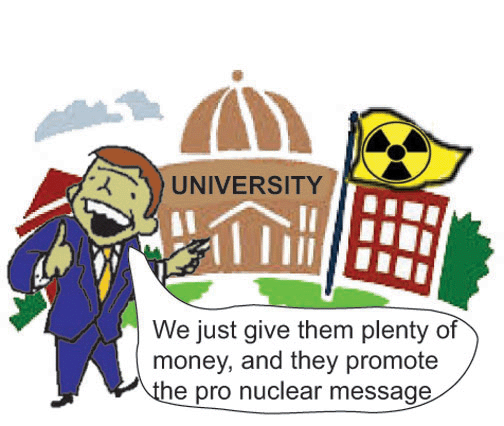
It’s common knowledge that Australia’s university sector is facing challenging times, but who knew installing nuclear reactors on campuses might be part of the future fix?
At least, that’s what the local anti-renewables, pro-nuclear campaign group in National Party maverick Barnaby Joyce’s home electorate of New England in north-eastern NSW is proposing.
Joyce, a former Deputy Prime Minister and current opposition frontbencher, is a leading voice in the self-styled “bush rebellion” against so-called “reckless renewables”, and a prominent political champion for Australia embracing nuclear energy.
He campaigns very actively on his own territory, but also roves further afield, even venturing into metropolitan Sydney, most recently at an anti-renewables, pro-nuclear forum in Labor Climate Change and Energy Minister Chris Bowen’s own electorate of McMahon.
His local ginger group, Responsible Energy Development for New England (RED4NE), has pitched this novel idea for regional universities in its submission to the current House Select Committee on Nuclear Energy.
It focuses on the University of New England, which is headquartered in the region’s largest urban centre, Armidale, and cites rising power demand for AI at all universities as a key driver for its nuclear notion based on next-generation Small Modular Reactors, or SMRs.
Just wait for the fallout from the university’s students and academics, and the local Armidale community’s not-in-my-backyard (NIMBY) brigade, if this gains any credence.
Although that said, given that no SMRs have been developed commercially anywhere in the OECD – as a number of the now over 340 submissions to the inquiry make clear, with only a couple of completed examples of SMRs in the world, in Russia and China – it may be a very long time before the good burghers of Armidale will need to get too worked up.
In its inquiry submission, the Australian Academy of Technological Sciences and Engineering (ATSE) confirms SMRs may power discreet use cases such as data centres and mining sites in the future, but describes the technology as still being in its “infancy”.
It says: “ATSE’s report on SMRs concluded that commercial releases in other OECD countries could be possible by the late 2030s to mid-2040s, with a mature market emerging by the late 2040s.”
Power-hungry universities growing their AI will need a lot of electricity well before then.
Such a proposition totally ignores the Liberal-National coalition pledge, should it win the national elections due within six months, to restrict its planned nuclear reactor developments to just seven already-named locations on old coal-fired power station sites across five states.
None of these seven sites are in the New England region, with the nearest being Muswellbrook in the adjoining Hunter Valley region, and currently the Coalition’s still poorly-defined and uncosted nuclear policy only specifies SMRs being built at sites in South Australia and Western Australia.
Under the heading “Deployment of Small Modular Reactors (SMRs) for New England Tablelands”, the RED4NE submission to the parliamentary inquiry says: “Even though renewable energy sources have a role to play in Australia’s energy mix, nuclear power, particularly through the deployment of SMRs, offers a compelling alternative for the New England Tablelands region.”
It then gets more specific, with a subheading “High energy needs of AI for Universities”, proposing that: “One of the most compelling uses would be the installation of SMRs for high energy users such as the University of New England (UNE) in Armidale.
“As Universities in general move to using more Artificial Intelligence (AI) systems, their need for power increases exponentially. New version SMRs do not require the vast quantities of water inherent in older models. As such, SMRs would be of vital importance for the continuing competitiveness for regional universities such as UNE.”
The New England Region is one of the NSW government’s five designated Renewable Energy Zones (REZ’s), which are earmarked for large-scale solar, wind and storage developments connected to high-demand areas of the electricity grid by transmission lines.
RED4NE’s submission mirrors most of the nuclear lobby’s standard arguments, concluding that: “When considering the alternatives, nuclear is more reliable, less destructive to communities and ecosystems, cheaper, and has longer lifespan. We urge you to consider seriously the positive benefits of nuclear power generation for Australia to avoid unnecessary violation of such beautiful rural communities such as the New England Tablelands.”
The submission also makes clear that RED4NE is collaborating with one of the pro-nuke brigade’s favourite “environmentalists”, wildlife photographer turned anti large-scale renewables campaigner Steven Nowakowski. He has helped them to produce a cumulative impact “panascope” of the wind, solar and battery developments, including transmission line and road infrastructures, proposed for the New England REZ.
Nowakowski was a guest speaker at a RED4NE-hosted community forum in Armidale on 3October, addressing landholders and other local residents on the topic: “Is the New England REZ broken?”
Other pro-nuclear speakers promoted for the forum included Centre for Independent Studies (CIS) Energy Director Aiden Morrison and Nuclear for Climate Australia founder Robert Parker, who, like Nowakowski, are regulars at similar events being held across regional Australia.
Of course, Barnaby Joyce is a regular too, frequently honing his arguments against the renewables-led energy transition – which he decries as the Labor government’s “cult-like attachment to intermittent power” – with his own constituents.
On the morning of the RED4NE forum, Joyce told his Facebook followers: “Tonight I am in Armidale with yet another gathering of standing room only of every political persuasion with one thing in common. We have been misled, ripped off and lied to. This is a social, environmental and energy train wreck of monumental proportions.”
It’s going to be a wild and wacky ride as the renewables versus nuclear, Labor versus coalition contest rages right up to election day.
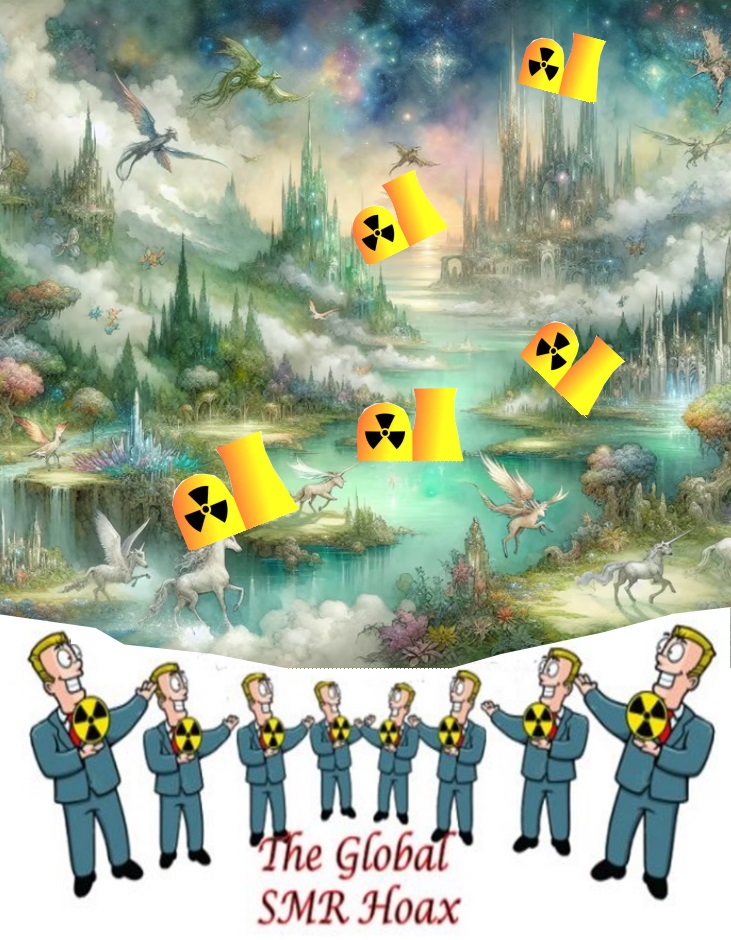
TODAY. Fantasies for 2025 – perhaps the nuclear one tops the list?
I mean – there’s a lot of competition for this title – top fantasy. There’s the fantastic possibility that all will go well with Donald Trump in power in the USA. That’s a big one seeing that we have a narcissisitic sociopath at the top, appointing a bunch of other narcissistic sociopaths, all of whom are singularly unsuited to their jobs, and who probably don’t trust each other, and certainly don’t trust Trump.
There’s the fantasy that the ruling Great Powers are actually going to do anything real about reducing fossil fuel emissions, or really helping the indigenous peoples who are most affeced by global heating.
Then there’s the plastic one. The same Great Powers are happy to allow those same fossil fuel companies to churn out plastic, while they make pious motherhood statements about the fantasy of “recycling” and somehow or other “disposing” of plastic wastes. They’d love to have all that toxic crap dumped on poor indigenous people too. But – at least, there’s a certain democracy about plastic wastes – as teensy weensy bits of plastic are in every organ of our bodies now, including the brain.
Still, I’m backing the nuclear industry fantasy to trump Trump and climate and plastic pollution for the fantasy of the year.
As to public realisation of these fantasies – there is a general uneasiness about the coming Trump administration.
And across the world 87% of people know that climate change is real, and are concerned about it. Public awareness of plastic pollution is growing too, especially in the USA. But the public are still using the fossil fuel products – and in order to cope with global heating, are turning on air-conditioners fuelled by fossil fuels. People are aware, but they don’t know how to stop it. So the corporate polluters are happy.
But nuclear power had a bad name, over previous decades. It really has been a huge challenge for this industry to turn all that around, to keep their profits thriving , and to have nuclear portrayed as a public good.
The well-paid minions of the nuclear industry have done an excellent job in conning the public, world-wide. They had to work hard to overcome nuclear’s history of accidents, bungles, and failed projects, not to mention how it has proliferated weapons of mass destruction.
Then, from strenuously not believing in Climate Change, the nuke lobby did a flip – with the inspired realisation that they could pretend that Nuclear Power is the Cure for Climate Change.
Well, it’s not the cure for climate change -nor for energy shortage, and it’s not “cheap” nor “clean”.
But the industry faces other huge problems, too. Nuclear publicists studiously avoid the topic of the cost of shutting down, and pulling down, nuclear reactors and then dealing with the toxic wastes. It’s supposed to be cheaper and better to “extend the lives” of crappy old nuclear reactors with their embrittled and cracked pipes. I think that the well-paid engineers, executives, politicians, trade union leaders, and media nuclear “experts” are all figuring that it’d be better if the “decommissioning” were to take place conveniently, long after their own retirement or death.
So the expensive horror of dealing with the tail end of the nuclear industry is a topic not to be discussed. Nor is the horror of nuclear war – with its weapons provided by the nuclear industry -and promoted by the ever-more profitable arms manufacturers. The “peaceful commercial nuclear industry is an essential part of this.
So – what is acceptable to discuss?
Well, it’s the “energy miracle” of Small Modular Nuclear Reactors” (SMRs). “Start-ups” for SMRs popping up all over the place (though some of them are quietly closing). The whole idea is that these, so far mythical, beasts will be commercially viable. However, Governments have always propped nuclear ventures up well, with various subsidies and tax exemptions. China and Russia solved the problem, with government ownership of the industry. France did too, though that’s not working too well. Now the British Labour government has “Great British Nuclear” set up as a government run venture- (by a conservative party that’s supposed to hate socialism.)
So – in a clearly non-commercially-viable venture, the tax-payer is to save the day.
Paul Brown sets out the whole sorry story, in particular for the UK. He explains the work of two pesky academics Prof. Stephen Thomas and Prof. Andy Blowers and their report – “It is time to expose the Great British Nuclear Fantasy once and for all.” The costs and delays of the Hinkley Point C big nuclear project, the planned Sizewell one, the £20 billion plan for unbuilt, untested SMRs – these are exposed, and make the pro-nuclear propaganda look absurd.
Yet the propaganda goes on. The big names in nuclear – Rafael Grossi, Bill Gates, Elon Musk, Jeff Bezos keep right on, maintaining the fallacy that all is well with the global nuclear industry, – and their sycophants in politics and media rebleat their message.
Thank you, Paul Brown, for explaining this so succinctly – if only the facts could be clearly set out in the mainstream media – and the public would not swallow the Kool-Aid. But of course, it won’t be, – the fantasy will prevail – until the shit finally hits the fan.
Australian nuclear news 2 – 9th December
Headlines as they come in:
- The question of nuclear in Australia’s electricity sector.
- Nuclear energy questioned again as new CSIRO report finds it will push up power prices
- CSIRO reaffirms nuclear power likely to cost twice as much as renewables.
- If you don’t know, vote no on nuclear
- Policy bum Dutton has two big ideas. They’re both in bad trouble.
- Renewable energy trounces nuclear on generation costs.
- ‘Nothing to see here’ says Australia as third Thales corruption case starts globally.
- Dutton axes third wind farm ahead of nuclear pitch
- Before you swallow Dutton’s nukes, look at the evidence.
- Dutton to claim nuclear rollout will end up cheaper than renewables
- Nuclear energy inquiry draws emotional response in Port Augusta
- Nuclear energy debate draws stark gender split in Australia ahead of next year’s election.
- The seven ways the Federal Coalition could cook the books on nuclear costings
- Peter Dutton cops backlash over push to build seven nuclear power stations in Australia.
- Women strongly opposed to nuclear power, just one in three men willing to live near a plant
- ‘Living next door to radioactive waste’: Latrobe Valley residents to rally against Coalition’s nuclear plan.
- Nuclear powered universities – the latest bright idea from Barnaby’s people.
- A sneak preview of Peter Dutton’s nuclear costings
‘Living next door to radioactive waste’: Latrobe Valley residents to rally against Coalition’s nuclear plan
In the lead-up to public hearings, a community organiser says ‘risky scheme’ is being pushed for region with no details or consultation.
Petra Stock, 2 Dec 24, https://www.theguardian.com/environment/2024/dec/03/latrobe-valley-liberal-coalition-nuclear-power-plan-peter-dutton
Community, environment and health groups will rally together against the Coalition’s nuclear proposal for the Latrobe Valley in Traralgon as public hearings for a nuclear inquiry take place in town on Tuesday.
Adrian Cosgriff, a member of community advocacy group Voices of the Valley, who worked in Gippsland’s oil and gas industry before retiring, said the region needed a decent plan for jobs as its coal-fired power stations shut down.
Peter Dutton’s nuclear idea made that “harder, not easier”, he said. “We’ve got people wasting time and making empty promises to a community that needs real jobs and real leadership.”
A self-described “industrial nerd”, Cosgriff followed Australia’s net zero commitment and local coal station closures closely.
So when Dutton proposed seven nuclear power stations nationally, including one in the valley, he went looking for details – and became frustrated with a lack of substantial detail on key aspects of the proposal, including the economics, timeframe and lack of available water resources for cooling.
Hayley Sestokas, a community organiser at Environment Victoria who grew up in the valley, said the “risky scheme” was being foisted on locals with no detail and consultation.
“The Coalition has not been upfront with the community,” she said. “If this was to go ahead, for the next 60 to 100 years we would be living next door to high-level radioactive waste and the threats and implications that actually entails.”
Sestokas hoped the rally and committee hearing would provide further information to people unsure what it meant to live next to a nuclear reactor.
Public hearings for the federal inquiry into nuclear power generation were scheduled for Traralgon, Melbourne and Adelaide this week. The local member for Gippsland and National party MP, Darren Chester, a member of the committee conducting the inquiry, has previously said: “Communities which have retiring coal-fired power station assets deserve to be at the centre of this inquiry.”
Dr Margaret Beavis, the vice-president of the Medical Association for Prevention of War, was due to speak about the health risks from radiation exposure, nuclear accidents and waste for local communities hosting nuclear reactors.
According to studies, increased radiation exposure raised the risk of cancers, heart attacks and strokes, she said, as well as increased incidence of leukaemia in children.
Beavis said studies – including from the US, the UK and Germany – showed the risk of childhood leukaemia roughly doubled for people within 5km of an operating nuclear power station, and was elevated within 50km.
While rare, accidents at nuclear power sites can occur, Beavis said, causing major exposures to large numbers of the population. “Complex systems do fail, as we’ve seen with [Chornobyl], Fukushima and Three Mile Island.”
Nuclear waste management was an unsolved problem, she added, which meant spent fuel rods could end up being stored at the site for decades. Globally, she noted, Finland is closest to a long-term storage solution, after a process that involved 40 years of planning and community consultation.
Dave Sweeney, a nuclear policy analyst with the Australian Conservation Foundation, said environment groups shared the community’s concerns relating to radioactive waste, energy costs, water resources and the consequences of delaying the energy transition for jobs and the climate. These concerns were detailed in a joint submission to the inquiry by the ACF and 15 other groups.
“We’re switching off coal, and we need to have secure energy supplies to make that transition,” Sweeney said. “Nuclear power is simply too uncertain, too expensive and too slow, and brings with it a range of related risks.
“When it comes to our energy future, we need effective climate action now, and we want to see an energy future that’s renewable, not radioactive.”
Nuclear news and more – week to 2 December.

Some bits of good news. Scientists develop a plastic that dissolves at sea. Cop29 offered some silver linings. More Than 30 Stranded Whales Rescued in New Zealand by People Lifting Them on Sheets.
TOP STORIES
Project 2025 calls for massive changes to Hanford nuclear cleanup. France is weighing zero-interest loan for 6 nuclear reactors, sources say.
Civil and military nuclear programmes: will they be derailed by skills shortages?
Decommissioning old nuclear sites to cost £130bn in blow to Miliband.
Climate. Huge COP29 climate deal too little too late, poorer nations say. ‘Unprecedented’ climate extremes are everywhere – Our baselines for what’s normal will need to change.
Environment. What Project 2025 Would Do to the Environment – and How We Will Respond.
Noel’s notes. SMRs underground – long drop nuclear toilets? – a chance to use that beaut new word – enshittification. Ecology be damned -we won’t know what’s hit us after January 20th
AUSTRALIA. ABC chair Kim Williams says investment in national broadcaster the best counter to ‘flood’ of misinformation. Australia’s top environment groups – Submission to Government Inquiry into Nuclear Power Generation in Australia.
NUCLEAR ITEMS.
ATROCITIES. Israel Attacks Kill 155 Palestinians in Gaza Over 72 Hours. Israel Has Killed Over 1,000 Doctors and Nurses in Gaza. Israeli snipers ‘shoot Palestinians for sport’.
CIVIL LIBERTIES. The Antisemitism Awareness Act Is the Death Knell for Free Speech.
ECONOMICS. Is Europe Ready for a Nuclear Renaissance? France postpones financing decision of 6 new reactors – report.
| EDUCATION. Christian Nationalism Marches on With ‘Bible-Infused’ Texas Curriculum. |
| EMPLOYMENT. Hinkley Point C: Hundreds down tools over concerns. Only 20% of Great British Nuclear staff employed permanently-ALSO AT https://nuclear-news.net/2024/12/02/1-b-only-20-of-great-british-nuclear-staff-employed-permanently/ |
| ENERGY. Hunterston ‘industrial revolution’ on our doorstep – liquid air energy storage. |
| ENVIRONMENT. Just Don’t Mention (or Measure) the Pu (Plutonium). Plans to turn land in Somerset into a saltmarsh should be scrapped.. |
| EVENTS. 5 December -Adelaide, Australia – STOP PETER DUTTON’S NUCLEAR REACTOR THREATS -Peaceful protest outside Federal Government’s Inquiry into nuclear power generation in Australia |
| HEALTH. ‘No plans’ for specific nuclear test veteran compensation. Plutonium. Suspected case of plutonium contamination in Rome plant. |
| INDIGENOUS ISSUES.Listening to Indigenous views. Indigenous views on nuclear energy and radioactive waste .https://www.youtube.com/watch?v=9i7XtIGFqyY |
| LEGAL. Today in Imperial Recklessness & Insanity. The United States Raises a Middle Finger to the International Criminal Court. |
| MEDIA. War Crimes in Lebanon: Human Rights Watch Says Israel Used U.S. Arms to Kill 3 Journalists. |
POLITICS. As America barrels toward war with Russia….Where’s Biden? From Genocide Joe to Omnicide Joe. Donald Trump’s quick trip to absolute dictatorship.
Inside Project Esther, the right wing action plan to take down the Palestine movement. https://www.youtube.com/watch?v=PPar-qf5FwY
EDF’s controversial River Severn saltmarshes plan should cease, says County Council leader.
POLITICS INTERNATIONAL and DIPLOMACY. “Israel Wants Wars”: Gideon Levy on Lebanon Ceasefire, Gaza & Gov’t Sanctions Against Haaretz– https://www.youtube.com/watch?v=i12aMIxc8As
Iran and Europe seek to break nuclear impasse before return of Trump. Iran to hold nuclear talks with France, Germany, UK. Iran says it could end ban on possessing nuclear weapons if sanctions reimposed.
PUBLIC OPINION Game changer: world turns against Israel – https://www.youtube.com/watch?v=gJSWAun9Xnc
SAFETY.
- IAEA warns of impact on nuclear safety of attacks on Ukraine’s energy infrastructure.
- Unidentified drones continue to fly over US military bases in UK. Mystery drone spotted over British aircraft carrier.
- Security planning for small modular reactors ‘not where it should be’, academic says= ALSO AT https://nuclear-news.net/2024/12/02/1-b1-security-planning-for-small-modular-reactors-not-where-it-should-be-academic-says/
- Indonesia’s nuclear energy push pits growth against safety concerns.
- Very ambitious’: regulator’s view of 2027 Bridgend nuke power plant plan. Channel Islands sign nuclear incident agreement. Small nuclear reactors are at risk from military attacks, so should be built underground.
- Why Bunkers Won’t Save The Super Rich.
| SECRETS and LIES. UK Government urged to end secrecy over ‘worrying’ drone sightings near nuclear-linked air bases. The secret audit that crucifies most French nuclear start-ups ALSO AT https://nuclear-news.net/2024/11/26/3-b1-the-secret-audit-that-crucifies-most-french-nuclear-start-ups/ |
| TECHNOLOGY. The entanglement of fusion energy research and bombs.Iran deploys advanced centrifuges in defiance of IAEA resolution. |
| URANIUM. Ironic Dependency: Russian Uranium and the US Energy Market |
| WASTES. The Nuclear Waste Management Organization (NWMO) Siting Process Fails to Achieve its Goal. South Bruce spared, but Ignace selected for Canadian nuclear waste dump. |
WAR and CONFLICT. Israeli army pushes deeper into south Lebanon as ceasefire violations intensify. Ceasefire Falters as Israel Launches Airstrikes, Artillery Shelling on Southern Lebanon.
Mass Desertions Over Radiation Could End the War in Ukraine. Ukraine has lost almost 500,000 troops – Economist. Mass desertions crippling Ukrainian army – AP. White House Pressing Ukraine To Draft 18-Year-Olds for War . Ukrainians And Americans Are Done With This War, But It Keeps Escalating Anyway.
WEAPONS and WEAPONS SALES. Biden seeking extra $24bn for Kiev – Politico. G7 finalizing $50 billion loan to Ukraine – Washington. White House finally confirms greenlight for deep Russia strikes. Russia Prepares to Respond to the Armageddon Wanted by the Biden Administration. Transfer of nukes to Kiev would be viewed as attack on Russia – Medvedev.
Biden administration advancing $680m arms sale to Israel, source says.
The Technology for Autonomous Weapons Exists. What Now?.
A sneak preview of Peter Dutton’s nuclear costings
Tristan Edis, Dec 2, 2024, , https://reneweconomy.com.au/a-sneak-preview-of-peter-duttons-nuclear-costings/
Any day now, we should be provided with an estimate from the Liberal-National Coalition and/or Frontier Economics on what Peter Dutton’s plan for nuclear power will cost us.
Keep in mind we already have plenty of sources of information for what nuclear power costs based on real-world experience.
The chart below,[ on original] based on analysis by myself and Johanna Bowyer, shows the power price required for nuclear power plants to be commercially viable compared to current wholesale energy costs passed on to residential power consumers.
These power prices are based on the cost of actual power plants which have either been committed to construction or which provided tender construction contract offers over the past 20 years across Europe and North America.
Our research indicates that conventional nuclear power stations cost anywhere between $14.9 to $27.5 million per megawatt to construct. They also accumulate significant finance interest costs over a lengthy construction period ranging between 9 to 18 years.
While yet to be commercialised small modular reactors are promised to achieve shorter build times, they don’t exist, except on the drawing board.
The only one that has progressed to a construction contract in the developed world would have cost $28.9 million per megawatt. These are the range of costs and build times that the Coalition and/or Frontier Economics should be using if they want to be realistic.
This would lead to the uncomfortable conclusion that household power bills would need to rise by around $665 per year for nuclear power plants to recover their costs from the electricity market.
Oddly, Ted O’Brien and Angus Taylor didn’t think real world experience with nuclear projects was a valid basis for assessing the cost of their plan. That, of course, makes one wonder what they might have in mind.
Here are four ways they might instead approach their costing:
1) Apply the shoulda, coulda, woulda approach to costing nuclear power plants also known as a “nth of a kind” costing;
2) Assume all transmission upgrade costs can be avoided with nuclear even though the prior Liberal-National Government approved and supported these transmission projects when in government;
3) Assume coal power plants never grow old;
4) Assume the damage from emissions released prior to 2050 don’t matter
We look at those claims in detail.
1) Look out for ‘NOAK’ or the shoulda, coulda, woulda approach to costing
Advocates for nuclear power aren’t terribly fond of using costs based on real-world experience. Instead they like to apply the shoulda, coulda, woulda approach to power plant costing.
This is where they assume away all the things that almost always go wrong with nuclear power plant construction, and imagine what should, could, or would happen if the real world would just stop being so damn unco-operative.
This typically requires that:
1. Construction companies and component suppliers stop making mistakes and stop seeking to claim contract variations;
2. Members of the community and politicians welcome nuclear projects with open arms and stop seeking to obstruct and delay them;
3. Nuclear plant designers get their designs perfect right from the start, avoiding the need to make adjustments on the fly as construction unfolds;
4. Financiers stop worrying about risk;
5. The community and politicians loosen-up about the small risk of radioactive meltdowns and apply less onerous safety requirements;
6. Construction staff aren’t tempted away to non-nuclear projects with offers of better pay or a more reliable stream of work;
7. Safety regulators work co-operatively and flexibly (compliantly?) with industry; and
8. Power companies en masse commit to ordering lots of reactors from a single supplier well in advance of when needed to enable the supply chain of nuclear equipment suppliers to achieve mass economies of scale and learning.
You generally know that these types of assumptions have been made in a nuclear costing because that costing will be described as a “nth of a kind” or NOAK cost.
The idea here is that incredibly high costs that were incurred in building all the prior nuclear power plants were an anomaly because they involved a whole bunch of mistakes and inefficiencies that the industry will learn from.
So, after they build several more and get progressively better, they’ll eventually reach the “Nth” number of plants, and all the problems that made prior plants so expensive will be ironed out.
At exactly what number plant do we reach N?
Well that’s usually a bit rubbery.
Under pressure from the nuclear lobby, you’ll find this NOAK costing approach is commonly adopted by the International Energy Agency, the US Department of Energy and even Australia’s CSIRO adopted a nuclear NOAK costing for its GenCost publication.
Unfortunately, while these agencies are generally good sources of information, the Nth power plant seems to always be a few more nuclear power plants away from being realised.
In reality the cost of building nuclear reactors has historically got worse rather than better over time in the western world.
The chart below [on original] illustrates the construction cost experience for pressurised water reactors in the US (in blue) and France (in red). Note this was based on a 2011 paper and omits the more recent and even worse cost experience detailed in the report by Bowyer and myself.
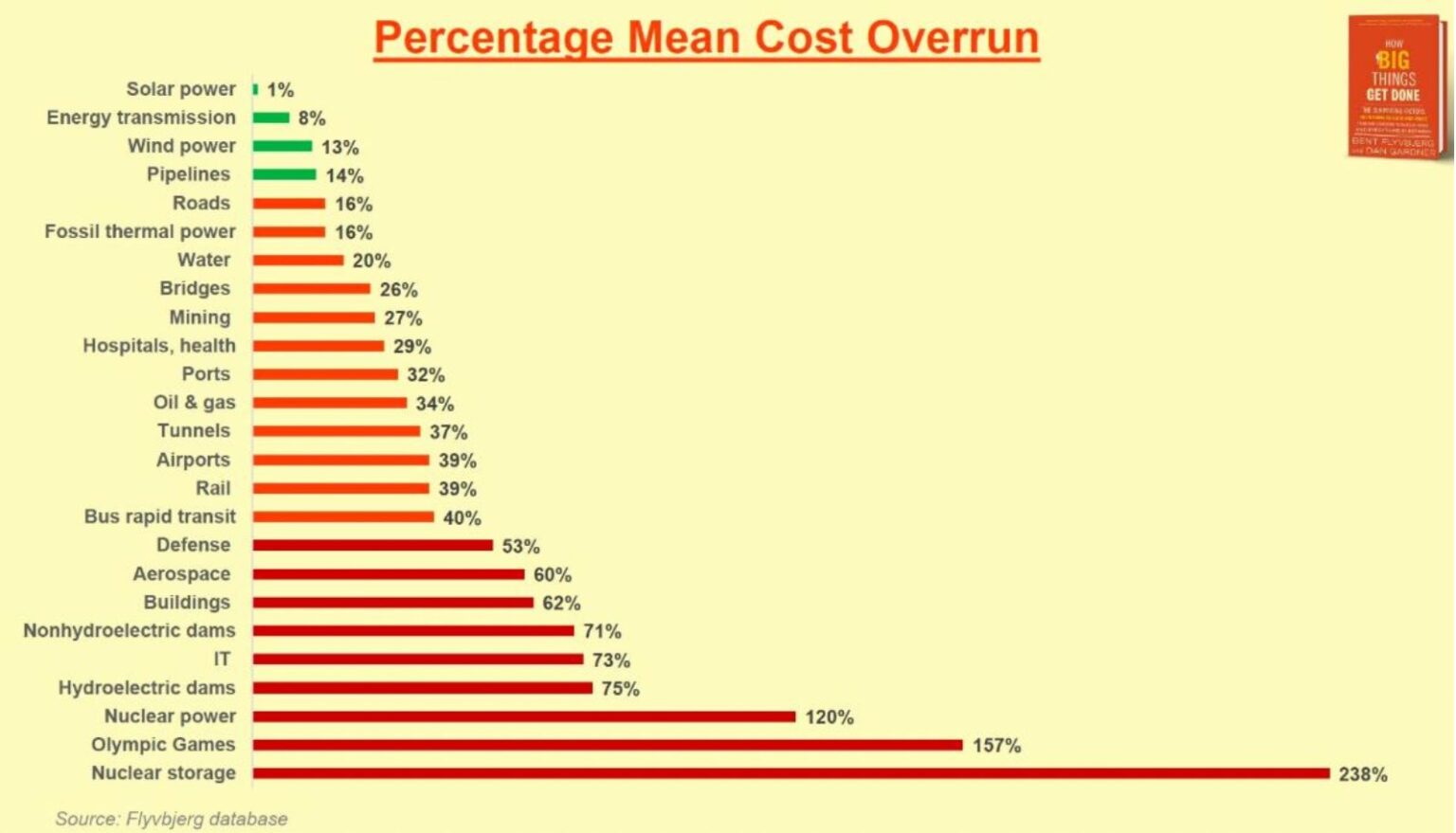
Bent Flyvberg – a professor in construction management at Oxford University and author of the bestselling book, How Big Things Get Done, has helpfully compiled a huge database of how major construction projects across the globe have performed against their original budgets.
This database reveals just how unreliable are the costings provided by the nuclear industry and its proponents. As the chart below published by Flyvberg reveals, the mean cost overrun of nuclear power projects stands at 120%, with only Olympic Games and Nuclear Waste Storage Facilities managing worse cost over-runs.
Meanwhile look at what types of projects perform well [graph at top of page]– notice anything?
For the journalists reading this article your task is simple – when the Coalition or Frontier Economics release their nuclear plan costing you need to ask them the following:
(1) Can you please provide us with a written assurance from the CEO of an experienced nuclear technology provider, like Westinghouse, EDF or Korea Hydro and Nuclear Power, confirming they are willing to enter into a fixed price contract to build a nuclear power plant in Australia for the cost and timeframe used in your costing?
If instead they cite to you the experience of the Barakah Plant in the United Arab Emirates let’s say, then you can always ask them:
So, like the United Arab Emirates, will you be:
– allowing the mass importation of construction labour from developing countries;
– removing the right of workers to collectively organise and bargain;
– exempting nuclear construction projects from paying Australian award wages; and
– banning the right to peacefully protest?
2) All transmission expansion costs are the fault of Labor and can be avoided with nuclear power
It should be acknowledged that transmission network expansion projects in this country are also being hit by large budget blow outs which involve multi-billion dollar costs. We need to do a far better and more judicious job in the roll out of transmission projects in this country.
It’s also true that several of these projects are critical to supporting ongoing expansion of wind and solar power. Ted O’Brien and David Littleproud have been highly critical of these new transmission projects and claimed extra transmission costs can be avoided by rolling out nuclear.
Given this, their forthcoming costing will probably suggest all of these new transmission costs can be sheeted home to Labor’s Renewable Energy Policies.
But this would also indicate that O’Brien and Littleproud suffer from amnesia. That’s because the major transmission expansions which are incurring the largest costs were actively pushed by the former Coalition Government which both of them served in.
Read more: A sneak preview of Peter Dutton’s nuclear costingsThe prior government “welcomed” and helped underwrite the new 900 kilometre transmission interconnector between SA and NSW.
In the lead up to the 2019 election, they vowed to build a second electricity interconnector between Tasmanian and the mainland.
In January 2020 the Federal Coalition entered into a funding deal with the NSW Government to upgrade transmission lines across north, central and southern NSW.
As part of the 2020 budget, Angus Taylor and a range of National Party MPs announced funding support for an 840km transmission line across inland Queensland which they declared was a “commitment to regional jobs, industry development and affordable reliable power.”
Then, leading into the 2022 election, they announced they would underwrite construction works on a major new transmission line between NSW and Victoria.
Then Energy Minister Angus Taylor’s press release at the time spoke glowingly about the benefits of new transmission, stating:
“Our investment in this project will support reliable electricity supply, deliver substantial cost savings and help keep the lights on for Australian families, businesses and industries.
This builds on the Morrison government’s record of judicious investment of over $800 million in priority transmission projects recommended by AEMO’s Integrated System Plan – projects that stack up for consumers.”
3) Relying on coal power plants that never grow old
It is almost guaranteed that the Coalition’s costing model will assume we can rely on the existing coal power stations to keep powering on for another decade or two with no deterioration in their reliability, before they then switch to nuclear power.
This is a very handy assumption to make because it allows you to avoid or delay significant costs involved in building the new, replacement power stations before the nuclear plants miraculously come to the rescue.
Yet while it might be a handy modelling assumption, it probably isn’t a realistic one.
To keep coal power plants reliable, especially when they are several decades old, requires ongoing significant expenditure on maintenance and replacement parts. Plus, even with this expenditure there can reach a point where a plant is so old it will continue to suffer serious reliability problems.
A good example of the risks and limitations of refurbishment is the case of the attempt to refurbish Western Australia’s Muja A and B coal generating units of 240 megawatts.
In 2007 these units, which were approaching 50 years of age, were mothballed. But by 2009 the WA Government announced they would be recommissioned due to a gas shortage that had afflicted the state. At the time the cost was estimated to be $100m.
The cost of refurbishment subsequently blew out to $290 million and in 2012 one of the units suffered an explosion due to corroded piping, injuring a worker.
A subsequent investigation highlighted a range of technical problems with the plant that made refurbishment challenging, but in 2013 the government chose to press on and sink a further $45 million into the project, claiming it would have a lifetime of 15 years and ultimately recover its costs.
However, even after refurbishment was completed it was reported by the West Australian newspaper the generating units were “plagued by operational and reliability problems, generating electricity just 20 per cent of the time. By 2018 the WA Government decided to cut their losses and shut Muja A and B permanently.
AGL’s Liddell Power Station is another case in point. AGL argued that a ten year life extension would cost $900m, and decided it wasn’t worth it. A government taskforce which sought to second guess AGL on the closure noted,
“a Liddell extension meets the maximum power output requirement.
This means it could provide sufficient capacity to maintain current levels of reliability in NSW as long as it is actually available during peak demand conditions. However, the increasing risk of outages as the plant ages gives rise to an increasing possibility those outages would lead to supply shortfalls.
Liddell already has a high outage rate compared with other NSW coal generators…. There is a risk that upgrades to make the plant compliant with safety and other regulation would not alter its upward trajectory of faults and unplanned outages.”
The other issue is that owners of power plants are likely to face considerable difficulty raising finance to undertake such refurbishment.
Delta Electricity, the owner of the Vales Point B coal power station, revealed in a rule change request to the AEMC that it was facing significant difficulty accessing bank finance stating, “A significant number of financial institutions…are no longer providing financing facilities to fossil fuel generators”.
The rule change request asked that Delta be able to provide cash, rather than a bank guarantee to AEMO to meet prudential requirements for trading purposes.
It explained that the bank providing its current guarantee was unwilling to continue with this arrangement because lending to a coal generator was in breach of environmental policies governing its financing practices.
In a search to find another lender Delta found, “during the refinancing process that 13 of the 15 lenders declined due to ESG [Environment, Social and Governance] constraints, which included the Big-4 Australian banks.
“Both of the remaining financial institutions were prepared to offer a bank guarantee facility to provide credit support related only to requirements for mining rehabilitation obligations and renewable Power Purchase Agreements.”
Some conservative politicians might like to pass this off as some short-term, woke fashion that will pass once they reach power. But it won’t pass, because bankers don’t like to lend money to risky commercial ventures.
Some conservative politicians might think global warming is an idea promoted by a mass conspiracy of meteorological science agencies across the globe to impose a socialist, world-wide government. However, most people think that’s a bit far-fetched.
Conservative politicians that think climate change is a hoax aren’t always in power, so bankers recognise there is a significant risk coal generators will be subject to emission control policies that will undermine their commercial viability.
This isn’t a distant risk, because such policies (which often are targeted towards supporting growth of renewable energy) have already been implemented.
4) The damage caused by power plant emissions in the years prior to 2050 don’t matter
Carbon dioxide and a range of other greenhouse gas emissions released by fossil fuel extraction and combustion last many decades once released into the atmosphere. Consequently, the extent of global warming is a function of the accumulated stock of greenhouse gas emissions in the atmosphere built up over time.
It isn’t a function solely of emissions in the single year of 2050. If we manage to achieve net zero emissions in 2050, but have polluted the hell out of the atmosphere in the preceding years then global warming will be very bad indeed.
A tonne of CO2 emitted this year and each of the years preceding 2050 will cause damage to society that is worth something to avoid. Any economist worthy of calling themselves an economist knows that the value of this avoided damage needs to be taken into account in any attempt to properly cost alternative options for our electricity system.
The Australian Energy Regulator provides one such option for valuing this in its paper – Valuing emissions reductions.
It should be noted the AER’s attaches significantly lower value to avoiding emissions than the United States Environmental Protection Agency recommends in the years prior to 2050, and very far below values used by the UK Government.
If the Liberal-National Party’s policy leads to slower emission reductions (even if they ultimately deliver net zero by 2050) this carries a serious penalty for our children and future children.
If it is ignored from their economic analysis, can we come to any other conclusion than the Liberal-National Party think climate change is so unimportant its impacts can be ignored?
Tristan Edis is director of analysis and advisory at Green Energy Markets. Green Energy Markets provides data and analysis on energy and carbon abatement certificate markets to assist clients make informed investment, trading and policy decisions.
Australia’s top environment groups – Submission to Government Inquiry into Nuclear Power Generation in Australia.
Friends of the Earth Australia
Australian Conservation Foundation
Greenpeace Australia Pacific
The Wilderness Society
Climate Action Network Australia
Nature Conservation Council (NSW)
Environment Victoria
Conservation SA
Queensland Conservation Council
Conservation Council of WA
Environment Centre NT
Solutions for Climate Australia
Arid Lands Environment Centre
Environment Tasmania
Environs Kimberley
Cairns and Far North Environment Centre
Submission to the House Select Committee on Nuclear Energy Inquiry into Nuclear Power Generation in Australia. November 2024 – (23 pages)
EXECUTIVE SUMMARY
Our groups maintain that federal and state legal prohibitions against the construction of
nuclear power reactors have served Australia well. We strongly support the retention of
these prudent, long-standing protections.
Claims that nuclear reactors could be generating electricity in Australia by 2035‒37 do not
withstand scrutiny. Introducing nuclear power to Australia would necessitate at least 10
years for licensing approvals and project planning, and around 10 years for reactor
construction. Nuclear power reactors could only begin operating around the mid-2040s at
the earliest. Most or all of Australia’s remaining coal power plants will be closed long before
nuclear reactors could begin supplying electricity.
Small modular reactors (SMRs) do not exist. The so-called operating SMRs in Russia and
China were not built using serial factory production methods. They could not even be called
prototype SMRs since there are no plans to mass-produce these reactor types using serial
factory production methods. SMRs are best thought of as Smoke & Mirror Reactors: they do
not exist. A few small reactors are under construction (in China, Russia and Argentina) but
once again serial factory production methods are not being deployed.
Construction timelines for the so-called SMRs in Russia and China were protracted: 9 years
in China and 12 years in Russia. In both countries, planning plus construction took 20 years
or more.
After costs rose to a staggering A$31 billion per gigawatt, US company NuScale abandoned
its flagship SMR project in Idaho last year. This led the Australian Coalition parties to
abandon their SMR-only nuclear policy. Worse was to follow. In mid-2024, French utility EDF
announced that it had suspended development of its Nuward SMR and reoriented the
project “to a design based on proven technological building blocks.” In May 2023, Ultra Safe
Nuclear claimed at an Australian Senate hearing that the company is building SMRs in North
America. In fact, the company has not begun building SMRs anywhere and in October 2024
the company announced that is pursuing a sale process under Chapter 11 of the US
Bankruptcy Code.
Many other SMR projects have failed. The French government abandoned the planned
ASTRID demonstration fast reactor in 2019; Babcock & Wilcox abandoned its Generation
mPower SMR project in the US in 2017; Transatomic Power gave up on its molten salt
reactor R&D in 2018; MidAmerican Energy gave up on its plans for SMRs in Iowa in 2013;
TerraPower abandoned its plan for a prototype fast neutron reactor in China in 2018; and
the US and UK governments abandoned consideration of ‘integral fast reactors’ for
plutonium disposition in 2015 and 2019, respectively.
The SMR sector is littered with failed and abandoned projects, false claims and false dawns
Large reactor construction projects have also suffered catastrophic cost overruns and
delays. In both of Australia’s AUKUS partner countries, early cost estimates were proven to
be wrong by an order of magnitude:
- One project in the US was abandoned in 2017 after A$13.9 billion was wasted on the
failed project, in South Carolina. Another project ‒ the twin-reactor Vogtle project in the
state of Georgia ‒ reached completion at a cost 12 times higher than early estimates, and 6‒
7 years behind schedule. Not a single reactor is currently under construction in the US. Not
one. - In the UK, the Hinkley Point twin-reactor project was meant to be complete in 2017 but
construction didn’t even begin until 2018 and the latest cost estimate is 11.5 times higher
than early estimates. No other reactors are under construction in the UK. The UK National
Audit Office estimates that taxpayer subsidies for the Hinkley Point project could amount to
£30 billion (A$58.4 billion). The Hinkley Point reactors are being built by French utility EDF.
France’s only recent domestic reactor construction project has also been a disaster: the
reactor is still not operating 17 years after construction began and costs increased six-fold to - A$31 billion.
If we were to make the heroic assumption ‒ the absurd assumption ‒ that reactor
construction projects in Australia would fare as well (or as badly) as those in the US and the
UK despite Australia’s lack of experience and expertise, they would be 20+ year projects and
costs would range from A$23.8 ‒ 27.9 billion per gigawatt. Or A$31 billion per gigawatt for
unproven NuScale SMR technology.
The two most significant economic modelling studies of Australia’s energy options are the
Net Zero Australia 2023 analysis and CSIRO’s annual GenCost analyses. Both make extremely
generous assumptions about nuclear costs ‒ indeed both assume costs several times lower
than real-world experience in the UK and the US ‒ yet nuclear power is still found to be
uneconomic in both studies.
Pursuing the nuclear path would be a recipe for increased power bills, increased taxes and
increased greenhouse emissions. And it would pose unnecessary risks of catastrophic
accidents and produce high-level nuclear waste for future generations of Australians to
manage for millennia.
There are currently no operating deep underground repositories for high-level nuclear waste anywhere in the world. The one operating deep underground repository for long- lived intermediate-level nuclear waste − the Waste Isolation Pilot Plant in the US state of New Mexico ‒ suffered a chemical explosion in a waste barrel in 2014 due to inept management and inadequate regulation.
Efforts to establish national radioactive waste facilities (repositories and stores) in Australia
for low- and intermediate-level waste have repeatedly failed since the 1990s. Decades of
failure do not inspire confidence that far more complex high-level nuclear waste challenges
from a nuclear power program would be responsibly managed in Australia.
Claims that converting coal power plants to nuclear plants will be straightforward and advantageous rest on untested assumptions rather than real-world success stories. Coal-to-nuclear transitions could potentially reduce nuclear costs by using some existing
infrastructure but nuclear power would still be far more expensive than firmed renewables
(i.e. renewable systems with storage capacity). No coal power plants have been repurposed
as nuclear plants in the US or the UK, so purported synergies and cost savings are
speculative.
There is no social license to introduce nuclear power to Australia. The Coalition’s nuclear
power policy is not supported by state governments in the five states being considered.
There is little or no support from Coalition parties in those states. The nuclear policy is not
supported by the energy industry, including the owners of the sites being targeted for
nuclear reactors. The policy is not supported by scientists. It is not supported by the public ‒
nuclear power recently regained its status as Australian’s least popular energy source ‒ or
by First Nations communities. The Coalition’s nuclear policy does not even enjoy widespread
support within the Coalition: deep rifts are evident.
While nuclear power has been stagnant for more than 20 years, renewable energy is
growing strongly around the world. Last year, nuclear power capacity fell by 1.7 gigawatts
while renewable additions amounted to 507 gigawatts ‒ record growth for the 22nd
consecutive year. This year, the same pattern is repeating: nuclear stagnation and record
renewables growth. Nuclear power accounts for a declining share of global electricity
generation ‒ currently 9.1%, barely half its historic peak ‒ whereas the renewables share
has grown to 30.2%. The International Energy Agency expects turbocharged growth in the
coming years with renewables reaching 46% by 2030. Renewable energy sources currently
generate over three times more electricity than nuclear reactors, and will likely generate
five times more by the end of the decade.
The energy transition is well underway in Australia, with renewables supplying nearly 40%
of the National Electricity Market. Nuclear power has no place in this transition. As
Australia’s leading scientific organisation CSIRO says, nuclear power “does not provide an
economically competitive solution in Australia” and “won’t be able to make a meaningful
contribution to achieving net zero emissions by 2050.”……………………………………………………………………………………………………………………………………………………………………………………………………………………………more https://www.aph.gov.au/Parliamentary_Business/Committees/House/Select_Committee_on_Nuclear_Energy/Nuclearpower/Submissions
The Green List: Peter Garrett on the ‘high-risk’, ‘cruel joke’ of nuclear energy
The Midnight Oil frontman, former politician and environmentalist says the idea that Australia needs a more expensive and riskier technology when it has an abundance of sun, wind and flowing water is ‘a cruel joke’.
Andrew McMillen, The AUSTRALIAN, November 22, 2024.
Andrew McMillen talks with the Midnight Oil frontman, former politician and committed environmentalist Peter Garrett about his passion for Australia to turn away from fossil fuels and towards a cleaner, greener, more sustainable future.
Have you always been “green”, or sustainability-inclined?
If growing up in nature and caring about the natural world means being green, then yes. As a young boy, I spent a lot of time playing in the bush. My parents gave me the great gift of freedom to roam, to explore and to imagine. Those experiences still sustain me. As a scout, I ventured further afield, learning self-sufficiency and independence. As a surfer, I learned to respect the power of the ocean, and marvel at its productivity.
This is an article from The List: 100 Top Energy Players 2024, which is published in full online on November 21.……………………………………………..
What is your view on nuclear energy?
The idea that Australia needs a far more expensive, high-risk, difficult to manage and uninsurable technology when it has an abundance of sun, wind and flowing water is a cruel joke. Despite assertions by vested interests, nuclear can’t happen quickly, efficiently or safely enough to deal with the need to get out of oil, coal and gas and put ourselves on a safe, reliable and affordable energy footing. Given the millions of solar panels on roofs and the now substantial contribution of renewables to providing power, I’d say we’re ready. Still, it’s a desperate race to avoid more climate tipping points. Expanding fossil-fuel production flies in the face of rational thinking. It’s time we called it criminal behaviour, since we can foresee the terrible harm being caused.
……………………………………. If you had a magic wand, what’s one thing you would change about how we, as a nation, approach our allocation of natural resources?
That we adopt the “do no harm” principle in regulation, so any resources allocation – particularly coal, oil and gas exploitation that increases the amount of CO2, or damages the environment – be ruled out. The employment gains of moving away from fossil fuels are tangible. In many cases, markets have already made the call, yet perversely, fossil fuel companies who pay little tax in Australia and are hellbent on continuing with their destructive business model are still allowed to operate. In summary: start by getting rid of fossil fuel subsidies so energy businesses can operate on a level playing field.
What is your greatest hope with regard to Australia’s natural environment?
That we stop treating the environment as an afterthought. I sense and hope for an attitudinal sea change – informed by Indigenous experience, inspired by our holidays, our artists, our farmers, our gardeners – that lifts our gaze to the extraordinary coastline, reefs, rivers and wetlands, verdant rainforests; the whole panoply of environments to which we owe our existence, and decide irrespective of age, political persuasion or station, that protection of nature – whose health is vital to our survival – is no longer a mercenary trade-off, but as inviolable as family, barbecues and footy.
https://www.theaustralian.com.au/business/renewable-energy-economy/the-green-list-peter-garrett-on-the-highrisk-cruel-joke-of-nuclear-energy/news-story/2b4df8d5055ff0ccd5db76b45f3d02fa
1 This month
Chernobyl: The Lost Tapes – A good documentary on Chernobyl on SBS available On Demand for the next 3 weeks– https://www.sbs.com.au/ondemand/tv-program/chernobyl-the-lost-tapes/2352741955560
15 April – Zoom –Nuclear Power is Not the Solution
Apr 15, 2026 01:00 AM in Canberra, Melbourne, Sydney

Join the International Physicians for the Prevention of Nuclear War (IPPNW) on Tuesday, April 14th for a timely webinar exploring the risks associated with nuclear power and challenging the myth that it offers a simple, safe, carbon-free solution to the climate crisis

21 April Webinar: No Nuclear Weapons in Australia
Start: 2026-04-21 18:00:00 UTC Canberra, Melbourne, Sydney (GMT+10:00)
End: 2026-04-21 19:30:00 UTC Canberra, Melbourne, Sydney (GMT+10:00)
Event Type: Virtual
A virtual link will be communicated before the event.
Host Contact Info: australia@icanw.org

of the week – Australians for War Powers Reform (AWPR)
To see nuclear-related stories in greater depth and intensity
 Antinuclear