Albanese ducks and weaves on targets as he seeks energy deal with Morrison — RenewEconomy

Albanese rules in CCS, rules out nuclear, and indicates compromise on targets as he seeks energy and climate deal with Morrison. The post Albanese ducks and weaves on targets as he seeks energy deal with Morrison appeared first on RenewEconomy.
Albanese ducks and weaves on targets as he seeks energy deal with Morrison — RenewEconomy
Julian Assange’s fiancé calls on the Australian government to secure his freedom
 Julian Assange’s fiancé calls on the Australian government to secure his freedom, https://www.wsws.org/en/articles/2020/06/22/assa-j22.html, By Oscar Grenfell, 22 June 2020Stella Morris, the fiancé of Julian Assange and mother of his two young children, issued a powerful call last night for the Australian government to secure the WikiLeaks founder’s freedom and prevent his extradition to the US, where he faces life imprisonment for exposing American war crimes. Julian Assange’s fiancé calls on the Australian government to secure his freedom, https://www.wsws.org/en/articles/2020/06/22/assa-j22.html, By Oscar Grenfell, 22 June 2020Stella Morris, the fiancé of Julian Assange and mother of his two young children, issued a powerful call last night for the Australian government to secure the WikiLeaks founder’s freedom and prevent his extradition to the US, where he faces life imprisonment for exposing American war crimes.
Morris was featured on Channel Nine’s “60 Minutes” program. The 24-minute segment provided an objective account of Assange’s decade-long arbitrary detention, first in Ecuador’s London embassy where he was a political refugee, and since April 2019 in the maximum-security Belmarsh Prison. The program, presented by Tara Brown, was the first substantive examination of Assange’s plight by the Australian media since the coronavirus pandemic began. Despite the fact that he is an Australian journalist being persecuted by the most powerful governments in the world for his publishing activities, corporate media outlets have maintained an effective D-notice on Assange for more than three months. This has dovetailed with the refusal of the Australian government, the Labor opposition and all of the official parties to defend the WikiLeaks founder. Morris warned that Assange’s incarceration in Belmarsh, which she noted has been dubbed the “UK’s Guantanamo Bay,” is exacerbating physical and psychological health issues stemming from his protracted persecution. “He’s very unwell and I’m very concerned for his ability to survive this,” she said. “Now he’s in the UK’s worst prison. It’s a high-security prison. One in five prisoners are murderers. He shouldn’t be there. He’s not a criminal, he’s not a dangerous person, he’s a gentle intellectual thinker and a journalist. Those people are not the people who belong in prison.” Morris stated that she was “very worried” about Assange’s circumstances. She has been unable to visit him since February, as a result of coronavirus lockdown measures. Despite widespread infections throughout the British penitentiary system, including in Belmarsh, and Assange’s vulnerability to the virus as a result of a chronic lung condition, he has been refused bail. “If you’re separated from your family and you’re alone in a tiny, dark room for 23-hours a day, with no control over your surroundings, I think people can imagine what that is like,” Morris said. Brown stated that in such circumstances, “most people would probably go mad.” Morris responded: “I think any person would get very severely depressed and he is very depressed.” “60 Minutes” showed Morris and her two young children speaking with Assange on the phone. The older of the two asked Assange when he was coming home. Morris, a 37-year-old lawyer, recounted the circumstances of her relationship with Assange. They had grown close when she was working on his legal cases after he had successfully sought political asylum in the Ecuadorian embassy. When the couple’s two children were born in 2017 and 2018, the new Ecuadorian government had initiated closer relations with the US and was increasingly hostile to Assange. UC Global, a Spanish firm contracted to manage the embassy’s security, was surveilling every aspect of Assange’s life and was passing the the material gathered to the US Central Intelligence Agency. When she fell pregnant, Morris informed Assange by writing the news on a piece of paper. They were fearful that any conversation about their personal life would be picked up by the audio recording devices placed throughout the embassy by UC Global. Morris sought to hide her pregnancies from the embassy staff and after the children were born, a friend of Assange pretended to be their father and brought them to the embassy. “The real issue was I thought that our family would be targeted by the same people that were trying to harm Julian,” Morris stated. The program featured news clips of senior US government figures denouncing Assange in hysterical terms and calling for him to be silenced. Morris noted that UC Global had considered stealing the diaper of one of her children to confirm his paternity, and had even discussed plans to kill Assange or allow American agents to kidnap him. Morris commented that it would be difficult for many people to appreciate the lawlessness that had characterised Assange’s persecution. “There’s incredible criminality that has been going on in order to gather information about Julian’s lawyers, and his family, and journalists who were visiting him,” she said. “I’ve been in a permanent state of fear for years and now it’s slowly playing out.” Significantly, the politically-motivated character of Swedish sexual misconduct allegations against Assange was made clear in the program. The allegations were concocted by that country’s police and judiciary, in the midst of a frenzied US campaign against WikiLeaks’ exposure of war crimes in Iraq and Afghanistan. Brown noted that Assange had never been charged with a crime in Sweden, and that the Swedish investigation had been dropped. Australian independent parliamentarian Andrew Wilkie pointed out that documents had shown that the British government used the allegations to enforce Assange’s arbitrary detention in the Ecuadorian embassy. The British authorities had been aware that the Swedish claims were a smokescreen for plans to dispatch Assange to his US persecutors. The program concluded with an appeal from Morris to the Australian government. She said: “I want people to understand that we’re being punished as a family. It’s not just Julian in the prison. The kids are being deprived of their father. I need Julian and he needs me.” Morris declared: “I’d like to ask [Australian Prime Minister] Scott Morrison to do everything he can to get Julian back to his family. If Australia doesn’t step in I’m very fearful this wrong won’t be righted. It’s a nightmare.” Tellingly, Brown stated that Morrison, Foreign Minister Marise Payne and Christian Porter refused to be interviewed. This was in line with the ten-year collaboration of Australian governments in the US-led vendetta against Assange. Beginning with the Greens-backed Labor government of Julia Gillard, they have rejected calls to defend the WikiLeaks’ founder, instead participating in the campaign against him. The official hostility to Assange is bound up with the Australian ruling elite’s unconditional support for the US military alliance and all of American imperialism’s illegal wars and military preparations and dovetails with a domestic assault on democratic rights, including attacks on press freedom and laws increasing punishments for whistleblowers. It is facilitated by the refusal of the Greens, the pseudo-left groups and the unions to mount any campaign for Assange’s rights. This underscores the fact that the fight for Assange’s freedom and for the defence of all civil liberties requires the mobilisation of the working class. The international protests over recent weeks against police violence have demonstrated the objective basis for building such a movement. |
|
Inside the new US policy on financing nuclear abroad
 Daily on Energy, presented by API: Inside the new US policy on financing nuclear abroad, Washington
  Examiner, by Josh Siegel, Energy and Environment Reporter & Abby Smith, Energy and Environment Reporter | June 22, 2020
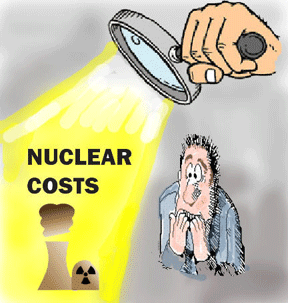
INSIDE NEW POLICY ON FINANCING NUCLEAR ABROAD: The U.S. International Development Finance Corporation mostly had small nuclear reactors in mind when it proposed this month lifting its ban on funding nuclear projects overseas. But a senior official from the DFC – a greatly expanded successor to the Overseas Private Investment Corporation – says the agency also envisions select situations for funding traditional large reactors, despite recent projects being delayed or canceled by cost overruns……..
The official cited a move by Congress a year after lawmakers passed the BUILD Act in 2018, which authorized the DFC, that called on the U.S. government to support energy diversification projects in Europe as a counter to Russia’s “energy dominance.”
The DFC offers direct equity financing, loans, and political risk insurance, while Ex-Im can only offer credit or lending. The DFC has a total investment limit of $60 billion, amounting to about a $1 billion maximum per project, the official said.
“I am not aware we have anyone on staff who has built a nuclear power plant,” the official said. “What we do have is very strong policies and procedures and frameworks to look at big complicated projects.” https://www.washingtonexaminer.com/policy/energy/daily-on-energy-presented-by-api-inside-the-new-us-policy-on-financing-nuclear-abroad
UK’s planning inspectorate should shut down the plan for Sizewell nuclear power, vulnerable to climate change
|
Spoiler alert: it’ll be a miracle if the project falls at that hurdle, radioactive though it is. It just starts the planning They include Nick Scarr, from the Nuclear Consulting Group, a collection of academics and experts. The consulting engineer believes Sizewell C is in a “dangerous location”, a position set out in a peer-reviewed paper. But, when his views were reported here almost a fortnight ago, EDF dismissed them. It claimed his analysis of th protective effects of the offshore Sizewell-Dunwich bank and a coralline crag was both confused and wrong. EDF made its point in a background briefing, since when it has repeatedly refused to provide any on-the-record statement to back its opinion. So, having given the company plenty of time, here’s one conclusion to draw. That Mr Scarr is bang-on. As he points How untrustworthy does it want to look? Big nuclear’s already toxic enough: exploding costs, endless delays, pricey https://www.thetimes.co.uk/article/shabby-treatment-of-go-outdoors-staff-nwst5btnl |
|

NSW first renewable zone attracts stunning 27GW of solar, wind, storage proposals — RenewEconomy
NSW plan for first Renewable Energy Zone attracts “phenomenal” 113 registrations of interest for projects totalling 27GW and valued at $38 billion. The post NSW first renewable zone attracts stunning 27GW of solar, wind, storage proposals appeared first on RenewEconomy.
via NSW first renewable zone attracts stunning 27GW of solar, wind, storage proposals — RenewEconomy
Big utilities split over delays to key reform that backs battery storage — RenewEconomy
Two big utilities that operate big batteries – EnergyAustralia and AGL – split from peers and argue against proposed delays to five-minute settlement period. The post Big utilities split over delays to key reform that backs battery storage appeared first on RenewEconomy.
via Big utilities split over delays to key reform that backs battery storage — RenewEconomy
June 22 Energy News — geoharvey

Opinion: ¶ “Latin America’s Potential Green Hydrogen Economy” • The Covid-19 pandemic and crisis has led to increasing calls to redouble efforts toward an energy transition that would help the world reduce CO₂ emissions. For many countries of the Latin American region, clean hydrogen markets can be a key part of the economic recovery. [Inter […]
Engineers say technology roadmap should focus on cheap renewables, energy storage — RenewEconomy

Australian engineers’ peak body join submissions calling for a technology roadmap based around cheap solar and wind and energy storage technologies. The post Engineers say technology roadmap should focus on cheap renewables, energy storage appeared first on RenewEconomy.
via Engineers say technology roadmap should focus on cheap renewables, energy storage — RenewEconomy
Amazon signs biggest corporate solar PPA in Australia with Suntop project — RenewEconomy
Amazon identifies solar farm in NSW that will support the biggest corporate PPA with a solar project to date in Australia. The post Amazon signs biggest corporate solar PPA in Australia with Suntop project appeared first on RenewEconomy.
via Amazon signs biggest corporate solar PPA in Australia with Suntop project — RenewEconomy
Minerals Council slammed for “woefully inadequate” Climate Action Plan — RenewEconomy
Minerals Council of Australia unveils Climate Action Plan with no dates or milestones for emissions reduction and no mention of phasing out coal mining or coal-fired power. The post Minerals Council slammed for “woefully inadequate” Climate Action Plan appeared first on RenewEconomy.
via Minerals Council slammed for “woefully inadequate” Climate Action Plan — RenewEconomy
Australian made hydrogen must be green, or it will have no export market — RenewEconomy
Global markets will increasingly require ‘green hydrogen’ certification as they decarbonise their economies in line with Paris goals. To get distracted by anything less would be a fool’s errand. The post Australian made hydrogen must be green, or it will have no export market appeared first on RenewEconomy.
via Australian made hydrogen must be green, or it will have no export market — RenewEconomy
Week to 23 June in nuclear/climate news – Australia
With a record world increase in coronavirus cases, Brazil and North America in the spotlight – media attention has been rightly focussed on the pandemic. FAIR exposes the false claims about China and COVID-19 . At the same time, global heating seems to be at a runaway pace, affecting the Northern Hemisphere, and especially the Arctic. https://www.youtube.com/watch?v=w-gEhYTu4Xs&t=42s To protect our planet – we need to transform, not grow, the economy.
Global nuclear news is mainly just the same old collection of handouts from the nuclear industry, faithfully regurgitated by journalists who want to keep their jobs. Otherwise, not much is happening.
A bit of good news – Coronavirus more than 1500 treatment studies are underway world-wide.
AUSTRALIA
Is Australia getting a second wave of Coronavirus?
NUCLEAR
National Radioactive Waste Management Mysterious, manipulative and corrupt process whereby Napandee was selected for nuclear dump site. Kimba community unaware that Australia’s medicine does not need nuclear reactor. South Australia targeted: easy to later bring international waste in to nuclear dump.
Australian Radiation Protection and Nuclear Safety Agency (ARPANSA) sits on the fence regarding Napandee choice for nuclear waste dump.
Senator Rex Patrick provides Federal Parliament with another option for nuclear waste storage. South Australia outlaws nuclear facilities, but yet not one S.A. Liberal MP voted against the waste dump!
Submissions to Senate Inquiry.
- Neville Reid – In a corrupt and undemocratic process, the Napandee nuclear waste decision has ignored environmental safety dangers.
- Carole Faulkner – Senate should reject Nuclear Waste Bill and recommend new consultation involving all Barngarla people
- Kimba farmer, neighbouring Napandee, stands firm against nuclear waste dump on agricultural land.
The seriousness of mobility of radionuclides in developing the nuclear waste facility at Kimba, South Australia
Expensive, dirty and dangerous: why we must fight miners’ push to fast-track uranium. Scott Morrison gives a boost to uranium mining at Olympic Dam.
Gabrielle Costigan- another one revolving from tax-paid jobs to weapons industry!
Coalition’s push to deregulate environmental approvals will lead to extinction crisis will lead to extinction crisis.
CLIMATE CHANGE.
Australia’s best energy measure – to lift energy efficiency – Chief Scientist says. Morrison government just doesn’t get it, on climate change. The number of climate deniers in Australia is more than double the global average, new survey finds. “Too late for gradual transition”: Quiggin calls for coal exit by 2030.
Foreign ownership of Victorian water hits whopping high – Herald Sun
RENEWABLE ENERGY. Renewables will power Australia’s economic growth. South Australia: The first big grid where rooftop solar could eliminate all demand. South Australia fast-tracks energy plan to dodge blackouts and meet 100% renewables goal. Rooftop solar reshapes Western Australia. grid, and retiring coal units won’t be missed Tesla says energy market reform must be accelerated in Australia
INTERNATIONAL
Now, the nuclear arms race has become even worse.
Joint Project Nuclear Risk and Public Control.
Explaining ionising radiation -a film about nuclear fallout https://www.youtube.com/watch?v=UaH5heMIC_k&t=96s
COVID-19, nuclear war, and global warming: lessons for our vulnerable world.
Covid-19 pandemic – ‘fire drill’ for effects of climate crisis. COVID-19 recovery plans – excellent opportunity for global renewable energy development.
The seriousness of mobility of radionuclides in developing the nuclear waste facility at Kimba. South Australia

has the government explained why the reprocessed nuclear waste has been reclassified by ANSTO from high level to intermediate on arrival in Australia ?
has anyone from the community and even the Kimba District Council ever sought any information as to the inventories and movement of the radionuclides in the intermediate level waste for above ground storage at Kimba?
The mobility of radionuclides is probably the prime and initial factor in determining the location and manner of nuclear waste management by storage and disposal
Although nearly thirty years old but still current the Code of practice for the near-surface disposal of radioactive waste in Australia (1992) prescribed radioactive waste hazards as:
The health risk to humans presented by radioactive waste depends upon the radionuclides present, the type of radiation emitted by the particular radionuclides, their concentrations, and their chemical and physical form. The hazard may arise from external irradiation of the body or internally as a result of radioactive substances entering the body by ingestion, inhalation or absorption through the skin. The radioactive waste specifically covered by this code may also present a long-term hazard to the environment and to future generations if disposal is not carried out in a responsible manner.
Even though the Code deals with disposal rather than storage the requirements for both are basically similar with the only difference being the retrieval of the waste as seen from the definitions in the Code being:
Waste disposal means the placement of radioactive waste in a structure and in a manner such that there is no intention of retrieval.
Storage means the emplacement of waste in a facility with the intent and in a manner such that it can be retrieved at a later time.
From this I trust that you understand the seriousness and importance of radionuclides mobility in the selection and development of the management facility at Kimba
IN VIEW OF THIS SOMEONE FROM KIMBA SHOULD FORMALLY IN WRITING ASK THE KIMBA DISTRICT COUNCIL THESE QUESTIONS
COPIES SHOULD BE SENT TO:
THE SENATE COMMITTEE CHAIRMAN
MINISTER PITT
MR ROWAN RAMSEY MP
ANSTO CEO PATERSON
BARNGARLA IF THOUGHT APPROPRIATE
EXCLUDE ARPANSA AS IT MAY BE COMPROMISING TO IT AND IT WILL IGNORE THE LETTER IN ANY CASE
Questions:
(a) whether there have been any discussions or arrangements regarding fire as a risk at the Kimba facility – had this ever been covered by the government in its presentations as one of the main reasons for underground burial of nuclear waste is to avoid any fire risks?
(b) has the government explained why the reprocessed nuclear waste has been reclassified by ANSTO from high level to intermediate on arrival in Australia ?
(c) has the community ever been informed of the radionuclides movement activity of the intermediate level waste to be sent to Kimba?
(d) what explanation was given as to the radionuclides movement and immobilisation in above the ground storage as opposed to geological burial?
(e) has anyone from the community and even the Kimba District Council ever sought any information as to the inventories and movement of the radionuclides in the intermediate level waste for above ground storage at Kimba?
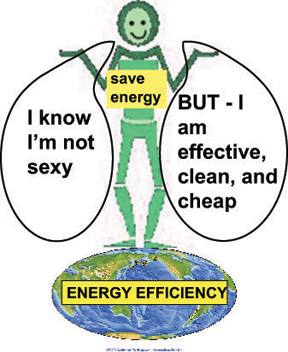
Australia’s best energy measure – to lift energy efficiency – Chief Scientist says
|
Chief scientist joins calls for Australia to dramatically boost energy efficiency
Alan Finkel calls saving electricity the ‘best form of generation’ as groups push for efficiency measures to lead economic recovery, Guardian, Adam Morton Environment editor @adamlmorton, Sun 21 Jun 2020 Australia’s chief scientist, Alan Finkel, has warned the country is not doing enough to lift energy efficiency, and described measures to save electricity as the “best form of energy generation you could possibly ever hope to have”.
Speaking in his role as chair of a panel advising the Morrison government on a low emissions technology statement, Finkel told an industry seminar that Australia had ongoing issues with energy efficiency and productivity, and noted a national energy productivity plan, agreed by federal and state energy ministers in 2015, did not appear on a list of national climate and energy policies. “I don’t think we’re anywhere close to having that nailed,” he said on energy efficiency. “There is no lack of appreciation from myself or my colleagues on the taskforce … that a gigawatt of power not needed because you’ve done an efficiency measure is the best form of energy generation that you could possibly ever hope to have.” Finkel’s view is in line with a raft of groups from across Australian society that are calling for federal and state governments to back an energy-efficiency drive for homes and other buildings to help address both the coronavirus-triggered recession and the climate crisis. Many have called for policies that focus on social and low-income housing. Buildings are responsible for nearly a quarter of national greenhouse gas emissions. The organisations calling for better energy efficiency say it could cut emissions, create tens of thousands of jobs and, unlike some other proposed stimulus measures, be delivered immediately. Household-level energy efficiency measures can include boosting thermal performance by sealing leaks and improving insulation, replacing gas appliances with those run on clean electricity, encouraging better lighting and installing solar panels and a battery to generate electricity onsite. Four separate reports on the issue were released last week. In one, more than 50 social, property, business, environment and other groups called for an energy efficiency and solar package focused on low-income houses. The 50, led by the Australian Council of Social Service (Acoss), said the government’s HomeBuilder stimulus program had helped high-income earners planning expensive renovations, but failed to do anything for those most in need, or to cut emissions. They recommended the federal government match state funding for energy efficiency upgrades and solar panel installations in social housing, work with local government to improve low-income homes, offer grants to landlords to fix inefficient rental properties and subsidise the replacement of inefficient appliances. Kellie Caught, an Acoss climate and energy senior advisor, said a low-income energy productivity program could quickly create more than 60,000 jobs in training, auditing, installation, manufacturing and local retail……… The groups calling for energy efficiency improvements are part of a push including global organisations, banks, major institutional investors and some governments, for a green recovery from the Covid-19 shutdown. A report by the International Energy Agency released last week found governments were planning to spend US$9tn globally on rescuing their economies from the coronavirus crisis, and the stimulus packages created this year would determine the shape of the global economy for the next three years. It warned emissions must start to fall sharply and permanently within that time or climate targets will be out of reach. The Morrison government and its National Covid-19 Coordinating Commission have emphasised gas, a fossil fuel, as being central to pandemic recovery……. https://www.theguardian.com/australia-news/2020/jun/21/chief-scientist-joins-calls-for-australia-to-dramatically-boost-energy-efficiency |
|
Foreign ownership of Victorian water hits whopping high
Herald Sun , 21 June
A shocking report has revealed just how much of our water is now owned by overseas interests, with China continuing to buy up to buy up precious Australian resources. – (subscribers only)
1 This month


Help Aunty Sue Protect Her Land and Sacred Sites From Destructive Rocket Testing.
.

Australians deserve the truth
about
AUKUS – https://aukuspublicinquiry.com/

PETITION – To: Prime Minister Anthony Albanese and the Australian Labor Government

of the week – Australians for War Powers Reform (AWPR)
To see nuclear-related stories in greater depth and intensity

