Adelaide residents blindsided by decision to store AUKUS nuclear waste at submarine shipyards
The act allows radioactive waste to be stored at both sites but does not define what level
the legislation was also ambiguous about the disposal of nuclear material from UK and US nuclear submarines.
By Angelique Donnellan 7.30 ABC
In short:
Federal parliament has passed legislation that allows for nuclear waste to be stored and disposed of at a shipping yard in Adelaide.
Residents said they were not consulted or told of the plan.
What’s next?
Construction of nuclear submarines is expected to start in Adelaide by the end of the decade.
The $368 billion AUKUS pact is promising thousands of jobs and the return of submarine construction to South Australia.
But residents have just learned the deal also means nuclear waste will be stored on their doorstep.
“It’s madness. It’s not only close to a residential area, but it’s right on a waterway,” Adelaide resident Eileen Darley told 7.30.
Last month legislation quietly passed the federal parliament that will allow for the storage and disposal of nuclear waste at the Adelaide shipyard in Osborne, which is 25 kilometres north-west of the city’s CBD and near the popular seaside suburb of Semaphore and historic Port Adelaide.
Residents said it was the first time they heard about plans for the waste facility.
Nuclear submarine construction at Osborne is expected to start by the end of the decade.
“There’s 30,000 people that live in this area,” Ms Darley, who runs the local action group Port Adelaide Community Opposing AUKUS, said.
“All the childcare centres, all the schools and the families that live in this area, but also waterways that feed the mangroves, that is a dolphin sanctuary, and so forth.
“None of us in this area have been consulted about it at all.”
The Osborne shipyard is in federal Health Minister Mark Butler’s safe Labor electorate of Hindmarsh.
In an interview with 7.30, he said residents would be consulted closer to when the facility would be established but stated the waste facility would go ahead even if residents did not want it.
“This is going to happen,” he said.
“The government and parliament have decided that the future defence strategy of the country will involve nuclear-propelled submarines.”
Indigenous elder criticises government’s ‘sly and conniving’ moves
The state Labor government is in lock-step with the Commonwealth on AUKUS but community concerns are growing.
The Port Adelaide Enfield Council has resolved to oppose any nuclear waste storage or disposal at Osborne and is calling for widespread community engagement.
Local resident and Indigenous elder Margaret Brodie said she was disappointed the government legislated the facility without people having a say. The shipyard is on the traditional lands of the Kaurna people.
“It’s sly and conniving. That’s how I feel about it,” she told 7.30.
“As an Indigenous woman I think I get used to it, government being underhanded, not telling us anything, or not asking.
“If you talk about closing the gap, they’re not going to close the gap by doing things like this.”
The legislation declares the Osborne Shipyard as well as the HMAS Stirling naval base near Perth as designated naval nuclear propulsion facilities.
The act allows radioactive waste to be stored at both sites but does not define what level……………………………………………………………………………
Ms Darley was sceptical.
“It does not allay our concerns to hear that the government is saying that it’s temporary and it’s low level,” she said.
“We’re the people who are most affected if something goes wrong.”
The Naval Nuclear Power Safety Regulator, which reports to the defence minister, would grant the licence for the operation of the waste facilities.
Waste from UK and US subs
Greens senator David Shoebridge told 7.30 the legislation was also ambiguous about the disposal of nuclear material from UK and US nuclear submarines.
“One of the key amendments we wanted was to prohibit the storage of high-level nuclear waste from any foreign country, the United Kingdom or the United States, and that was aggressively resisted by both the government and the opposition,” he said.
“Neither the UK or the US have any permanent solution for their nuclear waste, and the UK is the one that’s in the most trouble … and they have seen with AUKUS a potential sucker down here in Australia who’s literally put their hand up and said, ‘Yeah, we’ll take some of that. We’ll help out.'”
There is also opposition to the waste facility at Perth’s naval base, which needs to be up and running as early as 2027 when one UK nuclear submarine and up to four US boats start regular rotations.
But Mr Butler stated it would also only hold low-level nuclear waste taken from UK or US submarines which came to Australia.
“Intermediate and high-level waste [from overseas] will not be stored in Australia,” he said.
………………………………………………………………………………………………………………………………………………………………………………………………………………. In South Australia, the Port Adelaide Community Opposing AUKUS said it was prepared for a fight ahead of next year’s federal election.
“How far are we prepared to go? Well, I think we’re in it for the long haul. That’s for sure,” Ms Darley said.
“We don’t want our children, our grandchildren, to have to deal with this in the long run.
“We’ll definitely be making this an election issue.” https://www.abc.net.au/news/2024-11-18/aukus-nuclear-waste-to-be-stored-adelaide-suburbs/104605640
The 101 ways Google serves up Australians to known scammers

Using the world’s biggest search platform to find information on scams can deliver victims straight into the arms of criminals.
The Age, ByAisha Dow and Charlotte Grieve, November 18, 2024
oogle searches are delivering Australians into the arms of fraudsters, as websites and advertisements belonging to scammers are prominently served up to users on the world’s most popular search engine.
In some instances, Google searches provide some scam victims false reassurance that they are investing in legitimate companies.
Once they’ve lost their money, scam victims searching for help on Google are then being shown ads that direct them to a new set of criminals, known as recovery scammers, who claim they can retrieve people’s lost money for a fee, but instead disappear with the cash.
The findings are part of a months-long investigation into how investment scammers use some of the world’s biggest tech companies to find victims.
This masthead found that Google presents scam sites to users, even after those scams were the subject of explicit government warnings.
One example is the scam platform Bitcoin Evolution, which was blacklisted by the UK’s Financial Conduct Authority in 2020. In March, Australian authorities placed it on an investor alert list, declaring it “not to be trusted”.
But this month, when this masthead used Google to search for Bitcoin Evolution, the first result that came up was not an official notification, but two Bitcoin Evolution scam websites.
Registering a phone number with one of the websites resulted in a near-immediate call from a scammer. Invest just $300 and make daily profits of 10 to 15 per cent, the fraudster promised.
Fleeced of $700,000
Based on a Google search alone, it can be difficult for Australians to tell if potential investment companies are real or a scam. Results are sometimes muddied by the presence of scam platforms, fake reviews and fake news articles or blogs promoting scams.
Fleeced of $700,000
Based on a Google search alone, it can be difficult for Australians to tell if potential investment companies are real or a scam. Results are sometimes muddied by the presence of scam platforms, fake reviews and fake news articles or blogs promoting scams.
Swav, a Melbourne man who didn’t want to use his last name for privacy reasons, was connected to overseas criminals through an advertisement that appeared on his Facebook feed in spring 2020.
Although he didn’t realise it at the time, the celebrities who appeared in the ad providing endorsements were fakes, computer-modified replicas of the famous person.
This masthead revealed on Saturday that Meta, owner of Facebook, takes money for these “celeb-bait” scam ads, despite the ads promoting notorious fraudulent investment platforms and coming from accounts that were clearly not legitimate investment companies.
Swav was just one day into the con, and had only handed over $1500, when he noticed a contradiction in the scammer’s sales pitch. It piqued his suspicion, and when he hung up, he began doing a bit more research.
“I started to search intensively about this company to verify if they are legit,” he recalled. “I searched on Google … but most of the reviews were positive.”
Over the following nine months, the fraudster from a platform called StocksCM stole close to $700,000 from him.
This masthead tested Google results based on searches for 100 entities recently added to the Australian Securities and Investment Commission’s (ASIC) investor alert list.
The list includes the names of known scam platforms and businesses targeting Australian consumers without holding the appropriate licences.
It showed that Google was failing to block websites for even these publicised rorts.
In the first page of results, Google returned 101 links to websites for platforms using the same names as the blacklisted entities.
The search results also featured 10 Google ads directly promoting scam brands named in ASIC’s warning list.
Google was accepting money to run ads for the Immediate Connect, Immediate Edge and Immediate Vortex scam platforms, all on ASIC’s alert list.
Ten out of the top 14 Google results that appeared in a search for “Immediate Connect” were likely scam platforms, including the top four results, which were all sponsored links for the scam…………………………………………………………………………………………………………………………..
Simon Smith, a cybersecurity expert with Scam Assist, said many of his clients who had lost their savings were originally connected to scammers by Google ads, including through fraudulent AI auto-trading platforms.
He said the public had high levels of trust in Google, and many assumed that the results served up first would be most relevant to them.
“The fact that you can pay your money to have a scam ad is just, in itself, unbelievable,” he said…………………. more https://www.theage.com.au/business/consumer-affairs/the-101-ways-google-serves-up-australians-to-known-scammers-20241113-p5kqew.html
TODAY. Time to ban Israeli sporting teams, just as the world banned South African teams in the 1970s

The Western corporate media has done a terrific job in depicting Israeli hooligans in Amsterdam as victims of anti-semitism . We must hand it to the media for yet again depicting Zionists as the victims.
What happened in Amsterdam has been reported documented and videoed by those on the ground there. A November 8 video report by a 16-year-old who publishes YouTube reports under the moniker “Bender” provided extensive on-the-ground footage of a mob of armed Tel Aviv Maccabi ultras hunting victims, throwing metal poles at police vehicles, threatening journalists, and even being detained after attacking undercover police officers.
These were Israelis who travelled to Amsterdam ahead of the Uefa Europa League match against Amsterdam club Ajax, and provoked clashes with pro-Palestinian protesters. Ahead of match on Thursday, fans heading to the Johan Cruyff Arena stadium were seen shouting: “Let the IDF [Israeli army] fuck the Arabs”. After the match ,and later into the night, the Israelis provoked fights with the pro-Palestine youths.
The Gaza known death toll now approaches 44.000 – the media continues to report this as “reported by Hamas” – implying that perhaps we shouldn’t believe that number. In reality, with the unknown bodies beneath the rubble, the number would be much greater.
Yes, Jews have been the victims, over time – with the European pograms, culminating in the holocaust. Like some abused children, the Zionists have grown up to become the abusers, believing in an apartheid system, wherein Jews are the superior beings, and Arabs the inferiors.
In the 1970s and 80’s, the world condemned South Africa’s despicable regime of white superiority, and people in many countries took action, banning South South African goods. Musicians and artists boycotted South Africa, even some banks stopped lending to South Africa. And most painful of all, to the “superior” white South Africans, they were excluded from excluding sporting events, particularly football.
Not that this exclusion put an end to apartheid. Black South Africans, and eventually white ones too, did this. But the movement to end apartheid was greatly helped by international protest and action. The sporting boycott was symbolic of rejection of apartheid.
It is so appropriate, that South Africa is now leading the charge, in international law. South Africa filed 750 pages of “overwhelming” proof that Israel is committing genocide in Gaza to the International Court of Justice in The Hague, Netherlands. South Africa got rid of its apartheid policy, and now wants Zionist apartheid to end, too.
I am quite proud that my country, Australia, was prominent and outspoken in its banning of apartheid South Africa from sporting events. Now, Australia is joining 158 other countries in backing UN resolution recognising ‘permanent sovereignty’ of Palestinians.
It’s time to recognise who are the victims of the Zionist regime – and it’s not the Zionists – much as the media portrays them as victims.
Time to exclude Israeli sporting teams.
B-2 Bomber Strikes in Yemen and their significance for Australia
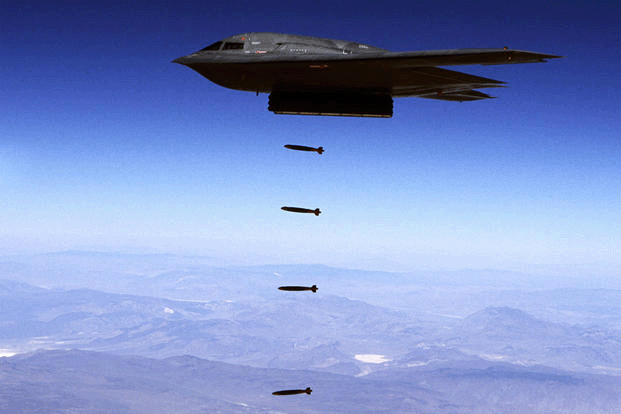
Australia is the only foreign country publicly known to have provided direct military support for the B-2 strikes in Yemen.
The obvious question that comes to mind therefore is why the Australian government acquiesced to involving Australia in the B-2 strikes?
what, if any, are the limits to Australia’s support for US strategic bomber operations should the region become engulfed in all-out war?
s. Washington now views Australia as ‘the central base’ of its Indo-Pacific operations squarely targeted at China
By Vince Scappatura Nov 12, 2024
Australian territory has been used in supporting US B-2 bombers en route and in return from strikes against Houthi targets in Yemen on October 17, and highlights the profound strategic significance of this event for the future role Australia may play in US strategic bomber operations against China, in the Asia Pacific and beyond.
NAPSNet Special Report:
Vince Scappatura, “B-2 BOMBER STRIKES IN YEMEN AND THEIR SIGNIFICANCE FOR AUSTRALIA”, NAPSNet Special Reports, November 11, 2024, https://nautilus.org/napsnet/napsnet-special-reports/b-2-bomber-strikes-in-yemen-and-their-significance-for-australia/
I. Introduction
Washington now views Australia as ‘the central base’ of its Indo-Pacific operations squarely targeted at China; and the strikes in Yemen make clear that the United States is willing and able to utilise its new base capabilities in Australia to devastating effect.[1]
Vince Scappatura documents the novel use of Australian territory in supporting US B-2 bombers en route and in return from strikes against Houthi targets in Yemen on October 17, and highlights the profound strategic significance of this event for the future role Australia may play in US strategic bomber operations in the Asia Pacific and beyond.
Vince Scappatura is Sessional Academic in the Macquarie School of Social Sciences at Macquarie University, and author of The US Lobby and Australian Defence Policy,………………………………………….
The global significance of B-2 strikes in Yemen
In a statement published late on the evening of Wednesday 16 October 2024 (EDT), Secretary of Defense Lloyd Austin revealed US forces had conducted strikes against five hardened underground weapons storage locations in Houthi-controlled areas of Yemen.[1] Although the US Navy also played a role in the operations, US Central Command announced the use of US Air Force B-2 Spirit long-range stealth bombers.[2]
The decision to launch strikes using the distinctive bat-wing bomber, which has been employed relatively infrequently in combat operations, contains a significance beyond the immediate conflict with the Houthis and carries implications that have assumed greater importance in light of the results of the recent US presidential election.
In the first instance the strikes signal the possibility of a larger conflagration in the Middle East, with the B-2’s unique combination of stealth and ‘bunker buster’ capabilities sending a clear message to Iran about America’s commitment to the defence of Israel; a commitment Washington has made even as Israel has taken a series of escalatory steps against Iran that have placed the region on the brink of all-out war.
However, they also carry a broader significance in demonstrating the ability of the US Air Force to deliver devastating strikes worldwide, including nuclear strikes due to the dual-capable role of the B-2, which is particularly salient for any future operations against both China and Russia.
Moreover, the B-2 strikes have momentous strategic implications for Australia, although this fact was left unexamined in media coverage of the event.
The Australian Department of Defence (hereafter Defence) confirmed to the Australian Broadcasting Commission (ABC) that Australian airspace and airbases were accessed in support of the strikes.[3] This participation marks the first time since World War II that Australian territory has been directly used to support US strategic bomber operations.
This novel use of Australian territory follows significant infrastructure developments at airbases across the north of the country, still ongoing, that are ultimately being developed to enable full-spectrum support for US ‘deterrence’ operations against China.[4]
The B-2 strikes in Yemen are the first active demonstration of these developing capabilities and a harbinger of more comprehensive Australian support for any future US strategic air operations, including potential nuclear missions, perhaps in the Middle East, but also ultimately against China and even Russia.
The Australian government is yet to acknowledge the profound strategic implications foregrounded by the strikes in Yemen, while Defence has been unnecessarily opaque about the details of the operation. A full account and wide understanding of Australia’s role in the strikes and what it portends are crucially important for democratic transparency and accountability, while the spectre of the forthcoming Trump administration contributes to the urgency.
Trump’s erratic and unpredictable decision-making, combined with the president’s sole authority over the use of nuclear weapons, highlights the risks of the United States, and by implication, Australia, becoming engulfed in a fateful conflict that is neither anticipated nor desired by their respective peoples. If there was a time for Australian political leaders to be forthright about the dangers of positioning Australia in the frontline of US strategic bomber operations it is now more than ever.
A rare bomber strike; and a message to Iran
…………………………………………….The Pentagon refused to divulge the specific type of ordinance that was employed in the strikes, although an anonymous source revealed to a specialist military journal that the B-2s dropped 2,000-pound BLU-109 JDAM ‘bunker buster’ bombs.[8]
Of particular significance for Iran is the fact that the B-2 is uniquely capable of employing the 30,000-pound GBU-57 Massive Ordinance Penetrator (MOP) in combat operations, reportedly reaching targets of up to 200 feet underground.[9] Iran’s nuclear facilities are known to be deeply embedded underground at Fordow and Natanz and could only plausibly be destroyed by the employment of the MOP.[10]
Although Iran wasn’t mentioned by name, the Pentagon made it clear that the employment of the B-2 was not only a message to the Houthis but any ‘potential adversaries that hide things deep underground. It’s a message to them as well.’[11]
An historic first for Australia
Although aspects of the Australian role in supporting the B-2 strike mission remain unclear, the fact that it prefigures future support for a range of US missions involving conventional and nuclear forces in contingencies anywhere in the world demands a full account and understanding.
Australia is the only foreign country publicly known to have provided direct military support for the B-2 strikes in Yemen. Moreover, achieving this level of logistical cooperation represents a significant milestone in Australia-US military cooperation.
In its statement to the ABC, Defence declared that support for US strikes in Yemen was provided ‘through access and overflight for US aircraft in northern Australia’. The ABC also reported that air-to-air refuelling aircraft were part of the mission, although Defence declined to confirm this claim.[12]
The precise extent and nature of Australia’s support is still unknown, including whether any Australian Defence Force (ADF) capabilities were employed in support of the B-2 bombers. Defence has so far declined to comment further about Australia’s involvement, citing operational security. However, a Defence department spokesperson did issue a clarification to the ABC that American B-2s were not operating out of RAAF Base Tindal in the Northern Territory at the time of the strikes.
RAAF Base Tindal is currently undergoing a major infrastructure expansion project to support the future forward-deployment of up to six B-52 (and eventually, possibly B-2 and B-1) strategic bombers, along with refuelling and transport aircraft. The upgrades include a squadron operation facility for mission planning, crew briefings and intelligence, along with maintenance facilities, strategic fuel reserves, and earth covered magazines for stockpiling munitions. The massive fuel storage facilities at Tindal have already been completed.[13]
B-2 bombers are known to have been operating out of RAAF Base Amberly in Queensland across the months of August and September in a Bomber Task Force mission that saw the aircraft covering vast distances throughout Australia and the Indo-Pacific, including ‘hot pit’ refuelling at the US base in Diego Garcia. However, the BTF mission had concluded by September 18.[14]
The clarification about Tindal issued by Defence, along with the nondescript use of the term ‘US aircraft’, leaves open the possibility that B-2 bombers operated from other RAAF bases in northern Australia, either en route or in return from Yemen, although there is no operational reason for the B-2s to have landed in Australia as against overflying and refuelling from aircraft operating from Australian airfields.
……………………………..photos taken by local Australian aviation enthusiasts provide evidence for a plausible scenario whereby US tankers operating out of Australia were used to refuel US B-2 bombers both enroute and in return from strikes in Yemen.
Western route to the Middle East
To fly over Australian airspace enroute to Yemen, US B-2 bombers are likely to have flown west over the United States and out across the Pacific Ocean before continuing over northern Australia and across the Indian Ocean to their eventual target.
A similar route, although traversing further to the north of Australia into Southeast Asia, was used when B-2 bombers launched strikes against the Taliban in Afghanistan in the aftermath of the terrorist attacks on 11 September 2001. To reach their targets without landing, the bombers were required to carry out aerial refuelling five times off the coasts of California, Hawaii, Guam, the Strait of Malacca and finally Diego Garcia (see figure 1).[16]
Although there is a shorter and more direct route to Yemen flying east from the United States, this path has the advantage of avoiding the need to inform and seek permission from several countries in Europe and the Middle East whose airspace would otherwise be traversed. Flying a carefully plotted western path over northern Australia would avoid the airspace of several Southeast Asian states with large Islamic populations and potential political sensitivities to the strikes. Whether intended or not, it also signals to China and Russia that US strategic airpower can attack them via their ‘soft’ southern underbelly as was planned and exercised during the Cold War.
Overflying northern Australia
The presence of B-2s over Australian airspace at the time of the strikes in Yemen can be confirmed by aircraft communications with civilian air traffic control towers responsible for managing Australia’s airspace.[17] This type of communications is publicly available via online sources such as LiveATC.net.[18]
………………………………………………….Having left their location in the Coral Sea after checking in with the Brisbane Centre on October 16 at 3pm AEST, the B-2 bombers arrived at their target destinations in Yemen approximately 19 hours later at around 3am in local time on October 17.[24]
As reported by ABC News, air-to-air refuelling aircraft were a part of the B-2 mission that logistically required ‘access and overflight’ in northern Australia. This claim was neither confirmed nor denied by Defence…………………………………………………………………………………………………………………..
Unanswered questions
There was no immediate post-strike assessment provided by the Pentagon when the strikes in Yemen were first announced on October 16………………………………………..
Although the Pentagon provided only scant details of the strikes, there has not to date even been an official statement about Australia’s participation in the operation made by the Minister for Defence or released on the website of the Australian Department of Defence. Nor has there been a post-operation account about the success or otherwise of the strikes.
This lack of transparency by Defence is typical but especially unwelcome given the operation marks an escalation in Australia’s participation in the conflict in the Middle East and especially its contested role in providing direct and indirect support to Israel in its wars in Gaza and Lebanon where there are reasonable grounds for believing war crimes and even genocide have been committed.[33]
Defence frequently promotes capability demonstrations of increased interoperability between the ADF and US military forces in official media releases, and Australia’s participation in the US strikes in Yemen represents the first combat demonstration of how Enhanced Air Cooperation under the framework of the US Force Posture Initiatives can be successively used for strategic bomber operations.[34] But if the joint operation was intended to contribute to ‘deterrence’ then the logical approach would have been to draw attention to it.
The obvious question that comes to mind therefore is why the Australian government acquiesced to involving Australia in the B-2 strikes? Australia’s long history of reflexive support for US military operations probably goes a long way in explaining the decision. But incremental decisions announced in a series of recent AUSMIN consultations has led to an unprecedented degree of Australia-US defence integration with implications for Australian participation in US global military operations that political leaders in Australia may not have fully appreciated.[35]
Whatever the rationale, Australians have a right to know about the nature and extent of Australia’s support for the strikes in Yemen, including what US aircraft were involved and what Australian bases they may have operated from. Specifically, Defence should be transparent with the Australian people about the following questions:
- Although it seems unlikely, did the B-2s in fact land at any Australian bases?
- US aerial refuelling aircraft were undoubtedly part of the mission. But did they draw from Australian or US dedicated fuel reserves?
- Were any ADF capabilities employed to support the B-2 strikes during their overflight of Australia or in the region more broadly?
- What assessment was made to ensure Australia’s participation in the strikes was compliant with International Humanitarian Law?
Finally, participation in the B-2 strikes in Yemen have taken Australia a step closer to becoming further entangled in the conflict in the Middle East. This leads to the obvious question of what, if any, are the limits to Australia’s support for US strategic bomber operations should the region become engulfed in all-out war?
Merely citing ‘operational security’ in refusing to answer such questions is wholly inadequate. Democratic transparency and accountability require any potential operational security concerns to be fully explained and justified.
The future of US strategic bomber operations in Australia
Although the strikes in Yemen point to the risks Australia faces in reflexively supporting its ally in yet another conflict in the Middle East, ultimately this unique demonstration of Australia’s growing capabilities to contribute to US strategic air operations is a harbinger of more comprehensive support for any future US conflict with China and/or Russia.
The Australian government has displayed no willingness to publicly acknowledge, let alone debate, the implications of America’s steady military buildup in the north of the country and the deepening integration of the ADF with US armed forces. Washington now views Australia as ‘the central base’ of its Indo-Pacific operations squarely targeted at China; and the strikes in Yemen make clear that the United States is willing and able to utilise its new base capabilities in Australia to devastating effect.[36]
It is critical therefore that the Australian public and its political leaders at all levels comprehend the profound implications of participating in the B-2 strikes in Yemen. It prefigures similar and more prominent roles for Australia in American conventional and nuclear operations not only in the Middle East, but in East Asia and the Pacific, and especially around China and even Russia.
Although tactical surprise may require opacity before and during such a joint operation, there is no excuse for the failure to share with the Australian people what Australia has done, not least so that they are prepared to make informed judgements that will restrain or enable future expanded joint operations now envisioned by the two governments under the 2014 Force Posture Agreement and more recent AUKUS rubric, but not shared with their respective peoples.[37]
Until a full official account is provided, observers could be forgiven for assuming that supine acquiescence on the part of the Australian government in supporting American strikes combined with Defence’s utter lack of accountability explains how Australian airbases and airspace were utilised to support the B-2 strikes in Yemen.
III. ENDNOTES – 1 – 37…………………………………more https://johnmenadue.com/b-2-bomber-strikes-in-yemen-and-their-significance-for-australia/
TODAY. Cop 30 Climate Summit probable change of venue – CorporateHub, Hades

by Nicholas Beelzebub Lucifer, 14 November 2024 https://theaimn.com/cop-30-climate-summit-probable-change-of-venue-corporatehub-hades/
I was a bit disappointed not to be invited to Cop 29, the 2024 United Nations Climate Change Conference. But cheered up by the fact that anybody who’s really anybody is boycotting this fossil fuel financial talkfest is boycotting it anyway – Chinese President Xi Jinping, US President Joe Biden and Indian Prime Minister Narendra. Heck, even little U.S. hanger-on Australia’s not sending their little man.
And, I can assure you, that even though uninvited, I have had an influence on these gatherings right from the start. International climate action began with the United Nations Framework Convention on Climate Change (UNFCCC) in 1992, but , really, nothing substantial happened until the Kyoto Protocol in December 1997, when nations sort of agreed to cut their greenhouse gas emissions. I happily predicted that this was doomed to failure, with the USA refusing to sign up, with China not included, and emissions target reductions woefully inadequate. Meanwhile the many Conferences of the Parties (COPs) held since 1995, have had the aim of reducing global warming, but with little effect .
My minions have worked on behalf of the polluting industries, and little Australia has been especially ingenious in appearing to support climate action, right from its original reluctance to sign and ratify Kyoto, through to its later ingenious use of carbon credits, to weaken climate action, despite its Kyoto and later Paris 2015 climate commitments.
Look, I’m acknowleging those tireless operators from many countries, who forwarded my interests – people like Mike Pompeo, (Who’s gone on to my greater causes – weapons and war), and Charles and David Koch, and the many thousands of well-paid lobbyists for fossil fuel companies. I do have a soft spot for Australia’s Scott Morrison, (who has now joined Mike Pompeo in the “defence” area)
It’s been so encouraging – in 2023 -the work of SULTAN AHMED AL JABER, and now Azerbaijan’s President Ilham Aliyev at Cop 29 – “Oil and gas are a ‘gift of God'”
But now it is time to take things into my own hands. So, while Brazil planned for COP 30 is OK (I’m happy that President Lula da Silva is boycotting COP 29) – well, it’s not adequate. COP 30 should be held in my capital, CorporateHub, Hades.
I’ve waited a long time, since I was so unjustly expelled from my top position in that smug boring country above, that tries to suck souls up. Indeed, since then, my goal has been to “go up and down, to and fro in the earth, seeking to destroy the souls of men”. I’ve had moderate success, with quite a few men. Women have been more difficult, but they shouldn’t count anyway. Indeed, if we can eliminate abortion, contraception, family planning etc, they’ll soon be put back in their place.
Mightily powerful and great as am, I could use a bit of help from the human species. And now, comes the time of opportunity. Not only is the USA President boycotting the current climate conference, but the President-elect, Donald Trump is strongly on my side on this climate matter(and on quite a few others!).
Under Trump the USA will:
- again withdraw from the Paris agreement,
- end climate reporting and regulation, politicising Environmental, Social, and Governance (ESG) criteria and related climate policies,
- hinder the renewable energy transition by gutting Biden’s Inflation Reduction Act (IRA)
His appointments to his coming administration bring joy to my heart: they mostly focus on my other favourite causes – like hatred of China, and support for Israel’s genocide of Gazans. But I’m sure that Trump will bring thorough attention to the climate issue. He’s starting by choosing Lee Zeldin to lead the Environment Protection Agency. I am disappointed that he’s excluded my old friend Mike Pompeo. But there’s plenty of time to remedy that, when Donald moves on from those primary causes. Happily the great Elon Musk used to be on the side of the climate activists – but now, dedicated to colonising Mars, Elon is back in my camp.
In the meantime, COP 29 is making a good start. Papua New Guinea’s pulled out of the climate summit due to frustration over “empty promises and inaction”. Squabbles over finance are the big thing now, in notoriously corrupt Azerbaijan. Already, Argentina has withdrawn due to dissatisfaction over climate finance negotiations.
UN Secretary-General António Guterres warns of “a stampede of greed that crushes the poor.”
There are so many COP goals that interfere with mine, and with corporate interests – the main goal – cutting back to net zero greenhouse gas emissions – ridiculous and intolerable! Fortunately the big new thing, AI, just has to have boundless energy, boundless fossil fuel emissions, the and then radioactive emissions from nuclear power. Then there’s the absurdity of cutting back on water use, and deforestation. Oh it’s a good new era for me, and all my fellow fallen cherabim, and for our all our devout corporate, political and media followers.
So, I look forward to a robust discussion on the way forward for future COP climate summits. We will ban that disgraced Antonio Guterres and his ilk. We will have a truly glorious international, intergalactic meeting in our capital city, CorporateHub, in Hades.
Australian nuclear news 11- 18 November.

Headlines as they come in:
- Plan to dispose of nuclear waste from Aukus submarines unanimously rejected by Adelaide council
- Adelaide residents blindsided by decision to store AUKUS nuclear waste at submarine shipyards
- B-2 Bomber Strikes in Yemen and their significance for Australia
- Australia’s Role in Military Alliances: Risks to Sovereignty.
- Trumped: $9B to US and UK shipyards … but why not make Australia make again?
- Nuked: The Submarine Fiasco that Sank Australia’s Sovereignty, book by Murray Horton
—
Trumped: $9B to US and UK shipyards … but why not make Australia make again?

The Government is shy on spending money on a steel works which they would have complete control over, in terms of success, but are happy to recklessly throw money at US shipyards.

Senator David Shoebridge: “The AUKUS submarine deal is a non-refundable $368 billion gamble on the goodwill of some future US President, and the US just elected Donald Trump. You only need to put these two facts side by side to realize what a disaster the whole thing is.”
by Rex Patrick | Nov 16, 2024, https://michaelwest.com.au/aukus-9b-to-us-and-uk-shipyards-but-wait-theres-more/
Make Australia Make Again?
The future of Whyalla’s steelworks is of vital national importance and should matter to all of us. It is critical to Australia’s manufacturing, construction and national security and resilience.
Being frank, the steelworks are in dire straits. They are 60 years old and have been on a rocky road for well over a decade. Its blast furnace has been out of action for over six months now, and whilst there is some optimism that they will get it back up and running it will not change the fact that the steelworks have been in operation for some six decades.
In 2016 when the previous owner, Arrium, went into administration with $4 billion in debts, UK billionaire Sanjeev Gupta’s GFG Alliance bought the steelworks making lots of big promises for a bright future, but it was not to be. At the turn of the decade Greensill Capital, GFG’s financier, collapsed and there’s been trouble ever since.
As it stands, the future of the steelworks, and Whyalla, is in the hands of a court entangled foreign billionaire with a gaping chasm between his promises and delivery. Those promises of a 21st century industrial transformation look very much like ever receding mirages.
The Federal Government needs to have the SA Government bring matters to a head by putting GFG’s South Australian operations into administration (by calling for unpaid and overdue mining royalties), taking an equity stake in the steelworks alongside someone like BlueScope Steel, and investing the necessary billions to build a new green steel industry for Australia.
It would be a part of Make Australia Make Again.
Make America Great Again!
Prime Minister Albanese’s focus is on investment in US industry, not Australian industry.
In September 2023 the Federal Government announced it was pouring $4.7 billion ($US3B) into the US submarine industrial base to assist the largest economy in the world get their submarine production rate up to 2.3 subs per annum (from the current rate of 1.4 subs).
Some $1.5 billion will be paid to the US this financial year, and $1.8 billion next financial year. The remaining $1.4B will follow thereafter.
The Government is shy on spending money on a steel works which they would have complete control over, in terms of success, but are happy to recklessly throw money at US shipyards.
Go figure!
Make Great Britain Great Again Too!
That’s not the end of the story though.
The British are in on this deal of a lifetime too. They’ve managed to pull $4.4B (£2.4 billion) over the next decade from Australian consolidated revenue.
There is no clawback on payment to the United Kingdom either.
Everyone must be feeling pretty chuffed in Groton, Connecticut, and Barrow-in-Furness, England.
But Wait, There’s More!
Whilst the Federal Government has been open about the totals, albeit with a little ‘encouragement’ from Green’s Senator David Shoebridge at Senate Estimates, there’s a dark secret being withheld from the Parliament and the public.
There’s more ‘shared’ cost to come.
FOI returns from the US Department of the Navy reveal that behind the scenes the three AUKUS government participants have been negotiating trilateral cost sharing principles to guide future cost sharing negotiations.
Whilst the Federal Government has been open about the totals, albeit with a little ‘encouragement’ from Green’s Senator David Shoebridge at Senate Estimates, there’s a dark secret being withheld from the Parliament and the public.
There’s more ‘shared’ cost to come.
FOI returns from the US Department of the Navy reveal that behind the scenes the three AUKUS government participants have been negotiating trilateral cost sharing principles to guide future cost sharing negotiations.
Senator David Shoebridge backed this in telling MWM, “Why on earth do cost-sharing principles need to be secret? Of course they should be made public.”
He went on to comment, “Once again, we get more transparency on AUKUS out of the US than Australia.“
“The one-sided secrecy is because the US has a whole lot less to be embarrassed about than Australia. They are the ones getting all our money after all.”
Transactional Trump
Transactional Trump
The approved appropriations in the US for enhancing their submarine industrial base through upgrades as well as recruitment and training of thousands of additional workers amount to $US14.7B. Australia adds another $US3B to that. But the total the US administration is seeking for this work is in the order of $US28.4B.
Of course, there is some quid quo pro in all of this with the Australia Government having committed to spending $8 billion upgrading HMAS Stirling near Rockingham to support the operations of UK and US nuclear powered submarines from 2027, and possibly Australian nuclear submarines from 2035.
There is a danger under the incoming Trump administration that the President will seek a greater contribution from Australia – just as he has demanded that members of NATO pull their weight. And it will be a case of having no choice but to pay, no matter the cost sharing principles negotiated, because our Defence Department simply has no Plan B.
Senator Shoebridge commented, “The AUKUS submarine deal is a non-refundable $368 billion gamble on the goodwill of some future US President, and the US just elected Donald Trump. You only need to put these two facts side by side to realize what a disaster the whole thing is.”
Ships and Steel
Meanwhile, as Australian money is being tossed around the US and UK like it’s free, Albanese is sitting on his hand on the issue of green steel manufacturing in Whyalla.
Anthony Albanese says he wants to revitalise manufacturing and Make Australia Make Again. But in this topsy-turvey world, he’s instead working to deliver on Donald Trump’s slogan to Make America Great Again.
Resisting the nuclear export and import policies in the age of climate crisis – Webinar on the International Joint Response to Nuclear Expansion

No Nukes Asia Forum (NNAF) is organising this webinar on Tuesday 19 November. Note that the time listed for Australia is “ACST” – ie Adelaide time. Please adjust to fit your time zone.
It will be an opportunity to hear about South Korea’s nuclear export program. As you are no doubt aware, South Korea’s APR1400 and APR1000 reactors have been promoted by the Coalition as candidates for Australia. South Korea constructed the United Arab Emirates reactors on which the Coalition is basing its (unrealistic) timeline.
As the climate crisis grows more serious, countries worldwide are promoting energy transition policies to reduce the use of fossil fuels. Meanwhile, some countries also pursue strategies to expand nuclear power plants by including nuclear power in their energy transition policies. The nuclear industry is emphasizing nuclear power as an alternative solution to the climate crisis, and it is expanding with small modular reactors (SMRs) that are costly and not feasible at present and conventional nuclear power plants with long construction processes. In Asia, South Korea and Japan have been promoting the export of nuclear power plants to the Philippines, Turkiye, Indonesia, and Thailand. Nuclear power plants’ safety and economic feasibility are not achievable and this is an undemocratic policy.
In response, we will host a webinar with Asian nuclear disarmament organizations to examine the current status of nuclear power plant exports and explore ways to jointly respond internationally. We look forward to your interest and participation.
○ Date: November 19 (Tue), 2024, 3:00-5:00 PM (UTC+9)
– Turkiye (UTC+3): 9:00-11:00 AM
– India (UTC+5:30): 11:30 AM – 1:30 PM
– Indonesia/Thailand (UTC+7): 1:00-3:00 PM
– Manila/Taipei (UTC+8): 2:00-4:00 PM
– South Korea/Japan (UTC+9): 3:00-5:00 PM
– Australia (ACST, UTC+10): 4:00-6:00 PM
○ Location: Zoom Webinar / Zoom link will be sent via email later
○ Organized by: No Nukes Asia Forum (No Nukes Asia Form)
Korean organizers: Citizens’ Action for No Nukes, No Nukes News Media Cooperative, Yoon Jong-oh(National Assembly’s member) of the Progressive Party of Korea, National Assembly Economy Forum on Climate Crisis & Decarbonization
Philippines Organizer: Nuclear-Free Bataan Movement(NFBM), YoungBEAN, KILUSAN, Green Peace PH
Japan Organizer: Citizens’ Nuclear Information Center
Turkiye Organizer: Nukleersiz
○ Primary language: English / Interpretation: Korean
○ Presentations (15 minutes each)
Moderator: Korea (Kim Hyunwoo, No Nukes News) & Philippines (DJ Janier, KILUSAN)
Presentation 1: Korea’s Nuclear Power Plant Export Strategy and Issues / LEE Heonseok (Energy Justice Actions)
Presentation 2: Problems of Resuming Power Generation at the Bataan Nuclear Power Plant in the Philippines / NFBM
Presentation 3: The Overview of Japanese Failed Nuclear Exporting Project: Hajime Matsukubo(CNIC)
Presentation 4: On Nuclear Power Plant Projects and Problems in Turkiye and the Export Strategy of Russia/ Pinar Demircan(Nukleersiz)
○ Q&A and discussion: 40 minutes
○ Summary and closing remarks: 20 minutes
○ Contact: GreenReds@gmail.com
○ 참가 신청(한국어) : bit.ly/3AB2yjs
○ Registration Form(English): bit.ly/3AE0JlV
Australia’s Role in Military Alliances: Risks to Sovereignty
November 12, 2024 by: The AIM Network
By Denis Hay
Description: Australia’s role in military alliances poses risks to sovereignty. Discover how AUKUS and BRICS impact Australia’s independence and security.
Australia’s Role in Military and Financial Alliances: Navigating Risks and Sovereignty
Australias role in military alliances and position in global military and financial systems has sparked intense debate. With deeper ties to U.S.-led military alliances, Australia’s sovereignty, economic stability, and security face growing questions. This article explores how Australia’s military alliance through AUKUS and its financial alignment with Western powers affect its autonomy, and considers how aligning with emerging economies in BRICS could provide a more balanced and sovereign path forward.
Military and Economic Dependence Risks for Australia
The ‘Brisbane Line’ Redux: Australia’s Military Role in AUKUS
Australia’s military alignment with the United States and United Kingdom, through the AUKUS pact, has seen Australia take on significant strategic responsibilities. AUKUS strengthens Australia’s military capacity, but it also intensifies its role as a potential staging ground for future conflicts in the Indo-Pacific region.
This positioning is reminiscent of the historical ‘Brisbane Line’ in WWII, where parts of Northern Australia were seen as disposable in defence plans. Today, the U.S. divides Australia into three zones for strategic purposes:
- Zone 1: Northern Australia for U.S. force projection.
2. Zone 2: Central Australia as a logistics hub. - Zone 3: Southern Australia for industrial and munitions production.
Financial Commitments Under AUKUS and the “No-Refund Policy”
Australia has committed an estimated AUD $368 billion for submarines under AUKUS. However, a “no-refund” policy means that even if the U.S. fails to deliver submarines, Australia would still be financially responsible. This financial burden raises concerns about Australia’s economic autonomy and public spending priorities.
Economic and Security Concerns
This financial dependency extends beyond hardware, with Australia agreeing to resource and industry allocations that make it a ‘resource base’ for U.S. and UK strategic interests. The Pentagon’s plans for Australia risk positioning the country as a proxy in global conflicts, making Australia a likely target rather than a protected ally.
Former Ambassador John Lander recently warned that Australia’s close alignment with U.S. military strategy puts the nation at greater risk of becoming a target, especially with Australia’s defence capabilities primarily serving U.S. interests.
Heightened Dependency and Lack of Sovereignty
The Strategic Bullseye on Australia’s Back
Australia’s role within AUKUS places it at the frontline in any Indo-Pacific conflicts, particularly with China. U.S. forces in Northern Australia, including B52 bombers, along with expansion plans for nuclear submarines and airbases, indicate that Australia could be a primary target in regional conflicts. This heightened military presence is often viewed as an increase in security; however, without a formal U.S. commitment to defend Australia, it primarily serves U.S. strategic interests rather than Australian security.
Financial Control and Dependency on Western Systems
Australia’s financial dependency on Western institutions also impacts its sovereignty. The dominance of the U.S. dollar in global trade creates risks of financial sanctions, restrictions, and compliance pressures. If Australia were to engage with BRICS or pursue independent financial structures, it would need to challenge entrenched dependencies on the U.S. financial system.
The BRICS bloc’s development of a Central Bank Digital Currency (CBDC) as a peer-to-peer settlement system offers a glimpse of potential independence from Western financial dominance, an area where Australia could consider involvement.
National Integrity at Stake
Australia’s alignment with AUKUS and its reliance on Western financial systems significantly impact its ability to act as a truly independent nation. By aligning its military strategy so closely with U.S. and UK interests, Australia risks becoming a subordinate player in global politics rather than an equal partner. This alignment has practical, cultural, and strategic repercussions that affect Australia’s sovereignty and national integrity in several ways:
1. Erosion of Independent Foreign Policy……………..
2. Economic Control Through Military Spending…………………
3. Public Discontent and Regional Divisions……………………………….
4. Risks to National Security……………………
5. Limited Diplomatic Flexibility………………….
6. Cultural Influence and National Identity……………………………….’
Reclaiming Sovereignty and National Integrity………………………
Paths Towards Sovereign Independence and Economic Stability
Re-Evaluating Australia’s Role in AUKUS
Australia can begin by reassessing its commitments within AUKUS. While Australias role in military alliances can strengthen defence capabilities, policies that prioritize Australia’s security over U.S. interests would better serve the nation.
Steps Australia could take to limit overreliance on the AUKUS alliance include:………………………………………………………………………..
Exploring Financial Independence through BRICS Collaboration…………………..
Pursuing an Independent Foreign Policy for Australia…………………….
Summary: Securing a Sovereign Future for Australia
Australia’s position as a key ally in AUKUS and a participant in U.S.-led financial systems has significant implications for its sovereignty. While these alliances provide certain benefits, they also pose risks to Australia’s autonomy and security. By reassessing Australias role in military alliances, exploring financial partnerships with BRICS, and developing a national interest-centred foreign policy, Australia can work towards greater sovereignty and stability.
Thought-Provoking Question
Do you think Australia’s strategic alliances serve its best interests, or do they put the nation at greater risk?
Call to Action……………………………….. more https://theaimn.com/australias-role-in-military-alliances-risks-to-sovereignty/
Secrecy ramping up as problems mount in the UK nuclear programme

The reliability issues in the Vanguard fleet, and extended patrols they have caused, are the most visible issues, but there are many more.
HMS Vanguard has rejoined the fleet after its extended seven year deep maintenance and refuelling, but appears not to have been sent out on patrol for many months after rejoining the fleet. We saw a failed missile test-firing earlier this year and the fire on HMS Victorious in 2022. The entire Astute-class fleet was unable to put to to sea for five months this year, and it’s possible that the problems that caused this may surface in the incoming Dreadnought fleet.
David Cullen NIS 12th Nov 2024
The UK’s nuclear weapons programme is at a critical stage with mounting problems, and secrecy is being increased when transparency and accountability are more vital than ever. Routine public disclosures of information are now months overdue, nearly a year in one case. At the same time, the increasingly draconian approach to secrecy from the Ministry of Defence (MOD) is limiting the information that they will disclose through Freedom of Information (FOI) requests, or in response to Parliamentary Questions.
The current level of public disclosure about the programme is lower than any time since at least the early 1990s. Without proper scrutiny there is no meaningful way for the public to understand what is happening, or for elected representatives to challenge it, and the likely result will be greater mismanagement, increased safety risks and a waste of huge sums of public funds.
At Nuclear Information Service (NIS) we prefer to focus on the content of our work, rather than drawing attention to ourselves and what we do, but these levels of secrecy are unprecedented during the 24 years we have been operating and we have decided to speak out. Whatever your position on nuclear weapons, the current information black hole is antithetical to good governance, and fundamentally unacceptable in a democracy.
Missing updates to Parliament
From 2011 to 2023, the MOD published an annual update to Parliament on the progress of its nuclear weapon upgrade programmes. The first of these was the ‘Initial Gate’ report on what is now known as the Dreadnought Programme, summarising the first few years of scoping work undertaken by the MOD and the plans for the new submarine class. From 2012 to 2021 these were routinely published shortly before Christmas (with the exception of 2015, when the Strategic Security and Defence Review published that November was deemed to have included enough information that there was no separate update).
The 2022 update was not published that year. NIS submitted an FOI request in January 2023 asking for a publication date and we were told in early February the update was “expected to be released in the coming weeks”. In response to a Parliamentary Question in late February from John Healy, who has since become Minister for Defence, the MOD said the update was “undergoing final clearance procedures”. No reason was given for the delay, despite this being explicitly asked by Healy and in a subsequent question submitted by Baroness Blower. The update was finally published on 8th March. The end of the update stated that the MOD planned “to next report progress to Parliament in late 2023”.
The 2023 update has not been published at all. NIS contacted the MOD in early December 2023 to ask what the planned publication date was and were told the annual update was “an enduring commitment by the MOD to Parliament…[but] there is no prescribed timeframe for its release” and the MOD was “unable to provide a date for its publication”. It is now early November 2024, nearly two years after the time period covered by the last update. In what sense can the MOD credibly describe these updates as annual?
Major Projects data not yet released
The other annual release of information about the progress of the MOD’s nuclear upgrades is the government’s Major Projects Data releases. These are coordinated by the Infrastructure and Projects Authority (IPA), a quasi-independent branch of government which sits under the Cabinet Office and is supposed to help ensure the government’s large projects are well managed and provide value for money. Projects are given a traffic-light colour rating, with many of the projects relating to the nuclear weapons programme being given ‘Amber’ or ‘Red’ rating, indicating respectively that they face serious problems, or appear unachievable.
Alongside the report published by the IPA which summarises the ratings for each programme and makes some general observations about programme management, data is published by each government department on their respective programmes. This includes predicted end dates, costs and a brief explanation of progress and/or problems. Since 2016 these have been published each July. Although the election this year may have interfered with the publication timetable, the data is typically assembled in March of each year, two months before the election was called. As it is now four months since the election, it is difficult to understand why the data has not been published.
Resistance to information disclosure
These missing information releases come at a time when the MOD is significantly more resistant to disclosing information to the public and parliamentarians than it has been in the past. In recent years key pieces of information have even been withheld in the MOD Major Projects releases. The 2022 release had redactions relating to the Astute, Dreadnought, Core Production Capability, Mensa, Pegasus and Teutates projects.
When NIS challenged these redactions we were told that that some were the consequence of an “anomaly” which caused them to be “withheld erroneously”. However, the planned end dates for the Astute and Dreadnought programmes were still withheld, as was the MOD narrative on the timetable for those two projects. The MOD took eight months to complete an internal review of this decision, instead of the maximum expected time of forty working days, and upheld the decision.
The FOI requests we submitted for our recent briefing on the US-UK Mutual Defence Agreement were treated similarly, although the delays were shorter. No information has been disclosed to us on the transfer of nuclear materials under the MDA between 2014 and 2024, and only three years of data on the transfer of non-nuclear components of nuclear weapons has been released, with the excuse that extracting the information would take too much time……………………………………………………………………………………….
This antipathy to disclosure is reflected in the recent changes to the government’s stance on official figures relating to its nuclear stockpile. These came in the 2021 Integrated Review, alongside the announcement of an increase to the UK’s warhead stockpile cap, breaking with a decades-long trend of reductions. Figures for the numbers of operational warheads that the UK owns, for deployed warheads, or deployed missiles are no longer published. These changes are a breach of commitments made by the UK and other nuclear-weapon states at the 2000 and 2010 Non-Proliferation Treaty (NPT) review conferences to increased transparency about their capabilities.
Foreclosed FOI avenues
The questionable role of the ICO, which is responsible for regulating FOI matters in the UK, is sadly not limited to the dubious interpretation of the rule on ‘similar’ requests. Our appeals to the ICO over the missing data from the 2022 Major Projects release and on the transfer of nuclear material under the MDA have both been recently rejected………………………………..
Under the FOI Act, we technically have the right to appeal to the Information Tribunal, but in this case there is no prospect of us being meaningfully able to exercise that right. In previous Information Tribunal cases, such the 2019 case over the government’s withholding of reports from its internal nuclear safety regulator, the MOD can refrain from making its key arguments in open court, and will instead make them in a closed session which we would not be able to attend.
If we wished to make a meaningful case at tribunal with any realistic hope of success, we would face the kafkaesque prospect of needing to employ a barrister who we could not even properly instruct, as we do not know what arguments are being made by the MOD. The position of the ICO suggests that most of the case would be heard in closed session and we would have little chance of winning. As rulings of the tribunal create FOI case law, it would actually be irresponsible for us to bring a case under these circumstances.
State of the programme
It is not hard to think of reasons why the MOD wishes to minimise information in the public domain about the weapons programme, considering what we do know about the state of the programme and its upgrade projects. The reliability issues in the Vanguard fleet, and extended patrols they have caused, are the most visible issues, but there are many more.
HMS Vanguard has rejoined the fleet after its extended seven year deep maintenance and refuelling, but appears not to have been sent out on patrol for many months after rejoining the fleet. We saw a failed missile test-firing earlier this year and the fire on HMS Victorious in 2022. The entire Astute-class fleet was unable to put to to sea for five months this year, and it’s possible that the problems that caused this may surface in the incoming Dreadnought fleet. It seems likely that US submarines had to help during the recent change in Vanguard patrols. There may be additional delays to the Dreadnought programme, particularly after the recent fire at Barrow, which would put additional strain on the Vanguard fleet.
There may be additional details of, or implications from, any of these problems, or undisclosed connections between them, which could prove highly embarrassing to the MOD. There may also be additional issues beyond those we currently know about or suspect.
From the responses that we have had to our FOI requests, it seems the MOD’s argument in favour of its recourse to secrecy is fairly consistent in general terms. It claims that disclosing any information relating to the UK’s nuclear programme could allow ‘adversary’ states, particularly Russia, to draw conclusions about the capabilities and vulnerabilities of the programme. The so-called ‘mosaic effect’, where multiple pieces of individually inconsequential information can be drawn together to form a wider picture, is frequently invoked. These conclusions could then be leveraged by Russia or others to disrupt the weapons programme and degrade the UK’s ability to keep one nuclear-armed submarine at sea at all times.
It is not possible to know to what extent this hypothetical risk would remain credible when subjected to detailed critique and analysis. We only know that the MOD has been able to successfully convince the ICO and Information Tribunal of its veracity in closed forums with no external scrutiny. However, it stands to reason that this convoluted scenario would appear more credible if the UK is already struggling to maintain patrols. To what extent are the vulnerabilities the MOD cites to justify its secrecy a function of its own mismanagement? It is not possible to say, but a clear inference can be drawn from the conspicuous absence of the 2023 Update to Parliament: the MOD has chosen to say nothing rather than provide a basic overview of how its upgrade programmes are progressing.
Is the spectre of Russian interference being used as an excuse to hide MOD mismanagement and emerging problems in the programme from the public? How close is the programme to being unable to field its nuclear armed-submarines safely? What is the MOD trying to hide? The public deserve answers to these questions, and there is no reason that they cannot be given in a form that poses no risk to the security of the UK and its population. At NIS we will continue to seek what information we can to highlight these issues, but regular detailed parliamentary scrutiny is long overdue.
Members of the public have the right under the FOI Act to be provided with information on request, and ministers are expected to be candid and transparent towards Parliament under the ministerial code. When the approach of the government is to frustrate that right and avoid those obligations, and the ICO does not challenge them, this is a serious threat to democratic oversight and accountability. We welcome the recent calls from the House of Lords following the changes to the Mutual Defence Agreement, but as the Public Accounts Committee stated earlier in the year, there is also gap in the parliamentary scrutiny of government nuclear spending. We believe the gap is actually much wider, and it is time for regular and detailed scrutiny by Parliament of the whole UK nuclear weapons programme. https://www.nuclearinfo.org/comment/2024/11/secrecy-ramping-up-as-problems-mount-in-the-uk-nuclear-programme/
Nuked: The Submarine Fiasco that Sank Australia’s Sovereignty, book by Murray Horton

Global Peace and Justice Aotearoa, 12 Nov 24, Reprinted from Covert Action Magazine
Andrew Fowler’s book Nuked: The Submarine Fiasco That Sank Australia’s Sovereignty (Melbourne University Press, 2024) was not written by a member of the peace movement. That is both a strength and a weakness. A strength, because Andrew Fowler is an award-winning investigative journalist, who has worked in mainstream Australian current affairs TV. So, it can’t be dismissed as “anti-American, anti-military” propaganda.
But it is a weakness because the author never questions the basic tenet of the book’s subject—why does Australia need any submarines at all, regardless of whether they are conventionally powered or nuclear powered. The book’s focus is a forensic analysis of who won the highly lucrative battle to supply Australia’s new subs—it was all set up to be France but then, after hidden, sub-surface maneuvering worthy of one of the book’s subjects, Australia and the U.S. torpedoed the French and did a deal among themselves.
This book is about AUKUS (Australia, UK, U.S.), the new kid on the “Indo-Pacific” block—although it should be pointed out that the UK is an awfully long way away from either the Indo or the Pacific. It is an attempt to build a new Western military alliance, initially between those three countries but with the prospect of other countries (including New Zealand) joining the ill-defined AUKUS Pillar Two at some unspecified time in the future. But let’s not get ahead of ourselves. The book is about the birth of AUKUS, which is all about submarines.
AUKUS
I’ve written about AUKUS previously in Covert ActionMagazine, so I refer you to that for the back story. In 2016 Australia signed a $A50 billion contract for France to build it 12 state of the art conventionally powered submarines for the Australian Navy. It was the largest defence contact in the history of both France and Australia. The right-wing Liberal Party was in Government in Australia, headed by Prime Minister Malcolm Turnbull…………………………………………………………………………………………………………………….
The book names names—the man who fronted the deception and betrayal of France was Scott Morrison, who replaced Turnbull as the Liberal Prime Minister in 2018, in an internal Party coup (a common occurrence in Australian politics). Behind the scenes, the key man was Andrew Shearer, “a vehemently pro-American China hawk” who went on to become Director-General of National Intelligence. Right up until just before AUKUS was announced in 2021, Morrison’s government continued to assure France that it was proceeding with the contract to buy French submarines.
Dumping France For the U.S.
Instead of 12 diesel-powered French subs, Australia signed up to have the U.S. and UK build eight nuclear-powered (but not nuclear-armed) subs for its Navy. The cost is astronomical—up to $A368 billion by 2055. Yes, that’s right—those eight subs will not be ready for more than 30 years. The first of them is unlikely to be ready until the 2040s so, to fill that gap, Australia will buy three existing U.S. subs from the early 2030s, at a cost of up to $A58b, with an option to buy two more. This is a staggering amount to spend on one military project from a country with a population of just under 27 million people.
“(AUKUS) was a clear victory for Washington, which had been concerned for some time that France had a different view on how to deal with the rise of China… There was barely a murmur of opposition from the media. Morrison had pulled off a major achievement of what U.S. public intellectual Noam Chomsky describes as the political art of ‘manufacturing consent’…”.
“How did it happen that the bulk of analysis and criticism of the submarine deal came from two former Prime Ministers, Paul Keating (Labor) and Malcolm Turnbull (Liberal) who, though on opposing sides of politics, were united in warning that the submarine deal stripped away Australia’s sovereignty……………………………..
Australia Expected To Fight Alongside U.S. In War With China
There is only the feeblest pretense that these nuclear submarines (still decades away from reality) will be used to defend Australia. Their role will be to patrol close to the Chinese coast, to hem in the Chinese Navy and, in the event of war, to attack China with cruise missiles. That’s the theory, anyway. The advantage of their being nuclear-powered is that they don’t have to return to port to refuel. U.S. hawks expect Australia to fight on its side in any war with China over Taiwan………………………………………………………………………………………..
Integration With U.S. Military
There is a lot more to the U.S.-Australia military relationship than some exorbitantly expensive nuclear submarines that may or may not ever materialise. There is the top-secret Central Intelligence Agency/National Security Agency Pine Gap spy base near Alice Springs, in central Australia, which is crucial to the global warfighting abilities of the U.S. There is the North West Cape facility on the westernmost point of mainland Australia, which the US Navy uses to communicate with its nuclear attack subs. There is Australia’s increasing involvement with the U.S. military and intelligence satellite programme, in preparation for war in space.
“Australia’s integration with the U.S. military was, of course, well underway before the AUKUS agreement. As already noted, Pine Gap and North West Cape are part of this. But there is also the basing of thousands of U.S. Marines in Darwin (northern coast), the stationing of nuclear-capable B-52s at Tindal (Australian Air Force base, northern Australia), and the stationing of U.S. military throughout the Australian Defence Force, including from the National Reconnaissance Office at the military headquarters in Canberra… Though Defence Minister Richard Marles has ruled out automatic support of the United States in any war over Taiwan, it is difficult to see how Australia won’t be involved. Pine Gap, Tindal, North West Cape and Perth (Western Australia’s biggest city) will all be integral to the battle.”
Change Of Government; No Change Of Foreign Policy
Scott Morrison’s Liberal government was voted out at the 2022 Australian election and was replaced by Anthony Albanese’s Labor Party. But Australia’s commitment to AUKUS remained unchanged………………………………………………………………………………
“Nuked” specifically attributes Labor’s fervent desire not to be seen as “anti-American” to the events of 1975, when the Central Intelligence Agency and its local collaborators, succeeded in getting Gough Whitlam’s Labor government overthrown in a bloodless coup. The U.S. covert state was particularly concerned about Whitlam’s revelations about its Pine Gap spy base and possible threats to close it. Jeremy Kuzmarov has recently written about this in CovertAction Magazine (15/11/23), so I refer you to that.
For half a century the Australian Labor Party has lived in fear of the same thing happening again, and has bent over backwards to prove its loyalty to the U.S.
………The consequences of the fear that drove the ALP leadership to embrace AUKUS with barely a second thought will haunt them for years to come. Just as Morrison was only too willing to trade Australian’s independence for the chance to win an election, so too was Labor. Now it is left to make work a deeply flawed scheme that, more than ever before, ties Australia’s future to whoever is in the White House.”
Jobs For The Boys
And what has happened to Scott Morrison, who retired from politics in 2024? “Along with Trump’s former CIA Director, Mike Pompeo, Morrison became a strategic adviser to U.S. asset management firm DYNE Maritime, which launched a $157 U.S. million fund to invest in technologies related to AUKUS. ………
“Morrison also became Vice-Chair of American Global Strategies (AGS), headed by former Trump National Security Advisor Robert O’Brien. AGS, stacked with former Pentagon, White House and State Department officials, boasts that it ‘assists clients as they navigate U.S. government processes,’ a useful addition to any company wanting to boost profits in the burgeoning area of military spending.”
New Zealand & AUKUS
…………………………………………………………………………… There are plenty of similarities between Australia and New Zealand but also significant differences. Whereas Australian governments of either party fall over themselves to loyally serve the U.S. empire, New Zealand has been nuclear free by law since the 1980s (and it was an Australian Labor government, on behalf of the U.S., which tried to pressure New Zealand to drop the policy. That pressure backfired).
……………………………………………………………….But there is a constant push to get New Zealand further entangled in the U.S. war machine, including Pillar Two of AUKUS (which has been, thus far, only identified as involving “advanced military technology”). New Zealand currently has a very pro-American Government, which is already a non-member “partner” of NATO and which is eager to serve the U.S……………………………………..
Not All New Zealand Politicians Lining Up To Grovel To Uncle Sam.
For a refreshing contrast, here’s an extract from a recent (2/10/24) press statement from Te Pāti Māori, the indigenous party, which has six Members of Parliament (out of 123). “Meanwhile the New Zealand Government is in talks with the United States about joining AUKUS to further support their war efforts. This represents the next phase of global colonisation, and it is being negotiated behind closed doors,” Co-Leader Rawiri Waititi said.
“The U.S. wants to use Aotearoa as a Pacific spy base. This could mean the end of our longstanding nuclear free policy to allow their war ships into our waters. AUKUS threatens our sovereignty as an independent nation, and the Mana Motuhake of every nation in the Pacific. It threatens to drag Aotearoa into World War 3,” said Waititi.
“The New Zealand government is putting everyone in Aotearoa at risk through their complicity. They must end all talks about joining AUKUS immediately. They must sanction Israel and cut ties with all countries who are committing and aiding war crimes,” said Co-Leader Debbie Ngarewa-Packer………………………………. more https://gpja.org.nz/2024/11/12/nuked-the-submarine-fiasco-that-sank-australias-sovereignty-by-murray-horton/
TODAY. The International Atomic Energy Agency in full force with its lying propaganda, at COP 29, with at least 20 ‘Events”.
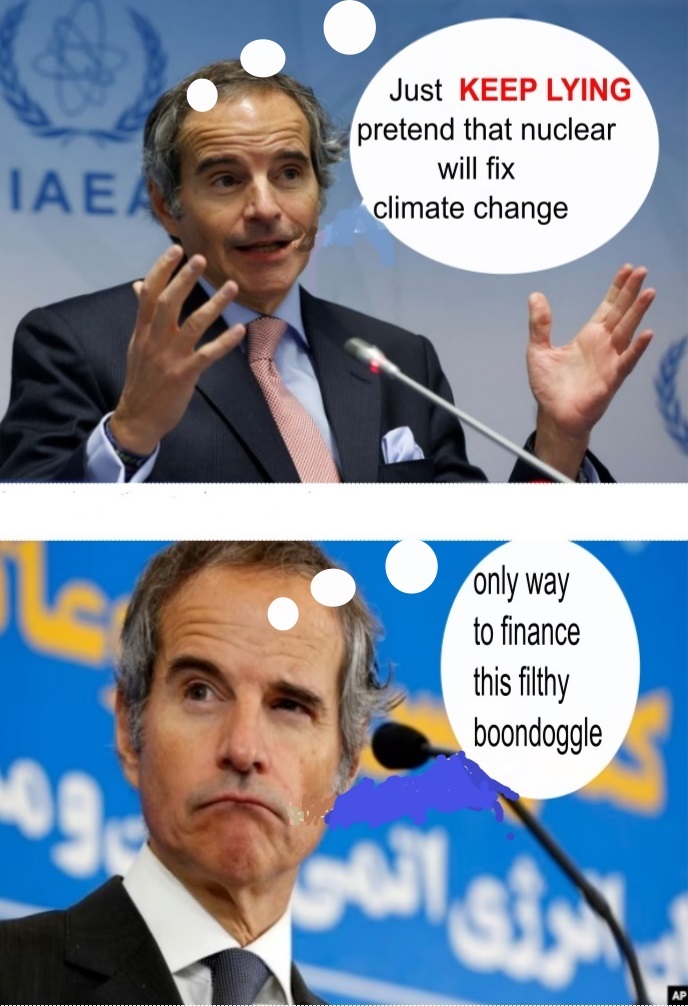
COP 29 will be a flop anyway – so I suppose that is some kind of twisted comfort – in that very few will trust the outcome of this hijacked UN Climate Summit
From IAEA website’s disgusting propaganda:
“ a rich programme of IAEA and partner events to showcase nuclear science and technology solutions for climate change “
“The IAEA is organizing a series of events on four thematic areas: energy, food, the ocean and water. “
“an informed debate on the tools and benefits offered by nuclear technology”
Hijacked by all the polluting industries, but the biggest liar of the lot is the IAEA – with their full knowledge that nuclear does nothing to fight climate change. And in fact – climate change effects will kill the nuclear industry,

World teeters on brink as Trump and cronies prepare to flood the zone with shit
By Giles ParkinsonNov 10, 2024, https://johnmenadue.com/world-teeters-on-brink-as-trump-and-cronies-prepare-to-flood-the-zone-with-shit/
Are you OK? It seems an important question as the unhinged and unrestrained president Donald Trump is swept back into power and the world contemplates the implications for the climate, for civil discourse, for women, for minorities, for society as a whole, and for our children and their children.
We have, of course, been here before. This time round, however, the guard rails have been removed: Trump will be back in the White House and in control of the Senate, the House of Representatives, the judiciary and, thanks to fellow and like minded billionaires who own it or fund it, mainstream and social media. Only the filibuster stands in his way.
It’s a kick in the guts to those who care about the future. The implications weigh heavy on anyone minded to consider them: Trump is a climate denier who describes the science as a hoax and his vow to wind back policies and frack, frack, frack, will – according to the best estimates – add around four billion tonnes of CO2 equivalent by 2030, when the opposite needs to happen.
That, of course, means that the small window to cap average global warming within the Paris climate target of 1.5°C is all but lost. But by how big a margin it will be missed will depend on the actions elsewhere in the world. That includes Australia but mostly it is China, whose role could get complicated with the threat of a tariff war.
Trump has been especially enabled by the likes of Tesla and Twitter/X boss Elon Musk, who used to say that his prime mission was to end the use of fossil fuels in the grid and transport with electric cars, storage and renewables.
Musk’s technology, the cars and the batteries in particular, have helped tip the balance towards a green energy transition. But he now appears more concerned by other ideological pursuits.
Bizarrely, Musk now dismisses the science – maybe if greenhouse emissions get close to 1,000 parts per million it might be hard to breathe, he has said. He is obsessed about getting to Mars, and is happy to enable and promote misogynists and conspiracy theorists on his social media platform. On earth, or at least in cyberspace and the Metaverse, Musk is, to borrow a phrase, flooding the zone with shit.
What does that mean for Australia?
The good news – and these things are comparative – is that at least in the short term, the green energy transition will continue apace.
While wind and solar stocks plunged in the US in anticipation of Trump’s fossil fuel fracking frenzy, and his planned dismantling of the Inflation Reduction Act, the program in Australia accelerates, as we report here, with added urgency.
Australia is getting close to the half way mark of kicking fossil fuels out of the grid, and replacing them with wind, solar and storage – essential for any significant emissions cuts in the broader economy.
Some argue that the tipping point – aided by new technology, falling prices, better engineering, and deep pocketed investors – has already arrived.
But that won’t stop others from trying to throw a spanner in the nacelle, as it were, and Australia’s conservative Coalition – emboldened by the chutzpah of the Trump campaign and the backing of the Murdoch and Musk media machines – will continue with its campaign of mischief and misinformation.
What the Coalition and Peter Dutton have learned is that if you do flood the zone with shit – it’s the Steve Bannon mantra – then a lot will stick, particularly when you find ways of making people fearful.
So expect to hear a lot about immigration, transgender, women, elites and any other group that can easily be demonised in a tweet or an Instagram post.
The federal Coalition’s pursuit and promotion of nuclear power as a solution for Australia is about as nonsensical and incoherent as anything that Trump has ever proposed, but as the New York Times’ Seth Abramson notes in a depressing analysis, many of the public are too frivolous, selfish, self-interested, ignorant, or petty to care.
And, I would add, they are also too fearful, too impressionable, and too vulnerable to the machinations of billionaires who want to be trillionaires, and their supporting cast of psychopaths, to care.
Which brings it back to those who do care. The world has seen the likes of Trump, Abbott, Morrison before. The work has fallen to others to get on with the job – be it sub-national governments, investors, and campaigners. There is a lot at stake.
In Australia, that means individuals, too. Which is a good thing. The grid has changed so much, thanks largely to the massive popularity of rooftop solar, that consumers and communities here are in a position not enjoyed by others in the world: They are poised, quite literally, to take the power into their own hands, if only they were allowed.
Their ability to do so will grow with the rollout of EVs, vehicle to grid technology, heat pumps, and software that allows and promotes demand management.
The biggest impediment appears to be the system itself, and entrenched interests. Voters in the US and Australia are being hurt by changing economic circumstances and inflation. Trump managed to con the US public by pretending that he wasn’t part of the system, or the problem.
His attack on established and respected institutions is echoed in Australia by Dutton and co, who appear more concerned about protecting the vested and often venal interests of legacy industry – many now crouching behind the veil of net zero by 2050 that they know they can use as an excuse rather than a target.
It seems to be working. Polls put the Coalition at a 52-48 per cent advantage, just six months out from the federal poll. At least in Australia there is strength in minor parties, and their role has never been as crucial as it is now. The world is is in desperate need of grown-ups. Australia cannot afford to follow the American path.
So, when the rest of us are able to pick ourselves up from the floor, and check with others that they are OK, then it might be time to set about convincing doubters that the push to zero emissions offers a safe and more prosperous future, and the chance to be part of a community rather than oppressed by a system.
Sadly, it’s not yet apparent that enough in the green energy industry have learned how to do that, or even that they know that they should.
Good luck, take care, and don’t give up. We won’t.
Climate, nuclear, news and more -this week

Some bits of good news –
World Children’s Day 2024 – Every year, World’s Children Day is celebrated on 20 November, marking the date that the United Nations Convention on the Rights of the Child was adopted. Jordan Recognized as First in the World to Eradicate Leprosy
TOP STORIES
Israeli Scholar Lays Out ‘True Brutality’ of Ethnic Cleansing Now Underway in Gaza.
The Evil Warmongering Zionist Won (No Not That One, The Other One).
From the archives: Trump has a strategic plan for the country: Gearing up for nuclear war.
Climate.
- Climate talks to open in shadow of Trump victory.
- This year ‘virtually certain’ to be hottest on record, finds EU space programme.
- How Trump’s second term could derail the clean energy transition.
- ‘A wrecking ball’: experts warn Trump’s win sets back global climate action. Trump planning to withdraw from Paris climate agreement.
- Von der Leyen’s Cop29 absence sends ‘fatal signal’, say watchers.
- ‘Two sides of the same coin’: governments stress links between climate and nature collapse.
Environment. The Guardian view on Trump’s planet-wrecking plans: the UK government’s resolve will be tested.
Noel’s notes. The International Atomic Energy Agency in full force with its lying propaganda, at COP 29, with at least 20 ‘Events”. The Trump period and the use of language.
***********************************
AUSTRALIA.
- Australia US Alliance: Is It Time to Rethink Our Loyalty? Airstrip One: How Albanese has integrated Australia into Trump’s military machine.
- What from Trump? | The West Report https://www.youtube.com/watch?v=N4GK0sY-cgc
- 10 reasons why Donald Trump can’t derail global climate action. Donald Trump can’t stop global climate action – If we stick together, it’s the US that will lose out.
- ‘No bigger rent-seeking parasite’ than nuclear industry, Matt Kean tells former Coalition colleagues in heated debate.
- Matt Kean says Australia must take ‘strong and decisive action’ on climate crisis despite Trump re-election.
- More Australian nuclear news at https://antinuclear.net/2024/11/07/australian-nuclear-news-4-11-november/
NUCLEAR ITEMS
| ATROCITIES. Israel Killed Over 50 Children in Jabalia in 48 Hours: UN. Report Details Israel’s Ethnic Cleansing Campaign in Beit Lahia, Northern Gaza. |
| CULTURE. Trump Puts An Appropriately Ugly Face On A Very Ugly Empire https://www.youtube.com/watch?v=iRThFwyddvk |
| ECONOMICS. Regulators deliver successive blows to Amazon and Meta’s nuclear power ambitions. Amazon’s nuclear datacenter dreams stall as watchdog rejects power deal.Talen-Amazon Nuclear Power Deal Hits Speed Bump – Why Constellation Stock Is Down More. This is why nuclear power stocks are falling |
EDUCATION. Nuclear lobby continues its infiltration of education. |
| EMPLOYMENT. Hinkley workers ‘unfair’ pay claim leads to action. Hinkley Point and Sizewell nuclear plant engineers go on strike. ALSO AT https://nuclear-news.net/2024/11/07/1-b-hinkley-point-and-sizewell-nuclear-plant-engineers-go-on-strike/ |
ENERGY. IEA: Countries not on course to double rate of energy efficiency improvement by 2030. Compelling Economics of Renewables Unmask Fossil Fuels and Nuclear.
Endangered Bees Halt Meta’s Nuclear-Powered AI Data Center Plans.
Minimal role for nuclear in UK government agency’s Clean Energy plan.
Clean Energy Community Mobilizes as Trump Rises, Supporters Embrace Project 2025.
ENVIRONMENT. Radioactive pollution from bomb plant sparks cancer fears. Radioactivity in Food and the Environment (RIFE) report UK published.
HEALTH. Radiation. Occupational exposure to radiation among health workers: Genome integrity and predictors of exposure.
LEGAL. The death of Karen Silkwood—and the plutonium economy. Three sentenced to death for role in Iranian nuclear scientist’s assassination .
| MEDIA. A massacre within a massacre: How journalists reporting on Gaza deaths are being targeted.The Government-Media-Academia Misinformation Machine and “Ukraine’s Victory”. |
| OPPOSITION to NUCLEAR . Seven Canadian environmental groups challenge the nuclear industry’s false claims ALSO AT https://nuclear-news.net/2024/11/07/1-b1-seven-canadian-environmental-groups-challenge-the-nuclear-industrys-false-claims/ |
POLITICS.
- Nuclear sector’s views on second Trump administration mixed as Rogan interview raises questions.
- What Netanyahu’s firing of Yoav Gallant means for Gaza, Israel’s regional war, and the US-Israel relationship.
- Big Promise From Trump: ‘I’m Going to Stop Wars’.
- UK budget outlines nuclear power plans (new nuclear not a high priority)
| POLITICS INTERNATIONAL and DIPLOMACY.Everybody Wants to Join BRICS.Can Trump 2.0 defuse the nuclear threat? These Washington heavyweights fear not.Iran says it rejects nuclear weapons, but will defend itself by all means. UN nuclear head to visit Iran for talks on country’s nuclear program as next Trump presidency looms.UK says it voted against UN nuclear war panel because consequences already known. Poodles and puppet masters – Mutual Defence Agreement puts USA in charge of UK military policy. |
| SAFETY. Can quake-prone Japan ever embrace nuclear energy again? When you combine AI and nuclear power, the results can be catastrophic . |
| SECRETS and LIES. COP 29 chief exec filmed promoting fossil fuel deals. |
| TECHNOLOGY. Japanese nuclear reactor that restarted 13 years after Fukushima disaster is shut down again. Micro-reactor developer optimistic about connecting South Wales project by 2027. |
| WASTES. Germany excludes over half of its territory in search for long-term nuclear waste storage. Robot Removes First Bit Of Fukushima’s Nuclear Fuel Debris – Just 880 Tons More To Go. Nuclear debris retrieved from Fukushima reactor weighs 0.7 gram. Tepco removes [a tiny sceric] of nuclear fuel debris from Fukushima disaster site. |
| WAR and CONFLICT. Israel’s attacks on Iran were an apocalyptic error by Netanyahu. Here’s why. Foreign Policy: NATO knows Ukraine is losing. Russia’s Swift March Forward in Ukraine’s East. Biden, Zelensky ponder face saving off ramp from failed US proxy war against Russia. |
| WEAPONS and WEAPONS SALES. US F-15 Fighter Jets Arrive in Middle East as Part of Buildup Aimed at Iran, US Bombers Arrive in Middle East as Part of New Deployment for Israel. F-35 components sent to Israel from Royal Air Force base. Iran says it can produce nuclear weapon if faced with existential threat. The Great American Nuclear Weapons Upgrade. US nuclear weapons could be sited in RAF Lakenheath in spring, CND protest hears. Fifty two nations call for global arms embargo on Israel. Depleted uranium: Is Israel using depleted uranium to bomb Lebanon? Biden Team Wants To Rush Weapons Shipments to Ukraine Before Trump Inauguration. With Trump back in White House, can Ukraine opt for nuclear deterrence? |
1 This month
Chernobyl: The Lost Tapes – A good documentary on Chernobyl on SBS available On Demand for the next 3 weeks– https://www.sbs.com.au/ondemand/tv-program/chernobyl-the-lost-tapes/2352741955560
15 April – Zoom –Nuclear Power is Not the Solution
Apr 15, 2026 01:00 AM in Canberra, Melbourne, Sydney

Join the International Physicians for the Prevention of Nuclear War (IPPNW) on Tuesday, April 14th for a timely webinar exploring the risks associated with nuclear power and challenging the myth that it offers a simple, safe, carbon-free solution to the climate crisis

21 April Webinar: No Nuclear Weapons in Australia
Start: 2026-04-21 18:00:00 UTC Canberra, Melbourne, Sydney (GMT+10:00)
End: 2026-04-21 19:30:00 UTC Canberra, Melbourne, Sydney (GMT+10:00)
Event Type: Virtual
A virtual link will be communicated before the event.
Host Contact Info: australia@icanw.org

of the week – Australians for War Powers Reform (AWPR)
To see nuclear-related stories in greater depth and intensity
 Antinuclear