Delve into details before voting for Dutton’s nuclear vision

John Bushell, Surry Hills, NSW, https://www.afr.com/politics/federal/delve-into-details-before-voting-for-dutton-s-nuclear-vision-20250304-p5lgrs 4 Mar 25
Examination of detail will quickly demonstrate that the (would be) emperor has no clothes (“Dutton’s nuclear bid short on detail, but who cares?”).
From 2018 to 2023, electricity delivered globally to customers from various energy sources changed as follows: utility solar, plus 193 per cent; onshore wind, plus 80 per cent; nuclear, minus 1.1 per cent.
Independent international investment bank Lazard advised last year that the average electricity costs from these same energy sources, in US dollars per megawatt hour, were: utility solar 61; onshore wind 50; nuclear 182.
The International Energy Agency advised in January that solar and wind energy generation is being installed five times faster than all other new electricity sources combined, and it forecasts that renewable generation capacity globally from 2024 to 2030 will be triple that added from 2017 to 2023.
So, who do you think is right? Peter Dutton or the rest of the world?
It might be a good idea to find out before the federal election rather than after it.
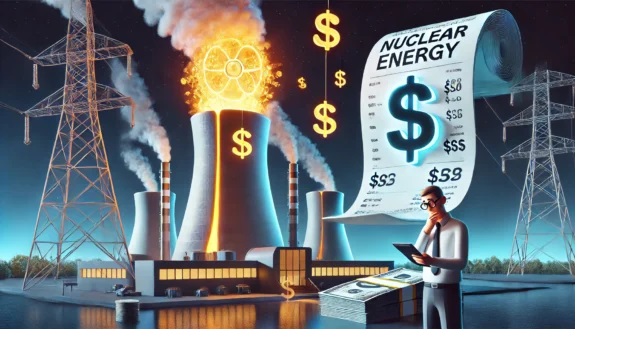
Nuclear could cost households an extra $450 or more a year by 2030
Australians for Affordable Energy , https://theaimn.net/nuclear-could-cost-households-an-extra-450-or-more-a-year-by-2030/
New modelling confirms a shift to nuclear power could significantly increase household electricity bills, with Australians for Affordable Energy (AFAE) urging policymakers to back the most affordable energy option.
The analysis, released by the Clean Energy Council, found households could face a 30 per cent increase in power bills by 2030 under a nuclear pathway, with households paying an additional $450 annually.
“Australians want affordable and reliable energy now. Every independent study we’ve seen suggests nuclear power will be a guaranteed hit to household budgets now and in future,” AFAE spokesperson Jo Dodds said.
“The cost of living is what it’s all about for most Australians, with energy prices a major concern. From everything we know so far, nuclear is the far more expensive option, and cheaper practical alternatives exist.
“While we wait decades for expensive nuclear plants Australians will be forced to rely on expensive gas and aging coal plants, driving bills even higher. A 30 per cent hike in power bills would place even more strain on Australian households who are already grappling with cost-of-living pressures. Our energy policies must prioritise affordability.”
The findings mirror concerns raised in the Climate Change Authority’s recent report, which found nuclear energy could add 2 billion tonnes of emissions and delay Australia’s clean energy transition until 2042.
“It says small businesses could expect an $877 increase in their bills by 2030 if we slow down our clean energy rollout,” Ms Dodds said.
“There’s a clear choice here between affordable energy now or higher bills for decades to come.”
“Any energy policy that doesn’t put affordability front and centre is out of touch with what voters actually want. These are tough times for households, we shouldn’t allow energy policy to make them worse.”
Australians for Affordable Energy is urging policymakers to focus on practical, cost-effective energy solutions that can deliver more affordable power right now.
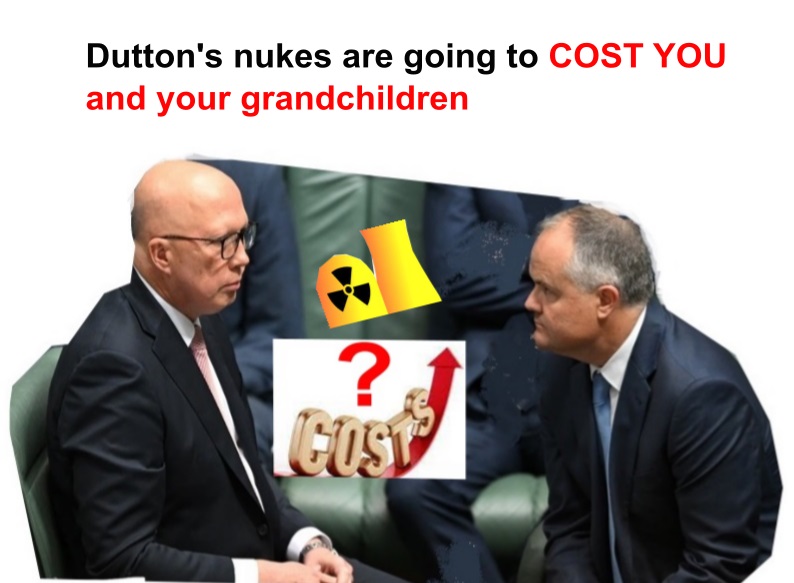
Peter Dutton’s nuclear plan could blow out household electricity bills by up to $600 a year by 2030
https://reneweconomy.com.au/peter-duttons-nuclear-plan-will-blow-out-household-electricity-bills-by-up-to-600-a-year-by-2030/ Sophie Vorrath, Mar 4, 2025
A new report has torpedoed Peter Dutton’s claim that the Coalition’s nuclear power plan for Australia would be 44 per cent cheaper than Labor’s plan for renewables, finding instead that it would inflate average consumer electricity bills by up to 41 per cent between now and 2030.
The report, commissioned by the Clean Energy Council, models the outcomes on electricity prices across Australia’s main grid, the NEM, if the build rate of utility scale renewable generation capacity was reduced significantly – as it promises to be under a Coalition government.
The modelling, conducted by global consultancy, Jacobs, sets a base case using the Australian Energy Market Operator’s (AEMO) Integrated System Plan Step Change Scenario, where 26 gigawatts (GW) of renewables in 2025 grows to 72.7 GW by 2030.
This base case is then contrasted against two scenarios based on the modelling by Frontier Economics for the federal Coalition, which restricts renewables to 49.1 GW by 2030 and relies on coal and gas while waiting for nuclear power.
In that report, Frontier Economics reduced the build rate for renewables, in particular, onshore and offshore wind, big solar and big batteries, in a world where longer term, post 2035 nuclear capacity is installed to meet customer electricity needs.
Frontier’s economic modelling has since been used to underpin claims from Liberal Peter Dutton that his plan for a power system including a significant role for nuclear will be 44% cheaper than a system relying predominantly on renewables.
As Tristan Edis writes in a series of articles starting here, a range of energy analysts and economists have found an array of problems with how this number was derived, but this hasn’t stopped the LNP leader from repeating it every chance he gets.
The Clean Energy Council has therefore decided to fight fire with fire.
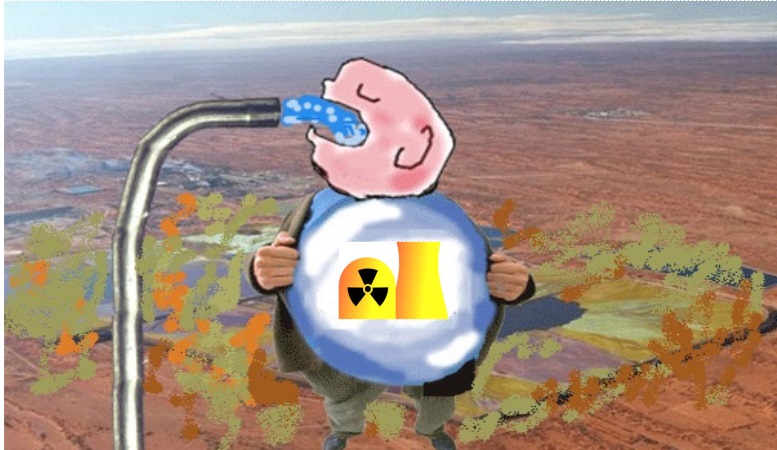
Reactors thirsty for water
Anne O’Hara, Wanniassa, ACT, https://www.afr.com/politics/federal/delve-into-details-before-voting-for-dutton-s-nuclear-vision-20250304-p5lgrs 4 Mar 25
Thanks to The Australian Financial Review for a balanced and informative article on the Coalition’s nuclear policy (“Dutton’s nuclear bid short on detail, but who cares?”). It’s no wonder numerous studies show nuclear power to be one of the least popular energy sources for Australian voters
Cost and time are two major drawbacks. The 10-year delay in building the reactors is set to blow Australia’s carbon budget right out of the water. Speaking of which, where will the water come from to operate these reactors? The proposed reactors would use up to three times the amount needed for coal, posing a threat to drinking supply and irrigation for farms.
Despite the loud opposition to wind and solar projects by a small minority, research shows that over two-thirds of people in the regions already support renewables. A nuclear energy policy will hardly be a vote-winner in rural areas, where water supply is crucial.
Nuclear power struggling to maintain current level of stagnation, let alone achieve any growth
Alongside the risk of Fukushima-scale disasters, the weapons proliferation risks, the risk of attacks on nuclear plants (and the reality of attacks on nuclear plants in Ukraine), and the intractable nuclear waste legacy, the reality is that nuclear power just can’t compete economically.
The industry’s greatest problem at the moment is a recognition of this by investors, resulting in a capital strike.
Darrin Durant, Jim Falk & Jim Green, Mar 3, 2025, https://reneweconomy.com.au/nuclear-power-struggling-to-maintain-current-level-of-stagnation-let-alone-achieve-any-growth/
The current push in Australia to deploy nuclear power reactors once again contrasts an excessive optimism by nuclear proponents against the continuing stagnant situation of nuclear power worldwide. That contrast is the subject of our new report for the EnergyScience Coalition.
The latest nuclear proposals are built on three speculations.
First, projected AI-related energy demand where – as with nuclear power proponents in the 1970’s who projected huge demand that never eventuated – there are already signs demand is overblown. For example the new leading AI entrant DeepSeek requires just 10 per cent of the energy of competitors.
Second, speculative techno-optimism that new technologies such as small modular reactors will resolve industry project management issues. Yet these small reactors are unproven.
Third, prospective wish-fulfilment, where dozens of nuclear ‘newcomer’ countries are offered as saviours, despite not having reactor approvals and funding in place in a large majority of cases.
So what is the state of nuclear power in 2024? A review by the World Nuclear Industry Status Report notes that seven new reactors were connected to grids last year while four reactors were permanently closed. The net increase in operating nuclear capacity was 4.3 gigawatts (GW).
Worldwide nuclear power capacity was 371 gigawatts (GW) at the end of 2024. That figure is near-identical to capacity of 368 GW two decades earlier in 2005.
As of 1 January 2025, the mean age of the nuclear power reactor fleet was 32.1 years. In 1990, the mean age was just 11.3 years. Due to the ageing of the reactor fleet, the International Atomic Energy Agency projects the closure of 325 GW of nuclear capacity from 2018 to 2050 – that’s 88 per cent of current worldwide capacity. Thus the industry faces a daunting challenge just to maintain its pattern of stagnation, let alone achieve any growth.
There were no ‘small modular reactor’ (SMR) startups in 2024. Indeed there has never been a single SMR startup unless you count so-called SMRs not built using factory ‘modular’ construction techniques, in which case there is one each in China and Russia.
The SMR sector continues to go nowhere with setbacks in 2024 including the suspension of the Nuward project in France (following previous decisions to abandon four other SMR projects) and the bankruptcy of US company Ultra Safe Nuclear.
Nuclear growth dwarfed by renewables
In striking contrast to nuclear power’s net gain of 4.3 GW in 2024, the International Energy Agency’s October 2024 ‘Renewables 2024’ report estimates 666 GW of global renewable capacity additions in 2024. Based on the Agency’s estimate, renewables capacity growth was 155 times greater than that of nuclear power.
The International Energy Agency expects renewables to jump sharply from 30 per cent of global electricity generation in 2023 to 46 per cent in 2030.
Conversely, nuclear power’s share of global electricity generation has fallen steadily since the 1990s. As of 1 January 2025, nuclear power accounted for 9.15 per cent of global electricity production, barely half of its peak of 17.5 per cent in 1996.
A Bloomberg analysis finds that renewable energy investments reached $A1.17 trillion in 2024, up 8 per cent on the previous year, whereas nuclear investment was flat at $A55.1 billion. Thus renewable investments were 21 times greater than nuclear investments.
In contrast to massive cost overruns with nuclear projects, renewable costs have fallen sharply.
Lazard investment firm data shows that utility-scale solar and onshore wind became cheaper than nuclear power from 2010-2015. From 2009-2024, the cost of utility-scale solar fell 83 per cent; the cost of onshore wind fell 63 per cent; while nuclear costs increased 49 per cent.
Nuclear newcomer countries
Claims that 40-50 countries are actively considering or planning to introduce nuclear power, in addition to the 32 countries currently operating reactors, do not withstand scrutiny.
As of 1 January 2025, reactors were under construction in just 13 countries, two less than a year earlier. Seven percent of the world’s countries are building reactors; 93 percent are not.
Of the 13 countries building reactors, only three are potential nuclear newcomer countries building their first plant: Egypt, Bangladesh and Turkiye. In those three countries, the nuclear projects are led by Russian nuclear agencies with significant up-front funding from the Russian state.
The World Nuclear Association observes that apart from those three countries, no countries meet its criteria of ‘planned’ reactors, i.e. “approvals, funding or commitment in place, mostly expected to be in operation within the next 15 years.”
The number of potential newcomer countries with approvals and funding in place, or construction underway, is just three and those projects are funded heavily by the Russian state. That is the underwhelming reality underlying exaggerated claims about 40-50 countries pursuing nuclear power.
There is no evidence of a forthcoming wave of nuclear newcomer countries in the coming years and decades. At most there will be a trickle as has been the historical pattern with just seven newcomer countries over the past 40 years and just three this century.
The number of countries operating power reactors in 1996–1997 reached 32. Since then, nuclear newcomer countries have been matched by countries completing nuclear phase-outs and thus the number is stuck at 32. And less than one-third of those countries are building reactors (10/32).
It is doubtful whether the number of nuclear newcomer countries over the next 20-30 years will match the number of countries completing phase-outs.
Capital strike
Alongside the risk of Fukushima-scale disasters, the weapons proliferation risks, the risk of attacks on nuclear plants (and the reality of attacks on nuclear plants in Ukraine), and the intractable nuclear waste legacy, the reality is that nuclear power just can’t compete economically.
The industry’s greatest problem at the moment is a recognition of this by investors, resulting in a capital strike. Even with generous government/taxpayer subsidies, it has become difficult or impossible to fund new reactors – especially outside the sphere of China and Russia’s projects at home and abroad.
Who would bet tens of billions of dollars on nuclear power projects when the recent history in countries with vast expertise and experience has been disastrous?
In France, the latest cost estimate for the only recent reactor construction project increased seven-fold to A$39.4 billion for just one reactor. Construction took 17 years. No reactors are currently under construction in France.
In the US, one project in South Carolina, comprising two Westinghouse AP1000 reactors, was abandoned in 2017 after $A14.3 billion was spent. Westinghouse declared bankruptcy and its debts almost forced its parent company Toshiba into bankruptcy. All that remains is the nukegate scandal: an avalanche of legal action including criminal cases.
The only other reactor construction project in the US – the twin-reactor Vogtle project in the state of Georgia – reached completion at a cost 12 times higher than early estimates. The final cost was at least $A27 billion per reactor. Completion was six to seven years behind schedule.
No power reactors are currently under construction in the US. Thirteen reactors have been permanently shut down over the past 15 years.
The situation is just as bleak in the UK where there have been 24 permanent reactor shut-downs since the last reactor startup 30 years ago, in 1995.
The 3.2 GW twin-reactor Hinkley Point project in Somerset was meant to be complete in 2017 but construction didn’t even begin until 2018 and the estimated completion date has been pushed back to 2030-31.
The latest cost estimate – A$46.6 billion per reactor – is 11.5 times higher than early estimates. The UK National Audit Office estimates that taxpayer subsidies for the Hinkley Point project could amount to $A60.8 billion and the UK Parliament’s Public Accounts Committee said that “consumers are left footing the bill and the poorest consumers will be hit hardest.”
The estimated cost of the planned 3.2 GW twin-reactor Sizewell C project in the UK has jumped to $A81 billion or $A40.5 billion per reactor, twice the cost estimate in 2020. Securing funding to allow construction to begin is proving to be difficult and protracted despite a new ‘Regulated Asset Base’ funding model which foists the enormous risk of enormous cost overruns onto taxpayers and electricity ratepayers.
Lessons for Australia
Those three countries – France, the US and the UK – have vast nuclear expertise and experience. They all enjoy synergies between civil and military nuclear programs – President Macron said in a 2020 speech that without nuclear power in France there would be no nuclear weapons, and vice versa.
All of the above-mentioned construction projects were (or are) on existing nuclear sites. All projects were (or are) long delayed and tens of billions of dollars over-budget.
Claims that potential nuclear newcomer countries such as Australia, without any of those advantages, could build reactors quickly and cheaply are not credible.
Our report expanding on these issues is posted at the EnergyScience Coalition website.
Darrin Durant is Associate Professor in Science and Technology Studies at the University of Melbourne. Jim Falk is a Professorial Fellow in the School of Geography, Earth and Atmospheric Sciences at the University of Melbourne and Emeritus Professor at the University of Wollongong. Dr. Jim Green is the national nuclear campaigner with Friends of the Earth Australia and a member of the Nuclear Consulting Group.
Global Ocean Treaty two years on: Australia’s chance for international cooperation
Greenpeace SYDNEY, Tuesday 04 March 2025 – Two years after the United Nations agreed to bring the historic Global Ocean Treaty into force, Greenpeace is urging the Australian government to make good on its pledge for ocean protection and finally ink the treaty into law.
The UN treaty to protect the high seas was agreed two years ago today in 2023. It is a legally binding pact to conserve international waters, a crucial component in global efforts to protect 30% of the world’s oceans and lands by 2030. While 110 countries have signed the treaty, only 18 countries have ratified the treaty into law so far.
Greenpeace Australia Pacific Senior Campaigner Georgia Whitaker said:
“The government has been sitting on the Global Ocean Treaty for two years while other countries rapidly move to ratify and bring the treaty into force. We are an ocean-loving nation, and the Australian government could act as a proud leader on the world stage by making good on its promise to protect the high seas now. Our oceans don’t have the luxury of time – we need to ratify now, then deliver protected ocean sanctuaries in our big blue backyard: the Tasman Sea.”
Once the treaty is in force, governments can propose ocean sanctuaries for the high seas. A 2023 scientific report by Greenpeace identified the South Tasman Sea and Lord Howe Rise – the high seas between Australia and New Zealand – as being of critical importance for protection.
Until the treaty enters into force, the management of our global oceans is very fragmented. There is no legal global instrument that allows for the creation of sanctuaries in international waters. To this day, less than 1% of the high seas – the largest habitat on Earth, comprising 64% of the world’s ocean – is fully or highly protected from human activities.
The countdown is on, as the pivotal UN Ocean Conference (UNOC) will take place in Nice, France, in less than 100 days.
“UNOC is a unique chance for Governments to show global leadership for ocean protection. Australia must use this opportunity and ratify the treaty before arriving in Nice,” added Whitaker.
Another troubling week in nuclear news

Some bits of good news –
10 Ways Investing in Children’s Well-Being Changed the World
China is Rewiring the Global South With Clean Power. We’re making child marriages a thing of the past in Malaysia.
TOP STORIES.
Zelensky needs to go …been risking nuclear war far too long.
What Trump got right about nuclear weapons—and how to step back from the brink.
Global security arrangements “unravelling”, UN chief warns nuclear disarmament conference.
The Supreme Court faces the absurdly difficult problem of where to put nuclear waste.
More powerful than Hiroshima: how the largest ever nuclear weapons test built a nation of leaders in the Marshall Islands.
Climate. A Lawsuit Against Greenpeace Is Meant to Bankrupt It and Deter Public Protests, Environmental Groups Warn. Total collapse of vital Atlantic currents unlikely this century, study finds.
Noel’s notes. Ukraine to soon jump back out of the fire and into the frying-pan?
AUSTRALIA.
- AUKUS ‘impact assessment’ report ignores nuclear submarine risks in South Australia. Not everyone knows acronyms’: Australian politicians shrug off Trump blunder on AUKUS.
- If China can’t scale nuclear, Australia’s got Buckley’s. Nuclear reactors could become targets of war, defence experts warn.
- New report skewers Coalition’s contentious nuclear plan – and reignites Australia’s energy debate. Too slow, too risky, too impractical: Interim senate report pans nuclear. Chinese warships sailing the Tasman Sea expose AUKUS folly.
- Parliamentary inquiry finds nuclear is high risk, zero reward. Peter Dutton abandons global ‘Paris Agreement’ to phase out climate pollution by 2050. Trump-lite: Coalition promises purge of experts who call out nuclear bunkum.
- More Australian nuclear news at https://antinuclear.net/2025/02/26/australian-nuclear-news-week-to-4th-march/
NUCLEAR ITEMS
ECONOMICS.
- New report details nuclear power’s demise. Nuclear power struggling to maintain current level of stagnation, let alone achieve any growth.
- Stop government handouts to EDF for Hinkley Point C. Rachel Reeves eyes cuts to nuclear in spending review. Small modular reactor plans edge closer, amid claims that the technology makes no economic sense .
- EDF appears to consider reduced final stake in Sizewell C to as low as 10% Sellafield nuclear site plans cuts as chief says £2.8bn funding ‘not enough’. Nuclear site warns £2.8bn budget is ‘not enough’. UK construction and engineering firm Costain has secured a multi-millionpound contract to support the construction of the Sizewell C nuclear powerplant -ALSO AT https://nuclear-news.net/2025/02/28/2-b-uk-construction-and-engineering-firm-costain-has-secured-a-multi-millionpound-contract-to-support-the-construction-of-the-sizewell-c-nuclear-powerplant/
- We can’t afford Doug Ford’s nuclear fantasy.
ENERGY. UK Energy Secretary Signals China Pivot.
ENVIRONMENT. ‘Fish disco’ row risks fresh delays to Hinkley Point nuclear plant.
ETHICS and RELIGION. Archbishop Gallagher: Nuclear weapons pose existential threat.
EVENTS. Nuclear Ban Week – the UN Treaty on the Prohibition of Nuclear Weapons (TPNW). 1 March -Remembering All Nuclear Victims. 6 March – WEBINAR –Arming for Armageddon: How US Militarism could lead to Nuclear War
HEALTH. Nuclear reactors killing Americans at accelerating rate.
LEGAL. SCOTUS goes nuclear: Justices’ decision could seal spent fuel storage options for decades. Beyond Nuclear files two relicensing legal actions.
OPPOSITION to NUCLEAR . 93% say NO: latest polls in Lincolnshire condemn nuke dump plan
PERSONAL STORIES. The island priest who fought a nuclear rockets range.
POLITICS.
- Techno-Fascism Comes to America. German election results tilt EU back toward nuclear energy.
- How the Warfare State Paved the Way for a Trumpist Autocracy.
- The Guardian view on UK PM’s gamble: exploiting crisis to remake Labour was a step too far for an ally.
POLITICS INTERNATIONAL and DIPLOMACY. Donald Trump was rude to Zelensky, but he did tell him the hard truths. Zelensky: Victim of Colosseum Politics.
The National goes to the UN: The fight for nuclear disarmament– ALSO AT https://nuclear-news.net/2025/02/27/1-b1-scotus-goes-nuclear-justices-decision-could-seal-spent-fuel-storage-options-for-decades/
US correct to vote against UN resolution solely condemning Russia for Ukraine war. The pro-war lobby in the West needs to come up with new ideas, rather than saying the same old things.
SAFETY. United States: White House Threatens Nuclear Regulatory Commission‘s Independence. IAEA Director General Statement on Fire Situation in Chernobyl nuclear station. Ontario’s outdated nuclear vision poses serious safety and financial risks.
A Single Trumputin Drone Can Turn the “Peaceful Atom” Into World War 3. Vladimir Putin right now has in his sights nearly The physical hazards of nuclear energy. IAEA mission arrives at nuclear plant in Ukraine through Russia.
URANIUM. As tensions rise, Canada to lean on U.S. for uranium enrichment.
WASTES. Tonnes of nuclear waste to be sent back to Europe. Hinkley Point C will be a Sellafield waste dump . Nuclear Decommissioning Authority budget raises Sellafield safety concerns. Public concern increasing about nuclear waste shipments west of Sudbury. Election candidates should face nuclear waste questions: group.
WAR and CONFLICT. Israel seen as likely to attack Iran’s nuclear sites by midyear.
WEAPONS and WEAPONS SALES.
The Pentagon and Starlink Satellites.
Nuclear weapons are ‘one-way road to annihilation’ warns Guterres.
Iran on ‘high alert’ amid fears of attack on nuclear sites. Starmer drags
Britain deeper into war drive. Reawakening a Nuclear Legacy: The Potential Return of the
US Nuclear Mission to RAF Lakenheath. John Swinney: UK’s nu
clear deterrent offers ‘no tangible benefit’. As Freed Palestinians Describe Torture,
Trump OKs $3 Billion Arms Package for Israel.
Peter Dutton’s nuclear plan is off in the never-never, but our power bills and emissions pledge are not

Peter Dutton’s nuclear plan is off in the never-never, but our power bills and emissions pledge are not
Lenore Taylor, Guardian 28th Feb 2025 https://www.theguardian.com/australia-news/commentisfree/2025/mar/01/peter-duttons-nuclear-plan-is-off-in-the-never-never-but-our-power-bills-and-emissions-pledge-are-not
The nuclear plan handily leapfrogs the next 10 years – when a Dutton government might actually hold office – a critical time for emissions reduction.
I don’t often agree with Matt Canavan on matters to do with global heating. But when the senator labelled the Coalition’s nuclear plan a “political fix” last year, I think he was speaking the truth.
For 15 gruelling years the Coalition has been trying to distract a voting public, ever more aware of the climate crisis, from its inability to get a credible climate and energy policy past the climate sceptics and do-nothing-much-to-reduce-emissions exponents in its own ranks (including the Queensland senator).
Peter Dutton’s nuclear policy is the latest iteration, framing the “debate” as one between two different technological means to get to the same goal of net zero emissions by 2050, and those critical of nuclear power as “renewables only” ideologues who blindly refuse to consider a credible solution.
But even under the Coalition’s very optimistic calculations nuclear power cannot come onstream for a decade, so this is also a framing that handily leapfrogs the next 10 years; the decade when a Dutton government might actually hold office, and also a decade when today’s voters will still need to pay power bills and require a reliable energy supply, and when the world must reduce emissions to avoid the most disastrous impacts of heating.
Having so carefully set up the nuclear-in-the-never-never policy for some time now, the Coalition can be quite aggressive when anyone points out its many near-term deficiencies.
This week’s target was the Climate Change Authority, which found the Coalition’s plan – to slow the roll-out of renewable energy and somehow keep crumbling coal-fired power plants running until after 2040 when taxpayer-funded nuclear reactors might become available – would massively increase Australia’s carbon dioxide emissions, by more than 2bn tonnes.
It’s pretty obvious, really, that continuing to burn coal will produce more emissions, and it certainly wasn’t an outlandish estimate, being based on the Coalition’s own modelling, and broadly in line with estimates from energy experts at the University of New South Wales.
But the Coalition chose not to address it, but rather to shoot the messenger; in this case the independent authority and its chair, the former NSW Liberal minister Matt Kean. The authority, it said, had become “a puppet of Anthony Albanese and [energy minister] Chris Bowen”. There were strong hints that under a Dutton government Kean himself might be sacked.
Dutton’s claim that power prices will be 44% cheaper in the near term under his plan are also unsubstantiated and somehow also less scrutinised than all the competing assessments of what nuclear may or may not cost in the long term, if it is ever eventually built.
Experts say Dutton’s pronouncements on near-term costs show he clearly doesn’t know what he is talking about.
The opposition leader routinely cites modelling from Frontier Economics, itself contested, which did find that nuclear power would reduce the energy system costs in the longer term by 44%. Frontier’s managing director, Danny Price, confirms his work did not forecast household power bills or electricity prices, and that nearer term reductions in system costs were not quantified.
And then there are the deep fears, from the Australian Energy Market Operator, among others, about how the ageing coal-fired power system would hold together in the 10 years or more during which nuclear power was being developed.
Canavan’s criticism of his own party’s policy was made in the context of his argument that neither major party was being upfront about the challenges of keeping the energy system running while reaching net zero by 2050.
I disagree with him there. Australia is just starting to shake off the decades of stultifying climate wars to achieve a necessary and long-delayed energy transition. The east coast grid now runs on about 43% renewable energy. The lights are staying on. Investment is increasing.
As the AGL chief executive, Damien Nicks, said last week: “Both time and cost won’t allow nuclear to be done on time … the question right now is about getting on and getting this done as soon as we can.”
If Dutton wants to discuss nuclear as a long-term option, that’s fine, but it’s no substitute for knowing what his plan means for the here and now, for power bills, and emissions, and the promises we have made on the international stage. That is, if it is actually a serious policy rather than another tactic for delay.
Earth’s strongest ocean current could slow down by 20% by 2050 in a high emissions future
In a high emissions future, the world’s strongest ocean current could
slow down by 20% by 2050, further accelerating Antarctic ice sheet melting
and sea level rise, an Australian-led study has found. The Antarctic
Circumpolar Current – a clockwise current more than four times stronger
than the Gulf Stream that links the Atlantic, Pacific and Indian oceans –
plays a critical role in the climate system by influencing the uptake of
heat and carbon dioxide in the ocean and preventing warmer waters from
reaching Antarctica.
Guardian 3rd March 2025, https://www.theguardian.com/environment/2025/mar/03/antarctic-circumpolar-current-slow-down-ice-melting-climate
Nuclear powers down as global reactor numbers shrink.

By Jennifer Dudley-Nicholson, March 3 2025 – https://www.canberratimes.com.au/story/8906917/nuclear-powers-down-as-global-reactor-numbers-shrink/
The number of nuclear reactors operating around the world is shrinking, a report has found, and renewable energy generation is outpacing the technology.
The EnergyScience Coalition released the findings on Monday in a report analysing progress on renewable and nuclear energy generation, as well as investments in each.
It found nuclear power generation was “stagnating rather than growing” despite claims to the contrary, and that only three countries were planning to add nuclear reactors to their energy mix, while another three were planning to phase it out.
The report comes after the coalition pledged to establish nuclear power plants in seven Australian locations if it won the upcoming federal election, and after warnings that Australia could miss its climate targets by years under a nuclear plan.
The EnergyScience Coalition study, authored by academics from the University of Melbourne and the Nuclear Consulting Group, found the number of nuclear power plants worldwide had shrunk from 438 in 2002 to 411 last year.
Nuclear reactors also generated just 9.15 per cent of the world’s energy in 2024, it noted, compared to 17.5 per cent in 1996, and gained 4.3 gigawatts during the year.
By comparison, renewable energy sources added 666 gigawatts, according to the International Energy Agency, and were expected to overtake coal-fired power generation this year.
Claims about the number of countries investing in nuclear reactors had also been overstated in Australia, co-author and Nuclear Consulting Group member Jim Green said.
Nuclear reactors were being built in 13 countries, the study found, but only three were new to nuclear energy: Egypt, Bangladesh and Turkey.
“This report provides a factual rebuttal to the pro-nuclear disinformation campaign currently underway in Australia,” Dr Green said.
“There has been zero growth in nuclear power over the past 20 years and the number of countries operating reactors is the same as it was in the late 1990s.”
Four countries had already phased out nuclear power generation, including Italy and Germany, the report said, and another three were planning to phase out the technology, including Switzerland and Spain.
Recent nuclear power projects in countries where the technology was well established had also suffered significant cost and time blow-outs including a project the US state of South Carolina that was abandoned and the Hinkley Point reactor in the UK that was expected to cost 11.5 times more than its original estimate.
The examples proved Australia would face a significant challenge to build nuclear reactors within deadlines and budgets, co-author and University of Melbourne Professor Jim Falk said.
“Reactor construction projects in countries with vast expertise and experience, such as France, the US and the UK, have run literally tens of billions of dollars over budget and construction schedules have slipped by many years,” he said.
“Since those countries have failed to build reactors on time and on budget, it would be naive to believe that a nuclear newcomer country such as Australia could do it.”
The coalition’s nuclear plan would establish five large nuclear reactors and two small modular reactors across five states, with the first forecast to be operational by 2035.
But a recent report from the Climate Change Authority found switching from a renewable energy pathway to nuclear would delay Australia’s progress to its 2030 climate goal by 12 years.
Dutton’s nuclear gamble short on detail, but voters don’t seem to care

Dutton is unlikely to be bothered by the pockets of negativity towards nuclear, as they are concentrated among “high-information” voters who pay a lot of attention to politics………. he’s pitching himself to the so-called low information voters.”
the specific unpopularity of nuclear is unlikely to be politically significant in the outer-suburban electorates that Dutton covets.
The Coalition does not really want to talk about the practicalities of establishing nuclear energy in Australia. The question is: does anyone?
AFR, Ryan Cropp, 3 Mar 25
ppearing in front of local media in the north Queensland town of Ingham last month, Opposition Leader Peter Dutton was asked about his nuclear policy.
Did he expect the teals to support the Coalition’s nuclear plan? Dutton said yes, citing the new bipartisan support for nuclear in the UK and US, before unspooling a range of loosely related talking points: power bills, Victorian gas imports, and the floods that were affecting mobile phone and internet coverage.
For those opposed to Dutton’s nuclear policy, the pivot was telling. If elected, the Coalition has promised to build seven nuclear reactors, from scratch. But eight months since announcing the policy, Dutton has so far managed to dodge questions on many of the key details of his nuclear gamble.
Those details include the cost of building them, which Labor puts at $600 billion; the earliest a reactor could be built, arguably a decade later than Dutton’s plan; the extra billion tonnes of emissions caused by running old coal plants for longer, threatening Australia’s international commitments to reduce its carbon pollution; not to mention questions about water use, insurance and safety and health risks.
“It’s not clear exactly how they’re going to introduce nuclear,” says Tony Wood, an energy expert at the Grattan Institute.
“What is the policy plan? [There is a] vague idea that they’re going to have some big nuclear plants in seven places … and they’re also going to have these small ones – but they’re not too sure where and how they would run.
“It’s a high-risk strategy and the opposition is really not very clear on how they’re going to deliver on that.”
Despite the big outstanding questions, Labor has so far struggled to land any significant punches on the subject. The Coalition, it appears, does not really want to talk about the practicalities of establishing nuclear energy in Australia. The question is: does anyone?
Mentions of Dutton alongside nuclear in print and online media have halved since their peak in December 2024, when the Coalition released the policy costings, according to media intelligence provider Streem.
A survey of Dutton’s recent doorstop interviews and radio and television appearances also shows the nuclear issue falling from the top of the agenda, overwhelmed by concerns around antisemitism, Donald Trump and interest rates.
The longer Dutton can keep his big policy a small target, the longer he can keep the focus on his core message: cost-of-living, energy prices, and why Labor’s “renewables only” policies are making it worse.
That high-level, “vibes-based” messaging appears to be part of a broader political strategy.
Dutton wants to use nuclear to replace the country’s ageing coal-fired power generators and shore up the country’s energy security for decades to come. He says the first would be built in 2035 if a small modular reactor, or 2037 if a large power plant.
The policy ostensibly aligns a party with a large contingent of fierce climate sceptics behind Australia’s Paris Agreement commitments to net zero emissions by 2050. It also contrasts with Labor’s plan, which relies for the most part on a massive build-out of large-scale wind and solar, plus 10,000 kilometres of new poles and wires to connect it all to the grid.
According to one former senior Liberal who remains close to the party, Dutton’s nuclear gambit not only puts a Band-Aid over the party’s internal warfare on energy, but also shifts the debate over the green transition back onto Labor.
“He’s been able to change the debate with the government into a question of how you get [to net zero], and in doing so, has backed the government into the position of being seen to be the dogmatists,” said the former Liberal, who requested anonymity in order to speak freely.
For his part, shadow energy minister Ted O’Brien denies the small target strategy. “We’re not taking a small target approach – we’re leading the debate on how to fix Labor’s energy mess. The real question is: why is Labor running scared from serious conversations about nuclear?”
Opponents of Dutton’s nuclear plan take heart from a steady stream of studies that show the technology to be among the least favourable energy sources among voters.
Polling commissioned by the Clean Energy Council found only a third of voters supported nuclear, with half supporting gas and close to 80 per cent favouring rooftop solar.
Similar Australian Financial Review/Freshwater polling over the last two years has consistently shown that nuclear comes in only marginally above coal on a net favorability basis, and is well behind renewable sources of power like solar and wind.
But according to the former Liberal politician, Dutton is unlikely to be bothered by the pockets of negativity towards nuclear, as they are concentrated among “high-information” voters who pay a lot of attention to politics.
“That’s not where Dutton is pitching himself,” the former Liberal says. “In this area – and in a lot of other areas – he’s pitching himself to the so-called low information voters.”
“These are people who are not particularly interested in politics anyway, but they hear through the fog: ‘Oh, Dutton wants nuclear. The government’s against it. That’s interesting.’ That’s all they hear.”
Voters are ‘not resistant’ to nuclear
That’s a view shared by electoral experts, who say that the specific unpopularity of nuclear is unlikely to be politically significant in the outer-suburban electorates that Dutton covets.
To win government, the Coalition is targeting voters aggrieved by the difficult economic circumstances of the post-COVID years – many of whom live in mortgage belt seats held by Labor.
Dutton, pollsters say, will not be overwhelmed with demands for details of his nuclear policy on the streets of western Sydney.
Redbridge analyst Kos Samaras says there is not a huge amount of opposition to the idea of nuclear energy in Australia…………………………………
Rural support is key to the Coalition’s plan. Under Labor’s preferred energy mix, copious new solar and wind facilities need to be built in the regions, then connected to the grid by a vast new network of poles and wires. Many of these projects have been plagued by pockets of intense community pushback, undermining the social licence required for the renewables rollout to proceed…………………………………..
Also significant in the opposition’s calculations is the apparent age differential on support for nuclear, which Samaras says is clearly evident, but not likely to be a huge vote-swinger.
“I don’t believe nuclear is an issue in the marginal seats.”— John Black, demographic analyst
“Younger Australians in particular don’t want to rule out all solutions,” he said. “But it is nuanced. When it comes to nuclear, young people do have some reservations about things like safety.”
This age dynamic is well understood within Coalition ranks, according to two party sources not authorised to speak publicly….. those of a younger vintage are open to persuasion……………………………………
The most recent cost of energy report published by US investment bank Lazard, which looks at global averages, also found large-scale onshore wind and solar to be substantially cheaper than nuclear.
On top of the cost, Labor has zeroed in on the logistical difficulties of actually building the reactors, on time and on budget. Experts appearing at a recent Labor-led inquiry into nuclear energy estimated that in a best-case scenario, the earliest Australia was likely to get a nuclear plant up and running from a standing start was the mid-2040s – well beyond the Coalition’s estimates.
In addition to production and supply chain difficulties, the switch to nuclear would also involve overturning a handful of state and federal laws, as well as navigating even more complex planning and environmental approvals.
And given the cost and timing blowouts of other large infrastructure projects like Snowy Hydro and the National Broadband Network, only the most optimistic of nuclear boosters would be willing to put money on a facility being up and running in just over a decade.
And that delay comes with its own costs. In a dramatic intervention last week, the government’s independent advisory body, the Climate Change Authority, said that even under the optimistic scenario modelled by Frontier Economics, the Coalition’s plan to extend coal and gas generation until nuclear comes online would produce an additional billion tonnes of carbon emissions from the electricity sector alone………………………………………
Dutton should expect the government to keep up the negative messaging. On Friday, the prime minister advised Australians to “buy some popcorn” after Bowen invited O’Brien to debate him on nuclear at the National Press Club.
The opposition leader, for his part, lets it all roll off his back.
With recent polls showing the Coalition edging ahead of the government on a two-party preferred basis, it appears nuclear is not registering as the political liability many on the Labor side of politics think it could be………………..https://www.afr.com/companies/energy/dutton-s-nuclear-gamble-short-on-detail-but-voters-don-t-seem-to-care-20250219-p5ldj0
New report details nuclear power’s demise
March 3, 2025 AIMN Editorial, EnergyScience Coalition , https://theaimn.net/new-report-details-nuclear-powers-demise/
A new report by the EnergyScience Coalition corrects false claims by the federal Coalition and others that ‘the world is going nuclear’.
Co-authors Assoc. Prof. Darrin Durant, Prof. Jim Falk and Dr. Jim Green note that:
- The number of operating power reactors worldwide has fallen to 411, which is 27 fewer than the peak of 438 reactors in 2002.
- In 2024 there were 666 gigawatts (GW) of global renewable power additions compared to nuclear growth of 4 gigawatts, a ratio of 155:1. In China the ratio was 100:1.
- Nuclear power’s contribution to global electricity production fell to 9.15 percent last year, barely half of its peak of 17.5 percent in 1996. Conversely, the International Energy Agency expects renewables to jump sharply from 30 percent of global electricity generation in 2023 to 46 percent in 2030.
- Global nuclear power capacity is no greater than it was 20 years ago.
- Of the 32 countries operating power reactors, less than one-third (10) are building new reactors.
- The number of countries building nuclear power reactors fell from 15 to 13 last year. Seven percent of the world’s countries are building reactors; 93 percent are not.
- The number of potential nuclear ‘newcomer’ countries with reactor approvals secured and funding in place, or construction underway, is just three and those projects are all heavily funded by the Russian state.
- The ‘small modular reactor’ sector continues to go nowhere with setbacks in 2024 including the suspension of the Nuward project in France and the bankruptcy of US company Ultra Safe Nuclear.
Report co-author Prof. Jim Falk said: “Reactor construction projects in countries with vast expertise and experience ‒ such as France, the US and the UK ‒ have run literally tens of billions of dollars over-budget and construction schedules have slipped by many years. Since those countries have failed to build reactors on-time and on-budget, it would be naïve to believe that a nuclear ‘newcomer’ country such as Australia could do so.”
Co-author Dr. Jim Green said: “This report provides a factual rebuttal to the pro-nuclear disinformation campaign currently underway in Australia. Simple facts are ignored by the nuclear lobby, such as the fact that there has been zero growth in nuclear power over the past 20 years and the number of countries operating reactors is the same as it was in the late 1990s.”
The report, titled ‘Nuclear Power’s Global Stagnation and Decline’, is co-authored by Assoc. Prof. Darrin Durant (Associate Professor in Science and Technology Studies at the University of Melbourne), Prof. Jim Falk (Professorial Fellow in the School of Geography, Earth and Atmospheric Sciences at the University of Melbourne; Emeritus Professor at the University of Wollongong) and Dr. Jim Green (President of Friends of the Earth Australia and a member of the Nuclear Consulting Group).
What US wants for Ukraine must serve as a warning to Taiwan, Australia and others
By Jerry GreyFeb 27, 2025 https://johnmenadue.com/what-us-wants-for-ukraine-must-serve-as-a-warning-to-taiwan-australia-and-others/?fbclid=IwY2xjawItzONleHRuA2FlbQIxMQABHcT0lfuEL8oOMiWVfXt6tf52gPFX6pGbQU5vU6uH2Cf7O9ZbQLMfD6Yv7A_aem_2nBT5Nx8EUx9X5fenP72KQ
So, US Secretary of Defence Hesgeth has made it clear that what most of us knew three years ago will come to pass.
Ukraine is getting no more support, Trump has declared he wants their mineral rights and Putin has declared he’s not giving up territory, Ukraine will not become a NATO country and half a million dead people are dead for no reason at all – everything Putin wanted this time three years ago, he’s going to get and everything Ukraine wanted at the same time, they have lost.
This is not just a widely held belief coming true, there was never ever going to be a world in which Ukraine fighting alone was going to prevail against Russia, there was never going to be a world in which Russia was going to fight wars with reportedly untrained personnel equipped with shovels and backed up with cannibalised washing machine parts – the Western world has been conned and very well conned too.
NATO followers are quiet now, everything they were targeting has been lost, every obnoxious insult, every hateful post and every disgusting individual who prayed for more death and destruction has been exposed for what they were, and probably still are – ignorant, racist and obscenely ill-informed. They were either paid to be part of the misinformation, or stupid enough to be used by it.
Of course, we’ll see all kinds of claims of victory from people on the losing side – Zelensky will probably retire with ignominy, or perhaps experience a Hitler moment in his bunker. To be honest, I’ll be surprised if he’s still around this time next year but one thing is certain, he won’t be president of a sovereign nation.
Ukraine faces losing its agricultural rights to US corporations, its mineral rights to the Trump Administration’s supporters and it will be mired in debt for generations to come with no hope whatsoever of repaying that debt since it will be controlled by capitalist corporate vampires, sucking everything it has out for the benefit of shareholders. And, to cap it all off, they will lose the three areas they were fighting for because there is no way Russia is going to give back what it shed blood for. The Russian regions may not become part of Russia, but they sure as heck will not become part of Ukraine again.
Millions of displaced people will return to Ukraine as they were never wanted in surrounding countries, hundreds will be put on trial for war crimes, desertions or worse and in about two years, the matter will be completely forgotten by all but those personally involved, who will never, ever forget.
It doesn’t get any better for the people of Europe – Hesgeth’s statement went on to say he wants to keep Russia sanctioned, keep their largest form of income off the table, and continue to weaken them by ramping up US oil, gas and other fossil fuel supplies so that Europe can remain in fuel debt bondage to the USA.
What’s the greatest lesson to be taken from this?
The greatest lesson is that, if the US is allowed to do it again, which they are now, quite obviously aiming to do, Taiwan supporters will fare a lot worse – the US will not enter a war against China, it will enrol proxies. It is working on getting Vietnam involved but that’ll never work, it wants the Philippines involved but the people are not supportive enough of Marcos. The US currently controls the military of South Korea and Japan, so those two countries will get involved when, not if they’re needed and, based on precedent, Australia is likely to join in – if it does, it will be destroyed, but that won’t bother the US because China has no intention whatsoever of invading Australia, it never has, it never will, despite stupid predictions from stupid people working for Washington’s pet funded think-tank, ASPI.
The real reason ASPI wants us to think this is to deflect from the reality that it’s already happened – the US owns the banking, retail, agricultural and logistics systems of Australia, it also controls defence and seems to have some kind of strong influence over politics. The reality is, Australia is already owned, occupied and controlled by the US.
’ve said it before and will say it over and over again, China will never invade Taiwan, but it will defend its sovereignty and Taiwan is part of that sovereignty. If Taiwan, with US instigation, attempts to remove itself from China, the Civil War will be concluded and Taiwan will become the last province to be controlled by the CPC after the conclusion of a 75-year-old unfinished Civil War. Australia, South Korea, Japan and anyone else, even with support from NATO and other “allies”, will not stand a chance against the largest, best trained, best equipped, defensive military in the world. Because China has no ambitions to take anything other than to reunite Taiwan back under the umbrella of one-China. Those countries involved will, like Ukraine, be handing their sovereignty to the US in exactly the way Ukraine is now being humiliated.
Thousands, if not tens or even hundreds of thousands of our young people, do not need to die to prove the US is wrong, Ukraine is the lesson we need to learn from – remembering that all Ukraine had to do is to declare neutrality, abide by an agreement that it had signed in Minsk and hundreds of thousand of its people would be alive, not dead or disabled, millions of its people would have remained in their country and they could, at any time, have sold their mineral rights, their agricultural land and their labour for a profit if they’d wanted to.
As it is now, they are an impoverished, enslaved nation with very limited options and the people of Australia, Japan, South Korea and particularly those residents in Taiwan should sit up, take notice and learn from history – this is what happens when you follow the leadership of a hegemon.
AUKUS ‘impact assessment’ report ignores nuclear submarine risks in SA

By David Noonan, Feb 28, 2025, https://johnmenadue.com/aukus-impact-assessment-report-ignores-nuclear-sub-risks-in-sa/
Environment Minister Tanya Plibersek has released an EPBC Act ‘Impact Assessment Report’ (IAR) to address the environmental impacts of constructing nuclear submarines at Osborne, Port Adelaide. A deluge of documents — the 200-page IAR with 750 pages of appendices — have been released for “public consultation” running till 17 March. However, the IAR fails to provide answers to community’s “right to know” on nuclear submarine accident risks and radioactive waste storage facing Port Adelaide.
The proponent Australian Submarine Agency ruled a range of lead community safety concerns as “out of scope” of this Osborne assessment. The IAR says: “Information on potential sources of radiation has been provided to inform, however does not form part of the Strategic Assessment as these sources will be managed via separate environmental assessment processes and approvals as necessary.”
Impacts of commissioning and operation of the “power module” (the nuclear reactor) “is considered outside the scope of this assessment” ‒ that assessment is to be “held over” for a new non-independent military nuclear regulator that reports to Defence Minister Richard Marles. The military are to effectively take over public safety at Port Adelaide even though the federal Health Minister Mark Butler is the local MP.
Federal Labor is in denial over nuclear submarine reactor accident risks. The word “accident” does not even appear in the 200-page IAR. Even a visit by a nuclear-powered submarine to a port in Australia requires emergency response planning that sets evacuation zones for potential nuclear reactor accidents. It is at best inept to decide to impose nuclear sub reactor accident risks onto communities across Lefevre Peninsula and Port Adelaide while failing to conduct full impact assessments and limiting “public consultation” to only those aspects that suit Labor’s staged roll-out of the AUKUS nuclear sub agenda.
The management facility for radioactive waste at Osborne, and the disposal pathway for such radioactive waste, “is considered outside the scope of the Strategic Assessment”. Marles is already a year late on his own schedule to announce a “process” for managing AUKUS nuclear waste storage and disposal, due back in March 2024. The IAR radioactive waste management section says: “The facility is to be designed to have the capacity to manage radioactive material over the 50-year Strategic Assessment timeframe.” Thus, radioactive wastes may accumulate and remain ‘stored’ at Osborne for decades.
The IAR also misrepresents nuclear submarine reactor radioactive wastes to be stored at Osborne as “similar to those that occur in over 100 locations nationwide, including hospitals, science facilities and universities” and “similar to the waste generated by hospitals and research facilities around Australia”.
Emergency services workers have a ‘right to know’
SA emergency services workers — first responders, the police, fire, ambulance and hospital personnel — have a right to know what nuclear health risks they face. Federal emergency provisions apply in event of a nuclear sub reactor accident at Port Adelaide. The civilian Australian Radiation Protection and Nuclear Safety Agency “Guide for Radiation Protection in Emergency Exposure Situations” and “Nuclear powered vessel visit planning” set out the studies and Emergency response measures that are to be put in place.
The ARPANSA Guide authorises very high ionising radiation dose exposures to emergency workers in tasking them to undertake “urgent protective actions” on site at a nuclear accident, at a dose of up to 50 milliSieverts (mSv). That is 50 times in excess of the recommended civilian maximum allowed dose of 1 mSv per year.
Affected members of the public within an “Urgent Protective Action Zone” of 2.8 km radius from the site of a nuclear sub reactor accident also face authorised high ionising radiation dose exposure of up to 50 mSv. In a “Reference Accident” the local population may face evacuation and may require “decontamination” and medical treatment. A wider zone where “the surrounding population may be subject to hazards” is described as having a radius of several kms. ARPANSA also require studies of a local population out to 15 km from a nuclear submarine mooring.
Catastrophic conditions
In an even more severe AUKUS nuclear accident, federal provisions provide for civilian SA emergency workers to face “the development of catastrophic conditions”. Emergency workers and designated shipyard workers are then to be called upon to “volunteer” to risk dangerously high ionising radiation dose exposures of up to 500 mSv. The ARPANSA Guide states female emergency workers are to be excluded: “Female workers who might be pregnant need to be excluded from taking actions that might result in an equivalent dose exceeding 50 mSv”.
The ARPANSA Guide authorises “actions to prevent the development of catastrophic conditions” by civilian workers. “Category 1 Emergency workers” may “receive a dose of up to 500 mSv”, a dangerously high ionising radiation dose exposure that is 500 times the maximum allowed civilian annual dose. The ARPANSA Guide states:
“Emergency workers may include workers employed, both directly and indirectly, by an operating organisation, as well as personnel of response organisations, such as police officers, firefighters, medical personnel, and drivers and crews of vehicles used for evacuation. …
“Emergency workers undertaking mitigatory actions and urgent protective actions on-site, including lifesaving actions, actions to prevent serious injury, actions to prevent the development of catastrophic conditions that could significantly affect people and the environment, and actions to prevent severe tissue reactions. … They may also receive a dose of up to 500 mSv for life saving actions, to prevent the development of catastrophic conditions and to prevent severe tissue reactions.”
Federal and SA governments have a responsibility to be transparent over a required “Emergency Response Plan” for AUKUS nuclear reactor accidents. No government can claim to have a social licence for AUKUS nuclear subs while failing to inform affected community and affected workers of the nuclear accident and ionising radiation health risks they may face.
Further information is online.
Australia’s Nuclear Plan: Climate & Security threat.
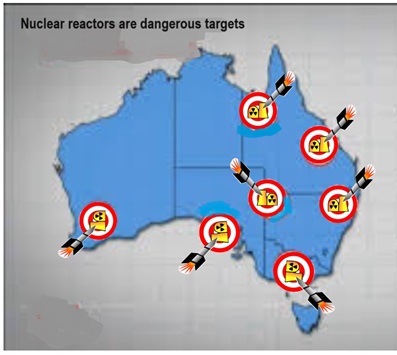
The Australian Security Leaders Climate Group, 28 Feb 25
Australia’s proposed nuclear power plan is facing serious pushback from former defence and security leaders, who warn that it increases national and regional security risks and delays climate action.
The Australian Security Leaders Climate Group (ASLCG) has issued a strong statement today highlighting the dangerous vulnerabilities nuclear power plants would introduce:
A Target in Modern Warfare – Nuclear power plants would become high-value, vulnerable targets for missile strikes, sabotage, and cyberattacks. With all proposed sites located within 100 km of the coast, they are easy targets in times of conflict.
A Military Dilemma – Admiral Chris Barrie (Retd), former Chief of the Australian Defence Force, warns that these power stations would divert critical defence resources away from protecting Australian cities and military bases. “Where do we allocate limited national defence capabilities?” he asks.
A Costly Security Burden – Cheryl Durrant, former Defence Department Director, says that Australia lacks a layered missile defence system to protect these plants. “Building one would be complex, expensive, and stretch our security resources even further.”
A Climate Setback – The nuclear plan would perpetuate reliance on coal-fired power for decades, adding two billion tonnes of carbon emissions and derailing our climate targets.
1 This month
17 October, Free Public Talk on Nuclear Issues in South Australia
David Noonan will speak on public interest concerns over the new Roxby Downs Indenture Act 2026 on BHP copper-uranium mining and ore processing in SA, and on how AUKUS may face SA with a High-Level nuclear waste agenda.
Dr Jim Green will discuss international developments in the field of nuclear power including ‘small modular reactors’ and Generation 4 ‘advanced’ nuclear reactor concepts.


Help Aunty Sue Protect Her Land and Sacred Sites From Destructive Rocket Testing.
.

Australians deserve the truth
about
AUKUS – https://aukuspublicinquiry.com/

PETITION – To: Prime Minister Anthony Albanese and the Australian Labor Government

of the week – Australians for War Powers Reform (AWPR)
To see nuclear-related stories in greater depth and intensity

