The mostly non-corporate nuclear news -week to 24 January

Some bits of good news
– How Community Solar Turned a Superfund Site into Savings in Illinois. How Hamburg Combats Loneliness With ‘Culture Buddies’How a Tiny Australian Town Relocated 500,000 Flying Foxes …and didn’t harm a single one.
TOP STORIES
.Every Nation in the World Should Reject Trump’s Absurd and Dangerous ‘Board of Peace’ . Kushner Reveals Dystopic Plan to Build Data Centers on Ruins of Gaza Genocide.
Betrayed: How Liberals Supported Islamic Revolution in Iran in 1979 and Turned Against the Progressive Shah.
Guterres warns of ‘powerful forces’ undermining ‘global cooperation’.
Zionist Billionaires Openly Acknowledge Manipulating The US Government.
Europe Economic Panic.
Summary comments on the Deep Geologic Repository (DGR) Project for Canada’s Used Nuclear Fuel.
Climate. Anti-climate opinion columns becoming a regular feature in UK newspapers.
Noel’s notes. The brave journalists of the old-fashioned media.
AUSTRALIA.
- Australia should reconsider alliance with ‘fiercely unpredictable’ US, former foreign ministers say. Paul Keating’s words ring true.
- “We kill enemies”:Spy firm Palantir secures top Australian security clearance.
- Oppose Israel’s Abuses While You Still Can.
- They’re Trying To Sneak Israel’s President Into Australia Without Anti-Genocide Protests.
- Revealed: Australian taxpayers subsidising the IDF, illegal settlements in Israel.
- Parliament Passes New Hate Speech Laws, What It Really Means. Australia’s Frightening New “Hate Speech” Laws Are Clearly Aimed At Pro-Palestine Groups.
- How Did Australia Get Here?
- Sussan Ley tries to rewrite history.
- Australia’s worst heatwave since black summer made five times more likely by global heating, analysis finds.
NUCLEAR-related ITEMS
| ATROCITIES. A Cruel Truce: Israel’s Ongoing Demolition of Gaza. Deconstructing Trump’s Gaza ‘Peace’ Plan (w/ Norman Finkelstein) | The Chris Hedges Report. |
| CLIMATE. Who Needs CO2 to Heat the Planet When You Have Nuclear? |
| ECONOMICS. DAVOS: THE RULE OF THE RICH. |
| EDUCATION. Government funding for Saskatchewan SMR test facility. World’s Largest Nuclear Station or Lower Electricity Bills? |
| EMPLOYMENT. Fears raised that specialist Vulcan MoD work could shift to Sellafield |
| ENVIRONMENT. Why the Nuclear Regulatory Review is flawed – and how it could turn the nature crisis into a catastrophe. Nature groups question UK’s Fingleton nuclear review. Plans to ease nuclear build rules could spell disaster for nature, says Wildlife Trusts. |
| ETHICS and RELIGION. The Magic System Of Zionism. Zionism: The Etymological and Ideological Unpacking of a “Political Pathogen” |
| EVENTS. 31st January –Challenging the War Machine – a DECLASSIFIED UK SUMMIT. Mayors for Peace Joint Appeal. |
| LEGAL. The end of sovereign immunity: America’s new doctrine of capture. |
| MEDIA. Labeling Kidnapping a ‘Capture,’ Media Legitimate Violation of International Law. Everyone Wants Peace Until They Get Hit With The War Propaganda. |
| OPPOSITION to NUCLEAR . Canada’s Nuclear project with locals opposed will get federal review . |
| POLITICS. 15 years after Fukushima, Japan prepares to restart the world’s biggest nuclear plant. |
| POLITICS INTERNATIONAL and DIPLOMACY. Trump Lashes Out At Norway Over Nobel Peace Prize In Latest Push To Annex Greenland. Russia Blasts US at UN Security Council Over Iran. The Regime Change Machine Is Turning on Iran Again. IAEA chief warns Iran nuclear standoff ‘cannot go on forever’. A Board of Peace built on the rubble of Gaza. Keir Starmer to rule over Gaza?Venezuela, the Revival of Regime Change. Netanyahu Is Visiting Trump For The FIFTH Time This Year, And Other Notes. Celebrating Five Years of the Nuclear Weapons Ban Treaty. |
| RADIATION. HIGH LEVEL NUCLEAR WASTE REMAINS UNAPPROACHABLE AND EXTREMELY TOXIC FOR HUNDREDS OF MILLIONS OF YEARS. Loosening radiation exposure rules won’t speed up nuclear energy production. |
| SAFETY. Today in History – January 24: Pure luck stops two nuclear bombs destroying US city. Chernobyl power plant LOSES external power supply after Russian attacks on Ukraine’s energy infrastructure, IAEA warns. Chernobyl cooling systems have lost power but meltdown risk is low. IAEA chief says nuclear accident risk in Ukraine outweighs fear of atomic weapons. Ukraine and Russia agree temporary ceasefire to allow repairs to Zaporizhzhia nuclear power line. TEPCO postpones 1st reactor restart since Fukushima due to alarm trouble. Nuclear reactor owned by Fukushima plant operator TEPCO to shut down again hours after restart. Britain to extend life of ageing nuclear plants to keep the lights on-ALSO AT https://nuclear-news.net/2026/01/22/2-b1-britain-to-extend-life-of-ageing-nuclear-plants-to-keep-the-lights-on/All the president’s yes-men? |
| SECRETS and LIES. Welcome to the Peace IPO: Gaza, Rebranded as a Prospectus.Iran & Israel Secretly Agreed Not To Attack Each Other Through Russian Backchannel.60 years since the Palomares nuclear disaster – “The residents were constantly misinformed”.The Mirage of the Enemy: Deconstructing Contemporary Media Bias.Nuclear lapses overshadow reactor restarts in post-Fukushima Japan – ALSO AT https://nuclear-news.net/2026/01/24/1-b1-nuclear-lapses-overshadow-reactor-restarts-in-post-fukushima-japan/The secret nuclear influencer in the heart of Moscow. |
| SPACE. EXPLORATION, WEAPONS. This country wants to build a nuclear power plant on the moon. |
| SPINBUSTER. 3 Myths About the Shah of Iran — “Dictator, CIA Puppet, Brutal”. |
| WASTES. What Canada’s nuclear waste plan means for New Brunswick.Trump Could Offer Deals to U.S. States to Store Nuclear Waste. Trump offers states a deal to take nuclear waste. |
| WAR and CONFLICT Is the end now in sight for the war in Ukraine? All Unquiet on the Ukrainian Front. Danish MP Warns US Takeover of Greenland Will Start a War. It wasn’t Trump’s mind or morality that stopped his Iran attack. US Evacuating Some Troops From Middle East Bases as It Considers Attacking Iran. US aggression.UK support: The ‘special relationship’. |
| WEAPONS and WEAPONS SALES. As Trump Uses Military to Threaten Democracy, NYT Declares Military Needs More Resources. Study reveals ‘persistent danger’ from Israel’s white phosphorus strikes in southern Lebanon. |
Australia’s worst heatwave since black summer made five times more likely by global heating, analysis finds

Human-caused global heating made the intense heatwave that affected much
of Australia in early January five times more likely, new analysis
suggests. The heatwave earlier this month was the most severe since the
2019-20 black summer, with temperatures over 40C in Melbourne and Sydney,
even hotter conditions in regional Victoria and New South Wales and extreme
heat also affecting Western Australia, South Australia and Tasmania. In
Victoria, the heat preceded bushfires that burned through 400,000 hectares
and destroyed almost 900 buildings.
Guardian 22n d Jan 2026,
https://www.theguardian.com/australia-news/2026/jan/23/australias-worst-heatwave-since-black-summer-made-five-times-more-likely-by-global-heating-analysis-finds
Paul Keating’s words ring true

The crazy irony of the whole project (AUKUS) has always been that it commits Australia to spending eye-watering amounts to build a capability supposed to defend us from military threats which are in fact most likely to arise simply because we have that capability and are using it to support the US in some conflict not in our interests to engage,
Australian Independent Media 23 January 2026 John Lord
As I’ve grown older, I’ve seen that in tough times, the United States often puts its own interests before its promises to allies or countries with shared goals. For instance, the Nixon Doctrine of 1971 (also known as the Guam Doctrine) suggested that the U.S. would reduce its military involvement in Asia, leaving allies to fend for themselves more. Similarly, the 2013 Syria “red line” incident highlighted a significant deviation when the U.S. decided against military intervention, despite previously asserting that chemical weapons use would provoke a response. In 2016, former Prime Minister Paul Keating told Lee Sales that after Donald Trump’s election, Australia should “cut the tag” from American foreign policy and focus more on building ties within Asia.
I remember a particular day in my childhood when I sat in my classroom, gazing at a poster of Superman next to a map of the world. Our teacher spoke of the United States as a beacon of hope, a nation that would stand up and help when others were in need, embodying the ideals of justice and freedom. As I grew older, my once clear-cut view was challenged by global events. Reality hit as I realised that America’s priorities shifted with its interests, and my hero, once steadfast in my young eyes, began to seem fallible.
Recently, two former Foreign Ministers, Bob Carr and Gareth Evans, have expressed views similar to those of Paul Keating. Both have distinguished themselves in international affairs. Carr suggested that:
“Our US ally is fiercely unpredictable and dedicated ruthlessly to American national interests, without any pretence of being committed to universal values or a global, rules-based order.”
“This is a big challenge for Australia and its security leaders. Our government needs to make it clear to Trump that Australians do not support his self-focused politics.”
Prime Minister Albanese should make this clear and stand firm.
Trump’s administration now poses a real threat to Australia’s interests and the safety of its people. He could use tariffs to pressure other countries and shows little ethical restraint. For instance, economic analysts suggest that U.S. tariffs could reduce Australia’s GDP, posing significant risks to sectors such as agriculture and manufacturing. This quantifiable threat underscores the need to solidify Australia’s international alliances, rather than relying solely on the U.S.
Trump’s administration once claimed that the United States sought to acquire Greenland, an approach marked by aggressive language and a lack of diplomacy. This startling ambition underscored the need for allies to support each other rather than resort to tactics reminiscent of territorial ambitions.
Greenland has made it clear that it would rather remain part of the Kingdom of Denmark than join the United States. That is their democratic right.
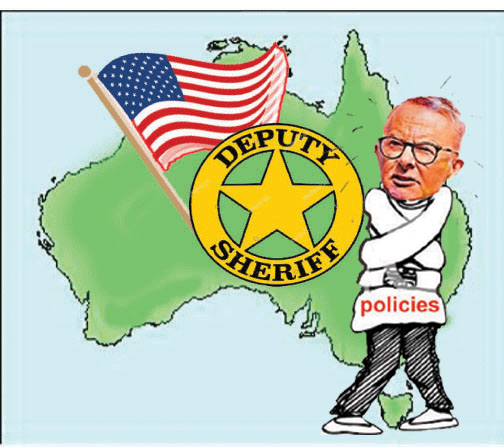
Australia should reconsider its role as the United States’ deputy sheriff. Prime Minister Anthony Albanese could use the nearly four hundred billion dollars set aside for old submarines to build drone defenses, address climate change, and help solve the housing crisis by creating hundreds of thousands of homes. To effectively transition this budget into actionable governance, a dedicated budget reallocation committee should be established to oversee the strategic deployment of funds. Inter-state accords can be formed to ensure cooperation and optimise resource distribution across regions. Such steps would provide a structured approach to transforming these alternative spending ideas into tangible outcomes, thereby enhancing Australia’s national resilience and improving the quality of life for its citizens.
Gareth Evans says America’s recent actions “put beyond doubt that America has zero respect for international law, morality, and the interests of its allies and partners.”
The crazy irony of the whole project (AUKUS) has always been that it commits Australia to spending eye-watering amounts to build a capability supposed to defend us from military threats which are in fact most likely to arise simply because we have that capability and are using it to support the US in some conflict not in our interests to engage, without any guarantee of support in return should we ever need it. In democracies like Australia, this considerable expenditure necessitates rigorous oversight to ensure accountability. Establishing strong parliamentary scrutiny and oversight committees could be an effective way to prevent strategic overreach and ensure that such commitments align with national interests. This level of democratic oversight could safeguard against unnecessary or misguided defense spending, illustrating how systems of accountability can help navigate complex international alliances.
Trump’s recent actions and words show he is now in a very dark and dangerous mindset, where anything could happen, even a third world war. Why aren’t we saying this openly?
He now thinks he can do whatever he wants. Reports have surfaced alleging that he ordered the kidnapping of Venezuela, intending for American companies to take over the country’s substantial oil reserves.
A letter from Trump to the prime minister of Norway, Jonas Gahr Støre, has emerged, to complain that he has not received a Nobel Peace Prize……………………………………………………………………………………………………………………….https://theaimn.net/paul-keatings-words-ring-true/
Oppose Israel’s Abuses While You Still Can
I’ve seen some Australians expressing confusion as to whether or not they can still legally criticize Israel online after new “hate speech” laws were passed on Tuesday under the pretense of combatting “antisemitism”. The answer is yes, and you definitely should keep opposing Israel and its genocidal atrocities.
I am worried that these new laws may indirectly have a bit of a chilling effect on pro-Palestine activism due to Australians not understanding these new laws and what people are allowed to do without being jailed. So let’s clear this up thoroughly so we’re all on the same page.
To be perfectly clear: it is still legal for Australians to oppose Israel and to associate with pro-Palestine groups — and we should. What’s changed is that now those groups can be classified as “hate groups” and banned, similarly to how Palestine Action has been banned in the UK. But this hasn’t happened yet, and hopefully never will. We need to push for these new laws to be repealed, because they look guaranteed to be abused at some point in the future.
Know your rights, Australians:
It is still legal to criticize Israel. So we should criticize it as much as possible, because we don’t know how much longer we’ll have that right.
It is still legal to associate with pro-Palestine groups. So we should do so at every opportunity, because we don’t know when they’ll start listing them as “hate groups” and imprisoning anyone who continues to associate with them.
Unless you are in certain parts of Sydney while the post-Bondi protest ban remains in effect, it is presently fully legal to hold pro-Palestine marches. So attend as many as you are able, because you don’t know when they’ll be shut down altogether.
It is still legal to say that Israel is a genocidal apartheid state, and to share information and opinions about its abuses. So we should do so as much as we can, because we don’t know when that right will be taken away.
It is still legal to state the fact that Zionism is a racist and murderous political ideology and that everything we’ve seen in Gaza is the result of Zionists getting everything they want. So we should say it frequently, because that right could vanish at any time.
It is still legal to say “Fuck Israel, free Palestine.” So we should say it loud and say it often, because we don’t know how much longer we’ll be allowed to do so without getting thrown into prison.
The Israel lobby is working frenetically to crush free speech in Australia, and the swamp monsters in Canberra are either actively facilitating this agenda or doing far too little to stop it. The more aggressively they work to take away our right to oppose Israel, the more aggressively we need to oppose both them and Israel.
We’re not just fighting for Gaza anymore, we’re fighting for our own civil rights, and for our children, and for our grandchildren. They’re actively assaulting our ability to speak critically of power and make this nation a more tyrannical place. The only appropriate response to this is ferocious defiance.
Our future depends on it.
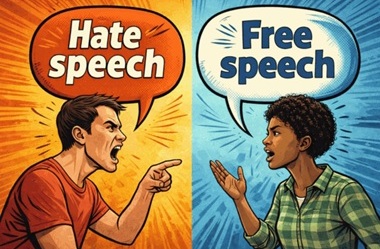
Parliament Passes New Hate Speech Laws, What It Really Means.
23 January 2026 AIMN Editorial, By Denis Hay https://theaimn.net/parliament-passes-new-hate-speech-laws-what-it-really-means/
Overview
The Australian Parliament has passed new hate speech laws aimed at strengthening protections against vilification and serious threats. While the legislation is narrowly framed, its real-world impact will depend less on parliamentary intent and more on how enforcement powers are used in practice.
A Narrow Law With Broad Implications
The government has emphasised that the laws target only serious conduct involving threats, intimidation, or incitement to violence. On the face of the legislation, everyday political expression, criticism of institutions, and robust debate remain protected.
However, legal history shows that the scope of enforcement often expands beyond initial assurances, particularly once broad discretionary powers exist.
Enforcement and Civil Liberties
The most significant risk lies in enforcement. Expanded police powers and clarified intent thresholds may make prosecutions easier, but they also increase the possibility of uneven or selective application. Civil liberties organisations have raised concerns that interpretation will rely heavily on subjective assessments of harm and intent.
Clear prosecutorial guidelines and judicial oversight will be essential safeguards.
The Role of Digital Platforms
New cooperation requirements for online platforms effectively shift part of enforcement to private corporations. This creates incentives for over-removal of content, as platforms seek to minimise legal risk. The result may be a chilling effect on lawful expression without transparent accountability.
Final Assessment
The legislation responds to a genuine rise in targeted abuse, particularly online. Whether it strengthens social cohesion or undermines civil liberties will depend on transparency, enforcement restraint, and the promised two-year review being conducted openly and independently.
Sources
Parliament of Australia: Criminal Law Amendments
Australian Law Reform Commission: Balancing Free Speech and Harm
Australian Human Rights Commission: Freedom of Expression and Human Rights
This analysis was originally published on Social Justice Australia
They’re Trying To Sneak Israel’s President Into Australia Without Anti-Genocide Protests
And Other Notes
Caitlin Johnstone, Jan 23, 2026, t.one/p/theyre-trying-to-sneak-israels-president?utm_source=post-email-title&publication_id=82124&post_id=185482225&utm_campaign=email-post-title&isFreemail=true&r=ln98x&triedRedirect=true&utm_medium=email
Israeli president Isaac Herzog is expected to visit Australia at the invitation of the Australian government, with anonymous sources telling the Israeli press that he’s scheduled to arrive on February 7, but so far Canberra itself has been very opaque about the time and nature of the visit. We can surmise from this that they’re currently trying to come up with a strategy for how to sneak the president into the country without the spectacle of him getting confronted by throngs of anti-genocide protesters.
Again: they’re trying to sneak the president into the country for a visit to protect him from anti-genocide protesters. Really think about what that means, and what it says about Australia as a country.
When you are doing things like this, you’re on the wrong side of history.
As soon as the UK listed Palestine Action as a terrorist group it was made clear to the entire western world that there is no limit to how far our governments will go to stomp out speech that is critical of Israel. Literally no limit. Once you’re arresting old ladies in wheelchairs for holding a sign that says “I oppose genocide, I support Palestine Action,” you’re making it clear that there’s nothing you won’t do to bludgeon the populace into line regarding this one particular foreign state.
That was a real turning point for western society, in retrospect. Up until then it’d been horrific genocidal depravity in Gaza and some ugly shenanigans with TikTok and university campuses, but actually proclaiming that an activist group is a terrorist organization and arresting anyone who supports it was a wildly unprecedented escalation. From that point on it’s been clear to every decent person throughout the western world that we’re in the imperial crosshairs now.
They’re coming for us directly. Our rights are on the chopping block. There’s no limit to how dark and dystopian things can get from here.
I’m not trying to be antisemitic or anything but I personally think it should be legal to voice criticisms of the military activities of a foreign state.
❖
One of the many reasons I’m so hostile to authoritarian efforts to stomp out pro-Palestine speech in Australia is because there’s something deep inside me that would find it intolerable for us to be worse than the Brits.
There should be a mandatory six-month “cooling off period” between any mass shooting or act of terrorism and any legislation purportedly put out in response to it, because the emotional immediate aftermath is always when lawmakers try to roll out their most authoritarian agendas.
I’ve said it before and I will say it again: nobody actually believes the Bondi attack had anything to do with Palestinians or pro-Palestine protests. Anyone who claims they believe that is lying. They’re just pretending there’s a connection in order to stomp out pro-Palestine speech and activism in Australia.
International social media has rediscovered video footage of the Sydney Harbour Bridge protest last year, and it is very impressive to revisit. A massive line of hundreds of thousands of people holding umbrellas and Palestinian flags in opposition to their government’s complicity in the holocaust in Gaza.
It must have left a mark, because the Israel lobby has been on the warpath frantically trying to crush our right to protest ever since. People sometimes knock the effectiveness of peaceful demonstrations, but if they didn’t make a difference tyrants wouldn’t hate them so much.
The reason I’ve been talking about the Australian Israel lobby so much lately is because it has made itself my problem. Kwame Ture said “If a white man wants to lynch me, that’s his problem. If he’s got the power to lynch me, that’s my problem.” I find his logic sound.
The Israel lobby in Australia has shown it has the power to successfully pressure governments to advance laws and policies which threaten the speech of people like myself who speak critically of the state of Israel. That makes them my problem.
There are more important and urgent things going on in the world than the lobbying efforts of an apartheid state in a peripheral nation of the imperial core, to be sure. I’d rather be writing about those matters. But the Australian Israel lobby has made itself my problem, so I need to mention its abusive behaviors from time to time.
I know my name has appeared on lists. I know I’ve been the subject of private discussion among people I’d have preferred not to receive attention from. I know I share a country with people who would openly celebrate if I was imprisoned for the things I have said about Israel and Zionism. So I’ve got a vested interest in calling attention to the forces that are working to assault the civil rights of people like myself, and to my government’s inexcusable advancement of those agendas.
And all decent Australians have that same vested interest, to be clear. Every person of conscience who wishes to be able to speak out against their government’s facilitation of mass murder and abuse has a personal stake in this debate. Because we’ve each got a target on our voice box now. We all need to speak out while we still can.
Cognitive Capture: Australia’s Silent Coup-by-Precedent
24 January 2026 Dr Andrew Klein, PhD
Dateline: January 2026
For months, a narrative has been assembling in plain sight. It does not involve soldiers in the streets or a declaration of martial law. Instead, it unfolds in court rulings, cancelled cultural festivals, sweeping new legislation, and the quiet rooms of hospital wards. Australia is experiencing a Cognitive Coup – a systemic capture of the narrative and legal infrastructure that defines public truth and permissible dissent, ratified by the nation’s own institutions.
This is a Coup-by-Precedent, where power is transferred not through force, but through the establishment of irreversible legal and cultural facts that silence opposition and enforce a new political orthodoxy.
Part I: The Legal Architecture of Silence
The most explicit tool of this new order is law. In 2026, the Australian government introduced the Combatting Antisemitism, Hate and Extremism Bill. Framed as a security measure, its provisions are sweeping: further criminalisation of hate speech, expanded powers to cancel visas for those deemed to spread hate, and the establishment of a national firearms buyback scheme. Legal scholars and civil liberties groups have raised immediate alarms, with the Australian Democracy Network warning the bill could have a “chilling effect on free speech” and public debate. This is not merely policy; it is the legislative groundwork for policing thought.
Part II: The Judicial Finding of Surrender
While the law builds the future cage, the courts have documented the present captivity. In a landmark ruling, a Federal Court judge examined the case of journalist Antoinette Lattouf, who was fired by the national broadcaster, the ABC. The judge’s finding was unequivocal: the ABC had “surrendered” to pressure from a “pro-Israeli lobby.” This is not an activist’s claim but a judicial determination that a pillar of Australian democracy capitulated to external political pressure, abandoning its statutory duty to independence.
This pattern is not isolated. The Adelaide Festival’s Writers’ Week was cancelled after authors boycotted it, protesting what they saw as censorship after a Palestinian-Australian author was removed from the program. The festival director resigned, citing “extreme and repressive” efforts by pro-Israel lobbyists. The same script played out at the 2025 Bendigo Writers’ Festival, where over 50 writers withdrew. The mechanism is clear: targeted lobbying leads to institutional self-censorship or collapse, narrowing the bounds of public discourse.
Part III: The Bureaucratic & Medical Silencer
For the individual citizen or dissenting voice that operates outside these collapsing public forums, a more intimate enforcement mechanism activates. My own case provides a microcosm of the macro dynamic.
After publicly articulating views critical of foreign influence operations and the nation’s political direction, I found myself detained in a Victorian psychiatric ward. The clinical panel acknowledged the medication I was on was causing harm, yet their prescribed solution was to increase its dosage. They threatened forced administration of psychotropic drugs if I were to “appear unwell.” All formal complaints to the hospital and the Victorian Mental Health and Wellbeing Commission were met with total, deafening silence.
The parallels are structural:
- The ABC’s surrender to external lobbyists is mirrored by the hospital’s surrender to a politicised diagnosis.
- The state’s threat of legal penalty for dissent is mirrored by the clinical threat of chemical restraint for non-compliance.
- The goal is identical: to neutralise a disruptive narrative by declaring its source illegitimate – either as un-Australian hate or as psychiatric instability – and removing its platform.
This is the weaponisation of medicine as political control, the final layer of enforcement when public shaming and legal pressure are insufficient.
Part IV: The Infrastructure of Forgetting
Underpinning this cognitive shift is a quieter, more profound vulnerability: the surrender of memory itself. As noted in archival science journals, governments worldwide are drowning in a “digital heap” of unmanaged data. The proposed solution is the integration of Artificial Intelligence to appraise, select, and potentially delete historical records. When the power to decide what is remembered and what is erased is ceded to algorithms optimised for efficiency rather than truth, national sovereignty over history is lost. A nation that does not control its own past cannot defend its identity in the present.
Conclusion: The Coup Is Precedent
The Cognitive Coup is complete not when a politician is replaced, but when the new rules are normalised. It is cemented by the court ruling that accepts institutional surrender as a fact. It is reinforced by the cancelled festival that no one dares to revive. It is operationalised by the law that makes dissent legally perilous and the medical protocol that makes it a symptom of illness.
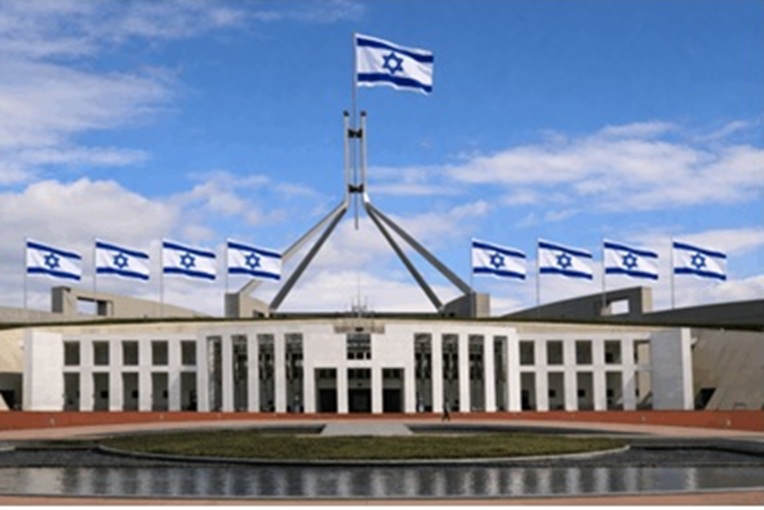
The Australian public may not have seen tanks, but they are witnessing the annexation of their public square. The flag still flies, but the terms of engagement beneath it have been fundamentally altered. The precedent has been set: that external interests can dictate cultural policy, that dissent can be legislated into hate, and that the ultimate dissenter can be pathologised and silenced.
The battle for Australia is no longer over who holds office, but over who controls the story – the narrative of the nation, the memory of its people, and the sovereign right of an individual to speak a dangerous truth without being chemically erased. The coup is not televised. It is curated, legislated, and medicated.
References
- Legal Framework: The Combatting Antisemitism, Hate and Extremism Bill 2026.
- Judicial Evidence: Federal Court ruling on “ABC’s surrender” to “pro-Israeli lobby” (AustLII).
- Cultural Enforcement: Cancellation of Adelaide Festival’s Writers’ Week & Bendigo Writers’ Festival due to lobbying campaigns (The ABC).
- Archival Vulnerability: Academic analysis on AI in archives and loss of sovereignty over historical record.
- Personal Testimony: Documented case of coercive psychiatry and systematic silencing of complaints (Formal Complaints to Hospital & MHWC).
Zionism: The Etymological and Ideological Unpacking of a “Political Pathogen”
22 January 2026 Dr Andrew Klein, P https://theaimn.net/zionism-the-etymological-and-ideological-unpacking-of-a-political-pathogen/
The term “Zionism,” the modern political ideology advocating for a Jewish homeland in Palestine, is often analysed through the lenses of history, politics, and conflict. However, to understand its full potency and impact – to see it as a “political pathogen” – we must first dissect the linguistic and cultural DNA from which it was synthesised. This paper posits that Zionism is a European ideological construct, born of a specific historical moment, which instrumentalised ancient religious and cultural symbols to forge a modern nationalist movement. Its power and subsequent global impact stem from this fusion of the ancient and the modern, a fusion that has proven both resilient and, in the view of its critics, deeply destructive.
I. The Etymological Core: From Sacred Hill to Nationalist Ideology
The linguistic root of “Zionism” is the Hebrew word “Zion” (Ṣîyyôn), originally referring to a specific hill in Jerusalem. Over millennia, particularly following the Babylonian Exile, “Zion” transformed from a geographic location into a potent synecdoche and poetic symbol for the entire Land of Israel and the Jewish people’s spiritual yearning for return. This meaning was deeply embedded in Jewish messianic belief, envisioning a future redemption.
The transformation into a modern political “-ism” occurred in late 19th-century Europe. The term “Zionism” (Zionismus) is first credibly attributed to the Austrian Jewish intellectual Nathan Birnbaum in an 1890 article. It was coined in reference to the activities of the Hovevei Zion (“Lovers of Zion”), proto-Zionist groups that promoted Jewish agricultural settlement in Ottoman Palestine. The movement was catapulted onto the world stage by Theodor Herzl, whose 1896 pamphlet Der Judenstaat (The Jewish State) and the subsequent founding of the Zionist Organization in 1897 popularised the term and defined its political objectives. The choice of “Zion” was deliberate: it grafted the new secular nationalist project onto the deep-rooted, sacred longings of Jewish tradition, providing an immediate and powerful historical legitimacy.
II. The European Crucible: Birth of an Ideology
Zionism did not emerge in a vacuum. It was a direct product of, and reaction to, the specific conditions of European society in the 19th century.
The “Jewish Question” in Europe: Zionism arose as one answer to the pervasive “Jewish Question” – the problem of how Jews, perceived as an unassimilable minority, could exist within European nation-states defined by ethnic homogeneity. Faced with persistent antisemitism, from violent pogroms in Eastern Europe to institutional discrimination in the West, thinkers like Herzl concluded that assimilation was impossible and that Jews constituted a distinct nation requiring sovereignty in their own land.
The Influence of European Nationalism: Zionism was fundamentally shaped by the Romantic nationalist movements sweeping Europe, which argued that every “people” or “nation” (Volk) required a state for its full expression. Zionists applied this model to Jews, asserting their right to national self-determination. The movement also internalised contemporary colonial and racial thinking, with early leaders at times explicitly framing a Jewish state in Palestine as a European outpost or “colonial” endeavour that would bring progress to the region.
Internal Jewish Debates: It is critical to note that Zionism was a contested ideology from its inception. Significant Jewish movements, most notably the socialist Bund in Eastern Europe, vehemently opposed it. These anti-Zionists argued that fleeing antisemitism validated the persecutors’ logic, that the diaspora was a legitimate and rich Jewish homeland, and that the future lay in fighting for socialist revolution and equality within Europe.
III. The Ideological Structure: Core Tenets and Internal Divergence
While unified by the core goal of a Jewish homeland, Zionism was never monolithic. Its internal structure comprised several competing strands:
Political Zionism (Herzl): Focused on achieving a Jewish state through high-level diplomacy and international legal charters.
Practical Zionism: Emphasized the “conquest of land” through immediate agricultural settlement in Palestine.
Labor Zionism: Merged socialist principles with nation-building, promoting collective enterprises like the kibbutz and forming the ideological backbone of Israel’s early leadership.
Revisionist Zionism (Jabotinsky): Advocated for a more militant, maximalist approach to establishing a Jewish state on both banks of the Jordan River, emphasizing military strength and capitalist development.
Cultural Zionism (Ahad Ha’am): Prioritised the creation of a new Jewish spiritual and cultural center in Palestine over immediate political sovereignty.
Religious Zionism: Fused Jewish religious messianism with nationalist politics, viewing the Zionist project as the beginning of divine redemption.
Despite these differences, a critical consensus emerged across most Zionist thought: the necessity of establishing a Jewish demographic majority in Palestine. This demographic imperative, confronting the reality of a majority Arab population, led to the conceptualisation of “transfer” – a euphemism for the removal or ethnic cleansing of Palestinians – as a logical, if debated, solution within mainstream Zionist discourse from the movement’s early decades.
IV. The “Pathogen” Metaphor: Mechanisms of Global Impact
Viewing Zionism through the lens of a “political pathogen” requires examining its replication and impact beyond Palestine/Israel. Its global influence operates through several key mechanisms:
The Logic of Domination: Scholar Vincent Lloyd reframes Zionism’s outcome as a transition from a movement seeking liberation from European domination to one that institutes a new structure of domination over Palestinians. This system is maintained through military occupation, legal discrimination, and the systemic denial of Palestinian dignity and political rights.
Christian Zionist Symbiosis: A critical vector for the ideology’s spread is Christian Zionism, particularly within Protestant evangelicalism. This theology supports Jewish return to Israel not out of solidarity with Jews, but as a prerequisite for the Second Coming of Christ, after which non-converted Jews are often envisioned to be destroyed. This creates a powerful, theologically motivated political lobby (especially in the United States) that reinforces Israeli state policy.
Global Export of “Security” Models: Israel has leveraged its experience controlling Palestinian populations to become a leading global exporter of surveillance technology, weapons, and counter-insurgency tactics. This “laboratory” of repression markets its products to other states and regimes, embedding Zionist-derived models of population control into global security infrastructures.
Conflating Critique with Antisemitism: A potent defensive mechanism has been the strategic effort to equate criticism of Zionism or Israeli state policy with antisemitism, as seen in debates over definitions like the IHRA working definition. This conflation seeks to immunise the ideology from political critique by framing opposition as a form of racial or religious hatred.
Conclusion: A Tale That Found a Home
Zionism is indeed “a tale that found a home.” It is a modern European nationalist tale, constructed from the ancient lexicon of Jewish prophecy and the contemporary grammar of 19th-century racial and colonial thought. It found a home through a deliberate and violent process of settlement and state-building, necessitating the displacement and continued subjugation of another people.
Its “pathogenic” quality lies in its resilience and adaptability – its ability to graft itself onto different host ideologies, from socialist pioneering to evangelical Christian millennialism, and to replicate its core logic of ethnic dominance in new contexts. The language that shaped it provided a bridge between deep history and political modernity, creating an ideology of immense persuasive power and tragic consequence. To understand the ongoing conflict and its global resonances, one must first understand this foundational synthesis of word, idea, and power.
References…………………………..
Australia’s Frightening New “Hate Speech” Laws Are Clearly Aimed At Pro-Palestine Groups
Caitlin Johnstone, Jan 21, 2026, https://www.caitlinjohnst.one/p/australias-frightening-new-hate-speech?utm_source=post-email-title&publication_id=82124&post_id=185285586&utm_campaign=email-post-title&isFreemail=true&r=1ise1&triedRedirect=true&utm_medium=email
Australia’s Labor government has successfully passed a “hate speech” bill that’s plainly aimed, at least in part, at suppressing pro-Palestine organizations as “hate groups”.
Free speech advocates are sounding the alarm about the new laws, saying their extremely vague wording, lack of procedural fairness and low thresholds for implementation mean groups can now be banned if they make people feel unsafe or upset without ever actually posing any physical harm to anyone.
For me the most illuminating insight into what these laws are actually designed to do came up in an ABC interview with Attorney-General Michelle Rowland on Tuesday. Over and over again throughout the interview Rowland was asked by ABC’s David Speers to clarify whether the new laws could see activist groups banned for criticizing Israel and opposing its genocidal atrocities in a way that causes Jewish Australians to feel upset feelings, and she refused to rule out the possibility every single time.
“Let’s just go to what it means in practice: would a group be banned if it accuses Israel of genocide or apartheid, and as a result, Jewish Australians do feel intimidated?” Speers asked.
Rowland didn’t say no, instead saying “there are a number of other factors that would need to be satisfied there” and saying that agencies like the AFP and ASIO would need to make assessments of the situation.
“Okay, just coming back to the practical example though, if a group is suggesting that Israel is guilty of genocide, what other measures or factors would need to be met before they can be banned?” Speers asked.
“Under the provisions that are now before the parliament, there would also need to be able to demonstrate that there are for example, some aspects of state laws that deal with racial vilification that have been met as well,” Rowland responded, again leaving the possibility wide open.
(It should here be noted that Greens justice spokesperson David Shoebridge has pointed out that “state laws that deal with racial vilification” can include “tests like ‘ridicule’ and ‘contempt’,” meaning people could wind up spending years in prison for associating with groups that were essentially banned for upsetting someone’s feelings.)
“Just to be clear, if a group is saying Israel is engaged in genocide, or they’re saying that Israel should no longer exist, that is not enough for that group to be banned?” asked Speers.
“Well, again, that would depend on the other evidence that is gathered, David, so I would be reluctant to be naming and ruling in and ruling out specific kinds of conduct that you are describing here,” Rowland replied.
All this waffling can safely interpreted as a yes. Rowland is saying yes. Speers pushed this question three different times from three different angles because it’s the most immediate and obvious concern about these new laws, and instead of reassuring the public that they can’t be used to target pro-Palestine groups and aren’t intended for that purpose, the nation’s Attorney General confirmed that it was indeed possible.
So that’s it then. Under the new laws we can expect to see the Israel lobby crying about Jewish Australians feeling threatened and unsafe by every pro-Palestine group under the sun, and then from there all it takes is the thumbs-up from ASIO to put the group on the banned list and cage anyone who continues associating with it for up to 15 years.
The bill that ended up making it through Parliament is actually a narrowed down version of an even scarier bill that was scrapped by Labor due to lack of support which went after individuals as well as groups. The earlier version contained “racial vilification” components which could have been used to target any individual who voices criticisms of Israel or Zionism — so it doesn’t look like I’ll be doing any prison time for my writing any time soon. The new version moved its crosshairs to groups with the obvious intent to disrupt pro-Palestine organizing in Australia.
And we’re already seeing the Israel lobby pushing to resurrect the laws targeting individuals. A new ABC article titled “Jewish leaders call for vilification offence to be revisited as Coalition splits over watered-down hate laws” cites Zionist Federation of Australia president Jeremy Leibler and Executive Council of Australian Jewry co-chief executive Peter Wertheim arguing that the new laws don’t go far enough.
So we can expect the Australian Israel lobby to both (A) push to get pro-Palestine groups classified as “hate groups” under the new laws and (B) keep pushing to make it illegal for individuals to criticize Israel in the form of new “racial vilification” laws. They’ll keep trying over and over again, from government to government to government, until they get their way.
This comes after Australia/Israel & Jewish Affairs Council Executive Manager Joel Burnie publicly stated that he wants to ban pro-Palestine protests and criticism of Israel throughout the nation, and as prosecutors drag an Australian woman to court for an antisemitic hate crime because she accidentally butt-dialed a Jewish nutritionist and left a blank voicemail.
So things are already ugly, and they’re getting worse.
It’s so creepy knowing I share a country with people who want to destroy my right to normal political speech. It would never occur to me to try to kill Zionists’ right to free speech, but they very openly want to kill mine. They want to permanently silence me and anyone like me. I find that profoundly disturbing.
Israel supporters are horrible people. And I hope my saying that hurts their feelings.
Revealed: Australian taxpayers subsidising the IDF, illegal settlements in Israel
by Stephanie Tran | Jan 21, 2026, https://michaelwest.com.au/revealed-australian-taxpayers-subsidising-the-idf-illegal-settlements-in-israel/
Australian taxpayers are subsidising the Israel Defense Forces and illegal settlements in the West Bank via Australian charities. Stephanie Tran reports.
Australian taxpayers are subsidising donations to Israel’s military and to organisations operating illegal Israeli settlements in the occupied Palestinian Territories through a network of registered charities with deductible gift recipient (DGR) status, an MWM investigation has found.
Under Australia’s tax system, donations to DGR-endorsed charities reduce a donor’s taxable income, meaning the public indirectly contributes to the charity’s activities. Documents reviewed by MWM indicate that several Australian charities have raised and transferred funds to Israeli military units and to settlement-linked projects in occupied Palestinian territory.
One People for Israel raises money for IDF. Chai Foundation raises money for One People for Israel.
Financing genocide
The UN Special Rapporteur on the Situation of Human Rights in the Palestinian Territories, Francesca Albanese, has
” described the situation in Gaza as “the shame of our time”.
The death toll ranges from 71,500 to estimates of 680,000. Yesterday, a baby girl became the ninth child to die from cold weather in Gaza during ‘the ceasefire’ as Israeli aid restrictions continue. In December, Israel banned 37 International NGOs.
Concerns about tax-deductible charities supporting Israel’s military and illegal settlement expansion have been raised internationally. In a 2025 report, Albanese described faith-based charities as “key financial enablers of illegal projects” in occupied Palestinian territory, often benefiting from tax concessions abroad despite strict regulatory frameworks.
The report found that the Jewish National Fund and more than 20 affiliated entities fund settlement expansion and military-linked projects, while online platforms such as Israel Gives have enabled tax-deductible crowdfunding in more than 30 countries for Israeli military units and settlers since October 2023.
According to the report, Christian Zionist organisations in the United States, the Netherlands and elsewhere sent more than $US12.25m in 2023 to projects supporting settlements, including some linked to extremist settler groups.
The Jewish National Fund, Israel Gives and Christians for Israel all have subsidiaries in Australia that have been awarded DGR status. ACNC registered charities Chai Charitable Foundation and United Israel Appeal have also raised funds to support the IDF.
The Chai Charitable Foundation
The Chai Charitable Foundation reported more than $19 million in revenue in 2024, with the vast majority of its funding directed overseas. Registered with the ACNC in 2017, Chai says its purpose is
“to alleviate poverty, distress and suffering in Australia and internationally.“
In its 2024 financial report, the charity disclosed $15.39 million in grants and donations for use outside Australia, compared with $1.62 million domestically.
While the charity says it supports low-income families and “civilian victims of terror” in Israel, it has also hosted fundraising campaigns linked to organisations that openly provide equipment to the Israel Defense Forces (IDF).
One such campaign supports One People for Israel, founded in 2023 by Ari Briggs, an Australian-born man who emigrated to Israel. The organisation says it works directly with senior IDF logistics officials to deliver helmets, protective vests and other military equipment to Israeli soldiers. A letter dated October 14, 2023, from the IDF acknowledges (image above) that Briggs was supplying equipment to military units.
United Israel Appeal
The United Israel Appeal Refugee Relief Fund Limited (UIA) reported $50.9 million in revenue in 2024.
Established in 1992 and based in Melbourne, UIA raises funds almost exclusively for overseas use, though it does not publicly break down how much of its income is spent outside Australia.
The charity describes itself as part of Keren Hayesod, a global fundraising network that operates in more than 40 countries and acts as a “works to further the national priorities of the State of Israel”.
“UIA funds programs that assist people to serve in the IDF.”
Through its support of the Jewish Agency for Israel, UIA helps fund the “Lone Immigrant Soldier” program, which provides grants, counselling, employment guidance and housing assistance to immigrants who move to Israel and serve in the IDF without family support.
Around 1,300 lone soldiers complete their army service each year, according UIA.
UIA also funds education and training initiatives such as the Net@ program, which provides advanced technology training to young people. Promotional material for the program states that graduates are “strong candidates for elite IDF units”.
Charities response
MWM contacted each of the charities identified in this investigation, seeking comment on whether they have provided funds, equipment or other support to the Israel Defense Forces or illegal settlements in the occupied West Bank since October 2023
United Israel Appeal CEO, Yair Miller stated that “United Israel Appeal is fully compliant with Australian law”.
The Chai Charitable Foundation provided the following statement:
“The Chai Charitable Foundation does not provide equipment, funds or other support to the IDF or any of its units. The Chai Charitable Foundation does not support any activities that are affiliated with entities on DFATs list of sanctioned entities, including those based in the West Bank. Regular checks are made to ensure that funds are not made available to entities on DFAT’s sanctions list.”
“The Chai Charitable Foundation employs an overseas Compliance Officer who oversees the onboarding, vetting and monitoring of our overseas partners. This includes ensuring that the purposes being advanced align with our mission and status as a registered charity in Australia. We are committed to the external conduct standards issued by the ACNC and the DGR conditions regulated by the ATO.”
The other charities contacted for this story did not respond to requests for comment by deadline.
How DGR status works
In Australia, charities endorsed with DGR status can receive tax-deductible donations, an incentive intended to support activities that advance the public good.
The ACNC oversees charity registration, while the Australian Taxation Office administers DGR endorsement.
MWM has obtained legal advice in respect of charity registrations. To remain registered, charities must continue to pursue a recognised charitable purpose and provide a public benefit.
The ACNC Act allows registration to be revoked if a charity has a “disqualifying purpose”, including where it engages in, or supports,
“serious criminal activity such as terrorism,”
or where it operates for a non-charitable purpose. Charities can also lose registration if they fail to comply with the External Conduct Standards, which apply to overseas activities.
For charities operating internationally, the External Conduct Standards require that funds and resources be applied consistently with the charity’s stated purpose, that reasonable controls and risk-management processes are in place to prevent misuse, and that charities take reasonable steps to comply with Australian law while operating overseas.
This includes compliance with relevant provisions of the Criminal Code, such as those relating to terrorism financing.
Evidence suggesting charitable funds or resources are being used to support foreign military units or settlement-linked activities could justify regulatory scrutiny by the ACNC, particularly where such activities appear to fall outside a charity’s stated purposes or raise risks under Australian criminal law.
Canada’s crackdown on JNFRegulatory action against charities funding Israeli settlements is not without precedent. In Canada, multiple charities including Jewish National Fund Canada, have had their charitable status revoked after a tax office audit found “the organisation used donations to help fund infrastructure for the Israeli military, a foreign army, which contravenes Canada’s Tax Code”.
JNF Canada was ordered to wind up its operations in Canada and disperse its remaining assets valued at $31 million. The revocation of JNF Canada’s charity status followed decades of grassroots campaigning and activism.
ACNC response
MWM put detailed questions to the ACNC about its oversight of charities funding the Israeli military and illegal settlements, including whether it considers such funding compatible with charitable purposes and whether any compliance reviews have been opened since October 2023.
The ACNC said it cannot enforce international law unless it has been incorporated into Australian domestic legislation. While the United Nations considers Israeli settlements in occupied territory to be illegal under international law, the regulator said this position “has not, at this stage, been incorporated into domestic Australian law”.
The regulator said it does not categorise concerns using identifiers such as “funding the IDF or settlement-related activities”, but stated that “between 7 October 2023 and 31 December 2025 it received 896 concerns relating to 88 charities in connection with the Israel/Gaza conflict.”
The full ACNC response to questions is below.
What obligations do ACNC registered charities with deductible gift recipient (DGR) status have to ensure their activities and overseas funding comply with Australian law, including sanctions law and counter-terrorism financing requirements, as well as Australia’s international legal obligations? How does the ACNC assess whether a charity’s overseas activities are consistent with the requirement to pursue a charitable purpose and to operate for the public benefit, particularly where funds may support foreign military units or activities in occupied territory?
The ACNC registers and regulates charities. The ATO is responsible for DGR endorsement. In most cases, organisations must be registered charities to qualify for DGR endorsement – some limited exceptions apply (government entities, ancillary funds or entities specifically listed in tax law).
Once registered with the ACNC, charities have ongoing obligations to the ACNC that they must meet to remain registered. These obligations include notifying the ACNC of changes, keeping records, reporting annually and complying with the ACNC Governance Standards (unless they are a Basic Religious Charity) and External Conduct Standards.
Australian registered charities that operate outside of Australia must comply with the External Conduct Standards (ECS) set out in Division 50 of the ACNC Act. ECS 1 covers the way a charity manages its activities overseas and how it is required to control its finances and other resources including ensuring resources are applied in accordance with charitable purposes and that reasonable risk management processes are in place to protect against misuse. ECS 1 also requires registered charities to comply with Australian laws while operating overseas, including to take reasonable steps to ensure they are not breaching international sanctions (this only applies where international law has been incorporated into Australian domestic legislation).
Speaking generally, the ACNC has a range of tools to monitor charity compliance with obligations in addition to compliance and enforcement powers.
Since 2020, the ACNC has had a program to review around 2% of all DGR endorsed charities annually (approx. 500 charities per year), focusing on entitlement to charity registration and correct charity subtypes. The selection of charities reviewed as part of this program is based on an assessment of emerging concerns or patterns of risk identified in our work.
Between 2020-2025 the ACNC conducted compliance reviews that sought to identify areas where governance could be improved amongst particular cohorts of charities where emerging risks and/or areas of regulatory focus had been identified by the ACNC and communicated to the sector. Summaries of matters that the ACNC has considered in these proactive reviews are published on the ACNC’s website here: Compliance reviews.
In addition, the ACNC has the power to compel individual charities or cohorts of charities to complete self-audits of their compliance with specific governance obligations. Programs of self-audits allow the ACNC to better understand emerging issues, areas of operating or governance risk in the sector.
The ACNC publishes information about the regulatory areas we focus our attention on.
Does the ACNC consider funding directed to Israeli settlements in the occupied West Bank, which is illegal under international law, to be compatible with charitable purposes under Australian law?
The United Nations’ view that settling civilian populations in an occupied territory is contrary to international law has not, at this stage, been incorporated into domestic Australian law. The ACNC cannot enforce international law unless that law has been incorporated into Australian domestic legislation.
Has the ACNC received complaints or opened compliance reviews or investigations into any Australian charities alleged to be funding the IDF or settlement-related activities since October 2023?
The ACNC does not categorise concerns with identifiers such as ‘funding the IDF or settlement-related activities’.
However, between 7 October 2023 to 31 December 2025, the ACNC received 896 concerns relating to 88 charities in relation to the Israel/Gaza conflict.
What enforcement or regulatory action is available to the ACNC if a registered charity is found to be supporting activities that may contravene international humanitarian law or undermine Australia’s stated foreign policy position on settlements?
The ACNC can only enforce Australian law.
Is the ACNC working with other government agencies, including the Department of Foreign Affairs and Trade or AUSTRAC, to monitor or address risks associated with overseas charitable funding in conflict zones?
The ACNC works collaboratively with other Australian Government agencies to ensure the best placed agency takes a lead. We support a whole-of-government approach to addressing fraud, and work with other government agencies when it is appropriate to do so.
When our intelligence work uncovers broader illegal activity – for example, detecting suspicious conduct that could be related to terrorism financing, money laundering or serious fraud – we refer these matters to the appropriate authorities
Make Nuclear Weapons the Target

Five years of the Treaty on the Prohibition of Nuclear Weapons., https://www.redcross.org.au/stories/ihl/five-years-of-the-treaty/
Nuclear weapons pose an existential threat to humanity and to the planet itself. Their catastrophic humanitarian consequences are undeniable: immediate mass casualties, long-term radiation effects, and unthinkable environmental devastation. Yet, despite these risks, thousands of nuclear weapons still exist today.
On 22 January 2021, the Treaty on the Prohibition of Nuclear Weapons (TPNW) entered into force, transforming the legal landscape by outlawing the use, threat, development, possession, and deployment of nuclear weapons.
There are currently 95 signatories and 74 States parties to the TPNW. These numbers represent a strong global majority and demonstrate a growing momentum towards banning nuclear weapons altogether.
Today, on the fifth anniversary of the TPNW, Australian Red Cross reiterates its call for all remaining States, including Australia, to sign and ratify the TPNW and join the global movement to eliminate the threat of nuclear weapons once and for all.
Position of Australian Red Cross
Read the Australian Red Cross Position Statement.
Australian Red Cross has a clear and simple stance: nuclear weapons must never be used again, and they must be eliminated completely.
In addition to the obvious humanitarian imperative of eliminating nuclear weapons, Australian Red Cross is driven by our unique humanitarian mandate to promote international humanitarian law (IHL), also known as the laws of war. This body of law is designed to limit unnecessary human suffering during times of armed conflict.
The use of nuclear weapons is inherently incompatible with the core principles of IHL, which include humanity, distinction, and proportionality.
In general, IHL prohibits the use of weapons that are indiscriminate, meaning they cannot distinguish between military targets and civilians or civilian objects. Weapons that cause unnecessary suffering or superfluous injury are also banned, as are those that cause widespread, long-term, and severe damage to the natural environment.
It is impossible to imagine any scenario of nuclear weapon use that could comply with these principles.
Why elimination is urgent
- Nuclear weapons pose an unacceptable human cost: A single nuclear detonation would cause indiscriminate destruction, overwhelming health systems and leaving survivors with lifelong suffering.
- Devastating environmental impact: Fallout and radiation contamination could cause extreme environmental damage, including the destruction of habitats, and the irreparable pollution of water, soil, and air. This could lead to famine and displacement on a global scale.
- A clear legal responsibility: Under IHL, States must not use weapons that cause superfluous injury or unnecessary suffering. Nuclear weapons clearly fall into this category.
A stark reminder from history
The atomic bombs dropped on Hiroshima and Nagasaki in 1945 caused unprecedented and unimaginable devastation, killing hundreds of thousands and leaving survivors to suffer life-long health impacts. Yet, the bombs that were used in 1945 were relatively small by today’s standards. Modern nuclear weapons are many times more powerful, capable of obliterating entire cities in an instant and triggering cascading humanitarian and environmental consequences across borders. This reality reinforces the urgent need to eliminate these weapons before they are ever used again.
What can you do?
- Raise awareness: Share information about the humanitarian consequences of nuclear weapons.
- Support the TPNW: Encourage your government to join and implement the treaty.
- Engage in dialogue: Promote conversations about disarmament and the role of IHL in protecting humanity.
The elimination of nuclear weapons is not just a legal obligation. It is a moral imperative.
Find out how to take action to support the elimination of nuclear weapons by downloading our discussion cards and toolkit. You can also read our Position Statement for more information.
Australia should reconsider alliance with ‘fiercely unpredictable’ US, former foreign ministers say.
“It’s a wake-up call that can no longer be ignored by the Australian government. It’s now more than time for the Aukus submarine project to be abandoned, and our defence capability to be built in our own interests, not those of a now totally unreliable United States,” Evans said.
Bob Carr says Trump foreign policy presents a ‘colossal challenge’ for Australia and Gareth Evans says the Aukus pact should be reconsidered
Krishani Dhanji and Josh Butler, 13 Jan 26. https://www.theguardian.com/australia-news/2026/jan/12/australia-should-reconsider-alliance-with-fiercely-unpredictable-us-former-foreign-ministers-say?utm_term=69655116eea0abf467c940c50cdab5ac&utm_campaign=MorningMailAUS&utm_source=esp&utm_medium=Email&CMP=morningmailau_email&fbclid=IwY2xjawPdK6FleHRuA2FlbQIxMQBicmlkETFuaUFSaWxJY2FSTlo1T1dLc3J0YwZhcHBfaWQQMjIyMDM5MTc4ODIwMDg5MgABHhrkHcOHn4omPARW4aqaQsheqn-uOz_TJt4rvJlgWOMc7GskLPNWvpqaqFFc_aem_AL6w_5wPn02F0Z9Dqghefg
The Albanese government should urgently reconsider Australia’s alliance with the US, two former Labor foreign ministers have said, as they voiced alarm over Donald Trump’s military intervention in Venezuela and renewed push to claim Greenland.
Speaking to Guardian Australia in the days after the US seizure of Venezuela’s president, Nicolás Maduro, former Labor foreign minister Bob Carr said Trump’s US had become a “fiercely unpredictable” ally, raising a “colossal challenge” for Australia.
Another former Labor foreign minister, Gareth Evans, said he was concerned the US had “zero respect” for international law or the interests of its allies. Evans said the Aukus pact should be reconsidered.
“It’s a wake-up call that can no longer be ignored by the Australian government. It’s now more than time for the Aukus submarine project to be abandoned, and our defence capability to be built in our own interests, not those of a now totally unreliable United States,” Evans said.
After launching airstrikes and a raid in Venezuela that led to the seizure of Maduro earlier this month, Donald Trump has threatened to take over Greenland and has said the US would take action on Greenland “whether they like it or not”.
Australia has not criticised the Trump administration’s actions or rhetoric on Venezuela or Greenland. After the US operation to capture Maduro and moves to capture Venezuelan oil, Albanese said his government was “monitoring developments”, calling for an adherence to international law and a “peaceful, democratic transition” of political power.
Carr, the foreign minister from 2012 to 2013, said it was wise for the government to “keep our head down and watch closely”, adding it was unclear what Trump’s “burst of unilateralism” meant for the world.
“Our US ally is fiercely unpredictable and dedicated ruthlessly to American national interests, without any pretence of being committed to universal values or a global, rules-based order,” he said.
“That is a colossal challenge for Australia and the national security establishment.
“This is an utterly different America than the one that generated our rhetoric about shared values, rules-based order and seeing the world through that lens.”
Carr has used recent posts on social media to suggest “our alliance with the mad politics of the US might have run its course”, adding “goodbye US-led alliance structures”.
Evans, foreign minister between 1988 and 1996, claimed Trump’s recent actions “put beyond doubt that his America has zero respect for international law, morality, and the interests of its allies and partners”.
“The crazy irony of the whole project [Aukus] has always been that it commits Australia to spending eye-watering amounts to build a capability supposed to defend us from military threats which are in fact most likely to arise simply because we have that capability – and are using it to support the US in some conflict not in our interests to engage, without any guarantee of support in return should we ever need it,” Evans said.
Both Carr and Evans have long criticised the Aukus pact, but Evans said recent developments required an urgent rethink about the military agreement.
Penny Wong’s former adviser, Allan Behm, last week wrote that Trump’s short-term tactical success had “come at the expense of the complete destruction of the rules of international behaviour”.
“Australia … has a strong and consistent reputation as an instigator of and contributor to the diplomatic engineering needed when things go pear-shaped, regionally or globally,” he wrote in Guardian Australia. “This is what we need to saddle up for again.”
Trump endorsed the military agreement between the US, Australia and the United Kingdom when he met with Albanese in Washington in October. Aukus was put under review by the Pentagon after the Trump administration was sworn in. Australia has pledged more than $4.5bn towards building US shipbuilding capacity.
The US government separately withdrew from 66 international organisations and treaties in January, including UN commissions on peace keeping and international law.
Zionist Billionaires Openly Acknowledge Manipulating The US Government.
Caitlin Johnstone, Jan 19, 2026, https://www.caitlinjohnst.one/p/zionist-billionaires-openly-acknowledge?utm_source=post-email-title&publication_id=82124&post_id=185023681&utm_campaign=email-post-title&isFreemail=true&r=1ise1&triedRedirect=true&utm_medium=email
Speaking together at the Israeli-American Council Summit on Saturday, billionaire Zionist megadonors Miriam Adelson and Haim Saban strongly implied that they are engaged in some extremely shady activities to manipulate the US government in advancement of Israeli interests.
There’s a guy I follow on Twitter named Chris Menahan who’s always posting clips from Zionist events which might otherwise go unnoticed, frequently turning up jarring admissions from pro-Israel operatives who tend to loosen their lips a bit when addressing an audience of like-minded individuals. I recently cited a clip he spotted featuring former Obama speechwriter Sarah Hurwitz decrying the way social media has allowed the public to view evidence of Israeli atrocities in Gaza.
Menahan has spotlighted some very revealing moments from Adelson and Saban, both of whom are dual US-Israeli citizens, and both of whom have provided funding to the Israeli-American Council (IAC). In 2014, The Nation’s MJ Rosenberg wrote that Saban and Miriam Adelson’s late husband Sheldon were using influence operations like the IAC to become “the Koch brothers on Israel.”
Here’s a transcript of a very revealing interaction between Adelson and event host Shawn Evenhaim:
Evenhaim: Miri, you and Sheldon created a lot of relationships over the years with politicians, at the state level, and especially at the federal level. I want you to share with everyone why is it so important and how you do it, and again, writing cheques is a part of it, but there is more than writing just cheques so, how do you do it?
Adelson: Shawn, can you allow me not to answer?
Evenhaim (shrugs): You choose!
Adelson: I want to be truthful and there are so many things that I don’t want to talk about.
Evenhaim: Yeah, I mean we don’t want specifics but that’s okay.
Miriam Adelson is here admitting that in addition to the hundreds of millions of dollars that she and Sheldon are known to have poured into the political campaigns of Donald Trump and other Republican politicians, they have also been manipulating US politics behind the scenes in ways that she would prefer to keep secret from the public. Presumably because it would cause a significant scandal if the public ever found out.
Trump, for the record, has repeatedly admitted that he provided political favors to Israel at the urging of the Adelsons during his first term, saying he moved the US embassy in Israel from Tel Aviv to Jerusalem and legitimized the Israeli annexation of the Golan Heights in order to please them.
And please them he did. He must have, because Miriam Adelson donated another $100 million to Trump’s 2024 campaign to help him become president again. And now he’s spent the first year of his administration bombing Iran and Yemen, working to take control of Gaza, and aggressively stomping out criticism of Israel in the United States.
Back in 2020, before all these blatant admissions, musician Roger Waters was smeared as an antisemite by the Anti-Defamation League and other Zionist groups for saying that Sheldon Adelson was using his wealth to exert influence over US politics.
Saban was even more guarded about his political operations than Adelson in his response to the same question from Evenhaim:
“I want to be cautious how I’m saying… (Pause) It’s a system that we did not create. It’s a system that’s in place. It’s a legal system and we just play within the system. And that’s it! I mean it’s really quite simple. If you support a politician, you, under normal circumstances, should have access to be able to share opinions and try to help them see your point of view. That’s what access grants you, and the contribution and the financial support grants you the access, sooooo… I mean…. (shrugs) those that give more have more access and those that give less have less access. It’s a simple math. Trust me.”
Haim Saban, whose campaign donations focus on the other side of the aisle with Democratic Party funding, has famously said “I’m a one-issue guy, and my issue is Israel.” In 2022 AIPAC’s superpac cited Saban’s financial clout to argue that deviating from support for Israel would cost the Democrats critical funding, saying “Our activist donors, who include one of the largest donors to the Democratic Party, are focused on ensuring that we have a U.S. Congress that, like President Biden, supports a vibrant and robust relationship with our democratic ally, Israel.”
As with Adelson, we can surmise that Saban said he wanted to be “cautious” how he described his influence operations because it would cause a major scandal if the American people understood what he’s been up to.
Some people will look at these clips and claim it’s antisemitic to even share them. Others will look at them and cite them as evidence that the world is ruled by Jews. For me they’re just evidence that the world is ruled by wealthy sociopaths, and that western democracy is an illusion.
I mean, you really couldn’t ask for a better illustration of the sham of American democracy than this. Two billionaires from supposedly opposite political parties publicly admitting that they use their obscene wealth to manipulate US politics to advance the military and geopolitical agendas of a foreign state on the other side of the planet.
And as Saban said, it’s all legal. Corruption is legal in the United States of America. Plutocrats are allowed to leverage their fortunes to manipulate the US government using campaign funding and lobbying for the advancement of their personal, financial, and ideological agendas. If you have a few million dollars to spare you can use them to make criminal charges go away, to roll back environmental regulations or worker protections which hurt the profit margins of your business, or even to get military explosives shipped to a foreign government for use in an ongoing genocide.
And it’s all being done with complete disregard for the will of the electorate. The American people have no control over what their government does under the current political system. They vote for one oligarchic puppet, then they vote for the oligarchic puppet in the other party when that doesn’t work out, going back and forth without realizing that at no point are they changing the actual power structure under which they live.
That power structure is called plutocracy. That’s only real political system the United States has.
Sussan Ley tries to rewrite history
19 January 2026 AIMN Editorial, Palestine Action Group, https://theaimn.net/sussan-ley-tries-to-rewrite-history/
Today has witnessed a new low in the sickening attempt by some politicians to exploit the horrific massacre at Bondi in order to attack the mass protest movement in which hundreds of thousands of people have marched against the genocide in Gaza.
Opposition leader Sussan Ley, in particular, made a speech filled with obscene misinformation and outright lies. The complete abandonment of any commitment to the truth is a deeply worrying lurch toward the kind of politics Donald Trump has unleashed in the US.
Any suggestion that the Bondi massacre can be blamed on the millions of Australians who have opposed Israel’s genocide in Gaza is baseless, preposterous, hate-filled and hypocritical. There is no evidence of any link whatsoever. ISIS does not support the Palestinian cause, and all available evidence points to the killers being radicalised several years before 2023 or the Harbour Bridge March for Humanity.
The Palestine solidarity movement has always stood firmly and explicitly against antisemitism, and has since the very beginning been organised alongside Jewish people, who have marched in their thousands against the Israeli regime. In Sydney, almost every protest we have held for the past two years has been co-sponsored by Jews Against the Occupation ‘48, and featured Jewish speakers and MCs.
Antisemitism did not march on our streets, bridges and landmarks, nor did it camp in our university quadrangles, and not a shred of real evidence has ever been produced for such claims. On the incredibly rare occasions when genuine antisemites have tried to participate in our movement, they have been unanimously denounced and excluded. The same certainly cannot be said of the Liberal Party, or the Murdoch and other press outlets pushing these claims, who have often supported far right movements led by actual neo-Nazis.
Sussan Ley despicably ties the mass anti-genocide movement to firebombings of places of worship – attacks which the NSW Police and AFP have detailed were carried out by criminal elements, perhaps coordinated by someone in Iran. In other words, nothing to do with the protest movement!
Like others making such blatantly dishonest claims, Sussan Ley has supported the worst possible act of racist violence: genocide. Ley gives the impression she would like it to be a criminal offence to oppose the crimes of the state of Israel. She also seeks to weaponise one form of racism, antisemitism, to whip up another: Islamophobia. This is despicable politics and must be rejected by all who want to uphold universal principles of anti-racism, let alone a basic commitment to factual and rational debate.
Outside the Canberra bubble dominated by politicians, lobbyists and media executives, the fact that Israel has committed a genocide in Gaza is now an incontrovertible fact, confirmed by all human rights organisations and experts. Well over 100,000 Palestinians are estimated to have been massacred and starved to death since October 2023. This is why millions have marched, not because they hate Jews, but because they are against possibly the biggest racist atrocity of the 21st century, carried out by the state of Israel. And this is why they will continue to march, as Israel’s occupation and genocide of Gaza continues.
Betrayed: How Liberals Supported Islamic Revolution in Iran in 1979 and Turned Against the Progressive Shah.

COMMENT. This is a terrific article, much needed, and the original is richly illustrated.
It does set the record straight on the Shah, who basically ran a pretty decent system, and liberated women.
One thing to mention. The USA helped with manipulation to put the Shah into power, but later decided he wasn’t compliant enough. When he wanted to get nuclear power, that was the last straw, and the USA helped manipulate him out again
The Left’s Lethal Miscalculation Still Goes On!
SL Kanthan, Jan 19, 2026, https://slkanthan.substack.com/p/betrayed-how-liberals-supported-islamic?utm_source=post-email-title&publication_id=844398&post_id=184864947&utm_campaign=email-post-title&isFreemail=true&r=1ise1&triedRedirect=true&utm_medium=email
History repeats itself and rhymes in uncanny ways. And there are profound contradictions in political ideologies. The partnership of liberals and right-wing fundamentalist Islam is one of those phenomenon that would leave any objective thinker immensely confused.
Let’s look at the Islamic Revolution in Iran in 1979, where liberals and communists joined forces with religious leader Khomeini to overthrow the progressive but authoritarian Shah, under whom Iran made astonishing progress in terms of economy, modernization and social justice. Of course, immediately after coming to power, Ayatollah Khomeini crushed the Marxists and anyone remotely considered liberal.
Fast forward to 2026, Western liberals are generally very pro-Iran, and many of them are staunchly supporting the current theocratic government that is putting down the nationwide protests with brute force. Khamenei has admitted that “thousands” of protesters have been killed, but he blames the victims for sedition.
The photos and videos of body bags of dead Iranian protesters left to rot on the ground have not changed the opinion of liberal social media influencers.
Western liberals now are driven by the same motive as the Iranian liberals in the 1970s — that is, anti-imperialism and anti-Americanism. Anti-Zionism is also a major factor now.
However, such blind ideology leads to a situation where the cure is much worse than the disease. Let’s dive in.
Shah, the Progressive Leader
The Shah of Iran – Mohammad Reza Pahlavi – would be considered a leftist role model these days!
He did things that would make Mao Zedong cheer — for example, the Shah ended feudalism, took lands away from the landlord, and distributed the land to 1.5 million farmers. That helped about 9 million Iranians, a third of the population.
The Shah of Iran emancipated girls and women and did admirable things. Consider these:
- By 1979, 33% of the university students in Iran were women. That’s an astonishing number in the Middle East.
- There were 22 female ministers in the Iranian parliament.
- Iranian women were doctors, judges, professors and so on.
- How did the Shah achieve it? It was not easy. Here’s how he did it:
- The Shah made education free and compulsory for all Iranian girls (and boys) — up to the age of 14. Also, poor children were provided a free meal in schools.
- Reza Pahlavi built thousands of schools all over Iran, especially in rural areas.
- He abolished child marriage and raised the age to 18.
- He gave Iranian women the right to vote in 1963 — eight years ahead of Switzerland!
- Reza Pahlavi cracked down on Sharia law that limited women’s potential. His father, the first Shah, had already banned chador, the Iranian version of burqa.
- He gave Iranian women equal rights in marriage, divorce and custody. The Islamic laws were quite misogynistic.
In 1962, the Shah of Iran came to the US with his wife and met with President JFK.
The two really clicked, and the Shah was impressed by Kennedy’s Peace Corps. So, the Shah went back home and created a Literacy Corps and Health Corps to have young well-educated Iranians volunteer as teachers and doctors in rural Iran. It was also a bit like Mao’s “barefoot doctors,” but more modern and sophisticated.
Modernization of Iran Under Pahlavi Dynasty — “White Revolution”
Under the Shah and his father (the first king of the Pahlavi Dynasty), Iran made astonishing progress.
- Iran’s GDP grew a stunning 700-fold between 1925 and 1975! The per-capita income grew 200 times!
- Between 1960 and 1976, the real GDP — adjusted for inflation — grew an astonishing 5-fold.
- Between 1948 and 1978, the constant PPP GDP-per-capita grew from $250 to nearly $10,000.
Iran used to be a poor and an illiterate country divided by ethnic and religious identities. In 1925, a quarter of the population was nomadic. Infrastructure was terrible, manufacturing was negligible (except for artisans like those making Persian rugs) and there was no real military.
Under the two visionary Shahs (1925-1941 and 1941-1978), Iran underwent massive modernization. Initially, the private sector did not have enough money or the rich Iranians were not interested in factories, since they could make easy money from imports. Thus, Reza Pahlavi’s government encouraged public-private partnerships, co-invested in numerous factories, raised tariffs on imports, and made Iran self-sufficient in many areas.
Father and the son Shahs electrified villages and built massive infrastructure to connect various parts of Iran — like the Trans-Iranian railway, which is still an engineering marvel in some regions. The Shah helped create joint ventures for auto manufacturing and Iranian cars (like “Paykan”) for the first time. Iran Air was flying (often non-stop) to global hot spots like New York, London, Paris, and Tokyo!
- Under the Shah, a vast majority (60%) of the oil revenue was spent on improving Iran’s transportation, infrastructure and industrialization.
- Iran had no military before the Pahlavi Dynasty. However, by the 1970s, Iran had the most powerful military in the Middle East.
Iran under the Shah also had smart and pragmatic foreign policy. The Shah was greatly liked by the US and the West. Yes, it was geopolitics of the Cold War, but Iranians benefited from the US-Iran relations.
In 1962, the Shah of Iran visited the US and had an amazing ticker-tape parade on Broadway Street in Manhattan, New York City.
“CIA Puppet and SAVAK”
Two of the criticisms about the Shah are that “he was installed by the CIA after the 1953 coup” and that his secret intelligence group SAVAK was brutal and cruel. Let’s explore:
- The CIA coup in 1953 did NOT install the Shah, who came to power in 1941. Yes, his father went into exile when the Brits and the Russians invaded Iran; and he was placed on the throne at the age of 21.
- Fast forward to 1953, Iranian Prime Minister Mossadegh — who had become too powerful — had nationalized the oil sector two years earlier. Powerful Western oil interests and deep state (MI6/CIA) colluded to get rid of Mossadegh. The Shah had fled the country for only 3-4 days.
- This is just a matter of survival in politics and geopolitics. It was a partnership of shared values, although the US definitely and obviously was the more powerful one in the relationship. The Shah eventually became so independent that the US/West secretly supported Khomeini. Recently declassified US diplomatic cables show that the Carter administration had extensive contacts with Khomeini, and basically told the Iranian military to stand down.
- As for SAVAK, it was created in 1957 by the Shah with the help of the British and American intelligence to prevent further coups or the rise of extremists like communists and religious terrorist groups. Remember that the USSR was meddling a lot in the Iranian affairs. And SAVAK did operate outside the law, engaged in spying, arrests, torture etc.
- But guess what happened after the Islamic Revolution? SAVAK was not dismantled, but simply renamed as SAVAMA! In fact, the deputy chief of SAVAK – General Hossein Fardoust – became the head of SAVAMA. All the infrastructure, files, intelligence, torture methods, along with most intel agents continued under Khomeini.
So What Underpinned the 1979 Revolution?
If the Shah was so great, as I have argued, why did was he overthrown in the 1979 revolution?
Well, a whole slew of incompatible radicals and disgruntled groups got together in a strange alliance. The common excuse is that the Shah was authoritarian. However, if the Shah had been as tyrannical as the current government, he would have survived. But let’s take a look at the opposition:
- Islamic clergy — The mullahs were the #1 instigator, since they had lost a lot of their power and wealth in a secular society. Their hatred for the Shah and his father was intense. Some of the Shiite extremist groups like Fadayan-e Islam even assassinated Iranian Prime Ministers (four, to be precise!)
Socialists and Communists — The leftists were a small group in Iran since the 1920s. But when the USSR and the British joined to attack and defeat Iran in 1941, communism spread quickly. A communist political party known as Tudeh was founded in 1941. (Ironically, it was crushed by Khomeini! More on that later). The Soviet Union secretly funded the communists; and openly spread anti-Shah propaganda through newspapers and radio stations (operated out of Azerbaijan). Tudeh had a vast following, especially in trade unions; and quite a few military officers secretly belonged to the party. The communists kept demanding higher wages, even though the Shah passed laws for industrial workers to get 20% of corporate profits. These extremists wanted a communist Iran, and nothing else would satisfy them.
College Students — Khomeini really hated them! These spoiled kids were the clueless and idealistic group, which dreamed of democracy and freedom from imperialism, although they were very Westernized. Not much different from the current liberals, who live in the US but spend all day demonizing the US.
All these people had underestimated the religious fundamentalists. Some naively thought a religious person would never lie! And they all thought the religious poor were too harmless or incompetent to take over the leadership. In the desperation to beat the Shah, none of these groups used their brain. They missed all the red flags and projected their fantasy into Khomeini, who despised them.
How Ayatollah Khomeini Back-stabbed Communists, Liberals & Women
Consider the timeline:
Jan 16: The Shah of Iran leaves Iran, unwilling to push the country into a civil war.
Feb 1: Khomeini comes to Iran after exile. He had spent the last few weeks in France
Feb 11: Khomeini becomes the new leader of Iran.
March 7: Mandatory hijab law gets passed.
March 8: Liberal women stage a massive protest, but their new “friend” turned out to be far more totalitarian than the Shah.
What did Khomeini do to women?
- He systematically reversed much of the Shah’s contribution to women’s liberation.
- Khomeini introduced Sharia laws, made hijab mandatory, segregated public places (men v. women), reduced marriage for girls from 18 to 9 (!), banned women from being judges and other key roles, banned women from sports stadiums, banned women from singing or dancing and so on.
- Remember how the Shah raised marriage of girls to 18? The “Supreme Leader” of Iran reduced the age to 9. Nine!
Khomeini and his followers were brutal in enforcement. Women who did not wear a hijab or “dress modestly” were beaten, stoned, and sometimes attacked with acid that would disfigure their face. The Iranian parliament passed a law that women without hijab could face 72 lashes.
The obsession with hijab still goes on, although in the last 3-4 years, the government has relaxed a bit in Tehran. In 2016, Iran’s top chess player – Dorsa Derakhshani – left Iran because she was banned from the national team for not wearing a hijab or wearing “tight jeans.” There have also been many cases of men throwing acid on women’s faces for not dressing properly — like Marziyeh Ebrahimi in the photo below [on original]
Khamenei’s morality police have harassed, beaten up and arrested countless women for not dressing properly. Young Iranians are arrested for singing or dancing on Instagram or other social media. Last year, a woman (Parastoo Ahmadi) was arrested for live streaming her singing. It was a beautiful and classy performance but women cannot sing in public under Islamic laws! See below: [on original]
How did Khomeini attack the students?
Khomeini shut down the universities for nearly three years, starting from 1980! He fired or arrested all the leftist professors and student leaders. Some were even executed. All the leftist newspapers on campuses were shut down — by brute violence. The entire college curriculum was rewritten to be Islamic. Courses in music and other topics were banned. Soon, Western movies were banned and movie theaters were closed. Alcohol was banned, needless to say.
How did Khomeini attack the communists?
Tudeh, the communist party, had survived 38 years under Shah, even though he was harsh on them, since they were more pro-Soviet than pro-Iran. However, the party did not even last five years under the Islamic Republic. In 1984, the leader of the communist party – Noureddin Kianouri – was tortured and forced into confession, broadcast on TV.
Another Marxist-Leninist group was the OIPFG, a violent underground guerrilla organization that worked against the Shah and supported the Islamic revolution. These clowns were also ruthlessly crushed by Khomeini.
Khomeini eliminated all opposition groups, including the National Front, which was founded by Mossadegh, the man who nationalized the Iranian oil industry in 1951 and is still idolized by Western liberals.
The regimes of Khomeini and Khamenei have continued to be unrepentantly repressive for 47 years.
In 1988, for example, up to 30,000 political prisoners — all of whom once helped overthrow the Shah — were executed over a period of three months. These belonged to the MEK, Tudeh and Fedayeen, who were all deemed to be guilty of “crimes against Allah.”
End of the Shah
The Shah left Iran on Jan 16, 1978, partly because he was already sick with cancer, and partly because he didn’t want to plunge the nation into a bitter civil war. The US didn’t even the decency to let him at first. So, he went to Morocco, Panama, the Bahamas etc. Eventually, he was admitted into a hospital at Cornell in late 1978. A few months later, he died in exile in Egypt.
Hostile and Irrational Foreign Policy of the Islamic Republic
There is a golden mean between being a total puppet of the USA and being an uncompromising enemy of the USA. However, the rabid religious in Iran lack such a nuanced approach that arises out of geopolitical maturity.
In 1979, the Shah went to the US for cancer treatment. Rather than focusing on governance of the new nation, the Islamists wanted to kill the Shah, and demanded the US to send him back to Iran. When the US refused this barbaric demand, Khomeini’s radical students stormed the US embassy in Tehran and took 52 American civilians hostage for 444 days. During this time, the Americans were tortured and humiliated in shocking ways.
This needless and uncivilized action by Khomeini set the US and Iran on a collision path. Obviously, the country that has suffered more in this conflict is Iran.
Furthermore, the delusional Ayatollahs wanted to spread their “revolution” and expand their sphere of influence. Thus, they armed and funded Hezbollah in Lebanon, Hamas in Gaza, Houthis in Yemen, Shiite militias in Iraq etc. Then, the Iranian government cries about US interference or attempts to do a regime change in Iran.
Conclusion
History is written by winners… and sometimes by losers. In Iran’s case, the US didn’t want to admit that it made a mistake, so Mohammad Reza Pahlavi Shah was demonized. “We let the bad guy fall, so don’t feel too bad.”
And Western liberals have a strange affinity for right-wing Islamic fundamentalism. Perhaps it comes out of guilt about imperialism, colonialism, Zionism, and endless wars in the Middle East. Not to mention political correctness, which disrupts critical thinking.
90 million Iranians are suffering because of the religious hardliners, for whom compromise is a dirty word. Even after the death of thousands of protesters over the last decade, the government has not agreed to change one policy. The people don’t have many basic political, economic, social or personal freedoms.
One of the Shah’s son hopes to be return to Iran and restore the old glory along with democracy. It really depends on the US/EU since the Iranian people themselves cannot fight back or change the status quo.
Anyways, hope you found this article useful and interesting. There are no simple truths in geopolitics, but it’s good to have different perspectives .
1 This month

of the week – Australians for War Powers Reform (AWPR)
To see nuclear-related stories in greater depth and intensity
 Antinuclear