Dirty Energy: Adelaide SpeakOut Nov 19, eve of BHP Annual General meeting
 BHP SPEAK OUT! Let’s make a clean break from dirty energy!
Wednesday November 19, 2014 | 6.30pm
The Governor Hindmarsh Hotel, 59 Port Road, Hindmarsh South Australia, Australia 5007
RSVP: https://www.facebook.com/events/571897972939767/ [free event]
Come and hear about community and environmental concerns with BHP mining projects in Australia and overseas. From coal mines in Colombia and Indonesia, the infamous Olympic Dam uranium mine in South Australia to uranium exports through Port Adelaide – at this forum the spotlight will be on BHP’s behaviour not their share price.
SPEAKERS:
Uncle Kevin Buzzacott
Bob Briton, NOW Port Adelaide
Dave Sweeney – Australian Conservation Council
Mia Pepper – Conservation Council WA
Alternative G20 Summit, and church groups call for inclusion of climate change in G20
Australia: Alternative G20 ‘People’s Summit’ planned for Brisbane, Asian Correspondent, By Rowena Dela Rosa Yoon Nov 04, 2014 BrisCAN-G20 will stage Visioning Another World: The G20 Peoples Summit, a three-day festival packed with events. Programs include conversations, symposiums, creative activities, cultural performances, education, and peaceful demonstrations. It will take place in various locations in Brisbane, aiming to bring together local and international thinkers to collaborate on broad themes such as the economy, growth vs sustainability, environment, climate change, earth rights, dispossession decolonisation, and other issues of social justice. BrisCAN–G20 is concerned about social and economic disparities perpetuated by G20 and the systems it represents.
Various groups and NGOs will join the summit including the Friends of the Earth, OXFAM, National Congress of Australia’s First People, International Trade Union Confederation, Australian Greens and Palm Island Community.
Church Communities call for stewardship
Church groups have also been pressing for environment to be included in the G20 summit.Eleven Brisbane ministers from five churches have formed alliance to call for the Abbott government to pay attention to one of the most pressing issues of the time.
The dean of St John’s Anglican Cathedral, Reverend Peter Catt, who also serves as the group’s spokesperson, said the government did not understand how the economy and the environment are deeply linked, and how the economy operates and how it depends on the environment. Dr Catt views the environment as the foundation of economic growth, prosperity, and “human flourishing”. Noting Christianity’s principle of stewardship, he said, “the Earth is a precious gift and that humans are called to act as stewards.” He added:
Climate change is a deep concern. The G20 leaders should be showing leadership and discussing it at the top of their agenda when they meet in our city.“It would be wonderful if a meeting held in our city led the way to sustainable life and a healthy economy.
The ministers call on the Australian Government, which has control of the agenda, to deal with climate change as a priority. http://asiancorrespondent.com/127944/australia-alternative-g20-peoples-summit-set-in-brisbane/
Project to document the health effects from atomic bomb testing in South Australia
Uranium the Silent Killer By Hilary Tyler
http://www.pozible.com/project/187985 The story of the project At the ANFA (Australia  Nuclear Free Alliance) meeting in Oct 2014 Indigenous Elders called for documentation of the health effects from the Maralinga and other atomic bomb tests in the 1950’s and 1960’s. See https://ausnukefreealliance.wordpress.com for the meeting statement.
Permission was never sort from the Aboriginal nations.
“Just remember that the fallout at Maralinga affected the whole lot of us. Black, white, brindle; we all breathe the same air, and we’re all being affected in various ways, even though that happened a long time ago. It’s still around.” Sue Coleman-Haseldine (Kokatha Mula – Ceduna)
From 1952 to 1963 atomic testing covered vast areas of South Australia including Maralinga and Emu Fields test sites.
In November 2014 there will be a 3 week road trip to archive the stories of the people from Arabuna, Walitina, Ceduna, and Yalata country to produce film, audio and digital documentaries. We will begin a data base of the families affected, the geographical distributions of fall out and detrimental health repercussions of these unconsented tests.
Nuclear weapons are the most destructive, inhumane and indiscriminate weapons ever created. Both in the scale of the devastation they cause, and in their uniquely persistent, spreading, genetically damaging radioactive fallout, they are unlike any other weapons.
For more information on nuclear weapons, including an article on Yami Lester, one of the survivors of the nuclear tests in South Australia, see http://www.icanw.org/au/
Many Aboriginal people in South Australia still rely on bush foods – plants and animals sourced from land that still is contaminated. The possibility of bioaccumulation is very real. Certainly the stories of early death from cancer, thyroid disease and congenital deformities are continuing.
“I’ve lost a lot of my family members through early death – and a lot of it was through cancer, and I do blame the Maralinga fallout.”
Aunty Martha – Arabana (Lake Eyre) Contact us at: uraniumthesilentkiller@gmail.com

Alternative G20 ‘People’s Summit’ in Brisbane 12 – 14 November
Australia: Alternative G20 ‘People’s Summit’ planned for Brisbane, Asian Correspondent, By Rowena Dela Rosa Yoon Nov 04, 2014 An alternative G20 People’s Summit led by an indigenous people’s group will be held separately in Brisbane in response to the Coalition Government’s exclusion of climate change from the G20 Summit 2014 agenda. The three-day People’s Summit will take place on Nov. 12-14, ahead of the G20 leaders summit on Nov. 15-16.
While Australian Prime Minister Tony Abbott will welcome delegations of the G20 for talks on global economic issues and cooperation, climate activists and civic groups will take to thestreets and other venues in Brisbane to highlight what is missing in the leaders’ summit agenda. The Brisbane Community Action Network – G20 (BrisCAN–G20) was created to question the policies enshrined in the free market ideologies of the G20. BrisCAN-G20 wants “to reframe public G20 discourse around issues that impact people, communities and environment; issues that are not addressed or have been ridden roughshod over by the G20 to date.”
Abbott argued that G20 is an economic summit, not a climate summit. He stands by his word, ignoring his disappointed European counterparts and US President Barack Obama.
In September this year, UN Secretary-General Ban Ki-moon hosted the UN Climate Summit in New York, but Abbott did not show. Managing director of the International Monetary Fund (IMF), Christine Lagarde, later noted that climate change should be discussed during the G20 Summit in Brisbane, but Abbott said the G20 is meant to focus primarily on economic growth. He said other issues would only clutter the issue and distract from the summit’s focus. Obama’s international adviser, Caroline Atkinson, also expressed disappointment and was reported to have said, “the idea that Abbott is preventing a discussion on climate change is laughable.”………
Abbott is a self-confessed climate sceptic. He already scrapped the carbon tax, and the nation’s renewable energy target is under threat……..http://asiancorrespondent.com/127944/australia-alternative-g20-peoples-summit-set-in-brisbane/
Submissions called for on Australia-India nuclear energy co-operation
Agreement between the Government of Australia and the Government of India on Cooperation in the Peaceful Uses of Nuclear Energy.
 The Committee invites interested persons and organisations to make submissions by Friday, 28 November 2014.
http://www.aph.gov.au/Parliamentary_Business/Committees/Joint/Treaties/28_October_2014
(Links for the Treaty Text, the National Interest Analysis with Attachment on Consultation, and requirements for submission preparation are provided here: http://www.aph.gov.au/Parliamentary_Business/Committees/Joint/Treaties/28_October_2014/Terms_of_Reference – PDF format)
Up till Nov 10 send comments on nuclear waste to Federal Industry Minister Ian Macfarlane
 Natalie Wasley 29 Oct 14, Minister Ian Macfarlane has opened a public comment period on radioactive waste until November 10– see information and links below. After almost a decade of campaigning against the NT waste dump proposal, which itself followed a seven year battle in SA, this is an important time to urge a new approach to waste management in Australia.
 It’s time to manage Australia’s radioactive waste – not dump it For over two decades successive Australian governments have searched for a location to dump Australia’s radioactive waste. This has caused heartache in targeted remote communities and headlines in the national media. And this “out of sight, out of mind” approach has failed.
www.beyondnuclearinitiative.com
0429 900 774
Attachment(s) from nat wasley | View attachments on the web
3 of 3 File(s)

Dubbo public meeting: Dr Gavin Mudd, Bev Smiles, Natalie Lowrey to speak on radioactive exploration and mining
Group gets proactive about radioactive risks of project, Daily Liberal 10 Oct 14, “…….Uranium Free NSW has invited speakers to a community discussion on the risks associated with radioactive exploration and mining. Yesterday David Mould, one of the organisers, stood in Dubbo’s main street and handed out leaflets inviting local residents to attend……..
“When I started to raise awareness of this I was pretty much expecting to get run out of town,” he said.
Mr Mould said yesterday’s goal was to “get people talking about the issue”.
“The only information we are getting is from people with a stake in the business,” he said.
“We’re inviting some people to the cultural centre who are going to give us some of the less financially-oriented facts.”.
Those listed on the forum’s line-up included environmental engineer Dr Gavin Mudd, who specialised in the mining sector, the Central West Environment Council’s Bev Smiles and Nat Lowrey, a campaigner on rare earths and the impacts of radiation on health…….Mr Mould urged members of the public to attend the forum at the Western Plains Cultural Centre at 6pm on October 23 to listen and make up their own minds. http://www.dailyliberal.com.au/story/2614988/group-gets-proactive-about-radioactive-risks-of-project/?cs=112
Petition against storing nuclear waste on pastoral land
To keep any kind of nuclear waste away from pastoral areas, where it could contaminate agricultural land.
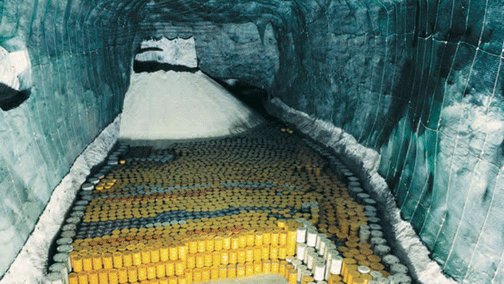
With nuclear power stations across the globe, deciding where to store nuclear waste safely is a priority that seems to have slipped under the media radar for awhile now. However, now that MP Ian Macfarlane has re-introduced plans for a nuclear waste dump in NT after changing the original location for the dump on Aboriginal land at Muckaty station, it seems more than likely that the government will settle on using a pastoral station.
A pastoral station with stored nuclear waste? What if the storage leaks? How are we to know if there is the possibility for this?
Firstly, information as to the details of how the waste will be stored and where it will be stored on one of these stations is not readily available to the public; problem number one. Secondly, keeping this dump on a property full of livestock that will eventually be available as meat for consumers to purchase in supermarkets is undeniably a problem. Farmers have agreed that the benefits financially from creating this dump will outweigh the ‘low-risk’, but is that good enough? Although cattle would not be raised directly on the location where the dump was, who is to say how far away a location would need to be to be safe from contamination if there were any issues?
by Stephanie Hosler Petition Organiser
-
Also, if you would like to try and bring MP Ian Macfarlane’s attention to the issue, this is his email address, which can be found on the Parliament of Australia website.
Ian.Macfarlane.MP@aph.gov.au
Confronting Our Consumerism: Values for a sustainable future
Confronting Our Consumerism: Values for a sustainable futureInstitute for Sustainable Futures, UTSThursday, October 9, 2014 from 6:30 PM to 8:30 PM (AEDT)Ultimo, NSW andThe Conservation Council SA invites you to join us in the live stream lecture:
Thursday October 9, 2014.
5.30pm – 8.00pm (lecture starts at 6pm – streaming from Sydney) Adelaide South West Community Centre, 171 Sturt Street, Adelaide.
Free event, light supper provided |
 Human consumption and economic growth are putting increased pressure on the Earth; our actions and policies are leading to climate disruption, loss of biodiversity, pollution, and unsustainable exploitation of natural resources.
We also know that consumption and economic growth do not bring happiness. How can we bring about cultural change to deliver genuine human well being?
This public lecture and panel discussion confronts the contribution of consumer culture to the world’s environmental and social challenges. It examines how human values underpin these challenges, and how we can work with values to find pathways towards sustainable futures.
To explore these questions, ISF is very pleased to host Professor Tim Kasser from Knox College, Illinois as the keynote speaker at this event. Prof Kasser is at the forefront of research on the role of human values and materialism in environmental challenges. He will use psychological theory and research to show how contemporary culture’s focus on materialistic values and consumerism must be confronted if humans are to create a sustainable future. Prof Kasser will present a strategic approach that provides lifestyle and policy alternatives that would not only be positive for the planet, but would promote people’s wellbeing and a more civil society.
Tim will be followed by presentations from Dr Chris Riedy from the Institute for Sustainable Futures and Mark Chenery from Common Cause Australia, and then a panel discussion with the audience.
Rally for renewable energy Friday Sept 26
National Rally For Renewables This Friday http://www.energymatters.com.au/index.php?main_page=news_article&article_id=4505 21 Sept 14,
Thousands of solar supporters across the nation will be sending another very clear “hands off” message to the government this Friday regarding the future of the Renewable Energy Target.
The Rally for Renewables on Friday, September 26 at noon will be held in major centres across Australia;with events occurring at key Cabinet ministers electorate offices in each state.
Coordinated by Solar Citizens, the event is also being supported by the Clean Energy Council (CEC), Australian Solar Council, Solar Energy Industries Association (SEIA) and the Australian Wind Alliance.
With a decision on the Renewable Energy Target expected soon, it’s crunch time. The heat has already been well and truly turned up on the government and the rally is expected to further bump up the temperature.
“Cabinet ministers are MPs too – and it’s time they understand the depth of feeling in their local communities,” says part of a statement from Solar Citizens. “Before they make their decision on the Target they need to know that solar workers, business owners, solar owners and supporters everywhere want the Renewable Energy Target kept in full, with no cuts.”
Cuts to the Target would translate to the loss of thousands of jobs, and at least another 18,000 jobs won’t be created in the next 6 years. Solar Citizens says it will be more difficult for households to go solar and take control of their power bills, with installation costs to skyrocket by 30-50% if the Target is slashed.
While maintaining the Renewable Energy Target in its current form has been supported by PUP, Labor and the Greens; it’s believed there are other ways the government could affect solar subsidies without necessarily needing the blessing or cooperation of other parties; making the rally and the message it will send even more important.
“This is our chance to ensure a strong future for solar and renewables. By coming together on September 26, we can show our politicians the real impact on jobs, small and large businesses and families that any cuts to the Target will have in local communities across Australia,” says Solar Citizens.
Further information on the National Rally For Renewables can be viewed here.
Save Solar campaign is taking off
 Save Solar campaign revs up http://ecogeneration.com.au/news/save_solar_campaign_revs_up/088884/ Mon, 15 September 2014 As part of the next stage of its campaign to save the Renewable Energy Target, the Australian Solar Council has launched a new TV advertisement.
The ad will run in regional Queensland and regional Victoria in the lead up to State elections, and on Sky News, according to the Australian Solar Council.
Australian Solar Council CEO John Grimes said, “Voters going to the polls in Victoria and Queensland should be aware where the parties stand on support for solar.
“Governments should be making it easier, not harder, for families to drastically cut their power bills.”
“By abolishing or cutting the Renewable Energy Target, the Government will be locking millions of Australian families into every spiralling power bills.” The TV ads complement the Australian Solar Council’s Save Solar Forums, which are being run in marginal seats across Australia.
The next Save Solar Forum will be held in the seat of Barton in Sydney on 17 September, and will be attended by Opposition Leader, Bill Shorten; Shadow Environment Minister, Mark Butler; and Greens Leader, Senator Christine Milne.
Demand no dumping of nuclear waste on lands belonging to Indigenous Australians
 This petition has been signed by 25 720 people! The target before it is presented to Tony Abbott is 26000 so its almost there.
The Australian Government has been attempting to dump radioactive waste on lands belonging to Indigenous Australians.
In a recent dispute, Indigenous owners of Muckaty Station located north of Tennant Creek in the Northern Territory won a seven-year battle to stop domestic nuclear waste being dumped on their land, saying they were not properly consulted.
It follows more than 20 years of Indigenous communities in South Australia and the Northern Territory fighting and defeating federal government plans for a national radioactive waste dump on their country.
Australia has resisted using nuclear power and storing radioactive waste from overseas. This is in spite of the country holding some of the largest deposits of uranium in the world.
Why should Indigenous Australians who have been systematically disadvantaged by white settlement have radioactive waste dumped on their lands?
Please sign and share the petition to demand no nuclear waste dumping on lands belonging to Indigenous Australians.
Save Solar event in Sydney on September 17
 Save Solar Forum In Sydney On September 17 http://www.energymatters.com.au/index.php?main_page=news_article&article_id=4483 The Australian Council is taking no prisoners in its battle to help retain Australia’s Renewable Energy Target and ruffling government feathers in the process.
The next destination for its very successful Save Solar marginal seats campaign is in Sydney.
The Council’s CEO, John Grimes says the government is becoming increasingly desperate.
“Their next tactic will be to try and vilify the Australian Solar Council and me personally,” he says. “The more they come after us, the more we know our campaign is working. We will not sell out on the 21,000 solar workers of Australia, or the 4,500 business that employ them. We will not sell out on the developers of large solar projects. But most of all, we will not sell out on the people of Australia who want to slash their power bills by installing solar PV and solar hot water.”
The recent forum in Queanbeyan was extremely well-attended – solar supporters were being turned away after the venue reached capacity; reflecting the findings of a recent survey that shows a vast majority of Australians have a passion for renewable energy.
“It is time to turn up the pressure – as we bring Save Solar to Sydney,” said Mr. Grimes.
The Sydney forum will focus on the Federal Electorate of Barton. It will be held at Wednesday, 17 September; from 6:00 PM until 8:00 PM at Ramsgate RSL Club; on the corner of Ramsgate Road and Chuter Avenue, Sans Souci (Map).
In related news, the Clean Energy Council has released a new report stating New South Wales and Queensland would suffer the most if the Federal Government adopts the Warburton report recommendations to slash the Renewable Energy Target. New South Wales alone would lose $4.24 billion in projected investment out to 2020, and 4410 jobs would be at risk.
The Clean Energy Council briefing paper titled “The impact of cutting the Renewable Energy Target on state jobs and investment”, can be downloaded her
‘Seed’, Australia’s first Indigenous youth climate network
Seed: Australia’s first Indigenous Youth Climate Network
After more than a year of hard work, today I’m joined by young Indigenous leaders from across the country to launch “Seed”, Australia’s first Indigenous youth climate network.
Our vision is to build a movement of Indigenous young people taking action on climate change. Seeds need to be planted in the earth in order to sprout, grow, and to produce more seeds – representing our strong connection to country as well as a cycle that’s been going on for tens of thousands of years. We’re building this movement for our country, for our people, and for our culture.
Our plans are exciting and ambitious. In October we’re holding the first ever Indigenous youth climate summit in Australia, where we will bring 50 young Aboriginal and Torres Strait Islander leaders together in Melbourne, to learn skills from some of our best climate and Indigenous campaigners and plant the first seeds of our movement. We need to ensure that Indigenous young people from all over Australia have the opportunity to get involved. Can you help us grow our movement by sharing this video with your family and friends?
https://www.facebook.com/AYCC.org.au/posts/10152653974384491
Aboriginal and Torres Strait Islander peoples have looked after this land sustainably for tens of thousands of years, and this gives us hope that we can do it again. This is why Indigenous communities need to be front and centre of our efforts to solve the climate change – and why at the AYCC it is our responsibility to ensure that Indigenous youth are leaders of our generation-wide movement. Click share our Seed launch video with your family and friends.
If you would like to attend the summit you can register here.
Dinner 29 August: meet Mr Naoto Kan, former P.M. of Japan
The Australian Conservation Foundation and the Medical Association for the Prevention of War invite you to a very special evening with Mr Naoto Kan.
Mr Kan was Prime Minister of Japan when the Fukushima nuclear reactor crisis began in March 2011. He was forced to consider a full scale evacuation of Tokyo in response to the unfolding emergency and subsequently made the decision to shut down all of Japan’s nuclear reactors.
Since the meltdown Mr Kan has withdrawn his previous support for nuclear power and now strongly supports an energy future that is renewable, not radioactive.
In October 2011 it was formally confirmed that Australian uranium was fuelling the failed Fukushima reactor complex at the time of the accident.
We are pleased to have the unique opportunity to welcome Mr Kan in Melbourne for a just a few hours at the very end of his Australian tour.
Please join us to hear Mr Kan speak on his experience of the Fukushima crisis and reflections on subsequent energy policy. There will be the opportunity for mingling and discussion surrounded by the beautiful Flagstaff Gardens.
Where: City of Melbourne Bowls Club Lounge, Flagstaff Gardens, Dudley St, West Melbourne
When: Friday 29th August, 7pm-9.30pm. Mr Kan will speak at 8pm.
Cost: $60 per head includes finger food buffet. Drinks at bar prices.
All funds raised will be dedicated towards funding Mr Kan’s Australian speaking tour.
RSVP by Wednesday 27th August at www.acfonline.org.au/naotokan
Further information Kirsten Blair: 0412 853 641
1 This month

of the week – Australians for War Powers Reform (AWPR)
To see nuclear-related stories in greater depth and intensity
 Antinuclear