The decision by Adelaide University to withdraw a venue booking for an event featuring a leading United Nations human rights expert has ignited a fierce debate about academic freedom and censorship in South Australia.
The controversy surrounds a panel discussion titled “Settler Colonialism: What It Can Tell Us About the Conflict in Israel/Palestine,” which was scheduled to be held at the university’s Elder Hall. The event is part of the Constellations: Not Writers Week, a breakout festival created in response to the recent cancellation of the official Adelaide Writers’ Week.
The panel features Francesca Albanese, the United Nations Special Rapporteur on the Occupied Palestinian Territories, who was to appear via video link, alongside esteemed historian Henry Reynolds and UNSW academic Lana Tatour.
According to event moderator Chris Sidoti, Elder Hall had been booked a month in advance. However, on Tuesday, the university informed organisers that the booking was being revoked, citing “health and safety” concerns.
In a statement, an Adelaide University spokesperson defended the decision, stating they were only made aware of the external event the previous Friday. The university claimed it could not accept the booking because it:
“… did not go through the required review and approval process in accordance with the required policy and procedure.”
The spokesperson added that the university could not “ensure the safety, respect and comfort of those attending” and suggested an alternative venue – the National Wine Centre – at a significantly higher cost of $23,500, compared to the $750 fee for the university hall.
This explanation has done little to quell the criticism. Mr. Sidoti described the move as a “sad reflection on the state of Adelaide University today,” arguing that the institution’s core role is precisely “to provide forums for these kinds of discussions – and it’s failing in that.”
The cancellation has drawn sharp rebukes from political figures, who see it as part of a worrying trend of silencing dissenting voices.
Democracy education resources
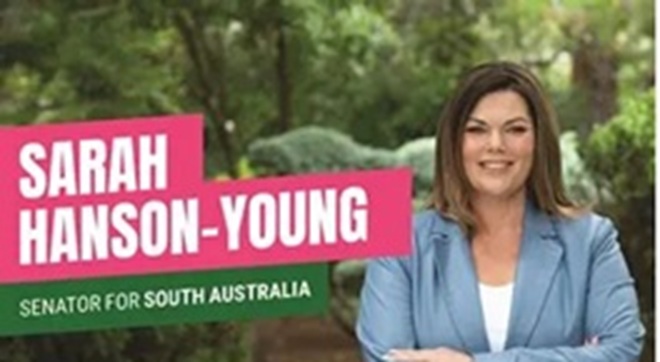
Greens Senator for South Australia, Sarah Hanson-Young, demanded the university explain its actions, calling the reports “concerning.” She linked the decision to the earlier controversies surrounding Writers’ Week, suggesting a broader “culture of fear infecting our institutions.”
“You cannot cancel curiosity, you cannot cancel compassion, and you cannot silence a city that believes in the exchange of ideas and freedom of expression,” Senator Hanson-Young said. She accused the university of capitulating to external pressure, stating that “seeking to silence a distinguished international human rights expert undermines academic freedom, weakens intellectual integrity, and contradicts the very principles universities are meant to uphold.”
The event is part of the Constellations festival, which was formed after the official Adelaide Writers’ Week was cancelled this year. That decision followed the withdrawal of hundreds of authors protesting the treatment of Palestinian-Australian writer Randa Abdel-Fattah, who was controversially uninvited from the original lineup.
When questioned directly about whether concerns regarding Ms. Albanese’s appearance – particularly in light of past criticism and US sanctions – influenced the decision, the university spokesperson did not provide a direct answer. They reiterated that the institution prides itself on being a place for the free exchange of ideas.
Event to Proceed at New Venue
Despite the university’s withdrawal, the discussion will go ahead. Organisers have secured the Norwood Concert Hall in Adelaide’s eastern suburbs for Thursday evening, where a sold-out crowd is expected to attend.
Senator Hanson-Young highlighted the public response as a rebuke to the university’s decision:
“Thankfully the event will go ahead… showing that South Australian audiences aren’t as fearful as these institutions,” she said.
NSW Police have assaulted dozens of peace protestors who gathered to protest the visit by Israeli president Isaac Herzog to Australia. Andrew Brown was there.
I was there. Not watching from a distance. Not reconstructing events from police statements. I was on the steps of Sydney Town Hall, with organisers and MPs, looking out over a vast peaceful crowd and then watching the state choose violence.
Israeli President Isaac Herzog arrived in Sydney for a tightly secured visit. That context matters, because what unfolded was not crowd management. It was a demonstration of power. A message. A deliberate assertion of authority.
An estimated 15,000 to 20,000 people gathered peacefully at Town Hall to protest Herzog’s presence. Thousands more were turned away by police cordons. Had the crowd been allowed to assemble freely, numbers would almost certainly have reached 30,000 or more. Families. Elderly people. Students. Health workers. Jews and Muslims standing together. Calm. Disciplined. Focused.
“There was no riot energy. No vandalism. No threat.“
I stood on the steps with protest organisers and elected representatives, looking out over a crowd that never surged, never damaged property, never turned violent. Beside me were Stephen Lawrence MLC, Sue Higginson MLC, Senator Mehreen Faruqi, Cameron Murphy MLC, and other Greens MPs and MLCs.
At least five sitting members of the Minns government were present. They were not hovering at the edges. They were chanting with the crowd. Standing shoulder to shoulder with constituents. Watching events unfold in real time.
This was not fringe politics. This was Parliament in the street.
Dr Muhammad Mustafa, known widely as Dr Mo, did not address the crowd. He spoke quietly to me. Online, he goes by the handle Dr Mo the Beast from the Middle East, a name that reads like bravado until you understand what forged it.
He told me about operating on children without anaesthetic. About hospitals without power. About performing surgery by torchlight while bombs fell nearby. About the dozens of his own relatives who have been murdered in Gaza.
He did not raise his voice. He did not need to. People who have lived through that kind of loss do not perform outrage. They carry it.
“That was the moral gravity of the gathering.“
And while tens of thousands of Australians stood in the open air exercising democratic rights, Premier Chris Minns was not there.
He was dining.
Dining with a war criminal
Inside the International Convention Centre, Minns broke bread with Herzog as the Israeli president spoke about social cohesion.
This is the same Isaac Herzog who once declared there were no innocent civilians in Palestine. The same Herzog who autographed artillery shells later dropped on Gaza. His government now stands before international courts, its conduct under legal scrutiny.Minns knew exactly what this moment represented.
Last year, more than 300,000 people marched across the Harbour Bridge in support of Palestine.
“Minns tried to stop it. He failed.“
He lost in court. He lost the argument. He lost control. That march exposed the limits of his authority and the strength of public opposition.
This was his chance to correct that.
Herzog was in town. The optics were international. Minns was not going to lose again.
Peace, then the violence
The rally ended peacefully. Speakers finished. People began to leave.
That should have been the end of the day.
Instead, it was the beginning of a deliberate escalation.
New South Wales Police blocked exits and sealed movement south toward Circular Quay. People trying to go home were trapped without explanation. There were no clear lawful directions. No safety rationale. Just containment.
Bottlenecks were deliberately created. Confusion was manufactured. Then force was applied to the disorder police themselves had caused.
This was not crowd control. It was crowd engineering.
Police brutality
I watched police push into a dispersing crowd.
I watched elderly people panic.
I watched bodies hit the ground.
I helped a young girl who had been pepper sprayed in the face and collapsed into a seizure on the pavement. She was convulsing, incapacitated. As she lay there on the ground, police sprayed her again in the face. Again.
Attacks on the elderly
Nearby, I helped a 71-year-old woman whose eyes and face were burned red from pepper spray. She was blinded, sobbing, asking what she had done wrong. She had done nothing.
“My own family was not spared.“
My mother is 84 years old. She was attempting to leave peacefully. She was pushed by police, knocked to the ground, and suffered a fractured arm.
My sister lives with Parkinson’s disease. She was shoved and thrust by police during the same operation.
As the evening wore on, the brutality escalated. Dozens upon dozens were arrested. Protesters were dragged across pavement, punched, kicked, restrained. This was not reactive policing. It was proactive force.
“Attacks on people praying“
Later, I witnessed a line crossed that should alarm anyone who believes Australia still respects basic freedoms. Sheikh Wesam Charkawi was praying peacefully with followers, prostrate on the ground. Silent. Non-confrontational. Police moved in anyway.
People were brutalised while in the act of prayer. Shoved. Dragged. Hauled up by force.
This was no longer just an attack on protest. It was an attack on worship.
There were roughly 500 police deployed at Town Hall and an estimated 3,000 across the CBD. This scale was not accidental. It was a show of force. Police created the disorder they later claimed to suppress. This tactic is known. It is taught. It is deliberate.
And it is political.
“Minns owns this”
Chris Minns owns this operation from top to bottom. He cannot hide behind operational reviews or police statements. His own MPs were there. Chanting. Watching. Warning. They knew instantly this was wrong.
Minns wanted to prove he was in charge. He wanted to assert authority while hosting a foreign leader accused of mass atrocities. He chose force as his language.
A Premier who dines with a leader accused of genocide, who has signed the very bombs dropped on civilians, while his police break the arm of an 84-year-old woman, assault a woman with Parkinson’s disease, spray a seizing child in the face, and brutalise people at prayer has forfeited all moral authority to govern.
This was not a mistake.
“It was a tactic.“
Chris Minns may still occupy the office. “Thank you friends,” he told the pro-Israel crowd at the Convention Centre to a warm round of applause.
But tonight, in the streets of Sydney, while he clinked glasses with Isaac Herzog, he lost the right to lead this state.
Friends of the Earth Adelaide has lodged a submission to a Commonwealth Government environmental review into the proposed desalination plant at Mullaquana Station near Whyalla. The submission related to the referral of the ‘Northern Water Desalination Plant and Water Transfer System Infrastructure Project’ under the Environment Protection and Biodiversity Conservation Act (EPBC Number: 2025/10397, closing date for submissions 21/01/2026).
“This would be achieved by constructing a seawater desalination plant and a transfer pipeline to supply industry in the Upper Spencer Gulf and Far North.”
“Northern Water aims to deliver a secure, climate-resilient water source to meet the growing needs of existing and emerging industries in South Australia’s Upper Spencer Gulf and Far North. It will unlock the economic growth potential of the region … and will reduce reliance on precious water resources including the Great Artesian Basin and the River Murray.
We certainly support reducing reliance on precious water resources of the Great Artesian Basin (GAB) and the River Murray, but we want stronger assurances that the mound springs (formed by pressurised water from the GAB forcing its way to the surface) will be protected. The vast quantities of water drawn from the GAB by BHP to mine copper, uranium, etc. have caused many mound springs to dry up and threaten those that remain.
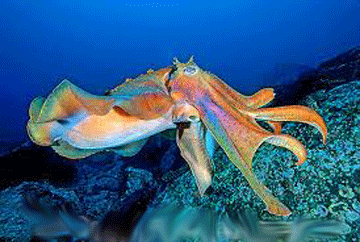
We also question whether the Giant Australian Cuttlefish will be adequately protected and wonder why Mullaquana Station was chosen over Cape Hardy, which is further south and was originally the preferred site.
Our submission focused on two issues:
1. Giant Australian Cuttlefish, and 2. Mound Springs (Great Artesian Basin).
We made the following three recommendations:
An independent comparative environmental analysis of the Mullaquana Station and Cape Hardy sites should be published before a final decision is made.
The positive and negative impacts of the project on the Great Artesian Basin, the Mound Springs and the River Murray should be included in the assessment.
by David Noonan Independent Environment Campaigner 10 Nov 2025.
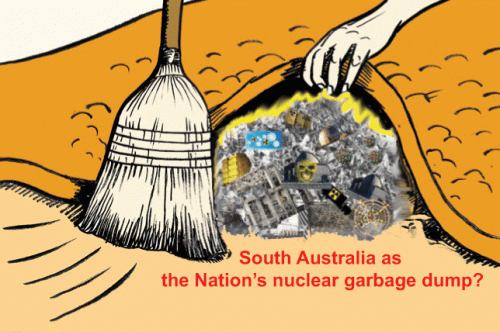
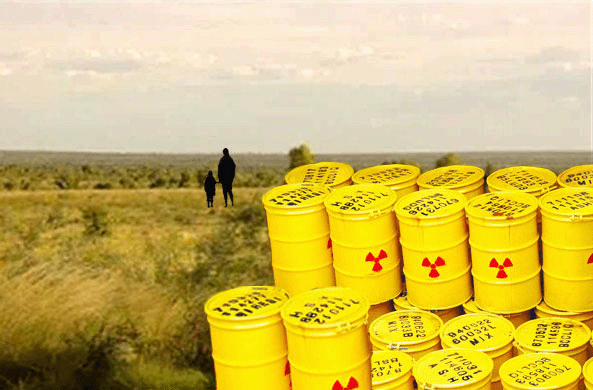
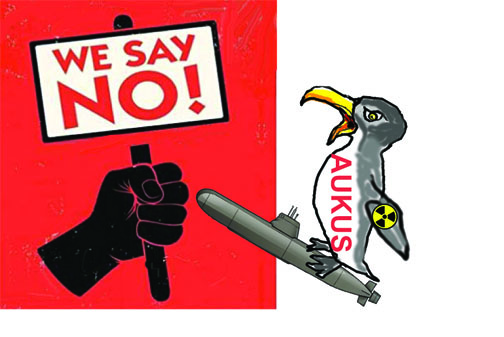
South Australians have a Right to Say No to undemocratic Federal imposed storage of AUKUS High Level nuclear waste in our State. All Federal MPs & Senators from SA, Members of the SA Parliament and candidates for the SA State Election on 21st March should declare their position:
Q: Will you accept or reject Federal imposed storage of AUKUS nuclear waste in SA?
The Federal Government quietly took up new AUKUS Regulations (2 Oct) as powers to impose AUKUS wastes by override of State laws that prohibit nuclear waste storage in SA, NT and WA.
AUKUS Regulation 111 “State and Territory laws that do not apply in relation to a regulated activity” names and prescribes our SA Nuclear Waste Storage (Prohibition) Act 2000. The Objects of this key SA Law set out what is at stake: “To protect the health, safety and welfare of the people of SA, and the environment in which they live” from nuclear waste storage.
Federal Labor’s draconian powers to compromise public health, safety and welfare protections in SA Law, lacks social licence, are an affront to civil society, and damages trust in governance. This is also a threat to Indigenous People with a cultural responsibility to protect their country.
Community expects our State Labor Government to give a clear State Election commitment to protect SA from the risks and impacts of untenable and illegal AUKUS High Level nuclear waste storage, see “The lethal legacy of Aukus nuclear submarines will remain for millennia – and there’s no plan to deal with it” (The Guardian, 10 August 2025, interview with Prof Ian Lowe).
Labor has a further key leadership test ahead of our Election: to commit to support Indigenous People’s human rights, set out in the United Nations Declaration on the Rights of Indigenous Peoples Article 29 (UNDRIP 2007), to “Free, Prior and Informed Consent” over storage of hazardous materials on their lands. AUKUS wastes absolutely are hazardous materials!
a Question for Premier Peter Malinauskas: Will you respect and support Indigenous Peoples Rights to Say No to Federal siting of AUKUS nuclear waste storage on their country in SA?
Call for full disclosure on a N-waste siting process after Labor breaks its commitment: The public has a Right to Know what regions are being targeted for storage of High-Level nuclear wastes. A secretive ongoing Defence review “to identify potential nuclear waste disposal sites” (ABC News March 2023) must be made public ahead of the SA State Election.
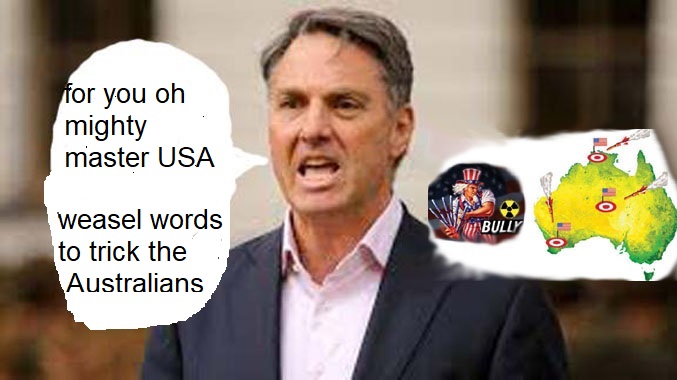
AUKUS Minister Marles has broken his commitment to announce a process by early 2024 to identify a site to dispose of AUKUS High-Level nuclear wastes. The failure by Defence to set out any process – other than to take up powers to impose nuclear wastes – is unacceptable.
REPORTER: Is a high-level nuclear waste dump the price that South Australia will have to pay for the jobs that go to the state? (Minister Marles Press Conference 14 March 2023)
MARLES: Well, as I indicated there will be a process that we will determine within the next 12 months for how the site will be identified. You’ve made a leap there, which we’re not going to make for some time. It will be a while before a site is ultimately identified. But we will within the next 12 months establish a process for how we walk down that path.
It is now over 4 years since Federal Labor agreed with Morrison’s AUKUS nuclear sub agenda.
SA Labor to let ‘national security interests’ decide siting for AUKUS nuclear waste?
National press reported the Woomera Area to be a ‘favoured location’ for storage and disposal of nuclear sub wastes back in August 2023 (“Woomera looms as national nuclear waste dump site including for AUKUS submarine high-level waste afr.com). WA, Qld and Vic political leaders have rejected a High-Level nuclear waste disposal site in their States, with WA suggesting the Woomera Prohibited Area in SA: “would be one obvious location within the Defence estate, however, we will await the outcomes of the federal review” (SMH 15 March 2023).
Premier Malinauskas has so far only said AUKUS nuclear waste should go to a ‘remote’ location in the “national security interest” (see “Site for high-level nuclear waste dump under AUKUS deal must be in national interest, SA premier says” ABC News 15 March 2023).
The Premier’s “Office for AUKUS” (Letter, 7 Oct 2025) accepts “safe and secure disposal” of High-Level nuclear waste, including spent fuel, produced when subs are decommissioned. The Office says no decision has been made on a location but declines to reveal what is underway, expresses no concerns over unprecedented nuclear waste storage or ‘social license’, and expects “community acceptance” (in SA?) for a nuclear ‘disposal solution’:
“I can confirm that no decision has been made on a location within Australia for the disposal of intermediate, or high-level radioactive waste from nuclear-powered submarines. Determining suitable locations and methods for safe and secure disposal will take time, but Australia will do so in a manner that sets the highest standards … and which builds community acceptance for a disposal solution.”
SA is left in the dark, without a say, as an ongoing target for an AUKUS nuclear waste dump.
AUKUS is to store US origin nuclear wastes from 2nd hand Virginia Class subs in Australia: AUKUS aims Australia take on second-hand US Virginia Class nuclear powered subs in the early 2030’s loaded with up to a dozen years of US origin military High-Level nuclear waste and fissile Atomic-Bomb fuel accrued in operations of US Navy High Enriched Uranium nuclear reactors.
Swapping an Australian flag onto this US military nuclear reactor waste places an untenable ‘for ever’ burden on all future generations to have to cope these US nuclear wastes.
Scenario: an AUKUS nuclear dump imposed on SA, High-Level military waste shipped into Whyalla Port to go north, nuclear subs to be ‘decommissioned’ at Osborne Port Adelaide.
Whyalla Port is back on a nuclear waste target range. How else could AUKUS nuclear waste get to a storage site in north SA? The Woomera Area is expected to be on a regional short list for an AUKUS dump, requiring nuclear waste transport routes across SA. Port Adelaide community has a Right to Say No to nuclear decommissioning plans for expanded Osborne submarine yards.
SA politicians must protect SA and rule out both an untenable AUKUS nuclear dump and decommissioning nuclear subs and nuclear reactors at Osborne or else-where in SA.
SA must respect Traditional Owners Human Rights to Say No to imposition of nuclear wastes.
The SA public have Rights to full disclosure and for politicians to have to declare their positions, We need an informed public debate ahead of our State Election. Silence by our political leaders, while a path is paved toward nuclear decisions, makes a nuclear waste dump future more likely.
Info: see Rex Patrick & “AUKUS waste in perpetuity”, and David Noonan in Pearls and Irritations
Solar and wind reached a remarkable new milestone in Western Australia’s isolated grid over the weekend, reaching 100 per cent of demand at various occasions on Sunday morning, as the state’s growing fleet of batteries allowed coal and gas generators to keep running in the background. The W.A. grid, with no links to other states, is becoming a fascinating focal point for the green energy transition, largely because of the huge impact of rooftop solar and the high levels of variable renewables seen on almost a daily basis.
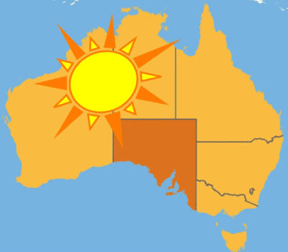
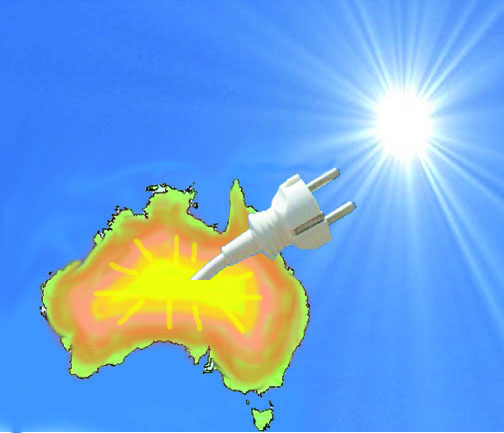
South Australia – the country’s most advanced renewables grid – has average more than 100 per cent net renewables (compared to state demand) over the past week, and more than 90 per cent renewables over the last 28 days. It is not the first time that South Australia has reached 100 per cent renewables – it has done so previously over the Christmas/New Year period – but it marks a significant milestone, given that its mix of renewables is made up entirely of variable wind and solar, and with no hydro or even biomass to speak of.
South Australia, the most advanced renewable grid in the country and even the world – thanks to its unrivalled near 75 per cent share of wind and solar – is also the most secure, according to a major new report on the state of the energy transition.
The Transition Plan for System Security, published on Monday by the Australian Energy Market Operator, identifies South Australia as the only state grid which is not facing a system strength deficit in coming years.
That’s largely because South Australia went first, and it went hard and fast. Its last coal fired power station closed in 2016, and because it has such a high percentage of wind and solar, as well as rooftop PV, it has had to deal with the issues around frequency control, inertia and system strength before other states. South Australia, the most advanced renewable grid in the country and even the world – thanks to its unrivalled near 75 per cent share of wind and solar – is also the most secure, according to a major new report on the state of the energy transition.
When the new transmission link to NSW is complete in 2027, South Australia will be the first in the world to be able to run its gigawatt scale grid at times with “engines off” – i.e. no gas plant required for bulk power or system security – as it nears or even achieves its target of reaching 100 per cent net renewables.
South Australians have a Right to Say No to undemocratic Federal imposed storage of AUKUS High Level nuclear waste in our State. All Federal MPs & Senators from SA, Members of the SA Parliament and candidates for the SA State Election on 21st March should declare their position:
Q: Will you accept or reject Federal imposed storage of AUKUS nuclear waste in SA? The Federal Government quietly took up new AUKUS Regulations (2 Oct) as powers to impose AUKUS wastes by override of State laws that prohibit nuclear waste storage in SA, NT and WA.
AUKUS Regulation 111 “State and Territory laws that do not apply in relation to a regulated activity” names and prescribes our SA Nuclear Waste Storage (Prohibition) Act 2000. The Objects of this key SA Law set out what is at stake: “To protect the health, safety and welfare of the people of SA, and the environment in which they live” from nuclear waste storage.
Federal Labor’s draconian powers to compromise public health, safety and welfare protections. n SA Law, lacks social licence, are an affront to civil society, and damages trust in governance. This is also a threat to Indigenous People with a cultural responsibility to protect their country.
Community expects our State Labor Government to give a clear State Election commitment to protect SA from the risks and impacts of untenable and illegal AUKUS High Level nuclear waste storage, see “The lethal legacy of Aukus nuclear submarines will remain for millennia – and there’s no plan to deal with it” (The Guardian, 10 August 2025, interview with Prof Ian Lowe).
Labor has a further key leadership test ahead of our Election: to commit to support Indigenous People’s human rights, set out in the United Nations Declaration on the Rights of Indigenous Peoples Article 29 (UNDRIP 2007), to “Free, Prior and Informed Consent” over storage of hazardous materials on their lands. AUKUS wastes absolutely are hazardous materials!
a Question for Premier Peter Malinauskas: Will you respect and support Indigenous Peoples Rights to Say No to Federal siting of AUKUS nuclear waste storage on their country in SA?
Call for full disclosure on a N-waste siting process after Labor breaks its commitment: The public has a Right to Know what regions are being targeted for storage of High-Level nuclear wastes. A secretive ongoing Defence review “to identify potential nuclear waste disposal sites” (ABC News March 2023) must be made public ahead of the SA State Election.
AUKUS Minister Marles has broken his commitment to announce a process by early 2024 to identify a site to dispose of AUKUS High-Level nuclear wastes. The failure by Defence to set out any process – other than to take up powers to impose nuclear wastes – is unacceptable.
REPORTER: Is a high-level nuclear waste dump the price that South Australia will have to pay for the jobs that go to the state? (Minister Marles Press Conference 14 March 2023)
MARLES: Well, as I indicated there will be a process that we will determine within the next 12 months for how the site will be identified. You’ve made a leap there, which we’re not going to make for some time. It will be a while before a site is ultimately identified. But we will within the next 12 months establish a process for how we walk down that path.
It is now over 4 years since Federal Labor agreed with Morrison’s AUKUS nuclear sub agenda.
SALabor to let ‘national security interests’ decide siting for AUKUS nuclear waste?
National press reported the Woomera Area to be a ‘favoured location’ for storage and disposal of nuclear sub wastes back in August 2023 (“Woomera looms as national nuclear waste dump site including for AUKUS submarine high-level waste afr.com). WA, Qld and Vic political leaders have rejected a High-Level nuclear waste disposal site in their States, with WA suggesting the Woomera Prohibited Area in SA: “would be one obvious location within the Defence estate, however, we will await the outcomes of the federal review” (SMH 15 March 2023).
Premier Malinauskas has so far only said AUKUS nuclear waste should go to a ‘remote’ location in the “national security interest” (see “Site for high-level nuclear waste dump under AUKUS deal must be in national interest, SA premier says” ABC News 15 March 2023).
The Premier’s “Office for AUKUS” (Letter, 7 Oct 2025) accepts “safe and secure disposal” of High-Level nuclear waste, including spent fuel, produced when subs are decommissioned. The Office says no decision has been made on a location but declines to reveal what is underway, expresses no concerns over unprecedented nuclear waste storage or‘social license’, and expects “community acceptance” (in SA?) for a nuclear ‘disposal solution’:
“I can confirm that no decision has been made on a location within Australia for the disposal of intermediate, or high-level radioactive waste from nuclear-powered submarines. Determining suitable locations and methods for safe and secure disposal will take time, but Australia will do so in a manner that sets the highest standards … and which builds community acceptance for a disposal solution.”
SA is left in the dark, without a say, as an ongoing target for an AUKUS nuclear waste dump.
AUKUS is to store US origin nuclear wastes from 2nd hand Virginia Class subs in Australia:
AUKUS aims Australia take on second-hand US Virginia Class nuclear powered subs in the early 2030’s loaded with up to a dozen years of US origin military High-Level nuclear waste and fissile Atomic-Bomb fuel accrued in operations of US Navy High Enriched Uranium nuclear reactors. Swapping an Australian flag onto this US military nuclear reactor waste places an untenable ‘for ever’ burden on all future generations to have to cope these US nuclear wastes.
Scenario: an AUKUS nuclear dump imposed on SA, High-Level military waste shipped into Whyalla Port to go north, nuclear subs to be ‘decommissioned’ at Osborne Port Adelaide.
Whyalla Port is back on a nuclear waste target range. How else could AUKUS nuclear waste get to a storage site in north SA? The Woomera Area is expected to be on a regional short list for an AUKUS dump, requiring nuclear waste transport routes across SA. Port Adelaide community has a Right to Say No to nuclear decommissioning plans for expanded Osborne submarine yards.
SA politicians must protect SA and rule out both an untenable AUKUS nuclear dump and decommissioning nuclear subs and nuclear reactors at Osborne or else-where in SA.
SA must respect Traditional Owners Human Rights to Say No to imposition of nuclear wastes.
The SA public have Rights to full disclosure and for politicians to have to declare their positions, We need an informed public debate ahead of our State Election. Silence by our political leaders, while a path is paved toward nuclear decisions, makes a nuclear waste dump future more likely.
Info: see Rex Patrick & “AUKUS waste in perpetuity”, and David Noonan in Pearls and Irritations.
The ACT government continues to reap the rewards for its early and bold push to 100 per cent renewables, which is now looking like the smartest policy of all – shielding its residents from the ravages of largely fossil-fuelled electricity price hikes.
The latest quarterly data assessing the cost of the ACT government’s commitment to sourcing the equivalent of its annual demand from wind and solar – which it met on schedule in 2020 – shows the additional cost of the policy in the latest quarter was just $3 a megawatt hour. Indeed, three of the wind farms contracted by the ACT government returned significant sums of money (a total of $4.4 million) to the ACT because the contract prices they agreed to are significantly lower than current wholesale electricity prices.
The South Australia state government has appointed ASL to run its first auction for long duration storage, as the world’s most advanced wind and solar grid seeks around 700 MW of new firm capacity over the next six years.
South Australia leads the world in the uptake of wind and solar – which together accounted for 75 per cent of its local electricity demand over the last 12 months – and has set a world-leading target of reaching 100 per cent “net” renewables by the end of 2027. It already has seven big battery projects operating in the state, and another dozen under construction or contracted, but it is now seeking longer duration storage through the Firm Energy Reliability Mechanism (FERM) that it announced earlier this year.
Forty local organisations and community groups are launching a joint Port Kembla Declaration today, opposing the establishment of a nuclear submarine base at Port Kembla.
They’re calling for the federal government to rule it out, saying the risks are far too great, the declaration has been endorsed by many organisations, including health, faith, and social justice.
Tina Smith, President of the South Coast Labour Council, said they reject the idea of turning the region into a frontline for war games or nuclear escalation.
I wanted to hear from the traditional owners of the Arrernte land it was built on, and from the spies tasked with finding targets in Afghanistan and Iraq during the Global War on Terrorism. But how do you investigate something as secretive as Pine Gap when everyone who works there has made a promise never to talk about what they do?
serious claims being made that intelligence gathered at the facility was being used in the Israel-Gaza war.
In journalism, it’s often politicians who won’t answer your questions.
But in my outback town, it’s just as likely to be the neighbours who won’t, or rather can’t, answer this basic conversation starter: “So, what do you do at work?”
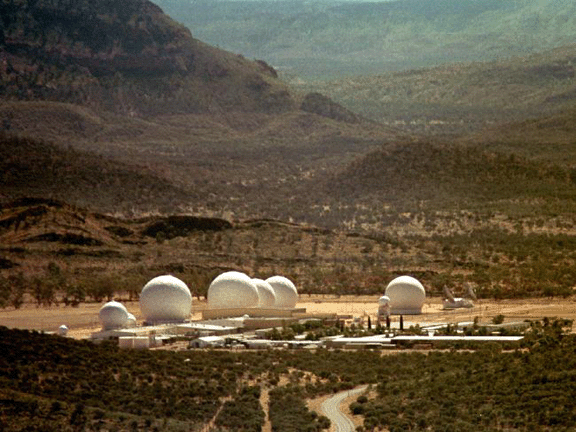
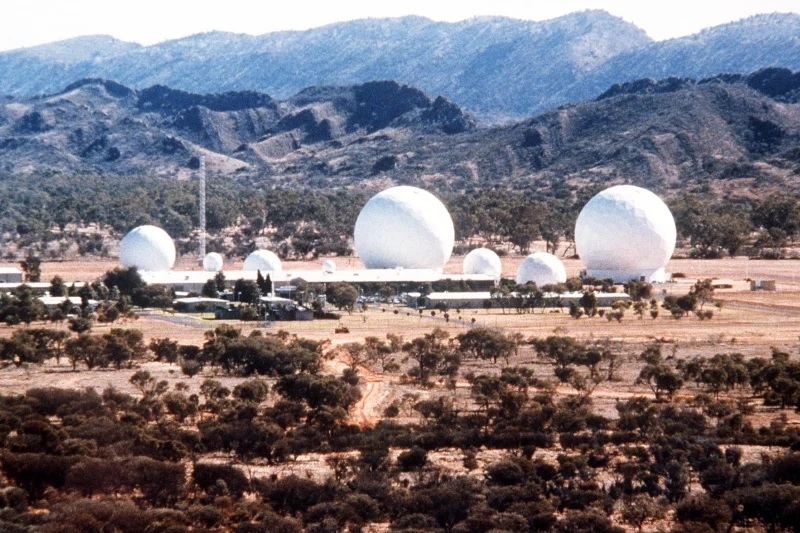
That’s because about 800 of the town’s 25,000 residents are employed at the most secretive intelligence facility in Australia — the Joint Defence Facility Pine Gap — on the edge of Alice Springs/Mparntwe.
When I rolled into this beautiful landscape 16 years ago and began working at the ABC’s Alice Springs bureau, it quickly became clear I wouldn’t hear from this significant section of the community.
Given local radio is all about connecting with the community and sharing people’s stories, this silence felt strange.
My curiosity grew and the book Peace Crimes, written by long-term local journalist Kieran Finnane, motivated me to start looking deeper.
I wanted to know what was going on in my backyard, but I knew trying to make a podcast about a secret military facility hidden in a secluded valley in Central Australia wouldn’t be easy.
Telling this story in a town the size of Alice Springs would undoubtedly feel personal and would likely offend parts of the community.
It’s a line regional journalists walk all the time — telling stories that are in the public interest, while living in the community that is affected by them.
That includes everyone from my neighbours, to the parents of my kids’ friends, to people I see regularly at community events.
For them, it’s not a story – it’s their life.
And that can get awkward.
But there are stories in the public interest that the Australian government won’t comment on and this often means they’re shrouded in mystery, or rife with rumour.
Pine Gap is one of those stories.
What goes on beneath the cluster of enormous, oversized-golf-ball-shaped domes covering the military base’s listening antenna on the desert floor, raises big questions for all of Australia, not just my town.
The Pine Gap intelligence-gathering facility is often described as the jewel in the crown of our military partnership with the United States.
But what have we got ourselves into, and do we benefit from it?
Protesters, politicians and spies
Over the past six months, I’ve had lots of off-the-record coffees, trawled the news and library archives, followed some bizarre leads and heard plenty of wild stories, as I have tried to understand the goings-on behind the razor wire.
I wanted to know why America’s Central Intelligence Agency (CIA) decided to build a so-called “space base” in outback Australia in the mid 1960s.
And how had it drawn Australia onto one battlefield after the next through its large-scale surveillance and intelligence gathering?
While plenty of people outside Alice Springs/Mparntwe have never heard of this desert spy base, most people in town have an opinion on it.
There are three main camps: those who say it’s vital for the town’s economy and global peace; those who still see it as a nuclear target and want it shut down; and those who feel generally apathetic to its existence.
And yet, nobody really talks about Pine Gap.
Still, I felt it was important to really understand the diversity of views on this outback spy base as I conducted my research.
I wanted to hear from the traditional owners of the Arrernte land it was built on, and from the spies tasked with finding targets in Afghanistan and Iraq during the Global War on Terrorism.
But how do you investigate something as secretive as Pine Gap when everyone who works there has made a promise never to talk about what they do?
I certainly wasn’t looking to see anyone exiled to Russia like Edward Snowden after he leaked a raft of National Security Agency (NSA) documents, including information on Pine Gap.
In the end, gentle, determined persistence meant I was able to tell the Pine Gap story in a way that lifted the lid but didn’t put national security at risk, and that (I hope) was sensitive to the lives of those in Alice Springs affected by it.
Back in the national spotlight
And then, in late 2023 as I tracked down activists, former spies and politicians … protesters were suddenly blocking the road to Pine Gap again.
There were serious claims being made that intelligence gathered at the facility was being used in the Israel-Gaza war. With Pine Gap back in the spotlight, I knew I had to look deeper.
This spy base, which became operational in 1970 during the Cold War, had expanded through the decades in scale and capability and was more relevant than ever.
The Australian government says Pine Gap is one of the country’s “most longstanding security arrangements” with the United States but it does not comment on its operation.
As each episode of Expanse: Spies in the Outback has been released, I’ve received emails and text messages that confirm why it was an important story to tell.
Some people have been shocked and appalled, while others have been grateful to learn we have this secret intelligence facility in our backyard.
Even in my own town of Alice Springs, where everyone knows someone who works at Pine Gap, there is an appetite to know more – regardless of how uncomfortable that might be.
Following the breakdown of a nuclear treaty, an antinuclear advocate wants world leaders to hear a message she’s made from the doors of a top secret Territory spy base.
An antinuclear ambassador for a Nobel prize winning group has delivered a message to world leaders at the edge of a Red Centre spy base, days after Russia pulled out of an arms treaty following an American missile test in the Top End.
“Get rid of your weapons. Lets fund and focus on world peace, not arm up and test missiles,” she said.
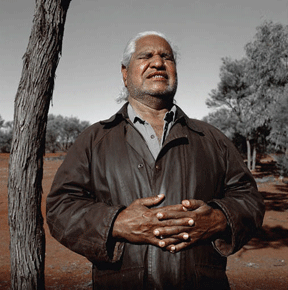
Ms Lester’s visit to the border of the Pine Gap restricted zone on Hatt Rd comes a day after she gave a speech at the sixth Yami Lester memorial event in Alice Springs – an event named after her father.
He was blinded as a child, and spent his life advocating against nuclear weapons – a mantle his daughter has taken up with ICAN, who won a Nobel Peace Prize in 2017 for their antinuclear advocacy.
The group got to the edge of the Pine Gap restricted at about 4.30pm Sunday, where they were again met with a police blockade at where the restricted zone begins.
Two unmarked Toyota LandCruisers followed the convoy to their meeting place, and a police drone was also observed overhead.
The group heard from speakers who opposed the US-run base, with members of the crowd holding signs reading “Yankee go home” while others held Palestinian flags.
At the conclusion of the demonstration, the group gathered for a photo and chanted “land back, close Pine Gap” while various media outlets filmed and photographed them.
Federal NSW Greens senator David Shoebridge was also billed to be at the Pine Gap demonstration on Sunday, but pulled out due to covid, this masthead understands.
The Greens defence and foreign affairs spokesman said the political party has opposed the US-run base “for decades” but did not comment on why he was unable to come on Sunday when asked by this masthead.
NATIONAL CONVERGENCE ON CANBERRA DEMANDS THE AUSTRALIAN GOVERNMENT SANCTION ISRAEL NOW
Advocates for justice and human rights from across the continent will converge at Parliament House Canberra from Sunday, 20 July 2025 to Tuesday, 22 July 2025 to demand that the Australian government immediately impose sanctions on the state of Israel.
Over the last 77 years, the Israeli government has openly committed genocide and crimes against humanity against the Palestinian people without consequence. Over the last 21 months, we have witnessed an escalation of these atrocities as Israel flaunts its human rights violations and contraventions of international law before the eyes of the world.
Despite international law compelling states including Australia to take action to prevent these atrocity crimes, the Australian government has failed to take meaningful action by imposing boycotts, divestments and sanctions on the genocidal state. Instead, it has opted to remain friends and allies with, and supply weapons to, a state openly committing gross human rights violations.
“Palestinian men, women and children are being massacred and starved to death before the eyes of the world. All eyes are on Gaza but no one is willing to do anything to help ” said Nasser Mashni, Australia Palestine Advocacy Network President.
Israel has sought to cripple Gaza by imposing a blockade, bombing hospitals and manufacturing a famine. Repeated human rights violations have been documented while states, including Australia remain reluctant to take concrete action.
Noura Mansour, Democracy in Colour National Director said that “We are witnessing a humanitarian and global catastrophe. We have been asking the international community to stop these atrocities for over 77 years. The escalation and atrocities we are witnessing today are a direct result of Palestinians being ignored since 1948.”
The Australian government remains complicit in the genocide, occupation and crimes against humanity being committed against the Palestinian people by the Israeli government.
We remain steadfast in demanding the Australian government take immediate action to pressure Israel to abide by international law by imposing sanctions.
“We have been constantly demanding that the Australian government impose sanctions and an arms embargo on Israel for over 21 months. Despite the constant bombardment, starvation and brutality, the Australian government is reluctant to take any concrete action. Instead, it has shamefully chosen to take the side of the oppressor” said Activist and Organiser, Sarah Baarini.
We call on the community from every corner of the continent to converge at the centre of decision making on this colony, for the opening of Parliament, to send a clear and strong message that the people remain united and demand that the Australian government
SANCTION ISRAEL NOW
“We will not be passive in the face of injustice. Every second that passes without meaningful action taken by those in power is another second too late. Time is truly of the essence. We are already 77 years too late – we can not afford to wait a second more. We will not stop and we will not rest – we will continue to resist and demand justice until Palestine is free, from the river to the sea” said Dan, Renegade Activist and Political Staffer.
ENDORSED BY:
Academics for Palestine – South Australia
Academics for Palestine WA
ACT Greens
ANMF nurses and midwives for Palestine
ANU 4 Palestine
Anak Bangsa Malaysia
Australia Palestine Advocacy Network
Australia’s Voice
Australian MADE (Muslim Adolescent
Development & Education) Inc
Australian Greens First Nations Network
Australian Social Workers for Palestine
ASU for Palestine
Banyule Palestine Action Group
Canberra Islamic School
Canberra Palestine and Climate Justice
Central Coast Friends of Palestine
Central West New South Wales 4 Palestine
Climate Activists for Palestine
Climate Justice Alliance Northern Rivers
Coalition for Justice and Peace in Palestine
Connecting the dots
Conversations For Palestine
Darebin for Palestine
Defend Dissent Coalition
Democracy in Colour
Disrupt Burrup Hub
Disrupt Wars
DrummersforPalestine
Education4Palestine
Extinction Rebellion
Extinction Rebellion ACT
Extinction Rebellion Peace – XR Peace
Fairfield for Palestine
Families For Palestine
Food Not Bombs Gadigal/Sydney
Fowler for Palestine
Free Gaza Australia
Free Palestine Central Vic
Free Palestine Coalition Naarm
Free Palestine Far North Queensland
Free Palestine Frankston
Free Palestine Gippsland
Free Palestine Melbourne
Free Palestine Newcastle
Free Palestine Sunbury
Free Palestine Townsville
Free Palestine Wurruk
Friends of Palestine Western Australia
Green Left
Greens (WA) Inc
Happily Made
Health Workers 4 Palestine (South
Australia)
Healthcare Workers for Palestine WA
Hobsons Bay 4 Palestine
Hunter Asylum Seeker Advocacy
Hume for Palestine
Independent and Peaceful Australia
Network (IPAN)
Independent and Peaceful Australia
Network ACT
Inner West for Palestine
Institute for Collaborative Race Research
IPAN Geelong and Southwest Victoria
Ireland Palestine Solidarity ‘Australia’Islamic Association of Monash Mosque







 Antinuclear