Opposition to proposed nuclear submarine base at Port Kembla
September 25, 2025 , by David Clark, https://www.wavefm.com.au/local-news/opposition-to-proposed-nuclear-submarine-base-at-port-kembla/
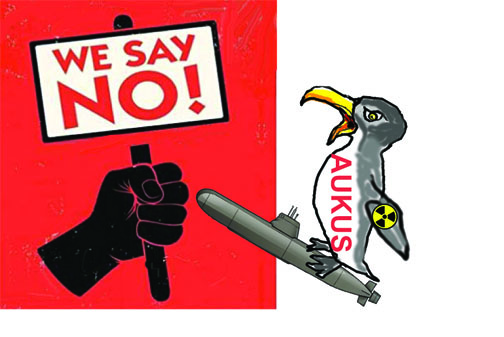
Forty local organisations and community groups are launching a joint Port Kembla Declaration today, opposing the establishment of a nuclear submarine base at Port Kembla.
They’re calling for the federal government to rule it out, saying the risks are far too great, the declaration has been endorsed by many organisations, including health, faith, and social justice.
Tina Smith, President of the South Coast Labour Council, said they reject the idea of turning the region into a frontline for war games or nuclear escalation.
Another Hunter Valley earthquake sounds alarms on Coalition’s nuclear scheme

Solutions for Climate Australia,
Elly Baxter, Senior Campaigner for Solutions for Climate Australia, 7 Sept 24 https://newshub.medianet.com.au/2024/09/another-hunter-valley-earthquake-sounds-alarms-on-coalitions-nuclear-scheme/65734/
The third earthquake in two weeks in NSW’s Hunter Valley today highlights the serious questions about the Liberal National Coalition’s plans for nuclear reactors they are still refusing to answer, says Solutions for Climate Australia.
The earthquake’s epicentre was again very close to the existing Liddell power station, where the Coalition aims to build at least one nuclear reactor. Solutions for Climate Australia Senior Campaigner Elly Baxter said the Coalition has not answered the many questions already raised about safety, emergency response, radioactive waste and water availability at the site.
“Five of the seven sites proposed by the Coalition as suitable for nuclear reactors experience earthquake activity,” Baxter said. “Their energy spokesman Ted O’Brien told ABC Radio Newcastle that a nuclear reactor at Liddell would not proceed if it was deemed unsafe, but what about the four other sites? If these sites are ruled out, where will the Coalition build their nuclear reactors? And will those communities be informed ahead of the federal election?
“Meanwhile, the safety issues we raised two weeks ago remain unanswered. Would local firefighting volunteers handle the nuclear material? What training would local firefighting volunteers receive in handling nuclear radiation? Who would train them? Would the army come in to help?
“How would iodine tablets be distributed to locals to try to reduce cancer risk? What would be the fallout zone and where would the local emergency staging area be? Where would nuclear refugees be accommodated?
“Would the Federal Government be responsible for the emergency management given under the Liberal National policy, the Federal Government would own the nuclear reactor?
“What would happen to the radioactive waste and who would be responsible for that? Where would the enormous volume of water come from to deal with the toxic, radioactive emergency?
“The safety issues highlighted by these earthquakes only compound our concerns that nuclear reactors will take far too long to build to protect Australians from the worst impacts of climate change.”
ENDS
Earthquake damages buildings near site of proposed nuclear plant
The Age, By Ben Cubby and Jessica McSweeney, August 23, 2024
A magnitude 4.7 earthquake struck near Muswellbrook just after midday on Friday, a few kilometres from the site where the Coalition has pledged to build a nuclear power plant, damaging some buildings in the town and sending tremors as far away as Sydney.
The State Emergency Services were called to help some people who suffered damage to their homes and businesses in Muswellbrook, but there were no reports of serious injuries.
Some buildings in Muswellbrook’s CBD had broken windows, fallen chimneys and stock spilling off shelves, locals said. At least two public schools were evacuated, and the local power grid was knocked until 2.30pm.
“It was quite alarming, we certainly felt it within the building,” said Muswellbrook Shire Council’s general manager Derek Finnigan. “It went for about 15 seconds I suppose, but it seemed longer of course.”
“We are assessing reports of minor damage to buildings in the community, some private structures in the CBD.”
Tremors were felt in a large radius around the quake’s epicentre at Denman, just south of Muswellbrook, from southern Sydney to Coffs Harbour on the Mid North Coast.
About 2400 people contacted Geoscience Australia to report that they had felt the quake which struck at 12.01pm, senior seismologist Hadi Ghasemi said.
“That is a very large number,” he said. “The earthquake itself was of a decent size and at a depth of 10 kilometres it was quite shallow, so it’s not surprising that it was widely felt.”
Ghasemi said fault lines run near the quake’s epicentre, and these had probably been triggered by stress building up as Australia’s continental plate nudges slowly north-east at a pace of about seven centimetres per year.
“There are existing cracks and weaknesses in the rock in this area, so it is a place where you might expect stress to build up,” he said.
The quake’s epicentre was a few kilometres west of Lake Liddell, where the federal Coalition plans to build a nuclear power plant if elected.
Nuclear facilities can be designed to withstand quakes of magnitude 4.8 and above, according to the World Nuclear Association and studies prepared by the Australian Nuclear Science and Technology Organisation for the Lucas Heights reactor in southern Sydney. However, hardening nuclear facilities against large quakes would add to the overall cost of building them…………………………………..https://www.theage.com.au/national/nsw/earthquake-damages-buildings-near-site-of-proposed-nuclear-plant-20240823-p5k4te.html
Transition ‘well under way’ as AGL rejects nuclear push
Illawarra Mercury, By Marion Rae, August 14 2024 –
AGL Energy has staked millions more on the clean energy transition as higher power prices and fewer outages generate stellar profit growth and spare cash.
Australia’s biggest emitter announced on Wednesday the $250 million acquisition of Firm Power and Terrain Solar, adding solar power and battery storage across all states.
Their combined projects, at 8.1 gigawatts, will add to renewable sources of electricity as coal-fired power plants close from coast to coast.
However, recent polls show that many Australians don’t believe the transition is feasible or on track for the national target of 82 per cent renewable energy by 2030.
“We’re investing back into the transition … it’s well underway,” AGL managing director Damien Nicks told AAP.
He said big batteries would ultimately assist renewable generation by responding to market demand in milliseconds, along with pumped hydro and other firming assets including fast-start gas.
“It is the most complex transition this country has seen but you’re right, community engagement through this time is going to be critical … whether that’s on our sites or outside of our sites,” Mr Nicks said.
“We’re also trying to utilise the infrastructure and grid that’s available to us today, whilst the transmission gets built out around the rest of the country – that’s incredibly important.”
But he dismissed the option of nuclear reactors, which the coalition has promised to build if it wins power in 2025.
“Nuclear is not part of our plans, nor our strategy … we cannot sit around and wait for nuclear,” Mr Nicks said.
“The rationale for that is both cost and time to get there.
“We need to find 12 gigawatts of renewable and firming assets by 2035.”
AGL earlier posted an underlying net profit of $812 million for the year to June 30, up 189 per cent, while underlying earnings rose 63 per cent to $2.22 billion.
Shares in AGL rose in the wake of the results, delivering paper gains for AGL’s major shareholder billionaire Mike Cannon-Brookes…………………………………………………. more https://www.illawarramercury.com.au/story/8729378/transition-well-under-way-as-agl-rejects-nuclear-push/
Shoalhaven’s nuke-free vote

Shoalhaven City Councillors voted unanimously to remain a nuclear-free zone at Monday night’s ordinary meeting. A motion was tabled seeking council reaffirm its 2006 position that it would oppose any plan or attempt to establish a nuclear reactor or power plant in the region or in the Jervis Bay Territory. It comes after federal Opposition Leader Peter Dutton flagged seven nuclear sites across Australia in June.
Summary of Australian federal and state/territory nuclear/uranium laws and prohibitions.

Current prohibitions on nuclear activities in Australia: a quick guide
From Jim Green, 30 May 2024
https://www.aph.gov.au/About_Parliament/Parliamentary_departments/Parliamentary_Library/pubs/rp/rp2324/Quick_Guides/NuclearActivitiesProhibitions
PDF Version [564KB]
Dr Emily Gibson
Science, Technology, Environment and Resources; Law and Bills Digest Sections
This quick guide provides an overview of current prohibitions on nuclear activities under Commonwealth, state and territory laws. It considers the primary legislation most relevant to current policy debates about domestic nuclear energy only and consequently does not consider recent changes to Commonwealth law to facilitate Australia’s acquisition of conventionally-armed, nuclear-powered submarines under the AUKUS partnership.[1] It also does not include consideration of Australia’s international obligations in respect of nuclear activities, including the safeguarding of nuclear materials and the non-proliferation of nuclear weapons.
If a domestic nuclear energy industry were to progress, it is expected that a comprehensive framework for the safety, security and safeguarding of the related nuclear material would need to be legislated to accommodate such an industry.[2] Consideration of these issues is beyond the scope of this paper.
What are nuclear activities?
A nuclear activity is any process or step in the utilisation of material capable of undergoing nuclear fission; that is, any activities in the nuclear fuel cycle.[3] Nuclear activities therefore include:
- mining of nuclear or radioactive materials such as uranium and thorium milling, refining, treatment, processing, reprocessing, fabrication or enrichment of nuclear material
- the production of nuclear energy
- the construction, operation or decommissioning of a mine, plant, facility, structure, apparatus or equipment used in the above activities
- the use, storage, handling, transportation, possession, acquisition, abandonment or disposal of nuclear materials, apparatus or equipment.
Prohibitions on nuclear activities
Commonwealth
Nuclear activities are regulated under the Australian Radiation Protection and Nuclear Safety Act 1998 (ARPANS Act) and the Environment Protection and Biodiversity Conservation Act 1999 (EPBC Act).
Australian Radiation Protection and Nuclear Safety Act 1998
The ARPANS Act establishes a licensing framework for controlled persons (including a Commonwealth entity or a Commonwealth contractor) in relation to controlled facilities (a nuclear installation, a prescribed radiation facility, or a prescribed legacy site).[4] A nuclear installation includes a nuclear reactor for research or the production of radioactive materials for industrial or medical use, and a radioactive waste storage or disposal facility with an activity that is greater than the activity level prescribed by the Australian Radiation Protection and Nuclear Safety Regulations 2018.[5]
The ARPANS Act allows the CEO of the Australian Radiation Protection and Nuclear Safety Agency (ARPANSA) to issue licences for controlled facilities.[6] In issuing a facility licence, the CEO ‘must take into account the matters (if any) specified in the regulations, and must also take into account international best practice in relation to radiation protection and nuclear safety’.[7]
However, subsection 10(2) of the Act expressly prohibits the CEO from granting a licence for the construction or operation of any of the following nuclear installations: a nuclear fuel fabrication plant; a nuclear power plant; an enrichment plant; or a reprocessing facility.[8] This prohibition does not appear to apply to a radioactive waste storage or disposal facility.
Environment Protection and Biodiversity Conservation Act 1999
The EPBC Act establishes 9 matters of national environmental significance (MNES) and provides for the assessment and approval of these actions if the action has, will have, or is likely to have a significant impact on the MNES.[9] ‘Nuclear actions’ are one of the MNES.[10] Where a nuclear action is determined to be a controlled action (that is, one likely to have a significant impact and requiring assessment and approval under the Act), the assessment considers the impact of a nuclear action on the environment generally (including people and communities).[11]
The Act establishes offences for the taking of nuclear actions in those circumstances.[14]
Similarly, the Act provides that a relevant entity (as set out below) must not take an action (including a nuclear action) unless a requisite approval has been obtained under Part 9 of the Act or a relevant exception applies:
- a person must not take a relevant action on Commonwealth land that has, will have or is likely to have a significant impact on the environment[15]
- a person must not take a relevant action outside Commonwealth land if the action has, will have or is likely to have a significant impact on the environment on Commonwealth land[16]
- the Commonwealth or a Commonwealth agency must not take inside or outside the Australian jurisdiction an action that has, will have or is likely to have a significant impact on the environment inside or outside the Australian jurisdiction.[17]
The Act establishes offences and civil penalty provisions for the taking of an action in those circumstances.[18]
Subsection 140A(1) prohibits the Minister for the Environment from granting an approval for a nuclear action relating to specified nuclear installations. These installations are a nuclear fuel fabrication plant, a nuclear power plant, an enrichment plant, and a reprocessing facility.
Potential reform of the nuclear action trigger
The second independent review of the EPBC Act, completed in October 2020 by Professor Graeme Samuel (Samuel Review), recommended that the nuclear actions MNES be retained.[19] The review recommended that ‘the EPBC Act and the regulatory arrangements of [ARPANSA] should be aligned, to support the implementation of best-practice international approaches based on risk of harm to the environment, including the community’.[20]
In 2022, the Government’s Nature Positive Plan adopted this approach and stated, ‘[a] uniform national approach to regulation of radiation will be delivered through the new National Environmental Standards’.
In February 2024, a policy draft of the National Environmental Standard for Matters of National Environmental Significance indicates that ‘nuclear actions’ will be renamed ‘radiological exposure actions’ and states:
Relevant decisions must:
Not be inconsistent with the ARPANSA national codesfor protection from radiological exposure actions including in relation to:
- human health and environmental risks and outcomes; and. radiological impacts on biological diversity,
- the conservation of species and the natural health of ecosystems.[22]
States and territories
States and territories generally regulate nuclear and radiation activities through either the health or the environmental protection portfolios. The relevant legislation provides for the protection of health and safety of people, and the protection of property and the environment, from the harmful effects of radiation by establishing licensing regimes to regulate the possession, use, and transportation of radiation sources and substances.[23] Mining of radioactive materials is regulated through the resources portfolio.
In addition, as outlined below, the states and territories have legislation prohibiting certain nuclear activities or the construction and operation of certain nuclear facilities. Importantly, where permitted, nuclear activities (including mining) would also be subject to assessment and approvals under a range of other legislation, including planning and environmental impact assessment, native title and cultural heritage, and radiation licensing laws at the state or territory and Commonwealth level.
New South Wales
Exploration for uranium has been permitted under the Mining Act 1992 since 2012.[24] However, the mining of uranium is prohibited by the Uranium Mining and Nuclear Facilities (Prohibitions) Act 1986 (NSW Prohibitions Act).[25]
The NSW Prohibitions Act also prohibits the construction and operation of certain nuclear facilities, including uranium enrichment facilities, fabrication and reprocessing plants, nuclear power plants, and storage and waste disposal facilities (other than for the storage and disposal of waste from research or medical purposes, or the relevant radiological licensing Act).[26]
Northern Territory
The Atomic Energy Act 1953 (Cth) provides that the Commonwealth owns all uranium found in the territories.[27] Uranium exploration and mining in the Northern Territory (NT) is regulated under both NT mining laws (the Mineral Titles Act 2010 and the Mining Management Act 2001) and the Atomic Energy Act.[28] The Ranger Uranium Mine operated until 2021 and is now undergoing rehabilitation.[29]
The Nuclear Waste Transport, Storage and Disposal (Prohibition) Act 2004 (NT) prohibits the construction and operation of nuclear waste storage facilities, as well as the transportation of nuclear waste for storage at a nuclear waste storage facility in the NT.[30] Nuclear waste is defined as including waste material from nuclear plants or the conditioning or reprocessing of spent nuclear fuel.[31]
This Act also:
- prohibits public funds from being expended, granted or advanced to any person for, or for encouraging or financing any activity associated with the development, construction or operation of a nuclear waste storage facility
- would require the NT Parliament to hold an inquiry into the likely impact of a nuclear waste storage facility proposed by the Commonwealth on the cultural, environmental and socio‑economic wellbeing of the territory.[32]
Queensland
Exploration for and mining of uranium are permitted under the Mineral Resources Act 1989. However, it has been government policy to not grant mining leases for uranium since 2015.[33] The government policy ban extends to the treatment or processing of uranium within the state.[34]
The Nuclear Facilities Prohibition Act 2007, in similar terms to the NSW Prohibitions Act, prohibits the construction and operation of nuclear reactors and other nuclear facilities in the nuclear fuel cycle.[35]
Unlike other state and territory prohibition legislation, the Nuclear Facilities Prohibition Act would require the responsible Queensland Minister to hold a plebiscite to gain the views of the Queensland population if the Minister was satisfied that the Commonwealth Government has taken, or is likely to take, steps to amend a Commonwealth law or exercise a power under a Commonwealth law to facilitate the construction of a prohibited nuclear facility, or if the Commonwealth Government adopts a policy position of supporting or allowing the construction of a prohibited nuclear facility in Queensland.[36]
South Australia
The exploration and mining of radioactive material (including uranium) is permitted in South Australia (SA), subject to approvals under the Mining Act 1971 and the Radiation Protection and Control Act 2021 (RP&C Act).[37] For example, uranium is mined at Olympic Dam, Four Mile and Honeymoon. However, conversion and enrichment activities are prohibited by the RP&C Act.[38]
The Nuclear Waste Storage Facility (Prohibition) Act 2000 prohibits the construction or operation of a nuclear waste storage facility, and the import to SA or transport within SA of nuclear waste for delivery to a nuclear waste storage facility.[39]
The Nuclear Waste Storage Facility (Prohibition) Act prohibits the SA Government from expending public funds to encourage or finance the construction or operation of nuclear waste storage facilities.[40] The Act would also require the SA Parliament to hold an inquiry into the proposed construction or operation of a nuclear waste storage facility in SA authorised under a Commonwealth law.[41]
Tasmania
The exploration and mining of atomic substances (which includes uranium and thorium) is permitted under the Mineral Resources Development Act 1995 (Tas), subject to approval.
Victoria
The Nuclear Activities (Prohibitions) Act 1983 prohibits a range of activities associated with the nuclear fuel cycle, including the exploration and mining of uranium and thorium, and the construction or operation of facilities for the conversion or enrichment of any nuclear material, nuclear reactors and facilities for the storage and disposal of nuclear waste from those prohibited activities.[42]
Western Australia
Exploration for and mining of uranium is permitted under the Mining Act 1978. A state policy ban on mining approvals was overturned in November 2008;[43] however, this was reinstated in June 2017, with a ‘no uranium’ condition on future mining leases.[44] The ban does not apply to 4 projects that had already been approved by the previous government.
The Nuclear Activities Regulation Act 1978 aims to protect the health and safety of people and the environment from possible harmful effects of nuclear activities, including by regulating the mining and processing of uranium and the equipment used in those processes. The Nuclear Waste Storage and Transportation (Prohibition) Act 1999 also prohibits the storage, disposal or transportation in Western Australia of certain nuclear waste (including waste from a nuclear plant or nuclear weapons).[45]
Can the Commonwealth override a state ban on nuclear activities?
The Commonwealth Parliament only has the power to make laws in relation to matters specified in the Constitution of Australia, including in sections 51, 52 and 122. Assuming the Commonwealth has a sufficient head of power to legislate, section 109 of the Constitution specifically provides for circumstances in which there might be an inconsistency between Commonwealth and state laws:
When a law of a State is inconsistent with a law of the Commonwealth, the latter shall prevail, and the former shall, to the extent of the inconsistency, be invalid.
Therefore, even though some states have enacted prohibitions on certain nuclear activities within their jurisdictions, the Commonwealth Parliament could enact specific legislation in relation to nuclear activities so that such activities can take place within those jurisdictions. One such example is the National Radioactive Waste Management Act 2012 (Cth), which provides for the establishment of a national radioactive waste management facility at a site to be declared by the responsible Commonwealth Minister. Section 12 of that Act provides that state and territory laws have no effect in regulating, hindering, or preventing such a facility
Further information
- ‘Who we regulate’, ARPANSA
- ‘State & territory regulators’, ARPANSA
- ‘Uranium and thorium’, in Geoscience Australia, Australia’s Energy Commodity Resources, 2023 Edition, (Canberra: Geoscience Australia, 2023).
Murrumbidgee Council launches survey on establishing nuclear power generator near Coleambally, Darlington Point or Jerilderie

from Greg Phillips -I was wondering if this was a belated April Fool’s joke. Especially since it is an “online survey” with no checks on who votes (as usual I expect it to be overrun by nuclear fanatics pretending to be locals). I think the rate payers in that area will have to pay much more attention to who they let get into the council next time.
30 April 2024 | Oliver Jacques, https://regionriverina.com.au/council-launches-survey-on-establishing-nuclear-power-generator-near-coleambally-darlington-point-or-jerilderie/59543/
Murrumbidgee Council has asked residents of Coleambally, Darlington Point, and Jerilderie to voice their opinions on the idea of establishing a nuclear power generator in their area.
“In an effort to explore diverse energy solutions, the community is invited to participate in an online survey aimed at understanding their appetite for nuclear power,” the council said in a statement.
Nuclear power plants generate electricity by using controlled nuclear chain reactions to heat water and produce steam to power turbines.
Advocates say the plants can generate clean energy without the by-products emitted by fossil fuels, while critics argue nuclear power is expensive, unreliable, possibly unsafe and it produces hazardous waste.
Murrumbidgee Council General Manager John Scarce said the council sought to understand public sentiment regarding the possible integration of nuclear power into the local energy landscape.
Mr Scarce said the concept would be contingent upon dismantling existing renewable energy infrastructure, including solar and wind farms, at the end of their operational life.
“The land would then be reclaimed for agricultural purposes, aligning with sustainability and resource optimisation goals,” he said.
The survey is designed as a precursor to gathering more information on the idea, with a view to undertaking a more formal poll in the future.
Nuclear power is banned in Australia and under current laws, nuclear power stations can’t be built in any state or territory.
At a recent event in Wagga, Essential Energy CEO John Cleland said nuclear energy would remain an important part of the global energy network, but it was an unlikely option for Australia in the near future.
“The lived experience and reality of nuclear is that all new nuclear generation built globally in the last 40 or 50 years has ended up being very expensive,” he said.
“In Australia, we have this wonderful endowment of wind and solar and existing gas reserves and systems that will provide a very robust peaking generation source going forward.
“The economic case for nuclear is challenging but we do need to continue to monitor the evolution of the technology around small-scale modular nuclear reactors because they might in time play a role.”
The Murrumbidgee Council survey can be accessed online at survey monkey and will remain open until 5 pm on 22 May 2024.
“No feasible pathway:” Liberal MP Matt Kean quits Coalition-based charity because of its obsession with nuclear
Giles Parkinson, Apr 4, 2024, https://reneweconomy.com.au/no-feasible-pathway-kean-quits-coalition-based-charity-because-of-its-obsession-with-nuclear/
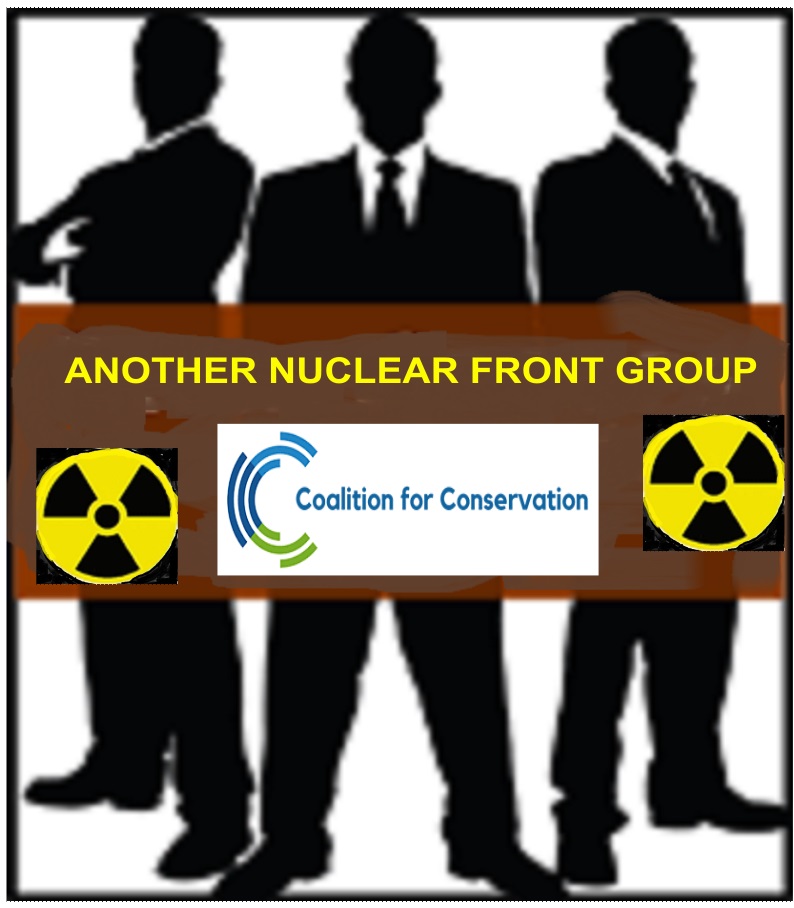
Former NSW Liberal government energy minister Matt Kean has quit his role as ambassador of an environmental charity dominated by state and federal Liberal and National Party MPs, saying it had become obsessed with promoting nuclear power and is seeking to delay the rollout of renewables.
Kean says he is quitting the Coalition for Conservation (c4C) because of concerns about the direction of the charity, which has undergone a major shift in focus in the past year, coinciding – according to the AFR – with the growing involvement of patrol Trevor St Baker, the former coal baron and now nuclear investor and proponent.
“When the network was formed, I was an enthusiastic supporter, because I believe that it is the Coalition that should be the best custodians for our environment,” Kean wrote in a letter to the organisation’s chair, former federal Coalition minister Larry Anthony.
“It has become clear in recent times that the Coalition for conservation has increasingly focussed on nuclear power in the electricity system.
“In particular I was concerned to read an article in the Canberra times advocating nuclear power stations as an alternative to building new large scale transmission lines.
“While I recognise that one cannot rule out nuclear playing a constructive role in the Australian electricity system in the distant future, the reality is that there is no feasible pathway to play any material role in helping Australia replace our coal fired power stations in line with the climate science.”
The C4C appears to have undergone a rapid rethink on emissions reductions, dumping its previous support for renewable as the cheapest path to net zero in favour of nuclear.
It is a major major shift which has coincided – according to the AFR’s Rear Window column – with the growing involvement of one of the C4C two patrons, the billionaire Trevor St Baker, the former coal baron and now nuclear investor and proponent.
Kean is the architect of the plan to replace Australia’s biggest fleet of coal generators with wind, solar and storage, and whose work now forms the basis of the Federal Labor government’s Capacity Investment Scheme that will lead its own ambitious renewable energy targets.
His decision to quit the group highlights the growing divide between moderates in the Coalition, and the hard right, which has become obsessed with nuclear and is supported by a growing number of so-called “think tanks”, Murdoch media, and charities such as C4C.
The group’s recent activity on X and its own website have been focused entirely on nuclear, and it has joined the chorus of conservatives, including Coalition leader Peter Dutton and energy spokesman Ted O’Brien, in attacking institutions such as the CSIRO and AEMO for their GenCost reports and renewable energy roadmaps.
Kean wrote in his letter that large scale nuclear reactors have proven costly and slow to deliver, particularly in the UK with the massive delays and cost overruns at the Hinkley point C nuclear power project.
He also noted that small modular nuclear reactors promoted by the charity as a solution to Australia’s energy challenges are not currently commercial anywhere in the world, and early stage demonstration projects have been cancelled or delayed into the 2030’s.
“Even if (nuclear energy in Australia) were possible, it would be extremely expensive and far more expensive than the alternative as set out in AEMO’s integrated system plan,” he wrote.
“I not only regard advocacy for nuclear power as against the public interest on environmental, engineering and economic grounds, I also see it as an attempt to delay and defer responsible and decisive action or climate change in a way that seems to drive up power prices in NSW by delaying renewables.”
No nuclear option for $275m green-manufacturing and innovation grants
Sam McKeith, Feb 26, 2024, https://reneweconomy.com.au/green-manufacturing-gets-275m-boost-with-launch-of-innovation-grant-scheme/
Grants from a NSW $275 million green manufacturing fund will not go towards nuclear projects as the state says the technology is not part of its plans to reach net-zero emissions.
Under the Net Zero Manufacturing Initiative program, announced on Monday, businesses can access grants for manufacture of renewable energy systems, low-carbon products and clean-technology innovation.
The program is part of the state’s legislated pledge to cut greenhouse gas emissions to 50 per cent of 2005 levels by 2030 and hit net zero by 2050.
But Climate Change Minister Penny Sharpe ruled out any grants going to projects such as the development of small modular nuclear reactors, despite a Newspoll on Monday showing two-thirds of younger Australians backed the technology.
“We’re looking at, even if you wanted to start today … a 14-year horizon to get it in the ground, which we don’t actually have,” she told reporters.
“The second point that I make is that nuclear energy is 350 per cent more expensive than renewables.”
Premier Chris Minns said the grants would bolster local manufacturing in the renewable and clean-technology industries, especially among small and medium-sized firms.
“The thing I like about this so much is that it enhances what is taking place in our research universities in the state as it currently stands,” he said.
The initiative will focus on lab-proven tech and the build of “market-ready products” ready to be scaled up and rolled out in NSW, the government says.
It comes as the state scrambles to replace ageing coal power stations with renewable energy to meet its emission targets, while also trying to keep a lid on power prices and maintain capacity.
Sydney smashes 1 October heat record as Victoria fights bushfires

Sydney has endured its hottest ever start to October on record as fire
danger warnings were issued across NSW – and as two bushfires threatened
campers and towns in eastern Victoria.
Guardian 1st Oct 2023
New nuclear medicine factory to replace ageing site at Lucas Heights reactor
SMH By Liam Mannix, September 26, 2023 —
Hundreds of millions of dollars will be spent building a new radioactive medicine factory at the Lucas Heights nuclear reactor in Sydney, replacing an ageing and accident-prone facility.
The new manufacturing centre will produce the radioactive drugs doctors use to image the heart, lungs, kidney and brain for diagnosing and tracing diseases such as cancer. The current facility has been plagued by safety breaches, including in 2017 when a worker suffered radiation burns.
The federal government has been tight-lipped on costs ahead of a competitive tender process, but equivalent facilities in other countries have often come with price tags exceeding $400 million. The factory is expected to open in the mid-2030s…………
The facility will replace Lucas Heights’ trouble-plagued Building 23, built in 1959 as a research laboratory and later repurposed to make nuclear medicine.
Building 23 recorded seven “events with safety implications” in 2017 and 2018.
The worst of these occurred in 2017, when a worker dropped a vial of radioactive Molybdenum-99, covering their hands in the liquid.
Despite wearing two pairs of gloves, the worker suffered radiation burns and blistering.
ANSTO, which operates Lucas Heights, initially estimated the worker had been exposed to a mild dose of radiation. But an investigation by the radiation safety regulator determined the dose could have been 40 times higher than the legal annual radiation exposure limit.
The Australian Radiation Protection and Nuclear Safety Agency was so concerned, it issued a direction notice to ANSTO demanding an independent review of radiation safety in 2018, noting seven separate safety incidents within two years…………..
Like the current facility, the new one will assemble and test nuclear medical products, particularly Molybdenum-99, or Mo-99.
ANSTO is a major supplier of Mo-99, a radioactive substance that naturally decays to form Technetium-99m (Tc-99m), the workhorse of nuclear medicine. The organisation supplies about 12,000 doses a week, shipping them to facilities across Australia and the region.
Tc-99m can be used as a radioactive dye. Doctors inject it, allow it to accumulate in target organs or tissues, and then image the radiation it releases using special cameras. Tc-99m is particularly useful because it exposes patients to only a low dose of radiation.
To make Mo-99, plates of uranium are inserted into the Lucas Heights nuclear reactor, known as OPAL, which stands for open-pool Australian lightwater reactor……………………………………………………..more https://www.smh.com.au/national/new-nuclear-medicine-factory-to-replace-ageing-site-at-lucas-heights-reactor-20230925-p5e7g8.html
Australian theatre company stages On the Beach, Nevil Shute’s nuclear-doomsday novel

WSWS Kaye Tucker, 1 Sept 23
On the Beach, Nevil Shute’s 1957 book, was recently staged by the Sydney Theatre Company (STC) in a two-act adaptation by playwright Tommy Murphy (Significant Others, Gwen in Purgatory, Holding the Man). The show was directed by Kip Williams, the STC’s artistic director.
Shute’s story is set in the Australian city of Melbourne in 1963—in other words, a few years into the future—following a devastating nuclear war in the northern hemisphere, and what are the final months of human civilisation. All human life has been wiped out in North America, Europe, China and the Soviet Union, and a deadly radiation cloud is moving southward towards Australia.
City residents, along with the captain and crew of the visiting American nuclear submarine USS Scorpion, are preparing for their inevitable deaths with only state-sanctioned suicide pills to ease their final days…………………………….
Shute’s novel was an immediate financial success in 1957, selling over a hundred thousand copies in the first weeks after its publication, and quickly becoming an international best seller. Twelve years after the US atomic bombing of Hiroshima and Nagasaki, millions of people around the world were deeply concerned about the possibility of nuclear war.
US director Stanley Kramer acquired the rights and the movie, shot in Melbourne and featuring some of Hollywood’s greats—Gregory Peck, Ava Gardner, Fred Astaire and Anthony Perkins—was released in 1959. “It was a fictional scenario,” Gardner said of the film, “but my God, everyone in the cast and crew knew it [nuclear war] could happen… I was proud of being part of this film.”
Other film and television productions have since been made. These include a made-for-television version in 2000 with Armand Assante, Rachel Ward, and Bryan Brown, followed by a full-cast audio dramatisation in 2008. In 2013, Lawrence Johnston directed Fallout, a documentary about the production of the Kramer’s film.
The STC’s staging of On the Beach—the first ever theatrical production—is timely and politically significant. Its four-week season at the 800-seat Roslyn Packer Theatre in central Sydney was well attended, indicating that Shute’s frightening story still resonates, not just with those who read it in the late 1950s, but for a new generation.
In fact, the ongoing and increasingly public speculation by government and military officials about the possible use of nuclear weapons in the US-led NATO war against Russia in the Ukraine, make Shute’s novel even more relevant than when it was released. Likewise, the Albanese government’s deepening involvement in US-led preparations for war against China, with multi-billion dollar purchases of nuclear submarines and other deadly weaponry, and the hosting of major military exercises in northern Australia, is encountering growing popular opposition.
Underpinning Shute’s book is his determination to raise awareness about the possibility and dangers of nuclear war. This is effectively presented in the opening pastiche of the STC production that gives a real sense of the impending danger that drives the author’s narrative………………………………………………………………………………………
On the flap of a 2010 edition of the novel, a Guardian reviewer rightly states, “On the Beach played an important role in raising awareness about the threat of nuclear war. We stared into the abyss and then stepped back from the brink.”
Rather than circumventing the crises “currently staring us in the face” or creating “a sense of hope,” as Williams suggests, Shute directly confronts his readers with the cataclysmic consequences of inaction……………………………………………………………………………………. https://www.wsws.org/en/articles/2023/08/31/nlzx-a31.html
—
Parramatta Labor Party’s FEC unanimous anti-AUKUS motion
Antonina Gentile 4 Aug 23
The ALP’s FEC of the entire Parramatta electorate tonight voted unanimously against aukus. This makes it the second FEC in NSW, the other being Sydney. Thus noone can try to attack the campaign as an inner urban phenomenon anymore.
This will certainly give AA and the Executive something to lose some sleep over. They are confident that they will win the National Conference vote, but they have a widespread party membership in movement and these are far less pleased than they thought.
If the “aukestra” outside Conference is impressive, parliamentary delegates will now more than ever need to take note and, if lobbied by their constituencies and organisations such as those on this list, some could start finding their tongues…
Port Kembla no place for a nuclear subs base, say local campaigners
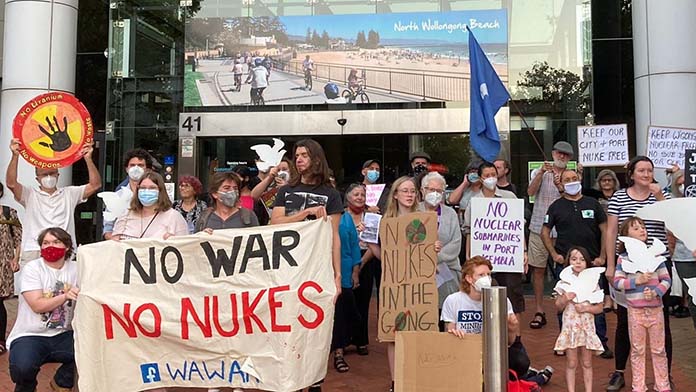
Activists in Wollongong are organising against plans for nearby Port Kembla to host the East Coast base for the AUKUS nuclear submarines. Solidarity spoke to Alexander Brown from Wollongong Against War and Nukes about local opposition and how unions have dedicated this year’s May Day march to opposing the plan
The cost is around $10 billion for an East Coast submarine base. The Treasurer says they can’t afford the $24 billion required to increase Centrelink payments above poverty levels and yet they can afford to spend $10 billion on a war base. And that’s a small part of the overall $368 billion dollars for AUKUS. It’s a gross waste of money.
The strategic justification for it doesn’t make any sense. That’s being picked apart even within the Labor Party by people like Paul Keating and Bob Carr. We’re now seeing current sitting MPs start to express criticism. The submarines may arrive in between ten to 30 years, when their supporters in ASPI and the Sydney Morning Herald say we’re about to have war with China in the next three years. If so the subs are not going to be much use.
More importantly, it’s a ridiculous approach to peace making in the region to say we will arm ourselves to the teeth and that will deter China. China and its regime have many problems but they’re not a military threat to Australia now and they’re unlikely to be in the future. And if these subs are supposed to be to defend shipping, we are shipping most of our exports to China anyway, so who are we defending it against?
We need to build people-to-people solidarity with ordinary people in China to ensure peace and democracy in the whole region—not get drawn into a US provocation and starting a regional arms race.
What kind of actions have you taken to build opposition?
When Scott Morrison suggested that Port Kembla could be a site for an East Coast submarine base there was a protest called by the Student Association at Wollongong University, and different groups and individuals including unions and local councillors came to that.
We started organising a dedicated campaign group called Wollongong Against War and Nukes (WAWAN) and held a successful rally about a year ago to support the local council renewing the declaration of Wollongong as a nuclear free zone, which goes back to 1980.
We held a public meeting with former Greens Senator Scott Ludlam and the South Coast Secretary of the Maritime Union.
We had a rally here two weeks ago, because some local business interests held a defence industry conference and want to build a war industry down here.
This year when the Labor government so fully endorsed continuing AUKUS, after I think many people hoped they might back away, it created shock.
Then there was also a report in the ABC that Port Kembla was firming up as the most likely location for the submarine base. So the campaign has really picked up in the last two months.
The local South Coast Labor Council endorsed a motion to oppose having a nuclear base here.
Unions like the maritime union have put a lot of work into trying to plan for a renewable energy industry here to survive the big shocks that are coming in terms of the decline of coal and steel. They’re interested in expanding offshore wind and potentially green steel through hydrogen.
WAWAN has a community meeting in Port Kembla on 29 April, and we are calling for everyone who can get there to come and support the South Coast May Day march on Saturday 6 May, which will include opposition to the nuclear base alongside the slogan of “Peace, Jobs and Justice”.
Wollongong and Port Kembla steel works have been hotbeds of militancy since the beginning of last century and that tradition continues. The Dalfram dispute in the 1930s saw waterside workers refuse to load pig iron bound for Japan, because they knew that it would be used to make bombs and bullets for the Japanese invasion of China. Pig iron exports to Japan more or less stopped after that struggle.
In the Vietnam War there was a strong movement here and in the 1980s the anti-nuclear movement was really big in Wollongong and the unions were a major part of that. A lot of people in Wollongong have seized the opportunity to say that fighting unionism needs to look beyond the workplace at the environment that workers are going to be living in and creating.
We are wasting money and resources on the defence industry when we could be spending that money on addressing climate change and jobs through a Green New Deal.
Unions back renewable energy jobs over nuclear subs
The South Coast Labour Council, which represents unions in and around Wollongong, is opposing the submarine base as a threat to alternative jobs in the area.
Port Kembla has been assessed as an ideal spot for offshore wind developments, due to wind conditions, grid connections and the working harbour. The area is one of the NSW government’s priority Renewable Energy Zones, with at least two companies already carrying out scoping work for multi-billion dollar offshore wind projects.
Even NSW Ports and the Port Kembla Chamber of Commerce have warned that the Outer Harbour site is needed for wind turbine assembly as well as a new container port, and should not be taken by defence. This is also the likely site for the submarine base. Even the two offshore wind projects already proposed would create thousands of jobs in construction as well as over 500 ongoing jobs.
March against the nuclear base in Port Kembla
12pm Saturday 6 May, Wentworth St, Port Kembla, more details here
Sign up for travel from Sydney here
Opposition grows to nuclear submarines in Port Kembla
by Owen Marsden-Readford https://redflag.org.au/article/opposition-grows-nuclear-submarines-port-kembla, Wednesday, 19 April 2023

Last year, as part of the AUKUS pact, Liberal Prime Minister Scott Morrison announced plans for a new submarine base on Australia’s east coast. The Labor government that succeeded Morrison’s has said it will stick with this plan.
There is increasing speculation that the site for the base will be Port Kembla, a southern suburb of Wollongong in the Illawarra region of the NSW south coast. While Labor insiders have claimed a final decision won’t be made until after the next federal election, the ABC recently reported that, according to “defence, government and industry figures”, Port Kembla “is now the strongly favoured option” for its deep port and proximity to other military bases and Australia’s lone nuclear reactor at Lucas Heights.
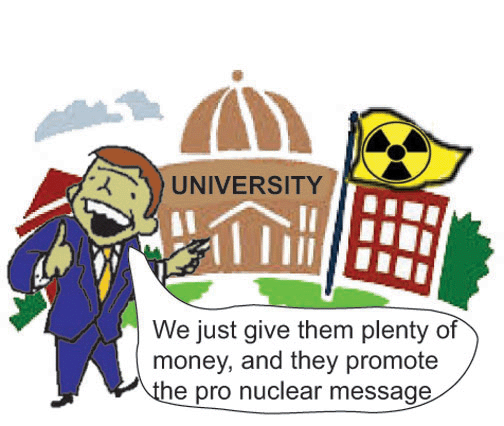
The plan has received support from some local business figures, and the University of Wollongong is deepening its already extensive ties with the military-industrial complex in anticipation. Among the wider community, however, opposition is growing.
Several unions have already come out against the proposed base. The New South Wales Teachers Federation passed a motion at its March council meeting:
“Continuing reports that Port Kembla is being considered as the site for a nuclear submarine base is of deep concern for our public education communities. While governments appear ever ready to commit huge amounts of public revenue on military expenditure there remains a serious underfunding of public pre-schools, public schools, TAFE and higher education, and other areas of the public sector.”
The Kiama council also passed a motion opposing a submarine base at Port Kembla. Even the Dapto and Port Kembla branches of the Labor Party have passed oppositional motions. Socialist students in the Wollongong Undergraduate Students’ Association have passed motions opposing the nuclear submarines, the AUKUS pact and the Australian government’s war drive.
Importantly, the South Coast Labour Council has called for this year’s May Day rally to be held in Port Kembla on Saturday, 6 May, to oppose the planned base. Council secretary Arthur Rorris told the Sydney Morning Herald, “If they want to turn our harbour into a nuclear parking lot, we will fight them tooth and nail”. There will even be a solidarity action held in San Francisco outside the Australian consulate.
Wollongong Against War and Nukes (WAWAN)—a campaign group formed last year—has held a series of protests against AUKUS. The most recent, on 4 April, drew more than 80 people in opposition to the Illawarra Defence Industry Conference—a gathering of war hawks and military profiteers.
Socialist and WAWAN activist Luke Hocking said in a speech at the protest, “If we are all committed to building this movement … then we can make something that can physically get in the way of their plans. And the more of us there are, the better we will be able to do that”. WAWAN will be holding a community forum in Port Kembla on Saturday, 29 April, and is planning further protests.
The Illawarra has a proud history of working-class anti-imperialism. We should look to these traditions as we set out to build resistance to the planned submarine base, the AUKUS pact and the militarism of the Australian ruling class and its US and British allies.
1 This month
To see nuclear-related stories in greater depth and intensity
– go to https://nuclearinformation.wordpress.com/


 Antinuclear