YASMIN Catley is calling for Premier Gladys Berejiklian to rule out nuclear power in NSW.
The Member for Swansea’s comments came after it was revealed the Deputy Premier John Barilaro was on a taxpayer-funded trip to the US where he attended the International SMR and Reactor Summit, in Atlanta, on March 27.
The NSW Nationals leader has on previous occasions called for nuclear power to be “part of the debate” about the state’s future energy mix.
Mr Barilaro was an invited speaker at the summit and billed on its website as one of the “biggest names in nuclear”.
While in the US he also met with representatives from NuScale and U-Battery, his office said.
These companies are “developing Gen IV reactors which will possibly be available mid 2020s, as well as the US Department of Energy to get an insight in relation to the Government’s approach to new nuclear technology,” a spokesperson for his office said.
“This was an opportunity to learn and gain knowledge about the sector.”
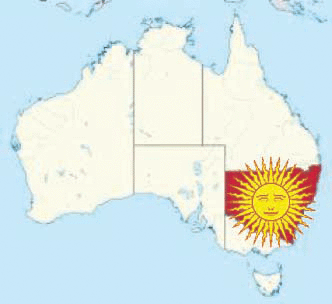
Ms Catley pointed to a 2016 map produced by the Australian Nuclear Association which identified two sites in Lake Macquarie and one site at the Central Coast – Eraring, Vales Point and Munmorah – which could be potential nuclear power plants.
However, Mr Barilaro’s office said he had not considered locations for any future nuclear power sites.
The Australian Nuclear Association’s Robert Parker said the Lake Macquarie and Central Coast sites were among many his organisation had identified across Australia.
The local sites’ suitability was due to existing power generation infrastructure, population density, access to cooling water, road and transport infrastructure, and an existing skilled workforce, Mr Parker said.
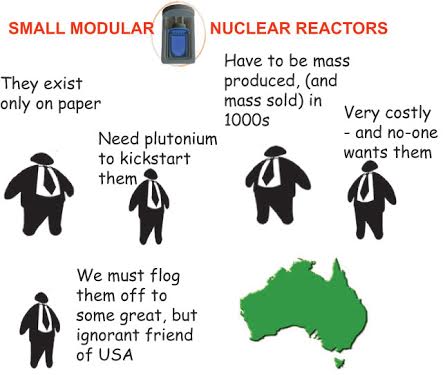
He stressed his organisation were proponents of small modular reactors, not large reactors.
The organisation would like to see 18 reactors operating in NSW by 2040.
“It’s impossible for them to have meltdown issues like at Fukushima,” Mr Parker said.
Ms Catley has called on the Premier to rule out nuclear power in NSW. “The Central Coast has a long history of being the powerhouse for NSW, but nuclear is not the way forward,” Ms Catley said.
The Member for Lake Macquarie Greg Piper said while he did not support nuclear power in Lake Macquarie, “Mr Barilaro should not be shut down if he believes it’s something that should be looked at.”
“But the people of Lake Macquarie would have a meltdown.”
Premier Berejiklian ‘openminded’ to nuclear energy, deputy premier says 2GB, BEN FORDHAM, 3 April 18 Premier Gladys Berejiklian is “openminded” to nuclear power in Australia according to Deputy Premier John Barilaro.
Mr Barilaro has touched back down in Australia this week after visiting the US to push new nuclear technology in our state.
After meeting with American companies who are building the world’s first small modular reactors, he says this is the way of the future.
Steve Dale Nuclear Fuel Cycle Watch South Australia, 2 April 18Larry Anthony is the president of the National Party, but is also the founding director of the SASGROUP, a lobbying firm. SASGROUP clients include Delta Electricity and St Baker Energy Innovation Fund. Both involve Trevor St Baker who is director of SMR Nuclear Technology company. Even Tony Abbott has concerns about the unhealthy mixture of lobbying and politics. http://lobbyists.pmc.gov.au/register/view_agency.cfm?id=227
‘We need to have a discussion’ about nuclear energy: MP, Northern Star, by JASMINE BURKE, 31st Mar 2018 ………NSW Labor Opposition has called on the Premier to intervene and put an end to the investigation by her Deputy, National Party Leader John Barilaro, into the potential establishment of a nuclear power industry in NSW.
In his speech to the Small Modular Reactor Summit in Atalanta this week Mr Barilaro said: “We need to have the discussion (about nuclear energy) and we need to have it now.”
He added the discussion will take place over a “5-10 year period”, before any nuclear energy options could even be introduced in Australia.
A spokesperson for Mr Barilaro said he met with some companies in the US including NuScale and U-Battery, who are developing Gen IV reactors which will possibly be available mid 2020’s, as well as the US Department of Energy to get an insight in relation to the Governments approach to new nuclear technology.
They said “the meetings were an opportunity to learn and gain knowledge about the sector”.
The Nuclear for Climate Australia website identifies 18 possible sites for nuclear power plants in NSW – including a 250km stretch of coast from Port Macquarie to north of Grafton.
The plan envisages the 18 reactors being constructed in NSW by 2040.
Last year NSW Labor leader Luke Foley accepted Mr Barilaro’s invitation to debate nuclear power and suggested Lismore host the forum.
In a letter addressed to the Premier dated June 1 2017, Mr Foley described nuclear power as “both risky and irresponsible” and said: “I accept your call for a debate and propose that we hold a public debate in Lismore to discuss the issues at stake.
“Lismore would be an appropriate location for such a debate as it is one of the most environmentally conscious communities in NSW.”
But when asked if Mr Barilaro was considering the offer his spokesperson said Mr Foley was “playing politics with the issue and is completely ignorant to the issues and clueless about the technology”.
……….More recently, Shadow Minister for Industry, Resources and Energy, Adam Searle MLC and Shadow Minister for Primary Industries, Mick Veitch MLC, made a two day visit to the North Coast to meet with primary producers and explore potential solutions to the energy crisis.Mr Searle said nuclear reactors would tarnish NSW’s clean and green image, and threaten the reputation and emerging markets of many north coast primary industries.
“Mr Barilaro’s nuclear thought bubbles were a distraction from real long term energy solutions that provide the cheapest and most sustainable forms of electricity for the community and business – which is renewable energy,” he said.
“The Premier has let this debate run for too long and now needs to rule out herself any proposal to build nuclear power plants here in NSW.”
He also called for the Deputy Premier to “come up to the North Coast and explain why the National Party believes nuclear reactors are the best option”.
Mr Veitch said: “North Coast primary producers pride themselves on the quality of their goods and their clean and green reputation.”
Photographs from a rally in Sydney, protesting against Federal Government plans to establish a nuclear waste dump at Brewarrinain North Western NSW, on Ngemba land. Traditional custodians of the land, the Ngemba, are opposed to the dump.
Speakers at the rally included organiser Natalie Wasley, Ngemba and Brewarrina representatives, Trish Frail and Natalie Eastwood, Nathan Moran from the Metropolitan Local Aboriginal Land Council, Dave Sweeney from the Australian Conservation Foundation, Jim Green from Friends of the Earth, and NSW Greens parliamentarians Jamie Parker and David Shoebridge, as well as others. The Wakagetti dance troupe provided dance performances and a smoking.
About 100 people from all around Australia then marched from Bligh Street outside the Commonwealth offices, through Sydney’s CBD to NSW Parliament House, chanting, “No bundabunda (poison) on Ngemba land”.
New South Wales has long played second fiddle to Queensland – the “Sunshine state”, when it comes to rooftop solar. Despite its bigger population, NSW is beaten into second place on rooftop solar installations by Queensland, which has already reached the 2GW mark.
But the Australian Energy Market Operator suggests that is about to change.
Over the next few years, it expects NSW to overtake Queensland with the most installed capacity (by 2020/21) and by 2035 it expects NSW to have more than 7GW of rooftop solar in the state – 50 per cent more than its nearest rival.
This graph above [on original] shows the estimate, including in the AEMC’s Reliability Panel’s annual report, which highlights the growing shift to decentralised energy, which includes rooftop solar and storage.
Indeed, this graph shows only one of AEMO’s installation scenarios – it’s high uptake shows another 3GW of rooftop solar, and many suggest that half of all Australia’s electricity needs may come from decentralised energy within a decade or two.
Recent data suggests that NSW recently pipped Queensland as the biggest market for rooftop solar in the month of February (with just over 28MW installed in the month), but AEMO’s forecasts suggests NSW will continue to set the pace over the next decade or two.
The rooftop solar is already having an impact, delaying and reducing the size of grid peaks, and so reducing the cost of peak demand events. Ausgrid is also looking at providing more subsidies to encourage more rooftop solar in inner-city suburbs to reduce the need for network upgrades.
The AEMO forecasts suggest a total of 18.6GW of rooftop solar PV capacity by 2035/36, which will be accompanies by strong growth of integrated solar PV and battery storage systems.
Indeed, this graph shows only one of AEMO’s installation scenarios – it’s high uptake shows another 3GW of rooftop solar, and many suggest that half of all Australia’s electricity needs may come from decentralised energy within a decade or two.
This will have an impact on the shape of the demand curve in Australia. Not only will it reduce maximum demand, and push it into the evenings, it will also push minimum demand into the middle of the day, rather than overnight.
This is already happening in South Australia (it has been since 2012), but will extend to NSW, Queensland and Victoria. Minimum demand may turn “negative” – where rooftop solar output exceeds customer demand – as early as 2025 on some days in South Australia.
AEMO suggests that in South Australia the excess rooftop solar output can be stored (in batteries) or exported to the rest of the market.
“This signals the important need for market and regulatory frameworks that support storage solutions and maximise the efficiency or shared electricity services for consumers.”
Indeed, the new South Australian government is toying with that idea, proposing its own $100 million plan to subsidise the installation of batteries in 40,000 homes, and considering what to do with the Tesla plan for solar and storage in 50,000 low income homes that would create the “world’s biggest virtual power plant”.
And here’s another interesting graph [on original] from a separate AEMO report, one that looks at the last quarter of the electricity markets.
It shows the average rooftop solar PV output in the last quarter, and it is nearing 1GW, having risen from 905MW in the same quarter last year to 969MW in the fourth quarter of 2017.
AEMO says the largest increases were in Victoria (+15 per cent) and South Australia (+8 per cent). These increases correspond with an increase in rooftop PV capacity and higher than average sunshine across all capital cities except Adelaide.
The Brewarrina community is stepping up the campaign against a proposed national nuclear waste dump, with two successful events held over the weekend.
A silent protest was held at the local Council meeting on Friday the 23rd February, with over 20 local protestors attending. Ngemba man Jason Ford presented the No Nuclear Bundabunda on Ngemba Land – Bad Poison petition to the councillors. The petition had 563 clear ‘no’ votes compared to 84 residents who voted in a Council survey that Council should ‘continue with the project.’
Ngemba woman and campaign coordinator Trish Frail said, “We did not win gold, but we won silver and we are happy with that at this stage of the campaign. No further action can be taken by Council until a Working Group is established and the many questions we put to them are answered.”
“We want to know the motivation and funding behind the delegation to Lucas Heights last November and details of the consultation arrangement for nuclear advocate Robert Parker. There is clearly no mandate for the Council to just push ahead and keep promoting the nuclear waste dump,” Ms Frail stated.
The ‘Keep Bre Nuclear Free’ rally the following day mobilised over 100 people, with young people proudly leading the march and chanting ‘No Bundabunda on Ngemba Land’ and ‘Keep Bre Nuclear Free’.
Many Elders also came out to support the campaign.
Aunty Doreen said, “As a Ngemba Elder and a custodian of the land it is important that I support the younger generation in preventing this atrocity from happening on our land, which came from the Dreaming. We struggle with the atrocities that have happened in the past; our future generations should not have to struggle with this danger.”
“It is nuclear genocide. The cotton industry has wrecked our water ways, we can’t let the nuclear industry wreck our land, water and environment,” Aunty Doreen concluded.
Supporters from Melbourne and Canberra travelled to participate in the rally, with messages of support sent from other areas currently under assessment to host the national nuclear dump.
22 Feb 18Brewarrina residents, including Ngemba people with local cultural responsibilities, are stepping up their campaign against the proposal for national nuclear waste dump in the region.
A silent vigil will be held during the Council meeting at 8:30am this Friday February 23, followed with a rally on Saturday morning at 9:30am.
In November 2017 the Brewarrina Council revealed that a delegation had traveled to Lucas Heights nuclear reactor in Sydney and subsequently engaged pro-nuclear consultant Robert Parker.
Trish Frail, a Ngemba woman who is coordinating the local campaign to oppose the dump, said the community was shocked by the proposal.
“This nuclear facility will not benefit our town, the community or the environment,” Ms Frail said.
“Ngemba people are custodians for the Ngunnhu Fish Traps. The site is claimed to be over sixty thousand years old and is heritage listed, being the oldest man-made structure in the world.”
“The Biami Traps were once a great gathering site for all clans to trap fish and to host corroborees, initiation ceremonies, and meetings for trade and barter.”
“A lot of our younger generation are talking about moving away if a nuclear dump is built on our land, they will lose our culture and our lore, this must not happen. The young people have been helping.”
“Brewarrina will not become a nuclear dumping ground for the Australian Government. We say No Nuclear Bundabunda (poison) on Ngemba Land – Bad Poison,” Ms Frail concluded.
Hunters Hill residents wary of latest announcement on uranium contamination, ABC News, 20 Feb 18, By Jade Macmillan
Residents on Sydney’s lower north shore have dismissed the Government’s latest plans to clean up land contaminated by a uranium smelter more than hundred years ago as “a hollow promise”.
Property Minister Victor Dominello announced $30 million to remediate the waterfront land on Nelson Parade in Hunters Hill, the former site of the Radium Hill refinery, which closed in 1915.
The area was also occupied by a carbolic acid plant until the early 1900s and a tin smelter until the 1960s.
Residents have spent decades urging the Government to remove the affected soil, which the NSW Environment Protection Authority found it was contaminated with petroleum hydrocarbons, coal tar pitch, arsenic and lead.
“Having this funding should give the community confidence that we are determined to remediate the site,” Mr Dominello said, ahead of a public meeting of more than 200 residents on Tuesday night.
“The Government is currently considering suitable disposal locations for the waste, and is in discussions with the Federal Government on the possibility of using the proposed National Radioactive Waste Management Facility earmarked for development in South Australia.”
The minister did not provide a timeframe for the works and a site for the radioactive facility has not yet been selected.
Rosemary Manusu, 80, who has lived on Nelson Parade for more than 50 years, said she had little faith in the announcement after years of inaction from successive governments.
Brewarrina, or “Bre” as it is known, is an historic and fascinating town on the Barwon-Darling River. New South Wales.With 68% of the local population identifying as indigenous it is essentially an Aboriginal town. …. It is hard to underestimate the importance of the Aboriginal stone fish traps which, at 40,000 years old, may be the oldest man-made structures on the planet.
Brewarrina was the scene of a huge massacre of Aboriginals. “They rounded them up like cattle, old and young, on the Quantambone plain, and shot them. It is said that there were about 400 and that was how Hospital Creek got its name”
It is disappointing that the local Councillors and Council would even consider such an atrocity as a nuclear waste dump at Brewarrina.
If Nuclear waste was so safe why is it taken over 35years to find a site, why are they seeking to build in isolated communities with the majority off the population being Aboriginal?
Brewarrina is known worldwide for the oldest man-made structure in the world with Baiame’s Ngunnhu Fish Traps and we want to keep it that way, not to be known as a nuclear waste facility.
The local Council approached the Federal Government for this proposal without consultation with the community and without negotiation with the Local Land Council or the Ngemba Community Working Party or other local councils.
We believe the health of the community will be at risk. We are being promised 15 jobs, what is 15 jobs compared to the health of the community and the land and water.
There are other options available to boost the economy of the town such as solar power, tourism and the abattoirs.
No Nuclear Bundabunda at Brewarrina – bad poison
(please note; 7 out of 9 Councillors have supported this proposal)
Council released their survey for the proposal to go ahead.
The Greens will table our petition in Federal Parliament.
The Berejiklian government has approved 11 large-scale solar energy plants in the past 12 months, clearing the way for NSW to join a “tsunami” of new renewable energy capacity across the nation.
The 170-megawatt Finley Solar Project in the Riverina, which will include half a million solar panels, is the first to get approval in 2018.
The 10 to get the go-ahead in 2017 doubled the number in the previous year, and alone supported 1800 construction jobs, Planning Minister Anthony Roberts said.
Those 10 “collectively reduce carbon emissions by over 2.5 million tonnes, which is equivalent to taking around 800,000 cars off the road”, he said.
NSW had more renewable generation capacity under construction than any other state, Energy Minister Don Harwin said.
“These projects will ensure our energy security and with many more in the pipeline, NSW is in a stronger position than other states,” he said.
Energy security remains a contentious issue in Australia, with the Turnbull government’s proposed National Energy Guarantee yet to secure sign-on by states and territories unsure about the fine detail.
John Grimes, chief executive of the Smart Energy Council, a group promoting solar energy and storage, described the acceleration of solar approvals in NSW as “fantastic”. The Coalition-led state government was “one conservative group that’s not working against renewables, and that’s got to be good thing”, Mr Grimes said.
In 2017, large-scale and roof-top solar added about 1.3 gigawatts nationally, a record for the industry.
On current trends, roof-top panels could alone add 1.4 GW of new capacity this year, with solar farms soaring by 2.5-3.5 GW, the Smart Energy Council estimates.
Together the 2018 tally may come close to doubling existing capacity in a single year as firms rush to supply the Renewable Energy Target that has to be filled by 2020.
“We’re about to get this giant, enormous tsunami, and nobody knows about it,” Mr Grimes said. “Wind [energy] used to be big and solar was small – now solar’s big, and wind is small.”
Officials in various approval agencies are struggling to keep up with approvals as companies flood them with applications, he said.
“With some of the best sunshine anywhere in the world and lots of good locations available, it is not surprising that NSW is up there with Queensland as one of the national frontrunners for new large-scale solar power projects,” Kane Thornton, chief executive of the Clean Energy Council, said.
At present, Queensland is ahead of NSW in terms of projects with finance or under construction, although the two states have similar numbers of approved ventures.
Renewable energy projects to be built under the Renewable Energy Target in the next couple of years add up to more power than the original Snowy Hydro project, which took a quarter of a century to complete, Mr Thornton said.
Solar projects can typically be developed, approved and built faster than wind ventures.
“And with the cost of new solar power continuing to plunge, they can also be built for a very competitive price which is substantially lower than either new coal or new gas,” Mr Thornton said.
An example of other states’ development includes a plan by Tilt Renewables to spend almost $500 million to integrate two projects – a solar farm and battery venture, and a 300-megawatt, pumped hydro storage project in a disused quarry – with its wind farm interests in South Australia.
Tilt’s $90 million Snowtown North solar and storage project includes a 180,000-panel farm with 44-MW capacity and a 26 MW-hour battery. It is forecast to have an operational life of around 25 years and offset around 85,000 tonnes of CO2-equivalent.
“By combining wind energy – with typically an evening peak at this site – and solar energy with a daytime peak, the two assets can combine to better match daily electricity demands,” Tilt chief executive Deion Campbell said, adding that “with the battery reducing the effect of short-term variability from the two renewable generation technologies”.
One area where NSW is a relative laggard is the penetration of rooftop solar, with roughly half the 30 per cent rate of South Australia and Queensland. “There’s a lot of ground to make up,” Mr Grimes said.
Beyond the big solar farms, though, is a jump in demand from companies looking to install smaller systems – such as between 400 kilowatt to 10 MW capacity – without power purchase agreements to offset the output.
“They are doing it to offset their own electricity use” and to get price certainty, Mr Grimes said.
Paul Waldon, Fight To Stop Nuclear Waste Dump In Flinders Ranges SA Australian Nuclear Science and Technology Organization, founded 1987… Australian Atomic Energy Commission, established 1952… Atomic Energy Policy Committee, created 1949…
How long it was on the drawing board is unknown. However the locals willingness to embrace and accept a nuclear waste producing machine with its ever growing stockpile of manufactured waste in their region is alive and strong.
For 69+ years the facility has been endorsed every time someone relocates to Lucas Heights/Barden Ridge and surrounding burbs,, or when a contract for a house or business in the area has been secured. 69 Years is along time in the cycle of a persons life, and presents a question:are there any surviving post nuclear residents residing in the district? So keep ANSTO’s deadly radioactive waste at Australia’s only accepted high grade nuclear waste dump, Lucas Heights. https://www.facebook.com/groups/344452605899556/
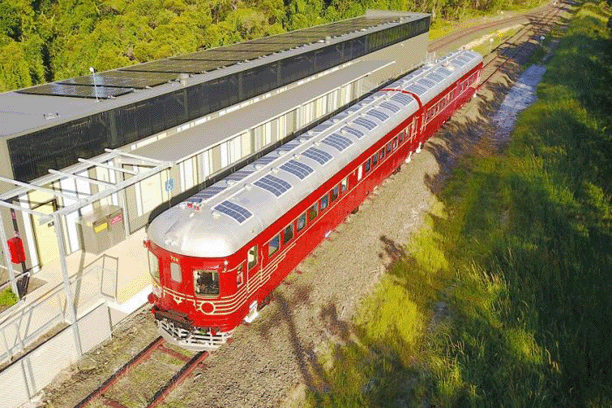
World-first solar train now leaving the platform in Byron Bay with zero emissions,ABC North Coast , By Bruce Mackenzie, 17 Dec 17, What is claimed to be the world’s first fully solar-powered train is operating on the New South Wales North Coast.
A refurbished 70-year-old ‘red rattler’ is running on a three-kilometre stretch of disused rail line at the popular tourist destination of Byron Bay.
It made its maiden trip yesterday with almost 100 passengers on board.
Electric bus solar system
The $4-million project is the brainchild of multi-millionaire businessman Brian Flannery, who owns a resort in the area.
“Hopefully it attracts people to Byron Bay,” Mr Flannery said.
“I think international tourists will come here to have a look at this world’s first solar train.
“So let’s see, in five years’ time they’ll probably still say I’m mad, but it’s a bit of fun.”
Tim Elderton, from the Lithgow Railway Workshop, was tasked with building curved solar panels and a battery system to power the train.
“Of course the major difference is it’s got solar panels on the roof so it can recharge itself.
“For those cloudy days we’ve also got 30 kilowatts of solar panels in this [station’s] roof here so we can also plug it in.
“On a sunny day like today we can do about four or five trips before we have to plug it in.”……..
Tram infrastructure a possibility
Longer trips than this one — 10 minutes to cover three kilometres or so — would require regular recharging stations along the route, but Mr Flannery said the technology might be suited to inner-city trams.
A lot of the tram networks of course have overhead wires and they’re electric but they’re powered off the grid from overhead,” he said.
“But in a case where you want to build a tramline without that infrastructure, I think you could.
The Advertiser can reveal the accident occurred on August 22 when a vial of the nuclear medicine product Molybdenum-99 was dropped when its cap was being removed during a quality-control test. The incident was rated “severe” by regulators and has led to changes in safety procedures.
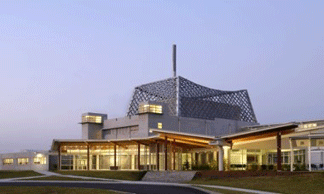
Molybdenum-99 is produced by the Australian Nuclear Science and Technology Organisation at Lucas Heights, below, for use in cancer and heart disease scans.
ANSTO Health general manager Mark Moore said the analyst has a slightly elevated risk of developing skin cancer after the liquid spilt on their hands.
“The analyst was working in a shielded fume cupboard that, in normal operation, limits a dose received, but the dropping of the vial resulted in the radiation dose,’’ Mr Moore said.
“Our employee remains at work and is currently performing alternative quality assessment work in the nuclear medicine field.”
Mr Moore said the staff member had burn-like symptoms, including blistering and reddening of the skin.
“While ANSTO is still waiting to be advised on the final estimate dose by an independent clinical specialist, we know it was above the annual statutory dose limit of 500 millisieverts, and expect to be issued with a formal breach from the regulator,” Mr Moore said.
“At this stage, the dose is estimated to be more than 20 Sieverts, which is 40 times above the extremity dose limit.”
The incident was reported to the Australian Radiation Protection and Nuclear Safety Agency and the International Atomic Energy Agency.
An ARPANSA investigation criticised some safety practices in Lucas Heights’ radiopharmaceutical production facilities.
Sydney’s closer to being a zero-carboncity than you think, The Conversation, You live in one of the sunniest countries in the world. You might want to use that solar advantage and harvest all this free energy. Knowing that solar panels are rapidly becoming cheaper and have become feasible even in less sunny places like the UK, this should be a no-brainer.
Despite this, the Australian government has taken a step backwards at a time when we should be thinking 30 years ahead.
Can we do it differently? Yes, we can! My ongoing research on sustainable urbanism makes it clear that if we use the available renewable resources in the Sydney region we do not need any fossil resource any more. We can become zero-carbon. (With Louisa King and Andy Van den Dobbelsteen, I have prepared a forthcoming paper, Towards Zero-Carbon Metropolitan Regions: The Example of Sydney, in the journal SASBE.)
Enough solar power for every household
Abundant solar energy is available in the Sydney metropolitan area. If 25% of the houses each installed 35 square metres of solar panels, this could deliver all the energy for the city’s households.
We conservatively estimate a total yield of 195kWh/m2 of PV panel placed on roofs or other horizontal surfaces. The potential area of all Sydney council precincts suited for PV is estimated at around 385km2 – a quarter of the entire roof surface.
We calculate the potential total solar yield at 75.1TWh, which is more than current domestic household energy use (65.3TWh, according to the Jemena energy company).
Wind turbines to drive a whole city
If we install small wind turbines on land and larger turbines offshore we can harvest enough energy to fuel our electric vehicle fleet. Onshore wind turbines of 1-5MW generating capacity can be positioned to capture the prevailing southwest and northeast winds.
The turbines are placed on top of ridges, making use of the funnel effect to increase their output. We estimate around 840km of ridge lines in the Sydney metropolitan area can be used for wind turbines, enabling a total of 1,400 turbines. The total potential generation from onshore wind turbines is 6.13TWh.
Offshore turbines could in principle be placed everywhere, as the wind strength is enough to create an efficient yield. The turbines are larger than the ones on shore, capturing 5-7.5MW each, and can be placed up to 30km offshore. With these boundary conditions, an offshore wind park 45km long and 6km wide is possible. The total offshore potential then is 5.18TWh.
Altogether, then, we estimate the Sydney wind energy potential at 11.3TWh.
Turning waste into biofuels
We can turn our household waste and green waste from forests, parks and public green spaces into biogas. We can then use the existing gas network to provide heating and cooling for the majority of offices………
Extracting heat from beneath the city
Shallow geothermal heat can be tapped through heat pumps and establishing closed loops in the soil. This can occur in large expanses of urban developments within the metropolitan area, which rests predominantly on deposits of Wianamatta shale in the west underlying Parramatta, Liverpool and Penrith.
Where large water surfaces are available, such as in Botany Bay or the Prospect Reservoir, heat can also be harvested from the water body…….
Hydropower from multiple sources
The potential sources of energy from hydro generation are diverse. Tidal energy can be harvested at the entrances of Sydney Harbour Bay and Botany Bay, where tidal differences are expected to be highest………
Master plan for a zero-carbon city
All these potential energy sources are integrated into our Master Plan for a Zero-Carbon Sydney. Each has led to design propositions that together can create a zero-carbon city.
Apr 15, 2026 01:00 AM in Canberra, Melbourne, Sydney
Join the International Physicians for the Prevention of Nuclear War (IPPNW) on Tuesday, April 14th for a timely webinar exploring the risks associated with nuclear power and challenging the myth that it offers a simple, safe, carbon-free solution to the climate crisis










 Antinuclear