ABC Radio Sydney By Amanda Hoh 14 Apr 17 A start-up accelerator program, dedicated to supporting entrepreneurs designing renewable energy products and technologies, has kickstarted in Sydney.
EnergyLab, based in Chippendale, has granted four companies $50,000 each to spend 12 to 24 months bringing their clean-tech products to market.
Most start-up incubators give entrepreneurs 90 days to develop their products, according to co-founder Piers Grove.
The companies include:
- Eveeh: An electric vehicle car-sharing network.
- Iron Matrix: A Perth company designing a construction system that replaces bricks and mortar with easy-to-manoeuvre steel posts and solar panels.
- BlueVolt: Solar products that can be installed anywhere by anybody.
- Energy Assist: Loans company for those wanting to buy energy-efficient appliances.
The first cohort of start-ups moved into the EnergyLab hub this week at the University of Technology Sydney, where they will receive dedicated mentors, office space and partnership opportunities as they bring their ideas to fruition……..http://www.abc.net.au/news/2017-04-13/renewable-energy-startup-accelerator-launches-in-sydney/8442594
April 15, 2017
Posted by Christina Macpherson |
energy, New South Wales |
Leave a comment
 Renewables roadshow: how Broken Hill went from mining to drag queens and solar farms The home of BHP and Mad Max can now take credit for kickstarting the large-scale solar industry in Australia, Guardian, Michael Slezak, 13 Apr 17, “…….Broken Hill gave birth to one of the least renewable industries on Earth, but it can now claim to be the Australian birthplace of one of the most renewable.
On the outskirts of the city lies a solar farm that covers an area equivalent to 75 Sydney Cricket Grounds. Built by AGL, the 53MW Broken Hill solar plant is one of two solar farms (the other 102MW one is in Nyngan) built in outback
New South Wales at the same time. Adam Mackett from AGL, who was the project manager for the Broken Hill plant, credits these farms with kickstarting the large-scale solar industry in Australia.
Officially opened in January 2016, the plants were built with subsidies from the federal government through the Australian Renewable Energy Agency (Arena), as well as support from the NSW government.
With that funding, AGL was able to jump into the large-scale solar industry, and in doing so, create a supply chain that is bringing down the cost of solar farms around the country.
For example, Mackett says a manufacturing plant in the struggling car industry retooled to provide the frames for the solar panels, and is now able to do that for the whole industry. Continue reading →
April 14, 2017
Posted by Christina Macpherson |
New South Wales, solar |
Leave a comment
 Transgrid gets 6,000MW solar proposals in 2017, sees 95%
  renewables by 2050 http://reneweconomy.com.au/transgrid-gets-6000mw-solar-proposals-2017-sees-95-renewables-2050/ By Giles Parkinson on 7 April 2017 Transgrid, the owner and operator of the main transmission line in New South Wales, reports that is has received “enquiries” about more than 6,000MW of large scale solar so far in 2017.The figure, revealed by business development manager Gustavo Bodini at the Large Scale Solar conference hosted by RenewEconomy and Informa earlier this week, is more than a six fold increase over 2016, and highlights the huge interest in solar as it matches wind on costs and beats new gas (and new coal) by a significant margin.
Of course, not all that 6,000MW will be built, or even get to development approval stage, but large scale solar is clearly the energy source of choice at the moment, accounting for at least half of new projects for the renewable energy target – a share that is likely to increase in coming years.
Amy Kean, the renewable energy advocate for the NSW government, showed this slide (on original) at the conference, indicating the amount of large scale solar already installed, under construction, and those in the pipeline and the “stealth” projects, which may well refer to the Transgrid enquiries.
This graph above from Transgrid’s Bodini is the most striking – because it predicts that by 2050, 95 per cent of the demand will be delivered by renewable energy – some 65 per cent from large scale renewables like wind and solar and hydro, and another 30 per cent from “distributed energy”.
That’s why, says Bodini, we need to get out and test new technologies, such as battery storage, to see how they operate and integrate with the grid.
There is some grace. There will be enough synchronous generation, Bodini says, within the whole National Electricity Market by 2030 to provide the inertia required to keep the grid stable. From that point, as more of the legacy coal and gas plants retire, it will be up to new technologies to take over.
The grid of the future, he says, will focus on better ways of managing peak demand, energy efficiency, widespread deployment of distributed generation (mostly solar), network based storage and new market rules to allow this to happen and one that promotes “genuine competition” and protects consumers when there is ineffective competition.
April 8, 2017
Posted by Christina Macpherson |
New South Wales, solar |
Leave a comment
The “off-grid” guy is not happy with his off-grid system http://reneweconomy.com.au/the-off-grid-guy-is-not-happy-with-his-off-grid-system-58229/ By Giles Parkinson on 5 April 2017 One Step Off The Grid
Michael Mobbs has been involved in sustainability for more than two decades, leading public discourse with his “sustainable house” blog, cutting his connections to mains water and sewer more than two decades ago, and finally cutting the electricity wires to his inner-Sydney terrace home in March, 2015.
His exploits and determination to lead a self-suficent lifestyle earned him the sobriquet of the “off-grid-guy”. But two years after cutting the link to the electricity grid, Mobbs is deeply frustrated – his off-grid system is not working anywhere near as well as he expected.
For the last few weeks, in cloudy, rainy Sydney, Mobbs has had to turn off the fridge during the day to ensure that the house, which he shares with two others, has enough power for a “civilised life” at night-time. Worse than that, his system has a bug in it that causes it to trip every two days. Flashing digital lights have become part of his life.
“I’m running short of power,” Mobbs complains. He reckons that the system that he has in place is delivering 1kWh a day less than he expected. “I thought this would be a walk in the park, but I appear to have tripped over.”
Mobbs in now looking to replace the system, and has even launched a public ‘invitation” for people to suggest solutions. (Submissions are due on April 13).
But he wants this to be a public discourse, because from his experience he sees a cautionary tale for anyone looking to install battery storage, and particularly those who are looking to go off grid.
“I don’t live off-grid just for myself,” he writes on his blog. “I live off-grid to trial and to show options, create and publish real-life data for others, to give hope through action and accountability. ”
But he admits that his particular journey for going off-grid for electricity is incomplete. “When complete, and the new replacement system is installed soon, the project will show what is feasible.”
Although battery storage has been used for decades, mostly in remote areas that don’t easily connect to the grid, the mass-market is new, and so are many of the products now available to those in the inner city, suburbs, and regional towns.
And battery storage is a complex business – it relies so much on the consumer’s usage pattern, available solar power, local weather, orientation and how it is configured and paired with other hardware and software such as inverters and solar panels. Going off grid requires a bespoke solution.
Some people have the money and can throw surplus dollars and capacity at the solution. Hobbs clearly wants to find a smarter way – and in the inner city, he is restricted by space.
Mobbs says that from his experience it is pretty clear that there is a consumer blind spot. He now emphasises the need to be clear about what is wanted from the system, and for good monitoring and analytics to indicate what is going wrong and when.
So what did go wrong with his system?
April 7, 2017
Posted by Christina Macpherson |
New South Wales, solar |
Leave a comment
 Why Koalas Are Suddenly Drinking Extra Water, National Geographic, 30 Mar 17, Koalas usually get the water they need from their food—but hotter, drier weather is making some koalas desperate. March 31, 2017 – Koalas have been showing an uncharacteristic behavior: drinking water. Koalas typically meet most of their daily need for water just by eating leaves. But researchers from the University of Sydney have documented an increase in sightings of koalas looking for water. Cameras near watering spots around the New South Wales, Australia town of Gunnedah showed koalas coming to drink, a cute sight that nonetheless may signal increased pressure from climate change……..http://news.nationalgeographic.com/2017/03/koala-bears-water-eucalyptus-leaves-trees-australia/
April 1, 2017
Posted by Christina Macpherson |
climate change - global warming, New South Wales |
Leave a comment
Solar and storage boost? NSW households face 5c/kWh price rise http://reneweconomy.com.au/solar-storage-boost-nsw-households-face-5ckwh-price-rise-99553/ By Giles Parkinson on 17 March 2017 The continuing surge in New South Wales wholesale electricity costs – and in other states for that matter – is likely to add even more incentive for households and business to turn to rooftop solar and battery storage. NSW baseload futures prices for 2018 have jumped another $10/MWh to $115/MWh in the last two weeks, meaning that a rooftop solar system is cheaper than the wholesale price of the coal-fired grid, let alone retail prices which are more than twice as high.
Analysts at Morgan Stanley say that if the wholesale price increase was to be fully captured by energy retailers, then the retail price would need to rise by around 5c/kWh, or about 20-25 per cent.
This scale of rise, shocking as it would be, is unlikely to happen because most retailers will have a rolling hedge book that will mitigate part of the cost increase.
Still, Morgan Stanley expects that retail prices will still have to increase around 10 per cent from July 1, which would add at least 2c/kWh on to energy costs, which are currently 21c/kWh to 24c/kWh, not including hefty network charges of up to $1.50/day.
This should be yet another incentive for NSW households to invest in rooftop solar. The state trails most other states on solar penetration, with around 15 per cent of homes, compared to nearly 30 per cent in Queensland and South Australia.
And the fact that NSW retailers offer such a small amount on solar exports (most at around 6c/8c/kWh, with a couple of outliers on 12c/kWh) this should increase the attraction of battery storage.
NSW is already seen as the best state for battery storage because of the recent expiry of premium feed-in tariffs.
March 18, 2017
Posted by Christina Macpherson |
New South Wales, solar, storage |
Leave a comment
 Malcolm Turnbull says Snowy Hydro plan will outdo South Australian battery storage
PM says plan would turn Snowy Hydro into energy storage system but Labor says proposal leaves unanswered questions, Guardian, Gabrielle Chan, 16 Mar 17, Malcolm Turnbull has used his expansion plans for the Snowy Hydro to try to outdo South Australia on battery storage, saying it would provide 20 times the capacity of the battery system proposed by the premier, Jay Weatherill. Continue reading →
March 17, 2017
Posted by Christina Macpherson |
AUSTRALIA - NATIONAL, energy, New South Wales, politics, Victoria |
Leave a comment
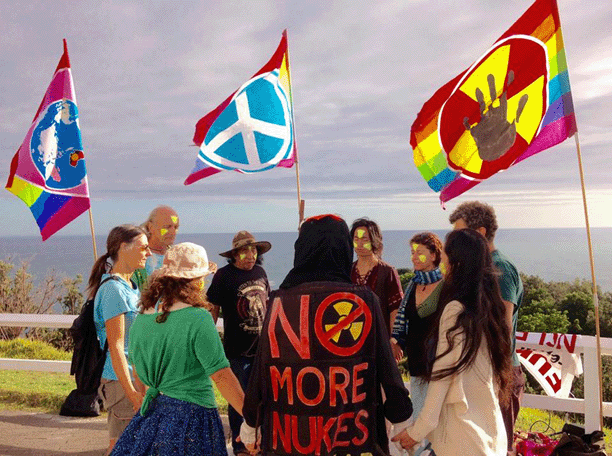
Benny Zable with Chibo Mertineit and 4 others . Sat 11 March 2017 Cape Byron Lighthouse, Byron Bay, Australia
Anti-nuclear activists gathered at Cape Byron Lighthouse today morning to mark the sixth anniversary of the tsunami that crippled the nuclear power reactors in Fukushima and to send a message of solidarity to the people of Japan.
Morning joggers and walkers were greeted by the sound of shakuhachi and Indonesian harp. The Pacific ocean rose in gentle swells; an osprey rode the updrafts.
Local activist Iris Nunn led the group in prayers for the children and families of Fukushima. Nimbin resident Chibo Mertineit spoke of the long peoples’ struggles to stop the spread of nuclear power that started in West Germany in the seventies and is now part of a global movement to draw attention to the perils of the nuclear age.
Activists unfurled a banner that said: Fukushima reminds us that nuclear power is a dead end.
With radioactivity still spilling into the oceans, land and air, activist called for urgent international assistance to resolve the crisis.
Artist and environmentalist Benny Zable said: “Say no to nuclear. Go Green!’ Pic: Harsha Prabhu
March 13, 2017
Posted by Christina Macpherson |
New South Wales, Opposition to nuclear |
Leave a comment
This summer saw record-breaking temperatures across New South Wales and most of eastern Australia. January 2017 recorded the highest monthly mean temperatures on record for Sydney.
The Bureau of Meteorology has confirmed the 2017 heatwave was the most severe since 1939, and since that time the frequency of such intense large-scale heatwaves has increased across spring, summer and autumn, and especially over the past 20 years. The maximum temperatures from the February 2017 heatwave now make up eight of the top 10 highest February temperatures for NSW ever.
What set this heatwave apart was the prolonged period of sweltering days and nights which impacted over one-third of the state. The people out at Moree suffered the most with 54 days in a row over 35 degrees. Walgett had 48 days above 35 degrees.
The heatwave contributed to almost 100 fires across NSW in February. Homes, stock and agricultural assets were lost.
NSW Health issued an air pollution alert and warning to those with asthma or respiratory problems on January 10, with ozone pollution made worse by the hot, still conditions. In Victoria, the heatwave was blamed for a large spike in deaths.
On the NSW South Coast, dairy farmers reported cattle dropping dead in the heat and humidity. Piles of dead turtle hatchlings were found on Queensland’s Mon Repos beach amid a heatwave which pushed the sand’s temperature to 75 degrees. This important breeding site for the Loggerhead turtle was turned into a baby turtle graveyard overnight.
Sydney Harbour suffered its first ever recorded coral bleaching last year and scientists predict more this year, with water temperatures exceeding 26 degrees at times.
Water temperatures have been more than 3 degrees warmer than average off parts of the NSW South Coast. It doesn’t sound like much when you’re enjoying mid 20s water on a 35 degree day, but marine life aren’t used to these spikes – these are signs that the ecological balance is at risk.
Of course, these heatwaves, fires, warming oceans and coral bleaching fit the predictions of climate change science about the impact of greenhouse gas emissions primarily by human activity.
New research released in February concluded that human activity was changing the climate 170 times faster than natural forces.
We are already seeing some key tipping points start to flip. In February, sea ice in Antarctica hit a record low. The melting permafrost in Siberia is causing craters to form on an ever-larger scale with the resulting methane release driving further global warming.
Before our very eyes the warnings of scientists are being realised. Climate change is not something off in the future – it is here and now – and given science has been right so far, their predictions about what happens next without action to drastically reduce emissions are truly frightening……..
The Greens, under Energy and Resources spokesperson Jeremy Buckingham have launched its ‘climate not coal’ policy. It sets out a 10-year framework for the phase out of thermal coal mining in NSW. This is a managed transition that calls for a 1 billion tonne cap on the amount of thermal coal that can be mined during the phase-out period while a supported exit of the industry occurs.
A $7 billion fund to assist impacted workers and communities would be created through the auctioning of permits to access the remaining coal allowance.
It is a bold plan but we need bold plans to respond to climate change. The Greens plan sits in stark contrast to no plan at all from the major parties in this state to deal with coal. https://newmatilda.com/2017/03/08/temps-rising-greens-plan-to-ban-coal-within-10-years-amid-record-heat-wave/
March 11, 2017
Posted by Christina Macpherson |
New South Wales, politics |
Leave a comment
 Climate scientists say likelihood of extreme summers surging due to global warming
Report’s authors say Sydney unprepared for knock-on effects of a significant increase in average summer temperatures, Guardian, Calla Wahlquist, 2 Mar 17, New South Wales, which has just experienced its hottest summer on record, is 50 times more likely to experience another similarly hot summer and 10 times more likely to experience extremely hot days under climate change, according to a group of Australian climate scientists.
The mean temperature in Sydney was 2.8C above average in December, January, and February, according to the Bureau of Meteorology, and the three-day heatwave from 9 February to 11 was the hottest on record from Sydney to Brisbane, breaking records set in 1939.
It us the kind of weather event that would have been considered a one in 500-year occurrence before 1910, before global warming had a significant impact on the climate system, but had now become a one in 50-year event, according to a new analysis released on Thursday.
“In the future, a summer as hot as this past summer in NSW is likely to happen roughly once every five years,” the report said.
It could make Sydney a less liveable city, one of the report’s authors, Dr Sarah Perkins-Kirkpatrick, said. Perkins-Kirkpatrick is a research fellow at the University of New South Wales’ Climate Change Research Centre and said Sydney was unprepared for the knock-on effects of a significant increase in average summer temperatures……..
Melbourne University’s Dr Andrew King, another author of the report, said that while Australia had experienced extremely hot days or extreme weather events in the past, the data showed the frequency and severity of those events had increased markedly in the past 20 years and would continue to increase unless drastic action was taken to reduce greenhouse gas emissions.
“Yes, people would have experienced 40C days several decades ago around different parts of Australia and in Sydney but we know that these incidences of very hot days are getting more frequent and we are setting more records for heat,” he said.
Australia broke 12 times more records for hot weather than cool weather between 2000 and 2014.
“The purpose of the analysis in this report is to raise awareness that climate change is already impacting on weather in Australia,” King said. “Hopefully it motivates action on climate change, because we know what the solution to climate change is.”https://www.theguardian.com/environment/2017/mar/02/climate-scientists-say-likelihood-of-extreme-summers-surging-due-to-global-warming
March 3, 2017
Posted by Christina Macpherson |
climate change - global warming, New South Wales |
Leave a comment
 Tim Bickmore , Fight to stop Nuclear Waste Dump in South Australia February 18 There is also another elephant in the room which is yet to rate a mention. At Lucas heights there are 2 reactors – OPAL & HIFAR. OPAL is the working reactor, whilst HIFAR is the old one now undergoing de-commissioning – which includes dealing with more radioactive waste. Is the HIFAR waste
  (= old reactor parts) also destined for the dump? Considering the decommission schedule, this seems highly probable & where else would it go……
“HIFAR is currently being decommissioned and will be totally decommissioned by 2018.” HTTPS://WWW.FACEBOOK.COM/GROUPS/344452605899556/
February 20, 2017
Posted by Christina Macpherson |
Federal nuclear waste dump, New South Wales, South Australia |
Leave a comment
 SA power woes to spread nation-wide, starting with Victoria, Australian Energy Council warns, ABC News 9 Feb 17 By Claire Campbell The Federal Government needs to take urgent action to improve its energy policies before the rest of Australia falls victim to the type of large-scale blackouts experienced in South Australia, the Australian Energy Council has warned.
About 90,000 South Australian homes and businesses were blacked out Wednesday when the Australian Energy Market Operator (AEMO) issued a load-shedding order to avoid potential damage to the network equipment due to supply deficiency.
It asked for more power generators to be switched on but did not receive “sufficient bids” and said it did not have enough time to turn on the second unit at Pelican Point. AEC chief executive officer Matthew Warren said there was no shortage of electrons and available power, but it was not dispatched when required.
He said the entire nation’s system needed upgrading quickly because energy reliability was not just a state issue…….
AEMO has warned that load-shedding is possible in New South Wales on Friday. http://www.abc.net.au/news/2017-02-09/sa-power-woes-to-spread-through-rest-of-australia-aec-warns/8257032
February 10, 2017
Posted by Christina Macpherson |
AUSTRALIA - NATIONAL, energy, New South Wales |
Leave a comment
As the Turnbull government struggles to implement a clear and effective climate change policy, the City of Sydney will redouble its efforts to reduce emissions in a bid to bypass the federal impasse.Lord mayor Clover Moore, who returned from C40 Mayors Summit in Mexico earlier this month, said the climate conference had alerted her to the scale and urgency of the action required by cities to address climate change. Cr Moore said she now believed the city needed to do “twice as much in half the time” and, at Monday night’s council meeting, called on the council to accelerate its existing targets and re-allocate funding if necessary.
“It was clear from the conference that we need bolder action at a faster rate if we are to play our part in meeting the Paris Agreement,” Cr Moore stated in her report from the summit, which was tabled at Monday night’s council meeting.
At the meeting, she called on council staff to come back to council in February “with actions to accelerate our emissions reductions over the next four years”.
Fast-tracking the city’s move towards zero-carbon buildings, including developing a clear target date by which building standards should be in place, were key priorities, she said. She also called on City of Sydney chief executive Monica Barone to bring forward the city’s Draft Environmental Action Plan to the council’s first meeting in 2017 with a clear list of priorities in line with the C40 Summit.
Cr Moore said research presented at the summit provided cities with clear targets which, if adopted, would deliver 40 per cent of the savings need to achieve the ambition of the Paris Agreement.
Cr Moore’s report and recommendations were adopted unanimously by council.
The focus of Monday night’s council meeting on climate change policy comes after the Turnbull government’s beleaguered week in the policy arena, which culminated in a fractious meeting with state premiers at Friday’s Council of Australian Government meeting.
The week was dominated by Coalition intransigence on climate change, even as a report by chief scientist Alan Finkel warned Australia had no clear path to meeting the 2030 emissions target taken to the Paris climate deal under existing policies.
This report was preceded by a policy capitulation by Environment Minister Josh Frydenberg, who promptly dumped plans for a review of the Coalition’s direct action policy to examine whether to introduce an emissions intensity scheme for the electricity industry – a form of carbon pricing – after vocal opposition from the Coalition backbench.
Fairfax Media then revealed the Turnbull government had been sitting on advice that an emissions intensity scheme would save households and businesses up to $15 billion in electricity bills over a decade. The Paris Agreement commits signatories, including Australia, to “hold average temperature increase to well below 2 degrees and pursue efforts to keep warming below 1.5 degrees above pre-industrial levels”.
December 16, 2016
Posted by Christina Macpherson |
climate change - global warming, New South Wales |
Leave a comment
Effectively this is the same draconian situation that existed under the earlier Commonwealth 
Radioactive Waste Management Act 2005 introduced by the Howard government to override State and Territory interests to protect community health, safety and welfare from the risks and impacts of nuclear wastes and to nullify Federal laws that protect against imposition of nuclear wastes.
 Public submission to the draft ARPANSA Information for Stakeholders & associated Regulatory Guide to Licensing a Radioactive Waste Storage or Disposal Facility
Summary
Revised ARPANSA “Information for Stakeholders” should address the following:
The nuclear fuel waste Store in the Flinders Ranges is intended to operate for approx. 100 years.
The ARPANSA “Information for Stakeholders” fails to be transparent and is not fit for purpose.
ARPANSA must inform the public on the proposed licence period for this nuclear fuel waste Store.
ARPANSA should also publicly acknowledge the Contingency that the proposed nuclear fuel waste Store may be at a different site to the proposed near surface Repository in the Flinders Ranges.
The proposed above ground Store in our iconic Flinders Ranges is unnecessary as the ANSTO’s existing Interim Waste Store (IWS) at the Lucas Heights Technology Centre can manage reprocessed nuclear fuel waste on contract from France and from the United Kingdom over the long term.
The ANSTO application for the Interim Waste Store was conservatively predicated on a 40 year operating life for the IWS, and ANSTO has a contingency to “extend it for a defined period of time”.
ANSTO also has a contingency option for the “Retention of the returned residues at ANSTO until the availability of a final disposal option” – which does not involve a Store in the Flinders Ranges.
The Lucas Heights Technology Centre is by far the best placed Institution and facility to responsibly manage Australia’s existing nuclear fuel waste and proposed waste accruals from the Opal reactor.
The Interim Waste Store (IWS) at the Lucas Heights Technology Centre can conservatively function throughout the proposed operating period of the Opal reactor without a requirement for an alternative above ground nuclear fuel waste Store at a NRWMF in the Flinders Ranges or elsewhere.
It is an inexplicably omission or an unacceptably act of denial for ARPANSA to fail to even identity or to properly explain Australia’s existing nuclear fuel wastes and proposed further decades of Opal reactor nuclear fuel waste production in the “Information for Stakeholders”.
Australia’s nuclear fuel wastes are by far the highest activity and most concentrated and hazardous nuclear wastes under Australian management, and must be distinguished from other waste forms. Continue reading →
December 12, 2016
Posted by Christina Macpherson |
AUSTRALIA - NATIONAL, Federal nuclear waste dump, New South Wales, reference, South Australia |
Leave a comment
 Windfarm in Barnaby Joyce’s NSW electorate gets $120m CEFC loan Clean Energy Finance Corporation loan comes three months after minister slammed SA’s over-reliance on wind power, Guardian, Gareth Hutchens, 12 Dec 16, The Clean Energy Finance Corporation has made a multi-million dollar loan for a new windfarm in Barnaby Joyce’s electorate.
December 11, 2016
Posted by Christina Macpherson |
AUSTRALIA - NATIONAL, New South Wales, politics, wind |
Leave a comment




 The Paris Agreement commits signatories, including Australia, to “hold average temperature increase to well below 2 degrees and pursue efforts to keep warming below 1.5 degrees above pre-industrial levels”.


 Antinuclear