Sydney students pioneer a shared solar and battery system for apartment block
Stucco students install one of Australia’s first shared solar and battery systems for apartment block, 702 ABC Sydney ,By Amanda Hoh, 8 Dec 16, After 18 months of “bureaucracy” and jumping through regulatory hoops, the students of Sydney’s Stucco apartments have finally achieved their goal of spearheading a “solar revolution”.
The social housing apartment block in Newtown has become one of the first multi-dwelling buildings in Australia to install a shared solar and battery storage system.
Last week 30 kilowatts of solar panels were placed on the roofs and 36 batteries set up in the building totalling 42.3kW storage capacity. The solar system will now provide 80 per cent of the residents’ energy needs, with the remainder of electricity drawn from the grid. Each student is expected to save up to $35 a month on their electricity bill. “As poor uni students, that difference in a bill makes a huge difference,” Sarah King, Stucco committee president, resident and social work student, said.
“There’s also the great feeling of using green clean energy as opposed to dirty coal.

“As a cooperative, it’s quite empowering to have your own locally sourced power system, otherwise you’re quite vulnerable to what electricity companies are going to charge you. Stucco is a cooperative, not-for-profit housing complex for low-income students from Sydney University. There are 40 residents in the eight units who each pay about $90 in weekly rent. As a cooperative, the students self-manage the property, which is part-owned by the university and the Department of Housing.
How do students pay for solar? A software system was put in place to manage and analyse the energy output from each unit, meaning the Stucco committee now acts as its own energy retailer and issues electricity bills to the residents. For the energy consumption that is provided by solar, the students are charged a maximum of 10 cents during off-peak times and up to 40 cents during peak use.
They are currently in pricing talks with various commercial energy retailers for when the building draws from the grid.
The cost of the project totalled $130,000, with the solar technology costing $97,000……..The students received an $80,000 grant from the City of Sydney.
The remainder of the cost was made up from 25 years’ worth of sinking funds and “grassroots community efforts” of voluntary contributions and pro-bono work……The solar and battery system is expected to take about six to seven years to pay for itself, although Mr Janse Van Rensburg said the long-term gain and savings far outweighed the cost of the system…..The students have started a crowdfunding campaignto help rebuild the administration and sinking funds.
Calls for more solar as household tariffs dumped There are 1.6 million solar systems installed across the country; mainly in free-standing owner-occupied homes and in lower to medium income suburbs.
According to Claire O’Rourke from community-based organisation Solar Citizens, Stucco is “a pioneering project”, particularly as it was conceived by a housing cooperative.
“We’ve had a lot of anecdotal reports from apartment owners who have tried to get this [a multi-apartment dwelling solar and battery system] in place but have failed,” Ms O’Rourke said……..
“The real opportunity is in cities where there are more apartments and renters…….
The Solar Bonus Scheme in New South Wales ends on December 31, which means solar households will no longer receive a feed-in tariff when they redirect energy back into the electricity network. Solar Citizens is lobbying the Government for a mandated minimum tariff to pay solar owners.”Going solar now is the best way to save for the long term, because solar panels will last 20 to 25 years, batteries will last for a decade,” Ms O’Rourke said.
“Landlords and renters everywhere should be inspired by this project [Stucco] and look at starting up similar projects that help them save money and spearhead that revolution we want to see.” http://www.abc.net.au/news/2016-12-08/stucco-student-housing-installs-shared-solar-battery-system/8103298
Mike Baird’s New South Wales government – more “creative accounting” on #climate change
Mike Baird is going rogue on climate change, The Age, Christine Milne , 3 Nov 16.In NSW the Baird government is set to give the green light to land clearing that will increase our greenhouse gas emissions just as the Paris Agreement to limit global warming to 2 degrees and pursue a more ambitious 1.5 degrees limit comes into effect on Thursday. Premier Baird is going rogue on climate.
As the world meets in Morocco for COP22, Australia will be under scrutiny as never before. Not only have we not ratified the Paris Agreement, we are increasingly being seen as cheating the process with rubbery figures. To meet the Paris Agreement objectives, negative emissions will be required. That is pulling CO2 from the atmosphere at the same time as reducing emissions from all sources. The Baird government is doing the opposite, increasing emissions from coal and coal seam gas at the same time as pushing up emissions from land clearing.
The rest of the world is sick of Australia’s creative accounting using land use, land use change and forestry, or LULUCF, as a “get out of jail free card” to “offset” its rising greenhouse gas emissions from industry. Australia has argued that while its emissions from coal-fired power stations, industries, cars and transport fleet vehicles and fugitive emissions from gas are rising, they are offset by our forests.
That is the basis of the Turnbull government’s Emission Reduction Fund. It has spent over $1 billion paying farmers not to clear or to regrow forests so polluters can keep on polluting. People think the fund must be invested in upgrading industry. Wrong, it has been overwhelmingly paid to farmers.
That is why the Baird government’s proposed changes are so bad. Not only will they destroy biodiversity and send species to extinction by destroying habitat, they will undermine efforts to meet our greenhouse gas reduction targets by cancelling out any reductions that may have been made through the ERF……….
In its reports to the United Nations Framework Convention on Climate Change, Australia said that from 2005- 2013 land use emissions dropped by 10 per cent but admitted that they will increase by 8 per cent from 2013 to 2020. As part of a peer review process, other countries can ask questions and they have leapt at the chance.
The US asked: “Can you explain what caused this reversal from downward trend to upward trend?” Australia has not yet answered but it is obvious that the Liberal governments of Newman, Baird and Malcolm Turnbull are to blame.
The European Union has noted:”Australia updates some details on ‘avoided clearing of native regrowth’, stating that projected increases in land clearing will be offset by low rates of native forest harvesting. Noting that tree-clearing controls were instrumental in Australia meeting its Kyoto commitment, have the emissions projections been adjusted to account for the updates?”…..
This cannot go on. The offsetting, lies and rubbery figures must stop. Carbon in the landscape must be increased, not decreased. The Baird government’s new land clearing laws must be stopped and if NSW won’t act the federal government should step in to make it happen.
Christine Milne is the former leader of the Australian Greens. http://www.theage.com.au/comment/mike-baird-is-going-rogue-on-climate-change-20161102-gsg4zr.html
New South Wales households lose feedin tariff benefits
Households face steep hike in power charges as solar subsidies end, The Age, 28 Oct 16 Brian Robins Tens of thousands of households are facing a surge in their electricity bills from the start of the new year as the NSW government’s subsidy for rooftop solar panels expires.
This could add more than $1600 to the annual electricity bill as the so-called ‘feed-in tariff’, the price received for surplus electricity sold into the electricity grid, is slashed by as much as 90 per cent in some cases.
Under the original government program, households which installed solar systems received as much as 60¢ a kilowatt hour for surplus electricity sold into the grid. This will fall to 6¢, or possibly less, depending on the deals done with your electricity retailer. The state government’s pricing regulator IPART, the Independent Pricing and Regulatory Tribunal, has recommended electricity companies pay 5.5-7.2¢ per kilowatt hour for electricity bought from households with solar systems…….http://www.theage.com.au/business/households-face-steep-hike-in-power-charges-as-solar-subsidies-end-20161028-gscu4s.html
New South Wales govt push for electricity interconnector with South Australia
NSW push for electricity interconnector with South Australia, SMH, Kirsty Needham , 2 Oct 16 The Baird government will push for a high-voltage interconnector to be built between NSW and South Australia following South Australia’s blackout, convinced the incident has highlighted the need for national energy security.
NSW Minister for Energy Anthony Roberts will attend an emergency meeting of COAG’s Energy Council on Friday, where the South Australian government is expected to seek to speed up a proposal to build the new interconnector between South Australia and the east coast.

The $500 million proposal would involve South Australia’s ElectraNet and NSW’s Transgrid constructing a 300-kilometre transmission route, potentially between Buronga in NSW and Robertson in South Australia, that could supply surplus electricity from NSW.
NSW can already exchange power with Queensland and Victoria.
The project must first be approved by the Australian Energy Regulator because the construction cost will ultimately be passed on to electricity consumers.
But the Baird government argues the interconnector would not only ensure the lights stay on but also boost the growth of the NSW renewable energy sector, particularly solar farms in regional NSW, which would be able to access South Australian customers…….
The NSW Greens energy spokesman Jeremy Buckingham said: “NSW should adopt a state-based renewable energy target, otherwise all the investment and jobs in the clean energy sector will be attracted to other states that do have state-based targets and NSW will miss out.
“Mike Baird can either dance with the coal-loving dinosaurs or he can embrace the booming clean energy future.”
ElectraNet is expected to lodge an application for approval for the interconnector project by the end of the year. An analysis by PWC for Transgrid has estimated the cost to NSW households at $8 a year. http://www.smh.com.au/nsw/nsw-push-for-electricity-interconnector-with-south-australia-20160930-grspxa.html
Community solar fund shares sold out in nine minutes!
 “Although this is only a particularly small project, what it is is it represents the first community solar lease product in Australia, it represents the first community solar cooperative fund and it represents the first crowdfunded equity community solar project,”
Community Solar Co-Op Shares Sells Out in Minutes https://probonoaustralia.com.au/news/2016/08/community-solar-co-op-shares-sells-minutes/ Renewable energy organisation Pingala sold out of shares in nine minutes for its first community solar fund. Pingala partnered with the environmentally-conscious Young Henrys brewery in Newtown, Sydney to build a solar farm on its roof, which will save an estimated 127 tonnes of greenhouse gas emissions a year.
The newly launched Pingala Cooperative, which sits alongside the Pingala Not for Profit, allows the organisation to raise funds from member investors to install solar panels on its partner businesses.
“We then lease the solar to the business, so they pay us a fee to be able to use the equipment as though it were their own, and through that we get a revenue stream that allows us to pay our costs and generate a small profit,” Pingala secretary Tom Nockolds told Pro Bono Australia News.
“So we’re offering our investors between 5 and 8 per cent… return on investment. But they’re investing in Pingala on an ongoing basis, so there’s no predetermined timeline for when investors get their money back, it’s totally up to the investors themselves to decide when they want to sell their shares, it’s much like buying shares in a company. Continue reading
Safety concerns about Lucas Heights Nuclear Wastes repatriated from France
 Fight To Stop Nuclear Waste In The Flinders Ranges Paul Levai https://www.facebook.com/groups/941313402573199/ 16 Aug
 16
16
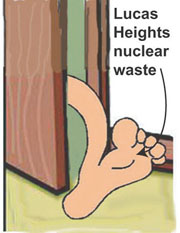
Paul Levai Interesting trip to ANSTO. A few concerns that I will post as some stage soon but the main one is that the intermediate waste that they propose to store here is our spent fuel rod waste from the old Lucas Heights HIFAR reactor that has been sent to France for reprocessing and must be returned to us as intermediate waste.
BUT the scary part is that rather than design and build a new container system for the ILW ( that would be easily identifiable) they decided to use an existing design container for HLW (high level waste) because its cheaper and easier and they think it will alleviate safety concerns (better and stronger).
Australia completes first phase of its waste repatriation project ANSTO :The The shipment of repatriated waste left France on 15 October, arrived in Port Kembla on 5 December, and was safely transported to the interim storage facility at Lucas Heights the following day (6 December, 2015).
Cutback in solar payments: smart meters might help
From solar boom to bill shock: Australians face loss of rooftop payments
About 275,000 people across the country will have their solar energy payments reduced by up to 80% over the next six months, Guardian, Michael Slezak 31 July 16 “……. more than 275,000 people across Australia who will see the subsidised payments they receive for their solar energy disappear over the next six months, replaced with rates up to 80% lower.
The solar boom in Australia, which has led to 1.5m households generating their own electricity from the sun, was accelerated by subsidised payments for people who sell solar-generated electricity back to the grid.
In some cases, like Shaw’s, solar customers were able to receive more than twice the money for the electricity they put in the grid, compared with what they paid for electricity they took out of it.
But for a lot of homes and businesses, those schemes are coming to an end over the next six months and, if they’re not prepared, they will be heading towards some serious bill shock.
Customers in New South Wales, who got the most generous rate, will be in for the biggest hit and will need to do the most to adapt to the changes…….
While about 150,000 homes and business will be kicked off these schemes in NSW on 1 January 2017, the party is ending for about 130,000 customers inVictoria and South Australia too.
(Others are on schemes that will continue for years to come. So if people are confused about their own feed-in tariffs, they should ask their retailer what’s happening with them.)…….
Smart meters
The issue of what kind of meter to get is a minefield right now, with different issues affecting consumers depending on where they are, and options are changing rapidly.
One thing that can help anyone make the most of their solar electricity is a smart meter, says Claire O’Rourke, national director of Solar Citizens, a group that lobbies on behalf of solar customers.
A smart meter can be read remotely, and can tell when the most power is being drawn, helping maximise the benefits. They can also open up services such as time-of-use tariffs, providing savings for people who avoid using energy during periods of high demand.
“You’re probably better off with a smart meter but they do have an increased cost,” says O’Rourke.
Some retailers are offering discounts for smart meters in return for fixed-term contracts. “It is really in the interest of consumers to shop around,” she says.
For many people right now a smart meter could be overkill. The smart meter will either be paid upfront, or in the case of free meters offered by retailers, will be paid for through increased tariffs, says Moyse. Whether the meter will allow consumers to recoup that cost is unclear.
For people outside NSW, the lowest-cost option is to keep their current meter, at least until it’s clear a smart meter is worth it. Outside NSW, the current meter will work fine on the new deals.
Unfortunately, for most people on the NSW solar bonus scheme, their meters will need to be replaced……..
the loss of generous feed-in tariffs is driving interest in battery storage, says Chris Cooper, chief executive of Suncrowd, a company using group purchasing power to get cheaper prices for batteries.
“It’s a bit of a trigger point for people to look at new technology,” Cooper says. So far Suncrowd has run its first round in Newcastle, and had about 200 homes join together and buy batteries at discount rates.
He says lots of the customers who have been approaching Suncrowd have been people coming off the NSW solar bonus scheme. Having a battery added to an existing solar system can significantly increase “solar self-sufficiency”, Cooper says, a measure of how much the customer relies on solar rather than electricity from the grid. “With an appropriately sized battery you can boost it from 20% to about 60 or 70% self-sufficiency,” he says. Cooper says Suncrowd is building an online tool to help people calculate their solar self-sufficiency and have been showing it to people at events they’ve been holding. “People are really motivated by seeing the numbers go up,” he says…….https://www.theguardian.com/environment/2016/jul/31/australia-residents-solar-rooftop-lose-payments
Tough new guidelines for New South Wales wind farms
 Tilting against windmills? Industry doubts NSW support for wind farms, SMH, Peter Hannam, 28 July 16 New wind farm guidelines are expected to impose tough requirements on developers to limit their visual impact in a move that proponents say will put NSW at a disadvantage to other states.
The proposed guidelines, requiring developers to prepare visual impact assessments according to the height of turbines, were disclosed by the planning department to a select group of prospective wind energy developers on the sidelines of a two-day clean energy summit in Sydney on Thursday. Continue reading
Victoria is beating New South Wales in the renewable energy race
 Climate change: how Victoria trumped New South Wales in the great renewable energy race
Wind and solar energy projects are set to be the big winners of the state’s ambitious renewable energy targets, Guardian, Giles Parkinson 6 July 16
Victoria’s ambitious renewable energy targets will see a doubling of the state’s wind energy capacity.
Two years ago Rob Stokes, the then environment minister for New South Wales, promised that his state could become Australia’s answer to California in the clean energy industry.
“We are making NSW No 1 in energy and environmental policy,” Stokes, a Liberal,told the Clean Energy Week gathering in Sydney in July 2014.“When it comes to clean energy, we can be Australia’s answer to California.”
It was a bold vision, and a laudable one, but it didn’t turn out that way.
Investment in large-scale renewable energy, apart from some federally funded large-scale solar projects, has all but dried up. In May, a report by the Climate Council rated NSW as the “worst place” for renewable energy investment in Australia.
It’s ironic because NSW has the biggest pipeline of undeveloped renewable energy projects in the country. But now other states are seeking to grab a bigger share of the renewable energy pie, particularly as traditional industries of car manufacturing and steel-making face an uncertain future.
Last month Victoria became the latest Labor government to announce renewable energy targets over and above the federal target, announcing it would aim to have 25% of its electricity served by renewable energy by 2020, and 40% by 2025.
That compares with a national target that translates to about a 23% by 2020, and the Australian Capital Territory’s 100% target by 2020, Queensland’s 50% target by 2030 and South Australia’s 50% target by 2025, a percentage it is likely to reach later this year.
ut Victoria’s target appears the most ambitious of the lot, simply for the sheer number of new wind and solar farms that will be needed to meet the target. And it also intends to have legislation in place from next year that will ensure the target is met.
The 40% by 2025 target translates into some 5,400MW of new renewable energy capacity to be installed within the next 10 years. That will be almost exclusively wind and solar farms and is three times as much renewable energy capacity as the state has installed up till now and nearly equal to the national target for 2020.
“This is an ambitious target but a very achievable target,” says the Victorian energy minister, Lily D’Ambrosio. She intends to adopt the system of “reverse auctions” pioneered successfully by the ACT, which will have some 600MW of large scale renewables in place by 2020 to meet its own 100% target.
Already, under a previously announced tender designed to support wind projects, the Victorian government has signed contracts that will help two windfarms be built over the next year – a 13-turbine windfarm at Kiata near Horsham and a 44-turbine windfarm at Mount Gellibrand near Colac………https://www.theguardian.com/sustainable-business/2016/jul/06/climate-change-how-victoria-trumped-new-south-wales-in-the-great-renewable-energy-race
New South Wales leading the nation with large scale solar farms
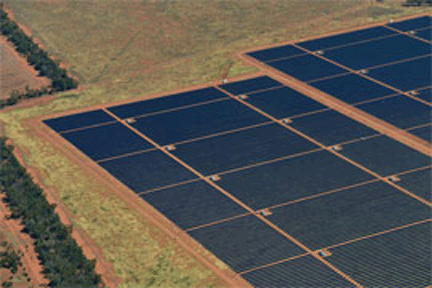 NSW to double existing solar farm capacity with four new plants approved, SMH, Peter Hannam ENVIRONMENT EDITOR, THE SYDNEY MORNING HERALD 23 JUNE 16 The Baird government has granted planning approval for four new large-scale solar plants, potentially more than doubling the existing capacity in the state.
The four plants approved for construction have a combined capacity of 175 megawatts (MW), and would generate another electricity for 56,000 homes if built. “NSW is Australia’s large-scale solar leader, with the country’s three largest solar farms and hundreds of megawatts of solar electricity capacity online and in the pipeline,” planning minister Rob Stokes said. Continue reading
Ever-growing boom in rooftop solar energy in New South Wales
 Solar usage through the roof in South West https://au.news.yahoo.com/thewest/wa/a/31844405/solar-usage-through-the-roof-in-sw/ Daniel Mercer – The West Australian on June 16, 2016,
In its first snapshot of the South West electricity market since getting responsibility for it last year, the Australian Energy Market Operator will today report that the number of solar panels had trebled in six years.
AEMO said there were 180,000 customers with solar panels across the network from Kalbarri to Kalgoorlie and south to Albany, compared with 165,000 a year ago and just 60,000 in 2011.
Though the latest figure represents more than 18 per cent of State-owned power provider Synergy’s entire customer base, the percentage of households with solar cells is even bigger.
AEMO says 22.5 per cent of South West network households have a system, making WA third for solar panels behind Queensland and South Australia.
The Melbourne-based body also found households and businesses were using bigger systems with the average size of new installations doubling over five years to 4.5kW.
AEMO said the growth rate in solar panel installations in WA was unlikely to slow as prices fell, electricity tariffs rose and subsidies continued. It said the amount of electricity solar panels generated would almost treble between 2016-17 and 2025-26.
One consequence would be flatter demand from the grid as more people generated electricity. With battery storage developing rapidly, the shift from grid power could accelerate with cost implications for customers unable or unwilling to use solar.
New South Wales lags behind in renewable energy use
NSW last in class on Climate Council report card for renewable energy use
South Australia and the Australian Capital Territory take the green podium for their efforts and policies pushing renewable energy targets, Guardian, Michael Slezak, 26 May 16. New South Wales is the worst Australian state at driving renewable energy, and South Australia and the ACT lead the pack, a report produced by the Climate Council has found.
The results came just weeks after South Australia closed its last coal power station, and the ACT announced a target to source 100% of its energy from renewable sources by 2020.
The report examined state and territory percentages of renewable electricity, the amount of large-scale renewable capacity per capita and the policy settings driving renewables.
NSW was bottom of the class in every category except rooftop solar. But it beat only Tasmania, which receives less solar radiation than any state or territory.
The territories had no comparable data for the percentage of their electricity that came from renewables, so they were scored separately. But the ACT was singled out as a leader for its 100% renewable energy target, which it will achieve using reverse auctions for large-scale renewable energy.
In the middle of the pack were Queensland, Western Australia and Victoria, although Queensland recently overtook South Australia with rooftop solar, now at 29.6% of households.
NSW and Victoria were the only states to have decreased the percentage of their electricity sourced from renewables. Between 2013 and 2014, NSW’s share of renewable energy dropped from 7% to 6% and Victoria’s from 12% to 10%. The Northern Territory was highlighted as lagging, along with NSW, with no specific renewable energy targets or policies and a low uptake of rooftop solar……http://www.theguardian.com/environment/2016/may/25/nsw-last-in-class-on-climate-council-report-card-for-renewable-energy-use
University of New South Wales team sets new world record for converting sunlight to electricity
 New world record set for converting sunlight to electricity http://www.gizmag.com/solar-cell-electricity-efficiency-world-record-unsw/43384/ Eric Mack May 17, 2016 An Australian team has set a new record for squeezing as much electricity as possible out of direct, unfocused sunlight via a new solar cell configuration. Engineers at the University of New South Wales (UNSW) achieved 34.5 percent sunlight-to-electricity conversion efficiency, a new mark that also comes closer than ever to the theoretical limits of such a system.
UNSW’s Dr. Mark Keevers and Professor Martin Green set the record with a 28 centimeter-square (4.3 sq in), four-junction mini-module embedded in a prism. This new configuration allows the sun’s rays to be split into four bands so that a higher amount of energy can be extracted from each beam.
The same team reached an even higher level of efficiency a few years back using mirrored concentrators that were able to convert 40 percent of incoming sunlight to electricity. However, this new record is the highest level achieved without the use of concentrators.
“What’s remarkable is that this level of efficiency had not been expected for many years,” said Green, citing a German study that set a goal of 35 percent efficiency to be reached by 2050.
The team does not expect that its record-breaking cell configuration will find its way on to home or office rooftops anytime soon, as they are more costly to manufacture. The group is working to reduce the complexity to make them cheaper to produce and sees a future for them on solar towers that make use of concentrating mirrors.
Meanwhile, efficiency gains are also being made in the development of organic solar cells that are cheaper and more flexible. There’s still a long way to go though, as the most recent record for organic photovoltaics set in February was 13.2 percent efficiency. Source: University of New South Wales
Environment groups slam NSW government attempts to generate interest in uranium trade.
 The future is renewable, not radioactive: Environment groups slam NSW government attempts to generate interest in uranium trade.
Environment groups have slammed attempts by the NSW government to talk up the potential for uranium exploration as well as coal seam gas to international investors.
The Sydney Morning Herald reported yesterday that at a conference held in Toronto in March, Department of NSW Trade and Investment spruiked NSW as a ‘greenfields’ opportunity for uranium, citing areas in the central west around Broken Hill and the New England region as possible hotspots.
Beyond Nuclear Initiative coordinator Natalie Wasley said “Minister Roberts is going head first down a radioactive rabbit hole. The uranium industry is outdated and unsafe and it is flat lining economically.”
“When the uranium exploration moratorium was overturned in 2012, environment groups were joined by trade unions and medical organisations, as well as the state ALP and Greens parties to launch the NSW Uranium Free Charter. There has historically been strong opposition to uranium exploration and mining in NSW and this has not waned over time.”
“Attempts to open a uranium mining industry here will be challenged head on.”
Kerry Laws from Uranium Free NSW added: “NSW has the potential to be a leader in renewables, but the government is instead trying to drag the state back into the dirty dark ages of the uranium trade.”
“Minister Roberts and Premier Baird could give some substance to Turnbull’s innovation bandwagon, by exploring and mapping out renewable options, rather than resorting to an industry that both damages our land and creates by-products that remain toxic for 100,000 years.”
“The future is in regional, renewable industries.”
Axe over controversial Shenhua coal mine in New England
China’s fossil fuel transformation places axe over controversial Shenhua coal mine in New England, The Age, March 29, 2016 Heath Aston Political reporter China Shenhua, which owns the contentious Shenhua-Watermark project on the NSW Liverpool Plains, has warned of plunging demand for fossil fuels and slashed its global budget for investing in new coal projects.
The company has surprised analysts with the depth of its pessimism on the coal market in its annual report released on Good Friday.
The proposed mine at Gunnedah is now almost certainly “commercially unviable”, according to Tim Buckley, Australasian director of the Institute of Energy Economics and Financial Analysis and it is only a question of whether the Chinese government proceeds to development in an attempt to “save face”, he said.
“I have no doubt the project doesn’t make any commercial sense unless the coal price doubles,” he said.
There is gathering speculation the Turnbull government is working on a political solution whereby the Baird Government would return Shenhua’s original $300 million exploration licence and allow the company to retreat with dignity……
NSW Greens’ mining and agriculture spokesperson Jeremy Buckingham said Mr Joyce should negotiate a “swift and fair exit” for Shenhua.
“Even the world’s biggest coal miner has recognised that there is no need for new coal and it’s up to Barnaby Joyce to create certainty for the farmers of the Liverpool Plains by negotiating an exit for Shenhua,” he said.
“It’s unacceptable for this coal mine proposal to hang over the Liverpool Plains, causing uncertainty and stress, and hindering investment in agriculture.” http://www.theage.com.au/federal-politics/political-news/chinas-fossil-fuel-transformation-places-axe-over-controversial-shenhua-coal-mine-in-new-england-20160329-gnt98y.html
The politically toxic proposed coal mine at the centre of the election battle between Deputy Prime Minister Barnaby Joyce and Tony Windsor appears doomed after its Chinese owner outlined an accelerated transformation plan away from mining into cleaner electricity generation.
1 This month
7 April – WEBINAR – Australia and the Doomsday Clock – Preventing nuclear war through NoFirstUse and other policies
Online | Tuesday April 7, 4:00-5:30pm, Australian Eastern Time / 8:00-9:30am Central Europe Time
– Access the registration link
15 April – Zoom –Nuclear Power is Not the Solution
Apr 15, 2026 01:00 AM in Canberra, Melbourne, Sydney

Join the International Physicians for the Prevention of Nuclear War (IPPNW) on Tuesday, April 14th for a timely webinar exploring the risks associated with nuclear power and challenging the myth that it offers a simple, safe, carbon-free solution to the climate crisis

of the week – Australians for War Powers Reform (AWPR)
To see nuclear-related stories in greater depth and intensity
 Antinuclear