Senate tables over 6,000 signatures against Hill End nuclear waste dump
 18 Mar 16 NSW Greens Senator Lee Rhiannon today tabled 6,282 signatures calling on the government to drop plans for a nuclear waste dump at Hill End. “Over 6,000 people have signed three petitions saying no to a nuclear waste dump at Hill End,” Senator Rhiannon said.
“The Hill End community has voted at three separate community meetings to unanimously oppose a nuclear waste dump and are strongly supported by their neighbouring towns, local councils and business groups.
“The Minister and the Department keep repeating that the nuclear waste dump won’t be imposed on communities that don’t want it.
“Yet the government has spent hundreds of thousands of dollars of public money sending glossy packages promoting the dump to residents in Bathurst and Mudgee, after promising the Hill End community meetings that they had heard the message it wasn’t wanted.
“They’re now following up their promotional package blitz with survey phone calls and face to face visits to Hill End , Bathurst and Mudgee residents fishing for support. “It’s time the Government acknowledges that no one wants nuclear waste at Hill End,” Senator Rhiannon said.
New South Wales Parliament passes anti-protest laws
 Anti-protest laws giving police greater powers pass NSW parliament http://www.theguardian.com/australia-news/2016/mar/16/anti-protest-laws-giving-police-greater-powers-pass-nsw-parliament
Anti-coal seam gas protesters could be jailed for seven years under laws described as a ‘crackdown on democratic rights’ Trespassing anti-coal seam gas advocates face heavier fines and greater jail sentences with tough new anti-protest laws passing through NSW parliament.
With the support of the Shooters and Fishers party and Christian Democrat Fred Nile, the controversial legislation was passed 20-16 in the upper house on Wednesday after minor amendments to the original proposal.
The bill gives police greater powers to search without a warrant, seize items and move protesters on, while fines for illegal entry to mining and CSG sites have increased tenfold from $550 to $5500.
Anti-CSG protesters who interfere with gas sites – including those who chain themselves to machinery – will also be exposed to a maximum jail sentence of seven years.
The Greens MP Jeremy Buckingham, who along with Labor voted against the legislation, condemned the changes as a “jackboot police crackdown on democratic rights”.
The Labor MP Adam Searle also spoke out against the bill’s “sinister” provisions.
“This legislation strikes at the heart of a fundamental aspect of our society – the right to peacefully protest,” he told parliament during hours of fierce debate.
But the premier, Mike Baird, defended the legislation, saying he didn’t believe it was too harsh.
“It’s quite simple, peaceful protests are fine,” Baird said. “Anyone that wants to disrupt a business or ultimately act illegally and puts the lives of themselves and others at risk, well we’ve put these measures in and I think it’s appropriate.”
About 500 protesters shut down a part of Sydney’s CBD to rally against the proposed changes on Tuesday.
A Reachtel poll commissioned by the NSW Nature Conservation Council this week also showed 61.4% of people opposed increasing police powers and fines for protest action.
The NSW Law Society said lawyers were concerned the legislation could seriously interfere with people’s human rights liberties.
Meanwhile, the NSW Unions movement says it’s considering launching a high court challenge against the laws.
Draconian anti-protest laws for New South Wales?
The proposed protest laws would give police new powers to break up protests, to search and destroy private property. If police say just one person obstructs traffic, they can shut down an entire peaceful assembly.
This is a slippery slope that gives police discretion to silence dissent and could turn NSW into a police state. Far from being a moderate, Baird is taking NSW down the sad road of Joh Bjelke-Petersen’s Queensland.
The laws will allow police to arrest anyone carrying or operating anything the police think will be used in a protest. Police would be able to arrest you and confiscate and destroy your car, for example, if they think it will be used to disrupt business in a protest. What has happened to the presumption of innocence?
Protesters could be fined more for opposing illegal mining activity than miners could for operating illegally.
Mike Baird’s anti-protest laws risk turning NSW into Bjelke-Petersen’s Queensland http://www.canberratimes.com.au/comment/mike-bairds-anti-protest-laws-risk-turning-nsw-into-bjelke-petersens-queensland-20160315-gnj4to.html March 15 2016 Naomi Hodgson
*Poll: More than 60 per cent of voters opposed Mining protesters could face seven years’ jail
*Freedom of speech and freedom of association are cornerstones of democracy. Continue reading
Community struggle against government plans for nuclear waste dump
The Government should scrap these sites, admit they got it wrong, and then apologise to the people this has affected. They should then start a responsible and correct process to decide what to do with the waste- not just pushing it on regional and rural communities with promises of financial gain. They need to find out a way to stop making more nuclear waste and research what we can do or use instead.
We’re under a nuclear cloud but we’re not backing down, Beyond Nuclear March 11,  2016/ By Robyn Rayner. Farmers contend regularly with fire, flood and drought, but fine wool producer Robyn Rayner never expected to be fighting off plans for a radioactive waste dump across the road from her property
How would you feel if you woke up one morning and was told via a media report that you could be living next door to a nuclear waste dump?
On November 13 last year the Federal Government announced a shortlist of six sites, from twenty eight volunteered properties around Australia, for a proposed national radioactive waste dump. A property at Hill End was named. Since then our lives have been turned upside down. My husband Geoff and I, along with our family, own and run Pomanara Merino Stud directly across the road from the proposed site. It is just 1.5km from our family home. We are second-generation woolgrowers and our son James would like to be the third. This may not be important to Government Departments, but it is to us. This nuclear waste will also be around for generations to come, wherever they put it.
We have worked long and hard to achieve the clean, green and sustainable label that we have today. Our region is renown for growing the best superfine wool in the world and we have won many major awards for the sheep we breed. At no time did the landowner who nominated his property consult with neighbours, nor did he take into consideration the environment or the village of Hill End, located nine kilometres away. Hill End is a historic precinct that host 5000 school children a year and over 100 000 other visitors. The nominated property backs onto the Turon River, a major waterway for the food bowl of Australia. Continue reading
Sallys Flat: How “ordinary people” are fighting back against nuclear waste dumping
 Nuclear dump site journey continues “http://www.westernadvocate.com.au/story/3777432/finish-lines-in-sight-for-hill-end-eco-warriors/
By LOUISE EDDY March 9, 2016, The past three months have seen three unlikely environmental advocates embark on a journey that has taken them all the way to Canberra and the halls of power.
The myth that a nuclear reactor is needed for medical uses
A very comprehensive 2010 OECD Nuclear Energy Agency report found reactor based isotope production requires significant taxpayer subsidies, as the cost of sale does not cover the cost of production.
The report concludes: “In many cases the full impact of Mo-99/Tc-99m provision was not transparent to or appreciated by governments… The full costs of waste management, reactor operations, fuel consumption, etc were not included in the price structure. This is a subsidisation by one country’s taxpayers of another country’s health care system. Many governments have indicated that they are no longer willing to provide such subsidisation.”
What is needed urgently is a debate about how much waste we make. We have a choice: whether we follow ANSTO’s expensive business model to ramp up reactor manufacture (and the long-lived radioactive waste that goes with it), or collaborate with Canada to develop cyclotron manufacture of isotopes that does not produce long-lived nuclear waste.
Debunking the myths around medicine and a nuclear waste dump
The Federal government is seeking a location for a nuclear waste facility. But the provision of information to communities has been problematic, with some major flaws.
Claims have been made that provision of nuclear medicine services is a key reason to build it, but existing medical waste makes up a very small proportion of the total waste requiring disposal.
In addition, little has been said about ANSTO’s business plan to greatly ramp up Australia’s reactor based production of isotopes from 1 per cent to over 25 per cent of the world’s market, which will massively increase the amount of long-lived radioactive waste produced in the future.
A new process may reduce the volume of the waste, but the actual quantity of radioactive material to store will be significantly greater, and will become most of the radioactive waste Australia produces.
In Australia nuclear medicine isotopes are indeed useful, but according to Medicare figures represent less than 3 per cent of medical imaging. They are most commonly used for bone scans and some specialised heart scans. They are not needed (as claimed by government) for normal X-rays, most heart scans and the vast majority of cancer treatments (surgery, chemotherapy and radiotherapy). Continue reading
Solar energy to the grid: New South Wales’ Moree solar farm in operation
 Moree solar farm starts feeding energy into grid http://www.abc.net.au/news/2016-02-29/moree-solar-farm-starts-feeding-the-grid/7207942 ABC New England By Kelly Fuller The largest single-axis tracking solar farm in the country is now feeding energy back into the grid from Moree in New South Wales.

The solar farm is led by Fotowatio Renewable Ventures (FRV) and has been funded with assistance of a $102 million grant from Australian Renewable Energy Agency and $47 million in debt financing from the Clean Energy Finance Corporation.
At full capacity the project is expected to generate 140,000 megawatt hours per annum, or the equivalent energy to supply the needs of 15,000 homes.
The company’s country manager Cameron Gamsworthy said feeding energy back into the grid was a significant step in the project’s development.
“It’s absolutely a major milestone. We’re now generating clean, renewable energy for the country,” he said. “[We are] looking forward to getting the project fully commissioned over the course of the next month.”
The farm’s 222,000 panels are expected to have a life of 30 years, and the company hopes the project will be at full capacity in a month’s time.
Mr Gamsworthy said FRV was considering other projects in the region.
Farm solar is the future
While the Moree project is unique, a University of New England academic said there was a growing demand for solar energy, particularly among rural communities.
“Farmers are getting more and more hungry for mobile technology that can be distributed around the farm,” said Professor David Lamb, from the university’s Smart Farm. “It could be a little water bore pump or some sort of gate alarm system or a trough monitor,” he said. “All of these technologies are going to need solar themselves because we obviously don’t want powerlines running around farms.
“I wouldn’t be surprised if there are literally thousands of little solar panels balancing on the back seat of old tractors that are used to keep the battery alive while it is left out in the weather for the next start.”At the end of the day the solar panel is becoming the set of pliers on a farm — you see them everywhere you look.”
Professor Lamb said the university was putting up ‘smart trees’ around the Smart Farm. “We literally have little sensors in the trees showing the amount of water these guys suck out of the ground, and each and every one of these trees has their own solar panel,” he said.
“[It] is quite ironic when you consider that trees are one of the most efficient harvesters of solar energy that we know.”
AGL proceeding with Silverton wind farm project in far west NSW
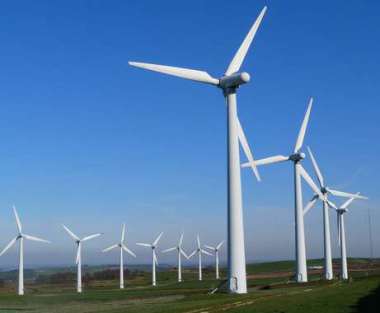 AGL vows to go ahead with Silverton wind farm project in far west NSW ABC Broken Hill
By Declan Gooch 27 Feb 16 Energy company AGL has reaffirmed its commitment to the Silverton wind farm project in far west New South Wales, and says studies of the site will get under way within weeks.
The proposed site along the Barrier Ranges just outside the Silverton township was first proposed in 2007 by Epuron, but stalled after AGL took over in 2012. AGL blamed uncertainty about the federal government’s Renewable Energy Target for the pause, with development approval set to run out in May.
The company announced at a community meeting on Thursday night it applied that day to have another five years added to the approval, and announced a new project manager, Adam Mackett.”We’re already doing work through the hydrogeological study where we’re committed to this project, so we’re showing that,” Mr Mackett said. “It is a half-a-billion-dollar project so before we then fully commit to constructing it we need to do a bit of work.”
Mr Mackett is no stranger to the state’s far west, having managed the construction of the Broken Hill solar farm around 25 minutes away. He also oversaw the construction of South Australia’s Hallett wind farm.
“We’re confident of having [the Silverton project] extended, we think the Silverton wind farm is a fantastic opportunity.”
AGL hopes the wind farm will generate enough power to supply around 120,000 average homes.
Funding will be contributed from AGL’s newly-announced Powering Australian Renewables Fund, which will be seeded partly by the Broken Hill solar farm……… AGL said it hopes its Powering Australian Renewables fund will be set up by the middle of the year, and that the extension to the project’s approval will be signed off in the next three months. http://www.abc.net.au/news/2016-02-26/agl-vows-to-go-ahead-with-silverton-wind-farm-project/7202338
New South Wales Riverina could become a solar energy hub
 Solar company sees potential for NSW Riverina to become renewable energy hub ABC Riverina, 16 Feb 16, A solar energy company believes the western New South Wales city of Griffith has the potential to market itself as a renewable energy hub. http://www.abc.net.au/news/2016-02-16/solar-company-envisages-nsw-riverina-energy-hub/7170684
Riverina Solar wants to build a $62 million, 30 megawatt solar farm at Yoogali near Griffith. The project has been shortlisted for funding from the Australian Renewable Energy Agency.
Director Steve McCall is hopeful a second solar farm project, also shortlisted for funding, will receive backing. He said it could be the start of a new industry for the region.
“We’ve been talking with Griffith council as well. We believe there’s a great opportunity for Griffith to become a renewable energy hub, or a region where you’ve got large scale solar here,” he said.
“That would hopefully potentially attract universities coming in and doing studies. “We’re also looking at other options, potentially in the future of how solar or how other renewable energies could be attracted to the area.”
Information sessions about the Riverina Solar proposal will be held at the Griffith Regional Theatre on Tuesday and Thursday.
Mr McCall said he would like to have the project’s environmental impact statement completed by the end of the month, and is hopeful the solar farm may be approved by mid-year.
“Griffith has an excellent substation based at Yoogali and it has just recently been upgraded over the last few years, so it has sufficient capacity to be able to connect into that site without a great deal of further upgrade,” he said. Mr McCall said the project would not be affected by the grants process. “We’ve got a number of different, interested offtakers and so once we establish that and finalise that aspect of it, that completes the commercial aspect of the project,” he said.
“While the funding would be terrific, and it’s only a small portion of the project, it doesn’t look like it would jeopardise our project going forward in any sense.”
Strong opposition to Hill End nuclear waste plan- petition
 Petition calls to halt Hill End waste plans By ELLE WATSON , The Weekly, Mudgee, NSW, 10 Feb 16 Campaigners against a proposed nuclear waste dump at Hill End have taken to the streets of Mudgee to gather support for a petition to be presented to parliament later this month.
Calm heads and clear information needed on nuclear medicine and waste claims
Parliamentary Committee Inquiry into Lucas Heights Nuclear Waste Management Facilities
| Upgrade and extension of radioactive waste management facilities at Lucas Heights House of Representatives, Parliament of Australia, 5 Feb 16 |
 The Parliamentary Standing Committee on Public Works today announced that it is conducting an inquiry into the upgrade and extension of radioactive waste management facilities for the Australian Nuclear Science and Technology Organisation (ANSTO). The Parliamentary Standing Committee on Public Works today announced that it is conducting an inquiry into the upgrade and extension of radioactive waste management facilities for the Australian Nuclear Science and Technology Organisation (ANSTO).
ANSTO’s submission notes that current storage facilities will reach full capacity early in 2017 and although locations for a new facility are being considered, the new facility is not expected to be operational until 2020. The inquiry will examine existing low and intermediate-level solid waste facilities at Lucas Heights that require extension and upgrade, with extension works for the low-level solid waste facilities expected to be completed by April 2017, and works for the intermediate-level facilities to be completed by June 2018. In addition to upgrading and extending storage capacity, works will include upgrading ventilation and security systems, electrical infrastructure and surrounding roads.The estimated cost of the project is $22.3 million and it is anticipated that the Committee will conduct public and in-camera hearings for the inquiry in the near future. Further information on the public hearing will be available soon on theCommittee’s website. Submissions to the inquiry close on 10 March 2016. NB the Parliamentary Standing Committee on Public Works is neither involved in the tendering process nor the awarding of contracts. Enquiries on those matters should be addressed to ANSTO. For media comment – Office of Senator Dean Smith (Chair of the Parliamentary Standing Committee on Public Works) (08) 9481 0349 Committee Secretariat (02) 6277 4636Full details on the project are available on the Committee’s website.
|
Community opposition stops nuclear waste dump: U-turn by MP John Cobb on nuclear policy
Hill End nuclear waste dump ruled out due to community opposition, ABC News 29 Jan 16 By Nick Dole
A nuclear waste facility will not be built at Hill End in central-west New South Wales because community opposition to the proposal is so strong, the Federal Government has said.
The site at Hill End, north of Bathurst, was one of six being considered for a nuclear waste facility.
It was offered up by a local landowner, who could be paid four times the land’s market value.
At a packed public meeting on Saturday, dozens of residents spoke against the concept, telling representatives from the Federal Government that Hill End was a “totally inappropriate” location.
Many residents expressed concerns about potential water contamination or the risk of transporting radioactive material. Local resident Kerri Burns said Hill End should be removed from the selection process immediately.
“We’ve been polite, but if this goes further, the gloves are off,” she said.
The audience was told Hill End would remain on the shortlist for now, due to a legislated consultation process.
But the Member for Calare, John Cobb, said he had already communicated the community’s view to Minister Josh Frydenberg.
“I said, ‘We are not going to be building this at Hill End’ and he looked at me and I said ‘The community is against it and they are not going to change their mind’,” Mr Cobb said……..http://www.abc.net.au/news/2016-01-30/hill-end-to-be-spared-nuclear-waste-dump/7127092
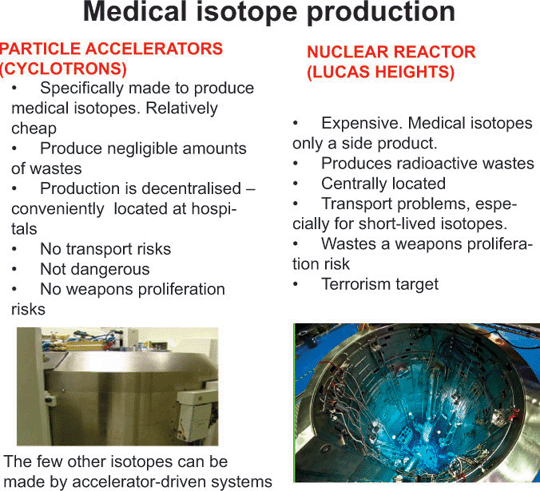
Cyclotrons able to produce medical isotopes; no need for Lucas Heights nuclear reactor
 This production method for Tc-99m can be used by retrofitting various brands of conventional cyclotrons already in use in hospitals and health centres across Canada.
Highly misleading to say that Lucas Heights nuclear reactor is mainly for medical uses
 it would be highly misleading to attribute this predominantly to medical isotope production given the broad range of uses of the HIFAR and MOATA reactors over the last 60 years.
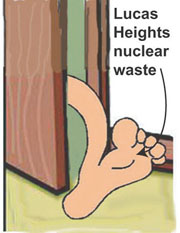 waste will be deposited in the repository? Less than 1% is medical waste (leftover radium and some disused sources). Most states and territories each only have a few cubic metres of low level medical waste.
1 This month
7 April – WEBINAR – Australia and the Doomsday Clock – Preventing nuclear war through NoFirstUse and other policies
Online | Tuesday April 7, 4:00-5:30pm, Australian Eastern Time / 8:00-9:30am Central Europe Time
– Access the registration link
15 April – Zoom –Nuclear Power is Not the Solution
Apr 15, 2026 01:00 AM in Canberra, Melbourne, Sydney

Join the International Physicians for the Prevention of Nuclear War (IPPNW) on Tuesday, April 14th for a timely webinar exploring the risks associated with nuclear power and challenging the myth that it offers a simple, safe, carbon-free solution to the climate crisis

of the week – Australians for War Powers Reform (AWPR)
To see nuclear-related stories in greater depth and intensity
 Antinuclear