Residents near Sally’s Flat, NSW, appalled at their area as potential radioactive trash site
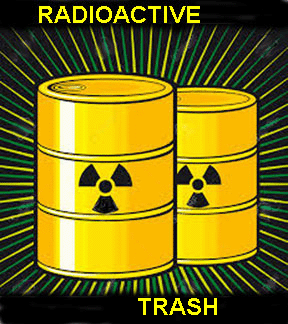 Locals frightened by ‘appalling’ prospect of living near nuclear waste dump http://www.abc.net.au/am/content/2015/s4351066.htm Michael Edwards reported this story on Friday, November 13, 2015
 Earlier this year landholders were invited to nominate land for the facility that will house almost all of Australia’s nuclear waste material. Sally’s Flat, north of Bathurst in central west New South Wales, is one of the areas that has been short-listed. Locals say they’re appalled at the prospect of living near a nuclear dump.
Michael Edwards reports.
MICHAEL EDWARDS: Twenty-eight landowners nominated their properties as a potential site for a nuclear waste dump. The Federal Government has whittled that list down to six potential areas – three in South Australia, one in the Northern Territory, one in Queensland and one in New South Wales.
Sally’s Flat, in the western New South Wales, is one of the places. It’s an area renowned for producing world-class wool.
LINO ALVAREZ: It’s a very fine place. There’s no industries here as such. Everybody works on the land.
MICHAEL EDWARDS: Lino Alvarez lives in Hill End, the nearest town to Sally’s Flat which is about ten kilometres away. The suggestion the area could be home to a nuclear waste dump scares him.
LINO ALVAREZ: It’s a disgusting proposition that in a lovely part of the world in which people come and enjoy from cities like Sydney, it will be a danger to everything. Continue reading
Why interim storage at Lucas Heights is the least worst solution for returning nuclear wastes.

 Dave Sweeney, Australian Conservation Foundation, 9 Nov 15 Last week Natalie Wasley (BNI) and myself spent a few days talking to a range of stakeholders in Sydney and Sutherland Shire and this note seeks to provide some context for the ENGO response to this development.
The BBC Shanghai left the French port of Cherbourg in mid-October carrying twenty five tonnes of Australian origin intermediate level waste returning here after reprocessing in France.
There has been controversy about the shipment, including safety and capacity concerns raised by Greenpeace about the vessel and a statement from the Indonesia’s Maritime Security Board that it can not pass through Indonesian waters. There is sure to be more domestic and international media attention when it arrives in Port Kembla (Wollongong), expected to be in early December.
After arrival in Kembla it is planned that the waste – which is in solid form inside a special transport container – will be moved by road to the Australian Nuclear Science and Technology Organisation’s Lucas Heights reactor facility in southern Sydney.
Some local residents are/will be calling for this material to not be stored in Sydney – this is an understandable response, but it is not one supported by the wider national nuclear free movement and key civil society partners.
We advocate that extended interim storage at Lucas Heights is the current least worst option as:
- ANSTO is already both the continuing producer of and home to the vast majority of Australia’s higher level radioactive waste
- ANSTO has certain tenure, a secure perimeter and is monitored 24/7 by Australian federal police
- Storing the waste at ANSTO means the waste will be actively managed as operations at the site are licensed for a further three decades – it also keeps waste management on the radar of the facility/people with the highest concentration of nuclear expertise and radiation response capacity in Australia
- Since the government realised in 2012 that the planned national waste dump at Muckaty would not be in place prior to the return of this waste, ANSTO has constructed and commissioned a new purpose built on site storage shed dedicated to housing this waste
- Extended interim storage at ANSTO helps reduce the political pressure to rush to find a ‘remote’ out of sight, out of mind dump site and increases the chances of advancing responsible management
- Storage at ANSTO has been publicly identified as a credible and feasible option by ANSTO, the nuclear industry lobby group, the Australian Nuclear Association and the federal nuclear regulator, the Australian Radiation and Nuclear Safety Agency (ARPANSA)
Importantly, this approach also provides the ability to have a circuit breaker in this long running issue in the form of an evidence based and open review of the best longer term management options.
Nothing about the nuclear industry, especially nuclear waste, is clean or uncomplicated and some in the wider community might be critical of this position.
However we believe that extended interim storage is the least worst approach and that coupled with a sustained ENGO call for a wider public review, is the path that is most likely to usefully advance the debate about future management options.
There is also an unusually high level of common acceptance that storage at Lucas Heights is the best option in the current circumstances – as well as ENGO’s this view is shared by the Sutherland Shire Council, local Greens and environmentalists, ANSTO and the Maritime Union.
Given this, pending a safety inspection upon the ship’s arrival, we do not forsee protest action aimed at disrupting the transfer of this waste from the Port to ANSTO – we want to see that happen with as low risk as possible. There are plans for a peaceful presence to witness the arrival and transfer and convey that while we (reluctantly) accept the need for this transport to occur we will not accept these shipments becoming routine and will actively resist moves to impose a national waste dump on remote communities or develop international waste dumps/storage in Australia.
Clearly this is an important message to convey in the context of the South Australian Nuclear Royal Commission and recent comments by PM Turnbull and other senior Coalition figures.
There is also both a real opportunity and need for a clear social and wider media profile at this time on the need for an open review of the best ways to manage this material and to end/reduce its production.
Sunshine in your beer in Sydney
 Pingala community-owned solar project to hit the roof of Young Henrys brewery, SMH, 2 November Lucy Cormack Environment Reporter
Imagine if there was sunshine in your beer. With a plan to build a solar farm atop the Young Henrys brewery in the heart of Sydney’s inner west, there soon could be.
Community members can become shareholders in the project – a collaboration with community energy organisation Pingala – and therefore, part owners of a future local solar farm. “When the Pingala guys came and spoke to us about it, we hadn’t had an interest in solar. Being able to put enough aside for large-scale solar wasn’t something we could afford,” said brewery part-owner Oscar McMahon.
“This was the perfect thing for us. We will start buying the power from the Pingala solar system on our roof, repaying people’s local investment into that system … we start buying renewable energy from our community.”
Electricity from the system will be used to power brewing processes, avoiding around 127 tonnes greenhouse gas emissions a year…….
The project will be the first for Pingala, part of a plan to start building community-owned solar farms on businesses and organisations across Sydney. The first stages have been realised with approval for a $40,000 innovation grant from the City of Sydney. Pingala volunteer Tom Nockolds said the renewable energy movement can no longer be ignored. “This idea, [it’s] time has really come. We’re opening up a new way for people to invest in renewable energy.” He said the project is directed at everyday “mums and dads who are struggling to find an opportunity to invest in renewables”. “Particularly in Sydney, where a high proportion of people live in apartments, are renters, or don’t have roof [space],” he said.
The Pingala initiative will aim for a 6 per cent to 8 per cent return for investors. After they have been paid back, the panels are gifted to the business to continue using. The first stages have been realised with approval for a $40,000 innovation grant from the City of Sydney.
Pingala volunteer Tom Nockolds said the renewable energy movement can no longer be ignored. “This idea, [it’s] time has really come. We’re opening up a new way for people to invest in renewable energy.”He said the project is directed at everyday “mums and dads who are struggling to find an opportunity to invest in renewables”. “Particularly in Sydney, where a high proportion of people live in apartments, are renters, or don’t have roof [space],” he said.
The Pingala initiative will aim for a 6 per cent to 8 per cent return for investors. After they have been paid back, the panels are gifted to the business to continue using
The Young Henrys project has the nod from Lord Mayor Clover Moore, who said it shows how Sydney “can make the shift to renewable energy even faster”. While Pingala is still obtaining financial and legal advice for the project, Mr Nockolds said in the early new year solar panels will be appearing on the Young Henrys roof…..http://www.smh.com.au/environment/pingala-communityowned-solar-project-to-hit-the-roof-of-young-henrys-brewery-20151029-gkltqu.html#ixzz3qIlYu8Jj
Time that Australia took a responsible attitude to radioactive trash management at Lucas heights
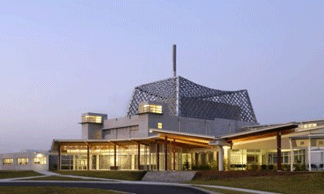 Australia’s Policy On Nuclear Waste Is All At Sea, Huffington Post, Dave Sweeney, 27 Oct 15 “…….. Australia has dropped the ball badly in relation to responsible radioactive waste management. For over 20 years, successive federal governments have repeatedly tried and failed to ‘solve’ this issue by imposing a national nuclear facility on unwilling remote communities. Apart from causing unnecessary and deep community stress, this approach has delivered little.
ANSTO’s Lucas Heights facility has secure tenure and is actively policed. The site is fenced and patrolled and both generates and is home to the majority of Australia’s radioactive waste. The facility is also home to Australia’s highest concentration of nuclear expertise and technology.
Furthermore, after an Aboriginal-led campaign saw Muckaty Station in the NT removed as a possible waste site during a Federal Court trial last year, ANSTO has improved its ability to store waste at Lucas Heights with a new dedicated and purpose built on-site storage facility.
Key parties including ANSTO, industry lobby group The Australian Nuclear Association, and federal regulator The Australian Radiation Protection and Nuclear Safety Agency all agree that the secure management of radioactive waste at ANSTO is feasible and credible. And in a rare case of consensus on matters nuclear, national environment groups agree.
Two decades of short-term political ‘fixes’ for a long-term environmental and human challenge have delivered very little. Extended interim storage at the site of production at Lucas Heights offers the least-worst solution and provides a circuit breaker in a long running but scarcely advanced public debate.
It gives us the assurance and ability to do what Australia has never done and clearly needs to do. We need an evidence-based and open review into the best options to most responsibly manage Australia’s radioactive waste.
In the interest of all, including future Australians, this is an opportunity we cannot afford to waste. http://www.huffingtonpost.com.au/dave-sweeney/australias-nuclear-waste-_b_8387352.html
Transport of nuclear waste is dangerous. Lucas Heights reactor should be closed
 Nuclear waste likely to be transported through the Illawarra, ABC News, 23 Oct 15 Ainslie Drewitt-Smith, Nuclear waste shipped from France to Australia is likely to land at Port Kembla.The ABC understands the 25 tonnes of treated waste is being returned to the Lucas Heights nuclear reactor in November, and is already on a cargo ship bound for the port.
It’s expected the intermediate-level waste will be transferred to trucks, before being transported to the Australian Nuclear Science and Technology Organisation (ANSTO).
Greens MLC John Kaye said transporting the waste through the Illawarra is risky. “It’s a very low probability event that there would be an accident, but if there is, it’s a very high consequence accident,” Dr Kaye said.
“Our concern with the nuclear cycle has always been nine times out of ten it’s fine, but then there’s one episode, and when that one episode happens, the results are totally catastrophic.”
The waste was sent to France in the 1990s to be processed, but its return to Australia was inevitable.While there were no issues with the original movement of the waste more than a decade ago, Dr Kaye said it’s not worth trying it again.
“The nuclear waste is set in a kind of glass, it’s then encased in a stainless steel vessel, but you can never keep anything 100 per cent safe,” he said. “The problem is, if there is an accident and one of those caskets is breached, the consequences for the local population are huge.”
Dr Kaye said ANSTO should be shut.
“This is a legacy of some very bad decision making that’s been happening in relation to Lucas Heights. It should have been shut ages ago,” he said.
“There should have been serious money invested into the alternative for isotopes used in medicine. Instead, we’ve continued with the same out of date process for creating these isotopes. It’s created this legacy of waste……..
ANSTO has confirmed in a statement on its website, the waste is on its way to Australia, but hasn’t said whether the material will land at Port Kembla, or be trucked through the Illawarra.
“Spent nuclear fuel was sent to France for reprocessing over four shipments in the 1990s and early 2000s, and the waste arising from that reprocessing operation is required under French law to have left that country by the end of 2015……..http://www.abc.net.au/news/2015-10-23/nuclear-waste-likely-to-be-transported-through-the-illawarra/6878860
Indigenous owners will manage huge new protected area in New South Wales
 Historic return of land to Indigenous owners in biggest protected area in South Australia There’s been an historic handover to traditional landowners in New South Wales, SBS, 27 SEP 2015 The 22,000 hectare Mawonga Station is now the biggest piece of Indigenous protected land in Southern Australia.
It’s located in central New South Wales, about 550 kilometres west of Sydney, and is the home of the Ngiyampaa Wangaaypuwan people…….
The handover happened thanks to a partnership between the federal government, the Indigenous Land Corporation, and the Nature Conservation Trust of NSW.
Nature Conservation Trust Board Member Russell Taylor said it will protect, preserve and maintain the natural and cultural heritage of country.
The land repatriation isn’t a native title claim. Former Labor environment minister Peter Garrett signed off on its purchase by the Indigenous Land Council in 2011.
“It was one of the great pleasures in my life as environment minister when i could start this process as a government and i think the tax payers got pretty good value from it to tell you the truth,” he said.
The former owner recognised sacred rock art sites on the property and pushed for its sale to an Aboriginal group, then to return it to its rightful owners.
It’s become the largest Indigenous Protection Area in southeast Australia. ……http://www.sbs.com.au/news/article/2015/09/27/historic-return-land-indigenous-owners-biggest-protected-area-south-australia
Radioactive trash returning to Lucas Heights by ship from France
Ship carrying nuclear waste heads to Australia, West Australian CHERBOURG, AFP October 16, 2015 A ship carrying 25 tonnes of reprocessed nuclear waste is steaming to Australia despite protests from activists about an “environmental disaster waiting to happen”.
The BBC Shanghai left the northern French port of Cherbourg after approval from local officials, who carried out an inspection on Wednesday, and is due to arrive by the end of the year in NSW. It is laden with radioactive waste from spent nuclear fuel that Australia sent to France for reprocessing in four shipments in the 1990s and early 2000s, the Australian Nuclear Science and Technology Organisation says.
The reprocessing involves removing uranium, plutonium and other materials, with the remaining substances stabilised in glass and stored in a container…….
Greenpeace, French environmental campaign group Robin des Bois (Robin Hood) and a leading Greens MP have called for the shipment, sent by Areva, to be halted. “Areva, almost bankrupt, are using a dustbin ship to carry waste, without any serious inspection!” Denis Baupin a senior MP with the French green party, tweeted.
Greenpeace Australia Pacific said the ship, owned by German firm BBC Chartering, was an “environmental disaster waiting to happen”, claiming the Shanghai was “blacklisted by the United States because of its safety record”……
But Areva’s external relations director, Bernard Monnot, said the ship was “not banned from ports in the United States but banned from transporting material for the American government”.
Nathalie Geismar from Robin des Bois said other ports had found it had a “staggering number of flaws”……
ANSTO said the material would be kept at the Lucas Heights facility in southern Sydney until a nuclear waste dump site, which has yet to be chosen, is found and constructed……https://au.news.yahoo.com/thewest/a/29834316/ship-carrying-nuclear-waste-heads-to-australia/
Broken Hill’s solar mega-plant operational this year
Broken Hill mega-plant solar panels lift the roof http://www.theaustralian.com.au/national-affairs/climate/broken-hill-mega-plant-solar-panels-lift-the-roof/story-e6frg6xf-1227565295647?sv=2fcdf280bb239bfc36e6b071c20e2458 OCTOBER 12, 2015 Sid Maher
The final panels on the biggest large-scale solar power station in the southern hemisphere will be installed at Broken Hill today, paving the way for the plant to be fully operational by year’s end.
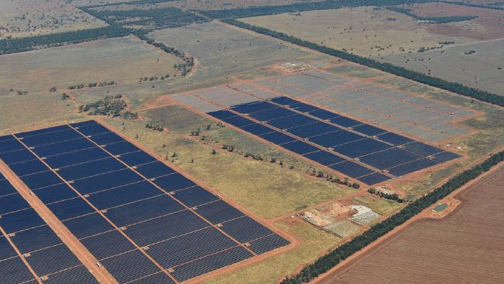
The 53-megawatt solar plant, a partnership between AGL and First Solar, will work in conjunction with the 102MW Nyngan solar plant to produce enough electricity to power about 50,000 average Australian homes. The Nyngan plant began operating six months ago. “There is a real sense of momentum driving large-scale solar in Australia today,’’ Australian Renewable Energy Agency acting chief executive Ian Kay said.
The large-scale solar plant begins operation as more than 1.4 million households in Australia have solar panels on their roofs, providing the highest penetration at the household level in the world.
However, the government is trying to drive more solar uptake at the commercial level as part of the 23.5 per cent renewable energy target. Environment Minister Greg Hunt has set a priority of increasing the uptake of utility- scale solar as part of the government’s renewable energy mix.
The government through ARENA had provided $166.7 million towards the $440m AGL Solar Project.
“As well as powering Australian homes with renewable energy, this project is also assisting AGL to transition towards a decarbonised economy. It’s a win-win scenario,’’ Mr Hunt said.
Mr said there was $350m available through ARENA and the Clean Energy Finance Corporation to further accelerate growth in the sector. ARENA has a $100m large-scale solar round that could double the capacity of large-scale solar.
AGL executive general manager group operations Doug Jackson said the Broken Hill Solar Plant was already generating up to 27MW of renewable energy into the grid and the remaining 26MW was expected to be brought on line this month.
First Solar’s regional manager for the Asia Pacific, Jack Curtis, said the project combined industry leading thin film modules and construction techniques. He said the Broken Hill plant contained 677,760 of First Solar’s advanced PV modules. The Cadmium Telluride modules offered significant efficiency and reliability advantages over typical crystalline silicon modules, Mr Curtis said.
National Affairs Editor
Solar cars for Australia
R** Solar cars tested in tough NT conditions ahead of World Solar Challenge 2015
On a remote road an hour out of Darwin, dozens of solar-powered cars have been pushed to the limits for the past two weeks.
http://www.abc.net.au/news/2015-10-11/solar-cars-tested-in-nt-conditions/6842916
R** Solar car on track to become Australia’s first road-legal solar vehicle.
3 October 2015. This group of students are the latest in a long line of undergraduates from the University of New South Wales that have been working on solar cars.
http://www.abc.net.au/radionational/programs/offtrack/sunswift-solar-car/6810376
New South Wales town Uralla shows the way to q100% renewable energy
 NSW town provides blueprint for 100% renewable energy communities, One Step Off The Grid By Giles Parkinson on October 6, 2015 (interesting diagrams),
 The NSW town of Uralla has outlined plans to go 100 per cent renewable energy, in a government-sponsored blueprint that could become the model of many other towns in NSW and other states to follow suite.
The Zero Net Energy Town – the Uralla Case study – was released today and describes a two-stage process that the town could adopt to go 100 per cent renewable, or “zero net energy”. It is a blueprint that others can follow, and two dozen towns in the state have already expressed interest.
The good news is that Uralla – population 6,034 and in the heart of Barnaby Joyce’s New England electorate – can get most of the way to their council’s objective of becoming “zero net energy” just by using measures that are proven and that will save them money.
These include things such as LED lighting and home insulation, and producing energy on site, particularly with solar PV. These measures will save the town around $2.2 million a year in energy costs, the study finds. Continue reading
New South Wales way behind on renewable energy
 NSW ‘at bottom of pack’ for renewable energy; Government says it’s committed to clean projects, ABC News By state political reporter Brigid Glanville. 30 Aug 15, It may be known as the premier state, but New South Wales is a clear under-achiever when it comes to renewable energy.
NSW has the highest level of greenhouse gas emissions in the country and does not have a renewable energy target.
In 2014 the renewable industry body, Clean Energy Council, listed New South Wales at the bottom of the states for renewable energy production. Only 6 per cent of its electricity is from wind, solar and water — compared with Tasmania, which uses 95 per cent renewables. “New South Wales is at the bottom of the pack of the Australian states when it comes to renewable energy,” Climate Council CEO Amanda McKenzie said.
“It’s behind the pack in terms of generating renewable energy and the amount of rooftop solar on people’s roofs.”
New South Wales and the two territories remain the only jurisdictions where Solar PV panel penetration is under 10 per cent.
In South Australia, take up is almost 25 per cent.
Clean energy penetration by state
- Tasmania 95%
- South Australia 40%
- Western Australia 13%
- Victoria 10%
- Queensland 7%
- NSW 6%
Source: Clean Energy Council, Clean Energy Australia Report 2014
Enova Energy New South Wales community organisation starts new renewable energy provider

The directors said in the prospective that the “nimble and collaborative locally based social enterprise model” used by Enova could be replicated and scaled across like-minded communities in Australia.
The share offer closes on September 25.
Northern Rivers community seeks $4m in energy IPO http://www.theage.com.au/business/energy/northern-rivers-community-seeks-4m-in-energy-ipo-20150828-gja99q.html#ixzz3kLbExZM1 August 30, 2015 Angela Macdonald-Smith A community-owned organisation in north-eastern NSW is set to take on the big guns in electricity supply through a $4 million initial public offering to fund a renewable energy retailing and solar company it hopes will stimulate local renewable energy projects across the country.
Enova Energy, chaired by consultant and former NSW state librarian Alison Crook, is aiming to capture customers in the Northern Rivers region, where retailing major Origin Energy dominates the market.
Ms Crook said Enova was not aspiring to be a major competitor of Origin but sought mainly to provide a customer for small wind farms, hydropower and bio-energy projects that were not large enough to be of any interest to major retailers as a green power provider.
“We see this as a game-changer to get community renewable energy really going in Australia,” Continue reading
Lucas Heights (terrorism target) gets security upgrades
Security upgrades at Lucas Heights nuclear reactor not influenced by trespasser scare, SMH, August 25, 2015 Henry Belot Canberra Times Reporter
Security upgrades at Australia’s oldest nuclear reactor were not triggered by the arrest of five men caught loitering outside the site last year, according to officials.
The men were arrested and questioned in September after parking their vehicles within 100 metres of the security gates to the Lucas Heights reactor in southern Sydney.
The group were eventually released without charge but their actions led police to question why they had strayed onto restricted Commonwealth land.
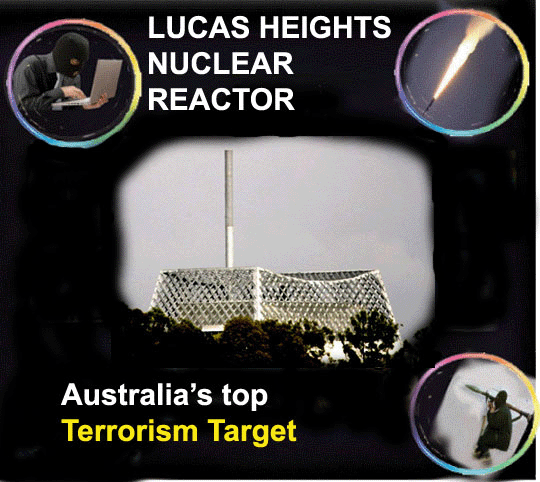
In response to a question on notice, Australian Nuclear Science and Technology Organisation chief executive Dr Adrian Paterson said security upgrades in October were not prompted by the scare.
“Control room operations were outsourced to one of Australia’s largest security firms with significant expertise and experience in control room monitoring,” an ANSTO spokesman said.”ANSTO’s first responder safety function was also outsourced to a private company.”
The spokesman said both changes were made after a detailed review of security arrangements and after consultation with the Australian Federal Police. “The changes have been successfully implemented and are delivering improved operational outcomes as well as cost savings,” he said.
“The AFP continues to be responsible for the 24-hour-a-day physical protection of the ANSTO site as well as armed first response.”
Dr Paterson said ANSTO received regular briefings from the intelligence community and their security posture could be strengthened quickly in response to specific threats……..
In 2001, Greenpeace activists gained entry to the Lucas Heights complex and unveiled banners claiming nuclear power was “never safe”…….
. The Lucas Heights site will also receive a shipment of radioactive waste returned to Sydney from France this year, after being sent to Europe for processing in the 1990s.
According to legal requirements, the waste must be returned from France by December with more waste set to be returned from Britain in 2017……….
ANSTO marketing material states the returning waste is equivalent to one third of a shipping container.
The cost of transferring waste from Britain is expected to cost nearly $27 million over four years, while the return of waste from France has been funded in budgets since 2010…….. http://www.smh.com.au/national/security-upgrades-at-lucas-heights-nuclear-reactor-not-influenced-by-trespasser-scare-20150825-gj71pv.html#ixzz3jrTJrpgg
Judge defending the NSW Land and Environment Court
 ‘If you have a degraded environment, you’re impoverished’: Justice Brian Preston, Peter Hannam ENVIRONMENT EDITOR, THE SYDNEY MORNING HERALD August 14, 2015 – Brian Preston, chief judge of NSW Land and Environment Court, joins Peter Hannam for a chat over lunch……. The Land and Environment Court was the first so-named court in the world when it was established in 1979, according to Ben Boer, Emeritus Professor at Sydney Law School and Preston’s first lecturer on environmental law, and a long-time friend and collaborator. There are now about 700 such courts globally.
But long before he got the top job at the court, he helped found another key organ of environmental law: the Environmental Defender’s Office of NSW.
It was the EDO that last week won a ruling in the Federal Court that found Environment Minister Greg Hunt had not properly considered advice on two threatened species, the Yakka skink and the ornamental snake, when approving Adani’s huge $16 billion Carmichael coal mine in Queensland.
The verdict prompted Prime Minister Tony Abbott to declare that courts were being used to “sabotage” mining projects, adding that Australia “must, in principle, favour projects like this”. The NSW Bar rejected the comments..
While our lunch preceded Mr Abbott’s outburst, Preston defended the importance of judicial independence, and later remarked that miners too often view environment checks as merely red tape.
Preston makes time for our lunch between his court duties, ongoing research for a book on environmentally sustainable development, and his work for a global effort to find ways the law can be used to curb climate change. He also teaches biodiversity law at Sydney University, and has helped develop environmental law in China and Thailand – two nations particularly in need of regulatory control –……..
He says that having a specialist court with judges well-read in environmental issues does not imply – as some miners argue – that developers won’t get a fair hearing.
“You should be environmentally literate,” he said. “All courts strive to make the right decision and you’re more likely to make that if you’ve got more knowledge.”……..http://www.smh.com.au/environment/lunch-with-justice-brian-preston-20150812-gixcdb.html
Australia’s government not stopping Sydney IKEA’s renewable energy project
The world’s biggest furniture retailer, which has annual sales of €30 billion ($44 billion), is aiming to be energy neutral by 2020, with 100 per cent of its energy needs coming from renewable sources.
IKEA’s Australian business took the first steps last year, installing 16,000 solar panels on the roofs of six stores, including almost 4000 panels at its flagship store at Tempe, near Sydney Airport.
“It’s really cool,” says Wilson, who gave up his job running Randwick Council’s Sustaining Our City program almost three years ago to join the Swedish retailer, attracted to the company by its ambitious long-term environmental targets.
“When they do have bold ambitions it makes things happen,” says Wilson. “It was the 100 per cent renewable energy targets that got me excited about working for IKEA – I want to be on that journey.”
It’s a journey that may not have got off the ground if not for Labor’s now defunct carbon tax. When electricity was cheap and solar panels expensive, the business case simply did not stack up.
The company pressed ahead after the carbon tax was scrapped by the Abbott government last year and now expects to achieve payback in less than 10 years, in line with its parent’s relatively generous return on investment hurdles……….http://www.afr.com/business/energy/solar-energy/ikea-backs-renewable-energy-targets-despite-government-changes-20150717-gid4gu
1 This month
7 April – WEBINAR – Australia and the Doomsday Clock – Preventing nuclear war through NoFirstUse and other policies
Online | Tuesday April 7, 4:00-5:30pm, Australian Eastern Time / 8:00-9:30am Central Europe Time
– Access the registration link
15 April – Zoom –Nuclear Power is Not the Solution
Apr 15, 2026 01:00 AM in Canberra, Melbourne, Sydney

Join the International Physicians for the Prevention of Nuclear War (IPPNW) on Tuesday, April 14th for a timely webinar exploring the risks associated with nuclear power and challenging the myth that it offers a simple, safe, carbon-free solution to the climate crisis

21 April Webinar: No Nuclear Weapons in Australia
Start: 2026-04-21 18:00:00 UTC Canberra, Melbourne, Sydney (GMT+10:00)
End: 2026-04-21 19:30:00 UTC Canberra, Melbourne, Sydney (GMT+10:00)
Event Type: Virtual
A virtual link will be communicated before the event.
Host Contact Info: australia@icanw.org

of the week – Australians for War Powers Reform (AWPR)
To see nuclear-related stories in greater depth and intensity
 Antinuclear