Western Sydney residents again face threat of radioactive waste dump at Kemps Creek
 Controversial radioactive clean-up to go ahead,SMH January 18, 2015 Kirsty Needham State Politics Editor, The Sun-Herald A bitter fight over radioactive waste between Sydney’s western and northern suburbs is set to be reignited by the Baird Government on the eve of the state election.
The NSW government will push ahead this year with a $12.4 million clean-up of Hunters Hill land contaminated by a uranium smelter 100 years ago, a government report has revealed.
But the only site in Australia identified by a string of government studies as the best option to store the waste – Kemps Creek near Penrith – is in a marginal Liberal seat where sitting MP Tanya Davies campaigned against the dump while in opposition. Continue reading
Questionable mining company applies to explore for uranium in NSW
Mining company with links to suspended firm first to apply for NSW uranium licence SMH, January 15, 2015 Sean Nicholls A Hong Kong businessman with ties to a company whose shares are suspended after rocketing to 40 times their value is seeking to explore for uranium in NSW after the government invited his firm to apply for a licence.
Chi Ho William Lo is a director of EJ Resources, one of six companies invited to apply by Resources Minister Anthony Roberts last September after the state government overturned a decades-old ban on uranium exploration in 2012.
It followed an expressions of interest process during which EJ Resources was assessed in February and March by a panel that recommended Mr Roberts grant the company consent to apply.
It lodged three exploration licence applications on December 19.
 But company records reveal Mr Lo and a fellow director, Siu-Wing Selwyn Chan, are former directors of Fifth Element Resources, which gained notoriety soon after listing on the Australian Securities Exchange in May last year.
Fifth Element Resources astonished market watchers when its share price soared from $0.20 to $7.96 in two months.
This valued the company at more than $300 million, despite it not announcing any significant news in relation to four gold and copper exploration licences it holds around western NSW. The licences were bought from EJ Resources the previous January.
On July 15 the ASX announced shares in Fifth Element Resources would be suspended from trading while an inquiry was launched into whether it had satisfied the rules for listing……..http://www.smh.com.au/nsw/mining-company-with-links-to-suspended-firm-first-to-apply-for-nsw-uranium-licence-20150114-12myku.html
News South Wales report on Renewable Energy progress in 2014
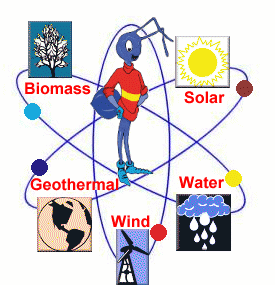 NSW Gov releases progress report on renewables http://ecogeneration.com.au/news/nsw_gov_releases_renewables_annual_report/090661/ Thu, 8 January 2015 The NSW Government has released its annual report, Progressing the Renewable Energy Action Plan for 2014, which confirmed approximately 13 per cent of the state’s energy generation came from renewables in 2013.
The Annual Report, which details the progress of the NSW Government’s Renewable EnergyAction Plan found that the share of renewable energy in NSW’s electricity generation mix has almost doubled in the past 5-6 years.
Other key findings include:
- There are currently estimated to be more than 13,000 jobs supported by renewable energy in NSW. This includes 4,400 direct renewable energy jobs.
- Over 2,900 megawatt (MW) of projects with an estimated investment value of $5.9 billion and the potential to support around 14,000 construction jobs and 1,000 operational jobs, currently have development approval. All of these projects are located in regional NSW (August 2014).
- Total investment in small-scale solar photovoltaic (PV) in NSW has been $1.3 billion. 298,000 households have installed small-scale PV.
The report also identifies the key achievements from the period since implementing the Plan, which include construction commencing on AGL’s $450 million, 155 MW Solar Flagships project in Nyngan and Broken Hill, which the Government has played a key role in supporting and facilitating.
Global warming contributed to Sydney’s record warm year
 Sydney weather: Record warm year with few cold spells January 6, 2015 Peter Hannam Environment Editor, The Sydney Morning Herald
If you thought Sydney had been warm over the past year or so, you’d be right.
Last year was the city’s equal warmest for overnight temperatures and its second-warmest for means and maximums in 156 years of record keeping at Observatory Hill.
For some temperature measures, such as for NSW heat, the previous record had been set only a year earlier.
Agata Imielska, senior climatologist at the Bureau of Meteorology in Sydney, said it was “quite surprising” to see last year eclipse 2013 given the bar had been set so high.
“We just didn’t have the cool periods,” Ms Imielska said. “There was a real persistence in the warmth.”
Globally, 2014 was the hottest year on record, the Japan Meteorological Agency declared this week. Land and sea-surface temperatures were 0.27 degrees above the 1981-2010 average, easily eclipsing the previous highs set in 1998, 2010 and 2013.
“Global warming is contributing to these heat records, and it’s very unlikely that we would have seen the proliferation or the frequency of these heat records around the world without the influence of global warming,” Karl Braganza, head of climate monitoring at the bureau, said.
“The climate system we live in … that’s all about 1 degree warmer than it used to be,” Dr Braganza said.
Warm and dry
For NSW, 2014 was the hottest on record for mean temperatures and the equal warmest for maximums. Among the other states, only the Northern Territory failed to notch a year among the four warmest on record……….http://www.smh.com.au/environment/climate-change/sydney-weather-record-warm-year-with-few-cold-spells-20150106-12ikgr.html
Health of Australians already threatened by global warming
As shepherds watched, it got hotter and hotter December 24, 2014 Peter Hannam Environment Editor, The Sydney Morning Herald Human health – and that of other animals and even plants – is likely to become an ever more pressing public issue as temperatures rise with global warming, cities grow and populations age………
Until recently, public health authorities would issue a warning whenever the temperature was likely to exceed a certain level.
However, heatwaves are also related to the conditions people are accustomed to. To reflect that, the Bureau of Meteorology last year pioneered a heatwave service that predicts the severity of coming heatwaves based on both how far temperatures are likely to deviate from historical averages but also taking into account the previous month’s weather.
In a further tweak, the bureau has added charts to assess the impact of each heatwave after it’s hit. That’s needed because people often don’t realise the damage to health can come from exposure to prolonged warmth rather than a particular temperature spike. Continue reading
Abbott government must hate Powershop – it’s making renewable sourced electricity cheaper!
 No wonder that the Abbott government is keen to wreck the Renewable Energy Target. Clever renewable electricity suppliers like Powershop are providing cheaper electricity – threatening Abbott’s backers – the polluting industries
Burge said that Powershop’s service was challenging the view put forward by major energy retailers that renewable energy would drive power bills up.
Miles George chairman of the Clean Energy Council and managing director Infigen Energy said that second tier generators had captured a “healthy” share of the retail energy market by offering discounts
“If we didn’t have a [target] those businesses wouldn’t be operating the way they are now and likely
Ben Burge, the man hoping to re-ignite the electricity market http://www.theage.com.au/it-pro/business-it/ben-burge-the-man-hoping-to-reignite-the-electricity-market-20150101-12fojw.html January 2, 2015 Andrew Colley Meet Ben Burge, the math whiz trying to shake up the staid retail energy market with a smartphone app and a good dose of analytics.
When he is away with the family, his mother-in-law pops by discreetly to do a load of washing. Her only explanation for his seemingly clairvoyant ability to know when to send her thank-you flowers is strategically placed web cams.
It’s a powerful tool and one he wants to put in the hands every Australian in a bid to take on the major energy retailers with cheaper and cleaner electricity.
 The truth is far more prosaic. Burge, chief executive of online retail energy challengerPowershop, knows when she’s there because the company’s app on his smartphone registers an unmistakeable spike in his home’s energy consumption. Burge, once Australia’s youngest CEO of a listed company, eMitch, at 25, and keen skateboarder, has already picked up 30,000 customers in Victoria whilst at the helm of what Powershop claims is the world’s first retail online energy market.
It lets consumers use a smartphone app (on iPhone and Android) or the web to monitor their energy consumption at home and choose the source of their electricity – from alternative energy projects including wind, solar or even sugarcane processing and landfill generation. A move that could help increase demand for renewable energy.
Some time early in 2015 the service will launch in NSW. Continue reading
World first – Australian breakthrough in solar energy efficiency
Solar energy world first in Australia http://www.brisbanetimes.com.au/environment/climate-change/solar-energy-world-first-in-australia-20141207-121w8n.html December 8, 2014 Peter Hannam
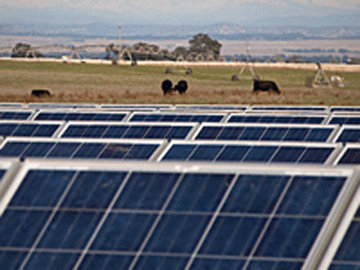 Australian solar power researchers have achieved world-beating levels of efficiency, potentially making large solar plants more competitive with other energy sources such as coal.
A team from the Australian Centre for Advanced Photovoltaics (PV) at the University of NSW has achieved 40.4 per cent “conversion efficiency” by using commercially available solar cells combined with a mirror and filters that reduce wasted energy.
Martin Green, the centre’s director, said the independently verified breakthrough eclipsed previous records without resorting to special laboratory PV cells that “you’ve got no chance of buying commercially”. Other top-performing solar panels convert about 36 per cent of the sunlight that falls on them into electricity.
The advance involved two steps. Three solar panels were stacked to capture energy from different wave lengths of sunlight, and then excess light from the stacked panels was directed by a mirror and filters to a fourth PV cell, making use of energy previously discarded.
“This is our first re-emergence into the focused-sunlight area,” said Professor Green, who pioneered 20 per cent-efficiency levels in similar technology in 1989.
The institute was prompted to revisit the technology in part because of Australian companies’ efforts to develop large-scale solar towers using arrays of mirrors to focus sunlight on PV cells.
One of those firms, Melbourne-based RayGen, collaborated with UNSW on the project. It is building a plant in China with an solar conversion rate of about 28 per cent. “We’d take them to the mid-30s” for future projects with the technology jump, Professor Green said.
Professor Green was critical of the federal government’s efforts to scrap the Australian Renewable Energy Agency – which chipped in $550,000 to the $1.3 million Power Cube project – and for its ongoing attempts to reduce the Renewable Energy Target set for 2020.
“A positive attitude to renewables would boost all these initiatives, a negative attitude will suppress them,” he said. “Clamping down on deployment of renewables will make it more difficult for developments like this to see the light of day.”
The next goal is to raise efficiency levels to 42 per cent next year, about half way to the theoretical maximum level of 86 per cent.
“It’s horse and buggy days as far as solar is concerned at the moment. There’s just this enormous potential for improvement in efficiency,” Professor Green said.
“To turn your back on those types of developments doesn’t seem to me to be a very sensible strategy.”
The university’s Mark Keevers led the engineering work on the so-called high efficiency spectrum splitting prototype, and its results were confirmed by the National Renewable Energy Laboratory (NREL) at its outdoor test facility in the US.
City of Sydney’s Renewable Energy Master Plan has won the European Solar Prize 2014 award
 Sydney gets international recognition for renewable energy plan http://www.thefifthestate.com.au/politics/local-government/sydney-gets-international-recognition-for-renewable-energy-plan/70135 2 December 2014
The City of Sydney’s Renewable Energy Master Plan has won the European Solar Prize 2014 award for excellence and innovation.
The award from not-for-profit organisation EUROSOLAR recognises outstanding commitment and contributions to the renewable energy sector.
“Our Renewable Energy Master Plan will help us transform Sydney into a city run entirely on renewable energy by 2030,” Lord Mayor Clover Moore said.
“The City is Australia’s first carbon-neutral government with ambitious targets to reduce emissions by 70 per cent by 2030. We are delighted that our renewable energy master plan has received this prestigious recognition on a global scale.”
The City’s renewable energy master plan was nominated by renewable expert and president of EUROSOLAR Peter Droege.
“The City of Sydney’s renewable energy master plan demonstrates civic vision, technological leadership and political courage,” Mr Droege said.
“The plan demonstrates a commitment to a fully renewable energy based community and is a stellar model for other communities around the world to aspire to.”
Byron Bay to get Australia’s first community-owned clean energy generator?
 Byron Bay residents push for Australia’s first community-owned clean energy generator, ABC News By Kerry Brewster , 26 Nov 14 Australia’s first community-owned clean energy generator and retailer is taking shape in the counter-culture capital of Australia.
Known for its alternative lifestyles, the Northern Rivers region of New South Wales is hoping to establish a not-for-profit energy company – Northern Rivers Energy – to rival the big retailers………
Northern Rivers Energy wants to attract 20,000 members, who would be able to buy, generate or invest in the enterprise.
After a feasibility study funded by the NSW Government is completed, a series of public meetings will begin.
Ms Crook has little doubt the people of the Northern Rivers will seize the opportunity to take control of their energy production………..
Rooftop solar and other renewables attractive for communities
With a surge predicted in rooftop solar and other power sources, renewable energy expert Giles Parkinson said consumers should expect profound change to electricity systems.
“The traditional domination by the three big retailers, that’s something of the past. How it evolves will be very interesting to see but certainly community ownership and the community-owned retailer is one of those options and we’ve seen it happen in Germany and other parts of Europe where it’s very powerful because you have people grouping together,” Mr Parkinson said.
“They’re not trying to make massive profits and they’re responding to what the people want to do.”……..
John Truman, manager of civil services for Ballina Shire Council, said his was one local council keen to get involved.
“We’re very interested in renewable energy sources so the opportunity to talk to anybody to assist in our future projects is something we’d be very interested in,” Mr Truman said. http://www.abc.net.au/news/2014-11-27/byron-bay-pushes-for-community-owned-clean-energy/5920272
Use of radioactive materials in coal seam drilling must be disclosed to public
 Anti-CSG groups says use of radioactive materials should be disclosed, The Age November 24, 2014 Peter Hannam Environment Editor, The Sydney Morning Herald Radioactive material is being used at some coal seam gas drilling sites in NSW and Queensland, raising concerns about potential health and environmental impacts.
A radiation management licence issued to US-based drilling company Halliburton shows it is permitted to use caesium-137, a radioactive isotope, for drilling by AGL at Gloucester, in the northern Hunter Valley and for Santos in the Pilliga forests near Narrabri.
Drillers deploy devices containing CS-137 to measure the composition of gas and water deep underground, with the isotope emitting gamma rays to operate like a miniature X-ray. Produced in nuclear reactors, the material is potentially deadly and among the main radiation concerns at failed power stations at Chernobyl and Fukushima…………
Environmental groups say the use of the radioactive material is not disclosed in the CSG projects’ Review of Environment Factors (REF) and Environmental Impact Statements, nor does it appear by name in Materials Safety Data Sheets.
An anti-coal seam gas campaigner at Gloucester, Jennifer Schoelpple, said AGL had played up the use of much more benign chemicals used for hydraulic fracturing – fracking – but had downplayed the role of caesium.
“No matter how thoroughly you search ‘under your kitchen sink’ or how scrupulously you check the ingredients of your condiments and ‘household products’, you are highly unlikely to lay your hands on any CS-137 in your family home,” Ms Schoelpple said.
“If they are so transparent, why don’t they document the most dangerous thing they use?”
Vicki Perrin, from Lock the Gate in Queensland, said farmers allowing CSG drilling on their land and the neighbouring communities should be made aware of the risks: “Farmers need to know there is a radioactive source on their site.”………http://www.theage.com.au/environment/anticsg-groups-says-use-of-radioactive-materials-should-be-disclosed-20141123-11s5vp.html
Warren Mundine not trusted by Aboriginal Land Council
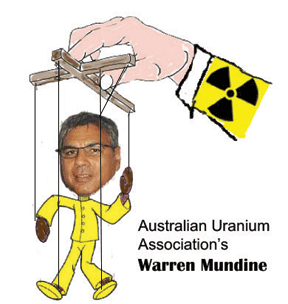 Aboriginal land council shuns Mundine over Wallarah 2 negotiations, Australian Mining10 November, 2014 Ben Hageman Warren Mundine has proven a poor choice to negotiate with local aboriginal groups, who have voiced their distrust in him for dealing with the Wallarah 2 coal mine.
After compensation negotiations with the Darkinjung Aboriginal Land Council broke down this year, Korean government-owned miner Kores hired the chair of the Indigenous Advisory Council to represent the company, SMH reported.
A spokesman for Kores said Mundine had been engaged by the company “to facilitate the resumption of discussions between Darkinjung ALC and Wallarah 2 on a land access agreement.”
However, land council CEO Sean Gordon said the ALC did not want to negotiate through Mundine. “From our end there is distrust in his position as chair of the Indigenous Advisory Council and his general support for the mining industry,” Gordon said……..http://www.miningaustralia.com.au/news/aboriginal-land-council-shuns-mundine-over-wallara
New South Wales govt backs community renewable energy projects
NSW Government throws its support behind renewable energy projects for regions like the Mid North Coast ABC News 10 Nov 2014, State government grants totalling $700,000 are now available for new renewable energy projects in areas like the Mid North Coast.
Community-based renewable projects can apply for grants of up to $70,000, to help with set-up costs.
So that may mean providing financial help with feasibility studies, to engage with the community about the project and do some planning
Parliamentary Secretary for Renewable Energy and Port Macquarie MP Leslie Williams, said the projects will not be industrial-scale in size, and will be entirely owned by community members…….http://www.abc.net.au/news/2014-11-11/nsw-government-throws-its-support-behind-renewable-energy-proje/5881366
For the moment, Aboriginal Land Rights in New South Wales are safe
The NSW Aboriginal Land Council said the Baird Government had withdrawn its controversial Crown Lands Amendment Bill.
“Moving forward we’re happy to talk to the Government, but this Bill was divisive and discriminatory and undermined Land Rights” NSW Aboriginal Land Council Chairman Craig Cromelin said.
“We call on the Government to respectfully deal with Land Rights and start from scratch by genuinely consulting with Aboriginal people before any changes are made to the way Crown Lands in NSW are managed.”………
Cromelin said a community rally held to fight the Bill had helped lead to its withdrawal.
“It means a lot to us to see such a great turnout from mob at such short notice, especially as many people travelled great distances, as well as those who sent letters, emails and tweets to protest against the Bill” he said.
“The rally shows the power of mob uniting for Our Land Council, Our Mob and Our Future.” http://www.probonoaustralia.com.au/news/2014/11/aboriginal-land-rights-safe-now#sthash.0IfywKIB.dpuf
Aboriginal people really cannot trust the New South Wales Baird Government
The government’s hurried assault on Aboriginal land rights – albeit followed by a hasty retreat – is a deeply unfortunate development, and has badly damaged any trust Aboriginal people can have in the Baird government in treating matters of Aboriginal rights with honesty and integrity.
 Aboriginal people must not negotiate with politicians who assault their land rights, Sol Bellear The Guardian 5 Nov 14 The NSW government’s hurried assault on land rights – followed by a hasty retreat – is deeply unfortunate and has damaged any trust Aboriginal people can have in the Baird government The NSW government’s decision earlier this week to abandon legislation aimed at another wave of dispossession of Aboriginal people is welcome. However, the fact that we even got to this point is a matter of grave concern to Aboriginal people across NSW, and the country.
In October, minister for western NSW Kevin Humphries announced his intention to introduce legislation to parliament which extinguished land claims under the NSW Aboriginal Land Rights Act on beaches and coastal reserves. It would have affected have affected more than 600 current Aboriginal land claims around NSW. This is the legilsation which was withdrew on Monday. Continue reading
Price fixing allegation involving indigenous “blow-ins” and mining companies
ACCC investigates claims of Aboriginal and mining ‘cartels’ October 24, 2014 SMH, Nicole Hasham
State Politics reporter Mining companies and Aboriginal groups allegedly engaged in “cartel conduct”, including price fixing for work involving ancient indigenous heritage sites, according to claims investigated by the competition watchdog……..Critics say Aboriginal cultural knowledge has been “commodified” and important artefacts and sites are being destroyed to make way for mining developments……..
Mining companies can pay groups known as “registered Aboriginal parties” to conduct field surveys and manage or salvage artefacts affected by mining development.
The ACCC investigated claims involving Rio Tinto Coal, Ashton Coal and NuCoal Resources,………
Aboriginal cultural heritage expert Maria Cotter claimed that decision-making on important sites was “being driven by dollar reimbursement and not by informed Aboriginal people making decisions about their heritage”.
“Aboriginality has been commodified in the process so that [people] are being bought to be Aboriginal, whether they have clear connections and understanding of the heritage of a particular place or not,” Dr Cotter said.
Scott Franks, who works with Ms Cotter and is a registered native title claimant for about 10,000 square kilometres of the Hunter Valley, claimed indigenous “blow-ins” from outside the area were engaged by mining companies, regardless of their knowledge or qualifications. Another local indigenous source close to the assessment process supported the claim……..http://www.smh.com.au/nsw/accc-investigates-claims-of-aboriginal-and-mining-cartels-20141026-119gab.html
1 This month
7 April – WEBINAR – Australia and the Doomsday Clock – Preventing nuclear war through NoFirstUse and other policies
Online | Tuesday April 7, 4:00-5:30pm, Australian Eastern Time / 8:00-9:30am Central Europe Time
– Access the registration link
15 April – Zoom –Nuclear Power is Not the Solution
Apr 15, 2026 01:00 AM in Canberra, Melbourne, Sydney

Join the International Physicians for the Prevention of Nuclear War (IPPNW) on Tuesday, April 14th for a timely webinar exploring the risks associated with nuclear power and challenging the myth that it offers a simple, safe, carbon-free solution to the climate crisis

21 April Webinar: No Nuclear Weapons in Australia
Start: 2026-04-21 18:00:00 UTC Canberra, Melbourne, Sydney (GMT+10:00)
End: 2026-04-21 19:30:00 UTC Canberra, Melbourne, Sydney (GMT+10:00)
Event Type: Virtual
A virtual link will be communicated before the event.
Host Contact Info: australia@icanw.org

of the week – Australians for War Powers Reform (AWPR)
To see nuclear-related stories in greater depth and intensity
 Antinuclear