Examining rural communities’ attitudes to wind farms, in New South Wales
 Wind co-op to study community attitudes http://www.abc.net.au/news/2013-06-11/wind-co-op-to-study-community-attitudes/4745110 Melinda Hayter Jun 11, 2013 The Central New South Wales Renewable Energy Cooperative which wants to buy a turbine at the proposed Flyer’s Creek wind farm near Blayney, says it has a back-up plan if the development is not approved.
The windfarm application was lodged in 2008 and Chairman Pat Bradbery says the group will not be disbanded if the windfarm does not get the go-ahead. “The first is to look at another windfarm that has been approved and preliminary talks have happened about that,” he said.
“But we will then at the same time look at our other goals, which is that we really want to do what we can to increase the amount of renewable energy being used in the central regions of New South Wales.”
He says solar farms and an initiative where businesses can rent solar panels to reduce their energy costs could be considered. “Orange, Bathurst, the Central Tablelands in particular gets a quite a lot of sunlight and so solar energy is very do-able.
“Also this part of the country is high wind territory so it certainly has the natural resources that are required to produce renewable energy.”The co-op has received a $60,000 state government grant to be spent on a study into community attitudes on wind farms, and a series of seminars.
Mr Bradbery says the grant will pay for a study on community attitudes to windfarms being done by the University of Technology Sydney.”They’ve actually almost finished that.
“We’re just waiting on the final report and to run 10 seminars through the region, in which we will present the results of the research and also get feedback about what they think of wind energy.” Seminars will be held in Orange, Bathurst, Lithgow, Cowra, Parkes, Forbes and Mudgee over the next two months.
Liberal State governments attack renewable energy – prelude to Abbott destruction of renewable energy
The second story was not just one, but a barrage of media placements from Queensland Premier Campbell Newman and others seeking to lay the blame for the state’s stunning 22.5 per cent average rise in electricity costs in 2013/14 on green energy schemes, glossing over the fact that the overwhelming majority of the bill increases come because the cost of the billions of dollars of network upgrades is being borne by the consumer.
 Abbott strangles $20bn green investment – to save 50c/week REneweconomy, By Giles Parkinson 3 June 2013 Two news stories over the weekend give a chilling insight into what might await the Australian renewable energy industry under a Federal Coalition government.
The first story was mostly symbolic in nature. The Newcastle Herald reported that the only wind turbine in Newcastle, the 600kW Kooragang turbine that was constructed in 1997 to “promote the emerging green energy market” is to be removed by Ausgrid – to make way for a new coal loader.
It is just a single turbine but, amazingly, apart from a small demonstration turbine at the CSIRO energy centre nearby, it is the only one in NSW north of Sydney. In fact, going north, you need to travel 2,000kms to the Atherton Tablelands before coming across another commercial wind turbine, 20 small towers amounting to 12MW at Windy Hill in the Atherton Tablelands. There are two other small turbines on Thursday Island, at the tip of the country and that is it – just 12.45MW of wind energy north of Sydney, out of a total of 2,500MW across the country.
How many other turbines are built in NSW will likely be influenced by key decisions being made by NSW Cabinet as early as today about rules governing wind farm developments and the state’s renewable energy plans. That, of course, and the fate of the large-scale renewable energy target – a federal decision. Continue reading
Farming the sun – Australia’s first community-run solar farm at Lismore?
 North coast looks at sustainable energy alternatives, By ABC North Coast, 31 May 13, “………… Lismore could host Australia’s first community solar farm, as part of the new Farming the Sun project. Adam Blakester is in charge of the project which has received funding to establish seven or more community-owned solar farms around the country.
Mr Blakester said Farming the Sun is about bringing the community together and strengthening the local economy. It would mean local people would invest in the project and then on-sell the energy to a local organisation. “It’s really a community building project and particularly about learning and understanding electricity and energy which is an increasingly significant issue for all of us on a local scale and a global scale.
“That solar farm is owned by a local company; which is local people as shareholders – so that’s the community ownership.”……. He said while community-run solar farms haven’t been viable in the past, solar energy has just recently become more affordable than grid power. “Now, it’s financially cheaper to produce your own electricity with a solar panel, than to buy it off the electricity grid.
“By locally owning it, the money we’re spending on electricity starts to be recirculated for the life of this solar farm in the local region and local economy.”
A memorandum of understanding was signed last night by Lismore City Council, and by Starfish enterprises which – along with the NSW Office for Environment and Heritage and The Earth Welfare Foundation – has contributed funding towards the Farming the Sun project. …….
A feasibility study will now be conducted to see if it can go ahead in Lismore. http://www.abc.net.au/local/stories/2013/05/31/3771758.htm?site=northcoast
Community solar energy gathering pace in Australia
 Community solar may be next big thing in Australia renewables REneweconomy. By Giles Parkinson 22 May 2013 The momentum for a big push into community solar projects appears to be gathering pace, with several different organisations planning public launches in the next month, and suggestions that several dozen projects could be built on NSW rooftops in coming years.
Among plans revealed this week are the launch of a community solar network Farming the Sun in the northern Rivers region, to be followed soon by similar groups in New England and the Riverina. This is the work of community energy advocate Embark and Starfish Enterprises, which has identified 7 different projects of at least 80kW that could be commissioned in the next 18 months.
A Newcastle community group has also emerged with a plan to launch a “crowd-funding model – similar to that used successfully by Mosaic in the US – to develop projects in its region. Meanwhile, a new organisation known as the Community Power Agency was launched on Wednesday to help the development of community energy projects.
The announcements come as news circulates that the NSW government’s Office of Environment and Heritage has approved funding for up to 9 groups to either conduct feasibility studies into their business models, or provide funds for the groundwork for particular projects.
Community ownership of renewable projects has yet to take off in Australia, even if in countries like Germany it accounts for around half of renewables investments.
Australia has two community-owned wind farms – the Hepburn Wind project near Daylesford in Victoria and in Denmark, near Albany in WA- but community owned solar projects are tipped to be a compelling proposition because of plunging cost of solar and their ability to compete with retail prices rather than wholesale prices.
Farming the Sun Project director Adam Blakester, of Starfish Enterprises, said the business model for the community projects his consortium is proposing is similar to that of the 400kW community solar project announced late last year for the Lend Lease development in Sydney’s Darling Harbour….. http://reneweconomy.com.au/2013/community-groups-look-to-crowd-funding-rooftop-solar-86008
Australia’s old dead reactor and radioactive trash to make way for more nuclear development?

Australia should shut down Lucas Heights and stop making radioactive trash
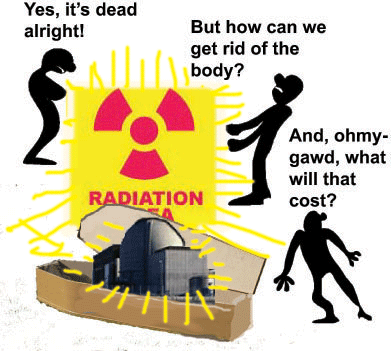 Nuclear waste on the move in clean-up http://www.smh.com.au/nsw/nuclear-waste-on-the-move-in-cleanup-20130515-2jmu5.html#ixzz2TV9sbj00 May 16, 2013 Heath Aston Radioactive waste and parts of Australia’s oldest nuclear reactor will be trucked out of Sydney under plans to clean up the Lucas Heights nuclear facility and develop a national hazardous-waste dump in the outback.
But residents in Sydney’s south are concerned at the prospect of having radioactive  material transported past their homes.
They believe the dismantling and removal of the 1960s-era ”high-flux Australian reactor” and spent fuel rods is a bid to clear the way for further development at Lucas Heights and the production of more dangerous waste.
The plan to move the retired reactor, switched on by former prime minister Robert Menzies in 1958 and taken out of service in 2007, emerged in the budget papers.
 The Australian Nuclear Science and Technology Organisation, which manages Lucas Heights, has been given $28.7 million to prepare for the move. The four-year funding package will pay for ”pre-disposal conditioning of existing radioactive waste in preparation for long-term storage and disposal, and for the clean-up of buildings and infrastructure containing hazardous materials” at Lucas Heights.
Separately, the government has put $35.7 million into securing a site to become the nation’s repository for radioactive material. It will host waste from Lucas Heights and may provide the state government with a destination for contaminated soil from the former uranium smelter site at Hunters Hill.
An area at Muckaty, 800 kilometres south of Darwin, is the government’s preferred site after it struck an agreement with the Northern Land Council. But development of the semi-arid claypan site is bogged down in a legal challenge by some traditional owners. The budget papers do not identify Muckaty specifically, but a spokesman for Resources and Energy Minister Gary Gray said Muckaty, 100 kilometres north of Tennant Creek, remained the only location under consideration.
Within four years a facility that could centralise waste from Lucas Heights, and 100 or so other industrial and medical waste facilities, would be ready for construction. An ANSTO spokesman confirmed the plan to move the reactor and waste. The load will include fuel rods due to arrive in Botany Bay for transportation back to Lucas Heights after they were reprocessed at a nuclear facility in France.
Local resident groups who supported a previous plan to encase the reactor in concrete will meet ANSTO management in Engadine in the next few days.
University of New South Wales makes solar cell efficiency breakthrough
Solar Cell Efficiency Breakthrough At UNSW http://www.energymatters.com.au/index.php?main_page=news_article&article_id=3721 6 May 13 Those clever folks at the University of New South Wales have done it again – this time with a solar breakthrough that wasn’t expected for another decade. Continue reading
Sutherland Council doesn’t want Lucas Heights nuclear wastes – “The local community would not support that”
the only sensible thing to do is to shut down the Lucas Heights nuclear reactor. Nuclear medicine is just a sideshow there anyway. All nuclear medicine’s pharmacueticals can be made in other ways, by non nuclera cyclotrons.
Lucas Heights real purpose is to keep a foot in the door for the nuclear fuel cycle in Australia
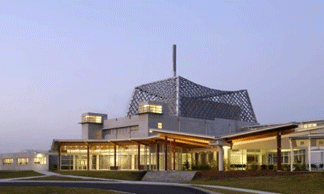 A Sydney council’s nuclear waste warning, BYVIKKI CAMPION The Daily Telegraph April 29, 2013 A SYDNEY council has warned it does not want to be the dumping ground for Australia’s nuclear waste.
It comes as a massive expansion of the nuclear medicine operations at Lucas Heights triples the amount of nuclear waste generated.
The Australian Nuclear Science and Technology Organisation plans to build a state of the art nuclear waste treatment facility – to safely store it – but could end up keeping it there for up to 10 years.
Sutherland mayor Kent Johns said the council’s biggest concern was making sure Lucas Heights did not become the permanent home of nuclear waste storage……..
A spokesman for ANSTO said it supported setting up a long term storage facility for nuclear waste, but not at Lucas Heights……. “By law ANSTO cannot be used as a national waste repository. The local community would not support that….. ( just like the Muckaty Aboriginal community C.M)
Wollongong’s revolutionary “solar renewal house”
A Photovoltaic Thermal Air System creates heat in winter while in summer the system creates cool air through the night. In winter the thermal storage allows the system to store heat during the day and then release this to the home at night. In summer the reverse occurs.
Solar renewal in the suburbs http://www.theaustralian.com.au/news/features/solar-renewal-in-the-suburbs/story-e6frg8io-1226611687319 BY:STEPHEN BROOK :The Australian April 05,
A QUIET design revolution is taking place in the streets of Wollongong which, if successful, could change the shape of the construction industry and our suburban landscape at the same time.
A team of 30 students from the University of Wollongong and the adjacent TAFE Illawarra, schooled in the disciplines of engineering, architecture, creative design, construction and marketing, supported by a network from industry and academia, are close to realising their dream – the transformation of the humblest of domestic dwellings, the fibro home, into an energy- efficient house of world class.
Just how world class will become apparent in August when the project – dubbed the Illawarra Flame – is displayed on the world stage.

The Illawarra Flame has won a place in the finals of the Solar Decathlon, one of the world’s biggest renewable energy competitions, scheduled to take place in August in the city of Datong, in northern China. Continue reading
Solar energy plant for Broken Hill approved by New South Wales govt
$200m Broken Hill solar plant approved ABC News By Eugene Boisvert Apr 2, 2013 A $200 million solar power station for the far west has been recommended for approval by the NSW Government.
Electricity company AGL is planning to build the plant at Rob Day Station south-west of Broken Hill.AGL has indicated there will be 150 jobs in construction and four ongoing positions once the solar power plant is operational at the end of 2015.
The company has agreed to environmental conditions the state has imposed in approving the solar power station….. AGL is also planning to build a wind farm near Silverton. It has not yet been approved for construction.
Both have been named major projects by the NSW Government. http://www.abc.net.au/news/2013-04-02/24200m-solar-plant-approved-by-state-government/4604438
Thousands petition NSW Parliament to oppose uranium exploration and mining
 27 March 13, NSW Parliament today received a petition of over 2,000 people opposing uranium exploration and mining in NSW and calling on the government to maintain the ban on uranium mining and to hold an open and transparent inquiry into uranium mining in NSW. Greens MP and uranium spokesperson Jamie Parker said:
 “The petitioners have told the Liberal government loud and clear: uranium exploration and mining must not be allowed in NSW.
“This is a hugely damaging industry with a long and well-documented history of safety breaches, dangerous leaks and failed attempts at rehabilitation.
“Labor and Liberal governments in Australia are legislating to allow uranium exploration and mining, placing local communities at risk while increasing the threat of nuclear proliferation and disasters overseas.
“This is even more alarming considering Federal Labor’s decision to export uranium to India, a country which has not signed the nuclear non-proliferation treaty.
“Exploration inevitably leads to mining and all the dangers and health hazards that involves – we must stop this damaging industry now, before it expands even further.
“We should be working toward a clean energy future and investing in renewables, instead of fostering this dangerous and unnecessary industry which will leave a lasting radioactive legacy for future generations.” Mr Parker said.
Global warming is changing New South Wales south east region
 Region’s weather changing http://www.abc.net.au/news/2013-03-05/region27s-weather-changing/4554482 Mar 5, 2013 A climate change expert says the New South Wales south east is becoming hotter and drier due to global warming. Climate Change Commissioner, Professor Lesley Hughes, will be in Bega next week to conduct a question and answer session on the effects of changing weather patterns.
Prof. Hughes says the region is in the midst of a long-term dry period that saw a 13-year drought and bushfires. She says there has been a one degree temperature increase in the last century with the alpine areas showing the greatest effect.
“In the terrestrial environment on land the alpine environment is probably is the most vulnerable eco-system to climate change,” Prof. Hughes said. “Our mountains in Australia are fairly short by world standards. Plants and animals can move up hill to stay in cooler climates but because our mountains are very short they don’t have very far to go.”
Prof. Hughes says the rise in temperature is being reflected among fauna and flora, and in ocean changes. “Over the last century for example in Australia we have had just a little bit under a degree of mean annual temperature rise but we are seeing plants and animals all over the place both in Australia and the rest of the world actually responding to that.
“In our marine life we are seeing lots of species moving further to the south.”
Hunter Region in New South Wales ready to change towards renewable energy
The Hunter is poised for energy innovation , Newcastle Herald, By Dr
Alan Broadfoot March 5, 2013 “….The Hunter generates over 60per
cent of the state’s electricity and is the largest regional economy in
Australia, with outputs last year totalling almost $37billion.
The region’s willingness for change is part of a growing push to
diversify and expand on our strengths.
Recent developments with hybrid power generation and renewable energy
show this transformative approach in the region. Continue reading
Greens MP Kate Faehrmann invited, but sidelined at Kemps Creek radioactive waste meeting, while ALP dominated
 Despite being invited to address the meeting, NSW Greens MLC Cate Faehrmann was told at the last minute that she would not be seated on the stage and would only get to speak at the start of discussion time.
She raised the proposal of shifting the waste to the Lucas Heights nuclear reactor site, and said that if the federal Labor government wanted to, they could step in now to make this a reality through an amendment to national laws.Despite a number of people in the crowd pressing the speakers to address this idea, all preferred to side step it.
Labor MPs hijack local outrage over uranium dump plan http://www.greenleft.org.au/node/53403, February 22, 2013 By Fred Fuentes Angry residents from Kemps Creek and surrounding neighbourhoods packed the local sports and bowling club auditorium on February 18 to protest against the state government’s plan to dump radioactive waste in the area.
The NSW Liberal government is proposing to shift 5800 tonnes of soil from an area in Hunters Hill, where a uranium ore processing plant once stood, to the Kemps Creek SITA dump site.
Cancer clusters have been detected in Hunters Hill, which have been linked to the contamination left behind at the former plant site.
The amount of community concern against the project was shown by the more than 3000 submissions against the proposal over the past two months.
The meeting was addressed by three federal politicians and a councillor from Penrith, all from the ALP. Continue reading
University of Newcastle linked with coal industry – but it’s time for the Hunter Valley to go renewable energy
 The Greens understand the challenges ahead and have acted responsibly
in negotiating a $10billion clean energy investment fund. This is the
closest we have in Australia to a sovereign wealth fund, to use some
of the considerable wealth we have generated now and invest it in the
future of our children and our communities.
The Hunter has long been a hub of renewable energy innovation and
entrepreneurship. A transition to a clean, renewable energy economy
promises to revitalise Australian manufacturing and create thousands
of new jobs in many rural and regional communities, including the
Hunter’s coal communities.
But we need to shift subsidies away from fossil fuels and towards
renewables if we are to do this.
The writers of Monday’s opinion piece were obviously not aware the
University of Newcastle had commercial links with coalmining.
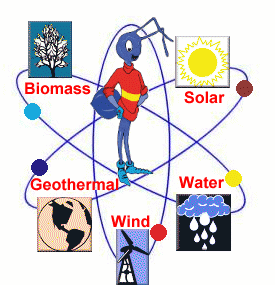 Renewable energy Hunter’s best future
http://www.theherald.com.au/story/1296245/opinion-renewable-energy-hunters-best-future/?cs=308
By CATE FAEHRMANN, 14 Feb 13, PEOPLE are rightly sick and tired of the childish
mud-slinging that now plagues Australian politics. So how about a bit
of honesty and even some vision for the future of the Hunter?
Readers would have been left scratching their heads this
week about why a pro-vice-chancellor (Professor Scott Holmes) and
researcher (Sam Bright) at the University of Newcastle would both
misrepresent the energy and mining policies of the Greens and
undermine his own institution’s research program to reduce reliance on
fossil fuels.
The Hunter’s coal communities are proud communities. Over more than a
century, the workers and their families of Cessnock, Muswellbrook,
Maitland and Singleton have created a booming economy for their
communities and for the Hunter.
Along the way, our knowledge about the impacts of coalmining has grown
and we now know that there are significant health and environmental
issues involved, not the least being the insidious clouds of coal dust
now blanketing communities and the very real, worldwide challenge to
reduce greenhouse pollution.
Tackling climate change means our dependency on coal as an export
earner and as a domestic fuel will have to be phased out over the next
few decades, rather than ramped up.
This will mean necessary changes for the whole national economy, and
for coal-affected regions such as the Hunter. The challenges
associated with this change are significant, but not insurmountable. Continue reading
Local Area Land Councils throughout New South Wales protest against (NSWALC) mining decisions
 Ryan’s defence of mining plan dismissed by angry protesters National Indigenous Times, 1 Feb 13, An angry mob of First Nations people representing Local Area Land Councils throughout New South Wales delivered the New South Wales Aboriginal Land Council (NSWALC) a blunt message at a protest rally last Friday – “Consult us before mining in our Country”.
And New South Wales Aboriginal Land Council Chairman, Stephen Ryan was delivered a warning by Gomeroi leader Alf...(subscription only) http://www.nit.com.au/news/2426-ryans-defence-of-mining-plan-dismissed-by-angry-protesters.html
1 This month

of the week – Australians for War Powers Reform (AWPR)
To see nuclear-related stories in greater depth and intensity
 Antinuclear