Chief Executive Officer of the Gandangara Land Council, Jack Johnson, against NSW Land Council
Jack Johnson lashes NSW Land Council National Indigenous Times, 23
Jan 13 The New South Wales Aboriginal Land Council (NSWALC) has
recommended a consultancy firm allegedly linked to the New South Wales
Labor Party mining corruption scandal and also linked to an Aboriginal
death in custody be appointed by the New South Wales Government to
investigate Gandangara Local Aboriginal Land Council.
Chief Executive Officer of the Gandangara Land Council, Jack Johnson
has made the claim… (subscription only)
http://www.nit.com.au/news/2331-jack-johnson-lashes-nsw-land-council.html
Chairman of Mutawintji land council opposes uranium mining in Western New South Wales
 NSW prospectors await uranium riches, 21 JAN 2013,
BILL CODE, SBS“…….There’s no doubt that talk on uranium
mining in western NSW is still in its very early stages.
But in the area, there are some traditional owners of the land who are
far from convinced of its benefits.
Wilcannia lies on the banks of the Darling River east of Broken Hill.
These days, many traditional owners from Western NSW live here.
One of them is William Bates, a man who fought against uranium mining
in South Australia in the early 1980s.
He’s the chair of Broken Hill’s neighbouring Mutawintji land council.
Because of the nascent stage of development, whether there’s uranium
under that arid piece of NSW taken up by the indigenous-run national
park is not certain, but he is sure the prospectors will come knocking
sooner or later.
‘I’m against it because it’s not safe, mining companies are always
stuffing up’ he says when I pull up in Wilcannia on a scorching
afternoon. ‘They might have an accident.’…
Sydney to cop very high UV radiation
 Extreme UV radiation levels warning, Hills News, Jan. 11, 2013 NOT
only is Sydney suffering from a heatwave, the area is also
experiencing extreme ultraviolet (UV) radiation levels which can be
damaging to people’s skin.
UV levels for Friday, January 11 were recorded by the Bureau of
Meteorology at an extreme level of 13. While on Saturday, January
12, temperatures are said to reach 42 degrees Celsius with a UV rating
of 12.
Regional manager for western Sydney at the Cancer Council, Rory
Alcock, said UV levels past three could damage skin.
‘‘The UV Index starts from a low level of one to two,’’ Mr Alcock said.
‘‘A level of over three can be strong enough to damage your skin.
‘‘Australia has among the highest ratings of skin cancer. ‘‘Two in
three people will develop skin cancer before the age of 70.’’
For the best protection against UV rays, Mr Alcock recommends a
combination of sun protection
measures……http://www.hillsnews.com.au/story/1230027/extreme-uv-radiation-levels-warning/?cs=12
Lucas Heights nuclear reactor shut down. Fire has been brought under control
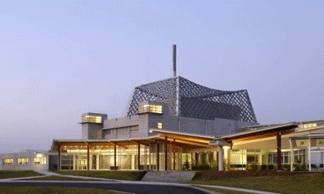 “The OPAL reactor is shut down and is safe.
Some sources say that the fire broke out as the city sweltered through a heat wave, which has caused dozens of bushfires, but the ANSTO saidthe incident was not related to the current weather conditions.
Fire has broken out at a nuclear research facility in Sydney, but its
operators say the blaze has been brought under
control.http://www.presstv.ir/detail/2013/01/08/282384/fire-breaks-out-at-sydney-nfacility/
The fire broke out at the Lucas Heights nuclear plant in southern
Sydney on Tuesday (local time)
The Australian Nuclear Science and Technology Organization (ANSTO)
raised the alarm at 10.36 a.m. local time (12.36 p.m. NZT) after smoke
was detected in an electrical substation at the rear of the facility,
which contains two nuclear reactors. Continue reading
Australian town powered by solar energy 1981 – 2004
 Historic Australian Solar Farm To Become A Museum http://www.energymatters.com.au/index.php?main_page=news_article&article_id=3526 25 Dec 12, Long before the solar power boom in Australia, the White Cliffs Solar Power Station was generating clean electricity for a town.
Located at White Cliffs, New South Wales, which had no grid connection at the time; it was constructed in 1981 by a team from Australian National University.
The solar farm originally featured fourteen three-metre parabolic dishes covered in thousands of mirrors and mounted on heliostatic mountings; which followed the sun throughout the day. Continue reading
New South Wales’ toxic radioactive waste by another name is still toxic radioactive waste
But the new plan involves reclassifying most of the contaminated earth as ”restricted solid waste”, allowing it to be trucked to Kemps Creek.
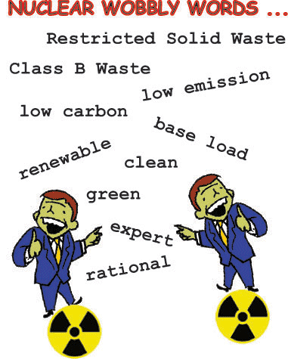 The Labor MP for Auburn, Barbara Perry, told Parliament in June that the move to reclassify the contaminated earth as restricted but non-hazardous was ”clever spin”.
Based on a series of tests by ANSTO, government and independent scientists, the detection of some hazardous radioactive material seems likely.
Uranium smelter’s legacy moves on, SMH December 16, 2012 Ben Cubby THE controversial clean-up of a radioactive site in Hunters Hill is set to begin early next year, with any hazardous waste to be moved from the harbourside suburb to Lidcombe, the NSW government says.
The contaminated properties in Nelson Parade – once the site of a uranium smelter – have been a thorn in the side of residents and governments for nearly a century.
After years of denials from successive governments about the extent of the contamination, the clean-up will now be extended to include suspected radioactive hot spots in neighbouring backyards and at the harbour foreshore.
The Premier, Barry O’Farrell, all but ruled out dumping the contaminated dirt at a Kemps Creek waste facility in western Sydney last year, in the face of protests from Penrith residents and councillors. Continue reading
Native Title rejected by Githabul because it will further coal seam gas mining
Ms Gloria Williams spokeswoman of Githabul said that the Native Title agreement is being wrongly used to allow coal seam gas interests into the region.
 Aboriginal people reject Native Title over coal seam gas http://www.coalguru.com/australia/aboriginal_people_reject_native_title_over_coal_seam_gas/6062 17 Dec 12, ABC News cited members of the Githabul people as saying that the coal seam gas issue is forcing them to reject their Native Title claim.
An application by the New South Wales Aboriginal Land Council for gas prospecting in the Tweed and Byron Shires, includes areas covered by the Githabul Native Title claim of 2007. The claim is more than 6000 square kilometer in size. Continue reading
New South Wales losing investment and jobs, as State govt prolongs anti wind farm rules
“There’s $10 billion worth of investment sitting in the pipeline waiting to find out what Brad Hazzard is going to do with their
future.
“Four thousand jobs, 17 million tonnes a year cut from the state’s greenhouse gas emissions, waiting to see what the O’Farrell Government will do.”
 Guidelines wait blows against NSW wind farms http://www.abc.net.au/news/2012-12-14/guidelines-wait-blows-against-nsw-windfarms/4427964 Dec 14, 2012 The Clean Energy Council says a delay in finalising new guidelines for
wind farms in New South Wales is forcing investors to look to other states for opportunities.
It is a year since the New South Wales Government put draft guidelines out for community consultation.
A spokesman for Planning Minister Brad Hazzard says the policy is still being finalised. In the meantime, no new wind farms have been approved.
The Clean Energy Council’s policy director, Russell Marsh, says that is sending investment elsewhere. Continue reading
Broken Hill’s exciting future as Australia’s first renewable energy town

Most rural communities are dying – this is a town that has the potential to move forward.

ALTERNATE WMA VERSION | MP3 DOWNLOAD
Broken Hill a frontrunner in renewable energy adoption ABC Radio AM Margaret Paul reported this story on Tuesday, November 27, 2012 …
DARRIEA TURLEY: There is a possibility that Broken Hill could be the first town that would live on renewable energy, that would be sustained by renewable energy. No other town has done that.
MARGARET PAUL: Broken Hill’s acting Mayor is Darriea Turley.
She’s excited that Broken Hill is set to become home to two major renewable energy projects.
The first, a photovoltaic solar farm, is set to produce 125,000 megawatt hours of electricity every year – enough to power 17,000 homes.
The second is a wind farm to be developed at nearby Silverton that could power as many as 43,000 homes. Continue reading
New South Wales Greens condemn the call for nuclear energy
 Nuclear Power In NSW – ‘Dangerous, Uneconomic And Retrograde’ http://www.energymatters.com.au/index.php?main_page=news_article&article_id=3486 by Energy Matters, 26 Nov 12, A parliamentary committee that called on the state government to foster public discussion of nuclear power generation in New South Wales has been slammed by Greens NSW MP John Kaye; who labeled nuclear energy as “dangerous, uneconomic and retrograde”.
“Parading nuclear energy as a viable low emissions energy source while the O’Farrell government continues to devastate the renewable energy sector is deeply contradictory,” said Mr. Kaye.
“Despite the ink barely having dried on community submissions to the O’Farrell government’s long awaited Renewable Energy Action Plan, nuclear energy is again being dragged out for debate.”
Mr Kaye said wind energy and solar power technologies are cheaper to develop and avoid the threat of toxic waste products that will haunt humanity for thousands of years; plus what he called the unavoidable connection to nuclear weapons.
“Energy Minister Chris Hartcher must now rule out a review of nuclear energy development in NSW and focus on fostering a jobs rich, clean energy sector in NSW,” he said. Nuclear power is continuing to raise its ugly radioactive head in Australia, with Resources Minister Martin Ferguson making his love affair with nuclear power more apparent during a speech in Sydney last month.
“The Australian government’s responsibility is to test all forms of clean energy and if at some point in the future we don’t get the breakthrough on baseload clean energy Australia will need to think seriously about considering nuclear,” he said, apparently including nuclear power as a clean energy source; a questionable association.
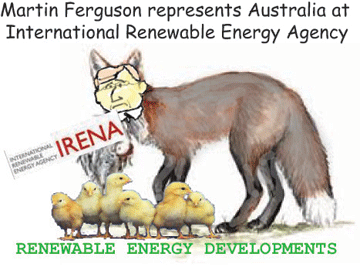 Minister Ferguson may need to spend less time daydreaming about nuclear power and take more note of what is happening in the renewables industry as the “breakthroughs” have already occurred; for example, solar thermal technology combined with heat storage systems.
Residential solar panels have already helped put off the need for constructing more large carbon intensive power plants and home energy storage systems – the Next Big Thing for small-scale solar power – will also increasingly wean Australia off fossil fuel based baseload power generation.
Protest rally: New South Wales Labor Party opposes uranium mining
“NSW Labor will stay true to what its position has always been, and that is no exploration or mining in NSW”
NSW uranium exploring immoral: opposition http://www.heraldsun.com.au/news/breaking-news/nsw-uranium-exploring-immoral-opposition/story-e6frf7kf-1226515943188 THE “immoral” decision to allow companies to express interest in exploring for uranium in NSW is simply testing the waters for a uranium mining industry, NSW deputy opposition leader Linda Burney says.
About 100 protesters gathered outside parliament in Sydney on Tuesday to mark the end of the government’s initial 60-day period for expressions of interest in uranium exploration. The protesters are highlighting the dangers of uranium mining, use and waste. Continue reading
Broken Hill Councillor inadvertently spelled out the problem with uranium mining
Broken Hill Land Council open to exploring uranium Australian Mining, 9 November, 2012 Alex Heber The Broken Hill Aboriginal Land Council is open to uranium exploration in New South Wales’ far west.
However BHALC chair Maureen O’Donnell said the details and risks still need to be discussed before any mining begins.
“I’ve got to see what benefits (it has) for the people,” she told the ABC .
“I don’t like uranium as it is because it causes a lot of cancer and there’s enough sickness but it sort of depends on how they’re going to do it and what they’re going to do.”
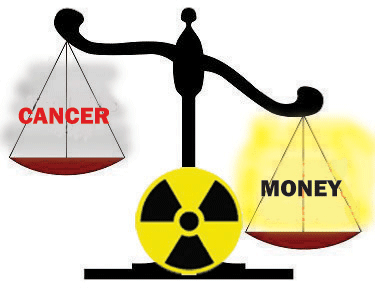
The New South Wales state government lifted the ban on uranium exploration earlier this year in a bid to ramp up the state’s involvement in the mining boom…. http://www.miningaustralia.com.au/news/broken-hill-land-council-open-to-exploring-uranium
New South Wales government’s wishy washy approach to renewable energy
We’ll leave it to the market to determine what the best proposals are,
Rob Stokes on clean energy in New South Wales EcoGeneration — November/December 2012
The New South Wales Government recently released a draft of its Renewable Energy Action Plan, which outlines 28 actions to help the state achieve its target of 20 per cent clean energy by 2020. New South Wales Parliamentary Secretary for Renewable Energy Rob Stokes spoke with EcoGeneration’s Melanie Ryan about the development of the plan, its implementation and general activities for attracting clean energy investment to the state. Continue reading
Parramatta riverside sites under threat from rising sea levels
 Rising sea a threat to riverside homes November 3, 2012 SMH Nicole Hasham WATER will swamp homes and businesses from Haberfield to Homebush as rising sea levels inundate the Parramatta River foreshore over the next century, a new analysis shows. The findings are critical as valuable river frontage becomes increasingly urbanised and former industrial sites are redeveloped into housing. Continue reading
Call to Aboriginal land councils to avoid uranium
Aboriginal land councils urged to avoid uranium http://www.abc.net.au/news/2012-10-23/aboriginal-land-councils-urged-to-avoid-uranium/4328580/?site=indigenous&topic=latest Eugene Boisvert 23, 2012 An environmental activist says Aboriginal land councils may apply for permits to explore for uranium because they now don’t have to give permission for exploration on their land.
Natalie Wasley from the Beyond Nuclear Initiative is organising a protest next month, when expressions of interest for the permits close.
The far west is believed to be rich in uranium. Ms Wasley says exploration will inevitably lead to mining, and that the Broken Hill Aboriginal Land Council should have to give permission for mining activity to happen on their land.
“Unfortunately when the exploration laws changed they actually altered the Aboriginal Land Rights Act to say that local councils don’t have to give consent for exploration to go ahead,” she said. “This is a very retrograde move and something that should be very strongly opposed.” Natalie Wasley from the Beyond Nuclear Initiative says it is unclear
who has applied for the licences, but she believes Aboriginal Land Councils will apply.
“I believe there’s been an expression of interest put in but we’re not sure who’s actually made applications until the application period closes on the 13th of November,” she said.
“There’ll be a rally outside Parliament House on that day where lots of different organisations are sending representatives to say that we don’t want any exploration licences to be granted. The ABC has attempted to contact the Broken Hill Aboriginal Land Council for comment.
1 This month
7 April – WEBINAR – Australia and the Doomsday Clock – Preventing nuclear war through NoFirstUse and other policies
Online | Tuesday April 7, 4:00-5:30pm, Australian Eastern Time / 8:00-9:30am Central Europe Time
– Access the registration link
15 April – Zoom –Nuclear Power is Not the Solution
Apr 15, 2026 01:00 AM in Canberra, Melbourne, Sydney

Join the International Physicians for the Prevention of Nuclear War (IPPNW) on Tuesday, April 14th for a timely webinar exploring the risks associated with nuclear power and challenging the myth that it offers a simple, safe, carbon-free solution to the climate crisis

21 April Webinar: No Nuclear Weapons in Australia
Start: 2026-04-21 18:00:00 UTC Canberra, Melbourne, Sydney (GMT+10:00)
End: 2026-04-21 19:30:00 UTC Canberra, Melbourne, Sydney (GMT+10:00)
Event Type: Virtual
A virtual link will be communicated before the event.
Host Contact Info: australia@icanw.org

of the week – Australians for War Powers Reform (AWPR)
To see nuclear-related stories in greater depth and intensity
 Antinuclear