Falling demand for electricity results in halting New South Wales coal fired power station
 Fossil Fuel Power – Another One Bites The Dust, by Energy Matters, 21 Oct AGL Energy Limited (AGL) announced on Friday the suspension of the first stage of its 1,000 MW Dalton power station in New South Wales. According to a very brief statement from the company, economic viability of the project had been under review for several months due to market conditions…
… The rising demand hasn’t happened – in fact, quite the opposite. According to a report from REC Agents Association (RAA) earlier this year, over the last three years electricity consumption in the eastern states’ National Electricity Market (NEM) had dropped by 3.2 % (6,565 GWh); with over half that reduction attributable to hundreds of thousands of solar hot water and rooftop solar panel installations, along with energy efficiency initiatives.
According to a Sydney Morning Herald article, electricity industry sources estimated more than 10 per cent of electricity demand in NSW was supplied by rooftop solar power systems during much of the daylight hours earlier last week.
The Dalton power station suspension adds to a continually growing scrap heap of gas and coal-fired projects around Australia. Elsewhere in New South Wales, the end of coal fired generation at Munmorah power station has been confirmed. In Queensland, Stanwell Corporation Limited is taking two units at its Tarong facility in Queensland offline soon and last week, it was announced some of Victoria’s Yallourn Power Station’s generation capacity would be mothballed. http://www.energymatters.com.au/index.php?main_page=news_article&article_id=3432
City of Sydney acting to develop locally produced energy
City Of Sydney: Locally Produced Energy The Smartest Investment http://www.energymatters.com.au/index.php?main_page=news_article&article_id=3408 by Energy Matters, 3 Oct 12 Regulation should be reformed to encourage locally produced energy says the City of Sydney. The City has lodged a submission to the Australian Energy Regulator (AER) review of electricity network companies.
Lord Mayor Clover Moore points out consumers were bearing the brunt of costly upgrades to aging and inefficient network infrastructure that transmits coal-fired electricity all the way from the Hunter Valley to the middle of Sydney.
“The smartest investment we can make is in generating electricity close to where it is used,” said the Lord Mayor.
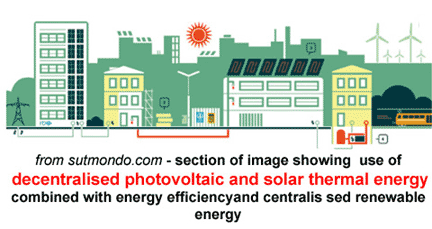
The City of Sydney is demonstrating leadership on this issue with a plan to boost the energy efficiency of its buildings and produce energy locally with solar, wind and trigeneration technology; which will drive down costs and environmental impact.
“But to make them a reality we need the government to get the regulation right,” says Lord Mayor Moore.
A media statement issued by the City of Sydney says network charges make up the lion’s share of electricity bills and are expected to account for 60 per cent of the average bill by 2014. In 2009. the AER approved spending of $17.4 billion on electricity network infrastructure in NSW over five years, representing $2,400 per person. The City says average electricity prices in the Sydney electricity distribution network area are expected to increase by a massive 83 per cent during this period.
According to a study from the University of Technology, Sydney, the City’s proposed $440 million trigeneration network could save electricity consumers $1.5 billion in avoided spending on network upgrades and new power stations by 2030.
The City has also called for electricity bills clearly detail the costs for peak, shoulder and off-peak, network and retail charges so consumers can see the contribution of each component and adjust their consumption to reduce costs.
According to solar solutions provider Energy Matters, households don’t have to wait for government to act in order to rein in electricity bills. A 4kW solar panel system installed in Sydney can generate electricity bill savings of over $1,000 a year. Factoring in the cost of a system from the company, such a system will produce electricity at a cost as little as 5.5c per kilowatt hour.
Australia: $11 billion for energy infrastructure that is rarely used
 $11B Spent On Electricity Infrastructure Used Only 4 Days A Year http://www.energymatters.com.au/index.php?main_page=news_article&article_id=3400 by Energy Matters, 27 Sept 12, A survey carried out by consumer group Choice shows electricity price rises are one of the biggest concerns of Australian households.
Massive power rises have occurred throughout Australia in recent years, but in New South Wales the hikes have hit particularly hard. “Since 2007, the average NSW household’s electricity bill has more than doubled to around $2,200, and the main driver of that – over $650 a year – is the multi-billion dollar price tag of electricity poles and wires,” says Choice head of campaigns, Matt Levey.
Choice states $11 billion has been spent on energy infrastructure that is only used four days out of every year. Continue reading
NSW govt pushes ahead in promoting uranium exploration
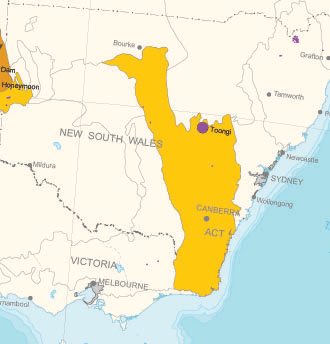
map shows (yellow) area where uranium might be explored for
NSW explores uranium mining, Australian Mining, September, 2012 Vicky Validakis NSW Resources Minister Chris Hartcher announced on Saturday the government was open to expressions of interest from miners wanting to
explore Group 11 minerals, which includes uranium and thorium, The Australian Financial Review reported. ..
… The announcement follows the government’s controversial move to overturn the state’s 26-year ban on uranium exploration.
Legislation overturning the exploration ban passed through the state’s upper house unamended, despite opposition from Greens and Labor MPs, who said the government had no mandate…… Applications will close
on November 13. http://www.miningaustralia.com.au/news/nsw-explores-uranium-mining
Anti nuclear waste candidate elected to Auburn City Council, New South Wales
 Fourth socialist elected to a local council in Australia, Green Left, September 14, 2012 By Peter Boyle, SydneyThe Communist Party of Australia’s (CPA) Tony Oldfield was elected to Auburn Council in the NSW local government elections on September 8. He became the fourth socialist to be elected as a local councillor around the country. The others are Sam Wainwright (Socialist Alliance, Fremantle Council) and Steve Jolly and Anthony Main (Socialist Party, Yarra City Council, Victoria).
Oldfield was elected as part of a local community activist group called “The Battler” . The group has been campaigning to stop the Coalition state government sending radioactive waste from the north shore suburb of Hunters Hill to a storage facility in Lidcombe….. http://www.greenleft.org.au/node/52229
Sneaking nuclear power into NSW the Thorium way?
 Citizens’ jury puts nuclear on the table http://m.smh.com.au/environment/energy-smart/citizens-jury-puts-nuclear-on-the-table-20120910-25ol6.html SMH, SEAN NICHOLLS September 11, 2012 A ”CITIZENS’ JURY” has recommended the government start a discussion about nuclear power stations in NSW as an issue that ”should not be dismissed”.
The jury of about 25 people from Sydney was one of two invited by the Parliament’s public accounts committee to participate in an inquiry into alternative energy. The other was from the New England area.
The juries were chosen by the New Democracy Foundation whose members include the chairman of Infrastructure NSW, Nick Greiner, and the former premier of Western Australia Geoff Gallop. Its founder is the executive director of Transfield Holdings, Luca Belgiorno-Nettis.
The Sydney jury’s report, released yesterday, urges the government to initiate ”informed public discussion” into ”emerging nuclear technologies” such as thorium as an energy source. ”The unanimous view of the jury was that the proposed issue of nuclear power generation should not be dismissed,” the recommendation – one of five – says.

”A minority view (10 per cent) supported starting deployment in the immediate future. While this view was not shared, the jury was in agreement that the topic should be discussed in greater detail withthe Australian public.”
The government is preparing to proclaim legislation that will overturn a 26-year ban on uranium exploration.
The Energy Minister, Chris Hartcher, and the Premier, Barry O’Farrell, have been at pains to deflect opposition claims that this could lead to nuclear power.
Mr Hartcher has previously said the decision was not about providing an alternative energy source to electricity generation. Unlike uranium, there is no ban on exploration or mining of thorium in NSW.
In its report, the New England jury said the community had no confidence in uranium-based power. But it also said the same applied to coal seam gas and neither should be pursued until that improved.
In an awkward recommendation for the government, it says the electricity distribution businesses, or ”poles and wires”, should be kept in public ownership. Mr O’Farrell has ruled out selling the poles and wires this term but has left the door open to taking it to the next election to raise infrastructure funds.
The chairman of the public accounts committee, Jonathan O’Dea, said the reports, which will be included in the committee’s final report, would be discussed on Thursday. A spokeswoman for Mr Hartcher said he would await the final report
before considering any recommendations.
New South Wales’ dud renewable energy plan
O’Farrell’s Renewables Goal ‘Realistic, But Plan Is A Dud‘ http://www.energymatters.com.au/index.php?main_page=news_article&article_id=3373 by Energy Matters, 9 Sept 12, Greens NSW MP John Kaye says a draft Renewable Energy Action Plan for New South Wales fails to call off the O’Farrell government’s war on rooftop solar and wind power.
Dr. Kaye believes the plan, if implemented in its current form, will lock NSW into a coal-fired future with jobs and investment “set to continue to haemorrhage out of the state”.
Unveiled on Friday, the Plan outlines 28 actions the Government says will help NSW meet its 20% renewables by 2020 target. Energy Minister Chris Hartcher says only the best value for money solutions will be adopted; delivering investment and jobs “at no cost to consumers”.
“The goal is realistic but the plan is a dud. Without a commitment to lowering the barriers that are stunting wind and solar investment, cuts to greenhouse gas emissions and the tens of thousands of new jobs will be nothing but a pipedream,” said Dr. Kaye
With regard to small scale solar, the only action listed under the plan is to “Annually request IPART to estimate a benchmark range for a fair price for small-scale generated solar energy.” The benchmark range recommended by IPARTfor 2012/13 is 7.7 – 12.9c per kilowatt hour – and is voluntary.
To support medium-scale solar power, the NSW Government will work with industry identify commercial sites where it will be cost effective and facilitate uptake for commercial buildings through the Renewable Energy Advocate.
“The failure to reverse the O’Farrell government’s policy hostility to wind and solar will turn the promised 6,000 new jobs into nothing more than a fantasy.”
“Parliamentary Secretary Rob Stokes worked hard to produce a new deal for renewables. It’s clear that he was badly undermined by his Minister Chris Hartcher and the fossil fuel lobby who want clean energy technology to remain a boutique industry that does not interfere with their profits.”
The Plan is available here and public comment is invited. Submissions will be accepted until 26 October 2012.
University of New South Wales (UNSW)’s solar cell innovation
UNSW, Suntech Power and Hanwha Solar Partner to Improve Solar Cell Efficiency AZOcleantech, September 6, 2012 By Gary Thomas Researchers at the School of Photovoltaics and Renewable Energy Engineering (SPREE) at the University of New South Wales (UNSW) in Australia have developed an advanced processing technology for enhancing the efficiency of silicon solar cells. SPREE has entered into a research partnership with Suntech Power and Hanwha Solar, twomajor silicon solar cell manufacturers.
Thin film The electric insulator in a solar cell is located between the aluminium back-plate and the silicon wafer. The newly developed technology involves “self-patterning” tiny metal contact regions into the electric insulator of a solar cell…..
http://www.azocleantech.com/news.aspx?newsID=17281
The University of NSW a global leader in solar technology research and development.
UNSW, Suntech and Hanwha Solar Collaborate http://www.energymatters.com.au/index.php?main_page=news_article&article_id=3370 by Energy Matters 6 Sept 12, Technology being developed at the University of New South Wales to improve the efficiency of silicon solar cells has grabbed the attention of two of the world’s largest solar panel manufacturers.
The School of Photovoltaics and Renewable Energy Engineering (SPREE) has inked a collaborative research agreement with Suntech Power and Hanwha Solar to further develop experimental technology to automate and speed up patterning of solar cell electric insulators.
“Currently closely-spaced small-area metal contact regions in an insulating layer can only be formed by deliberately patterning the holes with a laser scanning over the surface, which is quite slow,” says Dr Alison Lennon, a senior lecturer from SPREE.
Dr Lennon says other methods such as aerosol and ink-jet printing are at this point too slow and have been unable to demonstrate the required patterning reliability.
Dr. Lennon and her PhD students are investigating the use of aluminium anodisation, a process where a chemical coating is formed on a metal surface to protect against corrosion, which she says can turn an aluminium layer on a silicon solar cell into a dielectric layer with many tiny holes; exactly what is needed.
The team has already constructed prototypes of cells using the process and is now working on improving cell efficiencies and refining the technique to make it commercially viable – and this is where Suntech and Hanwha Solar solar come in.
Dr Lennon says the collaboration is an example of two companies realising they can achieve more as partners than as competitors, which could result in faster commercialisation.
The University of NSW is a global leader in solar technology research and development.
It was announced recently UNSW would be a partner conducting research in connection with two large solar farms projects to be constructed over the next three years in western New South Wales.
UNSW also has a long association with Suntech. Among other achievements, earlier this year collaborative research between the two led to a world record 20.3% efficiency for a production silicon solar cell through further refinements to Suntech’s Pluto cell technology.
Suntech founder Dr. Zhengrong Shi is a graduate of UNSW.
Rally opposing Sydney’s Hunters Hill radioactive waste going to residential suburbs
 Fallout spreads from uranium waste dumping plan http://parramatta-advertiser.whereilive.com.au/news/story/fallout-spreads-from-uranium-waste-dumping-plan/ 29 AUG 12 BY ELIAS JAHSHAN AROUND 200 residents attended a rally at Lidcombe’s Remembrance Park last Saturday to protest the NSW government’s plans to transfer radioactive waste from an old Hunters Hill radium smelter to residential areas, including a facility at Lidcombe.
The rally was organised by the Auburn Asian Welfare Centre and Soka Gakkai International Australia, a Buddhist and non-government organisation.
A spokeswoman from SGI Australia said waste products from at least 500 tonnes of uranium ore processed at the former Hunters Hill smelter remained in the soil, and will be sent to the Office of Environment and Heritage-owned facility at Joseph St, Lidcombe.
At the rally, Monash University environmental engineer Gavin Mudd acknowledged that radioactive waste needed to be removed from Hunters Hill, but said the problem was a lack of transparency in the plans to dispose of the contaminated soil.
Dr Mudd believed the best place for that waste was the Australian Nuclear Research and Development Organisation facility at Lucas Heights.
“The best place is not Kemps Creek, and it’s not (Lidcombe),” he added.
Lucas Heights is prohibited by law from accepting anything other than Commonwealth waste. Dr Mudd said the soil from Hunters Hill would be classed as state-owned waste.
“Politicians can change legislation quickly when the will is there,” he said. THE STORY SO FAR
– The state government wants to rehabilitate and sell the land at the Hunters Hill uranium smelter site, which closed in 1915.
– Contaminated soil waste is to be transferred to a Lidcombe facility.
– November 2011: Auburn Council unanimously votes to become a nuclear-free zone, but state government can still override this vote.
– February: Auburn RSL delivers 1000 signatures for a petition against the plans.
– March: Rally held at Auburn Town Hall.
New South Wales Uranium Free Charter gathers political strength
The waste from any uranium mining in NSW would remain dangerous long after the O’Farrell government is gone from Macquarie Street.
Rather than promoting the unsafe uranium sector the government should building an energy future that is renewable, not radioactive
(Map: yellow shows area where uranium exploration could occur)
Nuke South Wales? http://www.onlineopinion.com. au/view.asp?article=14007 By Natalie Wasley and Pepe Clarke -, 20 August 2012 Earlier this year, in a sharp break with a long standing and bi-partisan ban, the NSW Government announced it would allow uranium exploration across the state. This abrupt reversal of a 26-year prohibition came without warning or consultation and against the backdrop of the global nuclear industry reeling from the continuing
Fukushima disaster.
At the time, Premier O’Farrell cited the narrowly won ALP national conference vote allowing uranium sales to India as rationale for the policy change, but outside of cabinet responses ranged from wariness to outright hostility.
The decision to allow uranium exploration was – and is – fiercely opposed by NSW Labor and the Greens. Speaking against the move in both state parliament and a recent public meeting, Shadow Environment Minister Luke Foley captured the strength of this resistance: “As long as I am in public life I will argue against this dangerous industry
Civil society and community groups are increasing both the light and the heat on the Premier’s atomic ambitions including through this week’s launch of a NSW Uranium Free Charter in Sydney. The Charter highlights the dangers of the nuclear industry,calls on government to rule out uranium mining in New South Wales and has already gathered strong support state and national trade unions, environment groups, public health and student organisations. (see attached and
www.nccnsw.org.au/uranium ).
The Charter signals the start of a new campaign to keep NSW free from uranium mining and promises to increasingly locate this controversial mineral on the state political radar . Continue reading
New South Wales government stifling wind power development
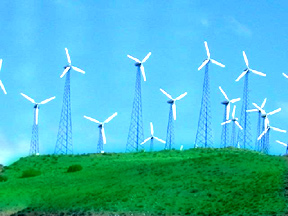 Answer to NSW’s power problems is blowing in the wind, says report SMH, August 20, 2012 Anna Patty State Political Reporter A REPORT on future power needs in NSW has identified wind energy – which has been publicly derided by the Premier, Barry O’Farrell – as a solution and investment opportunity for NSW.
The Australian Energy Market Operator – an independent company that closely monitors and operates the national electricity network – has released a report that says investment interest is focused on supplying renewable energy such as wind and gas during periods of peak demand on the hottest and coldest days of the year.
The report says investors are less interested in base load generation, which provides energy all year round…..
NSW government’s draft guidelines for new wind farm developments are designed to chronically handicap the expansion of the wind industry in this state,” Mr Foley said.
”The government has also placed prohibitive costs in the way of wind farm developments.”
Mr Foley said the wind industry in NSW had the potential to generate 3000 megawatts of wind energy to help future needs. ”According to the Australian Energy Market Commission, new wind energy projects in
Victoria facilitated by the renewable energy target will actually deliver lower wholesale electricity price increases than what will be seen in NSW,” he said.
”Rather than attacking wind farms, the O’Farrell government should require its own planning review to come up with a sensible and workable planning regime for the development of the wind industry in NSW.” http://www.smh.com.au/nsw/answer-to-nsws-power-problems-is-blowing-in-the-wind-says-report-20120819-24gjh.html#ixzz247RK3VnT
Exclusive meeting told of Australians’ approval of uranium mining, coal seam gas
Meanwhile, about 40 protestors turned up to voice their concerns outside the exclusive hotel.
CSG will be accepted, just like uranium: Hartcher ABC News 18 Aug 12, By Elyse Denman The Minister for Energy and Resources, Chris Hartcher, has told an energy forum in Armidale that coal seam gas will be accepted as an energy source, just like uranium.
The Minster says he’s convinced that public concern surrounding the coal seam gas industry will subside over time, just like the debate over uranium.

“There is no longer a community concern about uranium exploration or uranium mining,” he said. Continue reading
Red light for yellowcake in NSW: New campaign targets Premier’s uranium ambitions.
The NSW Uranium Free Charter and list of endorsing organisations is online at: http://nccnsw.org.au/uranium.
A community Charter opposing plans for development of a uranium mining industry in NSW will be launched at a public event in Sydney tonight, Thursday August 16.
The NSW Uranium Free Charter (attached and online at http://nccnsw.org.au/uranium) is an initiative of environment, trade union, public health and other groups concerned about the potential human and environmental impacts of uranium exploration and mining currently being promoted by the state government.
“The O’Farrell government has never taken its uranium plans to the people. This issue was not raised before the last state election and the government has no mandate to mine”, said Pepe Clarke from the Nature Conservation Council NSW. “In the shadow of Fukushima we should not be opening the back door to this dirty and dangerous trade”.
The Charter details concerns over the impact of uranium mining and the wider nuclear industry and calls for a shared energy future that is renewable – not radioactive. The document will be launched at the AMWU’s Tom Mann Theatre at 6pm tonight as part of a broadly endorsed public meeting. Continue reading
Dick Smith promoting CSIRO’s electric car
 the CSIRO test car is designed in such a way that it can be used as a household power source, feeding electricity back into the 240-volt grid, and being charged up again at night when power demand is low.
Dick Smith visits Newcastle CSIRO centre http://www.theherald.com.au/news/local/news/general/dick-smith-visits-newcastle-csiro-centre/2637702.aspx BY IAN KIRKWOOD 28 Jul, 2012 AS an avowed skeptic, entrepeneur and philanthropist Dick Smith says renewable energy is a good thing whether climate change is real or not.
“While I think we could be altering our climate, I think most business people like me are climate change deniers and I think we could be affecting the climate but coal and oil are going to run out one day,” Mr Smith said in Newcastle yesterday. Continue reading
1 This month
7 April – WEBINAR – Australia and the Doomsday Clock – Preventing nuclear war through NoFirstUse and other policies
Online | Tuesday April 7, 4:00-5:30pm, Australian Eastern Time / 8:00-9:30am Central Europe Time
– Access the registration link
15 April – Zoom –Nuclear Power is Not the Solution
Apr 15, 2026 01:00 AM in Canberra, Melbourne, Sydney

Join the International Physicians for the Prevention of Nuclear War (IPPNW) on Tuesday, April 14th for a timely webinar exploring the risks associated with nuclear power and challenging the myth that it offers a simple, safe, carbon-free solution to the climate crisis

21 April Webinar: No Nuclear Weapons in Australia
Start: 2026-04-21 18:00:00 UTC Canberra, Melbourne, Sydney (GMT+10:00)
End: 2026-04-21 19:30:00 UTC Canberra, Melbourne, Sydney (GMT+10:00)
Event Type: Virtual
A virtual link will be communicated before the event.
Host Contact Info: australia@icanw.org

of the week – Australians for War Powers Reform (AWPR)
To see nuclear-related stories in greater depth and intensity
 Antinuclear